
The Choice Almost Every Facelift Patient Gets Backwards
Most people arrive at a facelift consultation having already picked a technique. They have read that the deep plane facelift is the modern one, or that SMAS is the proven one, and they want the name rather than the operation. Both groups are choosing an answer before anyone has explained what the two techniques actually do differently, which is not what they lift. It is what they let go of.
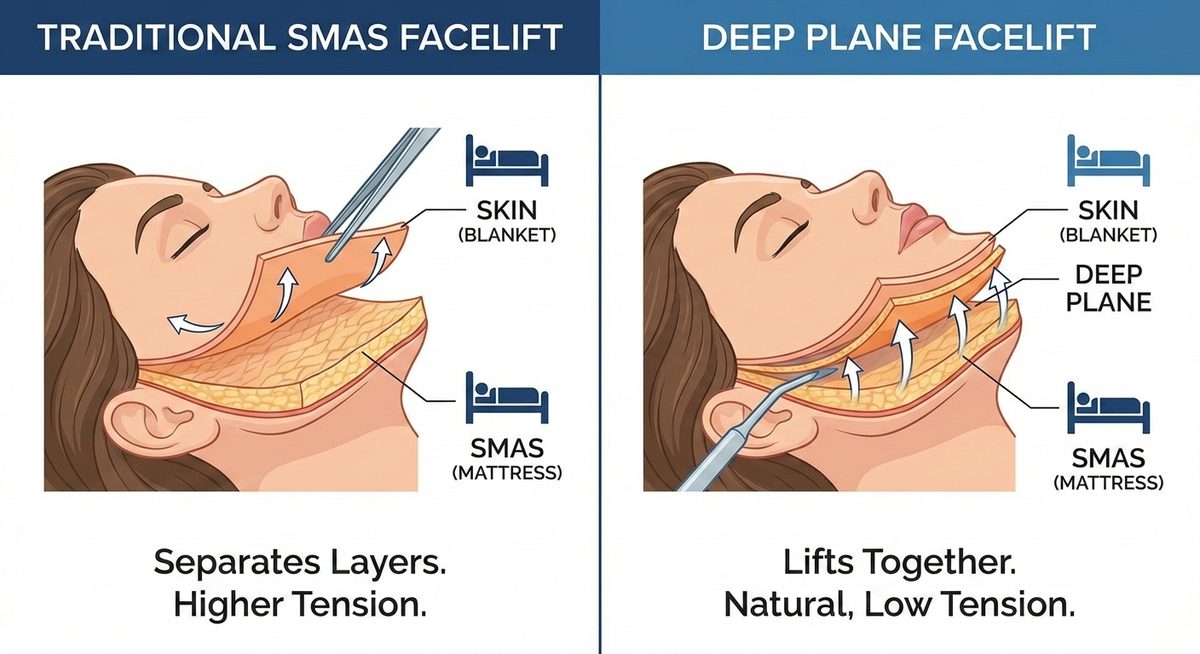
Put simply, a facelift works by releasing what is holding your face down, then repositioning what is freed. A SMAS facelift tightens the fibrous layer over your facial muscles without releasing the ligaments that anchor it. A deep plane facelift dissects beneath that layer, divides those ligaments, and moves skin, fat, and SMAS together as one unit. That difference decides how natural the result looks, how long it lasts, and whether your nasolabial fold comes back within a year.
This guide explains what the retaining ligaments are and why they matter, what each technique releases and leaves intact, how far the dissection has to travel to reach the fold, and why an Asian face makes this operation genuinely harder to perform.
The Real Question Is Not Which Technique. It Is What Gets Released.
Patients frame this as old versus new, or standard versus premium. That framing hides the actual mechanism. Both operations lift the same tissue. What separates them is whether the tissue was set free before it was lifted.
Your face is not simply hanging from your skull. It is anchored to it by retaining ligaments, fibrous tethers running from bone through the soft tissue to the skin, holding each region in place. As you age, tissue between those anchor points descends while the anchor points themselves stay put. That is why aging produces grooves and folds in specific locations rather than a uniformly drooping face. A fold forms exactly where a ligament is still holding on. The anchor points hold at every age. No measurement has found them lengthening, which is the starting point of what actually ages in the face by decade.
Now the consequence. If you pull on tissue that is still tethered, you are fighting the ligament. Pull hard enough to erase the fold and you have put enormous tension on the skin, which is what produces a flat, stretched, operated look. Pull gently and the fold stays. There is no tension setting that solves a tethered face, and that is the entire argument for releasing the ligaments first.
What Actually Holds Your Face Down
A short anatomy detour, because the rest of this article depends on it.
Under your skin and its layer of fat lies the SMAS, the superficial musculoaponeurotic system, a continuous fibrous sheet that wraps the muscles of facial expression and connects them to the skin. When you smile, the SMAS is what transmits that movement outward. It is also what surgeons have been tightening for fifty years.
Passing through the SMAS at specific points are the retaining ligaments. Zygomatic ligaments anchor the cheek to the cheekbone. Masseteric ligaments run down the front border of the chewing muscle and hold the mid and lower cheek. Others tether the jawline. Zygomatic, upper masseteric, and mid masseteric ligaments are the ones a facelift has to contend with. Each is a fixed point, and each becomes a fold line as the surrounding tissue descends around it.
There is one more structure, and it decides whether the nasolabial fold is corrected or merely pushed around. The melo fat pad is a triangular thickening of subcutaneous fat in the midcheek, bounded on its inner side by the nasolabial crease itself. It is the tissue sitting directly behind the fold, and it lies well beyond where a conventional facelift dissection stops.
That last fact explains a problem the literature openly acknowledges. Early reappearance of anterior midcheek laxity, with recurrence of the nasolabial fold, is a limitation of most facelift techniques, and why it recurs so early has not been adequately explained. The answer proposed by that anatomical work, and the reason it shapes how I operate, is that the fold recurs because the tissue actually responsible for it was never mobilized.
Two Techniques, One Fundamental Difference
The SMAS facelift
A SMAS technique lifts the skin off the underlying SMAS, then tightens the SMAS itself by folding it, stitching it, or removing a strip and closing the gap. Skin and SMAS are handled as two separate layers, tensioned separately, and closed.
It is a real operation with real results, it has decades of history behind it, and on the right face it works well. The dissection is more limited, which means less swelling and a faster return to normal life.
Its limitation is structural. Because the retaining ligaments are not released, the deeper tissue is still tethered when the SMAS is pulled. Midface descent and a deep nasolabial fold tend to persist, because the fold sits in territory the dissection never reached. And compensating by pulling harder is precisely what produces the tight, flat look patients fear, which I have written about separately in the guide to the overtightened, windblown facelift.
The deep plane facelift
Deep plane surgery, first described by Hamra in 1990, dissects underneath the SMAS rather than above it. Skin, fat, and SMAS stay attached to one another and are raised as a single composite flap. Once in that plane, the surgeon can see and divide the retaining ligaments directly.
Two things follow. Tissue is genuinely free before it is moved, so it can be repositioned with far less tension on the skin. And because skin and SMAS travel together rather than being pulled separately, the face moves as a unit and keeps its internal relationships. This is why a well executed deep plane result reads as a face put back where it used to sit, rather than a face that has been pulled. That same composite flap keeps its own blood supply from the SMAS rather than relying on the thin subdermal plexus alone, which is also why I consider it the safer structure for a patient who smokes; the vascular reasoning and my nicotine protocol for smokers are set out in my facelift protocol for smokers and skin flap necrosis risk.
Its cost is that it is a larger, more technically demanding operation, with a wider dissection, more swelling in the early weeks, and a genuine requirement for experience, since the plane runs close to branches of the facial nerve.
At a Glance
| SMAS facelift | Deep plane facelift | |
|---|---|---|
| Dissection plane | Above the SMAS | Beneath the SMAS |
| Retaining ligaments | Left intact | Divided directly |
| Skin and SMAS | Lifted as separate layers | Moved as one composite unit |
| Tension sits on | The skin | The released deep tissue |
| Nasolabial fold | Often persists | Addressed if dissection reaches it |
| Midface descent | Limited correction | Directly repositioned |
| Early swelling | Less | More |
| Technical demand | Moderate | High |
| Typical longevity | Shorter | Longer |

Why I Rarely Choose SMAS, and How Far I Dissect
Recurrence is a ligament problem
I use the deep plane technique in most of my facelifts, and the reason is not that it is newer. It is that a tightened SMAS is working against tension that never went away.
When the retaining ligaments are left intact, they keep pulling tissue back toward where it was anchored. Tightening the SMAS does nothing to them. They go on exerting their original force, and that force does not fade. In my experience this is the mechanism behind descent returning sooner than patients expected. That lift was fighting the anatomy rather than resolving it.
Releasing the ligaments removes that opposing force. It is also the step that lets me move tissue without loading the skin, and skin that is not under tension is skin that keeps looking like itself.
I should be honest about the other side. Deep plane is not immune to recurrence either, with some series describing early return of the nasolabial fold and jowl between six and twelve months. No technique makes a face permanent. What differs is whether the operation resolved the tethering or worked around it.
I release every ligament I can reach
This is where surgeons differ, and where I am deliberate. In my hands a deep plane facelift means releasing the retaining ligaments as completely as the anatomy allows, not partially and not selectively.
A partially released face is a compromised face. Whatever ligament is left intact becomes the new tether, the new fold line, and the new limit on how far the tissue can be repositioned. If the point of the operation is to free the tissue, freeing most of it produces most of a result. In practice the zygomatic ligaments come down completely, the masseteric ligaments along the front border of the masseter are released, and the dissection continues until the tissue moves freely when I test it.
The dissection has to cross the nasolabial fold
Here is the point that separates a deep plane facelift that softens the fold from one that corrects it, and it is the single technical detail I would most want a patient to understand.
After the zygomatic ligaments are down, I continue dissecting medially, past the fold, staying just superficial to the zygomaticus major and minor muscles, until I reach and mobilize the melo fat pad. That is the fat sitting directly behind the nasolabial crease. It is then lifted and fixed in its new position along with everything else.
Why this matters is straightforward. The nasolabial fold is not made of skin. It is made of the tissue behind the skin, and if that tissue is never released and never moved, the fold is still there when the swelling goes down. It softens temporarily, then returns. Carrying the dissection through to the melo fat pad is what converts a fold that was masked into a fold that was corrected, which is exactly why the anatomical work on this pad framed it in terms of longevity and recurrence.

The melo fat pad is not the only thing I mobilize, and it is worth being precise, because two nearby structures are often confused. The melo fat pad sits low and medial, directly behind the nasolabial fold. The malar fat pad sits higher and more laterally, over the cheekbone, and it is what carries midface projection. They are addressed by different maneuvers. To reposition the malar fat pad I dissect the prezygomatic space, the natural glide plane over the body of the zygoma, and release it fully so the whole mid cheek can be lifted vertically rather than pulled back. That vertical direction is deliberate, and it matters more in an Asian face than in a Caucasian one: work on Asian facial rejuvenation has argued for repositioning descending facial fat vertically rather than obliquely, and for designing the malar lift so it restores cheek highlight without widening an already wide face. In my hands this release is a routine part of a complete operation, not an optional extra. Releasing the melo fat pad corrects the fold; releasing the prezygomatic space restores the cheek. A face needs both.
That same dissection addresses the midcheek groove, the diagonal line running down the cheek that separates the lower eyelid region from the cheek proper and is known in Asia as the Indian band. Many patients notice it before they notice anything else about their aging, and it does not respond to a lift that stops short of the tissue creating it.
Asian anatomy makes this operation harder, and that changes how I dissect
Most facelift information online is written from operating on Caucasian faces. It transfers imperfectly, and pretending otherwise does patients no favors.
In a Caucasian face the planes are typically clean. Layers separate where they should, landmarks appear where the textbook says they will, and the dissection is, relatively speaking, straightforward.
In an Asian face it is not. The boundary between the SMAS and the zygomaticus major and minor muscles is often genuinely indistinct, and that is the single most characteristic difficulty of dissecting beneath the SMAS in these patients. It is also the most dangerous spot, because the correct plane runs immediately over those muscles and the nerve branches supplying them. When the boundary is unclear, the margin for error shrinks and the dissection has to be slower and more deliberate.
The second difference is mechanical, and it changes strategy rather than merely caution. Asian tissue, both the SMAS and the skin, is markedly less elastic. It does not stretch and redrape the way a Caucasian face does. It resists being moved. Published work describes the same picture from another angle. In Asian patients, skin is fibrous and richer in collagen, and the retaining ligaments are tougher and more rigid than in Caucasian anatomy. One consequence is stated even more directly elsewhere: release of the retaining ligaments in the sub-SMAS plane is the single most important step in an Asian facelift if the result is to hold.
Put those together and there is one honest conclusion. In a face where the tissue will not stretch, you cannot compensate for an incomplete release by pulling harder, because there is no give to pull on. Release has to be more complete, not less. Dissection has to run deeper and further medially, and every ligament that can be freed has to be freed, because the mobility must come entirely from the release rather than partly from the tissue’s own elasticity.

That is why I dissect the way I do. It is not thoroughness as a preference. On this anatomy it is the only thing that works.
The hemostatic net, every time
I place a hemostatic net at the end of every facelift, without exception. A deep plane dissection is extensive, and hematoma is the most common serious complication of this surgery. It is a series of quilting sutures that obliterate the space where blood could collect and hold the flap against the tissue beneath while it heals. I have covered the technique and the evidence in the guide to preventing facelift hematoma with a hemostatic net.
For a patient the relevant point is simple. A wider dissection is a larger raw surface, and a larger raw surface deserves a deliberate strategy for keeping it dry rather than a hope that it will be.
Which One Are You
Three questions sort almost every facelift consultation. Has the jawline softened while the cheek still sits high, which a SMAS technique can address? Has the cheek dropped and taken a deep nasolabial fold with it, which requires a dissection that travels past the fold? Or is the complaint the surface of the skin rather than where the skin sits, in which case surgery may not be the answer at all.

These are the presentations seen most often. Find the one closest to your face and bring it to consultation as a working hypothesis rather than a demand.
1. Your midface has descended and the nasolabial fold is deep
Your cheek has come down, the fold running from nose to mouth has deepened, and it looks worse in photographs than it feels. This is the classic deep plane case, and where the difference between the two techniques is most visible. A SMAS lift does not reach this tissue. Correcting it means releasing the ligaments and carrying the dissection through to the melo fat pad.
2. Your jawline has blurred but your midface is still holding
Jowling along the jaw, a softening of the jawline, but cheeks that have not dropped much. This is milder, and a SMAS technique can produce a good result here with less recovery. Being a reasonable candidate for the smaller operation is genuinely good news. When the neck is also clean, a shorter incision becomes an honest option, and this site works through that decision in mini facelift versus full facelift.
3. Your face looks heavy and you have had a lot of filler
Filler complicates the operation more than most patients expect, because it is encountered within the surgical planes and the tissue around it is fibrotic. That is its own decision with its own sequence, set out in the overfilled face and whether to dissolve it or lift it. The short version: the filler comes out first, and the lift comes months later. If the heaviness sits in the lower cheek rather than in product, the answer may be the buccal fat pad instead. Here it is removed through the mouth as the first step of the same operation, before the face is prepped, and only when it is the surplus, as set out in buccal fat removal and who hollows out later.
4. Your skin is thin and you are afraid of looking pulled
Thin skin hides nothing, which is why this fear is well founded and why it points toward the deep plane rather than away from it. Releasing the ligaments is what allows tissue to be repositioned without loading the skin, and skin that carries no load has nothing to betray.
5. You are Asian and researching mostly Western sources
Almost everything you are reading was written from operating on a different anatomy. The technique names are the same, but the dissection is harder and the tissue less forgiving. A surgeon who works on this anatomy routinely is worth more than a technique name.
6. Your concern is skin texture and mild laxity, not descent
Then a facelift may not be your operation at all. Surgery repositions structure and removes excess skin. It does not resurface. If skin quality is the complaint rather than its position, energy based tightening or resurfacing is the more honest answer, and the guide to Ultherapy, Thermage, and Shurink covers what those can and cannot do.
Recovery, and Why the Deep Plane Swells More Early
Expect the timeline to track the extent of the dissection, because that is mostly what it reflects.
Swelling and bruising peak in the first three to five days. Most patients are presentable for private life at around two weeks, when sutures are out and the worst of the bruising has resolved. Social recovery, meaning comfortable in front of people who did not know, is usually four to six weeks.
A deep plane dissection is wider, so early swelling is more pronounced than after a SMAS lift. What that early swelling does not predict is the final result. Tissue keeps settling for three to six months, and the face continues refining for up to a year. Judging a facelift at one month is judging swelling.
Two specifics worth planning around. Numbness over the cheek and in front of the ear is expected and resolves gradually over months. And the incision matures over a similar period, starting pink and settling into something inconspicuous, covered in more detail in the guide to facelift scars and how the incision heals.
Surgeon’s Insight: The Operation Is the Release, Not the Pull
Patients ask me how tight I will make their face. It is the wrong question, and it comes from looking at results where tightness was the only tool available.
A face that has been properly released does not need to be pulled. The tissue simply returns to where it used to sit, and the skin lies over it without strain. A face that has not been released has to be pulled, because pulling is the only remaining way to change its shape, and that is where the flat, wide, windblown look comes from. The stretched appearance is not a stylistic choice by the surgeon. It is the visible signature of an incomplete release.
This is more true on an Asian face than on any other, because the tissue will not stretch to hide the difference. If the ligaments have not been freed, the tissue does not move, and no amount of tension will persuade it. That is the whole reason I dissect as far as I do.
Safety, Risks, and Choosing a Surgeon
Both operations are safe in trained hands, and most complications are the resolving kind: swelling, bruising, temporary numbness, and early asymmetry that settles.
Two matter more than the rest. Hematoma is the most common serious complication of a facelift, and the risk rises with the extent of the dissection, which is exactly why I use a hemostatic net in every case. Facial nerve injury is uncommon but real, and it is the specific reason the deep plane demands experience: the dissection plane runs immediately over the branches supplying the zygomaticus muscles, which is why the technique calls for a systematic and reproducible approach to each step rather than improvisation. Most nerve weakness after a facelift is temporary, caused by swelling and traction rather than division, and recovers over weeks to months.
There is a selection risk too, and it is the one patients can act on. A face with significant descent treated by a technique that cannot reach it will disappoint no matter how well the operation is performed. Ask what your surgeon found on examination, not only what they plan to do.
There is a practical way to test all of this in a consultation, and it is set out in the last question of the FAQ below. In short, ask about the dissection rather than the technique name.
Ask What Needs Releasing, Not Which Technique Is Trending
Deep plane and SMAS are not rival philosophies, and neither is a marketing category. They are different amounts of release, and the right amount depends on what is holding your face down.
If your jawline has softened but your midface is holding, a SMAS technique can serve you well with less recovery. If your midface has descended and the nasolabial fold is deep, that tissue sits beyond where a SMAS lift reaches, and only a dissection that travels past the fold itself will move it. If your tissue is thick, fibrous, and inelastic, as most Asian faces are, the release has to be more complete rather than less, because there is no stretch available to compensate for whatever was left tethered. And if the weight you see sits above your eyes rather than along your jaw, that is the upper third, a separate operation judged less by the dissection than by what holds the lifted forehead in place.
One diagnostic question decides it. What is still holding my face down, and will this operation release it? A surgeon who answers that before naming a technique is planning for your anatomy. A clinic that leads with the technique name is selling a category.
Written by Dr. Yongwoo Lee, board-certified Korean plastic surgery specialist in facial anatomy and aesthetic procedures at VIP Plastic Surgery, South Korea.
Frequently Asked Questions About Deep Plane and SMAS Facelifts
What is the difference between a deep plane facelift and a SMAS facelift?
A SMAS facelift lifts the skin off the SMAS and tightens that layer, leaving the retaining ligaments intact. A deep plane facelift dissects beneath the SMAS, divides those ligaments directly, and moves skin, fat, and SMAS together as one composite unit. The practical difference is release: the deep plane frees the tissue before repositioning it, so the lift does not depend on tension in the skin.
What are retaining ligaments and why do they matter in a facelift?
They are fibrous tethers running from bone through the soft tissue to the skin, anchoring specific regions of the face in place. As you age, tissue sags between those fixed points, which is why folds form in predictable locations rather than the whole face drooping evenly. If the ligaments are not released, they keep pulling tissue back toward its anchor, and the lift is working against a force that never went away.
Why does the nasolabial fold come back after a facelift?
Usually because the tissue responsible for it was never moved. The fold is created by the melo fat pad, a triangular thickening of fat sitting directly behind the nasolabial crease, well beyond where a conventional dissection stops. If the dissection does not reach and mobilize that pad, the fold is masked by swelling and then reappears. Early recurrence of the fold is a recognized limitation of most facelift techniques.
What is the melo fat pad?
It is a triangular area of thickened subcutaneous fat in the midcheek, bounded on its inner side by the nasolabial crease and laterally by roughly the front border of the masseter. It is the tissue that physically forms the nasolabial fold, and anatomical work has identified it as central to why folds recur after surgery. Reaching it requires dissecting medially past the fold, staying just superficial to the zygomaticus major and minor muscles.
What is the difference between the melo fat pad and the malar fat pad?
They are different structures in different places, and confusing them leads to confusing advice. The melo fat pad sits low and medial, directly behind the nasolabial fold, and it is the tissue that physically creates that fold. The malar fat pad sits higher and more laterally over the cheekbone, and it is what gives the midface its projection. Correcting a nasolabial fold means mobilizing the melo fat pad by dissecting medially past the fold. Restoring a flattened cheek means freeing the malar fat pad, which is done through the prezygomatic space over the body of the cheekbone. A complete release addresses both.
What is the prezygomatic space and why does it need releasing?
It is a natural glide plane lying over the body of the cheekbone, beneath the soft tissue of the midface. Because it is a space rather than a solid attachment, it is where the mid cheek is meant to move, and releasing it fully is what allows the malar fat pad and the tissue with it to be lifted vertically rather than simply pulled backward. Without that release, the cheek can be tightened but not genuinely repositioned, which is one reason a lift can look tighter without looking younger.
Which lasts longer, deep plane or SMAS?
A deep plane result generally lasts longer, because the ligaments that would otherwise pull tissue back down have been divided and the repositioned tissue is not being held under skin tension. That said, no facelift is permanent, and published series describe early recurrence after deep plane surgery as well. Longevity depends on how complete the release was and how much descent there was to begin with, more than on the technique name.
Does a deep plane facelift look more natural?
It usually does, and the reason is mechanical rather than aesthetic. Because skin and SMAS move together as one unit and the tissue was released before it was moved, the face keeps its internal relationships and the skin is not under strain. The pulled, flat appearance people associate with facelifts comes from tension, and tension is what a surgeon resorts to when the tissue underneath was never freed.
Is a facelift different for Asian patients?
Yes, in two ways that change the operation. The plane between the SMAS and the zygomaticus major and minor muscles is often genuinely indistinct in Asian faces, which makes dissecting beneath the SMAS harder and less forgiving of error. And Asian tissue, both skin and SMAS, is thicker, more fibrous, and considerably less elastic, so it resists being redraped. The consequence is that the release has to be more complete and the dissection deeper and more medial, because the mobility cannot come from the tissue stretching.
Is a deep plane facelift more dangerous than a SMAS facelift?
It is more technically demanding, and difficulty and risk are related. Its dissection is wider, which raises hematoma risk, and the plane runs immediately over the facial nerve branches supplying the zygomaticus muscles. In experienced hands the complication rates are comparable to other facelift techniques. The relevant safety question is not which technique, but how much experience your surgeon has with that specific dissection.
What is a hemostatic net and why is it used?
It is a series of fine quilting sutures placed through the skin flap at the end of the operation, obliterating the space where blood could pool and holding the flap against the tissue beneath. Hematoma is the most common serious complication of a facelift, and the risk rises with the extent of the dissection, so a wider deep plane dissection is exactly the situation where a deliberate strategy is worth having.
How long is recovery after a deep plane facelift?
Swelling and bruising peak in the first three to five days. Most patients are presentable for private life at around two weeks, and comfortable socially at four to six weeks. A deep plane dissection is wider, so early swelling is more pronounced than after a SMAS lift, but that early appearance does not predict the result. The face keeps refining for three to six months and continues settling for up to a year.
Will a facelift fix my nasolabial folds?
It can, but only if the dissection travels far enough to reach the tissue that creates them. A lift that stops laterally will soften the fold temporarily as swelling resolves and then let it return. Correcting the fold means releasing the zygomatic ligaments, continuing medially past the fold, and mobilizing the melo fat pad so it can be repositioned along with everything else.
Am I too young or too old for a deep plane facelift?
Age is a poor guide, because the real question is what has descended and how tethered it is. Patients in their forties with early midface descent can be excellent candidates, and healthy patients in their seventies frequently are as well. What matters more is the pattern of aging in your face and whether the problem is position, which surgery addresses, or skin quality, which it does not.
Can a SMAS facelift ever be the better choice?
Yes. When the midface is still holding and the concern is jowling along the jawline, a SMAS technique can produce a good result with shorter recovery and a less extensive dissection. The mistake is not choosing SMAS. It is choosing SMAS for a face with significant midface descent, where the tissue that needs moving sits outside what the technique can reach.
What should I ask a surgeon at a facelift consultation?
Ask three specific things: how far medially they dissect, which retaining ligaments they release, and how they manage the risk of hematoma. Concrete answers describe an actual operation. Answers that stay at the level of technique names and recovery times describe a product. Also ask what they found when they examined your face, because the diagnosis should come before the technique.
This article is for informational purposes only and does not constitute medical advice. Always consult with a qualified medical professional before making any decisions about surgical or non-surgical procedures.