
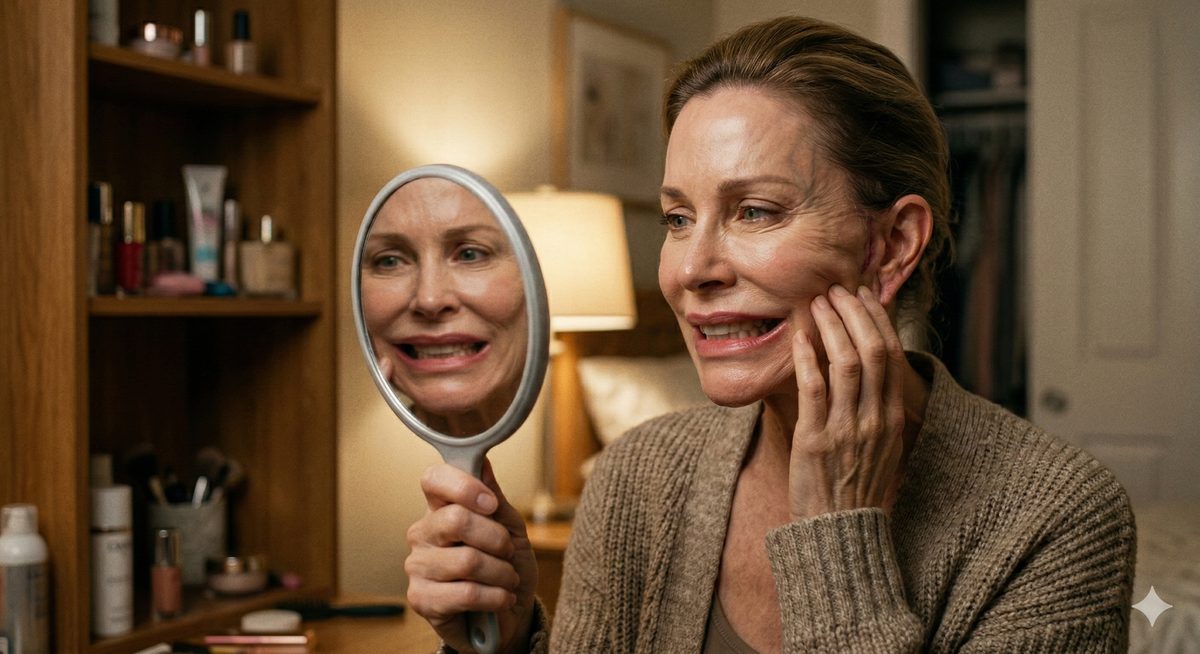
Why an Operated Face Looks Operated
A pulled face does not look pulled because the surgeon had unusual taste. It looks pulled because the skin was asked to hold a face up, and skin is not built to do that. Every feature people recognize as a bad facelift comes from that single mistake, expressed in different places.
Here is the answer, and it is more hopeful than most patients expect. Almost everything in the windblown appearance is a tension problem, and tension can be released. What cannot be undone is tissue that was removed and hairline that was moved. So the honest division is this: direction and tension are correctable, and loss is not.
This guide covers what actually creates each deformity, which ones settle on their own and which are permanent, what a revision operation can realistically achieve, and why the timing of that revision matters more than the technique.
The Real Question Is Not Which Surgeon Did It. It Is Where the Tension Went.
Patients arrive convinced they were unlucky with a surgeon. Sometimes that is true. More often the operation followed a specific logic, and the appearance is that logic showing on the face.
Your facial soft tissue is anchored to the skull by retaining ligaments. If those ligaments are not released, the deeper tissue cannot move, and the only remaining way to change the shape of the face is to pull the skin. That works, in the sense that the jawline improves. It also loads every millimeter of skin with tension that has nowhere to go, and tension travels. It flattens the cheek, drags the corner of the mouth, stretches the earlobe, and widens the scar.
A windblown face is a map of where that tension ended up. Which is why reading the face backward tells you what was done to it, and why the corrections are more predictable than they look.
What Each Deformity Actually Is
The lateral sweep, or windblown look
Skin pulled sideways rather than upward produces a face that looks swept back toward the ears. The lateral sweep occurs when tissue is pulled tight in a lateral vector without a supporting upward vector, and the skin-only lift is the technique most commonly associated with it.
Two things create the appearance. Direction is wrong, because the face descends vertically with age and pulling it horizontally does not reverse that path. And the tension required is enormous, because skin is being used as a structural material it was never designed to be. Using skin to carry the weight of the face requires so much tension that facial structures flatten, which is exactly what produces the drawn, wind-tunnel quality. The technique most associated with the sweep is the skin-tension short-scar lift, and this site examines what that operation leaves out in mini facelift versus full facelift.

Pixie ear
The earlobe is stretched downward and forward, fused into the cheek, with no free lobe hanging below the ear. It is the single most recognizable signature of a facelift, and it has one cause.
The earlobe is the only part of the ear with no cartilage inside it. Every other part of the ear has a framework that resists deformation. The lobe has skin and fat. When the skin flap is closed under tension, that tension pulls on the one structure that cannot resist it, and over the months of healing the lobe migrates downward into the cheek. Published work on the deformity describes exactly this mechanism: closure tension transmitted to an unsupported lobe.
The flattened cheek
A face can be tight and still look older, and this is why. Pulling laterally drags cheek volume backward toward the ear, away from where a young face carries it, which is high over the cheekbone. What results is a face that is simultaneously tight and flat, with an odd fullness in front of the ear where the volume was deposited.
Restricted expression
Not paralysis, and usually not nerve injury. When the skin is under permanent tension, the muscles underneath have to work against that tension to move the face. Smiles look effortful, the face reads as slightly masked at rest, and the mismatch between the eyes and the mouth is what observers register as artificial without being able to name it.
Widened scars and a displaced hairline
Skin closed under tension pulls at the incision line for months, and a scar healing under tension widens. If the temporal hairline was advanced or excised during closure, the sideburn can sit too high or disappear, which is one of the few findings that reads as surgery even from across a room. Scar quality is discussed in more detail in the guide to facelift scars and how the incision heals.
At a Glance
| Deformity | What causes it | Can revision correct it |
|---|---|---|
| Lateral sweep | Sideways vector, skin under tension | Yes, with release and a vertical vector |
| Pixie ear | Closure tension on a lobe with no cartilage | Yes, reliably |
| Flattened cheek | Volume dragged backward, not lifted | Usually, with repositioning and fat |
| Restricted expression | Permanent skin tension | Usually, once tension is released |
| Widened scar | Closure under tension | Improved by excision, never erased |
| Raised or lost sideburn | Hair-bearing skin excised | Partial, and difficult |
| Over-resected fat | Tissue removed | No, only replaced by grafting |
What I Find When I Reopen an Operated Face
The planes are gone
Revision facelift surgery is significantly harder than a first operation, and the reason is what previous surgery leaves behind.
When I dissect a face that has been operated on before, I am working through adhesions and scar tissue. The layers that should separate cleanly are fused together, and the boundaries between them are indistinct. In a first operation those planes guide the dissection. In a revision they have to be found, and sometimes they are simply not there.
Three consequences follow, and they matter to the patient. Dissection is difficult and slow. Lifting the tissue is harder, because scarred tissue resists repositioning in a way that virgin tissue does not. And there is more bleeding, in my experience noticeably more than in a primary case, which is why I place a hemostatic net in every one of these operations without exception, as described in the guide to preventing facelift hematoma.
That is also the honest reason revision results are less predictable than primary results. Not because the surgeon is less careful, but because the tissue is a different material.
Why the correction is a release, not a tighter pull
Instinct, when looking at a bad result, is to fix it by lifting again. That instinct produces a second bad result.
A windblown face is already carrying too much tension. Adding more compounds every problem it has. Correction runs in the opposite direction: release the tissue that was never released, redirect the vector from lateral to vertical, and take the load off the skin entirely. The literature describes revision the same way, as releasing tethering and rebalancing tension rather than pulling tighter.
In practice that means dissecting deep, dividing the retaining ligaments that the first operation left intact, and letting the deep tissue carry the lift. That mechanism is the same one set out in the guide to what a deep plane facelift actually releases. The same logic governs the upper face, where a brow lift holds or slips depending on what the lifted forehead is fixed to rather than on how firmly the skin was pulled. The difference in a revision is that scar tissue makes every step of it harder.
How I correct a pixie ear
Pixie ear is the most reliably correctable of these deformities, and the repair follows from understanding the cause.
I release the earlobe fully from the tissue that is dragging it forward and down, which usually means dissecting it free of scar in the cheek. Then I anchor the tissue beneath the lobe to the deeper tissue over the mastoid using Vicryl sutures, so the earlobe is supported from below by something solid rather than held in position by the skin. Published technique for this deformity uses the same principle, combining a lobe repositioning flap with a suspension suture to the mastoid region.
At the same time I excise as much of the old scar as the closure allows, for two reasons. That scar is usually widened by the same tension that deformed the lobe, so leaving it in place means the thing people still notice survives the repair. And a scar excised now can be closed without tension, which is the only condition under which it heals as a fine line.
One principle governs the whole repair. The lobe must be held by deep tissue, never by skin. A lobe held by skin will migrate again, and the patient will have had two operations for one result.

Timing, and why I make patients wait
I do not revise a face early. Six months is the minimum I want between the original operation and a revision, and there are cases where waiting longer is better.
That interval is not caution for its own sake. Three things are happening. Swelling resolves, and swelling can imitate deformity, so a face at three months may not be the face at eight. Scar tissue matures and softens, which makes the dissection safer and the plane more findable. And the skin regains some laxity, which matters because a revision needs redundant skin to work with, and a face still under tension has none to give.
Published guidance sits in the same range, advising six to twelve months for swelling to settle and scars to mature, with complete scar maturation taking twelve to twenty-four months. Early months are the least reliable time to judge a face and the worst time to operate on one.
There is one exception. A deformity that is worsening rather than settling, or one caused by something that will not resolve on its own, is assessed on its own timeline rather than by the calendar.
Which One Are You
Not every unhappy face needs an operation, and knowing which category you are in changes what happens next.

1. You are less than six months out and worried
Wait. This is genuinely the most common situation and the one where patients make the worst decisions. Early tightness is normal, swelling distorts contour, and the face at three months is not the face you will keep. Judging a facelift early is judging swelling, and operating on it early is operating on the wrong face.
2. Your face is tight and swept back, more than a year on
This is a true lateral sweep, and it is correctable. The correction is a release with a vertical vector, not a tighter lift. Expect the operation to be harder than your first one and the recovery to be similar, and expect an honest surgeon to tell you the result is less predictable than a primary lift.
3. Your earlobe has been pulled into your cheek
Pixie ear, and this is the good news category. It is reliably correctable, it can often be done as a smaller procedure than a full revision, and the repair is durable when the lobe is anchored to deep tissue rather than skin.
4. Your face is tight but looks hollow or flat
Tension took the volume backward, and there may also have been fat removed. Release and repositioning bring back what was displaced. What was resected has to be replaced, usually with fat grafted from your own body, and how much of that survives is a real question covered in how much transplanted fat actually lasts.
5. Your scars are wide or your sideburn is gone
Scars widened by tension improve when excised and closed without tension, though they are never erased. Hairline loss is the hardest of these problems, because hair-bearing skin that was removed cannot be conjured back, and correction is partial at best.
6. Your face is fine but you were never happy with your look
Worth saying plainly. Some faces are technically good results that do not suit the person, and no revision fixes a mismatch between expectation and anatomy. That is a conversation to have before another operation, not after.
Recovery After a Revision
Expect the timeline to resemble a primary facelift, with two differences worth planning around.
Swelling and bruising peak in the first three to five days. Most patients are presentable for private life at around two weeks, and comfortable socially at four to six weeks. Tissue keeps settling for three to six months, and the face refines for up to a year.
Two differences matter. Swelling is often more pronounced, because the dissection is working through scar and the tissue is less forgiving. And the final result takes longer to declare itself, because scarred tissue settles less predictably than virgin tissue. A revision judged at three months is being judged early even by revision standards.
Surgeon’s Insight: The Fix Is Almost Never a Tighter Lift
Patients come to me asking to be lifted again, and I understand why. The face looks pulled, and pulled looks like something that was done insufficiently well rather than something that was done too much.
But a windblown face is not an under-corrected face. It is a face carrying tension it was never designed to carry, in a direction it does not age in. Lifting it again in the same way makes every single problem worse: flatter cheeks, a more distorted lobe, a wider scar, a more masked expression. The correction is to take the load off, put it where it belongs on the deep tissue, and let the skin lie down.
The other thing I tell these patients is that revision surgery is harder and less predictable than what they had the first time, and I would rather say so at the consultation than have them discover it afterward. Scarred tissue does not behave like normal tissue. Anyone promising a revision as straightforward as a first operation is describing a face they have not opened yet.
Safety and Honest Limits
Revision facelift carries the same risks as primary surgery, with two of them elevated by the scarring.
Bleeding and hematoma risk are higher. Hematoma is the most frequent facelift complication requiring a return to surgery, at roughly 1.8 to 2 percent in primary cases, and scarred tissue bleeds more while the dissection runs longer. That is why a deliberate strategy for keeping the field dry matters more here than in a first operation. Facial nerve risk is also higher. Reported injury rates in primary facelift surgery run from about 0.3 to 2.6 percent, most of it transient neuropraxia that recovers, and risk is specifically described as elevated in revision surgery, because previous surgery distorts the landmarks the nerve is normally found by. Choosing a surgeon who does revisions regularly is not a marketing preference. It is the single most useful thing a revision patient can do.
There are also things surgery does not fix, and any surgeon who does not tell you this is selling. Fat that was resected cannot be restored, only replaced by grafting. Hair-bearing skin that was excised does not come back. Scars are improved, never erased, and there is a mechanical limit worth knowing: in a secondary lift there is little excess skin available, so scar more than about a centimeter from the previous incision may not be removable at all. And if the previous operation injured a nerve permanently, revision does not repair that.
Ask What Went Wrong Before You Ask What to Do
A pulled face is not a mystery and it is not a permanent sentence. It is a mechanical problem with a legible cause, and the cause tells you what can be corrected.
If the appearance comes from tension and direction, it is correctable, because both can be undone. Release what was never released, redirect the lift from sideways to upward, and take the load off the skin. If it comes from something that was removed, whether fat or hair-bearing skin, correction is partial and honesty about that is part of the treatment.
And if you are still in the first months after surgery, the most useful thing you can do is nothing. Swelling imitates deformity, tissue is still moving, and the face you are looking at is not the face you will keep.
One diagnostic question decides it. Is my face carrying tension, or is it missing tissue? A surgeon who answers that before proposing an operation is reading your face. A clinic that offers to lift you again without answering it is repeating the mistake that brought you there.
Written by Dr. Yongwoo Lee, board-certified Korean plastic surgery specialist in facial anatomy and aesthetic procedures at VIP Plastic Surgery, South Korea.
Frequently Asked Questions About the Windblown Look and Revision Facelift
What causes the windblown or pulled look after a facelift?
Tension and direction. When the retaining ligaments are not released, the deep tissue cannot move, so the skin has to carry the lift. Skin is not a structural material, and holding a face up with it requires enough tension to flatten facial structures. Pulling sideways rather than upward compounds it, because the face descends vertically with age and a horizontal pull does not reverse that path.
Can a windblown facelift be fixed?
Usually yes, because tension can be released. Correction is not a tighter lift but the opposite: releasing the ligaments the first operation left intact, redirecting the vector from lateral to vertical, and transferring the load from skin to deep tissue. What cannot be undone is tissue that was removed, meaning resected fat and excised hair-bearing skin.
What is a pixie ear deformity and why does it happen?
It is an earlobe that has been pulled down and forward until it merges into the cheek, leaving no free lobe beneath the ear. It happens because the earlobe is the only part of the ear unsupported by cartilage, so it is the one structure that cannot resist tension. When a skin flap is closed under tension, the lobe migrates downward over the months of healing.
Can pixie ear be corrected?
Yes, and it is the most reliably correctable of these deformities. Repair begins by releasing the lobe from the scar tissue pulling it forward, and the tissue beneath it is anchored to the deeper tissue over the mastoid so the lobe is supported from below rather than held by skin. Old scar is excised at the same time. A lobe held by skin will migrate again, which is why the deep anchor matters.
How long should I wait before a revision facelift?
At least six months, and sometimes longer. Three things need to happen: swelling has to resolve, because swelling imitates deformity; scar tissue has to mature and soften, which makes the dissection safer; and the skin has to regain some laxity, because a revision needs redundant skin to work with. Published guidance sits in the six to twelve month range, with full scar maturation taking one to two years.
Is revision facelift surgery harder than the first operation?
Considerably. Previous surgery leaves adhesions and scar tissue, and the planes that should separate cleanly are fused with indistinct boundaries. Dissection is slower, repositioning the tissue is harder because scar resists movement, and there is more bleeding. That is also why revision results are less predictable, and why choosing a surgeon who does revisions routinely matters more here than for a primary lift.
Why does my face look tight but also flat and hollow?
Because a lateral pull moves cheek volume backward toward the ear rather than lifting it upward. A young face carries volume high over the cheekbone, so dragging it toward the ear produces a face that is simultaneously tight and flat, sometimes with an odd fullness in front of the ear. If fat was also resected, there is a genuine volume deficit on top of the displacement.
Will my expression come back to normal?
Usually, if the cause was tension rather than nerve injury. Skin under permanent tension forces the underlying muscles to work against it, which makes expression look effortful and the face slightly masked at rest. Releasing the tension restores movement. Nerve injury is a different problem, though most of it is transient and the large majority resolves without surgery. Permanent injury is uncommon, and revision surgery does not repair it.
Can facelift scars be fixed?
They can be improved but not erased. A scar that widened because it healed under tension can be excised and closed without tension, which usually gives a noticeably better line. Its limit is that scar is permanent tissue, and every revision creates a new one. A scar that is thin and well placed is often better left alone.
Can a lost or raised sideburn be corrected?
Only partially, and this is the hardest problem in the group. If hair-bearing skin was excised during the original closure, that hair is gone and cannot be recreated by repositioning. Correction depends on borrowing from what remains, and the honest expectation is improvement rather than restoration.
Is a deep plane facelift less likely to look windblown?
It is, and the reason is mechanical rather than promotional. Because the ligaments are released and the deep tissue carries the lift, the skin is not under tension, and nearly every feature of the windblown look comes from skin tension. It also reduces pixie ear risk for the same reason, since the closure is not fighting a load.
How soon can I judge whether my facelift went wrong?
Not before six months, and preferably a year. Early tightness after a facelift is normal and expected, swelling distorts contour in ways that mimic deformity, and tissue continues settling for three to six months with refinement for up to a year. The most common mistake in this whole subject is a patient at three months concluding the result is permanent.
Will I need fat grafting during a revision?
Often, if volume was displaced or removed. Release and repositioning bring back volume that was dragged out of position, but volume that was resected has to be replaced, and the honest way to do that is with fat grafted from your own body during the same operation. How much survives is a genuine variable rather than a fixed number.
What should I ask a surgeon at a revision consultation?
Ask what they think went wrong, specifically, in mechanical terms. A surgeon who can tell you which vector was used, whether the ligaments were released, and where the tension ended up is reading your face. Then ask what they cannot fix, because the answer to that question tells you more about the surgeon than the answer to what they can.
This article is for informational purposes only and does not constitute medical advice. Always consult with a qualified medical professional before making any decisions about surgical or non-surgical procedures.