
The Choice Almost Every Double Eyelid Patient Gets Backwards
Most people walk into a double eyelid consultation having already picked a method. They have read that the non-incisional technique means less swelling and no scar, so they want that one. Or they have read that incisional lasts longer, so they want that one instead. Both are choosing the answer before anyone has looked at the actual problem, which is the single most common reason a double eyelid fails and needs revision later.
The short answer: preference has a place in this, but it has a floor. A non-incisional (buried suture) technique creates a fold with stitches alone and removes nothing, so it suits thin, light eyelids with no excess skin. An incisional technique opens the crease so a surgeon can remove skin, muscle, and fat, which is what a thick, heavy, or sagging eyelid actually needs. If your eyelid is light and carries nothing that needs removing, both routes are genuinely open and what you want can decide between them. If it is thick, fatty, or carrying excess skin, the buried suture is not a lighter version of the same operation. It is an option your anatomy has already closed, and no preference reopens it.
This guide explains how a crease is actually held in place, what each of the three techniques can and cannot do, which eyelid belongs to which method, and the one condition that quietly ruins results when it is missed.
The Real Question Is Not the Method, It Is Your Eyelid
Patients frame this as incisional versus non-incisional, as if one is modern and the other is old, or one is premium and the other is budget. That framing is wrong. These are not competing products. They are different amounts of surgery, and the right amount depends on how much tissue is standing between you and a clean fold.
Think of it as a spectrum rather than a rivalry. At one end, stitches alone create an adhesion and nothing is removed. At the other end, the eyelid is opened so excess tissue can be taken out before the adhesion is made. Ask one question: does your eyelid have anything that needs removing? If it does not, the light method works beautifully, and choosing it because you want less downtime is a perfectly good reason. If it does, no amount of clever suturing will compensate, and wanting the lighter option does not make it available.
How a Double Eyelid Crease Actually Forms
A natural double eyelid exists because the levator muscle, the muscle that lifts your lid, sends fibrous extensions forward that attach to the skin. When you open your eye, the muscle pulls and the skin at that attachment line tucks inward, producing the crease. People born without a visible crease usually lack that firm connection, or they carry enough fat and thick tissue in front of it that the skin cannot fold inward cleanly.
Every double eyelid operation, whatever the name, does the same thing: it creates an adhesion between the deep layer that moves and the skin that should fold. Techniques differ only in how that adhesion is made and whether anything is cleared out of the way first. Once you see that, the entire debate becomes simple. Stitches make the adhesion. An incision makes the adhesion and clears the obstacles.

Three Techniques, One Spectrum
Non-incisional (buried suture)
Fine sutures are passed through tiny puncture points to anchor the skin to the deep layer, and the knots are buried under the surface. Nothing is cut open and nothing is removed. Because the tissue is barely disturbed, the scar is inconspicuous, the swelling is less, recovery is faster, and the result is more easily revised than an incisional fold.
Its limitation is structural, not cosmetic. Thread alone holds the fold. If the eyelid is thick, heavy with fat, or carrying loose skin above the crease, that thread is asked to hold weight it was never designed to hold. Over months or years, the attachment can stretch and the crease fades. Older three-point suture designs in particular carry a high recurrence rate when the skin-to-tarsus attachment is insufficient.
Partial incision
A few small openings, often only a couple of millimeters each, allow a surgeon to remove a modest amount of fat and pretarsal tissue and to fix the crease more securely, without a long incision or a large skin excision. It is the middle setting on the dial. A systematic review of small-incisional techniques covering thirteen studies and over four thousand patients found that the published methods differ widely in how many incisions are made, how the lid is debulked, and how the crease is fixed, which tells you something in itself: this is not one operation but a family of them. It is a sensible option when the eyelid is slightly bulky but the skin is still tight.
One disclosure, since you deserve it: I do not use the partial incision. The tissue you can genuinely clear through a few small windows lands in an awkward middle, more than a suture can cope with but less than a truly bulky lid needs, so for most eyelids the honest answer sits at one end of the spectrum rather than in the middle of it. Those small openings also make it hard to place a proper deep fixation, static or dynamic, of the kind described in the next section. Other surgeons use the technique well and publish good results with it. It simply is not where the decision usually lands.
Full incision
Here the crease line is opened, so a surgeon can remove excess skin, partially thin the orbicularis muscle, and take out the fat that is blocking the fold before fixing the crease to the deep layer. This is the only route when tissue genuinely has to leave the eyelid, and it allows the strongest fixation available, because fixation that engages the tarsus is what makes a crease durable. Reducing pretarsal bulk is part of the same logic: the less tissue sitting between the skin and the deep layer, the tighter the adhesion that forms.
Its price is honest and predictable: more swelling, a longer settling period, and a scar. That scar sits inside the crease and becomes essentially invisible once healed, but it exists.

At a Glance
| Non-incisional (suture) | Partial incision | Full incision | |
|---|---|---|---|
| Tissue removed | None | Small amounts of fat | Skin, partial muscle, fat as needed |
| Holds the fold by | Buried threads | Threads plus small fixation | Direct deep fixation |
| Best for | Thin, light lids, no excess skin | Slightly bulky lids, tight skin | Thick, fatty, or sagging lids |
| Durability | Good if well selected, can loosen | Reliable | Strongest |
| Swelling | Least | Moderate | Most |
| Scar | None visible | None visible | Hidden in the crease |
| Reversibility | Easiest to undo | Limited | Permanent |
Method Is One Decision. The Crease Design Is Another.
Choosing incisional or non-incisional settles how the fold gets built. It says nothing about what the fold will look like, and that is a separate conversation you should be having. Two variables decide the look: how high the crease sits, and what it does at the inner corner.
Height is the quieter of the two and the more punishing to get wrong. It is the first thing worth arguing about and the last thing worth rushing.
How high should the crease sit?
Your tarsal plate sets the ceiling. A crease placed within the height of your own tarsus is the one least likely to loosen, least likely to thicken into a puffy fold, and the one that reads as natural. That is not a stylistic opinion. It is where a crease is anatomically supposed to live.
A natural crease forms where the levator sends fibers forward to the skin, and that happens at the superior border of the tarsal plate. Tarsal height therefore decides the ceiling, and it varies. One series measured central tarsal height at about 9.3 mm in Asian lids against 10 to 12 mm in Caucasian lids; a 2025 series of 1,272 patients measured a mean nearer 7.9 mm using a different convention. The number you are quoted depends on where the calipers were placed, which is why the only figure that matters is the one taken from your own lid. What is consistent is that where the aponeurosis, septum, and tarsus fuse below the superior tarsal border rather than above it, a crease sits lower. That is not a deficiency. It is the anatomy doing exactly what it is built to do.
A crease can be set higher than the tarsus. Ask for it and a surgeon can give it to you. What you are then asking the skin to do is fold at a level where nothing anchors it, and that is the classic route to a high, thick line that stays permanently swollen. I do not recommend it.
The ceiling has been measured. Across 1,272 patients measured during surgery, mean tarsal height was 7.94 ± 0.35 mm, and in the subgroup where the orbital septum was opened on both sides, the point where the septum fuses with the levator aponeurosis sat at 10.95 ± 0.56 mm. The authors point to underestimation of these two heights as what may underlie the unnaturally high creases produced by many classic techniques.

Above that zone the composition of the lid changes, and the change is not in the skin. Skin does get thicker as you move up: a histologic study of Korean upper eyelid skin at different levels measured 320 ± 49 µm near the ciliary margin against 1,127 ± 238 µm just below the eyebrow. But skin is not what makes one lid thick and another thin. In 20 cadaver upper eyelids sorted by thickness, the difference sat in how far forward the preaponeurotic fat protruded and in the subcutaneous tissue, with skin thickness not differing significantly across the groups at all.
Set the crease above that ceiling and the failure is predictable. A series of 256 patients treated for a high fold recorded a mean preoperative fold height of 13.5 mm, and 49.6 percent of them needed ptosis surgery at the same time, because a high fold increases the weight load on the levator. Revision works, but it is not free. In a separate revisional series of 48 eyes, skin shortage is named as a major obstacle to setting a high crease lower, and the average lowering achieved was 2.75 mm. A crease is much easier to raise than to lower.
One more number, and it is the one patients most often miss. The height marked on a closed lid is not the height you will see. An anatomic crease designed at 7 mm has a vertical equivalent of roughly 5 mm once the eye is open, because the upper tarsus sits at an incline of about 45 to 50 degrees, and that drops to a visible 3 to 4 mm once a fold of 1 to 2 mm overhangs it. Ask which of those three numbers your surgeon is quoting you.
Height is also the point where the word “natural” stops being useful and has to become a number. The published frameworks for what a beautiful eyelid measures openly disagree with one another, and a patient saying “natural” while a surgeon marks a house default is how two people end up with targets millimeters apart. This article is about choosing the method. What “natural” actually means in plastic surgery is about choosing the number: the two rulers used to measure a crease, where the anatomical ceiling sits, and the sentences that replace the word in a consultation.
Two practical points follow.
If you already have a crease, following your existing line is usually the best starting point, and the design conversation begins from there rather than from a catalogue.
And height is not one number for everyone. In Asian men I set the crease considerably lower than in women, because a low, quiet crease reads as natural on a male eye and a high one reads immediately as surgery. In non-Asian patients I often set it slightly higher, and the reason is not fashion: the tarsus is taller, so the anatomy actually supports it.
In-fold or out-fold: mostly a matter of preference
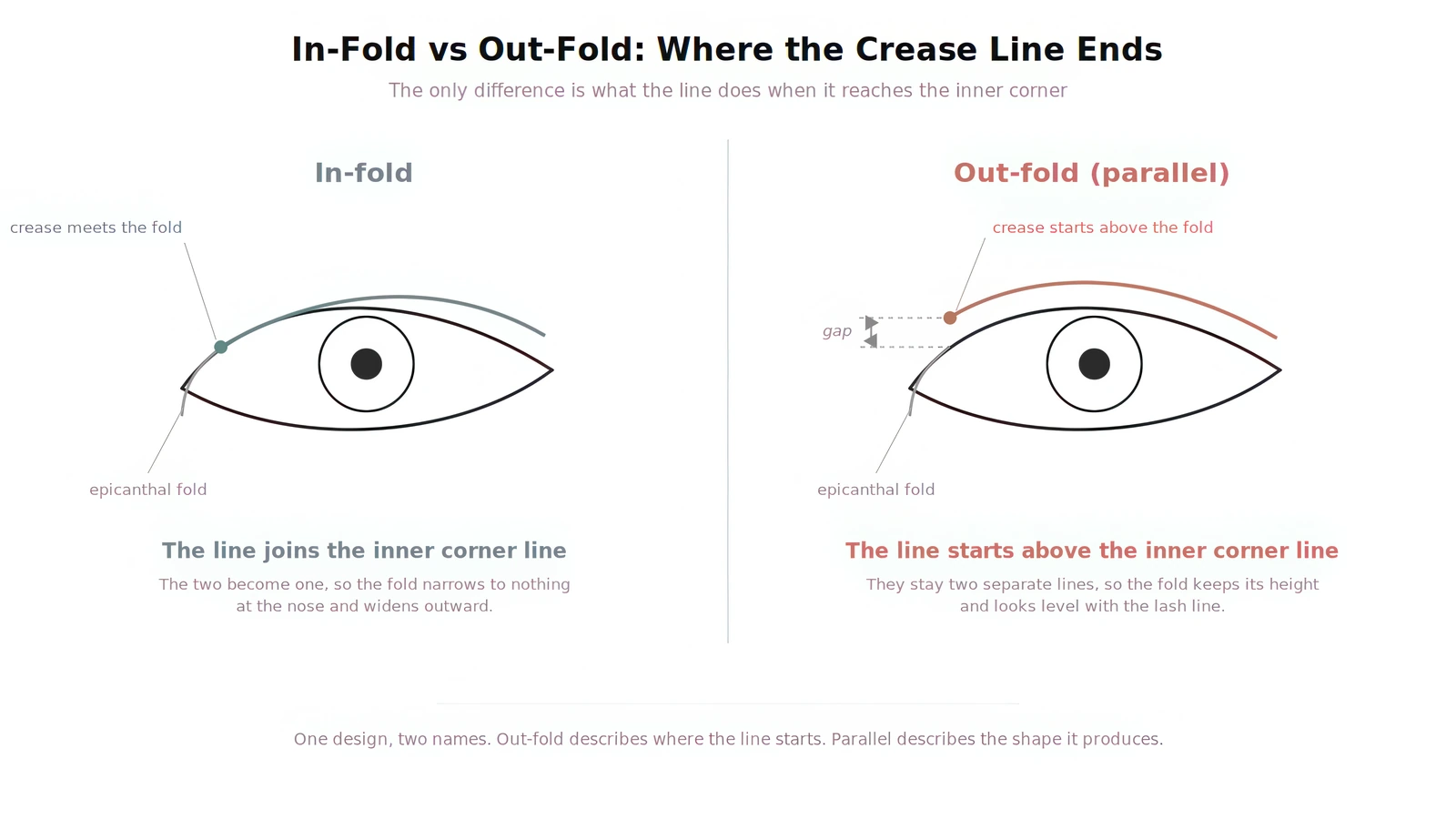
Most Caucasian eyelids come with a crease that starts above the inner corner and runs roughly level with the lash line. Most Asian eyelids either carry no crease at all, or carry one that runs down and merges into the epicanthal fold, the small web of skin covering the inner corner. Asians who do have a natural crease have one or the other: nasally tapered, or parallel.
Here the article changes its answer. Your anatomy set hard limits on the method. It does not set them on the design in the same way. Preference is largely yours here, and in practice I follow it.
In-fold. The inner end of the crease line runs down and joins the epicanthal fold so that the two become a single line. The visible fold is therefore narrow at the nose and widens outward. This is the configuration an Asian eyelid with a natural crease usually carries. Choosing the crease that matches the eye you were born with is the conventional recommendation, and the in-fold is widely regarded as the most natural result on an Asian face, a change subtle enough that it does not read as a departure from the patient’s own features.
Out-fold. The inner end of the crease line starts above the epicanthal fold instead of joining it, so the crease and the fold remain two separate lines. The crease therefore keeps its height all the way to the inner corner, and the eye looks larger and more defined. Clinics often call this a parallel crease, and it is worth knowing that out-fold and parallel are the same design described twice: one word says where the line starts, the other says what shape it produces. It is closer to the crease a Caucasian eyelid carries naturally, which is part of why it reads as bolder on an Asian face.
Plenty of patients want the bolder one, and that is a legitimate thing to want. A recommendation is not a verdict. What no surgeon should do is promise a design your anatomy cannot hold.
What your anatomy can actually hold
Preference still has to survive the inner corner. A prominent epicanthal fold restricts the out-fold, because the crease physically cannot stay above a web of skin that is already covering the corner. Force it anyway and the result tends either to look unnatural or to collapse back into an in-fold within a year or two.
That is why epicanthoplasty is combined with the fold operation when an out-fold, or parallel, design is the goal and the corner is covered. Opening the inner corner is what makes the design possible in the first place.
An epicanthoplasty is worth adding when the fold is prominent enough that opening it meaningfully improves the result. It is not worth adding as a default. If your anatomy suits an in-fold and you like an in-fold, there is no reason to put another operation on your eyelid.
What Actually Holds the Fold, and How I Fix It
Static or dynamic: the honest trade
The principle behind every double eyelid operation is the same: you connect the eyelid skin, the anterior lamella, to the tissue that actually opens the eye, the levator component. What changes, and what shows on your face, is which tissue the stitch actually takes hold of. There are two answers, and neither is simply better.
Fixing the dermis straight to the tarsal plate, so that the stitch bypasses the muscle and the levator, produces what surgeons call a static fold. Scar forms directly between skin and tarsus with no mobile tissue in between, and this is the strongest adhesion available: tarsal fixation is what makes a crease durable. Its price is visible. The line sits deep, stays depressed even when the eye is closed, and barely moves with the tissue around it. That is one of the tells people read as operated, and it tends to grow more obvious with age.
Bringing the levator aponeurosis and the pretarsal orbicularis into the fixation produces a dynamic fold. The crease deepens as the eye opens and lies smooth and almost invisible when the eye closes, which is what a physiologically natural crease does. What you give up is raw holding power. Every blink transmits a jerk force through that connection, and without a tarsal component these flexible fixations are not reliable: partial and complete loss of the fold are described.
So the choice is not between a good fold and a bad one. One buys durability at the cost of a line you can see with your eyes shut. The other buys an invisible closed eye at the cost of holding power. And these two are the ends of a range, not the only two places to stand. Most real eyelids are best served somewhere between them.

How I choose between them
TAO fixation is my base. For an incisional case I anchor the tarsus, the levator aponeurosis, and the orbicularis oculi muscle together. Keeping a partial bite of the tarsus preserves the reliability that a purely aponeurotic fixation lacks, and recruiting the bulky pretarsal orbicularis alongside the aponeurosis is what gives the fold its dynamic quality, spreading the pull of each blink across the fixation rather than concentrating it.
But I borrow one thing from the static technique. I trim part of the pretarsal orbicularis rather than leaving all of it. Less muscle sitting between the skin and the deep layer means a tighter, more reliable adhesion and a fold less likely to loosen over the years. The textbook static fold removes that muscle entirely. I do not. I take some of it.
So the fold I build sits between a pure static fold and a fully dynamic one, and that is deliberate. How much muscle I leave is how I set the position. The aim is to keep most of the holding power without paying the whole price in a visibly depressed closed eye.
The eyelid sets that dial, and the variable is thickness. A thick, heavy lid puts real load on the fixation and is the one that loosens, so it gets more trimming and the fold sits closer to the static end. A thin, light lid asks far less of the fixation, so it keeps more muscle and the fold sits closer to a fully dynamic one.
In practice this tracks ethnicity, because Asian upper eyelids are more often thick and more prone to losing a crease. Most of my Asian cases end up with more muscle trimmed and a fold nearer the static end, and most of my Caucasian and other non-Asian cases keep more muscle and land nearer the dynamic end. Ethnicity is the pattern, not the rule. A thin Asian eyelid keeps its muscle. A thick Caucasian eyelid gives more of it up. The eyelid on the table decides.
TAO is not the more durable fixation. It is the fixation that disappears when you close your eyes, and trimming the muscle is how it is made to hold on a lid that would otherwise loosen.
How I place the buried sutures
For a non-incisional case, I use four to five pairs of puncture points, eight to ten punctures in total, with the two points of each pair set close together. The suture takes a partial bite of the tarsus, passes out through the neighboring puncture, re-enters, then travels back beneath the skin to the original puncture, where the knot is tied and buried below the surface.
Two details in that description matter to you. Load is shared across several fixation points instead of resting on one or two isolated knots, which is precisely where older three-point designs tend to give way. And the knot finishes buried under the skin rather than sitting near the surface, which is what stops it from working its way out or leaving a small palpable bump months later.

Why you are woken up during the operation
Upper eyelid surgery is done under local anesthesia with sedation, and the sedative chosen decides something most patients never think to ask about: whether the fold can be checked before the operation ends.
In my hands the sedation is midazolam and ketamine. Its first job is comfort. Eyelid surgery involves pressure and tugging that most people would rather not feel, and this combination handles that well. But it has a second property that matters more to your result. It is shallow enough that you can be woken partway through and asked to open your eyes.
Propofol does not allow that. It puts you deeply asleep, which is entirely reasonable anesthesia and widely used. What it costs is the check. A crease that looks correct on a closed, sedated lid can sit too high, pull unevenly, or come out asymmetric the moment the levator actually fires, and a sleeping patient cannot show you any of it.
So partway through, you open your eyes. Where the line catches, whether the two sides match, whether the height behaves the way it was drawn: all of it is looked at while adjusting is still possible. A double eyelid only proves itself in motion, and checking the fold in action is how the line drawn on your skin becomes the fold you see in the mirror.
Not everyone wants sedation, and patients who would rather do without it are operated on under local anesthesia alone. That works. It is simply less comfortable, and most people choose the sedation.
What the Suture Method Can and Cannot Do
Non-incisional surgery has a reputation problem in both directions. Some clinics sell it as a lighter, safer, smarter version of the same operation, which is misleading. Others dismiss it as a temporary fix, which is equally wrong. It is an excellent operation on the right eyelid and a poor one on the wrong eyelid, and the difference is anatomy.
It works when the skin is thin, the eyelid is not fatty, there is no meaningful excess skin, and the levator muscle is strong. In that eyelid, the thread only has to hold a light curtain, and it does so for years. It fails when it is asked to hold a heavy one. A thick, fat-laden lid pushed into a crease by stitches alone tends either to lose the crease as the threads give way, or to bunch into a fold that stays permanently swollen and rounded. That second outcome is the thick, puffy fold patients call a sausage eye, and it is one of the most common reasons for revision surgery.
Choosing the suture method because it has less downtime, when the eyelid needed tissue removed, is not a shortcut. It is a delay.
Which Method Is Right for You: Patient Profiles
These are the cases seen most often. Find the one closest to your eyelid and take it into consultation as a working hypothesis rather than a demand.

1. Thin skin, no puffiness, no excess skin, and you are young
Your eyelid is light. There is no obvious fat bulge, the skin above the crease is not hanging, and your eye opens strongly. This is the ideal suture eyelid. A buried suture creates a clean fold, the swelling settles quickly, there is no scar, and if you ever want it changed, undoing it is straightforward. Choosing a full incision here would mean removing tissue you do not have to spare.
2. Your eyelid looks thick, heavy, or puffy
Your lid has a full, padded quality even without a crease, and pressing gently gives a soft, fatty feel. This is a debulking problem, not a stitching problem. Threads pushed through a heavy lid will either fail or produce a thick, swollen fold. An incisional approach, full or partial depending on how much bulk there is, lets the surgeon remove the fat and pretarsal tissue that is physically preventing the skin from folding.
3. Your upper eyelid skin is starting to sag or hood
Skin above your crease droops over the lash line, or you notice it resting on your lashes when you look straight ahead. Skin that is already in excess cannot be tucked away by a stitch. It has to be removed, and only an incision can remove it. Attempting a suture method here typically produces a crease that disappears under the overhanging skin within a year.
If the heaviness is actually coming from your brow rather than your eyelid, that is a different operation entirely, and our guide to sub-brow lift versus upper blepharoplasty explains how to tell the two apart.
4. Your eyes look sleepy, and the fold is not the real problem
One eye seems smaller, your upper lid sits low over the iris, you raise your eyebrows to see properly, or people say you look tired. This may be ptosis, a weak levator muscle, and it is the single most important thing to catch before surgery. Ptosis is a lifting problem, not a folding problem. Creating a crease on a lid that cannot lift itself gives you a fold that looks puffy and an eye that still looks sleepy, and it is why the preoperative examination has to identify ptosis before any fold is designed. That muscle has to be addressed, which usually means an incisional approach.
5. You want the least downtime and the option to change your mind
You have an event coming, you are nervous about committing, or you simply want to try the look. If your anatomy fits profile one, the suture method is a legitimate answer to this. If it does not, the honest answer is that no method gives you a good result quickly, and rushing the choice is how people end up in revision surgery, which is far harder than the original operation.
6. You are somewhere in between
Your lid is slightly bulky, the skin is still tight, and you want durability without a full incision. A partial incision is designed for exactly this case, and some surgeons will offer it. In practice the decision still resolves to one end of the spectrum. If the bulk is genuinely modest and the skin is tight, a buried suture with a partial tarsal bite holds well. If the bulk is enough to fight the fold, an incision that actually clears it is the more honest answer. Ask your surgeon which side of that line your eyelid falls on, because being somewhere in between describes your eyelid, not a plan.
Recovery, Scars, and How Long It Looks Unnatural
Expect the timeline to track the amount of surgery, because that is all it reflects. With a suture method, most of the visible swelling settles within roughly one to two weeks, and the fold keeps softening for a few months. With a full incision, the swelling is more pronounced and takes several weeks to subside, and the crease continues to relax and look more natural over three to six months. A partial incision sits between them.
Skin sutures come out about a week after an incisional operation, and most people are presentable enough to return to work once they are out. A buried suture case is usually quicker than that. Eye makeup waits longer than people expect, generally until around the two week mark, once the incision has sealed fully.
Two things are worth saying plainly. First, every fresh double eyelid looks too high and too thick at the beginning. That is swelling, not the result, and judging your outcome in the first month is the fastest way to make yourself miserable. Second, the incision scar is a real scar, but it lies within the crease, and by the time the fold has settled it is not something other people see.
Surgeon’s Insight: Match the Method to the Eyelid, Not to the Downtime
Almost every unhappy double eyelid I revise was not a technical failure. It was a selection failure. Someone with a thick, fatty lid was given stitches because stitches sounded easier, and the fold either vanished or turned into a swollen sausage. Someone with an unrecognized ptosis was given a crease when what they needed was a muscle corrected. Each operation was performed competently. It was simply the wrong operation.
This decision belongs to your anatomy, and anatomy is not a matter of opinion. A surgeon should be able to tell you, by looking at and touching your eyelid, how thick the skin is, how much fat sits behind it, whether there is excess skin, and how strongly the levator lifts. If those four answers are not part of the conversation, you are not choosing a method. You are guessing.
Safety, Risks, and What to Watch For
Both routes are safe in trained hands, and the risks are mostly the kind that resolve. Swelling, bruising, mild asymmetry in the early weeks, and a fold that sits higher than its final position are all expected and settle.
Specific risks differ by method. A suture technique can produce suture-related complications, such as a knot working its way toward the surface, small cysts along the line, or, uncommonly, a stitch irritating the eye itself, which needs prompt attention rather than patience. Its most common problem, though, is simply loss of the crease over time when the eyelid was too heavy for it. An incisional technique carries the ordinary risks of an open procedure: a scar, more swelling, and a small chance of asymmetry that needs adjusting.
One risk matters more than any of these: a missed diagnosis. An eyelid with ptosis, significant excess skin, or a heavy fat pad that is treated as a simple fold will produce a disappointing result no matter how skillfully the chosen technique is executed. Ask what your surgeon found, not just what they plan to do.
Match the Method to Your Eyelid, Not to the Trend
Incisional and non-incisional are not rival philosophies. They are different amounts of the same operation. Stitches alone suit a thin, light eyelid with nothing to remove. A partial incision suits a slightly bulky lid with tight skin. A full incision is necessary when skin, muscle, or fat genuinely has to leave the eyelid, and when a weak levator has to be corrected at the same time.
If you take one thing from this, take the diagnostic question rather than the method. How thick is my skin, how much fat is behind it, do I have excess skin, and how strongly does my eyelid lift? A surgeon who answers those four before naming a technique is choosing for your eyes. A clinic that names the technique first, especially the one with the shortest downtime, is choosing for their schedule.
Written by Dr. Yongwoo Lee, board-certified Korean plastic surgery specialist in facial anatomy and aesthetic procedures at VIP Plastic Surgery, South Korea.
Frequently Asked Questions About Incisional and Non-Incisional Double Eyelid Surgery
What is the difference between incisional and non-incisional double eyelid surgery?
Non-incisional surgery creates the crease with buried stitches and removes nothing, so it causes little swelling and leaves no visible scar. Incisional surgery opens the crease so the surgeon can remove excess skin, muscle, and fat before fixing the fold directly, which is stronger and more durable. Which one is right depends on whether your eyelid has tissue that needs removing.
What is a dynamic double eyelid fold?
A dynamic fold deepens when you open your eye and lies smooth and almost invisible when you close it, which is how a natural crease behaves. It happens when the fixation engages the levator aponeurosis and the pretarsal orbicularis muscle rather than bypassing them. A fold that stays visibly indented on a closed eye is called a static fold, and it is the version people tend to read as operated.
Is a dynamic fold more durable than a static fold?
No, and it is the other way around. A static fold, made by fixing the dermis straight to the tarsus so the stitch bypasses the muscle, produces the strongest adhesion and the lowest chance of the crease fading. Its cost is a line that stays visibly depressed when the eye is closed. A dynamic fold is almost invisible on a closed eye but has less raw holding power. A thick eyelid usually needs the durability. A thin eyelid can afford the dynamic fold. In practice these are the two ends of a range rather than two products, and most folds are best built somewhere between them, by leaving part of the pretarsal orbicularis rather than removing all of it.
What is TAO fixation in double eyelid surgery?
TAO means fixing the tarsus, the levator aponeurosis, and the orbicularis oculi muscle together. Recruiting the aponeurosis and the pretarsal orbicularis links the crease to the muscle that lifts the lid, so the fold deepens as the eye opens and lies almost invisible when it closes. Keeping a partial bite of the tarsus is what preserves reliability, since fixations that skip the tarsus entirely are prone to losing the fold. On its own it is not the strongest adhesion available, which is why part of the pretarsal orbicularis is trimmed as well: less muscle between the skin and the deep layer makes the adhesion tighter without giving up the dynamic fold.
What is the difference between in-fold, out-fold, and parallel double eyelids?
There are really only two designs, not three. In an in-fold, the inner end of the crease joins the epicanthal fold and continues along it as one line, so the fold is narrow toward the nose. This is the crease an Asian eyelid usually carries naturally. In an out-fold, the crease starts above the epicanthal fold and stays a separate line, so it keeps its height to the inner corner and the eye looks larger. Parallel is not a third option: it is the shape an out-fold produces, and it is closer to the crease most Caucasian eyelids carry naturally.
Should I choose an in-fold or an out-fold?
This one is largely yours in a way the choice of method is not. The conventional recommendation is the crease that matches the eye you were born with, and on an Asian face the in-fold is generally considered the most natural. Many patients prefer the larger, more defined look of an out-fold, and that is a legitimate preference rather than a mistake. The one real limit is anatomy: a prominent epicanthal fold restricts an out-fold, and forcing it tends either to look unnatural or to collapse back into an in-fold.
How high should my double eyelid crease be?
Within the height of your own tarsal plate. A crease placed there is the least likely to loosen, the least likely to thicken into a puffy fold, and the one that looks natural, because that is where the levator physically reaches the skin. The Asian tarsus is shorter than the Caucasian tarsus, roughly 9.3 mm against 10 to 12 mm, which is why a natural Asian crease sits lower. A crease set above the tarsus can be done, but you are asking the skin to fold where nothing anchors it, and that is the classic route to a high, permanently swollen fold.
Should a man’s double eyelid crease be lower than a woman’s?
On an Asian eyelid, yes, and by a clear margin. A low, quiet crease reads as natural on a male eye, while a high one reads immediately as surgery. Non-Asian patients often suit a slightly higher crease, and the reason is anatomical rather than aesthetic: the tarsal plate is taller, so the height is actually supported.
Do I need an epicanthoplasty with my double eyelid surgery?
Only if your inner corner requires it. A prominent epicanthal fold physically restricts an out-fold or a parallel crease, so those designs often need the corner opened to sit cleanly. If your anatomy suits an in-fold and you are happy with an in-fold, there is no reason to add the operation. It is worth doing when it meaningfully improves the result, not by default.
Are you awake during double eyelid surgery?
The operation is done under local anesthesia with sedation, and you are woken partway through and asked to open your eyes. That is deliberate, and it is why the sedative matters. Midazolam and ketamine keep the sedation shallow enough to wake you; propofol puts you deeply asleep and takes that option away. A crease that looks right on a closed, sedated lid can sit too high, pull unevenly, or come out asymmetric once the eye actually opens, so checking the fold in motion on the table is the only reliable way to confirm it before finishing.
Can I have double eyelid surgery without sedation?
Yes. The operation itself is done under local anesthesia, and sedation is there for comfort rather than necessity. Patients who would rather skip it are operated on under local anesthesia alone. Most people choose the sedation, because eyelid surgery involves pressure and tugging that is easier not to feel.
When can I wear eye makeup and go back to work?
Skin sutures come out about a week after an incisional operation, and most people are presentable enough to return to work once they are out. A buried suture case is usually quicker. Eye makeup waits longer than most people expect, generally until around two weeks, once the incision has sealed fully.
Which method lasts longer?
A full incision holds the longest, because the fold is fixed directly to the deep layer after the obstructing tissue is removed. A well-selected suture method can also last for many years, but it loosens more often when it is used on a thick, fatty, or sagging eyelid that was never suitable for it. Durability is decided by selection more than by technique.
Can I get non-incisional surgery if my eyelids are thick?
Usually not, and this is the most common mistake patients make. A thick or fatty eyelid physically blocks the skin from folding, and stitches cannot remove that obstacle. Forcing a crease anyway tends to produce either a fold that fades or a thick, permanently puffy fold. That eyelid needs the fat and pretarsal tissue removed, which requires an incision.
Does non-incisional double eyelid surgery leave a scar?
No visible one. Threads pass through tiny puncture points that heal without a noticeable mark, which is one of its genuine advantages. A full incision does leave a scar, but it sits within the crease itself, and once the fold has settled over several months it is not something other people notice.
How long is the recovery for each method?
With the suture method, most visible swelling settles in about one to two weeks. With a full incision, the swelling is heavier and takes several weeks, and the fold keeps relaxing and looking more natural over three to six months. A partial incision falls in between. Every fresh crease looks too high and too thick at first, and that is swelling rather than your result.
Is non-incisional surgery reversible?
It is the easiest of the three to undo or adjust, because nothing was removed and the fold is held by threads that can be released. That said, reversible does not mean consequence-free, and repeated operations on the same eyelid build scar tissue that makes future surgery harder. It is a reason to choose carefully, not a reason to choose casually.
What is partial incision double eyelid surgery?
It uses a few very small openings rather than one long incision, which lets the surgeon remove a modest amount of fat and fix the crease securely without a large skin excision. It suits an eyelid that is slightly bulky but still has tight skin. Recovery stays closer to the suture method while durability moves closer to the incisional one.
Can double eyelid surgery fix droopy or sleepy eyes?
Not by itself. If your upper lid sits low over the iris and you lift your brows to see, the likely problem is ptosis, a weak lifting muscle, which is separate from the crease. Making a fold on an eyelid that cannot lift leaves you with a puffy fold and an eye that still looks sleepy. That muscle itself has to be corrected, which usually means an incisional approach.
Why did my double eyelid disappear or get thicker after surgery?
Two causes are typical: a suture method used on an eyelid that was too heavy for it, so the threads gradually gave way, or a crease set too high for your anatomy, which bunches the skin into a thick, swollen fold. Both are selection problems rather than bad luck, and both are correctable, though revision is more demanding than the first operation.
How do I know which method I need?
Four answers decide it: how thick your eyelid skin is, how much fat sits behind it, whether you have excess skin, and how strongly your levator muscle lifts. A surgeon should establish those by examining and touching your eyelid before naming any technique. If a method is recommended before those four are assessed, the recommendation is not based on your eyes.
This article is for informational purposes only and does not constitute medical advice. Always consult with a qualified medical professional before making any decisions about surgical or non-surgical procedures.