
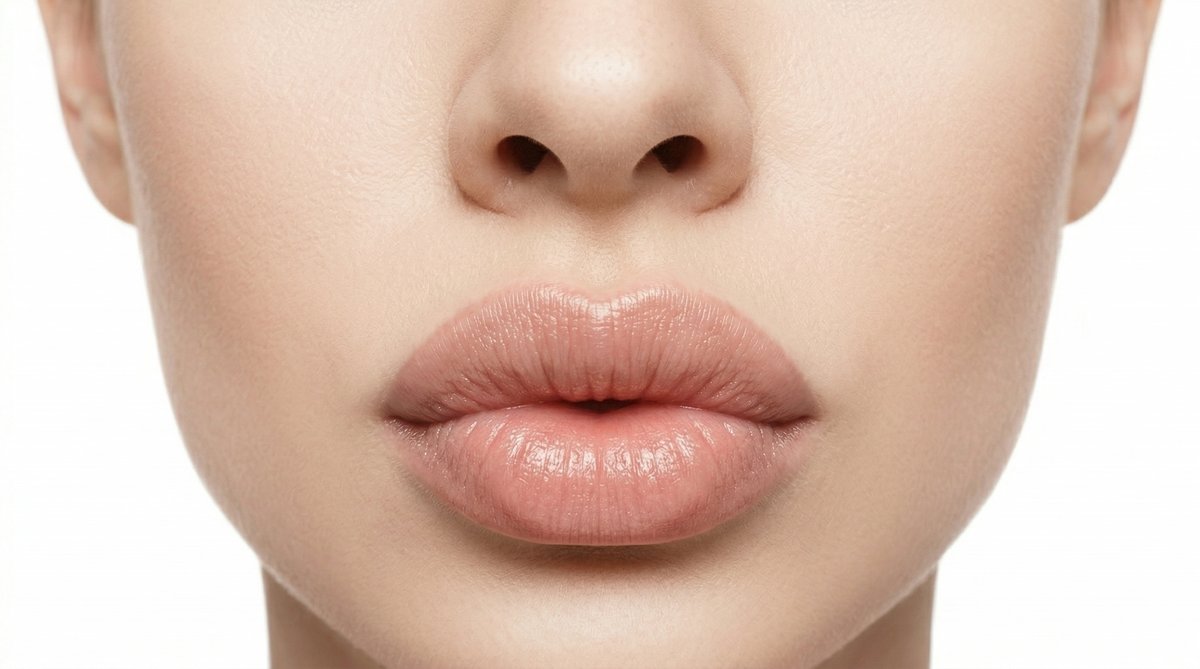
Are Duck Lips Just Too Much Filler? Usually Not
Duck lips, the puffy shelf that forms above the upper lip after filler, are usually not caused by volume alone. They are caused by filler sitting in the wrong tissue layer, where the lip’s own muscle slowly pumps it upward past the border of the red lip. That distinction matters, because the fix is different: removing product from the wrong place, not simply injecting less next time.
How often does filler end up in the wrong layer? More often than almost anyone assumes. A 2026 multicenter study that scanned the lips of 126 people with high-frequency ultrasound found that the subcutaneous layer of the lip averages less than 1 millimeter thick, so injected filler ends up inside or against the orbicularis oris muscle in most treated lips, whatever plane the injector was aiming for. Treated lips also showed thickened tissue layers and, with vertical injection techniques, deeper deposition and migration.
So if your upper lip has developed a heavy, forward-projecting ridge between the red lip and the nose, the useful question is not “did my injector use too much?” It is “where is that filler actually sitting, and what is pushing it around?” This article answers both, and then walks through the correction protocol step by step: staged enzyme dissolving, a defined waiting period, and re-augmentation only after the tissue has returned to baseline.
The Real Problem: Your Old Filler Is Still There
Hyaluronic acid lip filler does not reliably disappear in 6 to 12 months, whatever the product brochure implies. MRI studies have changed this picture completely. A review of MRI findings in 33 patients found hyaluronic acid filler still visible 2 to 15 years after injection, and in no patient had it fully dissipated within 2 years. Those scans were of the midface rather than the lips, so the exact timelines transfer imperfectly, but the core finding stands: cross-linked filler persists for years, not months.
This persistence is what turns small placement errors into visible deformity. A patient who feels her lips have “gone flat” at 8 months returns for a touch-up. Some of the first syringe is still there, displaced upward where it no longer adds attractive volume. New product goes in, some of it displaces too, and after three or four cycles the cutaneous upper lip carries a cumulative deposit that no single appointment created. Migration is rarely one bad injection. It is an accumulation problem, layered over years by a muscle that never stops moving.
There is a practical corollary worth knowing before any correction: because old filler can persist for years, it can also be dissolved years later. The enzyme protocol described below has successfully removed hyaluronic acid gel 63 months after injection. No one is stuck with a migrated result simply because it is old.
How the Orbicularis Oris Muscle Pushes Filler Out of Your Lip
The orbicularis oris, the sphincter muscle encircling the mouth, is the engine of lip filler migration. It contracts thousands of times a day for speech, chewing, drinking, and expression, and any filler bolus lying inside it is squeezed with every contraction, like paste worked through a tube along the path of least resistance.
Ultrasound anatomy studies show the muscle is not a simple ring. It has two parts arranged in a J shape: the pars marginalis, forming the tip of the J just beneath the vermilion border, and the pars peripheralis, forming the stem beneath the cutaneous lip. Between and around these parts run three injectable planes. Superficially there is the subcutaneous layer, which in the lip averages under 1 millimeter. Centrally sits the muscle itself. Deep to the muscle, against the wet mucosa, lies the submucosal plane, where the superior labial artery most often runs.

Filler placed in the thin superficial layer shows and lumps easily. Filler placed in or against the working muscle gets pumped, and the weakest containment is superior: past the vermilion border into the cutaneous upper lip, where there is no muscle sphincter to resist it. That is why migration so consistently presents as philtral puffiness and a blurred border rather than displacement downward or sideways.

Product choice feeds the same mechanism. Fillers are characterized by G-prime, a measured stiffness value, and cohesivity, the gel’s resistance to fragmenting. A laboratory comparison of 18 hyaluronic acid products measured G-prime values spanning roughly 10 pascals to more than 500, a fifty-fold range. That comparison was manufacturer-funded, and a second review of filler rheology written by authors with their own industry ties reaches the same practical conclusion, a caveat worth knowing about this literature generally. Stiff, high G-prime gels built for cheekbones feel rigid in a structure that folds and puckers all day. Very soft, low-cohesivity gels lack the internal integrity to hold position against muscular compression. Lip-appropriate products occupy a narrow window between those failures, and no product in any window survives placement directly inside a contracting muscle belly indefinitely.
What Can Be Done About Migrated Filler, at a Glance
Once filler has migrated above the lip line, there are only three honest options, and one commonly attempted non-option. Dissolving with hyaluronidase is the standard of care; everything else either waits too long or makes the problem worse.
| Option | What actually happens | Timeline | Verdict |
|---|---|---|---|
| Add more filler on top | New volume stacks onto displaced product; the shelf grows and the border blurs further | Immediate worsening | Never appropriate for visible migration |
| Wait for natural breakdown | MRI shows cross-linked filler persisting 2 to 15 years | Years, unpredictably | Not realistic for a visible deformity |
| Staged hyaluronidase dissolving | Enzyme clears the displaced gel; effect begins within hours, settles over days | 48 hours per round, final result by 2 weeks | Standard of care |
| Dissolve, wait, reinject correctly | Full reset, then anatomically planned re-augmentation in the correct plane | About 3 to 4 weeks start to finish | For patients who still want volume |
The enzyme itself, hyaluronidase, hydrolyzes the bonds within hyaluronic acid so the body clears the fragments through normal metabolism. Its action begins almost immediately, its duration of action is 24 to 48 hours, and for dense cross-linked products the visible result may take the full 48 hours to declare itself.
Dosing deserves a precise word, because patients often ask for a single number and the literature does not contain one. A classic consensus figure is 5 units per 0.1 milliliter of a 20 mg/mL gel, with published recommendations up to 30 units for the same volume. The current UK guideline goes further and abandons fixed dosing entirely, recommending instead that the clinician treat to visible effect using a concentration of at least 300 units per milliliter, reassessing after 48 hours and repeating only if needed. A 2024 review of published protocols found single-session doses ranging from 1.25 to 37.5 units per 0.1 milliliter, and far lower weekly doses when dissolving is staged. The honest summary: dissolving is titrated, not dispensed.
How I Correct Migrated Lip Filler, Step by Step
In practice, correction follows a fixed sequence: dissolve in stages, wait a defined interval, reassess the bare anatomy, and only then rebuild.
I dissolve in stages rather than all at once. The first session targets the migrated product above the vermilion border, the deposit actually causing the deformity, with a conservative dose. At 48 hours the result is assessed, and if displaced filler remains, a second round follows. Two findings from the literature drive this choice. A randomized trial in JAMA Dermatology showed that small quantities of hyaluronidase dissolve hyaluronic acid effectively, with a dose-related response, so large single doses are not required. And a 2024 series coined the term posthyaluronidase syndrome for tissue hollowing after dissolving: in 157 treated periocular areas, 18 percent of patients reported hollowing afterward, and the risk tracked with how long the filler had been in place and how much volume was dissolved, not with the enzyme dose. Staging lets me stop at the point of correction instead of overshooting past it. That calculus is specific to the lip. When clearing large volumes across the midface, under-dosing is the usual reason a patient ends up dissolved three and four times, so there a single adequate dose is the right call, as covered in our guide to the overfilled face. In the small, visible territory of the lip, overshoot is the greater danger, and the staged approach follows from that.
I wait a minimum of two weeks before any re-injection, longer if swelling persists. This matches the current UK guideline recommendation exactly, and the reason is worth understanding because it is not the reason patients assume. Enzyme activity is gone within 48 hours, and the body restores its own native hyaluronic acid within 15 to 20 hours; an animal study even showed re-injected filler surviving normally from about 6 hours after hyaluronidase. What takes two weeks is the tissue itself: swelling must fully settle before anyone can see the true baseline lip. Injecting into a swollen canvas means planning volume against a shape that will not exist a month later.

Only at that two-week mark do I evaluate the lips for re-augmentation, and the evaluation is dynamic. Lips are assessed speaking, smiling, and pursing, not just at rest, because filler that looks correct in a static photograph can still distort animation.
When I do reinject, I use a needle, placing small aliquots with the tip visualized against the anatomy of the plane I am filling. A needle demands more anatomical precision than a cannula, and the safety data reflect the tradeoff honestly: a practitioner-reported study covering 1.7 million syringe injections found vascular occlusion in roughly 1 per 6,410 syringes injected by needle versus 1 per 40,882 by cannula. What makes needle injection defensible in the lip is knowing exactly where the artery runs, which is covered in the safety section below, and keeping each deposit small and slow.
I do not perform the Russian lip technique, and I do not recommend it. Vertical threading passes the needle repeatedly through the vermilion border, the exact boundary that normally contains filler within the red lip, and the imaging evidence points the same direction: the 126-patient ultrasound study associated vertical injection techniques with deeper deposition and migration, and a 216-patient comparison of injection techniques found that patient satisfaction differed significantly with the direction of vertical threading, from 4.78 out of 5 for the best direction to 3.70 for the worst, with migration toward the cutaneous lip weighing on the lower scores. A technique whose outcome depends that heavily on execution direction, through the one barrier I most want intact, is a technique I am content to leave to others.
One disclosure completes the picture. If the border and philtrum are already so stretched by long-standing migrated filler that dissolving leaves lax, redundant tissue, no injection technique restores that. I say so before dissolving, not after.
Which Patient Are You?
A shelf above the lip after years of touch-ups. This is the classic accumulation pattern: each syringe partially displaced, stacked over years into a cutaneous deposit. Correction is staged dissolving of the migrated product first, and the result at two weeks is usually a revelation, because most patients have forgotten what their baseline lip looks like.
“My filler was gone in six months, so I kept adding more.” Feeling flat is not the same as being empty. MRI evidence of filler persisting for years means the volume often has not vanished; it has moved somewhere it was never intended to sit. Adding more product on that foundation is how the first patient profile is created. An assessment of where the existing filler sits comes before any new syringe.
Lumps or a bluish tint at the lip line. Discrete nodules and visible discoloration point to superficial placement in the sub-millimeter subcutaneous layer rather than muscular migration. Targeted dissolving of the individual deposits usually resolves it, and often needs less enzyme than a migration correction.
Never filled, and afraid of ending up with duck lips. Prevention is a screening exercise. Ask any prospective injector three things: which tissue plane they target in the lip and why, which product they use and why its stiffness suits a lip rather than a cheek, and what their correction protocol is when a result goes wrong. An injector who cannot answer the third question fluently should not be trusted with the first two.
Recovery After Dissolving and Reinjection
Recovery from dissolving is short and front-loaded. Expect swelling for the first 24 to 48 hours, occasionally with bruising at injection points; the enzyme’s visible effect begins within hours and the dense product may keep softening for the full 48. Most patients are socially presentable within 2 to 3 days. Final assessment of the dissolved result is made at up to 2 weeks, when residual swelling has fully settled.
If re-augmentation is planned, the two-week minimum wait applies, longer when swelling persists. After reinjection, expect the usual filler timeline: peak swelling at 24 to 48 hours, settled appearance at about 2 weeks. Judging the new result before then repeats the exact mistake the waiting period exists to prevent.
Surgeon’s Insight: A lip result cannot be judged in a photograph. The orbicularis oris contracts thousands of times a day, and filler either moves with that muscle or is moved by it. This is why assessment at every stage, before dissolving, at the two-week baseline, and after reinjection, happens with the patient speaking, smiling, and pursing. A lip that looks perfect at rest and distorts in animation is not a finished result. It is a migration in progress.
Safety: Vascular Risk, Enzyme Allergy, and Over-Dissolving
Lip filler’s most serious risk is vascular, and lip anatomy is the reason it is manageable. In a cadaver study of 193 heads, the labial arteries ran in the submucosal plane in 78 percent of cases, within the muscle in 17.5 percent, and subcutaneously in only 2 percent. A follow-up ultrasound study in living patients found the superior labial artery an average of 5.6 millimeters beneath the surface, with more intramuscular variation than the cadaver work suggested. Two practical conclusions follow: no plane in the lip is guaranteed artery-free, and deep boluses toward the wet mucosa deserve the most respect. Intravascular injection is the mechanism behind the tissue-loss and blindness cases in the FDA’s safety information on dermal fillers, and it is the reason correction of a suspected occlusion uses a completely different, high-dose emergency hyaluronidase protocol that has nothing to do with the staged aesthetic dosing described above.

Hyaluronidase itself is well tolerated. Reported local allergic reactions run 0.05 to 0.69 percent, with urticaria or angioedema below 0.1 percent. One history matters more than any test: anaphylaxis to bee or wasp stings is a relative contraindication, because venom contains hyaluronidase. Routine skin testing has shifted between guidelines, with the 2021 UK guidance no longer recommending blanket pre-testing in patients without a suggestive allergy history.
Over-dissolving is the risk patients hear about on social media, usually framed as the enzyme “eating your own lips.” The published data are more specific and less frightening. Native hyaluronic acid destroyed by the enzyme is restored by the body within 15 to 20 hours. The hollowing some patients report afterward, the posthyaluronidase syndrome described above, correlated with the age and volume of the dissolved filler rather than the enzyme dose, which suggests the deflation reveals stretch and volume dependence that the filler was masking, rather than enzyme damage to native tissue. Staged low-dose dissolving exists precisely to find the stopping point before that reveal becomes an overshoot.
Watch for warning signs after any lip injection, dissolving included: blanching or dusky discoloration of the lip or surrounding skin, pain out of proportion to the procedure, or mottled purple netting of the skin. These suggest vascular compromise and warrant immediate contact with the treating clinician, not observation overnight.
The Question to Ask Before Anyone Touches Your Lips
The diagnostic question in lip filler is not “which brand?” or “how many milliliters?” It is “where, exactly, will this product sit, and what will the strongest muscle in my face do to it there?” Every failure pattern in this article, the shelf above the border, the lumps, the blue tint, the lips that need refilling every few months while old product quietly accumulates above them, traces back to that single question going unasked.
Migration is not bad luck, and it is not a mystery. It is the predictable mechanical consequence of a persistent gel placed within reach of a tireless muscle. That predictability is good news: it means the deformity can be reversed by protocol, the anatomy can be respected the second time, and the result can be judged the only way that matters, in motion.
Weighing filler against other options for the lower face? Our comparison of lower blepharoplasty and tear trough fillers applies the same plane-first logic to the under-eye. If you are dealing with a face that has accumulated filler in multiple areas, the overfilled face: dissolve or lift covers the decision at facial scale. For injectables that hydrate rather than volumize, see Rejuran vs. Juvelook vs. Skinvive.
Written by Dr. Yongwoo Lee, board-certified Korean plastic surgery specialist in facial anatomy and aesthetic procedures at VIP Plastic Surgery, South Korea.
Frequently Asked Questions About Lip Filler Migration
What does lip filler migration look like?
Migration presents as puffiness or a shelf-like ridge in the skin above the upper lip, between the vermilion border and the nose. The crisp line of the lip border blurs, the philtrum looks swollen, and the area projects forward in profile. It develops gradually over weeks to months, which is why many patients do not connect it to an injection that happened a year or more earlier.
Why does lip filler migrate above the lip instead of downward?
The orbicularis oris muscle squeezes displaced filler along the path of least resistance, and the weakest containment is upward. Below and beside the red lip, muscle and tighter tissue planes resist spread, while above the vermilion border the cutaneous lip offers little resistance and no muscular sphincter. Displaced product therefore accumulates in the philtrum and upper cutaneous lip far more often than anywhere else.
Does lip filler dissolve on its own over time?
Far more slowly than commonly claimed. MRI studies have found hyaluronic acid filler still present 2 to 15 years after injection, and in one review no patient showed complete clearance within 2 years. The feeling that filler is “gone” at 6 to 12 months usually reflects settling, water loss, and displacement rather than true disappearance, which is why repeated topping up can quietly build a migrated deposit.
Can lip filler migration be fixed?
Yes, at any age of filler. Hyaluronidase dissolves hyaluronic acid regardless of how long it has been in place, with published removal of gel more than 5 years after injection. The standard correction is staged dissolving of the displaced product, reassessment at 48 hours, and a minimum 2-week wait before any re-augmentation.
How much hyaluronidase does it take to dissolve migrated lip filler?
Published dosing ranges from about 5 units per 0.1 milliliter of a standard 20 mg/mL gel up to 30 units, and the current UK guideline recommends abandoning fixed doses in favor of treating to visible effect at a concentration of at least 300 units per milliliter, repeated after 48 hours if needed. Staged low-dose treatment achieves correction with less risk of overshooting than a single large dose.
Does hyaluronidase damage your natural lip tissue?
The enzyme does break down some native hyaluronic acid, but the body restores it within 15 to 20 hours, and enzyme activity is gone within 48 hours. Hollowing occasionally reported after dissolving correlated in published data with how long the filler had been in place and how much was dissolved, not with the enzyme dose, suggesting it reflects what the filler was masking rather than tissue destruction.
How long after dissolving can I get filler again?
A minimum of two weeks, longer if swelling persists. Chemically, re-injected filler survives far earlier, from about 6 hours in animal data and certainly by 48 hours once no enzyme activity remains, but the waiting period exists for a different reason: the lip must return to its true baseline shape before anyone can plan accurate volumes. Injecting into residual swelling means designing a result against a shape that will soon change.
Is the Russian lip technique safe?
It carries a structural risk that standard techniques avoid: vertical threading repeatedly punctures the vermilion border, the boundary that normally contains filler within the red lip. Imaging studies associate vertical techniques with deeper filler deposition and migration, and in a 216-patient comparison, satisfaction differed significantly with the exact direction of vertical threading, with migration toward the cutaneous lip weighing on the lower-scoring direction. Outcomes depend heavily on execution, which is why some surgeons, including the author, choose not to perform it at all.
Is a needle or a cannula safer for lip filler?
Practitioner-reported data covering 1.7 million syringe injections found vascular occlusion in roughly 1 per 6,410 syringes with a needle versus 1 per 40,882 with a cannula. A needle offers finer placement of small deposits but demands precise knowledge of the labial artery’s course, which runs in the submucosal plane in the majority of people. Instrument choice matters less than the injector’s anatomical fluency with the plane being filled.
Why does superficially placed filler look blue, and is that the Tyndall effect?
Filler placed in the lip’s sub-millimeter subcutaneous layer can show as a bluish tint or visible lumps. It is conventionally called the Tyndall effect, though an optical analysis argued that true Tyndall scattering cannot explain the color and that the perception works more like the way veins appear blue through skin. Whatever the optics, the clinical meaning is unchanged: the product is too superficial, and targeted dissolving corrects it.
Can filler migrate years after my injection?
Yes. Because the gel persists for years and the orbicularis oris never stops contracting, displacement can continue long after the appointment, and deposits from multiple sessions can accumulate gradually. This is why a lip that looked correct for two years can still develop a shelf in the third.
How can I prevent lip filler migration?
Three questions screen most of the risk before a needle is ever placed: which tissue plane the injector targets in the lip and why, whether the product’s stiffness and cohesivity were chosen for lip movement rather than structural projection, and what the injector’s correction protocol is if the result goes wrong. Conservative volumes per session and avoiding repeated vertical passes through the vermilion border address the two main mechanical causes.
Is hyaluronidase allergy common?
No. Local allergic reactions are reported in 0.05 to 0.69 percent of cases, and urticaria or angioedema in fewer than 0.1 percent. One history changes the risk calculus: anaphylaxis to bee or wasp stings is a relative contraindication because the venom contains hyaluronidase. Current UK guidance no longer recommends routine skin testing for patients without a suggestive allergy history.
Can old filler from years ago still be dissolved?
Yes. Hyaluronidase has removed hyaluronic acid gel documented at 63 months after injection, and the enzyme works on cross-linked gel regardless of its age. Older, larger deposits are dissolved in stages, because published data link post-dissolving hollowing to the duration and volume of the filler that was removed, making a gradual approach the safer path for long-standing migration.
This article is for informational purposes only and does not constitute medical advice. Always consult with a qualified medical professional before making any decisions about surgical or non-surgical procedures.