
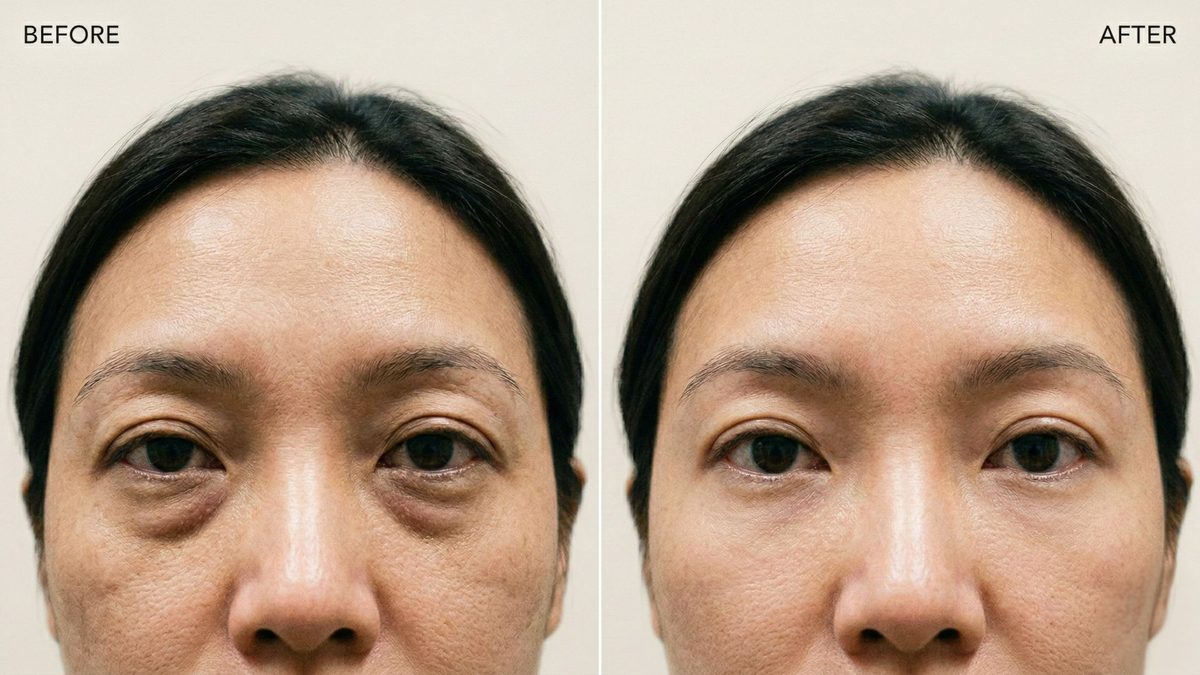
Should You Get Tear Trough Filler or Lower Blepharoplasty for Under-Eye Bags?
Whether filler or surgery is right depends on which of two things is casting the shadow. If fat is sitting in front of the orbital rim, that is a bag, and filler cannot move it; only lower blepharoplasty relocates it. If there is no bag and the problem is a groove below the rim, that is a hollow, and a small amount of hyaluronic acid tear trough filler placed correctly can fill it. Most of the disappointment in this area comes from buying the first treatment for the second problem, or the second for the first.
The mistake is easy to make because both look like a dark line under the eye. A bag and a hollow sit less than a centimeter apart, and the same overhead light makes them read as one shadow. Clinics that sell filler describe the hollow. Clinics that sell surgery describe the bag. Almost nobody starts by asking which one you have.
This article sets out how to tell them apart, what a syringe can and cannot do to a lower eyelid, what the five-year follow-up on under-eye filler shows, what a 200-case series of transconjunctival lower blepharoplasty shows, and how I decide between the two in my own clinic, including the patients I turn away from filler.
What Is Actually Casting the Shadow Under Your Eye?
A shadow under the eye is a step in the surface, and the step has two possible causes: a mound above the rim, or a valley below it. Which one you have is the entire diagnosis, and it can be read in a mirror before any test is ordered.
Behind the lower eyelid, the fat that cushions the eyeball is held in place by the orbital septum, a thin fibrous sheet that blends into the eyelid’s deeper layers 3.7 to 5.4 mm below the lower edge of the tarsal plate. When that sheet thins or stretches, the fat pushes forward through it. Nothing has grown. Fat that was always there is now sitting in front of the bone instead of behind it, and it stays there whether you slept eight hours or none.
Directly below that mound is a line the skin cannot rise above. In 48 cadaveric hemifaces, Wong, Hsieh and Mendelson confirmed the tear trough ligament as a true ligament running from bone to skin, from the medial canthal tendon out to the medial pupil line. Because it is anchored to bone, it does not move when the fat above it does. A bulge above a fixed line is a hill next to a valley, and overhead light does the rest.
The valley also deepens on its own. Measuring 160 women, twenty per decade, Fezza and Massry found the visible lower eyelid lengthening almost in a straight line with age, from a mean of 10.4 mm in the twenties to 18.6 mm in the nineties, with the largest single jump in the forties. A short lower eyelid with a high, smooth junction into the cheek is what a young face has. As the junction drops and the groove appears, the eyelid looks longer, and the face looks tired even when nothing is bulging.
East Asian eyelids start from a different baseline. Comparing 224 East Asian participants with 22 matched Caucasians on CT, Kato and Okuda found orbital fat projecting further forward relative to the rim, a negative vector in 40 percent of the young East Asian group against 20 percent of young Caucasians, and an infraorbital rim that did not recede with age the way it did in the Caucasian group. A Korean patient in her late twenties can have a real bag for structural reasons rather than for reasons of age, and that changes which treatment is even on the table.
One more thing has to be said before comparing treatments, because it removes a large group of patients from both. In a study that classified dark circles by cause with a Wood’s lamp and ultrasound in 65 Taiwanese patients, only 3 percent were purely structural. Pigment alone accounted for 5 percent, visible vessels for 14 percent, and a mixture of causes for 78 percent. Filler and surgery both act on shape. Neither lightens pigment, and neither hides a vein. If your darkness does not change when you tilt your head back under a ceiling light, shape is probably not your problem.
How Do Filler and Fat Repositioning Each Change the Lower Eyelid?
Filler fills the valley. Fat repositioning moves the hill into the valley. Both flatten the step, and that is where the resemblance ends, because one adds material below a bulge that stays where it is, and the other removes the bulge by using it as the filling.

Hyaluronic acid placed deep, on the bone below the tear trough ligament, raises the floor of the groove until the surface is level with the fat above it. The fat is untouched. It keeps sitting in front of the rim, and the treatment succeeds only if the mound is small enough that raising the ground beside it makes the step disappear. Add enough gel beside a large mound and you have a wider mound, not a smoother eyelid.
Fat repositioning goes the other way. Working from inside the eyelid, through the conjunctiva, the surgeon opens the septum, frees the fat that has come forward, releases the tear trough ligament from the bone, and lays the fat downward over the rim into the groove, where it is stitched in place. The mound is gone because the tissue that made it is now lying in the valley, and the groove is gone because it is full of the patient’s own fat. One tissue, two corrections, and no incision on the skin.
An older version of this operation simply cut the fat out. The bag disappeared, and ten or fifteen years later the eyelid was hollow because the face kept losing volume from a starting point that had already been emptied. A 2025 systematic review of 36 articles on lower blepharoplasty still records periorbital hollowness in 0 to 9.8 percent of patients depending on the series. Why moving fat has replaced removing it, and when a small amount of removal is still right, is set out in fat repositioning versus fat removal.
Filler or Surgery: What Does the Evidence Say About Each?
Filler works well in the right eyelid, for a limited time, with side effects that are common early and underestimated late. Surgery works in more eyelids, once, with a lower complication rate than most patients expect. Both statements are measurable, so the numbers follow.
What the tear trough filler data show
A 2024 meta-analysis pooled 31 reports and 2,556 patients treated with hyaluronic acid for the tear trough. Satisfaction was 91.0 percent. Swelling was reported in 19.2 percent, bruising in 18.4 percent, lumps or contour irregularity in 5.3 percent, and blue discoloration in 0.9 percent. Those are the honest headline figures, and they are good.
The regulator’s trial adds texture. In the randomized study behind the FDA approval of a filler specifically for infraorbital hollows, 333 patients were enrolled and 87.4 percent responded at three months against 17.7 percent of untreated controls. At twelve months the responder rate was 63.5 percent. The 80.3 percent figure sometimes quoted at eighteen months was reached only after a repeat treatment at month twelve. Investigators recorded adverse events in 12.7 percent of patients. Patients keeping their own diaries told a different story: 92 to 99 percent recorded at least one injection-related event, with swelling in 82 to 88 percent, bruising in 59 to 67 percent and lumps in 47 to 60 percent, most resolving within a week. Both numbers are true. One counts what a doctor thought worth writing down and the other counts what the patient saw in the mirror. The FDA’s own summary puts the duration plainly: results may last up to 12 months.
Very few products carry that indication in the United States. Everything else injected into the tear trough there is used off label, and the FDA’s general patient page on fillers recommends against injecting the periorbital area, lists blindness among the reported outcomes of vascular injection, and notes that side effects may appear weeks, months or years after treatment. That last clause is not boilerplate, as the five-year data show.
What happens to under-eye filler after five years
Under-eye filler looks different at five years than it does at six months, and worse. Most published follow-up on the tear trough stops long before the five-year mark, and short follow-up is kind to filler. Mustak, Fiaschetti and Goldberg examined 147 patients at least five years after infraorbital filler using five masked reviewers grading against the preinjection photographs. They found malar edema in 11 percent, blue-gray discoloration in 31.3 percent and contour irregularity in 30.5 percent, most of it mild. Set that 31.3 percent beside the 0.9 percent for blue discoloration in the pooled short-term data. They are not the same measurement, one being a masked reading at five years and the other whatever short-term studies chose to report, but the gap is thirty-fold, and most of it is explained by someone finally looking years later.
Swelling turns out to be dose-dependent in a way patients are rarely told. In a 447-patient series of 706 infraorbital treatments, Siperstein and colleagues looked at the 316 treatments given without a steroid and found swelling after 37 percent of those of 0.55 mL or less, 51 percent at 0.56 to 1 mL, and 60 percent above 1 mL. Under-eye skin drains poorly, hyaluronic acid holds water, and more gel means more water with nowhere to go.
Nor does the gel leave on schedule. When 14 patients presenting for dissolution were scanned by MRI, the volume of filler present averaged 2.8 times the volume originally injected, with product detectable up to 15 years after the last treatment. Filler that has drawn water is bigger than filler that was placed, and it does not vanish when the visible effect fades. Delayed problems follow the same clock: across 52 published cases of late complications after tear trough filler, the mean time to onset was 16.8 months, well after the point at which most patients assume the product is gone.
One correction to the folklore. That blue tint under thin skin is universally called the Tyndall effect, yet in a 2014 optical analysis of whether hyaluronic acid can scatter light this way, Rootman, Lin and Goldberg concluded that the Tyndall effect is unlikely to cause the hue change seen after filler. The discoloration is real. Its accepted explanation probably is not, which tells you how thinly this corner of the field has been examined.
What the lower blepharoplasty data show
The best-documented recent series of the inside-the-eyelid route is a 2026 prospective cohort of 200 consecutive extended transconjunctival lower blepharoplasties, mean patient age 41, followed for a mean of 22 months and as long as 95 months. In that series the orbital fat was excised and re-implanted as free grafts rather than swung down on a pedicle, so it is a volume-preserving operation of a different design from mine, but the safety numbers belong to the route. Satisfaction was 99.0 percent. Lower eyelid malposition and ectropion, the two complications this operation is feared for, occurred in no patient. Chemosis, a jelly-like swelling of the conjunctiva, occurred in 3.0 percent, and in none of the patients who had the lower eyelid operation alone. Two patients, 1.0 percent, needed revision for a residual bag.
For fat that is kept on its pedicle and moved, the numbers come from a Swedish series of 339 lower blepharoplasties comparing pedicled transposition with onlay grafting of the same fat, followed for a mean of 12.9 months: complications in 4 percent, revisions in 9 percent, and no significant difference between the two ways of keeping the fat. How the fat is fixed in place has its own data, described in the technique section below.
Korean data point the same way. In 229 consecutive Korean patients, 97.8 percent were satisfied, and graded fat prolapse fell from a mean of 1.94 to 0.07 while the tear trough score fell from 1.61 to 0.33. Those surgeons chose fat removal with fat grafting rather than repositioning, a legitimate minority position, and the result makes a useful point: more than one way of handling the fat can satisfy patients, and what separates a good lower eyelid from a bad one is selection and support of the lid as much as the fat itself.
The route decides the scar and most of the eyelid-position risk. A systematic review of 24 cohort studies and 3,623 patients notes a reported rate of symptomatic lid malposition of 0.4 percent with either approach, but found ectropion, the lid turning outward, in 2.6 percent after skin incisions against 0.04 percent after conjunctival ones. Read that with one caution: only 182 of those patients had the skin approach, so the comparison is unequal.
Tear Trough Filler vs. Lower Blepharoplasty at a Glance
| Hyaluronic acid filler | Transconjunctival fat repositioning | Skin-incision lower blepharoplasty | |
|---|---|---|---|
| What it changes | Raises the groove below the rim | Moves the bag into the groove | Moves or removes fat, and tightens skin |
| The bag itself | Untouched | Corrected | Corrected |
| Loose skin | Untouched | Small pinch excision at most | Corrected |
| Pigment or vessel darkness | No | No | No |
| Scar | None | None on skin | Fine line under the lashes |
| Duration | Up to 12 months on the FDA label; product persists far longer | Long-term; revision for residual bag 1.0 percent in a 200-case transconjunctival series | Long-term |
| Early events | Swelling 19.2 percent, bruising 18.4 percent, lumps 5.3 percent pooled | Bruising 1 to 2 weeks; chemosis 3.0 percent | Bruising 1 to 2 weeks; sutures out day 5 to 7 |
| Late events | Discoloration 31.3 percent, irregularity 30.5 percent, malar edema 11 percent at 5 years | Ectropion 0.04 percent pooled | Ectropion 2.6 percent pooled, from a much smaller group |
| Reversible | With hyaluronidase, incompletely | No | No |
| Suits | Mild hollow, no bag, elastic skin | Bag with or without hollow, skin still elastic | Bag plus real skin excess |
A published selection framework draws the line where this table does: a 2024 review of 20 studies places Barton grade I and II hollows with filler, and grade III or excess skin with fat repositioning. Whether anyone applies such a scale is another matter. When 39 experienced injectors were surveyed, only 26 percent used any tear trough classification at all, although they agreed that the two things that most define a youthful eye are the absence of a bag and a high, smooth junction between eyelid and cheek. That is the target. It is worth knowing that most people injecting toward it are not measuring where they start.
How I Decide Between Filler and Surgery, and What I Do in Each
I decide at the examination, not from the request, and the examination is mostly two fingers and a mirror. Here is what happens in my clinic before any plan is named.
I look for the hill before I look at the valley. With the patient looking straight ahead under overhead light, I check where the fullness sits: close to the lashes, out at the rim, or below it. Then I ask the patient to look up. Fat that has come through the septum pushes forward on upgaze and a hollow does not. If a mound is in front of the rim, filler is off the table for that eyelid, whatever the patient came in asking for. The reason is set out in aegyo sal versus eye bags: volume placed beside or above a mound builds a second mound and a deeper groove between them.
I measure lid laxity before choosing the route. Two bedside tests decide whether the eyelid can be trusted to hold its position after surgery. In the snap-back test I pull the lower lid down, let go, and watch how fast it returns to the eye; a lid that drifts back rather than snapping has lost tone. In the distraction test I pull the lid forward and measure the gap from the globe, and the thresholds I work to are these: three to five millimeters is normal, six to seven millimeters is significant laxity, and at ten millimeters or more I plan a horizontal shortening of the lid, because repositioned fat under a lid that cannot support itself is a retraction waiting to happen.

I choose the incision by the skin, not by the fat. Where fat has come forward and the groove has appeared but the skin has not loosened, which in my patients is most often between the mid-thirties and the late forties, I go through the conjunctiva and leave the skin untouched. If there is a small excess, a narrow pinch of skin just under the lashes is enough. When the case is really about loosened, redundant skin, usually later in life, I use the skin incision, because a transconjunctival operation cannot tighten what it never touches.
Repositioning is the default, and I lay the fat on the periosteum. I dissect the pocket over the rim in the supraperiosteal plane, above the bone’s covering rather than under it, and bring the medial, central and lateral fat down into it. If the eyelid still looks too full after the fat is down, I trim a measured amount rather than forcing all of it into a groove that cannot hold it.
I fix the fat from inside with a Chang’s needle. The fat has to stay where it is put while it heals, and the older way was to pass sutures out through the cheek skin and tie them over bolsters for several days. I use the internal method developed in Korea, sold as EZ-Tcon: a short, curved, double-ended needle that passes out through the cheek tissue and back in, catching the fat pedicle and the tissue beneath it on the way, so the fat is drawn snugly into the pocket and held there. In a 545-patient comparison of the older externalized sutures against this internal fixation, the internal group had fewer visible marks on the eyelid, fewer reoperations and fewer complications overall. My suture is 5-0 PDS, absorbable, tied in three to four knots to the periosteum about 4 to 5 mm below the nasojugal groove at the upper edge of the cheek fat, which is where the transposed fat needs to sit to erase the groove from below.

Sedation differs from my upper eyelid surgery. For lower blepharoplasty I use propofol sedation with local anesthesia, including an infraorbital nerve block, rather than the midazolam and ketamine I use for double eyelid surgery. The lower eyelid does not need to be checked in motion the way a crease does, and a still, comfortable patient matters more here.
I do inject tear trough filler, in the eyelids that suit it. Hyaluronic acid, through a cannula rather than a needle, within the volumes usually published for this area, placed low and deep. What matters more than the product is the stopping point. I add in small amounts, hand the patient a mirror between passes, and stop where the two of us agree, which is often sooner than the syringe would allow. An under-eye that is level is finished. An under-eye that is full is overfilled.
I decline filler in four eyelids. First, fat already in front of the rim, described above. Second, festoons or malar mounds, because hyaluronic acid draws water into a region that already cannot drain it. Third, a deep hollow and loose skin together, which is a surgical eyelid dressed as a filler request. Fourth, darkness that is pigment or vessels, because no amount of volume lightens skin. In those cases I would rather send the patient away with an accurate diagnosis than with a syringe.
If filler is already there, it comes out first. I dissolve it with hyaluronidase at least one to two weeks before surgery and re-examine before I fix the date, because I cannot plan how much fat to move over a groove I cannot see. Published consensus among facial surgeons recommends hyaluronidase at least two weeks before facial surgery, particularly in the infraorbital hollows. The single adequate dose I use, and why I do not operate immediately afterward, is described in the overfilled face.
Fat grafting is the addition, not the substitute. In a thin face with little fat to move, repositioning can leave the eyelid looking as though it will hollow once the swelling settles. In that case I suggest a small amount of micro fat grafting in the same operation. Otherwise I wait: about three months, once the contour has settled, and only if the patient still wants more. How much of a graft survives is not fully predictable, which is covered in fat graft survival.
Which Patient Are You? Five Under-Eye Profiles
Five lower eyelids walk into the consultation asking for the same thing. They leave with different plans.
A groove and no bag, in your twenties or thirties. Nothing pushes forward when you look up, the skin is elastic, and the shadow is a valley alone. Filler, placed deep, in a modest amount, is the right tool, and it is the only patient in this list for whom a syringe is the first answer.
A bag in your late twenties with a Korean or East Asian eyelid. Fat forward of the rim at an age when Western textbooks say it should not be. This is anatomy, not aging, and it is a surgical finding.
A bag with a groove, skin still tight, mid-thirties to late forties. The commonest patient in my lower eyelid practice. Transconjunctival fat repositioning, no skin incision, perhaps a small pinch of skin.
A bag, a groove and loose skin, fifties onward. Repositioning still, through a skin incision, with the excess skin removed and the canthus supported if the distraction test says so. A filler consultation for this eyelid ends in a puffy, heavy lower lid.
Filler already in, and unhappy. Persistent puffiness, a blue-gray line, or a lid that keeps growing. The order is fixed: dissolve, wait, re-examine, and only then decide between more filler and surgery. Whatever was wrong before the filler is still there underneath it, and the filler has to be gone before anyone can see it.
What Does Recovery Look Like After Tear Trough Filler and After Lower Blepharoplasty?
Filler is judged at two weeks. Surgery is judged at three months. Both look worse in the first days than most patients expect, and the lower eyelid gives a bruise nowhere to hide.
After filler, expect puffiness for two or three days and a bruise for up to a week or ten days, which the diary data above make clear is the rule rather than the exception. Swelling that is still soft at two weeks and consistently worse on waking is not healing; it is retained fluid, and it is the pattern that sends patients back for hyaluronidase.
After transconjunctival surgery there are no skin stitches to remove, only a wound check at day five to seven. After a skin incision the sutures come out on day five to seven. Bruising fades over one to two weeks either way, most patients are presentable with light makeup at about ten days, and the final contour, as the repositioned fat softens and settles, arrives at two to three months. Patients traveling for the operation should plan to stay in Korea roughly a week, which is set out procedure by procedure in how long to stay in Korea after plastic surgery. One symptom is never waited on: severe pain with pressure behind the eye in the first hours is a bleeding emergency, and it is the reason the first night is spent near the clinic.
Surgeon’s Insight
The question I hear most often is whether filler will “do for now.” If the eyelid has a groove and nothing else, it will. If the eyelid has a bag, filler does not buy time. It spends it, because the bag is still growing under the gel, the skin is stretching over both, and the operation I eventually do is being planned around tissue I cannot see. What decides the treatment is not the patient’s age or the clinic’s menu. It is whether the fat is in front of the bone, and that takes one look upward to know.
What Can Go Wrong With Under-Eye Filler or Lower Blepharoplasty, and How Often?
Filler carries rare but immediate vascular risk and common delayed swelling. Surgery carries a small early complication rate and almost no late one when the route is chosen correctly. The two risk profiles are shaped differently, and that shape matters more than any single percentage.
Filler. A systematic review of 91 studies on filler-related vascular occlusion lists the infraorbital region and tear trough among the regions that call for especially cautious technique, with early vascular compromise reported in roughly 0.07 percent of filler procedures. Sudden pain out of proportion, blanching or any change in vision during or after an injection is an emergency. Late problems are far more common and far less dramatic: the five-year discoloration and irregularity rates above, the 16.8-month mean onset of delayed complications, and swelling that does not drain.
Dissolving. Hyaluronidase is not a reset button. In 157 orbits of 90 patients treated for filler complications, 59 percent had a satisfactory result, 24 percent needed further enzyme because the first dose was insufficient, and 18 percent complained of facial changes such as hollowing afterward. Doubling the concentration did not change the outcome.
Surgery. Serious complications after lower blepharoplasty are uncommon, and the ones that do occur declare themselves early. In the 200-case transconjunctival cohort, chemosis occurred in 3.0 percent, necrosis of the grafted fat in 3.5 percent and revision for a residual bag in 1.0 percent, with no lid malposition and no ectropion. Across reviews, symptomatic lid malposition is reported at about 0.4 percent for either route. Periorbital hollowness is still reported in 0 to 9.8 percent of patients across series, and inappropriate fat removal in 0 to 4.9 percent, which is the strongest argument for moving fat rather than removing it. Damage to the inferior oblique muscle, which sits between the medial and central fat pads, can cause double vision; it is described in the literature as a case-report level event, and no reliable rate exists, which is itself a reason to ask how often the surgeon operates in this space.
The Question to Ask Before Anyone Touches Your Lower Eyelid
Do not ask which filler, and do not ask which surgery. Ask this: is the fat in front of the bone, or is the groove below it?
A surgeon who examines you looking straight ahead and then looking up, presses on the lid, pulls it and measures the gap, and then tells you whether your shadow is a hill or a valley, has given you a diagnosis, and the treatment follows from it without much argument. A clinic that answers with a product name and a number of syringes has skipped the only step that decides whether the treatment can work. On this part of the face, the wrong choice is not merely wasted. It is visible for years, on a lid too thin to hide it.
Written by Dr. Yongwoo Lee, board-certified Korean plastic surgery specialist in facial anatomy and aesthetic procedures at VIP Plastic Surgery, South Korea.
Frequently Asked Questions About Tear Trough Filler and Lower Blepharoplasty
Is tear trough filler or lower blepharoplasty better for under-eye bags?
Surgery, because a bag is orbital fat that has come forward through a weakened septum, and filler cannot move fat. Hyaluronic acid raises the groove beside the bag; the bag itself is untouched and keeps growing under the gel. Filler is the better choice only when there is a hollow with no bag, which is a different finding that happens to cast a similar shadow.
How can I tell whether I have a bag or a hollow?
Under a ceiling light, look straight ahead, then look up. Fat that has come through the septum pushes forward on upgaze; a hollow does not change. Then press gently: a bag is soft and sits at or in front of the bony rim, while a hollow is a groove you can feel below the rim with no mound above it. If you have both, the bag decides the treatment.
How long does tear trough filler last?
On the FDA label for the first product approved for infraorbital hollows, results may last up to 12 months; in its trial 63.5 percent of patients were still responders at one year. The visible effect and the product are not the same thing, though. MRI in patients presenting for dissolution found filler at 2.8 times the injected volume and detectable up to 15 years after the last treatment.
What are the long-term side effects of under-eye filler?
At five years or more after infraorbital filler, masked graders found blue-gray discoloration in 31.3 percent of 147 patients, contour irregularity in 30.5 percent and malar edema in 11 percent, most of it mild. Delayed complications in the published literature begin on average 16.8 months after injection. Short-term studies, which report blue discoloration in under 1 percent, are not looking at the same time frame.
Why does under-eye filler make some people look puffier?
Hyaluronic acid draws water, and the lower eyelid region drains poorly. Swelling is dose-dependent: in a 447-patient series, among treatments given without a steroid, it followed 37 percent of those of 0.55 mL or less, rising to 60 percent above 1 mL. Puffiness that is still present at two weeks and worse in the morning is retained fluid rather than healing, and it is the commonest reason patients ask to have tear trough filler dissolved.
Can under-eye filler be dissolved completely?
Not reliably. In 157 orbits treated with hyaluronidase for filler problems, 59 percent had a satisfactory result, 24 percent needed more enzyme, and 18 percent complained of changes such as hollowing afterward. Higher concentrations did not improve the outcome. The enzyme also acts on surrounding tissue, which is a real consideration in skin under a millimeter thick.
I have filler in my tear troughs. Can I still have lower blepharoplasty?
Yes, after it is dissolved. Published consensus recommends hyaluronidase at least two weeks before facial surgery, particularly in the infraorbital hollows, and I re-examine the eyelid before booking, because the amount of fat to move can only be planned over a groove that is visible. Filler that has been in place for years can sit in the same plane the operation uses, which is another reason to remove it first.
Does lower blepharoplasty leave a scar?
Not on the skin when it is done through the conjunctiva, the inner lining of the eyelid, which is the route for patients whose skin is still elastic. When loose skin has to be removed as well, the incision runs just under the lashes and fades into the lash shadow. Pooled data from 3,623 patients put ectropion at 0.04 percent after the conjunctival route and 2.6 percent after the skin route, which is the main reason to reserve the skin incision for eyelids that need it.
How long do the results of lower blepharoplasty with fat repositioning last?
Long enough that revision is uncommon: in a 200-patient transconjunctival cohort followed for a mean of 22 months and up to 95 months, 1.0 percent needed revision for a residual bag and satisfaction was 99.0 percent, and in a 339-case series of pedicled transposition followed for a mean of 12.9 months, revisions ran at 9 percent. I am not aware of a series with a five-year mean follow-up, so the honest statement is that the correction is structural and the eyelid continues to age normally around it, without the emptied starting point that fat removal used to leave.
Will lower blepharoplasty fix my dark circles?
Only the part caused by shape. In a 65-patient study that classified dark circles by cause, a mixture of factors accounted for 78 percent and pure structural shadow for 3 percent. Surgery and filler remove the step that casts a shadow; neither lightens pigment or hides visible vessels. If your darkness does not change when you tilt your head back under a light, shape is unlikely to be the main cause.
Am I too young for lower blepharoplasty?
Age is not the criterion; fat position is. East Asian orbits project fat further forward relative to the rim, with a negative vector in 40 percent of young East Asians against 20 percent of young Caucasians, so a Korean patient in her late twenties can have a genuine bag that no filler will correct. If the fat is in front of the bone, the operation is the same at 28 as at 48; what changes with age is whether the skin also needs tightening.
What is the snap-back test, and why does it matter for surgery?
It is one of two bedside checks of lower eyelid tone. The lid is pulled down and released, and a lid that returns slowly rather than snapping back has lost support. In the distraction test the lid is pulled forward from the eye, and the thresholds used in my clinic are 3 to 5 mm for normal, 6 to 7 mm for significant laxity, and 10 mm or more for shortening the lid horizontally during surgery. Repositioning fat under a lid that cannot hold itself is how lower lid retraction happens.
Is lower blepharoplasty painful, and what anesthesia is used?
In my practice it is done under propofol sedation with local anesthesia and an infraorbital nerve block, so the patient is asleep and comfortable rather than awake. Afterward most patients describe tightness and pressure rather than pain. Severe pain with pressure behind the eye in the first hours is the one symptom that is never waited on, because it can signal bleeding behind the eye.
Can fat grafting be combined with lower blepharoplasty?
Yes, and in a thin face it is sometimes planned into the same operation, because there may not be enough orbital fat to fill the groove without leaving the eyelid looking hollow once the swelling settles. Otherwise it is added later, around three months, if the settled contour still needs volume. A proportion of any fat graft is resorbed, so the amount placed is not the amount that stays.
This article is for informational purposes only and does not constitute medical advice. Always consult with a qualified medical professional before making any decisions about surgical or non-surgical procedures.