
The Skin Tightening Confusion Every Patient Brings to Consultation
Three names dominate every skin tightening consultation: Ultherapy, Thermage, and Shurink. They are marketed with the same promises, a lift without surgery, tighter skin, a sharper jawline, and patients arrive assuming they must pick the best one from a single ranking. They do not belong on one ranking. Two of them are the same technology in different machines, and the third works by a completely different mechanism. Choosing between them by brand name or by which one sounds most advertised is how patients end up with a treatment that was never built for their problem.
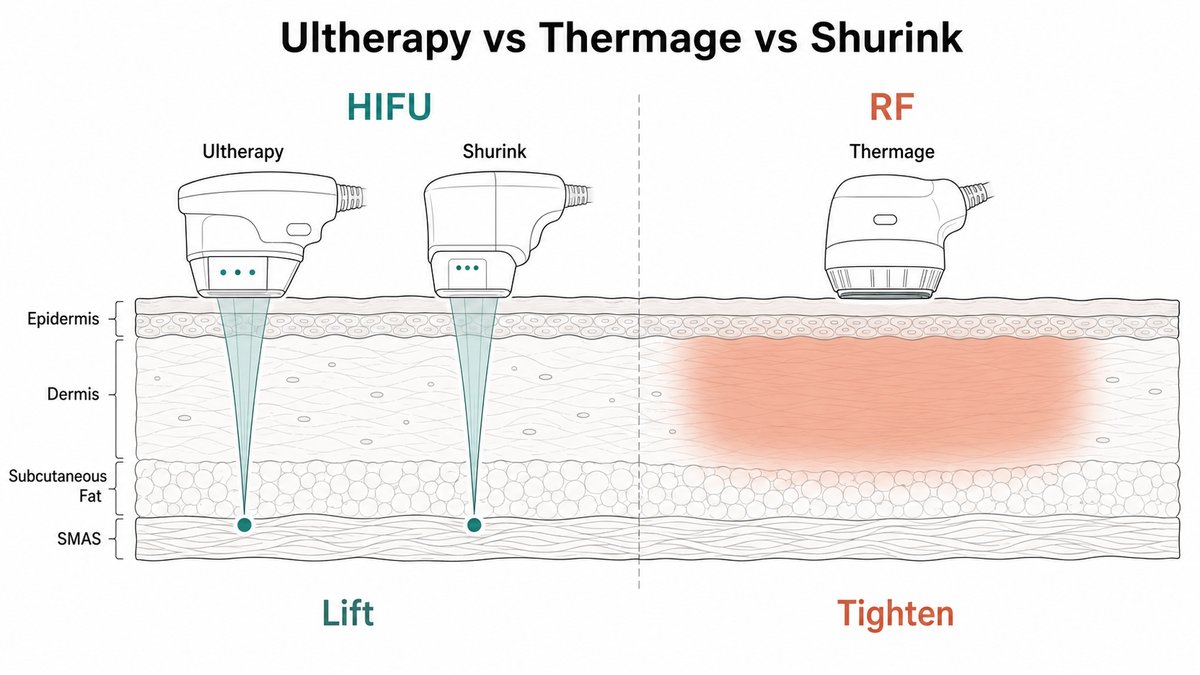
The short answer: Ultherapy and Shurink are both ultrasound (HIFU) devices that send focused heat deep to lift, while Thermage is a radiofrequency (RF) device that heats the dermis broadly to tighten and refine skin quality. Neither is universally better. They target different layers for different goals, and the right choice depends on whether your main issue is sagging that needs lifting or lax, crepey skin that needs tightening.
This guide sorts the confusion. You get a short primer on how heat actually tightens skin, a clear map of the two technologies and three devices, patient profiles matched to each, and an honest account of what these machines can and cannot do, including when your problem has outgrown a device and belongs to surgery.
The Real Split Is HIFU vs. RF, Not Brand vs. Brand
Most patients compare Ultherapy, Thermage, and Shurink as three rival brands. The useful split is by technology. Ultherapy and Shurink both use HIFU, high-intensity focused ultrasound, which concentrates energy into tiny focal points at set depths. Thermage uses RF, monopolar radiofrequency, which heats a broad volume of skin more evenly. Once you see the two camps, the decision stops being about logos and starts being about which layer your face actually needs treated.
Asking which brand is best is like asking whether a chisel is better than a sanding block. A chisel places force at precise points; a sander works a whole surface. HIFU is the chisel that reaches deep focal targets to lift, and RF is the sander that warms a broad field to firm and smooth. Your face tells you which tool it needs.
How Heat Tightens Skin
Both technologies exploit the same biology through different delivery. When collagen is heated to roughly 60 to 70 degrees Celsius, its triple-helix structure partly unwinds and the fibers contract immediately, which produces some visible tightening on the day of treatment. More importantly, that controlled thermal injury signals your fibroblasts to lay down fresh collagen and elastin over the following weeks and months. This second wave, neocollagenesis and neoelastogenesis, is where most of the lasting result comes from.
The difference is where the heat lands. HIFU deposits energy at discrete deep points, and studies show it drives the highest collagen and elastin response in the deep reticular dermis and can reach the superficial musculoaponeurotic system, or SMAS, the same fibrous layer a surgeon tightens in a facelift. RF instead raises the temperature of a broad block of dermis in a diffuse, volumetric way. Deep and focal versus broad and even: that single distinction explains almost every practical difference between these skin tightening treatments.

Three Devices, Two Technologies
The HIFU camp: Ultherapy and Shurink
HIFU devices focus ultrasound into thermal coagulation points, reaching down to the SMAS at about 4.5 mm, which is where the lifting happens, with shallower passes available for the dermis. Because that deep focal energy contracts and rebuilds the supportive layer, HIFU is the stronger lifting tool, favored along the jawline, under the chin, the brow, and the neck. Newer versions, such as Ultherapy PRIME and Shurink Universe, add more transducer depths and body applications.
Ultherapy is the original microfocused ultrasound platform and the one cleared by the FDA for lifting the brow, the chin and neck, and improving décolletage lines. Its distinguishing feature is visualization: an ultrasound image lets the practitioner see your tissue layers and place energy precisely, rather than treating blind.
Shurink (sometimes written Shrink in English) is a widely used Korean HIFU platform. It works on the same focused-ultrasound principle and targets the SMAS with a range of cartridges for different depths. In practice it is often chosen for being more comfortable and easier to book as a routine, repeatable session than Ultherapy, which is why it is so common across Korean clinics, while Ultherapy keeps the edge in real-time visualization and its specific lifting clearances.
The RF camp: Thermage
Thermage uses monopolar radiofrequency to bulk-heat the dermis to roughly 65 to 75 degrees, with cooling protecting the surface. Because the heat is diffuse rather than focal, Thermage excels at overall tightening and skin-quality improvement across broad areas: crepey texture, mild laxity, enlarged-looking pores, and a general firming and smoothing. It delivers a same-day contraction that then improves as new collagen forms, and it covers large zones like the whole cheek, forehead, or even the body comfortably in one pass pattern.

At a Glance
| Ultherapy (HIFU) | Shurink (HIFU) | Thermage (RF) | |
|---|---|---|---|
| Energy | Focused ultrasound | Focused ultrasound | Monopolar radiofrequency |
| Heat pattern | Deep, focal points | Deep, focal points | Broad, diffuse dermal |
| Main strength | Lifting (reaches SMAS) | Lifting, gentler and easily repeated | Tightening and skin quality |
| Best for | Jawline, chin, brow, neck lift | Prevention and routine maintenance lifting | Crepey, lax skin over larger areas |
| Feel | Can be intense at depth | Generally more comfortable | Warm with cooling, tolerable |
| Visualization | Yes, ultrasound imaging | No | No |
A histometric comparison of HIFU and RF confirms both remodel the deep skin, and a systematic review of focused ultrasound for sagging skin shows HIFU produces measurable, lasting improvement. The evidence points the same way: for skin tightening, neither technology wins outright. They do different jobs, and for many faces the strongest plan combines HIFU lifting with RF tightening.
Ultherapy vs. Shurink: Two HIFU Devices, Not the Same Experience
Because Ultherapy and Shurink share a mechanism, patients often assume they are interchangeable. They are close cousins, not twins. Ultherapy offers real-time ultrasound visualization, so energy is placed under image guidance, and it carries the specific FDA lifting clearances, which matters for consistency and for treating delicate zones precisely. Shurink, using cartridges rather than visualization, is typically quicker, more comfortable, and easier to repeat on a regular schedule, which makes it an excellent everyday lifting and prevention tool. If your priority is the most controlled, evidence-backed deep lift, Ultherapy has the edge. If your priority is a comfortable, easily repeated HIFU lift and you are treating straightforward laxity, Shurink is a very reasonable choice. Both are legitimate; they simply sit at different points on the precision-versus-accessibility line.
Which Treatment Is Right for You: Patient Profiles
These profiles cover the cases seen most often. Find the one closest to your skin and carry it into consultation as a working hypothesis.

1. Your jawline and jowls are starting to blur, and you want a lift
You see the early softening of a once-sharp jawline, a hint of jowl, and a neck that is losing its angle, but your skin is not yet heavily sagging. Your problem is descent of the deeper support, which is HIFU territory. Ultherapy or Shurink places focused energy down to the SMAS to contract and rebuild that layer, producing a subtle lift over the following months. Thermage would firm the surface but would not reach deep enough to lift the structure that is dropping.
2. Your skin looks crepey and lax rather than sagging
Your concern is quality more than descent: fine crepey texture, a slack, thin look across the cheeks or under the eyes, skin that feels loose to the touch without a heavy jowl. This is a tightening and resurfacing-of-quality problem, which favors Thermage. Its diffuse dermal heating firms and smooths broad areas and refines texture in a way focal HIFU points do not. If you also have early jowl descent, this is a classic case for combining a HIFU lift with RF tightening.
3. You are in your thirties and want prevention with minimal pain
You do not have real sagging yet, but you want to slow it and keep your skin firm, and you are wary of a painful, demanding treatment. Shurink is a sensible primary choice: a comfortable, low-barrier HIFU that stimulates collagen and maintains support as an every-year or two habit. Ultherapy is the upgrade when you want the most precise, visualization-guided lift, but for straightforward prevention Shurink is often the better fit.
4. You want the strongest single-session deep lift and value precision
Your laxity is moderate, you want a meaningful lift from one well-controlled session, and you would rather have image-guided precision and documented lifting clearances than the gentler, more repeatable option. Ultherapy is the match. Its visualization lets the practitioner deposit energy exactly at the SMAS depth for your anatomy, which is where a deep lift is won.
5. You have both descent and poor skin quality
You see a softening jawline and, at the same time, crepey, lax surface skin. Neither camp alone fully addresses both. The right plan is usually a combination: HIFU (Ultherapy or Shurink) to lift the deep layer, and Thermage to tighten and refine the surface, spaced sensibly rather than stacked in one day. Many of the best non-surgical results come from using the two technologies for the two different problems.
6. Your sagging is significant, with heavy jowls and loose neck skin
You have real, established sagging: clear jowls, a loose neck, deep folds, and skin that hangs rather than merely softens. This is the profile where a device is the wrong tool. No amount of HIFU or RF lifts skin that has genuinely descended and stretched; you would spend months waiting for a disappointing, subtle change. This belongs to surgery, and our guide to deep plane facelift versus traditional SMAS facelift explains the operations that actually address it. An honest clinic tells you this rather than selling you a series that cannot deliver.
What a Session Involves: Shots, Cartridges, and Numbing
A session is built from cartridges chosen by depth and a number of shots or lines placed across the treatment area. HIFU cartridges deliver energy at set depths, commonly 1.5 mm for the superficial dermis, 3.0 mm for the deep dermis, and 4.5 mm for the SMAS, with deeper cartridges available for the body. A facial treatment is commonly around 300 shots or lines, rising to roughly 500 to 600 for a wider or more intensive protocol, though the right number depends on your anatomy and goals. More shots is not automatically better. The energy has to be spaced so it does not stack, because overlapping points can drive swelling, nerve irritation, or fat loss rather than a better lift.
These treatments are done with you awake, using a numbing cream applied about half an hour beforehand and, for many patients, an oral pain reliever, with a nerve block sometimes added for sensitive zones. Deep sedation, sometimes called sleep sedation, is deliberately avoided, and not only because it carries its own anesthetic risk. Your pain response during treatment is a safety signal. A sharp or unusual pain can warn the provider that energy is landing too close to a nerve or too deep, so they can lower the intensity or move to another spot. Under sedation that feedback disappears, which raises the risk of nerve injury or a burn. Feeling a tolerable, brief heat is part of how the treatment stays safe.
Results, Pain, and How Many Sessions
The timeline is the same idea for all three: a modest immediate tightening from collagen contraction, then a gradual, more meaningful improvement as new collagen builds over roughly two to three months, often continuing to around six months. Results are not permanent, because your skin keeps aging; most patients maintain with a treatment every twelve to eighteen months.
Comfort differs. Ultherapy can feel intense when energy reaches the deeper focal points, though modern settings and technique have improved this. Shurink is generally gentler, one reason for its popularity. Thermage feels like brief heat pulses buffered by surface cooling and is usually well tolerated. Session counts vary: HIFU lifting is often a single annual session, while RF and prevention protocols may be repeated on a schedule your clinician sets.
Surgeon’s Insight: Match the Layer, Not the Logo
Patients spend enormous energy debating which brand is best, when the machine name is the least important variable. What matters is the layer your face needs treated and whether the device reaches it. Sagging is a deep problem, a descent of the SMAS and its support; crepey laxity is a surface problem, a thinning and slackening of the dermis. HIFU is built to reach the deep layer and lift, RF to warm the broad surface and tighten. Choosing well is a matter of diagnosis, not of picking the most advertised name.
The second truth is honesty about magnitude. These are refinement and maintenance tools for mild to moderate change, and they are wonderful at that. When someone with real sagging is sold a device as a facelift substitute, the disappointment is not the machine’s fault; it is a diagnosis that was avoided. Match the tool to the layer, and know when the layer has moved beyond what any tool can reach.
Safety, Side Effects, and Who Should Be Cautious
In trained hands, HIFU and RF skin tightening are low-risk, non-surgical treatments with little downtime. The common effects are temporary: some redness, mild swelling, and occasional tenderness, small bruises, or brief tingling for a few days. Most people return to normal activity the same day.
The risks that matter are almost all about technique and diagnosis rather than the machines themselves. HIFU energy placed too aggressively or at the wrong depth can reduce facial fat and leave a hollow, gaunt look instead of a lift, which is one reason an experienced provider and correct settings matter more than the brand. Less commonly, focused energy near a nerve can cause temporary numbness or a brief asymmetry of the smile that resolves over weeks. Thermage is generally well tolerated, with rare surface burns only if cooling or technique is off.
A few people should wait or skip these treatments. Anyone with an active skin infection, an open lesion, or a breakout in the treatment area should heal first. Those with permanent implants or recent fillers at the site, and anyone who scars or forms keloids easily, should raise it before booking. Most clinics also defer elective treatment during pregnancy. When in doubt, a careful consultation matters more than the device you choose.
What These Devices Cannot Do
Be clear about the ceiling. Energy-based skin tightening refines and lifts modestly; it does not remove excess skin or reposition heavily descended tissue the way surgery does. If your jowls hang, your neck skin is loose, or your folds are deep, a device will underdeliver, and the right conversation is about a lift, not another session. These treatments also will not erase deep static wrinkles, replace lost volume, meaningfully reduce a localized fat pocket the way microwave body contouring can, or substitute for the pigment and texture work that lasers and skin boosters provide. For skin quality driven by depletion rather than laxity, our guide to Rejuran, Juvelook, and Skinvive skin boosters covers a different set of tools. Used for the right problem, HIFU and RF are excellent; used as a facelift substitute, they disappoint.
Match the Device to the Layer, Not to the Brand
Ultherapy, Thermage, and Shurink are not rivals on one ladder. Ultherapy and Shurink are HIFU devices that send focused heat deep to lift, differing mainly in visualization, comfort, and how readily they are repeated. Thermage is an RF device that warms the dermis broadly to tighten and refine. The right choice follows a simple question: is your main problem descent that needs lifting, or lax, crepey skin that needs tightening, or both, which often calls for a combination.
If you recognized yourself in one of the profiles above, you now have a working hypothesis to bring to consultation rather than a brand name borrowed from an advertisement. And if your sagging has moved past what any device can lift, the honest answer is to consider surgery rather than a treatment that cannot reach the problem. Match the device to the layer that actually needs treating, and non-surgical tightening becomes what it should be: a precise, low-downtime way to firm, lift, and maintain.
Written by Dr. Yongwoo Lee, board-certified Korean plastic surgery specialist in facial anatomy and aesthetic procedures at VIP Plastic Surgery, South Korea.
Frequently Asked Questions About Ultherapy, Thermage, and Shurink
What is the difference between Ultherapy, Thermage, and Shurink?
Ultherapy and Shurink are both HIFU (focused ultrasound) devices that send heat deep, even to the SMAS, to lift, differing mainly in visualization, comfort, and how easily they are repeated. Thermage is a monopolar radiofrequency device that heats the dermis broadly to tighten skin and improve texture. In short, the two HIFU devices lift, and the RF device tightens and refines quality.
Is HIFU or RF better for skin tightening?
Neither is universally better, and studies show comparable results for sagging. They do different jobs: HIFU reaches deep focal points to lift, while RF warms a broad area to tighten and smooth. If your issue is early descent, HIFU fits; if it is crepey, lax surface skin, RF fits. Many faces do best with a combination of the two.
Ultherapy vs Shurink: which should I choose?
Both are HIFU, so both lift. Ultherapy adds real-time ultrasound visualization and specific FDA lifting clearances, giving the most precise, image-guided deep lift. Shurink is generally more comfortable and easier to repeat on a routine schedule, which makes it a great everyday lifting and prevention option. Choose Ultherapy for maximum precision, Shurink for comfort and easy maintenance on straightforward laxity.
When will I see results, and how long do they last?
Expect a small immediate tightening, then a gradual, more meaningful lift as new collagen forms over about two to three months, sometimes improving to six months. Results are not permanent because skin keeps aging, so most people maintain with a treatment every twelve to eighteen months. Judge your result at a few months, not on the day of treatment.
Do these treatments hurt, and is there downtime?
Ultherapy can feel intense at the deeper points, Shurink is generally gentler, and Thermage feels like warm pulses with surface cooling. Downtime is minimal for all three: usually some redness, mild swelling, and occasional tenderness or small bruising for a few days, with normal activity the same day. None require the recovery of surgery.
Can Ultherapy or Thermage replace a facelift?
No. These devices refine and lift modestly for mild to moderate laxity; they do not remove excess skin or reposition heavily sagging tissue. If you have real jowls, a loose neck, or deep folds, a device will underdeliver and surgery is the honest answer. Used for early or moderate change, they are excellent; used as a facelift substitute, they disappoint.
Is Ultherapy or Thermage better for a sagging jawline?
For an early sagging jawline, HIFU such as Ultherapy or Shurink usually fits better, because the jawline softens from descent of the deep support and HIFU reaches the SMAS to lift it. Thermage firms surface skin quality but does not lift that deep layer. If the jaw skin is also crepey, combining the two works well.
How many sessions will I need?
HIFU lifting is often a single session repeated about once a year to maintain, while RF and prevention plans may be spaced on a schedule your provider sets. You do not stack them on the same day. The right number depends on your degree of laxity, your age, and how your skin responds over the following months.
Can Ultherapy and Thermage be combined?
Yes, and for many faces it is the strongest plan. HIFU lifts the deep support while RF tightens and refines the surface, so each handles a different problem. They are usually spaced sensibly rather than performed together in one day. A combination suits people who have both early descent and crepey, lax surface skin.
Are there side effects, and can skin tightening reduce facial fat?
Most effects are minor and temporary: redness, mild swelling, and occasional tenderness or small bruises for a few days. The risk that matters most is technique-related. HIFU placed too aggressively or at the wrong depth can reduce facial fat and create hollowing, so an experienced provider and correct settings matter more than the brand you pick.
How many shots or lines are in an Ultherapy or Shurink session?
A facial session is commonly around 300 shots or lines, rising to roughly 500 to 600 for a wider or stronger protocol, delivered through cartridges at set depths, with the 4.5 mm reaching the SMAS for the lift. The exact count depends on your anatomy and goals, and more is not automatically better, because the energy must be spaced to stay safe.
This article is for informational purposes only and does not constitute medical advice. Always consult with a qualified medical professional before making any decisions about surgical or non-surgical procedures.