
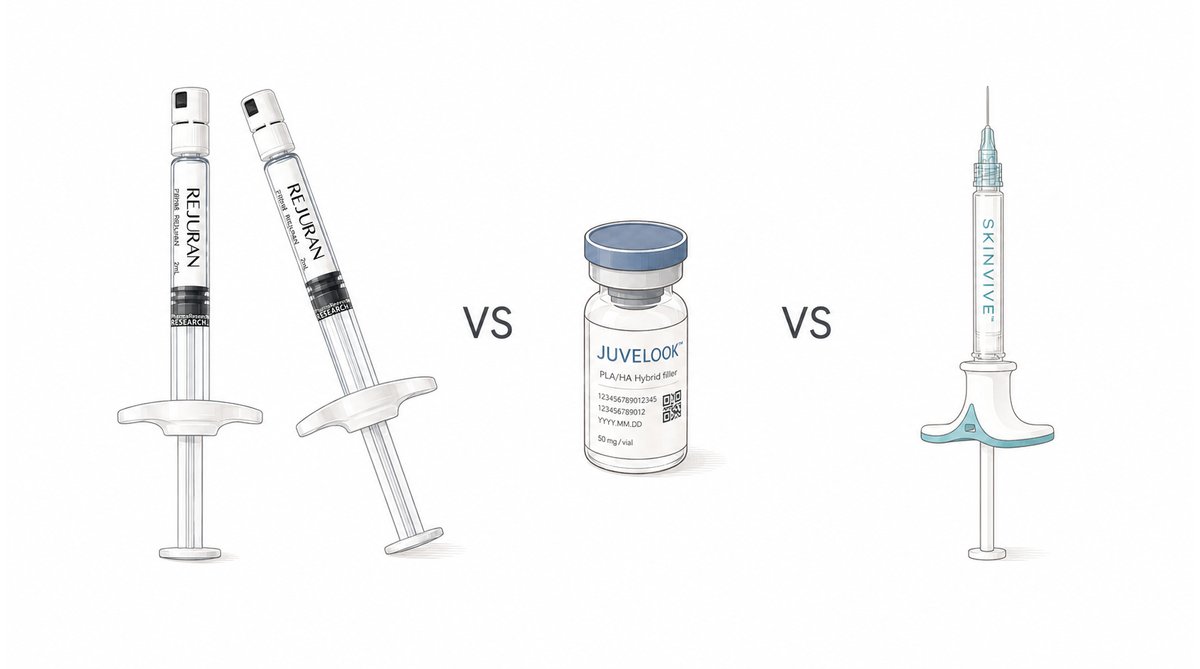
The Skin Booster Confusion Every Patient Brings to Consultation
A skin booster sounds like one product, and that single word is exactly where the trouble starts. You have read about Rejuran, Juvelook, and Skinvive as if they were three versions of the same idea, ranked on one ladder from basic to best, and you arrived wanting to know which one wins. They do not belong on a single ranking. They are three biologically different treatments that happen to share a marketing label, and choosing between them by popularity or by whichever name you have heard most often is how patients end up treated by the wrong mechanism.
A skin booster is an injectable treatment that improves skin quality from within, by hydrating, repairing, or stimulating collagen, rather than adding volume or reshaping contour the way a filler does. The three names you keep meeting, Rejuran, Juvelook, and Skinvive, each stand for a different one of those three jobs.
If you have searched for a skin booster, a Korean skin booster, or any brand-versus-brand comparison, you have met conflicting advice. One clinic pushed Rejuran. A friend swore by Skinvive. An influencer credited Juvelook for skin that “bounces back.” That disagreement is not noise. Each of them was probably right for the specific skin in front of them, and wrong as general advice for yours.
This guide treats the decision the way a consultation should. You get a short biology primer, a clear map of the three camps these products fall into, and eight common patient profiles matched to the right camp and product for each. By the end, you should recognize which case resembles yours and which family of skin booster fits your actual problem.
The Real Question You Should Be Asking
Most patients open with “which skin booster is best?” That question has no honest answer, because best depends entirely on what is wrong with your skin in the first place. Asking it is like asking whether a moisturizer is better than sunscreen. Both are good. They do different jobs.
A better question is diagnostic and personal. Two variables decide which product fits you.
Variable one: what your skin actually lacks. Dehydrated, dull skin lacks water-binding capacity in the upper dermis. Thinning, fragile, post-inflammatory skin lacks healthy fibroblast activity and repair signaling. Lax, deflated skin that has lost its spring lacks structural collagen. These are three separate deficits, and no single injectable corrects all three equally well.
Variable two: how fast you need to see it, and how long you want it to hold. A hydration booster shows a glow within weeks but fades in months. A collagen biostimulator shows almost nothing at first, then builds slowly and holds far longer. Your timeline and your patience belong in the decision.
Hold those two variables in mind. Every profile later in this guide is really an exercise in naming the deficit, then matching the camp.
A Quick Primer on What Lives in Your Skin
Three components decide how your skin looks, and each maps to one booster camp.
Water sits in the upper dermis, held largely by hyaluronic acid, a sugar molecule that binds many times its weight in moisture. When that capacity drops, skin reads as dull, tight, and crepey in the fine surface lines, even when collagen is still intact.
Fibroblasts are the worker cells of the dermis. They build collagen, build elastin, and respond to injury. Aging, sun damage, and inflammation leave fibroblasts sluggish and surrounded by a damaged matrix. Skin then heals poorly, thins, and holds onto redness and texture after acne.
Collagen is the scaffold. It gives skin its thickness, firmness, and bounce. Past your mid-thirties you lose it steadily, and that loss is what you feel when skin no longer springs back after you press it.
A skin booster works by topping up one of these three. Match the booster to the component you are short on, and the result looks effortless. Match it to the wrong one, and you spend months treating a deficit you never had.
Three Camps, Three Different Biologies
Skin boosters split cleanly into three families. Almost every product in a Korean clinic, including the full roster discussed below, falls into one of them.
Camp one: the regeneration camp (Rejuran family). Rejuran is built on polynucleotides and polydeoxyribonucleotide, repair molecules purified from salmon DNA. Rather than adding water or volume, polynucleotides quiet inflammation and wake up tired fibroblasts, which then rebuild the matrix themselves. Laboratory and clinical work shows polynucleotides driving fibroblast proliferation and collagen synthesis while protecting cells from oxidative and inflammatory damage, which is why this camp shines on damaged, thinning, and post-inflammatory skin. A comparative review of polynucleotides in dermatology and work on polydeoxyribonucleotide regulation of inflammation describe these repair and anti-inflammatory pathways in detail. The clinic roster here runs Rejuran 2cc for the face, Rejuran HB Plus 2cc which adds hyaluronic acid for hydration, and Rejuran I 1cc shaped for the delicate under-eye.
Camp two: the hydration and skin-quality camp (Skinvive, Filorga, Refilleo, Byryzn). These deliver hyaluronic acid, or an HA-dominant cocktail, into the skin to bind water, plump from within, and lift dullness. Skinvive by Juvederm is the prestige product here. The clinic files it under collagen internally, but its mechanism is HA-dominant, so treat it as the skin-quality flagship. Skinvive became the first FDA-approved hyaluronic acid microdroplet injectable for cheek skin smoothness, with trial patients reporting meaningfully better hydration and radiance at six months. A systematic review of injectable hyaluronic acid for facial skin quality reports consistent gains in hydration, elasticity, and radiance across studies. Filorga NCTF, a non-crosslinked HA mesotherapy solution carrying vitamins, amino acids, and coenzymes, Refilleo, and Byryzn round out this camp as classic quality-of-skin hydrators.
Camp three: the biostimulator camp (Juvelook, Ultracol). These do not hydrate and do not repair in the polynucleotide sense. They seed the deep dermis with polymer microspheres, poly-D,L-lactic acid in Juvelook and polycaprolactone in Ultracol, that act as a temporary scaffold and provoke your own fibroblasts into laying down fresh collagen over weeks to months. Reviews of PDLLA in dermatology and histology showing neocollagenesis after polycaprolactone injection document this gradual collagen response, and imaging of PDLLA-treated skin shows the collagen build on ultrasound over the weeks that follow. Juvelook face and neck 6cc and Juvelook Volume target laxity and lost bounce, while Ultracol 200 focuses on the neck and chest. Results arrive slowly and last the longest of the three camps.
Patient confusion between these three camps is the whole reason this article exists. Sort your problem into the right camp first, then the product choice gets easy.
Rejuran vs. Juvelook vs. Skinvive at a Glance
| Camp | Lead products | How it works | Best for | Visible results | Typical longevity | Sessions |
|---|---|---|---|---|---|---|
| Regeneration (PDRN) | Rejuran, Rejuran HB Plus, Rejuran I | Polynucleotides calm inflammation and reactivate fibroblasts to repair skin | Thin, damaged, post-acne, fragile under-eye skin | 2 to 12 weeks | 6 to 12 months | 2 to 3, about 4 weeks apart |
| Hydration and skin quality (HA) | Skinvive, Filorga, Refilleo, Byryzn | Hyaluronic acid binds water to hydrate, smooth, and brighten | Dry, dull, dehydrated skin and early surface lines | 1 to 2 weeks | A few months, Skinvive about 6 months | 1 to 3, 2 to 4 weeks apart |
| Biostimulator (PDLLA and PCL) | Juvelook, Juvelook Volume, Ultracol | Polymer microspheres trigger your own gradual collagen | Laxity, lost bounce, structural thinning, neck | 2 to 3 months | A year or more | 1 to 3, 4 to 6 weeks apart |

Which Skin Booster Is Right for You: Eight Patient Profiles
These profiles cover the cases seen most often in a Korean skin booster consultation. Find the one closest to your skin, then carry it in as a working hypothesis.
1. Your skin is dehydrated and dull in your thirties, with no real texture damage
Your concern is glow, not repair. Skin feels tight, looks flat in photos, and shows fine surface crepiness, yet the underlying texture and firmness are fine. Your deficit is water, which places you squarely in the hydration camp. A Filorga or Refilleo course is a sensible primary choice, delivering HA and skin-quality nutrients across a few sessions. If you want a longer-lasting and more polished result, Skinvive is the upgrade, since its microdroplet HA holds hydration and smoothness for months from a single careful treatment. Regeneration and biostimulator products would be overkill here, because you have nothing damaged to repair and no real laxity to rebuild.
2. Your under-eye is thin and shadowed with fine wrinkles, but not hollow
You see crepey, fragile skin under the eye and a tired shadow, yet the area is not truly sunken. This is a regeneration problem, not a volume problem. Rejuran I, formulated for the under-eye, is the primary choice, because polynucleotides thicken and strengthen fragile skin over a short series rather than filling it. Resist the instinct to fill. Under-eye HA filler or a tear trough filler corrects a hollow, and placing filler into thin skin that is not actually hollow risks puffiness and a bluish Tyndall shadow. If you are unsure whether your problem is thin skin or a true hollow, our guide to lower blepharoplasty versus tear trough fillers walks through that distinction in detail. When the under-eye problem is mainly thin, depleted skin rather than a hollow, an ECM booster is another route; our RE2O skin booster guide explains how it reinforces dermal matrix directly.
3. Your skin is recovering from active acne, with redness and uneven texture
Breakouts have calmed, but they left behind lingering redness, rough patches, and an uneven surface. Your fibroblasts and barrier are inflamed and underperforming, which is exactly what the regeneration camp addresses. Rejuran is a strong fit, since polynucleotides damp inflammation and push repair, and the anti-inflammatory action of this molecule family is well documented. If your skin also feels dehydrated alongside the texture, Rejuran HB Plus folds hyaluronic acid into the same treatment, covering repair and hydration together. Hydration-only or biostimulator products miss the point here, because your primary problem is inflamed, poorly healing skin rather than dryness or laxity.

4. You are in your mid-forties and your skin no longer bounces back
Press your cheek and it settles slowly. The complaint is lost spring and early laxity, not dryness, which points to the biostimulator camp. Juvelook for the face is the primary choice, seeding PDLLA that recruits your own collagen over the following weeks and months for a firmer, thicker dermis. Set expectations honestly: you will see little for the first few weeks, then a gradual build. Because that build is slow, Skinvive can serve as a quick visible bridge, restoring glow and smoothness while the collagen quietly develops underneath. Pairing a fast hydrator with a slow builder is a common and sensible combination here.
5. Your pores look enlarged and your skin looks thin
Visible pores often look worse on thin, lax skin, because the surrounding support has weakened and the openings gape. Skinvive is a reasonable primary, since improving HA content and skin quality can tighten the look of the surface and refine how pores read. Juvelook is the natural secondary, building dermal collagen so the skin around each pore regains support over time. A staged sequence works well: start with the quality and hydration layer, then build structure underneath. No single injection erases pores, and any clinic promising that is overselling. Realistic improvement means smaller-looking pores on firmer, better-hydrated skin, not poreless skin.
6. You have lost cheek or temple volume but resist deep filler
You can see flattening in the cheek or a hollow at the temple, yet you do not want the look or commitment of a deep hyaluronic acid filler. Juvelook Volume fits this middle ground, offering mild volume alongside genuine collagen stimulation, so correction comes partly from your own tissue rather than purely from injected gel. Understand the trade-off. Traditional HA volume filler gives immediate, controllable, and reversible projection, while Juvelook Volume gives a softer, slower, more diffuse improvement that you cannot dissolve later. For significant volume loss, a dedicated filler is still the more predictable tool, and a candid consultation will tell you which side of that line you fall on. For a cautionary look at how HA filler can behave when overfilled or misplaced, our guide to lip filler migration and duck lips is worth reading first.
7. Your neck shows fine wrinkles and early skin laxity
The neck ages on its own schedule, and crepey horizontal lines with mild looseness respond to the biostimulator camp. Ultracol 200, a polycaprolactone biostimulator developed with the neck and chest in mind, is a primary option, with Juvelook for the neck as an alternative, both working to thicken and firm thin neck skin through new collagen. Be clear about the ceiling. A booster improves skin quality and fine crepiness, but it will not correct moderate platysmal banding, the vertical cords that need muscle-targeted treatment or surgery. If your main concern is those cords or significant sagging, a booster is the wrong tool, and an honest assessment will say so.
8. You have both dehydration and early laxity at once
Many patients sit across two camps, dry and dull on the surface while also losing a little firmness underneath. You have two reasonable paths. Rejuran HB Plus offers a single-product approach, pairing polynucleotide repair with hyaluronic acid hydration in one treatment, which suits patients who want simplicity. The alternative is a staged regimen: start with an HA hydrator to restore glow quickly, then add a biostimulator such as Juvelook to build structure over the following months. Either path is defensible. The choice usually comes down to your tolerance for multiple visits, how quickly you want to see a change, and which deficit bothers you more right now.
Surgeon’s Insight: The Principle of Matched Mechanism
A skin booster has no personality, only a mechanism. After years of consultations, the pattern is consistent: patients who felt let down by a booster were almost never given a bad product. They were given a good product aimed at the wrong deficit, a hydrator for laxity or a biostimulator for simple dryness. The injectable performed exactly as designed, on a problem it was never built to solve.
What this means for you is that the brand on the syringe matters far less than the diagnosis behind it. Before you weigh Rejuran, Juvelook, and Skinvive on reputation or on how often you have heard the name, ask what your skin actually lacks, whether water, repair, or structural collagen. Name that deficit honestly, and the right camp chooses itself. Skip that step, and even the most advanced booster becomes an elaborate way to treat the wrong thing.
Combining and Sequencing Boosters Safely
Patients rarely have just one deficit, so combinations are common and reasonable. The art is in spacing and order. A sensible default is to correct hydration first, because a glow appears quickly and tells you how your skin tolerates injection, then layer regeneration or biostimulation underneath over subsequent visits. Stacking two different mechanisms in a single session is usually avoided, since it muddies your ability to judge what helped and raises the short-term reaction in the skin.
Boosters also coordinate with other treatments. Botox for dynamic lines, hyaluronic acid filler for true volume loss, and lasers for pigment or surface resurfacing all solve problems a booster cannot, and many faces benefit from a plan that uses several tools at different depths. Timing matters: most clinics space injectable sessions a few weeks apart and separate energy-based treatments from fresh injections so the skin settles between steps. Your sequence should be designed once, as a plan, rather than improvised one product at a time.

What a Skin Booster Cannot Do
Managing expectations is half of a good result, so be clear about the limits. A booster improves the quality of skin. It does not lift tissue that has genuinely descended, and noticeable jowling or heavy sagging belongs to threads, energy devices, or surgery rather than to any injectable in these three camps. A booster does not replace volume either. Deep cheek hollows, a flat temple, or a sunken tear trough need a volumizing filler placed for projection, not a thin hydration or repair product spread through the dermis.
Dynamic wrinkles are another boundary. Lines that appear only when you frown or smile come from muscle movement, and botulinum toxin relaxes that movement in a way no booster can. Finally, a booster cannot undo ongoing damage. Without daily sunscreen and reasonable skin habits, you are repairing a wall while leaving the tap running. Knowing these four limits (lift, volume, dynamic lines, and lifestyle) keeps you from choosing a treatment to solve a problem it was never built for.
Side Effects and Who Should Wait
Skin boosters are low-drama compared with surgery, but they are still injections, and honesty about side effects belongs in every consultation. Expect transient swelling, redness, and small injection bumps, most of which settle within days. Bruising is common, particularly around the under-eye and on thin skin. Hydration and microdroplet products can leave temporary small papules that flatten over a week or two. With HA placed too superficially, a faint bluish Tyndall tint can appear, which is why technique and depth matter.
Less common but real are persistent nodules, which the biostimulator camp can produce if product clumps or is placed incorrectly, and rare allergic or inflammatory reactions. Some people should postpone entirely. Skip a booster during active skin infection or an acne flare in the treatment zone, during an active cold sore outbreak, in pregnancy or breastfeeding, and during a significant autoimmune flare. If you scar or pigment easily, say so, because it changes both product choice and aftercare. None of this should frighten you away from a suitable treatment, but all of it deserves a frank conversation before a needle comes out.
Recovery, Schedule, and When Results Appear
Each camp runs on its own clock, and matching your patience to that clock prevents disappointment. Hydration products such as Filorga and Refilleo typically run as a short course, often around three sessions spaced two to four weeks apart, with a glow building over that window. Skinvive can deliver its hydration and smoothness from a single well-placed treatment, with patient-reported improvement holding through about six months in its trial data.
The regeneration camp asks for a series too. Rejuran is usually given over two to three sessions roughly four weeks apart, with skin quality and resilience improving across two to twelve weeks and results commonly holding six to twelve months before a maintenance visit. The biostimulator camp is the slowest and the longest-lasting, with Juvelook and Ultracol typically spaced four to six weeks apart over one to three sessions and collagen building over two to three months or more. Downtime across all three is modest, usually a day or two of redness and possible bruising rather than true recovery. Plan any treatment at least a week or two ahead of an important event, never the day before.

Match the Booster to the Source, Not to the Symptom
The headline comparison that brought you here, Rejuran versus Juvelook versus Skinvive, dissolves once you see the three of them clearly. They are not rivals on one ladder. They are tools from three different boxes, each correct for a specific deficit and wasteful for the rest. Rejuran repairs damaged and thinning skin. The hydration camp, led by Skinvive, restores water, glow, and smoothness. Juvelook and the biostimulator camp rebuild structural collagen for skin that has lost its bounce.
If one of the eight profiles above sounded like your own reflection, you now hold a working hypothesis to bring to consultation rather than a brand name borrowed from a friend. If you saw yourself in several profiles or in none, an in-person assessment will settle it, with a clinician evaluating your hydration, your skin thickness and repair, your laxity, and your goals together. For broader context on choosing procedures by anatomy rather than trend, our guide to sub-brow lift versus upper blepharoplasty applies the same source-first logic to eyelid surgery. The principle does not change with the treatment: match the booster to the biological source of the problem, not to the symptom you noticed or the trend you read about.
Written by Dr. Yongwoo Lee, board-certified Korean plastic surgery specialist in facial anatomy and aesthetic procedures at VIP Plastic Surgery, South Korea.
Frequently Asked Questions About Rejuran, Juvelook, and Skinvive
Are skin boosters the same as fillers?
No. A filler is placed deeper to add volume and reshape contour, and it works the moment it goes in. A skin booster spreads through the dermis to improve skin quality, whether by hydrating, repairing, or stimulating collagen, and most show their effect gradually. Skinvive blurs the line a little as an HA microdroplet product, but its goal is smoothness and hydration, not projection.
How long do Rejuran, Juvelook, and Skinvive results last?
It depends on the camp. Hydration products such as Filorga generally hold a few months and suit a regular maintenance rhythm. Rejuran and the regeneration camp commonly last around six to twelve months. Biostimulators like Juvelook and Ultracol last the longest, often a year or more, because they build your own collagen rather than depositing a temporary material. Longer-lasting also means slower to appear.
Rejuran vs Juvelook: which one is better?
Neither is universally better, because they fix different problems. Rejuran repairs thin, damaged, or post-acne skin through polynucleotides, while Juvelook rebuilds lost firmness by stimulating your own collagen. If your skin is fragile or inflamed, lean Rejuran. If it has lost bounce, lean Juvelook. Many patients stage both, treating one per visit a few weeks apart, since most skin has more than one deficit.
When will I actually see results?
Hydration products give a glow within one to two weeks. Rejuran and the regeneration camp build over roughly two to twelve weeks across a short series. Biostimulators are the most patient-testing, with collagen developing over two to three months or longer before the firming is obvious. If you need to look your best for an event, plan well ahead, because no booster delivers its full effect overnight.
Are skin boosters safe during pregnancy or breastfeeding?
Standard practice is to wait. These treatments have not been studied for safety in pregnancy or breastfeeding, so clinicians routinely postpone them until afterward rather than accept unknown risk for an elective cosmetic benefit. If you are pregnant, trying to conceive, or nursing, let your clinic know, and use that window for sun protection and a good topical routine instead, then revisit injectables later.
Can a skin booster replace surgery?
No. A booster improves the quality of skin, but it cannot lift tissue that has truly descended or remove significant excess. Sagging jowls, heavy hooding, and marked laxity need threads, energy devices, or surgery. A booster can refine and delay, and it pairs well with other treatments, but expecting it to do a facelift’s job leads to disappointment. A candid consultation will tell you which category fits.
This article is for informational purposes only and does not constitute medical advice. Always consult with a qualified medical professional before making any decisions about surgical or non-surgical procedures.