
The Decision Almost No One Discusses Before a Brow Lift
The most consequential choice in a forehead lift is not the incision or the recovery. It is how the lifted forehead will be held in place while it heals, and most patients never hear it discussed at all. That single technical decision determines how natural the result feels under your own fingertips, whether a foreign object will sit beneath your scalp for months, and how comfortable your first few days will be.
When patients come in to talk about an endoscopic forehead lift or a brow lift in Korea, the conversation almost always circles the same three things: where the cuts go, how long recovery takes, and whether the result will look done. Those matter. But the dissection that raises the brow is nearly identical no matter who performs it. What separates a forehead that feels like a forehead a year later from one that does not is the fixation, the method used to anchor the lifted tissue. Three modern approaches exist, and they are not interchangeable.
The three are Endotine, a bioabsorbable polymer device that grips the scalp; the cortical bone tunnel, a suture threaded through holes drilled into the skull; and deep-tissue suture fixation, a suture anchored to your own scalp tissue that never touches bone. All three can produce a beautiful lift on the operating table. The differences show up afterward, in what you feel and in what has been permanently changed about your anatomy.
The Real Question Is Not the Lift. It Is What Holds It.
The right question to bring to a brow lift consultation is not “which technique lifts best,” because on the day of surgery all three lift about the same. What matters is what will still be holding your forehead up in a year, and what that anchor will have cost you in feel, comfort, and permanent change to your skull. A lift is only as good as its fixation, because the moment the dissection is finished the tissue wants to fall back to where it came from.
Think of the operation in two halves. The first half, the release, frees the forehead so it can move. Fixation, the second half, decides where it settles and whether it stays. Marketing language spends all its energy on the first half, on scars you cannot see and downtime measured in days. The second half is where the real trade-offs live, and it is the half that follows you home. A device you can feel through your skin, a headache from a drill, a small permanent hole in your cranium: these are all fixation decisions, not lift decisions.
This distinction matters even more because the lift itself keeps working over time. A systematic review and meta-analysis in the Aesthetic Surgery Journal found that brow height not only holds after subperiosteal endoscopic surgery but continues to rise between year one and year five, by roughly 2.2 mm medially, 2.5 mm centrally, and 1.9 mm laterally. The initial elevation in that pooled data averaged 3.25 mm at the inner brow, 3.86 mm centrally, and 4.35 mm at the tail. Those gains only endure if the fixation held long enough for the body to build its own attachment. Pick the wrong anchor and you spend that window fighting a device instead of healing around it.
What an Endoscopic Forehead Lift Actually Does
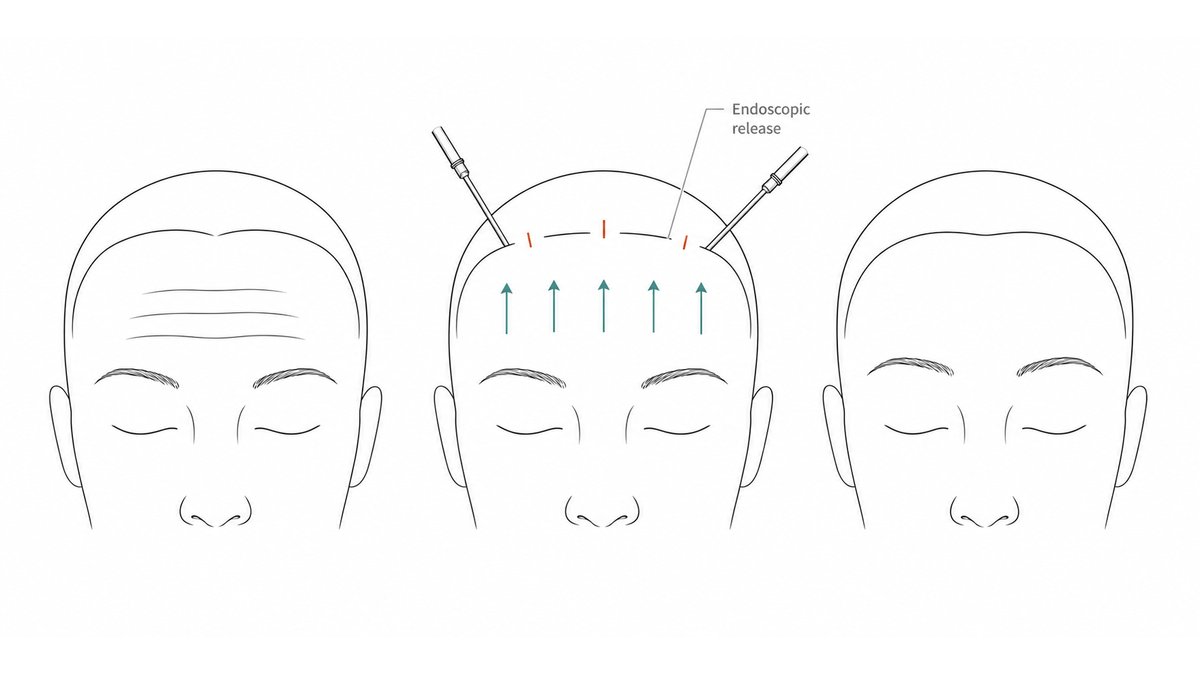
An endoscopic forehead lift raises a low, heavy brow, a condition called brow ptosis, through a few short incisions hidden in the hair, using a camera to work under the skin rather than opening the scalp from ear to ear. The surgeon releases the forehead in the subperiosteal plane, the layer directly on the bone, so the whole brow unit can slide upward into a higher, more rested position. Frown muscles can be weakened in the same pass. Then the lifted tissue has to be fixed in place, and that is where the three methods diverge.

Releasing the brow is only part of the goal. Many patients who want a brow lift also want their vertical frown lines softened, and those lines come from repeated pulling of the corrugator and procerus muscles between the brows. Working through the same endoscopic ports, the surgeon can weaken or partially resect those depressor muscles. A study associating corrugator and procerus myectomy with browlift outcomes supports treating the muscles at the same time, and the literature on corrugator disinsertion for frown lines shows the glabella can be addressed without a separate operation. Disinsertion, rather than aggressive resection, tends to preserve the small sensory nerves that thread through this region.
Up to this point the operation is the same in every skilled surgeon’s hands. The endoscope, the plane, the muscle work: none of that is where results diverge years later. What comes next is the fork in the road. By now the forehead has been freed and lifted, gravity is pulling it back down, and the tissue needs to be secured for the weeks it takes the body to form its own hold. How that is done is the entire subject of the rest of this article.
Three Ways to Hold a Lifted Forehead
There are three modern ways to fix a lifted forehead in place: a bioabsorbable device that grips the scalp, a suture run through tunnels drilled in the skull, and a suture anchored to your own deep scalp tissue with no bone involved. Each solves the same problem, and each pays for the solution differently. What follows is what each brow lift fixation method is, and what it costs.
Method 1: Endotine, the bioabsorbable device
Endotine is a small polymer device with a post seated in a shallow hole drilled into the skull and five tines that catch the lifted scalp and hold it forward. It goes in fast, in under two minutes per side, which is its genuine advantage. In the original device study in the Aesthetic Surgery Journal, it produced secure fixation and high satisfaction. The problem is the same bulk that makes it grip.
Palpability is the dominant complaint. In the device evaluation reporting the Endotine 3.5, it was often palpable with moderate sensitivity, and in patient and surgeon experience data it remained palpable up to 24 weeks after surgery, which is why a faster-absorbing second-generation polymer was later developed. Even improved, the device is a foreign object under thin scalp: it can be felt, is visible in a minority of patients, and carries documented risks of local inflammation, extrusion through thin skin, and a weaker lateral hold. The original Endotine was recalled by the FDA in 2003 over drill-bit depth concerns, after which the bone post was shortened from 4.25 mm to 3.75 mm. Endotine is not a bad device. It simply solves fixation by placing something in the scalp, and everything that follows is the price of that choice.
Method 2: The cortical bone tunnel
The cortical bone tunnel takes the opposite approach and uses no device at all. The surgeon drills two small angled holes into the outer table of the skull so they meet beneath a bridge of bone, then threads a permanent suture through that tunnel and ties the lifted forehead down to it. Malata and Abood, in the International Journal of Surgery, describe it as simple and reproducible, and it removes the foreign-body problem entirely. Its cost moves to the skull.
Drilling the cranium is not a trivial act. A study on the safety of cranial fixation measured calvarial thickness from just 1.1 mm to 13.6 mm, and found the bone thinnest precisely 1 cm in front of the coronal suture, exactly where this fixation is placed. Drilling has to stay within 3 to 4 mm; go past the inner table and you risk a cerebrospinal fluid leak. The percussive vibration of the drill also causes real early discomfort, with patients reporting immediate headache, dizziness, and nausea. Malata and Abood documented persistent nerve sensitivity at the fixation point that required suture removal six weeks after surgery in some patients, and the technique leaves a small permanent defect in the skull visible on later imaging. It is legitimate and time-tested, but it asks a lot of the cranium.
Method 3: Deep-tissue suture fixation
Deep-tissue suture fixation holds the forehead using only your own tissue, with no device and no drilling of the skull. The suture is anchored into a band of firm, undisturbed scalp tissue behind the incision, and the bone is never touched. This is the approach a 2025 scoping review in Aesthetic Plastic Surgery points toward when it defines the ideal fixation as one that combines durability, a clean patient experience, and minimal complications. It is also the method I use by default, and the next section is how I actually do it.
At a Glance
| Criterion | Endotine | Bone Tunnel | Deep-Tissue Suture |
|---|---|---|---|
| Foreign material in scalp | Polymer device with bone post | None | None |
| Skull drilling | Yes, shallow post hole | Yes, two angled holes | No |
| Risk of CSF leak | Theoretical, drove 2003 FDA recall | Documented, low but real | None |
| Drilling headache or nausea | Minimal | Common, sometimes marked | None |
| Palpability | Frequently palpable for months | Possible at the knot | Minimal to none |
| Extrusion risk in thin skin | Documented | Essentially none | Essentially none |
| Long-term durability | Good while present | Excellent | Excellent |
| Permanent bony defect | Small post hole | Two holes and a bone bridge | None |
| Works for thick foreheads | Limited | Yes | Yes |
| Surgical time | Fastest | Slowest | Moderate |
| Skill required | Moderate | High | High |
| Implant required | Yes | No | No |

How I Anchor a Forehead Without Drilling the Skull
I hold the lifted forehead with a loop of heavy braided polyester passed through a slip of the patient’s own deep scalp tissue several centimeters behind the incision, and I do not drill the skull or leave a device in the scalp to do it. The whole technique is built to give the durability of a suture anchor without either of the two things patients feel later: a lump under the skin, or a headache from a drill.
Here is the sequence. I make the main incision at the edge of the lifted forehead the same way every method requires, then add a second, smaller puncture several centimeters posterior, in scalp that is still firmly attached and was never dissected. First I pass a specialized instrument through that posterior puncture, slide it beneath the galea, and bring it out through the main incision carrying no suture yet. At the incision I load a heavy braided polyester onto the instrument, then draw it back toward the puncture, and on this return pass it deliberately bites through the galea, the strong fibrous layer of the scalp that actually holds a suture, before coming out at the incision again. Now I remove the instrument and leave the suture behind, engaged through the galea and the firm tissue beneath it. Tying it at the incision catches that galea and lifts the forehead into its fixed position. That braid stays as a low-profile buried anchor while the body grows its own biological attachment around it. Scalp above it feels like scalp, because nothing hard is sitting in it.
Why this over the alternatives. I want three things from a fixation, and I am not willing to trade any of them. It has to hold long enough for the tissue to reattach on its own, which braided polyester through firm tissue does. It has to leave nothing the patient can feel, which rules out a device seated in thin scalp. And it has to leave the skull untouched, because I see no reason to accept the drilling category of problems, the CSF-leak risk, the vibration headache, the permanent hole, when tissue anchoring gives me equal hold without them. A 9-year experience study of a related suture-anchor fixation reported no significant palpability, which matches what I see: at one year, patients touch their forehead and feel nothing unusual.
What I do not do is reach for Endotine because it is faster. Two minutes per side saved on the table is not worth months of a patient feeling the device, and the honest literature on whether current fixation methods are safe is clear that every method carries its own signature complication. I would rather spend the extra operative minutes and hand the patient a recovery with nothing to notice. Deep-tissue suture demands more skill and more time than dropping in a device, and that is precisely the point: the difficulty is moved from the patient to the surgeon, which is where it belongs.
Which One Are You
The right fixation depends less on your taste than on your scalp, your tolerance for a foreign object, and whether you would ever want to feel a device or a drilled hole. Here are the patterns I see most often, and where each one usually lands.

1. Your skin is thin and you are worried you will feel something
Thin scalp is the clearest case for deep-tissue suture, because a device seated under thin skin is the situation most likely to be palpable or, rarely, to work its way toward the surface. With nothing hard placed in the scalp, there is nothing to feel and nothing to extrude. This is the profile where the difference between methods is most obvious to the patient.
2. Your forehead is thick and heavy
Heavy, thick foreheads are exactly where the Endotine tends to struggle, because a bulky device has to hold a heavy load and its grip is finite. Deep-tissue suture and the bone tunnel both handle weight well. Between those two, I prefer tissue anchoring because it carries the load without asking anything of the cranium.
3. The idea of drilling your skull unsettles you
If the thought of holes in your cranium bothers you, that instinct is reasonable, and deep-tissue suture removes the question entirely. There is no drilling, so there is no CSF-leak risk, no drill headache, and no permanent bony defect on future imaging. Nothing about the skull changes.
4. You want the shortest possible operation
When operative time is the single priority, usually because a brow lift is one small part of a much longer combined surgery, Endotine’s two-minutes-per-side speed is a real argument. It is the one situation where I understand choosing it, provided the patient accepts the palpability trade-off with eyes open.
5. You are having a revision after a lift relaxed
Revision cases usually need the most secure hold available, because tissue that has already relaxed once has less to offer. Here I favor a robust tissue anchor or, when the anatomy demands it, a bone tunnel. The choice is driven by what firm tissue remains to grip, which is a decision made during the operation, not before it.
6. You are combining the brow lift with eyelid or facelift surgery
A brow lift is very often done alongside upper eyelid surgery or a facelift, and the fixation choice does not change because of it. What changes is the planning: the brow has to be set first, because lifting it alters how much upper-lid skin is truly redundant. Fix the forehead, then judge the eyelids against their new position.
Recovery, and Why Drilling Changes the First Few Days
Brow lift recovery runs on a similar timeline no matter how the forehead is held, with swelling settling within seven to ten days and many patients back to work around two weeks, but the fixation method changes the first few days more than anything else does. The dissection is similar across all three, so the early experience is mostly a story about what was done to hold the lift.
Patients whose forehead was fixed without drilling tend to describe an easier start. There is no percussive vibration through the skull, so the immediate headache, dizziness, and occasional nausea that follow bone drilling do not occur. Expect some numbness behind the incisions and a tight, slightly heavy feeling across the forehead for the first week or two, which is normal and fades as the tissue settles. Skin sutures or staples in the hairline come out on schedule, and the small incisions hide in hair-bearing scalp.
Longer term, the goal is that you forget the operation happened. The lift itself tends to hold and even improve over the first several years, as the meta-analysis data show, provided the fixation carried the tissue through the healing window. With a buried suture anchor there is no device to dissolve on its own timeline and no hardware to migrate, so once the early swelling is gone the forehead simply behaves like a forehead. That is the entire aim: a result that belongs to your own anatomy, not to something left inside it.
Surgeon’s Insight: The Best Fixation Is the One You Never Notice
When I see a patient a year after a forehead lift, my test is simple. I want them to feel nothing unusual when they run a hand across their forehead. I want them to have no memory of a headache from a drill against their skull. I want the result to belong entirely to their own tissue, with nothing left behind that they have to carry. Deep-tissue suture fixation is harder and slower for me than dropping in a device or drilling a tunnel, and I choose it precisely for that reason: the difficulty stays with me, and the patient is asked for less.
Safety, Risks, and What to Watch For
Every forehead lift carries real risks, and the fixation method shifts which ones you take on rather than removing them. Understanding that trade is the point of the whole comparison. All three techniques have established safety records in experienced hands, and none is free.
With Endotine, the risks cluster around the device: palpability for months, visibility in a minority, local inflammation, and extrusion through thin skin. With the bone tunnel, they cluster around the drilling: the documented, low-but-real chance of a CSF leak if the inner table is breached, drill-related headache and nausea, occasional bone-bridge fracture or bleeding from within the bone, and persistent nerve sensitivity at the knot that has, in reported cases, required suture removal. With deep-tissue suture, the residual risks are the ones common to any brow lift, temporary numbness, asymmetry, or under-correction, without the device-specific or drilling-specific categories layered on top.
Beyond the method, the variables that govern safety are the ones that govern every facial operation: an accurate diagnosis of what your brow actually needs, respect for the sensory nerves crossing the forehead, and a surgeon who has done enough of these to make the fixation decision on anatomy rather than habit. A technique is only as safe as the hands and judgment applied to it. If a surgeon offers only one fixation method for every patient, that is worth a question, because the right anchor depends on your scalp, not on the tray that happens to be open.
Ask What Will Hold Your Forehead, Not Just Who Will Lift It
The lift is the easy half. Any competent surgeon can raise a brow through an endoscope, and on the day of surgery all three fixation methods will show you a beautiful result in the mirror. What separates them is everything that comes after: whether you feel a device under your scalp, whether you carry a headache home from a drill, and whether a permanent hole was made in your skull to hold tissue that your own body could have held instead.
So the question to ask in consultation is not simply who will lift your forehead. It is what will be holding it up a year from now, and what that anchor will have cost you. A forehead held by your own tissue, secured with a technique that asks more of the surgeon so it can ask less of you, is the answer I keep coming back to. Nothing to dissolve, nothing to drill, nothing to notice.
Written by Dr. Yongwoo Lee, board-certified Korean plastic surgery specialist in facial anatomy and aesthetic procedures at VIP Plastic Surgery, South Korea.
Frequently Asked Questions About Forehead Lift Fixation
Will I feel anything under my scalp after suture fixation?
For the large majority of patients, no. The only material left behind is a buried braided suture and its knot, seated deep beneath thick scalp tissue rather than in the skin, so there is nothing hard sitting near the surface to feel. Most patients report normal sensation within a few weeks as the early numbness behind the incisions fades.
What is the safest fixation method for an endoscopic forehead lift?
All three have established safety profiles in experienced hands, but deep-tissue suture fixation carries the cleanest profile because it uses no device and no drilling. That removes the risks tied to a foreign object, such as extrusion, and the risks tied to the skull, such as CSF leak and drill-related headache. What remains are the ordinary risks common to any brow lift.
Will drilling my skull cause headaches or nausea?
This is a specific concern with cortical bone tunnel fixation, not with the other methods. The percussive vibration of the drill against the cranium often produces an immediate headache, dizziness, or nausea in the first hours after surgery. When the skull is never drilled, as with deep-tissue suture fixation, this category of symptoms does not arise.
Are the results of suture fixation permanent?
Yes. The suture holds the lifted forehead in place while your body forms its own biological attachment in the tissue, and that healed attachment is what maintains the lift long-term, supported by the permanently buried braid. Pooled data even show brow height continuing to improve between the first and fifth years after subperiosteal surgery.
How long does an endoscopic forehead lift last?
A well-fixed endoscopic forehead lift is durable and long-lasting. In systematic-review data, brow elevation not only held but rose further between year one and year five, provided the fixation carried the tissue through the initial healing window. Natural aging continues afterward, but the operation does not simply relapse.
Does the Endotine device dissolve completely?
Eventually, yes, but not on the schedule most patients expect. Early devices were still palpable up to 24 weeks after surgery, which is why faster-absorbing polymers were developed. Even the improved versions remain a foreign object under the scalp for a meaningful stretch of the recovery, which is the core trade-off of choosing a device.
Can a brow lift fix my frown lines too?
Often, yes. The vertical lines between the brows come from the corrugator and procerus muscles, and those can be weakened or partially resected through the same endoscopic incisions used for the lift. Disinsertion is generally preferred over aggressive resection because it lowers the chance of injuring the small sensory nerves woven through the glabella.
Is deep-tissue suture fixation suitable for thick, heavy foreheads?
Yes, and it is often the better choice for them. Bulky devices tend to struggle against a heavy tissue load, whereas a suture anchored through firm, undisturbed deep tissue carries weight well and does so without drilling the skull. Thick and thin foreheads are both well served by tissue anchoring.
What is the recovery time for a forehead lift?
Most swelling resolves within seven to ten days, and many patients return to work around two weeks. Expect some numbness behind the incisions and a tight, heavy feeling for the first week or two. Patients whose fixation did not involve bone drilling generally describe an easier first few days.
Will the incisions be visible in my hairline?
The incisions are small and placed in hair-bearing scalp, so they are hidden by hair once healed. Endoscopic technique is specifically designed to avoid the long, ear-to-ear scar of older open forehead lifts. Fixation method does not change where these incisions sit.
Can fixation be combined with eyelid surgery or a facelift?
Yes, and it commonly is. A brow lift is frequently performed alongside upper blepharoplasty or a facelift, and the fixation choice is unchanged by the combination. The sequencing matters, though: the brow is set first, because raising it changes how much upper-eyelid skin is genuinely redundant.
What happens if the lift relaxes over time?
A properly fixed lift settles into its healed position rather than relapsing, and natural aging continues gradually from there. If a revision is ever needed, it is planned around what firm tissue remains to anchor, which usually favors a robust tissue anchor or, when anatomy requires it, a bone tunnel. That decision is made during surgery.
Is a bone tunnel more durable than a suture anchor?
Both offer excellent long-term durability, so durability is rarely the deciding factor between them. The real difference is cost to the patient: the bone tunnel achieves its hold by drilling the skull, with the attendant risks and discomfort, while a deep-tissue suture achieves comparable hold using your own tissue. When the durability is equal, the method that leaves the cranium untouched is the more sensible one.
How do I choose a surgeon for an endoscopic forehead lift?
Look for a board-certified plastic surgeon who performs endoscopic brow lifting regularly and offers more than one fixation method, so the anchor is chosen for your anatomy rather than habit. A surgeon experienced in adjacent procedures, such as sub-brow lifting and deep plane facelift, tends to bring the broader anatomical judgment that refined brow work depends on.
This article is for informational purposes only and does not constitute medical advice. Always consult with a qualified medical professional before making any decisions about surgical or non-surgical procedures.