
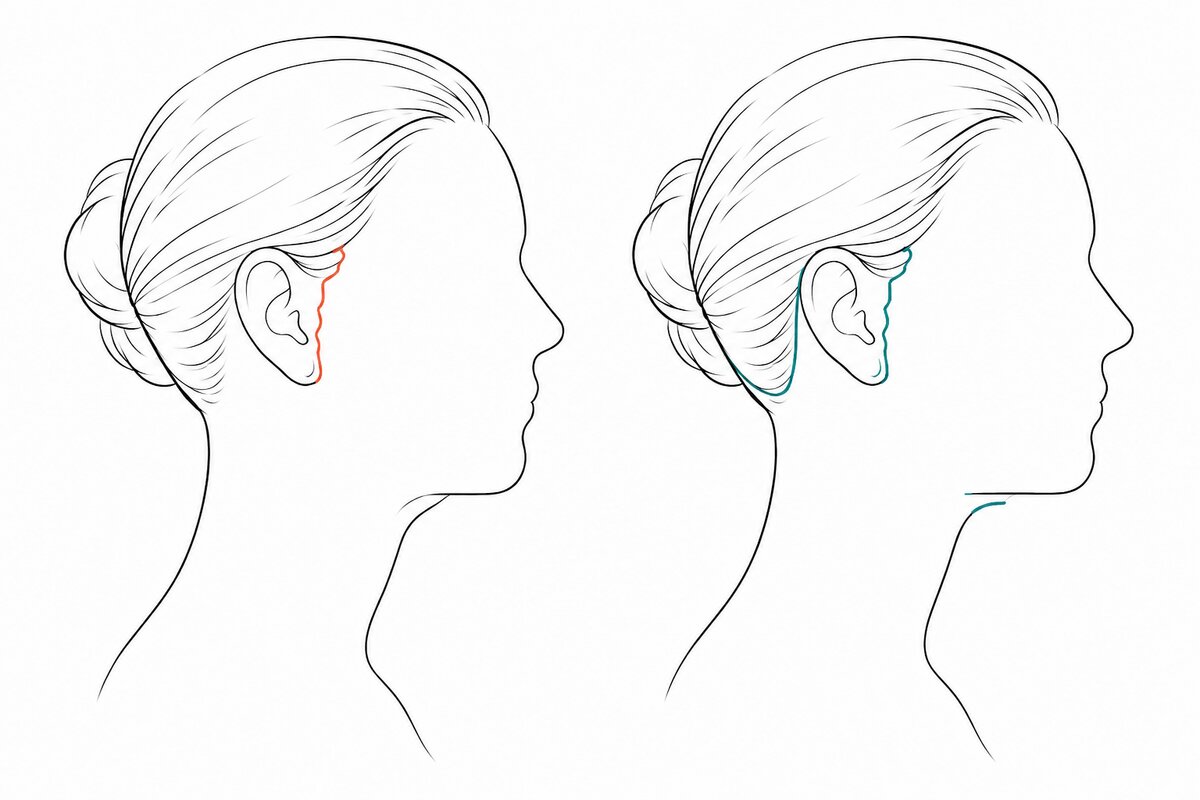
What Is a Mini Facelift? A Facelift With Parts Left Out
A mini facelift is a facelift performed through a short incision in front of the ear only, with no incision behind the ear, no direct repair of the neck, and in most versions no release of the retaining ligaments that hold the sagging tissue in place. A full facelift continues that incision behind the ear into the hairline, treats the lower face and neck as one unit, and lifts the deep layer instead of gathering it. Patients are shown the two as sizes of the same operation, and that is the mistake this article exists to correct. Mini does not describe a gentler version of the same procedure. It describes a list of things the operation will not do. What remains is a shorter scar in front of the ear, five to six centimeters of skin lifted off the cheek, and a suture or a fold placed in the deep layer to tighten it without freeing it.
The short answer: a mini facelift is a real surgical procedure with real results, and for a narrow group of patients it is the correct choice. For everyone else it is a full facelift with the parts their face most needed removed from the plan, and the parts that were left out are exactly where the result comes undone. In the closest thing to a controlled comparison anyone has run, identical twins given a short-scar lift or a full lift were indistinguishable at one year and clearly different in the neck at five. No study has measured how long a mini facelift lasts on its own; a full SMAS facelift averages about 12 years before a secondary lift.
This guide goes through what a mini facelift actually consists of, which structures it leaves untouched, and why the neck comes back first. It then covers what the published data say about longevity and revision, how the decision is made in practice, and who is a real candidate for the smaller operation.
What Does a Mini Facelift Actually Leave Out?
A mini facelift, by the definition used in the surgical literature, is a facelift performed through an incision in front of the ear with no horizontal extension behind the ear into the hairline. That single sentence, from a 2024 systematic review of 4,451 limited-incision facelift patients, is the whole definition. Everything else that is marketed under the name, the S-lift, the MACS lift, the short-scar lift, the weekend lift, the ponytail lift, is a variation inside that boundary. The name promises a smaller scar. What it quietly delivers is a smaller operation.
Three things disappear when the incision stops at the ear. The first is the neck. Without the incision behind the ear there is no access to the skin of the neck, and without a separate incision under the chin there is no access to the platysma muscle. Loose neck skin and vertical bands are left where they were. The second is the posterior vector. A full facelift redrapes the skin of the lower face and neck upward and backward toward the mastoid. A mini facelift can only pull toward the ear and temple, which is why skin excess along the jaw and under the ear has nowhere to go. The third, and the one that decides how long the result lasts, is the release. That layer is the SMAS, the superficial musculoaponeurotic system, the fibrous sheet that wraps the muscles of expression and connects them to the skin; this article calls it the deep layer throughout. In the same review, surgeons handled the deep layer by folding it over on itself, called plication, in 33 percent of cases and by cinching it with a purse-string suture in 28 percent. Neither one separates the tissue from the ligaments that anchor it to the bone. Deep plane dissection was not reported as a category of its own; the remaining cases were pooled as combined or other techniques.
The MACS lift, the most fully documented mini facelift in the literature, shows the pattern in detail. In the technique paper by the surgeons who designed it, the skin is undermined about 5 to 6 centimeters in front of the ear. The deep layer is gathered with purse-string sutures but explicitly not undermined, and the sutures are anchored to the deep temporal fascia above the cheekbone. Its neck work consists of two or three suture bites in the upper edge of the platysma rather than any direct repair. It runs 2 to 2.5 hours under local anesthesia with sedation. That is an elegant operation for the right face. It is also an operation whose own authors reported that in 23 of 450 consecutive cases, 5.1 percent, the neck result was unsatisfactory and additional surgery was needed. What that surgery usually required was the very posterior or submental incision the mini lift was designed to avoid.

Does a Mini Facelift Tighten the Neck? Why the Neck Comes Back First
A mini facelift does not tighten the neck, and the neck relapses first after one because it was never operated on and because neck tissue stretches faster than cheek tissue even when it is. In a biomechanical study of cadaver tissue, skin flaps showed far more stress relaxation and creep, the slow lengthening of tissue under sustained load, than deep-layer flaps, and neck tissue crept more than facial tissue. The authors offered that finding as the explanation for something every facelift surgeon sees: the neck relaxes sooner than the face. An operation that leaves the neck untouched and relies on skin tension for what lift it does deliver has picked the weakest material and the fastest-relaxing region and asked them to hold.
The clearest evidence comes from a study of identical twins and triplets: four sets of identical twins and one set of identical triplets, aged 56 to 73, all operated between January and August 2006. In each set the firstborn received a full-incision facelift and the siblings a short-scar lift. Eight board-certified plastic surgeons, blinded to which was which, scored the jawline, neck and nasolabial folds. Photographs were taken at about one year and again at about five. At one year there was no difference. At five years the full-incision siblings scored significantly higher, and the difference was in the neck. Genetics, age, sun exposure and habits were as close to identical as any facelift comparison will ever get; the only variable was what the operation included.
That result is not an outlier. An independent systematic review of the MACS lift, 18 years after its introduction, pooled six studies and 739 patients. It concluded that the effect on the neck is limited and that additional procedures are warranted to address the aged neck. Patients rarely notice this at the consultation, because the neck is not what they came in pointing at. They came in pointing at the jowl. The jowl is the lower end of a cheek that has slid, and the neck is where that slide ends. An operation that stops at the ear treats the middle of the problem and leaves both ends.
How Long Does a Mini Facelift Last? What the Studies Actually Measured
A mini facelift lasts less time than a full facelift, and the literature brackets the gap rather than dating it: the identical twins looked the same at one year and clearly different in the neck at five, and no study has followed a short-scar lift on its own long enough to give a number. For facelifts in general, the standard surgical reference puts the interval before a repeat rhytidectomy at 5 to 10 years for a well-performed operation and notes that minor revision procedures are commonly required within the first one to two years. A mini facelift comes back for revision sooner than that because its result was built from the two things that give way soonest, skin tension and an unreleased deep layer, while the neck it left alone keeps aging on its own schedule. Nothing fails on a date. The relapse simply starts from a smaller base and has fewer structures holding it back.
The part of the mechanism the neck section did not cover is the ligaments. Two of them, the zygomatic and the mandibular retaining ligaments, anchor the cheek and the jowl to bone, and the surgeon who first described them wrote that their tethering effect must be interrupted if maximum upward movement of the facial skin is desired. A purse-string or a plication tightens the deep layer against those anchors instead of freeing it from them, so whatever was left tethered becomes the new fold line and the new limit on the result. Add skin that creeps and a neck that was excluded, and there are three sources of relapse, all built into the plan before the first incision.
The published numbers put brackets around the timing rather than a date on it. A full SMAS facelift, in a review of 42 patients who came back for a second one, lasted a mean of 11.9 years before the secondary operation. The authors concluded that a well-performed SMAS lift lasts about 12 years on average. Even there, 9 of the 42, about 21 percent, needed the second operation within five years, mostly because of sun-damaged skin or medical factors. A limited-incision lift is starting from a smaller base. The 2024 review of limited-incision procedures found a reported revision rate of 1.0 percent, and that number deserves to be read carefully. It is what surgeons reported within their own follow-up windows, in a body of literature in which 85 percent of the studies were graded level 4 evidence and the rest level 3. Only about a third of those studies reported any patient outcome at all. It is not a five-year revision rate. Nobody has published one for the mini facelift. A meta-analysis of relapse after facelift reviewed 433 papers and found that only 19 reported relapse at all, with rates from 0.2 to 50 percent depending on who was measuring. The honest summary is that mini facelift longevity is mostly unmeasured, and what has been measured points the same direction as the twins.

Mini Facelift vs. Full Facelift vs. Deep Plane Facelift at a Glance
A mini facelift, a full SMAS facelift and a deep plane facelift differ in what they reach, not in how hard the surgeon pulls: a mini lift tightens the deep layer without freeing it, a full SMAS lift raises and tightens that layer while leaving the ligaments intact, and a deep plane lift divides the ligaments and moves the layer as a composite unit. Below is the comparison patients usually have to assemble from three different clinic pages.
| Decision point | Mini facelift | Full SMAS facelift | Deep plane facelift |
|---|---|---|---|
| Incision | In front of the ear, into the temple; nothing behind the ear | In front of the ear, around the lobe, behind the ear into the hairline | Same as full; often with a submental incision for the neck |
| Deep layer | Plicated or purse-string tightened, not undermined | Lifted as a flap and tightened, ligaments mostly left intact | Dissected beneath and moved as a composite unit with the skin |
| Retaining ligaments | Not released | Left intact | Released |
| Neck and platysma | Not addressed, or a few suture bites | Lateral platysma tightened; midline repair if a submental incision is added | Lateral and midline platysma addressed as one unit with the face |
| Skin undermining | About 5 to 6 cm in front of the ear | Extensive over the cheek and neck | Limited, because skin travels with the deep layer |
| What carries the lift | Suture tension on the deep layer plus skin tension | The tightened deep layer, with skin under moderate tension | The released deep layer; skin closes without tension |
| Anesthesia | Local alone in about 42 percent of cases, local with sedation in a further 42 percent | Deep sedation or general | Deep sedation or general |
| Operating time | About 2 to 2.5 hours | Longer | Longest |
| Sutures out | Around day 7 | Around day 7 | Around day 7 |
| Recovery | Shorter: no neck dissection, shorter anesthesia; not counted in days in the literature | Presentable at about 2 weeks; socially comfortable at 4 to 6 | Presentable at about 2 weeks; socially comfortable at 4 to 6 |
| Reported longevity | Mostly unmeasured; neck separates from full lift by year five | About 12 years on average to a secondary lift | Years; no series has measured mini against deep plane directly |
| Best fit | Early jowling, midface holding, clean neck | Jowling with some neck laxity | Midface descent, deep folds, heavy jowls, real neck laxity |
The row that matters most is the one about ligaments. A face that is tethered stays tethered under a mini facelift, and the operation can only tension tissue against that tether. This site covers the difference in detail in deep plane versus SMAS facelifts; the short version is that what an operation releases matters more than what it is called, and mini releases the least of the three.
How I Decide Between a Mini Facelift and a Full Facelift
The choice between a mini facelift and a full facelift is decided by the neck, and that is not a personal rule but the consensus of the literature. The standard surgical reference describes the short-scar lift as suited to patients with more limited facial aging, without severe jowling or sagging of the neck, and states plainly that short-scar techniques cannot produce significant recontouring of the neck. The surgeons who designed the MACS lift reached the same conclusion from their own 450 cases, and the twin study measured it. So the examination starts under the jaw: pinchable excess skin, a blunted angle between chin and neck, or vertical bands on clenching mean the incision has to go behind the ear and the platysma has to be addressed, and no amount of work in front of the ear will change that. The four bedside checks are the ones this site describes in neck liposuction versus a neck lift; the lower face and the neck are planned as one unit because they age as one.
In my practice a mini facelift is a deep plane facelift performed through a shorter incision, not a different operation. The incision stays in front of the ear and into the temple, and the limb behind the ear is omitted or kept short when the neck does not need it. Inside that access I enter the plane beneath the SMAS and dissect as far as the anatomy allows, releasing the zygomatic and mandibular ligaments the same way I would through a full incision, then move skin and deep layer together as one composite unit. I use the deep plane technique in most of my facelifts, and what the shorter incision changes is how far I can reach, not how I treat what I reach. A partially released face is a compromised face: whatever ligament is left intact becomes the new tether and the new limit on how far the tissue can move. That is why I do not gather the deep layer with a purse-string or fold it with a plication through a short incision. Those methods tighten the layer against ligaments nobody divided, and that is the operation whose result the twin study measured at year five.
This matters more on an Asian face than on any other. Asian tissue, both the skin and the deep layer, is markedly less elastic, and it does not stretch and redrape the way a Caucasian face does. A lift that depends on skin tension in a face where the skin will not give has nothing to pull on, so release has to be more complete, not less. Two things follow. A skin-tension mini lift on this anatomy is more likely to look pulled than lifted, and it is more likely to relapse, because the tissue that would not stretch on the table will not stretch afterward either.
Everything else stays the same regardless of the size of the operation. I place a hemostatic net at the end of every facelift without exception, passing 4-0 nylon through the lifted flap to the floor of the dissection at closely spaced points so no pocket is left for blood to gather. It stays in for three to four days. Closed-suction drains are placed in every case, two per side, both brought out near the mastoid behind the ear and directed into different territories, one down across the neck and one up over the cheek. Systolic pressure is kept under 140 during surgery and tranexamic acid runs intravenously from the day of surgery through the third or fourth day. None of that is optional in a smaller operation, because the raw surface is smaller but the vessel that bleeds does not know that. This site describes the whole protocol in preventing facelift hematoma with a hemostatic net.
And when a patient asks me for the mini version of a face that needs the full one, I state the trade in full and I make sure the patient can say it back to me before anyone agrees to anything. The refusal I hold firm on is narrower: I do not operate on a patient whose stated target cannot be produced by the operation they are asking for. That is not caution. A technically clean mini facelift delivered to a face with a lax neck and a descended midface is a result the literature has already described. The revision it leads to is harder, slower, and less predictable than the primary operation would have been, for reasons this site lays out in why some facelifts look windblown.
Who Is a Real Candidate for a Mini Facelift?
A real mini facelift candidate has early jowling along the jawline, a midface that is still holding its position, skin that recoils when pinched, and a neck with nothing to fix. That combination exists, and when it does, being a reasonable candidate for the smaller operation is good news rather than a compromise, the same way it is for a patient whose jawline needs a SMAS lift and not a deep plane one. The profiles below are the ones that arrive most often, and the examination sorts them faster than the calendar does.
1. Early jowl softening, midface holding, neck clean
Yes. This is the face the mini facelift was designed for: a jaw that has lost its line, cheeks that have not dropped, a nasolabial fold that is present but not deep, and a neck with none of the findings in the next answer. A shorter incision with real work beneath the deep layer gives this patient most of what a full lift would, with a scar that stops at the ear. Ask whether the deep layer will be released or merely gathered, and expect a specific answer.
2. Jowls plus any neck laxity
No, or not as a mini facelift. Pinchable skin under the jaw, a blunted angle between the chin and the neck, or bands that appear on clenching mean the neck is part of the problem, and the mini incision cannot reach it. This patient will look improved at one year and, by the fifth, will show in the neck exactly what the twins showed. The right conversation is about the neck first and the incision second.
3. Midface descent and deep nasolabial folds
No. The nasolabial fold is not made of skin; it is made of the tissue behind the skin, and a fold that is backed by a descended cheek fat pad does not move unless that tissue is released and repositioned. A mini lift tensions the cheek against ligaments it never divides, so the fold softens with the swelling and returns with it. This face needs the release, which means it needs the operation that includes one.
4. The patient in her forties who wants “just a little”
Examination decides, not age. The typical short-scar candidate in the surgical reference literature is described as 40 to 50 years old with limited facial aging, which is the profile that fits. National data show that only about 18 percent of facelift patients are between 40 and 54 and only 2 percent are under 40; 59 percent are 55 to 69. Patients in their forties with early jowling and an intact neck can be excellent mini facelift candidates, and patients in their forties with a lax neck are full facelift candidates who happen to be young. In the limited-incision literature the mean patient age was 56, which means the mini lift is not in practice being reserved for the young face it is marketed to. What actually changes in each decade, layer by layer, is set out in what ages in the face at 40, 50, 60 and 70.
5. Prior thread lifts
Proceed with caution, and expect the smaller operation to be harder than advertised. Faces that have been through two or more thread lifts arrive with fibrosis and fused tissue planes that make any dissection slower and redraping less predictable. The question is no longer whether a mini lift is enough; it is whether the tissue will still move at all. This site covers what threads leave behind in thread lifts versus facelifts.
6. Men
Possible, with two changes. The incision in a man sits in front of the tragus rather than behind it, so that bearded skin is not carried into the ear. Hematoma precautions are tightened, because male patients carry about 3.9 times the hematoma risk of women in one of the largest facelift outcome databases published. A short-scar lift in a man with an early jowl and a clean neck is reasonable. A short-scar lift in a man because it is quicker is not.

Mini Facelift Recovery vs. Full Facelift Recovery: How Long Is Downtime?
Recovery after a mini facelift is shorter than after a full facelift, and the literature explains why more precisely than it counts the days. Three things are documented. Operating time is significantly shorter: a meta-analysis of 286 patients comparing the MACS lift with a deep SMAS lift found a large, consistent difference in surgical duration with comparable early outcomes. Anesthesia is lighter, with 42 percent of limited-incision procedures done under local alone. And there is no neck dissection, which is where most of the swelling, tightness on turning the head, and days of collar-wearing after a full facelift come from. What the literature does not do is put a number of days on the difference, so any clinic that promises a specific downtime is quoting its own experience. Sutures come out around day 7 in both operations, swelling and bruising peak in the first week in both, and a full facelift runs about two weeks to being presentable in private and four to six weeks to social comfort.
Two things do not shorten. Numbness over the cheek and in front of the ear resolves over months in both operations, and a scar takes a year to finish in both. Redness peaks between one and three months, fades through the sixth month, and by twelve months most patients cannot easily find their own incision line. This site follows that timeline month by month in facelift scars and how the incision heals. A shorter scar is a shorter line on the same schedule, not a faster one.
Judging the result follows the same rule as any facelift: not at one month, when swelling is doing the talking, and not at three months, when the tissue has not finished settling. Six months is the earliest honest look, and a year is better. For a mini facelift there is a later checkpoint that most clinics never mention: the fifth year, which is when the twin study found the neck that was left out of the operation showing it.
Surgeon’s Insight
When a patient asks me for a mini facelift, the first thing I examine is the part of the face the mini facelift does not touch. If the neck is clean and the midface is holding, I tell the patient the small operation is enough and I mean it; that is the best news a facelift consultation can deliver. If the neck is loose or the cheek has slid, I say that the small operation will look right for a year and that the neck it did not touch will show the difference well before the fifth. I also say that the second operation it leads to will be harder than the first would have been. What I will not do is shorten the release to match the scar: through a short incision I still go beneath the SMAS and free what I can reach. A shorter incision is a design choice; an unreleased ligament is a result the patient will be living with, and only one of those is mine to give away.
Mini Facelift Risks: What “Gone Wrong” Actually Looks Like
A mini facelift is a lower-risk operation than a full facelift, and the honest version of that sentence includes both halves. Pooled across 20 studies and 4,451 patients, limited-incision facelifts carried an overall complication rate of 3.2 percent, a hematoma rate of 2.0 percent, and a return to the operating room for hematoma of 0.14 percent, with no permanent nerve injury reported. Across all facelift types in a database of 11,300 patients, the major complication rate was 1.8 percent and the hematoma rate 1.1 percent. Men carried nearly four times the hematoma risk, and combined procedures more than doubled the rate. Smaller dissection, less bleeding surface, shorter anesthesia: the safety advantage is real. So is the evidence problem behind the mini numbers, which come from studies graded mostly level 4, with complications defined by the operating surgeon.
One figure needs care. Limited-incision series report skin necrosis, the loss of a patch of skin near the incision because its blood supply failed, at 0.06 percent, lower than any full-facelift figure. What raises that risk is not the length of the incision but the plane: necrosis runs at about 3.6 percent of subcutaneous facelifts and under 1 percent of deep plane facelifts, because a skin-only or skin-heavy lift raises a thinner flap and closes it under more tension. A mini facelift that is also a skin-heavy lift inherits the 3.6 percent, not the reassuring 0.06 percent. Active smokers are about twelve times more likely to lose a patch of skin than nonsmokers, which is why complete nicotine cessation for four to six weeks before any facelift is a prerequisite rather than a preference. A shorter incision does not by itself lower that risk for a smoker; what matters is how far the skin is undermined and whether it stays attached to the deep layer, a distinction covered in can a smoker have a facelift.
What a mini facelift gone wrong looks like is rarely a complication. It is a result. The pulled look along the cheek, sometimes called the lateral sweep, comes from a lift that carried the face on skin tension in a sideways direction. In the literature the technique most associated with it is the skin-only lift, and this site explains the mechanism and the correction in why some facelifts look windblown. A pixie ear, the earlobe dragged forward and down, comes from skin closed under load at the lobe. When a jawline returns while the cheek stays tight, or a visible step appears in front of the tragus, the signature is a deep layer tightened against anchors that were never freed. None of these is a surgical error in the usual sense. They are what the plan predicted.
One piece of history belongs here because it still ranks for the search term. The most heavily marketed mini facelift brand in the United States, Lifestyle Lift, settled with the New York Attorney General in 2009 after employees posed as satisfied patients online. Six years later the company filed for bankruptcy. Its technique was not the whole problem. Offering one size of operation to every face was.
The Question to Ask Is Not “Mini or Full.” It Is “What Is Holding My Face Down?”
Choosing between a mini facelift and a full facelift by size is choosing an answer before the question has been asked. The question is what has descended, what is tethering it, and whether the neck has joined the problem. A face with early jowling, a holding midface and a clean neck can be answered by a shorter operation, and a surgeon who examines and says so is giving good news. A face with a lax neck or a descended cheek cannot, and a surgeon who offers the mini version anyway is offering a result with a date on it.
Ask what the operation will release, not how long the scar will be. Ask what the deep layer will be anchored to, and whether the neck will be touched. Ask what the surgeon expects the fifth year to look like, because a surgeon who has thought about the fifth year has thought about your face rather than a category. A shorter scar is easy to promise. A neck that still looks right at five years is the thing to ask for.
Written by Dr. Yongwoo Lee, board-certified Korean plastic surgery specialist in facial anatomy and aesthetic procedures at VIP Plastic Surgery, South Korea.
Frequently Asked Questions About Mini Facelifts and Full Facelifts
What is the difference between a mini facelift and a full facelift?
The incision and the reach. A mini facelift stops at the ear and cannot reach the neck; a full facelift continues behind the ear into the hairline and treats the lower face and neck as one unit. Inside that access most mini lifts gather the deep layer with sutures rather than releasing it, so the visible difference is the scar and the lasting difference is what was freed and whether the neck was included.
How long does a mini facelift last?
No study has measured mini facelift longevity directly, and the figures quoted for it vary by an order of magnitude with no study behind any of them. The best comparison available, identical twins and triplets given a short-scar lift or a full lift within each set, found no difference at one year and a clear difference in the neck at five years favoring the full incision. A full SMAS facelift lasts about 12 years on average before a secondary lift. A mini facelift result should be expected to separate from a full facelift result somewhere between the first and fifth year, most often in the neck.
Why do mini facelifts need a revision sooner than full facelifts?
Because the result was built on skin tension and an unreleased deep layer, and the neck was left out. Skin lengthens under sustained load, ligaments that were never divided become the new fold line, and neck tissue relaxes faster than cheek tissue. The published brackets are one year, when short-scar and full lifts looked the same in the twin study, and five, when they did not. For facelifts in general, minor revisions are commonly needed within the first one to two years, and a well-performed full lift is expected to hold for 5 to 10 years or more.
Is a mini facelift worth it?
For the right face, yes. Early jowling with a midface still in position and a neck with nothing to fix gets most of a facelift result with a shorter scar, a lighter anesthetic and a shorter operation. For a face with neck laxity or a descended cheek, a mini facelift improves the jowl for a while and leaves the neck and the cheek to keep aging, and the revision that follows is more difficult than the full operation would have been.
Can a mini facelift be done under local anesthesia?
Yes. In the limited-incision literature about 42 percent of procedures were performed under local anesthesia alone and a further 42 percent under local with sedation, and the MACS lift was designed for local anesthesia with sedation. The shorter dissection and the absence of neck work make this possible. It is a genuine advantage for patients who want to avoid general anesthesia, provided the face is a mini candidate in the first place.
What is a MACS lift, and is it the same as a mini facelift?
A MACS lift, minimal access cranial suspension, is the best-documented type of mini facelift: a short incision in front of the ear, permanent purse-string sutures that gather the deep layer and anchor it high on the temple, and no undermining of that layer. Its designers reported that 5.1 percent of 450 patients needed a second neck operation, and an independent systematic review concluded its effect on the neck is limited.
What is an S-lift or a short-scar facelift?
Both are older or broader names for the same category: a facelift performed through an S-shaped or short incision in front of the ear, with limited skin undermining and suture tightening of the deep layer, and no incision behind the ear. Weekend lift, lunchtime lift and ponytail lift are marketing names for procedures inside the same boundary rather than distinct techniques.
What is the difference between a mini facelift and a deep plane facelift?
A mini facelift tightens the deep layer against the retaining ligaments. A deep plane facelift dissects beneath the deep layer, divides those ligaments, and moves skin, fat and deep tissue together as one composite unit with no tension on the skin. A mini lift can only redistribute what is already mobile. A deep plane lift makes tissue mobile first, which is why it reaches the midface and the nasolabial fold and why its results are measured in years rather than debated.
What is the best age for a mini facelift?
There is no best age, only a best examination. The surgical reference literature describes the typical short-scar candidate as 40 to 50 years old with limited facial aging, yet the mean age in the limited-incision studies was 56, and national data put only 18 percent of all facelift patients between 40 and 54. A lax neck at 45 needs a full facelift; an early jowl with a clean neck at 60 may not.
Does a mini facelift leave scars?
Yes. The incision runs in front of the ear and usually into the temple. It heals on the same schedule as any facelift scar: red for the first one to three months, fading through six, and difficult to find by twelve. The scar is shorter than a full facelift scar because there is no line behind the ear. It is not faster.
What are the risks of a mini facelift?
Pooled across 4,451 patients, the overall complication rate was 3.2 percent, hematoma 2.0 percent, and return to surgery for hematoma 0.14 percent, with no permanent nerve injury reported. Skin loss near the incision is more common in skin-heavy lifts than in deep plane lifts, at roughly 3.6 percent versus under 1 percent, and smoking multiplies it. The most common bad outcome is not a complication but a result: a pulled cheek over a jawline that came back, or a neck that was never part of the plan.
What does a botched mini facelift look like?
Usually not a complication but a predictable result: a lateral sweep, the pulled sideways look that comes from carrying the face on skin tension; a pixie ear from closing the skin under load at the lobe; or a jawline and neck that returned while the cheek stayed tight, the sign of a deep layer tightened against ligaments that were never released.
Can a mini facelift be converted to a full facelift later?
Yes, and it is done often, but the second operation is more difficult and less predictable than a primary full facelift. Scar in the cheek fuses the tissue planes, the deep layer may be thinned or fixed by the earlier sutures, and there is less skin to work with. Six months is the minimum interval before any revision, and a year is better, because a face still under tension has no redundant skin to give. Ask about the neck and the ligaments before the first operation, and the second may never be needed.
Can a mini facelift be combined with a neck lift?
Yes, and at that point it stops being a mini facelift in the sense the word is used. Reaching the neck requires an incision behind the ear for the skin and usually a submental incision under the chin for the platysma, which is the exact boundary the mini facelift is defined by. What a clinic calls a mini facelift with a neck lift is a full facelift with a shorter cheek scar. That is a legitimate operation and often the right one; it simply is not the shorter recovery the mini label implies. When the examination finds pinchable skin under the jaw or bands on clenching, plan the neck first and let it decide the incision.
What is the difference between a mini facelift and a lower facelift?
A lower facelift treats the jawline, jowls and upper neck through an incision that continues behind the ear, and it can address the platysma. A mini facelift treats the same jowl through a short incision that stops at the ear and cannot reach the neck. The regions they target overlap; the access does not. Clinics use the two names loosely, so ask one question rather than trusting the label: does the incision continue behind my ear, and will the platysma be touched?
This article is for informational purposes only and does not constitute medical advice. Always consult with a qualified medical professional before making any decisions about surgical or non-surgical procedures.