
Buccal Fat Removal Is Permanent, and the Pad Was Never Going to Shrink
Buccal fat removal takes out a deep, encapsulated fat pad that does not come back, and the mistake most patients make is assuming they are removing something the face would have lost on its own. They are not. The buccal fat pad is not baby fat. Imaging studies of adults across the age range find its volume statistically identical in young, middle-aged, and elderly groups, and a 2026 MRI segmentation series found deep facial fat volumes rising, not falling, with age and body mass index. What thins with age is other fat, in other layers. Removing the pad at 24 does not accelerate a loss that was coming anyway; it subtracts a volume that would otherwise have stayed.
The short answer: for a face that is genuinely bottom-heavy, with a thick lower cheek that persists at a stable weight and a skin pinch over 6 mm, a conservative removal of roughly 2 mL per side gives a real, lasting refinement and a low complication rate in experienced hands. For a face that is only full at 22 because facial fat has not finished settling, or a face that is already lean under the cheekbone, the same 2 mL becomes a hollow that deepens through the forties, because the deep cheek fat around the gap keeps thinning and the skin above it keeps descending.
This guide covers what the pad actually is and how it ages, the published complication numbers across hundreds of patients, the measurable selection criteria that separate the two faces above, the technique used at this practice, and the one question worth asking before anyone agrees to take tissue out of a face that cannot put it back.
Will Buccal Fat Removal Make Me Look Gaunt Later? The Question Is Which Fat You Are Losing
Whether buccal fat removal ages a face depends almost entirely on what the rest of that face is going to do over the next twenty years, because the pad itself holds steady while its neighbors do not. With age the midface loses volume in the deep medial cheek fat and the superficial compartments slide downward; a CT study of cadaver heads aged 54 to 104 documented inferior migration of the midfacial fat compartments and volume loss in the deep medial cheek fat, with the buccal extension of the buccal fat pad behaving as its own separate compartment. Subtract the buccal pad from a face that is going to lose deep medial cheek fat anyway and the two losses add up in the same region: below the cheekbone, in front of the masseter, exactly where a gaunt face reads as gaunt.
That is why the honest framing is not “does buccal fat removal cause hollowing” but “is this the face in which the pad is the surplus, or the face in which the pad is the reserve.” In the first face, the lower cheek is heavy at a stable adult weight, the cheekbone above it is already defined, and taking 2 mL out per side reveals a jawline. In the second face, the fullness sits at the cheek because the patient is 21, or because the face is round in bone rather than in fat, and the pad is the only soft tissue keeping the region from reading as sunken once the thirties arrive.
The literature is unusually candid about not knowing the long-term answer. A 2021 systematic review that screened 1,413 references could include only four studies, and concluded that BFP removal has an initially favorable outcome but a lack of published data on its long-term follow-up results. The longest routinely reported follow-up in the aesthetic series is 12 months. So the ten-year answer is not in a paper; it is in the anatomy of the specific patient, which is where the rest of this article goes.
What the Buccal Fat Pad Is and How It Ages
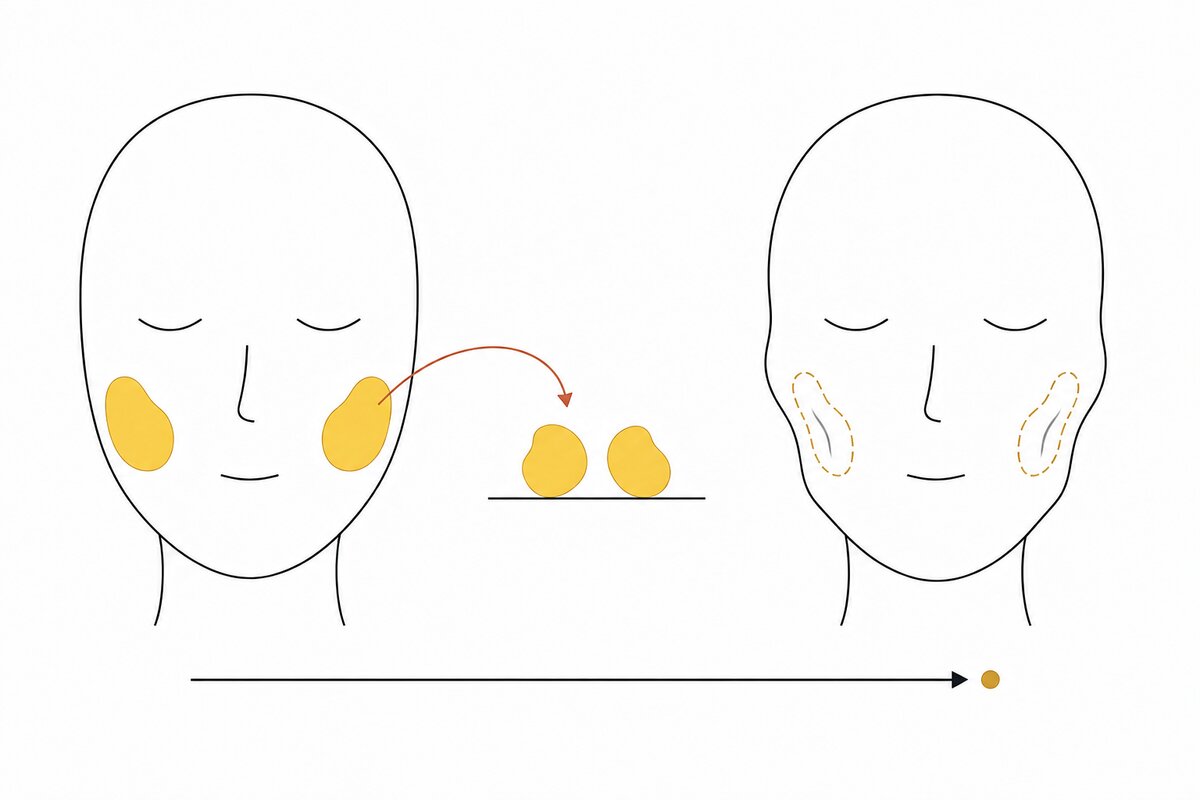
The buccal fat pad is a deep, capsule-bound fat body of roughly 9 to 10 mL per side that sits between the buccinator muscle and the masseter, and only one part of it, the buccal extension, ever contributes to visible cheek fullness. In the largest anatomical study, 80 adult cadavers, the pad averaged 10.2 mL in men and 8.9 mL in women, about 6 mm thick and 9.7 g in weight, with three lobes, four extensions, and six ligamentous attachments to the maxilla, zygoma, infraorbital fissure, temporalis tendon, and buccinator. Aesthetic removal touches only the buccal extension, the portion that drapes forward and down over the buccinator into the lower cheek; the deeper pterygoid and temporal extensions stay untouched, which is why a well-done removal takes out 2 to 3 mL rather than 10.

Its aging pattern is descent, not deflation. A 2026 scoping review of ten anatomical studies concluded that the pad is likely to increase between childhood and adulthood and may not begin to decrease until after the age of 60 or 70, and that vertical descent with pseudo-herniation of the buccal extension is its natural progression. In plain terms, the fat that was full at the cheek at 30 has slid toward the jawline by 55, where it now reads as a jowl. This matches the CT finding above: what shrinks in the aging midface is the deep medial cheek fat that supports the cheekbone, while the buccal pad drifts downward, unchanged in volume until very late.
Two consequences follow. First, a full lower cheek in a 25-year-old and a full lower cheek in a 55-year-old are different problems. The younger one is a stable pad in its normal position; the older one is a pad that has descended and is contributing to the jowl, which is why a Japanese series of middle-aged patients, mean age 54, found that removal reduced lower facial width by about 3.7 mm and lower facial volume by about 4 mL per side at 12 months, with body weight unchanged. Second, the deep medial cheek fat that thins with age sits in a different compartment from the pad, so removing the pad does not prevent that thinning. The two losses simply stack.
Removal, Repositioning, or Leaving It: The Options at a Glance
Buccal fat can be excised through the mouth, excised from outside through a facelift flap, repositioned rather than removed, or left alone while the surrounding structures are lifted; each option addresses a different finding. Excision is right when the pad is the surplus. Repositioning is an option when the pad has descended but the cheek above it is hollow, so the tissue is moved up rather than thrown away; one facelift series moved the pad into the sub-SMAS plane to augment the inframalar region in 22 patients, with stable position on MRI. Leaving it alone is right when the fullness is bone, muscle, or superficial fat, none of which a buccal excision reaches.
| Decision point | Intraoral excision | External excision during facelift | Sub-SMAS transposition | Facelift alone |
|---|---|---|---|---|
| What it does | Removes 1.5 to 3 mL of the buccal extension through a 1 cm mucosal incision | Removes the pseudoherniated extension through the facelift flap | Moves the pad upward under the SMAS to fill the inframalar hollow | Lifts the descended pad with the SMAS without changing its volume |
| Right face | Heavy lower cheek at stable weight, defined cheekbone, skin pinch over 6 mm | Same, in a patient already having a facelift | Descended pad with a hollow above it | Jowl from descent, no true surplus |
| Wrong face | Lean face, submalar hollow, temple hollowing, under mid-twenties | Same, plus any face where the pad is the reserve | True surplus, where adding volume above worsens width | Bottom-heavy face where lifting relocates the bulk without reducing it |
| Reversibility | None; fat grafting can partially replace volume | None | Partially, the pad can be released | Full |
| Key risks | Asymmetry, trismus, buccal branch weakness, parotid duct injury | Same, with the dissection near the nerve inside the flap | Malposition, asymmetry | Standard facelift risks |
Nonsurgical options do not reach the pad. Fat-dissolving injections are used for submental fat, not for a deep encapsulated pad that sits beneath the buccinator with the parotid duct crossing over it, and skin-tightening devices firm the envelope without touching the volume inside it. The choice is between changing the structure and leaving it, and that decision belongs to an examination, not a menu.
How Buccal Fat Is Removed at This Practice: Intraoral, Before the Facelift Begins
In practice, buccal fat is removed here through the mouth, as the first step of the operation and before the face is prepped and draped for the facelift, rather than from outside through the facelift flap. I make an incision of about 1 cm in the buccal mucosa opposite the upper second molar, kept below the parotid papilla so the duct is never in the field. Pressing the cheek from outside brings the buccal extension forward into the incision on its own, and I remove only what herniates under that gentle pressure, roughly 1.5 to 2.5 mL per side. I do not take the entire buccal extension, and I do not chase fat back toward the body of the pad. The two specimens are laid side by side and compared before I close, and the mucosa is repaired with one or two stitches of 4-0 absorbable suture.
Doing it this way, rather than through the flap as some facelift surgeons describe, is a deliberate choice for five reasons. First, a cadaver study of the external approach found that in every specimen the parotid duct crossed the pad superiorly and the buccal branches of the facial nerve ran across its capsule; the intraoral route lets me leave that plane under the flap undisturbed. Second, the mouth is not a sterile field. Finishing the intraoral step before the skin is prepped means the facelift starts clean instead of alternating between a contaminated cavity and a sterile face. Third, with the face still unswollen and the cheek pressed from outside, I can see the left and right volume as I go and match them, which is much harder once the facelift dissection has changed the tissue. Fourth, taking the surplus out first lets the SMAS flap redrape over a smaller lower cheek, so the lift holds more and the contour reads cleaner at the jawline. Fifth, an undisturbed face at the start of the case is simply the most accurate moment to judge symmetry.
The same intraoral step is added, when the lower cheek is heavy, to other facial operations where the patient is already asleep, and the decision follows the same rule: the pad is removed only if it is the surplus, never as a routine add-on.
Who Is a Good Candidate for Buccal Fat Removal, and Who Will Regret It
A good buccal fat removal candidate has a lower cheek that stays full at a stable adult weight, a skin pinch over the cheek thicker than 6 mm, a defined cheekbone above the fullness, and enough age to know that the fullness is not going to settle on its own. Those are not opinions; most of them have published thresholds. In a series of 66 patients examined by two experienced surgeons and then measured, the objective indicators that predicted suitability were a cheek skin-fold thickness over 6.00 mm, a midfacial contour over 2.20 mm, an ovoid or triangular facial form, and an ultrasound buccal fat volume over 2.05 mL, and the authors were explicit that no single measure should decide it: patients meeting at least three of the four were the best candidates.

Age changes which problem is being treated. A Japanese series of 133 patients separated them into a bottom-heavy Type I with a mean age of 43.7 and a ptotic, descended Type II with a mean age of 57.1, and found that where the fat is resected changes the shape of the result. The younger type is a true surplus; the older type is a descent problem, which is why in this practice it is usually addressed inside a facelift rather than as an isolated procedure, and why a patient in her fifties asking for buccal fat removal alone is often asking for the wrong operation.
Here, the disqualifiers are the faces that will hollow. A lean patient with a low body mass index is refused, because the cheek fat that would have cushioned the removal is already thin. A face that already shows a hollow under the cheekbone, in the submalar region, is refused, because the pad is what is holding that hollow at bay. A patient with temporal hollowing is refused for the same reason: the face has already begun the deflation that will reach the lower cheek. And an isolated buccal fat removal is not performed on anyone younger than the mid-twenties, because facial fat is still settling into its adult distribution, and the round cheek that bothers a 21-year-old is, in a large share of cases, gone by 26 without surgery. Fat that has been removed does not return, and transplanted fat survives only in part; the reserve, once spent, cannot be reliably restored.
Buccal Fat Removal Recovery: Swelling, Trismus, and When the Cheek Settles
Recovery from buccal fat removal is measured in days for daily life and months for the final contour, and the early phase is dominated by two things: swelling and a stiff jaw. In a meta-analysis of 12 studies and 308 patients, edema was reported in 38 percent and trismus, limited mouth opening, in 30 percent, with pain in about 19 percent. Those numbers describe the first one to two weeks. A soft diet for a few days, chlorhexidine rinses while the mucosal stitches dissolve, and gentle jaw opening exercises from the second or third day cover most of it. Because the incision is inside the mouth, there is no external scar and no dressing.

The contour is not visible early. Swelling in the buccal space mimics the fullness that was removed, and patients commonly report at two weeks that nothing has changed. Three months is the honest first look; twelve months is where the published measurements are taken, which is why the 3.7 mm reduction in lower facial width quoted above is a twelve-month figure. Function follows a similar curve: a small electromyographic series found that masseter and buccinator activity actually increased at 30 and 120 days after removal, with chewing patterns clinically unchanged and aesthetic satisfaction improving from about 60 days. When the removal is combined with a facelift, the facelift timeline governs, and that clock, sutures out around a week and presentable at about two, is laid out in how a deep plane facelift is done and healed.
Surgeon’s Insight
When a patient asks me for buccal fat removal, the first thing I do is not look at the cheek; I look at the temple and at the hollow under the cheekbone, because those two places tell me what this face is going to do in fifteen years. If they are already thinning, I decline, and I say why: the pad you want gone is the one deposit in your face that was going to stay, and you are asking me to spend your reserve. If the cheekbone is defined, the skin pinch is thick, the weight is stable, and the fullness sits low and in front of the masseter, then the pad is a surplus and I will take it, conservatively, through the mouth, before the facelift or whatever else we are doing that day. I remove only what comes forward when I press the cheek from outside, I lay the two pieces side by side, and I stop. The best buccal fat removal is one that nobody can identify ten years later, and that is far easier to achieve by taking too little than by taking too much.
Buccal Fat Removal Risks: Nerve Injury, the Parotid Duct, and Asymmetry
The serious risks of buccal fat removal are rare, but the minor ones are common, and the pooled data put the overall complication rate at one in four. A 2025 meta-analysis found 81 of 308 patients had some complication, a prevalence of 25 percent, most of it swelling, trismus, and pain; the rates that matter for consent were asymmetry in 11.65 percent, facial nerve paralysis in 0.97 percent, and infection, hematoma, and subcutaneous emphysema in 0.48 percent each. Their conclusion was blunt: recommend the procedure with caution, because the evidence shows safety concerns and a lack of predictability.
Two structures explain the nerve and duct numbers. The buccal branches of the facial nerve run across the surface of the pad’s capsule, and the parotid duct crosses it from above on its way to the papilla opposite the upper second molar. Dissect too far, too deep, or with cautery near the capsule and the buccal branch is at risk; a published case of transient facial paresis after buccal fat removal was treated with high-dose corticosteroids and facial therapy, and the authors’ message was that surgeons must discuss temporary facial weakness before the procedure, not after. Keeping the incision below the papilla and removing only the fat that presents on its own, without instrument dissection toward the body of the pad, is how both structures are kept out of the field.

Asymmetry deserves its own line, because at 11.65 percent it is the most common complication a patient will actually see. Its cause is usually not anatomy but judgment: unequal amounts removed from two cheeks that were not symmetric to begin with. The defense is procedural, comparing the two specimens before closing, and is the reason this practice removes the fat with the face unswollen and pressed from outside, where the two sides can be judged against each other. Hollowing, the late complication, is not in any meta-analysis because no series follows patients long enough to count it. It is prevented at the consultation, by refusing the faces described above, or not at all.
The Question to Ask Before Buccal Fat Removal
The question that decides buccal fat removal is not how much fat is in the cheek but which fat it is, and what the rest of the face will do around the gap it leaves. A full lower cheek that sits below a defined cheekbone, pinches thicker than 6 mm, and has not changed with weight is a surplus, and about 2 mL per side removed conservatively, ideally as part of an operation that also addresses the descent, gives a result that holds. A full cheek in a face that is lean at the temple, hollow under the cheekbone, or simply not yet finished settling is a reserve, and spending it buys a slimmer face in the twenties at the price of an older one in the forties.
That is the same standard this site applies to every procedure, including in what natural actually means in plastic surgery: treat the layer that is actually in surplus, at the amount the anatomy can spare, and leave the rest of the face its own future. When the finding is descent rather than surplus, the answer is usually a lift, and the trade-offs of the lifting options from threads to a facelift are their own decision. Removing a fat pad is the one facial procedure where the surgeon cannot give the tissue back, and the consultation should sound like it.
Written by Dr. Yongwoo Lee, board-certified Korean plastic surgery specialist in facial anatomy and aesthetic procedures at VIP Plastic Surgery, South Korea.
Frequently Asked Questions About Buccal Fat Removal
Is buccal fat removal permanent?
Yes. The buccal fat pad is a discrete, encapsulated deposit, and the portion removed does not regenerate. Weight gain can enlarge the remaining pad and the superficial fat around it, which is why some patients feel the cheek “came back” after gaining weight, but the excised tissue itself is gone. That permanence is the entire reason candidate selection matters more for this procedure than for most.
Does buccal fat removal make you look older?
It can, in the wrong face, and the mechanism is not that the pad ages you but that it stops cushioning what does. Deep medial cheek fat thins and the superficial compartments descend with age; the buccal pad does not, holding its volume until the sixties or seventies in imaging studies. Remove it from a face that is already lean under the cheekbone and the two losses add up in the same place. In a face with a genuine surplus and a defined cheekbone, a conservative removal does not produce that effect.
Does buccal fat shrink or go away with age on its own?
Not in the years that matter for this decision. MRI studies find buccal fat volume unchanged across young, middle-aged, and elderly adults and, if anything, correlated positively with age and body mass index. What the pad does with age is descend, sliding from the cheek toward the jawline, which is why in older patients it is treated as part of a jowl rather than as a full cheek.
At what age is buccal fat removal a bad idea?
Before the mid-twenties, in this practice, as an isolated procedure. Facial fat is still settling into its adult distribution, and much of the roundness that bothers a 21-year-old resolves by 26 without surgery. The pad cannot be put back, so the decision is deferred until the face has shown what it is going to keep.
How much fat is removed in buccal fat removal?
Published series average about 2.7 mL per side, with a range of roughly 1.8 to 4.9 mL; the whole pad is about 9 to 10 mL per side, so aesthetic removal takes only the buccal extension, the part that reaches the lower cheek. In this practice the amount is 1.5 to 2.5 mL per side, only what herniates forward under gentle pressure on the cheek, and the two specimens are compared before closing.
Does buccal fat removal help jowls?
Sometimes, in older faces, and usually not on its own. The pad descends with age and can contribute to jowl fullness, which is why a middle-aged series showed lower facial narrowing after removal. But the jowl is mostly descended superficial fat held at the mandibular ligament, and skin, none of which buccal fat removal addresses. In a patient over 50 the pad is more often reduced inside a facelift than removed alone.
Can buccal fat removal be done with a facelift?
Yes, and for a bottom-heavy face it is a common combination. Here it is done through the mouth as the first step, before the face is prepped, so the intraoral part is finished before the sterile facelift begins and the SMAS can be redraped over a smaller lower cheek. Some surgeons instead excise the pad from outside through the facelift flap; both are recognized techniques, and the choice is about where the surgeon prefers to work relative to the buccal nerve branches and the parotid duct.
Is buccal fat removal safe?
Serious complications are rare and minor ones are common. Across 308 pooled patients, one in four had some complication, mostly swelling, trismus, and pain in the first weeks; asymmetry was reported in about 12 percent, temporary facial nerve weakness in about 1 percent, and infection, hematoma, and emphysema in about half a percent each. Safety depends on staying below the parotid papilla, not dissecting toward the body of the pad, and removing conservative, symmetric amounts.
What are the signs that buccal fat removal went wrong?
Early: one cheek visibly fuller than the other after swelling settles, weakness lifting the upper lip on one side, or a persistent swelling near the cheek that may indicate a saliva collection from a parotid duct injury. Late: a hollow under the cheekbone that deepens over years, which is not a surgical error but a selection error. Asymmetry can sometimes be corrected by removing a little more from the fuller side; hollowing is treated with fat grafting, which restores volume only in part.
Can buccal fat removal be reversed?
Not truly. Fat grafting can add volume back to the region, but transplanted fat survives partially and unpredictably, and grafted fat in the lower cheek is a different tissue in a different layer from the encapsulated pad that was removed. Filler is temporary. This is why the procedure is treated here as a one-way decision and refused in any face where the pad may be needed later.
Will losing weight remove buccal fat?
Only a little. Deep facial fat compartments are largely excluded from ordinary lipid metabolism, and buccal fat volume tracks body mass index only loosely, so weight loss slims the superficial cheek far more than the pad. A round lower cheek that persists at a stable, healthy weight is the pattern that suggests a true buccal surplus; a round cheek that comes and goes with weight is mostly superficial fat.
How long does buccal fat removal recovery take?
Daily life resumes within a few days; the result takes months. Swelling and jaw stiffness are worst in the first week, the mucosal stitches dissolve by about two weeks, and the contour is still masked by swelling at one month. Three months is the first honest look and twelve months is when published measurements are taken. Combined with a facelift, the facelift recovery governs.
What is buccal fat pad transposition, and is it better than removal?
It is the alternative for a pad that has descended in a face that is hollow above it: the pad is mobilized and moved upward under the SMAS to fill the inframalar region instead of being discarded, with stable position documented on MRI in a 22-patient facelift series. It is better only for that specific face. In a face with a true surplus and a defined cheekbone, adding volume above the fullness widens the face rather than refining it.
What should buccal fat removal before and after photos show?
A subtle narrowing of the lower cheek below a cheekbone that was already defined, photographed at matching angles and lighting at three months or later. Two warning signs: photos taken in the first weeks, when swelling still hides the true contour, and portfolios of very young or very lean patients, whose results look sharpest early and hollowest a decade on. A clinic showing twelve-month results in patients over thirty is showing you what actually persists.
This article is for informational purposes only and does not constitute medical advice. Always consult with a qualified medical professional before making any decisions about surgical or non-surgical procedures.