
The Double Chin Is Rarely Just Fat
Most patients who ask for neck liposuction are asking the wrong question, because a full neck is almost never a single problem. What reads in the mirror as one soft bulge under the chin is built from four separate layers, skin, fat, muscle, and a deep compartment beneath, and liposuction treats exactly one of the four. When that one layer happens to be the whole problem, liposuction alone can give an excellent result. When it is not, removing the fat can leave the neck looking looser, stringier, and in some cases visibly older than before surgery.
The short answer: neck liposuction removes the superficial fat between skin and muscle, and it works when your skin still has the elasticity to shrink over the new contour and the layers underneath are sound. A neck lift repositions and tightens the deeper layers, the platysma muscle and sometimes the structures beneath it, and redrapes the skin. Both are sold under the umbrella of double chin surgery, but they are not the same operation at two levels of intensity. They treat different anatomy, and the honest way to choose is to find out which layer is actually responsible for your neck.
This guide walks through the four layers, what each procedure really does, the three specific ways fat removal alone goes wrong, the tests a careful surgeon runs before recommending either operation, and the in-between options with their real limits.
The Four Layers of a Full Neck
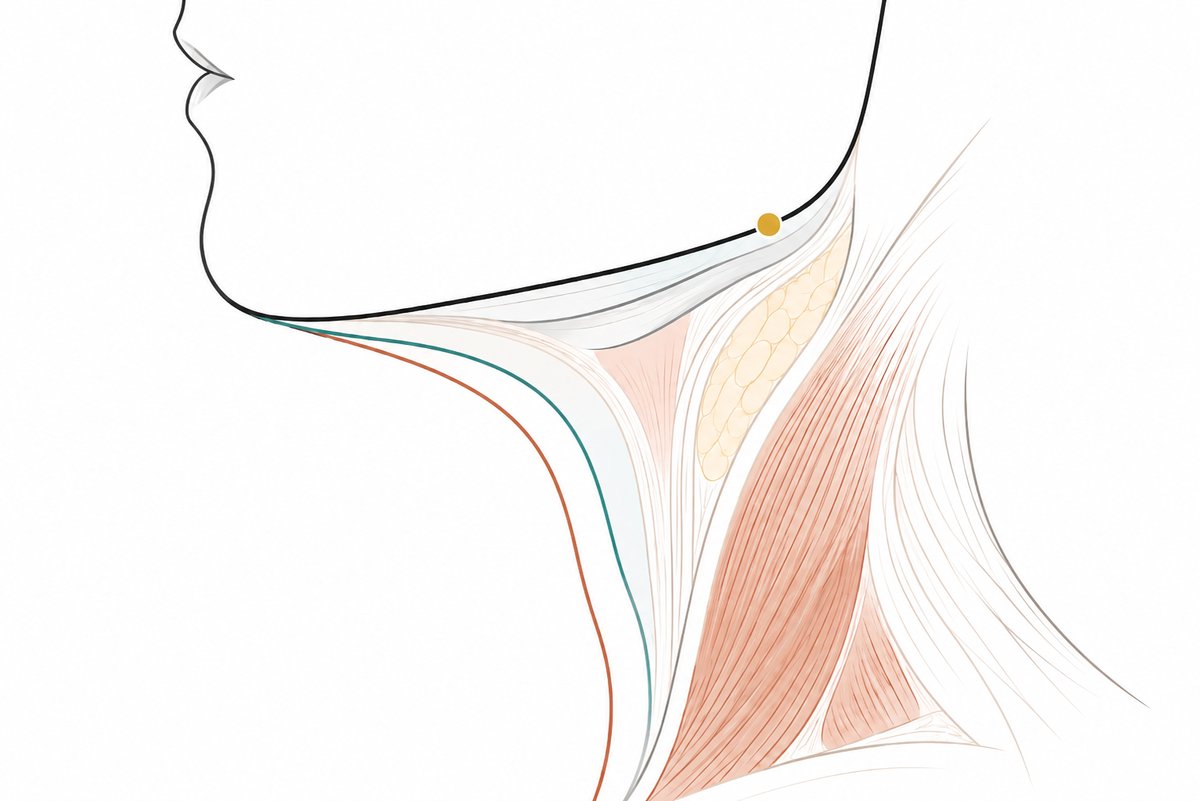
A neck contour is the sum of four stacked layers, and each one ages or fills differently. Plastic surgery describes them the way a layered approach to the neck formalizes: a superficial layer of skin and subcutaneous fat, an intermediate layer built around the platysma muscle, and a deep layer of subplatysmal fat, digastric muscles, and the submandibular glands, all sitting on the skeletal frame of the jaw and the hyoid bone.
Layer one is the skin. Its job is to shrink-wrap whatever contour the deeper layers present. Young skin recoils; sun-damaged or older skin settles and folds. Every decision that follows depends on how much recoil is left.
Layer two is the preplatysmal fat, the pinchable pad between skin and muscle, the submental fat of a classic double chin. This is the only layer a standard neck liposuction can reach, and in genetically fuller young necks it is often the dominant problem.
Layer three is the platysma, a thin sheet of muscle running from the jawline down the front of the neck. With age its inner edges loosen and separate, and they show through the skin as the two vertical cords surgeons call platysmal bands. Patients usually call the combination of cords and loose skin a turkey neck, and the nickname is anatomically apt: what sags is muscle edge and skin, not fat.
Layer four is the deep compartment: fat beneath the muscle, the digastric muscles, and the submandibular glands. A neck can be thick because of this layer alone, which is why some patients stay round-necked at a lean body weight. No amount of external liposuction reaches it; a large published series of deep tissue sculpture across 641 consecutive necks exists precisely because these structures need direct surgical access.

Surgeons have graded these combinations for decades. The Dedo classification runs from Class I, a well-defined young neck, through isolated skin laxity (II), excess subcutaneous fat (III), platysmal banding (IV), a recessed chin (V), and a low hyoid bone (VI). Those classes matter because each one points at a different operation, and only Class III points at liposuction.
What Neck Liposuction Actually Does, and Its One Hard Requirement
Neck liposuction, also called chin liposuction or submental liposuction, removes the preplatysmal fat through two or three entry points of a few millimeters, one hidden under the chin and one behind each earlobe, using a thin cannula. It does nothing to the skin except ask it to shrink, nothing to the platysma, and nothing to the deep compartment. The operation takes under an hour, is commonly done under local anesthesia with sedation, and the visible recovery is measured in days rather than weeks. On the right neck, that is the entire story, and it is a very good one.
The hard requirement is skin elasticity. What the operation actually produces is not the fat that leaves; it is the skin contracting smoothly over the sharper angle that remains. Technique matters here too: careful surgeons deliberately leave a uniform fat blanket of at least 3 to 5 millimeters on the underside of the skin, because skin suctioned bare adheres unevenly and shows every irregularity of the muscle beneath.
Age by itself is not the criterion, elasticity is, and this site has covered the mechanism in detail: fat cells removed by liposuction do not grow back, but skin that has lost its recoil will not shrink over a newly defined jawline either. It settles. That is why the pinch test below matters more than the birth year on your chart.
Why Fat Removal Alone Can Make a Neck Look Older
Removing fat from the wrong neck backfires through three specific mechanisms, and every one of them is documented rather than theoretical. The common thread: the fat you dislike is also padding. Take away padding from a structure that is itself loose, and you have not rejuvenated the neck, you have exposed it.
First, lax skin settles instead of shrinking. Skin with poor recoil does not contract over the new contour; it hangs in folds and fine crepe where the fat used to hold it out. The bulge is gone, but the neck reads as older, because loose skin is a stronger age signal than fullness. This is the failure mode most patients have seen in bad before-and-after photos without knowing its name.
Second, the fat was hiding the muscle. Platysmal bands sit directly beneath the fat layer, and a cushion of preplatysmal fat softens their edges the way a duvet softens the outline of whatever is under it. Surgeons have warned about this since a 1993 report named postoperative platysmal band deformity as a specific pitfall of submental liposuction: the patient arrives with fullness, leaves with two vertical cords, and needs a second, larger operation to fix what the first one revealed. The bands were always there. Fat was the only thing keeping them off camera.
Third, over-resection carves below the natural floor. Suctioning too aggressively, or chasing deep fat through a liposuction cannula, produces the central gutter with paramedian ridges known as a cobra neck deformity, a hollow under the chin flanked by the exposed edges of the digastric muscles and glands. The same layered-approach literature that defines the fat blanket rule calls this deformity very difficult to correct, because the missing tissue has to be rebuilt, not merely tightened. Prevention is a conservative cannula; correction is a reconstruction.

None of this makes neck liposuction a bad operation. It makes it a layer-two operation, and the three failure modes above are what happens when a layer-two tool is applied to a layer-one, layer-three, or layer-four problem.
What a Neck Lift Actually Does
A neck lift is not a deeper version of liposuction; it is a different operation aimed at the layers liposuction cannot touch. Through an incision under the chin, the surgeon opens the neck, sutures the separated inner edges of the platysma back together in the midline, the corset platysmaplasty, and through incisions tucked around the ears re-tensions the muscle laterally and redrapes the skin, removing any true excess. When the deep compartment is the culprit, the same submental access allows direct reduction of subplatysmal fat and, in selected cases, the digastric muscles and submandibular glands.
The midline muscle repair is not optional decoration. A review of 101 secondary neck lifts found that necks returning for revision were frequently necks whose first operation had skipped the midline platysmaplasty, and one open suture-suspension technique has published follow-up out to 13 years. Deep-compartment work has its own evidence base: the 641-case deep sculpture series documents the approach at scale, and in a separate 307-case gland-reduction cohort, transient weakness of the lower lip occurred in about 5.8 percent, with essentially all cases recovering.
What a neck lift buys is control of every layer at once: the muscle edges that make bands, the deep fullness that liposuction cannot reach, and the skin envelope that liposuction can only hope will shrink. The price of that control is a longer operation, a real recovery, and scars, hidden but present, under the chin and around the ears. Bleeding risk carries over from facelift surgery as well, and the prevention logic is the same one described in how surgeons prevent hematoma after a facelift.
The geometric goal of all of it is the cervicomental angle, the angle between the underside of the chin and the front of the neck, with the literature placing the youthful range at roughly 105 to 120 degrees. Liposuction sharpens that angle only if fat was what blunted it. A neck lift sharpens it by rebuilding the structures that define it.
How to Tell If You Need Neck Liposuction or a Neck Lift: Four Tests
The choice between neck liposuction and a neck lift is made at the examination table, not the brochure, and four simple checks settle most cases: skin recoil, a grimace, the depth of the fullness, and the skeleton. A surgeon who recommends either operation without doing them is guessing.
The pinch and recoil test. Pinch the skin under the jaw, hold two seconds, release. Skin that snaps back flat has the elasticity liposuction depends on. Skin that stays tented or drifts back slowly will not shrink over a suctioned neck, and removing its supporting fat will make the looseness more visible, not less.
The grimace test. Tense the neck as if grimacing, or simply say a hard, forced E sound at the mirror. Vertical cords that leap forward are active platysmal bands, Dedo Class IV anatomy. Fat removal does not treat them; it unveils them. Bands mean the muscle layer needs surgery, or in mild dynamic cases, targeted relaxation rather than any fat procedure.
The depth-of-fullness test. Clench the jaw and palpate the fullness. Fat you can pinch and roll between finger and thumb above the tensed muscle is preplatysmal, reachable by liposuction. Fullness that sits deep to the tensed muscle, firm and unpinchable, is subplatysmal fat, gland, or digastric, and belongs to deep neck surgery. This single distinction explains most of the young, lean patients whose double chin never responded to weight loss.

The skeletal check. A recessed chin (Dedo Class V) shortens the visual length of the jawline and makes even a lean neck read as full; it is treated with chin projection, not fat removal. A low hyoid bone (Class VI) sets a hard anatomical ceiling on how sharp any cervicomental angle can become, no matter the operation. Patients deserve to hear that ceiling before consenting to anything. The same four checks decide how short a facelift incision can be, which is why a mini facelift cannot be planned without examining the neck first.
Surgeon’s Insight
Skin elasticity is the strongest single predictor of how a neck looks after fat is removed, so it is the first thing I test and the first thing I say out loud. I do not automatically refuse a patient with lax skin who wants liposuction alone; I state the trade explicitly, the sharper angle against the risk of visible looseness, and I make sure the patient can repeat it back to me before we proceed. On the neck I keep the cannula at 2.0 to 2.5 millimeters and deliberately undercorrect, because in this territory removing too little is a touch-up and removing too much is a reconstruction. The refusal I hold firm on is different: when the photograph a patient brings shows an angle their hyoid position cannot produce, no operation will manufacture it, and saying so is part of the job.
Neck Liposuction vs. Neck Lift at a Glance
Neck liposuction treats one layer; a neck lift controls the other three. The table below is the short version of everything above: find your own finding in the left column, and read across to the operation built for it.
| Decision point | Neck liposuction | Neck lift |
|---|---|---|
| Layer treated | Preplatysmal fat only | Platysma, deep compartment, skin, with or without fat |
| Fixes a pinchable fat pad | Yes, when skin recoil is adequate | Yes, as part of the operation |
| Fixes platysmal bands | No, tends to unmask them | Yes, corset platysmaplasty |
| Fixes deep fullness (gland, subplatysmal fat) | No | Yes, when deep work is included |
| Fixes loose or crepey skin | No, depends on skin shrinking on its own | Yes, redrapes and removes true excess |
| Anesthesia | Usually local with sedation | Sedation or general |
| Incisions | 2 to 3 entry points of a few millimeters | Under the chin and around the ears |
| Visible recovery | Days, compression garment for support | Weeks, swelling settles over months |
| Ideal candidate | Good skin recoil, no bands, fullness above the muscle | Lax skin, active bands, or deep-layer fullness |
| Main risk if chosen wrongly | Unmasked bands, loose skin, over-resection | A larger operation than the neck needed |
Recovery After Neck Liposuction and a Neck Lift
Recovery after neck liposuction is measured in days, recovery after a neck lift in weeks, and in both cases the driver is swelling rather than pain. After liposuction, a compression garment or chin strap is typically worn continuously for the first several days and then at night for a week or two, most patients are socially presentable within about a week, and the final contour emerges over two to three months as swelling clears. Firmness or small lumpy patches under the chin in weeks two through six are a normal stage of healing, not the result.
A neck lift asks for more. Sutures around the ears and under the chin generally come out within a week, visible bruising and swelling settle enough for social comfort over two to three weeks, and a feeling of tightness or numbness under the chin commonly persists for weeks beyond that. The contour keeps refining for three to six months. Neither timeline should be rushed by comparing your neck to photographs taken at the finish line.
Nonsurgical Double Chin Removal: Kybella, Devices, and Their Limits
Four nonsurgical or minimally invasive options treat a double chin: fat-dissolving injections (deoxycholic acid, sold as Kybella), energy-based skin tightening, percutaneous suture suspension, and botulinum toxin for dynamic bands. Each has a legitimate lane, none of them moves a muscle edge or removes skin, and every one of those lanes is narrower than its marketing.
Fat-dissolving injections. Deoxycholic acid, sold as Kybella, is FDA-approved for moderate to severe fullness associated with submental fat in adults, with up to six sessions a month or more apart. In the pivotal trials, 43 percent of treated patients achieved at least a 10 percent MRI-measured fat reduction versus 5 percent on placebo, and in a follow-up of trial responders, 82 percent still held at least a one-grade improvement three years later. Read the label past the headline, though: it directs injectors to weigh treatment carefully in exactly the necks this article is about, those with significant skin laxity or prominent platysmal bands, because dissolving fat in those necks recreates the unmasking problem chemically, and temporary weakness of the lip branch of the facial nerve occurred in about 4 percent of treated patients in trials, resolving in a median of 44 days. It is a multi-session, swelling-heavy path to a liposuction-scale outcome, suited to patients with small pads who decline any procedure with a cannula.
Energy-based skin tightening. Ultrasound and radiofrequency devices genuinely firm mild laxity and are the right tool for skin quality on a neck whose structure is sound, which is exactly how they are framed in this site’s guide to Ultherapy, Thermage, and Shurink. What they do not do is move a muscle edge or empty a deep compartment. A device cannot lift what a suture holds, and a neck with true bands or deep fullness has outgrown devices.
Suture suspension and band release. Percutaneous suspension techniques occupy a middle seat: a multicenter series of 391 patients reported band recurrence in 4.6 percent and revision in 7.2 percent at a mean follow-up of eight months, respectable numbers, but 89 percent of those cases had energy-based skin tightening added and 43 percent had liposuction layered on as well. Even the flagship minimally invasive option is delivered as a package, not a standalone.
Botulinum toxin for dynamic bands. In a young neck whose bands appear only with animation and vanish at rest, relaxing the muscle chemically is a reasonable, reversible test drive of what a platysmaplasty would later do. It does nothing for fat, skin, or bands that stand at rest.
Am I Too Young for a Neck Lift, Too Old for Liposuction?
Neither, because age does not decide between these procedures; the failing layer does. A 28-year-old with a deep-compartment neck, full since adolescence at any body weight, is anatomically a candidate for deep neck surgery and would gain nothing from external liposuction except swelling. A 55-year-old with crisp skin recoil, no bands, and a soft pinchable pad is a legitimate liposuction candidate despite the birthday. The isolated management of the aging neck is its own surgical topic precisely because necks fail layer by layer, on their own schedules, and the operation has to follow the layer. The same rule holds for the whole face. It is worked through decade by decade in the best age for a facelift.

What no operation should follow is a trend. The goal of neck surgery is the angle and softness that fit your face, the same standard this site applies to every procedure in what natural actually means in plastic surgery, and the neck that fits a face is one whose deep structure, muscle, fat, and skin agree with each other. When the neck ages further, and it will keep aging, a structure that was repaired in agreement ages evenly instead of unraveling at its weakest layer, which is why the lower face and neck are often planned as one unit, an argument this site takes up in how deep plane and SMAS facelifts differ. That agreement, not the smallest possible measurement, is the result worth having.
Written by Dr. Yongwoo Lee, board-certified Korean plastic surgery specialist in facial anatomy and aesthetic procedures at VIP Plastic Surgery, South Korea.
Frequently Asked Questions About Neck Liposuction and Neck Lifts
Is neck liposuction permanent?
The removed fat cells are gone for good, because adult fat cells that are extracted do not regenerate. Two things can still change the picture: significant weight gain can enlarge the fat cells that remain, and the skin and muscle layers keep aging on their own schedule. A neck that was suctioned at 35 can still develop bands and laxity at 50, not because the fat returned but because a different layer aged.
How do I know if I need a neck lift instead of liposuction?
Three findings point to a lift: skin that stays tented or recoils slowly after a pinch, vertical cords that appear when you tense the neck, and fullness that stays firm and unpinchable when you clench your jaw. Any one of them means fat removal alone will disappoint. If all three are absent and the fullness is a soft, pinchable pad, liposuction is usually the right scale of operation.
What are platysmal bands?
They are the loosened inner edges of the platysma, the thin sheet of muscle under the skin of the neck, showing through as two vertical cords. They are muscle, not fat, which is why no amount of fat removal treats them and why removing the fat that cushions them tends to make them more visible.
Can neck liposuction fix a turkey neck?
No. A turkey neck is loose skin and separated platysma edges, which are the muscle and skin layers, and liposuction removes only fat. On that anatomy, fat removal tends to make the looseness and the cords more visible, not less. The operations that treat a turkey neck are a neck lift, with or without deep-layer work, and in mild, skin-dominant cases, energy-based tightening.
Why did my neck look worse after liposuction?
Almost always one of three reasons: the skin lacked the elasticity to shrink and now hangs; the fat had been masking platysmal bands that are now on display; or too much fat was taken and the underlying muscles and glands now show through as a hollow with ridges. All three are known, documented outcomes of applying fat removal to a neck whose real problem was another layer. The first two are usually correctable with the operation the neck needed in the first place; a true over-resection is harder, because missing volume has to be rebuilt.
What is a cobra neck deformity?
It is a central hollow under the chin flanked by two visible ridges, named for the shape a cobra’s hood makes, and it follows over-aggressive fat removal in the midline. The gutter is where too much fat was taken; the ridges are the edges of the digastric muscles and glands that the fat used to cover. Correction is difficult because it requires rebuilding volume and often formal neck lift surgery, which is why conservative suctioning matters more than aggressive sculpting.
Is Kybella a substitute for neck liposuction?
For a small, purely fatty pad in a patient with good skin, injections can approximate a liposuction result over multiple sessions, each with a week or more of swelling. It is a poor fit for anyone with loose skin or visible bands, and the FDA labeling itself directs injectors to weigh exactly those findings before treating. It also cannot shape the result the way a cannula can; it dissolves where it is injected.
Can Ultherapy or Thermage replace a neck lift?
No. Energy devices tighten skin modestly and improve its quality, which makes them a reasonable choice for mild laxity over sound structure and a useful maintenance tool after surgery. They do not reposition muscle, remove deep fat, or resect skin. A neck with standing bands, deep fullness, or real skin excess has outgrown what any device can deliver.
What scars does a neck lift leave?
A short incision in the natural crease under the chin and incisions that follow the contours around the ears, the same access used in facelift surgery. In most patients they mature into fine lines that are hard to find, but they are real scars and deserve the same scar care as any facial incision. Liposuction leaves only entry points of a few millimeters.
How long is recovery after neck liposuction?
Days rather than weeks for daily life: a compression garment continuously for the first several days, social activities within about a week for most patients, and exercise shortly after. The contour itself follows a slower timeline: swelling masks the result at first, and the neck you actually keep appears over two to three months.
How long does a neck lift last?
The repair itself is durable: long-term follow-up of muscle-support techniques reports results holding for many years, though no repair makes a neck permanently exempt from change. What continues is aging. Skin keeps losing elasticity and tissues keep descending at your biological rate, so the honest framing is not a countdown to expiry but a permanent head start: your neck ages forward from the repaired position rather than the old one.
Do I need a chin implant with a neck lift?
If your chin is recessed, quite possibly. A short jawline shortens the visual sweep from chin to neck and blunts the angle no matter how little fat is present, which is why chin projection, by implant or bone movement, is part of the classic algorithm for that anatomy. It is a question your surgeon should raise from your profile photographs, not one you should have to ask.
Why is my neck still full even though I am thin?
Because the fullness is probably deep to the muscle: subplatysmal fat, prominent digastric muscles, or low-hanging submandibular glands, none of which shrink with body weight and none of which external liposuction can reach. This pattern is usually lifelong rather than age-related. It responds to deep neck surgery, not to weight loss and not to external liposuction.
Can liposuction and a neck lift be combined?
They very often are. Conservative liposuction of the superficial fat is a routine component of a neck lift when a pinchable pad coexists with muscle and skin problems, and doing them together lets the surgeon balance all the layers in one recovery. The mistake is not combining them; the mistake is choosing only the smaller one when the larger one is what the anatomy requires.
Is it better to have neck surgery done in Korea?
Korea has an unusually deep bench of surgeons who operate on necks daily, particularly on the deep-compartment anatomy common in patients who have been full-necked since youth, and high volume correlates with refined judgment about how much to remove. But the variable that decides your result is the individual surgeon’s diagnostic care, not the country. Wherever you consult, the surgeon who examines your skin recoil, tests your bands, and palpates the depth of your fullness before naming a procedure is the one taking your neck seriously.
This article is for informational purposes only and does not constitute medical advice. Always consult with a qualified medical professional before making any decisions about surgical or non-surgical procedures.