
The Mistake Almost Every Patient Makes Before Liposuction
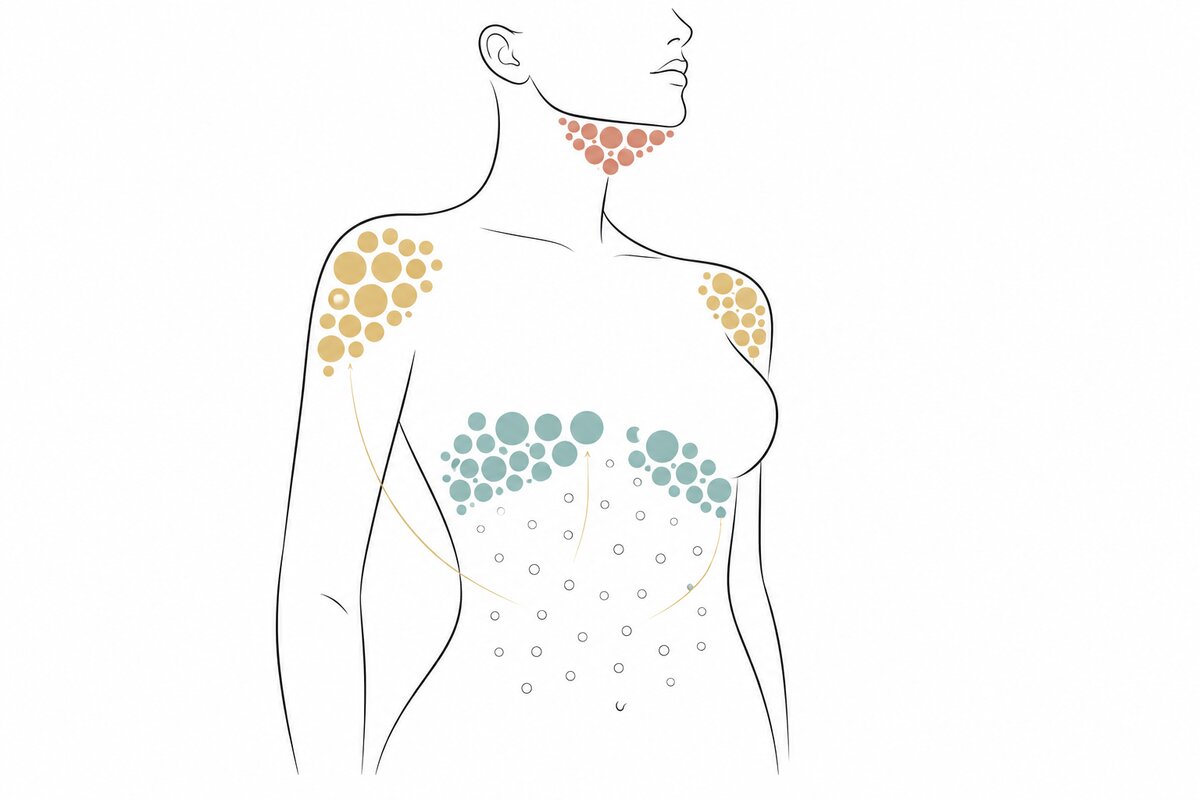
Fat cells removed by liposuction do not grow back, so in the literal sense the fat does not return. Patients still gain weight after surgery, though, and that weight has to be stored somewhere. It goes to the areas that were never treated, which is why a result can look worse over time even though not a single removed fat cell has regenerated.
Almost every consultation on this topic starts from the wrong premise. Patients want reassurance that the procedure is permanent, and surgeons often give it, because technically it is true. What goes unsaid is the more useful fact: liposuction permanently changes where your body prefers to store its next three kilograms. Understanding that shift is the difference between a result that holds for a decade and one that quietly unravels in eighteen months.
Does Fat Come Back After Liposuction?
No. Fat cells removed during liposuction are gone permanently, because the adult body does not replace them. Weight regained after surgery is stored by enlarging the fat cells that remain, not by building new ones in the treated area.
This distinction matters because it predicts the pattern of change. If new fat cells could form wherever they liked, a treated abdomen would eventually look untreated. Because they cannot, the abdomen retains a permanent deficit of storage capacity, and the surplus is pushed elsewhere. Patients describe this as the fat “moving,” which is a reasonable description of what they see even though nothing physically migrates.
Do Fat Cells Grow Back, or Do the Remaining Ones Just Get Bigger?
Remaining cells get bigger, and new ones do not appear. Fat cell number, in medical terms the adipocyte count, is essentially fixed by early adulthood, so an adult body accommodates extra energy by enlarging the cells it already has.
In a landmark study using carbon-14 from nuclear bomb testing to date the DNA of fat cells, researchers found that the total number of fat cells stays constant in adulthood in both lean and obese people, even after substantial weight loss. Roughly ten percent of fat cells are replaced each year, but the size of the population is defended.
That finding has a direct surgical consequence. Suctioning removes cells from the population, and the body does not restore the count in that location. Mathematical modeling of adipose tissue growth in mice found that hypertrophy is the main contributor to fat pad mass increase, while newly recruited cells add little volume because they begin small. Hypertrophy simply means existing cells swelling with stored fat. Since the human fat cell count is defended at a constant level, that swelling is what accommodates adult weight gain.
Put those two facts together and the mechanism becomes simple. Fat cells that survive the procedure can still swell to several times their original volume. A treated area with fewer cells will resist change longer than an untreated area with a full complement, but it is not immune, and it will never be immune.

Where Does the Weight Go If You Gain After Liposuction?
Regained weight is deposited preferentially in areas that were not suctioned. A randomized controlled trial of 32 non-obese women found that body fat fell 2.1 percent at six weeks and had returned to parity with untreated controls by one year, with redistribution occurring predominantly in non-aspirated depots, above all the upper abdomen and to a lesser extent the shoulders and triceps, while the treated thigh remained reduced at one year.
A second and less visible pattern also exists. In a randomized trial of 36 normal-weight women who had small-volume abdominal liposuction, visceral fat rose about 10 percent by six months in the group that did not exercise, alongside a measurable fall in energy expenditure, while the group assigned to a four-month training program showed no such increase. Visceral fat sits behind the abdominal wall and cannot be seen or pinched, so a patient can insist that she has not gained anywhere while her waist circumference slowly climbs.

Worth stating plainly: none of this makes liposuction a reliable metabolic treatment. In the best-controlled study of the question, researchers removed roughly 10 kilograms of fat from 15 obese women and measured insulin sensitivity in muscle, liver, and adipose tissue, along with C-reactive protein, interleukin-6, blood pressure, and lipid levels. They found no significant improvement in any of these markers at ten to twelve weeks. Later work on much larger aspirate volumes has reported modest shifts in lipid and glucose measurements, so the honest summary is that removing subcutaneous fat reliably changes shape and does not reliably deliver the metabolic benefits of actually losing weight.
How Much Weight Gain Ruins Liposuction Results?
Two very different thresholds apply depending on the area treated, and patients are almost never told this. In my practice the neck and submental area begin to show weight gain at about two to three kilograms. Body areas such as the abdomen and thighs tolerate considerably more, and I usually see the contour start to blur at around five to seven kilograms.
I want to be precise about what those numbers mean, because they are easy to misread. They are not the point at which the fat has returned. They are the point at which a patient looking in the mirror can tell that something has changed. That is a lower bar than biological reversal, and it is the bar that actually determines whether someone feels the surgery was worth it.
Published data supports the general shape of this. In a mailed survey returned by 209 of 600 liposuction patients operated between 1999 and 2003, 43 percent of respondents had gained weight since surgery, most of them by five to ten pounds, roughly two to four and a half kilograms, measured at six months. Among those who had not gained, 35 percent reported exercising more and 50 percent reported eating better, against 10 percent and 22 percent in the weight gain group, and two thirds of the weight gain group reported no dietary change at all.
At a Glance: Facial Versus Body Liposuction After Weight Regain
| Neck and submental area | Abdomen, flanks, thighs | |
|---|---|---|
| Typical volume removed | 30 to 60 mL | 1,500 to 4,000 mL |
| Proportion of local fat cells removed | Lower, by design | Higher |
| Weight gain before change is visible | 2 to 3 kg | 5 to 7 kg |
| Concealed by clothing | No | Usually yes |
| Margin for contour error | Very small | Moderate |
| Skin retraction dependence | High | Moderate |
| Where patients notice first | Almost always here | Later, and less specifically |

Why the Chin Shows Weight Gain Before the Abdomen Does
Patients notice the return in their face first, and this surprises them because it is not where most of the fat went. Body areas absorb far more of the regained volume in absolute terms, but the neck is the area that reports it.
Three factors converge here. First, the submental region is deliberately undertreated. Suctioning the neck aggressively produces a hollow, skeletonized look and unmasks every irregularity, so a smaller proportion of the local fat is removed than on the abdomen. More residual adipocytes remain, and those cells can enlarge.
Second, nothing covers the neck. A two millimeter increase in submental fat thickness is visible to the patient every time she turns her head, while the same two millimeters across an abdomen disappears under any garment.
Third, the neck has a very narrow tolerance for error in either direction. Jawline definition is a matter of one crisp shadow line, and a small change in the fat pad beneath it either sharpens or softens the whole lower face. Someone who had surgery specifically for a jawline is watching the most sensitive area on the body for exactly this kind of change, and will catch it early.
Reconciling this with the published redistribution data is straightforward once the two measures are separated. Volumetric studies using DXA and MRI measure where the fat actually accumulates, and they point to the upper abdomen, arms, and shoulders. Clinical observation measures where the patient perceives it first, and that is the face. Both are correct, and they are answering different questions.
How Do I Perform Liposuction? Layers, Cannula Sizes, and Deliberate Undercorrection
I work the deep and intermediate fat layers and leave the superficial subdermal layer as undisturbed as I can. This is not a stylistic preference. Preserving the superficial layer is what prevents dimpling, waviness, and the rippled contour that is far harder to correct than the original fullness. Treating the subcutaneous fat as distinct layers separated by the superficial fascial system has been established anatomy since the mid-1990s, and the surgeons who described those layers argued in favor of deliberate subdermal suctioning to improve skin retraction. I know that literature and I have chosen against it for routine cases, because the retraction gain is modest while the penalty for getting it wrong is a permanent surface irregularity rather than a recoverable one.
For cannula selection I stay with 3 to 5 mm on the abdomen, flanks, and thighs, dropping to 3 mm for arms, knees, and calves. In the face and neck I do not go above 2.0 to 2.5 mm. Smaller cannulas remove fat more slowly, and on the neck that slowness is the entire point. As many as 9 percent of liposuction patients report a contour deformity, and smaller diameter cannulas and avoidance of the superficial plane head the standard list of preventive measures, alongside crisscrossing from several small entry points and slight undercorrection to allow for fat lysis, the natural breakdown of fat cells injured during the operation.

Infiltration follows the standard tumescent formula: one liter of normal saline with 500 to 1,000 mg of lidocaine, 1 mg of epinephrine at 1:1,000, and 12.5 mEq of sodium bicarbonate, giving a final lidocaine concentration of 0.05 to 0.1 percent and epinephrine at 1:1,000,000. I infiltrate roughly three to four milliliters for every milliliter I intend to aspirate, and I keep total aspirate within 5,000 mL in a single session. ASPS defines anything beyond 5,000 cc of total aspirate, fat plus fluid, as large-volume liposuction that belongs in an acute-care hospital or accredited facility with vital signs and urine output monitored overnight. That advisory is candid that no data establish an absolute maximum volume, only that risk climbs with aspirate volume and the number of sites treated, so I treat the figure as a working limit rather than a rule.
On the neck I deliberately take out less than I could. Every surgeon learns to undercorrect slightly, because injured fat cells keep breaking down for weeks afterward and the area continues to shrink a little on its own. On the face I extend that margin further than the textbook allows. A neck that is still slightly full at three months can be revised with a small second procedure. A neck that has been hollowed out, with the vertical cords of the neck muscle showing through and the skin stuck down against the jawbone, often cannot be revised at all. That asymmetry of consequences drives the decision. The buccal fat pad is the sharpest version of the same asymmetry: it is removed whole, and it neither shrinks nor regrows. Who hollows out ten years after buccal fat removal is decided by the cheek fat around the pad, not by the pad itself.
When Is VASER Better Than Traditional Liposuction?
I start most cases with conventional suction-assisted liposuction and reach for ultrasound assistance in four specific situations. When the tissue feels fibrous under the cannula, when I am operating in a field with adhesions from previous surgery, when the skin needs whatever retraction I can get, and when the goal is high-definition etching along muscular borders.
Fibrous tissue is the clearest indication. Male chest tissue in gynecomastia and the dense fat of the upper back resist a plain cannula, and forcing the instrument through produces uneven planes rather than smooth removal. Ultrasound emulsifies the fat first, and a 45-patient three-arm trial in gynecomastia found roughly three to four times greater reduction of the firm tissue behind the nipple with ultrasound assistance than with traditional liposuction alone. Measured skin firmness in that same trial improved significantly only when a separate skin-tightening device, helium plasma radiofrequency, was added. Ultrasound alone did not tighten skin, which is a useful corrective to how the technology is often marketed.
One limitation deserves stating honestly, because patients are frequently sold otherwise. In my practice no form of liposuction reliably removes firm glandular breast tissue, and where a true glandular component is present I plan for excision rather than expecting the device to dissolve it. Some groups report that adding skin-tightening energy reduces the need for a second-stage excision, and that may well hold in their hands. My own threshold for excision is unchanged: ultrasound alters how fat behaves, not what glandular tissue is.
Can You Have Liposuction if Your Skin Is Already Loose?
Yes, but the result is a trade rather than a fix, and it has to be understood as one before surgery. I do not automatically refuse a patient with lax neck skin who wants liposuction alone, and I know that departs from the usual advice. What I do instead is state the risk explicitly and make sure the patient can repeat it back to me before we proceed.
My reasoning is simple. Skin elasticity is the single strongest predictor of how a neck will look after fat is removed, and skin that has lost its recoil will not shrink over a newly defined jawline. It settles. Telling such a patient that surgery is impossible is not accurate, because the fat can certainly be removed and some patients are content with the trade. Telling them nothing and operating anyway is indefensible.
So the conversation becomes a specific one. Skin will not retract the way it would have at thirty, the jawline will be sharper but the loosened skin envelope may hang, and if that happens the correction is a neck or deep plane lift rather than more liposuction. For patients who want to avoid surgery on the skin envelope entirely, energy-based skin tightening is a partial option with correspondingly partial results. Patients who understand that and still want the fat gone are making an informed decision, and I am comfortable operating on that basis.
Which Type of Liposuction Patient Are You?
The weight-stable contour patient. Weight has held within a couple of kilograms for a year or more, the concern is a specific pocket rather than overall size, and skin quality is good. Results in this group hold the longest, and the discussion about regain is largely preventive.
Someone recently down a significant amount of weight. Loss has happened, the shape has not followed, and there is a strong temptation to finish the job surgically. Timing is the issue here rather than candidacy, because operating before weight has stabilized means contouring a body that is still changing.
A patient using liposuction as weight loss. Expectations are the problem in this group, not anatomy. Liposuction is a contouring operation rather than a treatment for metabolic disease, and a patient whose eating and activity patterns are unchanged is the one most likely to join the sizable share who report gaining weight after surgery.
The submental-only patient. Concern is limited to the jawline and double chin, and the tolerance for change is the lowest of any group, since two or three kilograms will show. Realistic counseling here is as much about weight maintenance as about surgery. Where the pocket is small enough, a non-surgical option such as microwave body contouring may suit better than an operation.
How Long Is Recovery, and When Should You Start Exercising Again?
Compression is worn essentially continuously for the first two to three weeks, then full-time through about six weeks, then tapered as swelling settles. Activity restarts with gentle walking in the first two weeks, light cardiovascular work at three to four weeks, moderate exercise at five to six weeks, and unrestricted training after six weeks. Swelling follows its own longer timeline, and the final contour is not visible for three to six months.
Here is the part of recovery that most articles treat as an afterthought and that the evidence treats as central. Returning to exercise after six weeks is not merely permission to resume normal life. In a randomized trial of women who had abdominal liposuction, the group left sedentary developed a compensatory increase in visceral fat by six months, while the group assigned to four months of training did not. Exercise is the intervention that prevents the least visible and most metabolically unfavorable form of regain.
That reframes the whole conversation. Six weeks is not the point at which patients may exercise. It is the point at which they need to, and the surgical result depends on it in a way that no compression garment can substitute for.

Surgeon’s Insight
I give patients the two to three kilogram figure during the consultation, before anything is scheduled, and a few of them decide against surgery once they hear it. I count those as good consultations rather than lost ones. Someone whose weight swings five kilograms between winter and summer is not a poor candidate for liposuction in general so much as a poor candidate for submental liposuction specifically, and that distinction is worth saying out loud rather than discovering together a year later. A fluctuating patient can still hold a durable abdominal result. A jawline will not forgive the same swing.
What Are the Risks and Complications of Liposuction?
Contour irregularity is the complication patients fear most and the one most closely tied to technique. Suctioning too superficially and using an oversized cannula both produce waviness that is considerably harder to fix than the original fullness, and cross-tunneling, meaning approaching each area from several small entry points at different angles, is described as essential to even removal and a controlled result.
Seroma, prolonged swelling, and temporary numbness are common and self-limiting. Volume-related risk rises with the size of the procedure. A systematic review of 3,583 large-volume liposuction patients with an average aspirate of 7,735 mL reported major complications in 3.35 percent and minor complications in 11.62 percent, including seroma at 5.51 percent, pulmonary embolism at 0.18 percent, and deep vein thrombosis at 0.12 percent, with no deaths recorded. Those authors are careful to note that the available evidence is observational rather than randomized.
Skin laxity is not a complication so much as an unmasked pre-existing condition. Removing the fat that was filling a loose envelope does not tighten the envelope, and patients who were counseled about this beforehand experience it as an expected trade rather than a surgical failure.
The Question Worth Asking Instead
Asking whether fat comes back is asking about the tissue. A more useful question is about the person: what will my weight be doing for the next five years, and where does my body put weight when it arrives?
Those two answers predict the durability of a liposuction result far better than any technical detail of the operation. Someone whose weight has been stable for years and who trains consistently will hold a contour for a very long time. Someone who is about to enter a period of change will find that surgery has redirected the change rather than prevented it.
Fat cell biology is not the variable. Surgical technique determines whether the initial result is smooth, and it determines how much of the local storage capacity is gone, but it does not determine what the patient does afterward. Choosing a surgeon who explains this rather than promising permanence is itself a useful screening test.
Written by Dr. Yongwoo Lee, board-certified Korean plastic surgery specialist in facial anatomy and aesthetic procedures at VIP Plastic Surgery, South Korea.
Frequently Asked Questions
Does fat come back after liposuction?
Not in the treated area. Fat cells removed during liposuction do not regenerate, because adipocyte number is fixed in adulthood. Weight gained afterward is stored by enlarging the fat cells that remain, and most of it goes to areas that were never suctioned.
How much weight can I gain before liposuction results are ruined?
It depends on the area. The neck and submental region start to show change at about two to three kilograms, while the abdomen and thighs generally tolerate five to seven kilograms before the contour blurs. These are thresholds for visible change, not for biological reversal.
Where does fat go after liposuction if I gain weight?
Into the areas that were not treated. A randomized trial found redistribution predominantly to the upper abdomen, arms, and shoulders within a year. Treated thighs remained reduced at one year, while the reduction achieved over the abdomen had disappeared. There is also a compensatory increase in visceral fat in patients who do not exercise.
Why does my face look fuller after body liposuction?
Because the face reports weight change earlier than covered areas do. The neck is undertreated by design, has no clothing to conceal it, and depends on a single jawline shadow for definition, so a small increase in submental fat is immediately visible even though the larger share of regained fat went elsewhere.
Can fat cells grow back in the treated area?
The number of fat cells does not increase in adulthood, so new cells do not populate the treated area. Roughly ten percent of adipocytes turn over annually, but the total population is defended at a constant level rather than expanded.
Is liposuction permanent?
Removal of the fat cells is permanent. Durability of the appearance is not guaranteed, because remaining cells throughout the body can enlarge with weight gain and the balance of the figure can shift over time.
Does liposuction improve my health or metabolism?
Not reliably. The best-controlled study measured insulin sensitivity, inflammatory markers, blood pressure, and lipid levels after abdominal liposuction in obese women and found no significant improvement at ten to twelve weeks. Reviews of much larger-volume procedures have reported modest changes in lipid and glucose measurements, but liposuction should be understood as a contouring operation rather than a treatment for metabolic disease.
How long should I wear compression garments after liposuction?
Continuously for the first two to three weeks, then full-time through about six weeks, with tapering afterward as swelling resolves. Exact timing varies with the volume removed and the areas treated.
When can I exercise again after liposuction?
Gentle walking in the first two weeks, light cardiovascular work at three to four weeks, moderate exercise at five to six weeks, and full training after six weeks. Resuming exercise matters more than most patients realize, since the sedentary group in a randomized trial developed a compensatory visceral fat increase that the exercising group did not.
Do I need to be at my goal weight before liposuction?
Weight stability is more important than a specific number. Operating during a period of active weight change means contouring a body that is still moving, and the result is less predictable. Stability for several months before surgery gives the most reliable outcome.
What is the difference between VASER and traditional liposuction?
VASER uses ultrasound to emulsify fat before it is aspirated, which helps in fibrous tissue, in revision fields with scarring, when some skin retraction is desired, and for high-definition muscular etching. For soft fat and straightforward volume reduction, conventional suction-assisted liposuction is usually sufficient.
Can liposuction tighten loose skin?
Not reliably. Skin retraction depends on the elasticity the skin still has, and removing fat from a lax envelope can make looseness more apparent. Patients with significant laxity generally require a lifting procedure or energy-based tightening in addition to, or instead of, fat removal.
How much fat can be removed in one session?
Standard practice keeps total aspirate within about 5,000 mL in a single session. Anything beyond that is classified as large-volume liposuction and should be performed in an acute-care hospital or accredited facility with overnight monitoring of vital signs and urine output. No published data establish an absolute maximum volume, only that risk rises as aspirate volume and the number of treated sites increase.
Will I get lumpy or uneven results?
Contour irregularity is the most common aesthetic complication and is largely technique-dependent. Preserving the superficial subdermal fat layer, using smaller cannulas, cross-tunneling from multiple access points, and slightly undercorrecting are the standard defenses against it.
Does the fat come back if I get pregnant after liposuction?
Pregnancy involves substantial weight change and hormonal shifts in fat distribution, so the balance of the figure will change. Treated areas retain fewer fat cells and tend to gain less than untreated areas, but the overall contour achieved by surgery is unlikely to be preserved unchanged.
Is the fat removed by liposuction useful for fat grafting?
Aspirated fat can be processed and transferred, and this is common practice. Retention of grafted fat is a separate question with its own biology, covered in more detail in the discussion of how much transplanted fat actually survives.
This article is for informational purposes only and does not constitute medical advice. Always consult with a qualified medical professional before making any decisions about surgical or non-surgical procedures.