
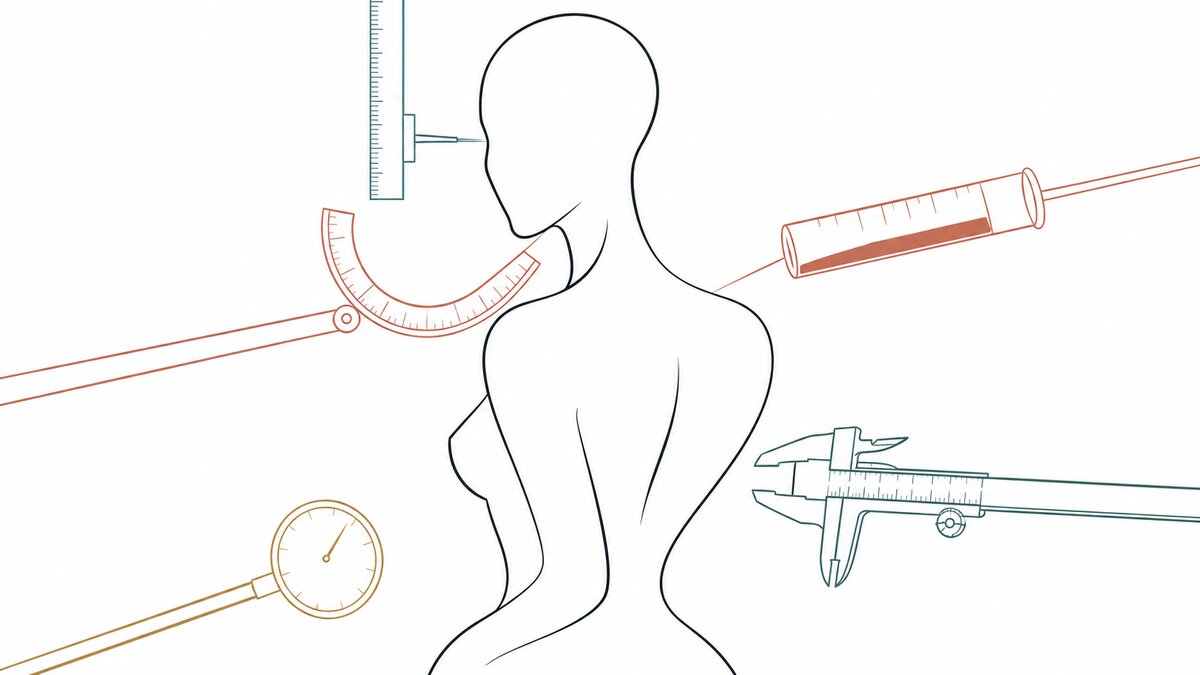
Why does saying “I want it to look natural” not actually tell your surgeon anything?
Because the word names a feeling, not a measurement, and your surgeon has to convert it into a number before the first mark goes on your skin. Two people can say “natural” in the same consultation room and mean targets four millimeters apart, or twenty degrees apart, or two hundred milliliters apart. The surgeon who hears it still has to pick one.
Almost every article written on this subject reassures you that a good surgeon will simply understand. That is the part I want to disagree with. In practice the request arrives without a reference plane, without a number, and often without the patient realizing that a number is required at all. What fills that gap is the surgeon’s own default, which is a real aesthetic position held by a real person, and it may not be yours.
This article is about what the word has to be turned into before it becomes surgery. Every operation has its own target and its own unit: millimeters for an eyelid crease, degrees for a facelift vector, residual thickness for liposuction, an assumed survival percentage for a fat graft, a running total for filler. In each case the number exists, in each case somebody chooses it, and in almost every case the patient never learns what it was.
Is “natural” a technique or a target?
It is a target, and this distinction decides more outcomes than the choice of method does. Two surgeons using the identical technique, both executing it well, will produce different results because they are aiming at different numbers. Nothing went wrong in either operation.
This is not a rhetorical point. It has been measured. In a study of 53 double eyelid surgeons and their own aesthetic preferences, ten cases were reviewed from each surgeon against a shape classification built from 1,605 patients. The shape a surgeon carried on their own eyelids predicted the shape they named as ideal, and that stated ideal in turn predicted the results their patients received. Their own eyelid shape had no direct effect on outcomes at all. It acted through their taste. The target was being set in the room, by a person, with a history.
What makes this hard to see is that the disagreement is not systematic. A survey of 11,153 respondents including 382 plastic surgeons found no significant difference between what patients preferred and what surgeons preferred at population level. So the problem is not that surgeons as a group want something patients as a group do not. It is that the variation is individual, and individual variation is invisible until it lands on your face.
The honest summary is that the profession has barely studied this. When the FACE-Q team built and validated a dedicated instrument for it in 2024, they opened by stating that the concept of “natural” after a facial aesthetic treatment is an understudied area. That is the current state of the evidence, written by the people who went looking for it.
What is the target in each operation?
Each operation has one, each is measurable, and the unit changes with the procedure. The table below is the spine of this article. Everything after it is one row, expanded.
At a Glance: the target set before five operations
| Operation | The target the surgeon actually sets | Unit | What a wrong target produces |
|---|---|---|---|
| Double eyelid | crease height, and what it becomes when the eye opens | millimeters | a fold too high to sit thin, or too low to show |
| Facelift and necklift | the direction of pull, and how much is released | degrees | the pulled or windblown look, or an undercorrected jawline |
| Liposuction | how much fat is deliberately left behind | millimeters of residual thickness | surface irregularity, or a shape that was never asked for |
| Fat grafting | the survival rate assumed, which sets the overfill | percent | too little volume, or a face that stays too full |
| Filler | the running total across every session and injector | milliliters, cumulative | the overfilled face, arrived at one reasonable syringe at a time |

Two things are true of every row. The number is real and the surgeon has one. And in most consultations it is never said out loud, never written down, and never agreed.
Eyelid surgery: how many millimeters, and measured how?
The upper eyelid is measured two different ways and the two conventions do not convert into each other. One measures the height of the crease from the lash line with the eye closed. The other measures how much lid you can see when the eye is open, expressed as a ratio against the space between the crease and the brow. Same eyelid, two rulers, two numbers that both sound like the answer.

In a 12-year series of 362 patients and 724 upper lids, the crease heights selected ranged from 6.0 to 8.0 mm with a median of 7.0 mm. That is the first ruler. The second is tarsal platform show measured against brow fat span, where a widely used reference states the ratio should be 1:1.618, the golden ratio, while a published series of Asian eyelids rejects that figure outright using its own intraoperative measurements.
The conversion between the two rulers is the number patients most need and least often hear. An anatomic crease designed at 7 mm has a vertical equivalent of roughly 5 mm once the eye is open, because the upper tarsus sits at an incline of about 45 to 50 degrees, and that drops to a visible 3 to 4 mm once a fold of 1 to 2 mm overhangs it. A patient asking for “about 7” and a surgeon marking 7 may be picturing results that differ by half.
Anatomy also sets a ceiling. Across 1,272 patients measured during surgery, mean tarsal height was 7.94 mm and the point where the orbital septum fuses with the levator aponeurosis sat at about 10.95 mm. Design a crease above that zone and it meets thicker tissue, so it tends to come out thick and stuck rather than thin and mobile. The full anatomy, the two rulers in detail and the method comparison are set out in incisional versus non-incisional double eyelid surgery; what a fold set too high looks like afterward is in why revision eyelid surgery is needed.
The point for this article is narrower. Nothing above is a technique. It is all target, all in millimeters, and a patient who says “natural” without naming a ruler has left every one of those numbers to somebody else.
Facelift and necklift: in which direction, and how far released?
The target is the vector, meaning the direction the deep tissue is pulled, and it changes the result more than the name of the operation does. This has been tested. In 107 facelifts compared by three blinded external surgeons, the same technique was performed with predominantly oblique-vertical traction in one group and predominantly oblique-horizontal traction in the other, and the vertical group scored significantly better on the cheek, the melolabial fold and the jowls. One operation, two directions, a measurable difference in how the face read afterward.
There is no agreed correct angle. Measuring the zygomaticus major, the muscle usually used as the reference, across 200 hemifaces during deep plane surgery gave a mean of 59 degrees and a range from 41 to 72. The authors state their conclusion without hedging: assumptions about its orientation should not be made in techniques that do not identify its course. A separate analysis of 142 hemifaces reported three different vectors inside one operation, about 71 degrees for the deep layer, 87 for the platysma and 58 for the skin, and found women were lifted more vertically than men.
The neck has the same problem in a different unit. The classic 1980 criterion for a youthful neck put the cervicomental angle between 105 and 120 degrees. A 2016 study of 185 observers rating altered profiles found 90 to 105 degrees acceptable. A 2025 survey of 2,114 respondents found 100 degrees most preferred and states plainly that the ideal is closer to 100 than to the range originally described. Three published ideals, a spread of thirty degrees, and no surgeon can follow all three.
The 2016 study contains the single most useful number in this section, and it is not an ideal angle. It is the threshold at which each group started wanting surgery: 110 degrees for patients, 115 for laypeople, and 125 for clinicians. Patients wanted intervention fifteen degrees earlier than clinicians did. If you and your surgeon disagree about whether your neck needs treating, that gap is measured, published, and has nothing to do with either of you being wrong.
How much is released is the other half of the target, and it is also measurable. In ten cadaveric hemifaces, adding a midline platysmaplasty to a deep plane lift reduced the achievable vertical lift by 40.5 percent, from 37.0 mm of redraped skin to 22.0 mm. Same operation, a different amount of release, a measurably different ceiling on what the lift can do.
The gap worth naming: the windblown look has been described in print since at least 2000, and the opposite error has its own named deformity, but no published study reports how often either happens. No study has ever linked a measured vector angle to what the patient thought of the result. The one decision that most changes how a face reads has never been evaluated against the opinion of the person wearing it. What the overtightened result looks like, and why it is a vector problem rather than a skill problem, is covered in the windblown look after a facelift; the plane comparison is in deep plane versus SMAS.
Liposuction: how much fat is deliberately left behind?
The target is the residual layer, not the amount removed. Patients think in terms of how much comes out. Surgeons work to how thick a layer of fat is left under the skin, because that layer is what the surface drapes over, and published sources give different numbers for it. The buccal fat pad is the extreme case of the same rule. It is taken out as a whole, about 2 mL per side, and it does not regrow. So whether buccal fat removal hollows a face ten years later is decided by how much deep cheek fat that face is going to lose on its own.
One review attributes to Illouz a minimum of 5 mm of fat left under the skin to prevent surface irregularity. Another states a full centimeter. A separate school deliberately suctions the subdermal layer as well, because doing so improves skin retraction. These are not variations in skill. They are three different answers to the question of what your surface should be sitting on, and no trial has ever compared them.
That third position has a measured price. A review of 2,398 superficial liposuction cases reported an overall complication rate of 8.6 percent with contour irregularity the most common, and the authors conclude that superficial liposuction carries potential risks for higher complications than conventional technique. A systematic review of high-definition liposuction across 6,964 patients put the overall complication rate at 14.4 percent with major complications at 0.2 percent and satisfaction at 92.6 percent.
The famous volume ceiling deserves a closer look than it usually gets. The 5,000 mL threshold comes from an American Society of Plastic Surgeons practice advisory, and the same document says, in its own words, that there is no scientific data supporting a specific volume maximum at which liposuction is no longer safe. The 5,000 mL figure is a rule about where you must be operated on, not a proven point where the operation becomes unsafe. Its authors say so.
In practice I work the deep and intermediate fat layers and leave the superficial subdermal layer as undisturbed as I can. I know the literature on superficial liposuction and I have chosen against it for routine cases, because the retraction gain is modest while the penalty for getting it wrong is a permanent surface irregularity rather than a recoverable one. My cannulas are 3 to 5 mm on the abdomen, flanks and thighs, dropping to 3 mm for arms, knees and calves, and I do not go above 2.0 to 2.5 mm in the face and neck. I infiltrate roughly three to four milliliters for every milliliter I intend to aspirate, and I keep total aspirate within 5,000 mL in a single session. Those are targets, and I say them out loud before anyone signs anything.
The satisfaction data points the same way it does everywhere else in this article. Pooling 39 studies and 29,368 patients, the overall complication rate is 2.62 percent and contour deformity is the most common complication at 2.35 percent, which makes it more than a hundred times as common as infection. Meanwhile a study of 609 ultrasound-assisted liposuction patients found satisfaction was independently predicted by body confidence and by not gaining weight afterward, not by any surgical variable. The operation was not what decided whether patients were happy.
One team went as far as recording “unnatural appearance of body contour” as its own complication category, 17 cases in a series of 417. Nothing was infected, nothing needed emergency treatment, and the shape was wrong. That is a target failure written into a complications table.
Whether fat returns elsewhere afterward is genuinely disputed rather than settled. A randomized trial in 32 nonobese women found body fat restored by one year and redistributed from thigh to abdomen. A separate randomized trial in 36 women found no subcutaneous regrowth but a 10 percent compensatory rise in visceral fat, abolished by exercise. A third author argues in print that redistribution is a myth. Patients are usually told one of these three as though it were the answer. The detail is in does fat come back after liposuction.
The gap: no published figure exists for how much weight gain a treated area tolerates before the contour blurs, even though the satisfaction data shows weight gain is what predicts unhappiness. In my practice the neck and submental area begin to show it at about two to three kilograms, and the abdomen and thighs at around five to seven. Those are my observations, not published values, and I say so when I give them.
Fat grafting: what survival rate did your surgeon assume?
The target is a percentage, it is assumed rather than measured, and it decides how much fat goes in. If your surgeon believes half the graft will survive, they inject double what you want. If they believe seventy percent will survive, they inject considerably less for the same intended result. The number is never on the consent form.
We know surgeons disagree about it, because they were asked. In a national survey of 164 fellowship-trained facial plastic surgeons, 81.2 percent said they deliberately overcorrect, most commonly by 10 to 20 percent, while 43 percent expected 41 to 60 percent of the fat to remain beyond a year and 28.9 percent expected 61 to 80 percent. Two surgeons in that survey, treating the same face with the same technique, would inject materially different volumes and both would consider themselves correct.
The literature does not settle it for them. A meta-analysis of 27 studies and 1,011 patients found facial retention ranging from 26 to 83 percent with a pooled figure of 47 percent, and states its conclusion without hedging: the exact percentage retained is currently unpredictable, and the reported rate varies with the estimation method. That last clause matters more than it sounds. The same operation reports a different survival rate depending on whether it was measured by CT, MRI, 3D surface imaging or someone looking at a photograph.
Even holding the surgeon constant, the number moves. In 26 patients treated by the same surgeons, retention was 53.0 percent in patients under 55 and 31 percent in those older, and 23.8 percent in patients having a simultaneous facelift against 47.6 percent in those who were not. A single overcorrection factor cannot be right for all four of those patients.
And the injected volumes themselves vary enormously. A systematic review of injection volumes by facial subunit across 19 articles and 510 patients reports a mean of 6.7 mL for the chin with a range from 1.0 to 20.0 mL, and states that the amount to inject is not standardized and has been based mainly on the surgeon’s experience. Twenty-fold variation for one part of one face. Some of that is genuine anatomical difference between patients. Not twenty-fold of it.
There is a published position directly opposed to overcorrecting, which is worth knowing exists. Some surgeons deliberately undershoot and plan a second session, beginning with the expectation that the first graft will be small and additional volume added later if a contour defect remains. Same operation, opposite target policy, both in print.
My own approach is arithmetic stated in front of the patient. If an area needs the equivalent of 100 cc of lasting volume and realistic retention there is about half, I plan to place roughly 200 cc so the survivors land on target. Where the volume wanted exceeds what one session can safely nourish, the answer is staging rather than overloading, because fat injected beyond what the blood supply can feed does not survive, it dies. I give the assumed retention figure and the resulting injection volume before surgery, not after. The full biology is in how much transplanted fat actually lasts.
The gap here is the largest in this article. No study has ever validated an overcorrection factor. Not 10 percent, not 20, not 100. Four out of five surgeons apply one, and no prospective trial has compared factors against final volume or patient satisfaction. Nor has any study measured whether patients are told which factor was used.
Fillers: what is the running total?
The target is cumulative volume across every session and every injector, and almost nobody is keeping it. This is the one procedure in this article where the target is not merely undisclosed. It usually does not exist.
Start with the regulator. The United States Food and Drug Administration states on its own patient page that the safety of these products used repeatedly over a long period of time has not been evaluated in a controlled, clinical study. That is not a critic’s claim. It is the approving body saying the repeated-use question was never asked.
Product labeling reflects that. One major manufacturer sets a limit of 20 mL per 60 kg of body mass per year, derived from preclinical studies. Another gives only per-session maxima and no annual figure at all. Neither addresses year two, and none addresses a lifetime.
Meanwhile the material lasts far longer than the marketing does. In an MRI review of 33 patients who had not been injected in the mid-face for at least two years, filler was still detectable in every one of them, with one patient showing it fifteen years after injection. The authors’ own conclusion is that refilling and top-ups as commonly performed will require reconsideration. Independently, surgeons removing skin cancers found hyaluronic acid filler in tissue up to 10.75 years after implantation, most often sitting in subcutaneous fat, in a series where only 19 of 36 patients could remember when they had been injected.
Read that last figure again. Seventeen of thirty-six people could not date their own filler. The running total does not exist on the patient’s side of the consultation either.
The target also drifts, and one clinic published the drift itself. A retrospective review of 66 consecutive full-face filler patients reported a mean of 4.7 syringes per patient, then noted in the same paper that in the time since, the clinic’s own recommendation had risen to a mean of around eight. A seventy percent increase in the house target, with no trial and no guideline behind it, and no announcement to anyone being treated.
None of this is an execution problem. Ultrasound verification of 100 facial injections found the product stayed in the intended tissue plane in approximately 90 percent of cases at day 30, and a cohort of 101,547 filler treatments reported a hyaluronic acid complication rate of 0.106 percent, about one in 945. The needle goes where it is aimed and almost nothing goes wrong. What has never been capped, measured or written down is the total.
Undoing it is not free either. In a series of 157 orbits in 90 patients treated with hyaluronidase, 59 percent had a satisfactory result, 24 percent needed further hyaluronidase because the first treatment was insufficient, and 18 percent were left complaining of facial hollowing. More enzyme did not help: outcomes did not differ significantly between dosage groups. The authors do say one thing directly, and it is the closest the whole literature comes to naming the target of this section: patients with longer filler histories and higher total volumes should be advised of the increased risk.
In practice I dissolve before I operate, not after. When a patient arrives for a facelift having had years of filler, I inject hyaluronidase directly into the filler and give an adequate dose in a single session rather than dividing it, and I do not operate immediately afterward. In lips I dissolve in stages and wait a minimum of two weeks before evaluating for any re-injection. The reason is not preference. When I lift a face that has been injected repeatedly I encounter the filler during dissection in the majority of cases, the planes no longer separate the way they should, and bleeding increases. The detail is in the overfilled face and, for lips specifically, in lip filler migration.
The gap: no study has ever measured cumulative lifetime filler volume in any population, no label states a lifetime maximum, and no dataset follows a patient across multiple injectors, which is the exact situation almost every long-term filler patient is in. The profession has named the outcome, calling it facial overfilled syndrome, without ever quantifying the dose that produces it.
How I set a target, and what I write down
Here is my own position, and it is not the one you will read elsewhere. I do not think of surgery as adding attractiveness to a face or a body. I think of it as returning it to the form it was already heading toward before something interrupted it.
Every eyelid had a trajectory. In some, the septum fused low and the levator’s pull never reached the skin, so a crease that would have existed never formed. Every face had one too, before the retaining ligaments loosened and the deep compartments descended. My job is not to import a shape from a photograph. It is to work out where this particular anatomy was going and remove what stopped it. That is what I mean by the word natural, and it is why my answer to “make me look like her” is usually no.
Four things follow from that, and they apply whatever the operation is.
The number goes on the chart and the patient sees it before anything is marked. If someone tells me they want a crease higher than their tarsal height and fusion point will support, I say that in millimeters rather than in adjectives. Telling a patient a request is unrealistic communicates nothing. Telling them the tarsus is under 8 mm and the fold they are describing sits above 11 mm gives them the same information I have. The same applies to an assumed fat retention figure and the injection volume it produces, and to how much aspirate I intend to take.
I check the result in motion wherever the anatomy allows it. Under midazolam and ketamine sedation an eyelid patient is woken partway through the operation and asked to open and close the eyes, and I look at the crease moving rather than at a static line on a sedated face. A crease judged only in a closed, motionless lid has been judged in the one state in which nobody will ever see it.
I say what is given up to get what was asked for. A fold linked to the levator disappears when the eye closes and looks like one somebody was born with, and it has less raw holding power than a fold fixed straight to the tarsus. Releasing the retaining ligaments completely rather than partially gives a facelift more movement to work with and takes longer under anesthesia. Leaving the subdermal fat layer intact in liposuction costs some skin retraction and buys a surface I can still fix. Each of those is a trade, and a patient who was not told about it did not choose it.
And I decline. I do not operate on a patient whose stated target cannot be produced by their anatomy, and I do not operate on someone whose reference is a photograph of a different person’s bone structure. The reason is not caution. A technically clean operation delivered to the wrong target is a failure I often cannot revise my way out of. Lowering an eyelid crease is limited by skin that is no longer there. Fat that has been overfilled into a face is, in the words of one published series, very difficult to repair.
Can surgery be technically successful and still leave you unhappy?
Yes, and this is the failure mode patients are least warned about, because dissatisfaction and complication are different things and a result can be one without being the other.
In a chart review of 369 consecutive cosmetic rhinoplasties, the complication rate was 7.9 percent, the revision rate was 9.8 percent, and the dissatisfaction rate was 15.4 percent, while surgeons judged 87 percent of those patients to have had successful anatomical correction. Dissatisfaction ran at roughly twice the complication rate in a series where the anatomy was fixed. Something other than technique was failing.

The same gap appears in every procedure in this article. Facelift carries a major complication rate of 1.8 percent across 11,300 patients, while pooled satisfaction across 2,896 patients leaves between five and twelve percent unsatisfied depending on the technique group. Liposuction is safer still at 0.7 percent major complications across 31,010 procedures, yet contour deformity is the most common thing that goes wrong with it. Filler complications sit near one in 945 while the overfilled face has a name and no measured incidence. These are two different literatures and they should not be subtracted from one another, but the direction is consistent across five operations: the rate of being unhappy exceeds the rate of being harmed.
The eyelid data names the mechanism. A seven-year review of 138 patient complaints arising from 38,230 blepharoplasty procedures found asymmetry the most frequent cause of dissatisfaction and asymmetric crease height the largest subcategory inside it, and the authors suggest this may come from inaccurate measurement during the surgical planning phase. Planning is where the target lives.
Expectation is the other half. A cross-sectional study of 500 upper blepharoplasty patients found 88 percent reported some social media influence on their decision, with satisfaction lowest in the strongly influenced group at 86 percent against 93 to 96 percent elsewhere, and the leading complaints were scarring and swelling beyond what was expected rather than aesthetic failure. It is a single center published in 2026, so read it as a signal. A systematic review of negative predictors for satisfaction in patients seeking facial cosmetic surgery names unrealistic expectations and minimal deformities among the recurring ones.
Some of this is clinical rather than aesthetic. A meta-analysis of 65 studies and 17,107 patients put pooled body dysmorphic disorder prevalence at 18.6 percent, and 21.6 percent within plastic surgery specifically. More pointedly, a multicenter study of 597 patients found surgeons correctly identified only 2 of the 43 screen-positive patients they assessed, 4.7 percent. Clinical intuition does not detect this, which is why a screening questionnaire in the waiting room is better practice than a surgeon’s impression, and why a surgeon declining to operate is sometimes the most skilled thing that happens in the room.
Which patient are you?
Four patients ask for “natural” and mean four different things by it. Find the one that describes you, then say it in the words underneath rather than in the word itself.
You want a change nobody will attribute to surgery. Your target is the smallest one that still reads, and the trade is durability or repeat treatment. Say that in those words. It is a real trade, not a sales objection.
You want a visible, defined result. This is a legitimate target and not a lesser one, but it is a different one, and asking for it while saying “natural” is how the mismatch happens. Bring a number and a reference plane.
You are coming to Korea from elsewhere. This is the case where silence is most expensive. A busy Korean practice has a house default, and that default is a good answer to the question most of its patients are asking. It may not be the question you are asking. If you do not state a target, the default is what you will receive, and it will be executed well.
You already had something done and something is wrong that nobody can name. If it healed, if it is symmetric and it is technically sound, but you do not recognize yourself, the problem is the target, not the execution. That is a real category and it is more common than the complication rate suggests.
What to say instead of “natural”
Replace the word with four things: a reference plane, a number, photographs of yourself rather than of anyone else, and one question that forces the surgeon’s target into the open. The consultation changes character.

Give a reference plane. For an eyelid, say whether you mean the crease measured with the eye closed or the lid you want visible with the eye open. For a neck, say whether you are describing the angle at rest or in the photographs that bother you. These are different measurements and confusing them is the commonest source of mismatch.
Give a number, or ask for one. Every operation in this article has a unit. If you do not have a figure, ask your surgeon to write down the one they intend and show it to you before marking. Any surgeon planning properly already has it.
Bring photographs of yourself, not of anyone else. Ideally from a period you liked. Bone structure is not transferable, and an image of another person imports theirs. Camera distance is worth knowing about here: it stretches the midface vertically by 12 to 19 percent at selfie range and changes eye-to-nose distance, though periorbital measurements hold up better than the rest of the face across camera distances. An old photograph of your own face is worth more to me than any reference image, because it shows where your anatomy was before it changed.
Ask one question that forces the target into the open: what number are you aiming at, what is my equivalent measurement, and what does that plan do when I move? A surgeon who has measured will answer in seconds. A surgeon who has not will answer with adjectives.
Surgeon’s Insight
The most difficult conversation in my clinic is not about risk. It is with the patient whose surgery went well and who is unhappy anyway. Nothing is asymmetric, nothing is infected, everything sits where it was drawn. What went wrong is that nobody wrote down the target, so the surgeon supplied one, and the patient only discovered what it was after it was permanent. That is not a complication. It is a failure of translation, and it happens before anyone picks up a blade. I would rather spend twenty extra minutes converting a word into a number than spend a year trying to undo a result that was executed perfectly and aimed wrongly.
The question to ask before anyone touches your face
Do not open with the procedure. Open with the target.
Ask what form your anatomy was heading toward, and what specifically prevented it. A surgeon who examines you in motion, measures the dimension that governs your operation, tells you what it will and will not support, and names a number has given you a plan. A practice that answers with a method name and a booking date has given you a product, and the whole difference between a result you recognize and one you tolerate is which of the two you walk out holding.
Written by Dr. Yongwoo Lee, board-certified Korean plastic surgery specialist in facial anatomy and aesthetic procedures at VIP Plastic Surgery, South Korea.
Frequently Asked Questions About Natural Results in Plastic Surgery
What does “natural” actually mean in plastic surgery?
It is a target rather than a technique. The word describes a result you want but not the measurement needed to produce it, so the surgeon converts it into a number before marking. As a measurable construct it barely exists in the outcome literature: the first validated instrument for natural appearance after facial aesthetic treatment was published in 2024, and its developers opened by calling the concept understudied. The conversion happens anyway, silently, in every consultation.
Why do two surgeons using the same technique get different results?
Because they are aiming at different numbers. Across 11,153 survey respondents, 382 of them plastic surgeons, preference did not differ significantly between the two groups. Yet in a separate study of 53 surgeons, each surgeon’s personal aesthetic predicted the results their patients received. Both can be true at once, and that is the whole problem: the mismatch is not between two groups, it is between two people in one room.
How is eyelid crease height actually measured?
Two ways, and they give different numbers on the same eyelid. Crease height is measured in millimeters from the lash line, usually with the eye closed. Tarsal platform show is how much lid is visible with the eye open, expressed as a ratio against the distance from crease to brow. A crease designed at 7 mm has a vertical equivalent of roughly 5 mm once the eye opens, dropping to 3 to 4 mm visible once a fold overhangs it. Ask which of the two your surgeon is quoting.
Is there a correct vector for a facelift?
No single published angle applies to everyone. Measuring the zygomaticus major across 200 hemifaces gave a mean of 59 degrees with a range from 41 to 72, and the authors state that assumptions about its orientation should not be made in techniques that do not identify its course. A separate analysis found three different vectors within one operation, roughly 71 degrees for the deep layer, 87 for the platysma and 58 for the skin. What is established is that the direction matters: in 107 facelifts rated by blinded surgeons, oblique-vertical traction scored significantly better than oblique-horizontal with the technique held constant.
What is the ideal neck angle after a necklift?
The published ideals disagree by about thirty degrees. The classic 1980 criterion gives 105 to 120 degrees, a 2016 rating study found 90 to 105 acceptable, and a 2025 survey of 2,114 respondents found 100 degrees most preferred and stated that the ideal sits closer to 100 than to the original range. More useful than any of those is the threshold at which people start wanting surgery, which was measured at 110 degrees for patients, 115 for laypeople and 125 for clinicians. Patients want intervention about fifteen degrees earlier than clinicians do.
How much fat should be left behind in liposuction?
Published sources give different answers, from about 5 mm of residual subcutaneous fat to a full centimeter, while a separate school deliberately suctions the subdermal layer as well to improve skin retraction. No trial has ever compared them head to head. The choice has a measured cost: a review of 2,398 superficial liposuction cases reported an 8.6 percent complication rate with contour irregularity the most common, and its authors conclude that superficial technique carries potential risks for higher complications.
Is the 5,000 mL liposuction limit a safety threshold?
Not in the way it is usually described. The figure comes from an American Society of Plastic Surgeons practice advisory, and the same document states that no scientific data support a specific volume maximum at which liposuction stops being safe. What the advisory actually requires is that large-volume cases be performed in an accredited or licensed facility. It is a rule about the setting, not a proven biological ceiling.
Does fat come back somewhere else after liposuction?
The literature genuinely disagrees. One randomized trial in 32 nonobese women found body fat restored by one year and redistributed from thigh to abdomen. A separate randomized trial in 36 women found no subcutaneous regrowth but a 10 percent compensatory increase in visceral fat, which exercise abolished. A third author argues in print that redistribution is a myth. Patients are usually told whichever of the three their surgeon believes.
What percentage of a fat graft actually survives?
Nobody can tell you precisely, and the meta-analysis says so. Pooling 27 studies and 1,011 facial fat grafting patients gave retention ranging from 26 to 83 percent with a pooled figure of 47 percent, and the authors conclude that the exact percentage is currently unpredictable and varies with the estimation method. The number also moves with the patient: in one series retention was 53 percent under age 55 against 31 percent over, and 23.8 percent when a facelift was done at the same time against 47.6 percent when it was not.
Why do surgeons inject more fat than the result they want?
Because a predictable fraction will not survive, so the injected volume is the target divided by the assumed survival rate. In a national survey of 164 facial plastic surgeons, 81.2 percent said they deliberately overcorrect, most commonly by 10 to 20 percent, while 43 percent expected 41 to 60 percent retention and 28.9 percent expected 61 to 80 percent. Those two beliefs produce materially different injection volumes for the same intended result. Ask which figure your surgeon is using.
How long does dermal filler actually last?
Far longer than the marketed duration. In an MRI review of 33 patients who had not been injected in the mid-face for at least two years, filler was detectable in every one of them, with one showing it fifteen years after injection. Separately, surgeons operating for skin cancer found hyaluronic acid still present in tissue up to 10.75 years after implantation. The clinical effect fading is not the same as the material being gone.
Is there a limit on how much filler I can have over a lifetime?
No published lifetime maximum exists. One manufacturer sets an annual figure of 20 mL per 60 kg of body mass, derived from preclinical studies; another gives only per-session maxima. The FDA states on its own patient page that the safety of these products used repeatedly over a long period of time has not been evaluated in a controlled clinical study. No study has ever measured cumulative lifetime filler volume in any population, and no dataset follows a patient across multiple injectors, which is the situation most long-term filler patients are actually in.
Does dissolving filler put everything back to how it was?
Not reliably. In a series of 157 orbits in 90 patients treated with hyaluronidase, 59 percent had a satisfactory result, 24 percent required further treatment because the first was insufficient, and 18 percent were left complaining of facial hollowing. Outcomes did not differ significantly between dosage groups, so more enzyme was not the answer. The authors advise that patients with longer filler histories and higher total volumes be warned of the increased risk.
Can an operation be technically successful and still leave me unhappy?
Yes, and it is more common than being harmed. In a review of 369 cosmetic rhinoplasties the complication rate was 7.9 percent while the dissatisfaction rate was 15.4 percent, and surgeons judged 87 percent of those patients anatomically corrected. The same pattern holds across facelift, liposuction and filler: the rate of dissatisfaction consistently exceeds the rate of complication. A result can be symmetric, safe and healed, and still be aimed at the wrong target.
What single question should I ask my surgeon?
Ask what number they are aiming at, what your own equivalent measurement is, and what the plan does when you move. Every operation in this article has a unit, whether that is millimeters of crease height, degrees of vector, residual fat thickness, an assumed survival percentage, or a cumulative volume. A surgeon who has measured answers immediately. A surgeon who has not answers with adjectives.
This article is for informational purposes only and does not constitute medical advice. Always consult with a qualified medical professional before making any decisions about surgical or non-surgical procedures.