
A Thread Lift Is Not a Small Facelift
A thread lift, routinely sold as the non-surgical facelift, and a facelift itself are presented as two sizes of the same idea, a little lift and a big one, and that framing is the source of most of the disappointment that follows. The two procedures do not do the same thing at different intensities. A facelift repositions the deep support layer of the face and removes skin that no longer fits; a thread lift places barbed sutures under the skin and asks them to hold soft tissue against gravity until the sutures dissolve. One changes the architecture; the other leans a prop against it.
The short answer: a thread lift can produce a real but modest lift in a face with mild sagging and good skin, and the best current evidence puts the visible effect in months, not years. A facelift produces a larger change that survives long enough to be measured in years, at the price of surgery, incisions, and real recovery. Neither is a scam and neither is obsolete. They are different tools, and the honest question is not which one is better but which one your face has already outgrown.
This guide goes through what barbed threads actually do under the skin, what the published follow-up data show about how long the effect lasts, what the pooled complication numbers look like across thousands of patients, what threads can leave behind for a future operation, and who genuinely belongs in each chair.
How Does a Thread Lift Work?
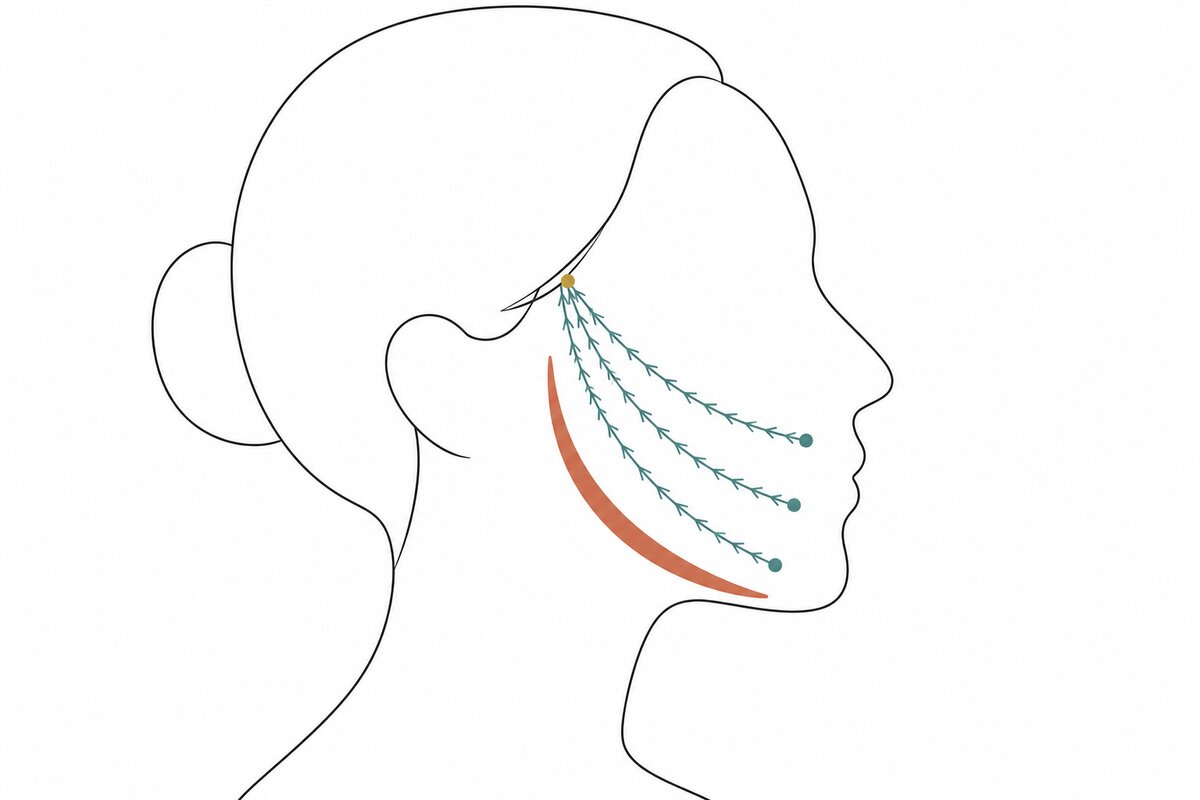
A thread lift passes absorbable barbed sutures through the subcutaneous fat with a needle or cannula, hooks the tissue on the barbs, and anchors the threads toward the temple or hairline so the cheek and jowl sit slightly higher. There is no incision beyond entry points, no tissue is removed, and nothing is cut loose and repositioned. The procedure runs under local anesthesia in well under an hour, and most patients present socially within days. That accessibility is the product’s entire appeal, and it is real.
Two materials dominate. Polydioxanone, the PDO of Korean thread lifting, dissolves in the body over several months; poly-L-lactic acid and related polymers last longer. The marketing adds a second mechanism, collagen stimulation: as the threads dissolve they provoke a controlled inflammatory response that recruits fibroblasts and new collagen along the thread track. That collagen is real. What it builds is a fine fibrous seam around a dissolving suture, not a new ligament, and it does not hold a jowl where the barbs used to.
The most precise description of what a thread lift does comes, fittingly, from a regulator. In the United States, the clearance for one of the best-known suspension sutures states its purpose as mid-face suspension surgery to temporarily fixate the cheek subdermis in an elevated position. Temporarily fixate. Not lift, not restore, not rejuvenate. It is a fair sentence, and every consultation about threads should start from it.

How Long Does a Thread Lift Last? What Follow-Up Studies Show
Published follow-up puts the visible lift of an absorbable thread lift at somewhere between several months and roughly a year, and the most credible end of that range comes from the people with the least reason to undersell it. A panel of Korean physicians convened around one of the most widely used PDO threads, asked to state expected duration, put it plainly: treatment effects are sustained for a maximum period of approximately eight months. Eight months is the ceiling claimed by experienced advocates describing their own preferred device.
The most cited independent series is harsher. A retrospective study of 160 consecutive patients lifted with barbed PDO threads found the immediate improvement held at one month, declined noticeably by six months, and was absent at one year. Not diminished at one year: absent. The authors, publishing in a major aesthetic surgery journal, concluded that the procedure was best limited to patients with contraindications to more invasive facial surgery.
Optimistic reviews claim more, up to 18 to 24 months when thread types are combined, and refined techniques keep evolving. But notice what even the optimistic number concedes. Two years is the best case for the best combination, and the mechanism explains why the clock cannot be beaten: the polymer dissolves on a fixed biological schedule, the barbs are microscopic hooks in mobile fat rather than sutures anchored in firm connective tissue, and a face moves thousands of times a day. A thread lift that fades on schedule has not failed through bad technique. It expires by design, and the expiry is written into its regulatory indication.
For comparison, surgical suspension sutures anchored in surgically prepared tissue have published follow-up measured in years, including one open suture-suspension neck technique with results documented out to 13 years. The difference is not the suture; it is what the suture is fixed to, and how the tissue around it was prepared to hold.

What a Facelift Does That No Thread Can
A facelift operates on the layer that actually sags. In a deep plane facelift, the surgeon raises the skin and the SMAS, the muscular fascia of the face, as a composite flap, releases the retaining ligaments that tether the midface and jawline, repositions the descended fat pads of the cheek, and closes the skin without tension because the lifting load is carried at the fascial level. Skin that no longer fits the face is removed rather than persuaded. This site has covered the anatomy of that operation, and how it differs from older SMAS techniques, in deep plane versus SMAS facelifts.
The comparison with threads is not a matter of degree but of address. Barbed threads run through subcutaneous fat, one layer above the structures a facelift repositions. Ligaments that still tether the sagging tissue are not released by a thread; skin excess is not removed by a thread; a deep, heavy jowl is not carried by a filament of dissolving polymer. Threads borrow against tissue that is still fundamentally in place. A facelift is for faces where it no longer is.
Surgery buys durability at surgical prices: general anesthesia or deep sedation, incisions around the ears, a hematoma risk under 2 percent in most series, one this site has examined in how surgeons prevent hematoma after a facelift, and a recovery counted in weeks. It also buys the possibility of failure at a larger scale; an over-tightened, flattened result is its own recognizable deformity, covered in why some facelifts look windblown. The point of naming these risks is not to score them against threads. It is that both procedures charge for what they deliver, and only one of them delivers years.
Thread Lift Complications and Side Effects: Pooled Data From 2,827 Patients
Across a meta-analysis of 26 studies covering 2,827 thread lift patients, the pooled numbers were: early swelling in somewhere between 16 and 34 percent depending on how the studies are pooled, bruising in about 26 percent, visible or palpable threads in about 10 percent, skin dimpling in about 7 percent, sensory disturbance in about 6 percent, thread exposure through the skin in about 5 percent, and infection in about 2 percent. Swelling and bruising are nuisances of any needle procedure. The rest deserve a slower read, because the searches for “thread lift gone wrong” are not describing rare events.
Set those middle numbers against the procedure’s lifespan. Roughly one patient in ten can see or feel the device that was supposed to be invisible, and one in twenty has had a thread work its way out through the skin, for a lift that the same literature struggles to document past a year. The 160-patient series above reported, by a different measure, an overall early complication rate of 34 percent, counting every event together, driven by thread displacement, redness, infection, and dimpling.
Fairness requires two footnotes. First, different threads behave differently, and surgeons who specialize in suspension techniques argue that lumping every thread type into one complication figure misleads. Second, those same specialists report refined methods with complication rates below 2 percent in experienced hands. Both footnotes argue for the same conclusion this article keeps reaching: outcome quality in thread lifting tracks the operator and the selection, not the thread. The procedure is quick to perform and easy to perform badly, and the barrier to offering it is low. That combination, not the polymer, is where most disasters come from.

What Thread Lifts Leave Behind: Scar Tissue and the Future Facelift
The least discussed finding in the thread lift literature is what remains after the lift is gone. Threads dissolve; the tracks do not. Each suture leaves a seam of fibrosis along its path, and repeated rounds of threads, the standard maintenance model, multiply those seams through the exact tissue plane a future facelift must elevate.
Surgeons are now publishing what that means in practice. A 2025 case series of facelifts performed on patients who had undergone two or more prior thread lifts described fibrosis, tissue distortion, fusion of anatomical layers, and reduced mobility of the SMAS, with operations that ran longer and dissected harder than in untreated faces. Seven of the ten patients showed suboptimal skin redraping or dimpling after surgery. The authors’ summary sentence deserves to be quoted wherever threads are sold: the thread lifting procedure leads to tissue changes that last much longer than the lifting effect of the threads.
This does not mean a thread lift makes a facelift impossible; it means the convenient procedure quietly borrows from the definitive one. A patient who spends her late forties on maintenance threads may arrive at her facelift with a face that is technically harder to operate on than if she had done nothing at all. That trade can still be reasonable. It should simply be made out loud, before the first thread, not discovered in the operating room years later. What a face in its forties has usually lost, and what it has not, is measured in what ages at 40, 50, 60 and 70.
Who Is Actually a Good Candidate for a Thread Lift
A good thread lift candidate is a patient whose sagging is early and mild, whose skin is neither heavy nor excessive, and whose expectations fit inside a small, temporary result, and on that narrow ground the procedure earns its place. Early jowl softening in a patient in her late thirties or forties. A midface that has begun to descend but still snaps back. A patient with a fixed reason to avoid surgery, medical or personal, who accepts months of effect as the deal.
Selection is also where technique earns its keep. Korean practitioners, working with a strong cultural preference against widened cheekbones, developed vertical vector techniques specifically for Asian faces, inserting short threads vertically so the lift opposes vertical sag without dragging tissue laterally over the zygoma, the cheekbone. In a 39-patient series the approach satisfied about 90 percent of patients at six months. Six months, again, is the follow-up window; the lesson is that a well-designed thread lift can be genuinely worth having and still be temporary.
The disqualifiers are the mirror image, and they are the same findings that define a facelift candidate: jowls that hang rather than soften, skin that stays folded when pinched, and deep nasolabial and marionette folds backed by descended fat pads. Any neck with real laxity belongs on the list too, a problem threads reach even less than the face and one this site maps layer by layer in neck liposuction versus a neck lift. Hanging a heavy face on dissolving barbs does not postpone a facelift. It prepays for a harder one.
Surgeon’s Insight
When a patient asks me for threads, I do not hear a request for a product; I hear a request for a smaller decision, and my job is to say out loud what the smaller decision buys and what it does not. If the sag is early, the skin recoils, and the patient accepts a result measured in months, threads are a legitimate choice and I say so. When the examination shows skin excess and tissue that has slid past ligaments still holding, I state that trade in full and I will not pretend threads can carry it; the anatomy has already voted for a different operation, and a device built to dissolve cannot overrule it. The conversation I insist on is the same one I have before any procedure on this site: here is what this buys, here is what it trades away, and I want to hear the patient say it back to me before anyone lies down on a table.
Thread Lift vs. Facelift at a Glance
A thread lift suspends tissue temporarily from within the fat layer; a facelift repositions the support structure itself and removes what no longer fits. The table compresses everything above into one look.
| Decision point | Thread lift | Facelift |
|---|---|---|
| What it does | Barbed absorbable sutures suspend soft tissue | Repositions SMAS, releases ligaments, removes excess skin |
| Layer addressed | Subcutaneous fat | SMAS, retaining ligaments, skin envelope |
| Documented duration | Months; about 8 months claimed by advocates, absent at 1 year in independent follow-up | Years; deep-support repairs documented lasting past a decade |
| Anesthesia | Local, sometimes light sedation | Deep sedation or general |
| Downtime | Days | Presentable around two weeks, socially fluent by four to six, months for final contour |
| Scars | Entry points only | Around the ears, fine when well executed |
| Key risks | Dimpling, visible or extruding threads, migration, infection | Hematoma, nerve injury (rare), visible scarring, over-tightened look |
| Repeatability | Designed to be repeated; each round adds scar tissue | Revision possible but not routine maintenance |
| Right face | Mild, early sagging with good skin recoil | Established jowls, skin excess, tissue tethered by unreleased ligaments |
| Wrong use | Heavy jowls, loose neck, skin excess | A face whose laxity a device or thread could still handle |
Thread Lift Recovery vs. Facelift Recovery: Days vs. Weeks
Thread lift recovery is measured in days, facelift recovery in weeks, and each timeline is the price tag of its result. For threads, recovery mostly consists of protecting the anchors: swelling and bruising for several days, a pulling or tight sensation for a week or two, and instructions to avoid wide mouth opening, hard chewing, and sleeping face-down early on so the barbs are not unseated before tissue settles around them. Dimples and puckering at entry points usually smooth within a couple of weeks; persistent tethering beyond a month is a reason to go back, not to wait politely.
Facelift recovery runs on the surgical clock this site has described before: sutures out around one week, strenuous activity held for two, presentable for private life at around two weeks, socially fluent over four to six, and a final contour that declares itself across months. The comparison is fair only when both clocks are shown next to both results: days of downtime for months of effect, or weeks of downtime for years of it.
Where Thread Lifts Sit Between Devices and Surgery
On the ladder of lifting options, threads occupy exactly one rung: above energy devices, below surgery, and narrower than either neighbor. Ultrasound and radiofrequency devices firm the skin and lift modestly by remodeling tissue with heat, but suspend nothing mechanically, a distinction this site draws in the skin-tightening guide to Ultherapy, Thermage, and Shurink; threads add actual mechanical suspension, briefly; surgery re-seats the structure. A patient climbing that ladder rung by rung, device to threads to facelift, is often not progressing but stalling, spending the years in which her tissue quality is best on measures her anatomy has already outgrown.
The frame that cuts through the menu is the same one this site applies everywhere, including in what natural actually means in plastic surgery: match the procedure to the layer that failed, at the scale it failed. A face with mild subcutaneous descent and good skin has a real, if temporary, option in threads. A face with structural descent has a structural option. The expensive mistake, in time and in tissue, is buying the small answer to the large question twice a year and calling it caution.
Written by Dr. Yongwoo Lee, board-certified Korean plastic surgery specialist in facial anatomy and aesthetic procedures at VIP Plastic Surgery, South Korea.
Frequently Asked Questions About Thread Lifts and Facelifts
Is a thread lift better than a facelift?
Neither is better; they answer different findings. A thread lift is the right tool for mild, early sagging in skin with good recoil, delivering a limited lift for months with days of downtime. A facelift is the right tool for established jowls, skin excess, and tissue tethered by unreleased ligaments, delivering a structural change measured in years. The wrong choice is not picking the weaker procedure; it is picking the one your examination did not call for.
How long does a thread lift really last?
Plan on months. A Korean expert panel working with one of the most used PDO threads put the maximum at about eight months, and an independent 160-patient study found the effect gone at one year. Claims of 18 to 24 months exist for combined thread techniques, but they are the optimistic edge of the literature, not its center. If a clinic quotes years for absorbable threads, ask which study they are quoting.
Is a thread lift worth it?
For the right face, yes, provided it is understood as a renewal rather than a repair: a result you re-earn every several months, not one you keep. A patient with early, mild sagging and good skin can get a genuine refresh with days of downtime. The value collapses when the face is too heavy for threads, because the result disappoints immediately, or when rounds are repeated for years, because the cumulative scar tissue starts to tax the facelift that usually follows.
What does a thread lift do that Ultherapy or Thermage cannot?
It mechanically suspends tissue. Energy devices firm the skin and produce a modest heat-driven lift over months, but they hold nothing; a thread physically carries soft tissue in a higher position while it lasts. The reverse is also true: devices improve skin quality, which threads do only marginally along their tracks. They answer different failures, which is why clinics so often sell them together.
What does a thread lift gone wrong look like?
Most often it looks like a thread you can see or feel: a visible line under the cheek skin, dimpling or puckering where a barb tethers, numbness along a track, or a thread tip working its way out through the skin. And these are not rare events: across 2,827 pooled patients, roughly 10 percent had visible or palpable threads, 7 percent dimpling, 6 percent sensory disturbance, and 5 percent thread exposure through the skin. Most problems are correctable, some only by removing the thread. The two biggest protections are boring ones: an experienced injector-surgeon who examines rather than sells, and conservative thread counts on a suitable face.
Do PDO threads really stimulate collagen?
They do, along the track of each thread, as part of the inflammatory response to a dissolving polymer. What that collagen amounts to is a fine fibrous seam, useful for mild skin-quality change, incapable of bearing a jowl. Collagen stimulation is the reason thread marketing survives the duration data; it is not a reason a sagging face stays lifted.
Can a thread lift be removed?
Early on, often yes: a freshly placed thread can be released or extracted, and visible dimpling can sometimes be freed by loosening the tether. Once months have passed and the polymer has begun to dissolve into surrounding fibrosis, removal becomes partial at best. This is worth knowing beforehand, because it reverses the usual intuition: the reversible-sounding procedure is only reversible at the start.
Does a thread lift ruin a future facelift?
Ruin is too strong; tax is accurate. Surgeons operating on faces after repeated thread lifts report fibrosis, fused tissue planes, and a stiffer SMAS, with longer operations and more postoperative dimpling and redraping problems. One or two rounds in the distant past rarely change much. Years of maintenance threading through the same plane is a different story, and it belongs in the consent conversation for round one.
What is the difference between a thread lift and a mini facelift?
A mini facelift is still surgery: smaller incisions, a shorter scar, actual repositioning of tissue and removal of some skin, with results that outlast any thread. A thread lift involves no incisions and no removal. The marketing places them side by side because both sound smaller than a full facelift, but the mini lift lives on the surgical side of the line, threads on the temporary side. What the mini lift leaves out, and why the neck is where it comes undone, is covered in mini facelift versus full facelift.
What should thread lift before and after photos show?
Honest before and after photos show a subtle elevation of the jowl and midface, millimeters rather than centimeters, photographed under matching light between one and six months after the procedure. Two warning signs: photos taken in the first week, when swelling itself mimics a fuller, lifted contour, and portfolios with no image past the one-year mark, the point at which the published data say the effect is gone. A clinic that shows its twelve-month results is showing you what actually persists; one that only shows day seven is showing you the swelling.
How many threads are needed for a thread lift?
Published series typically place two to four threads per side per region, and the largest independent PDO series used exactly that range for the midface and jawline. More threads do not buy proportionally more lift, because the limit is what mobile fat can hold, not how many barbs are in it. Escalating thread counts quoted for a heavy face are a red flag: the honest reading of a face that seems to need ten threads per side is that it needs a different procedure.
Is the MINT lift different from other thread lifts?
MINT is a widely used Korean barbed PDO thread with its own molding process and a large body of practitioner experience behind it, and Korean panels have published protocols around it. It is still an absorbable PDO device, which means the duration physics are the same: its own expert users state the effect in months. Brand refinements change comfort, anchoring, and complication profiles more than they change the calendar.
Do thread lifts work on jowls?
On early, soft jowls in a face with good skin, yes, temporarily. On established jowls that hang below the jawline, no, and this is the single most common mismatch in thread lift consultations. A hanging jowl is descended fat held back by a ligament that has not been released, under skin that no longer fits, three findings a subcutaneous barb cannot address. That anatomy is facelift territory.
Do thread lifts work on the neck?
Less than anywhere else on the face. Neck laxity is usually skin excess plus loosened platysma muscle, sometimes with deep fullness, and none of those layers is meaningfully held by an absorbable barb in fat. The neck has its own decision tree between liposuction and a neck lift, and it starts from which layer failed, not from which procedure sounds smallest.
What happens when the threads dissolve?
The polymer hydrolyzes over months and the mechanical suspension goes with it. What remains is the fibrous track each thread built, some slight local skin-quality change, and whatever descent the intervening months added. The face does not fall to worse than baseline, a common fear with no support in the literature; it returns to its own trajectory, minus nothing except the time the lift was visible.
How do I choose between a thread lift and a facelift?
Have your face examined rather than your preferences confirmed. Pinch-test the skin, assess the jowl weight, check the neck, and ask one question of whoever examines you: which layer of my face has failed, and does your recommendation address that layer? A practitioner who reaches for threads before touching your face is answering a different question than the one you asked. The right procedure is the one your findings would choose even if both cost the same effort.
This article is for informational purposes only and does not constitute medical advice. Always consult with a qualified medical professional before making any decisions about surgical or non-surgical procedures.