
Can You Have a CO2 Laser After a Facelift, and When?
Yes, and the answer to when is not a number of months. It is the moment the lifted skin has its own blood supply back, which in a facial flap is about one week. In practice I treat facelift patients with a superficial fractional CO2 pass between the seventh and the fourteenth day after surgery, while they are still under my care and before they fly home. Never on the day of the operation. The mistake patients make is in the other direction. They assume the laser must wait six months, and then it never happens, and the face that was lifted still carries the surface it came in with.
That surface is the point. A facelift moves tissue. It does not change what the sun did to the skin over forty years.
Why Does a Facelift Not Fix Skin Texture?
Because a facelift works on position and a laser works on surface, and no amount of lifting turns a sun-damaged surface into a smooth one. Surgeons say this in their own papers. A 2021 review of combined surgery and resurfacing puts it in one sentence: surgical interventions address the laxity of the skin and restore volume but do not fully correct the texture of the skin. An eight-year series on the lipo-facelift lists the problems that the classic SMAS operation still had not solved, and changes in skin and skin texture are on that list.
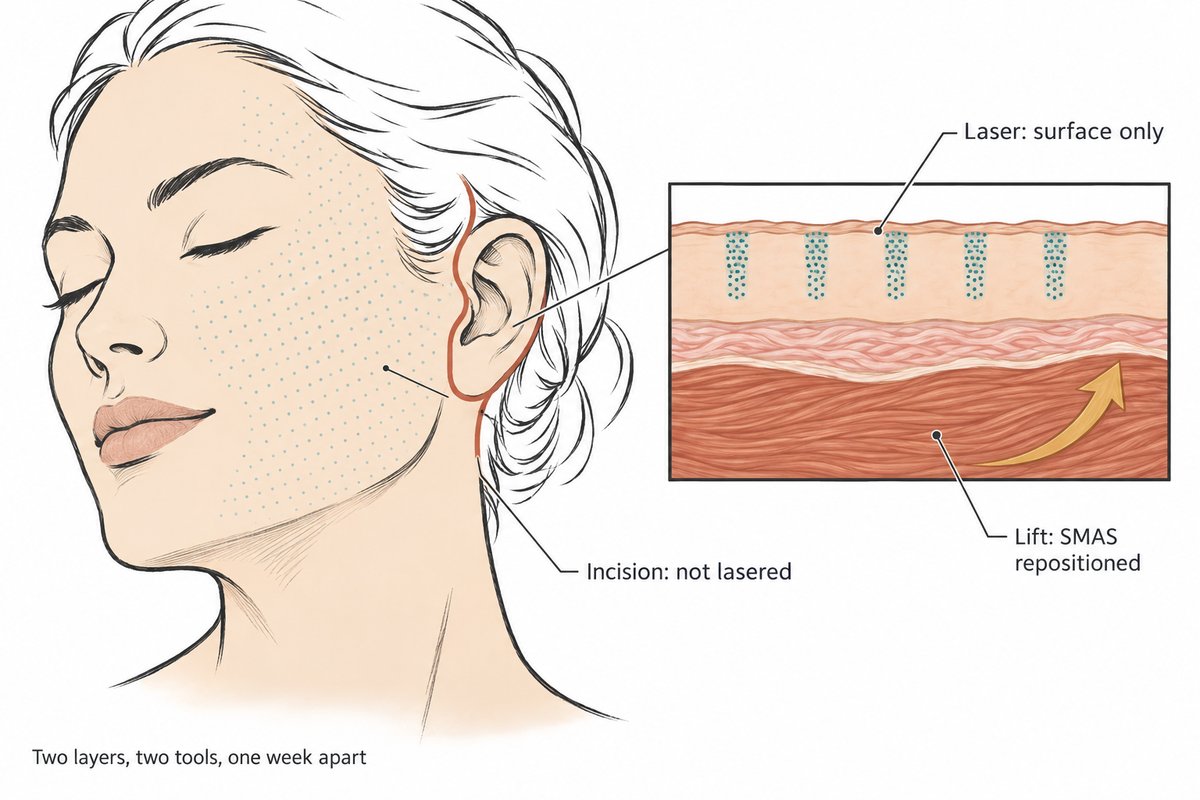
Think of the face in layers. A deep plane facelift releases the retaining ligaments and repositions the SMAS with the skin still attached to it. That fixes a jowl, a fallen cheek, a heavy neck. Above all of that sits the epidermis and the upper dermis, and that is where fine lines around the mouth, enlarged pores, mottled pigment and the crepe of solar elastosis live. A lift pulls that layer slightly smoother because it is under a little more tension, and the effect is real but shallow. It is the difference between ironing a linen shirt and replacing the linen.
No study has measured pore texture or dyschromia before and after a facelift alone, and the two statements above are assertions in the introductions of surgical papers rather than measurements. That is worth saying plainly. What has been measured is narrower. In a three-center review of 100 combination treatments, laxity and photodamage improved together when a tightening device was combined with ablative fractional laser. That is the same logic without surgery: two targets, two tools.
Why Is the Timing About Blood Supply Rather Than About the Scar?
Because the danger of lasering lifted skin is not that the incision opens. It is that the skin between the incisions dies. When a facelift flap is raised, the skin is separated from the vessels that fed it from below and survives for a while on flow coming in from its attached edges. An ablative laser is a second injury on top of that, and skin at half its normal perfusion cannot afford one.
The perfusion numbers exist, from a study that watched facial flaps heal in living patients. Using laser speckle imaging of the distal end of periorbital skin flaps, perfusion sat at 54 percent of baseline immediately after closure, 104 percent at one week and 115 percent at three weeks. Those were bipedicle flaps after tumor removal, smaller and less stretched than a cervicofacial facelift flap, so the curve in a facelift is probably slower at the far end. The study also measured resting flow, not the reserve a flap needs to survive a second injury. But the shape of it is what matters: the first week is the deficit, and by the end of it the flap is feeding itself.
The experiment that turned that curve into a rule was done on pigs, and it was designed to answer exactly this question. Surgeons raised 4 by 10 centimeter skin flaps, shortened them, and resurfaced them with two passes of a fully ablative CO2 laser at day 0, 7, 14, 21 or 28. Flaps lasered on the day of surgery took 23.9 days to heal, and every one of them sloughed and scarred. Flaps lasered at day 7 or later healed in 7.3 to 8.1 days, no different from skin that had never been lifted. The authors concluded that flaps may be safely resurfaced about one week postoperatively. It is an animal model with a continuous-scan laser far more aggressive than anything I use, so a clinic that waits months is being more careful than the experiment requires. But it is the only controlled timing data that exists, and it says the cliff is at day 0, not at day 60.
Two more findings set the stakes. In a review of facelift complications, skin slough ran about 3.6 percent after subcutaneous facelifts and under 1 percent with a deep plane technique, and active smokers were 12.46 times more likely to slough. A thicker flap with the SMAS still attached to it is the whole reason a deep plane patient can tolerate an early laser at all.

Same Day, Early, or Months Later: What Do the Published Series Show?
Same-day resurfacing has been reported as safe for twenty-five years. Read the methods, though, and most of those reports made it safe by changing the operation or by stopping the laser short of the flap. Staged treatment removes that compromise.
In the late 1990s several groups published simultaneous full-face CO2 with facelift. One Brazilian series treated 239 patients, 106 of them with a facelift in the same session, after one to two months of retinoic acid and hydroquinone. It reported no tissue necrosis but gave no complication rate. Another was titled as a question, asking whether the simultaneous technique was safe, and answered that none of the feared complications occurred in over 100 patients followed for up to 36 months, on the condition of careful management. The most revealing was a technique named for the problem it was solving. Its authors called it the RSVP facelift, rejuvenation with sparing of vascular perforators, deliberately limited undermining so that the laser could be used on top of it. In other words, the 1990s solution to the flap problem was to lift less, not to laser less.
Modern fractional devices changed the arithmetic, and there are real series. In 86 facelift patients with extended supraplatysmal dissection, fractional CO2 at 20 millijoules over the elevated flaps produced complete re-epithelialization by one week in every patient, with no flap loss and no delayed healing. Erythema lasted beyond two weeks in 4.6 percent. Every one of those patients had Fitzpatrick type 2 skin. An 80-patient series combining a subcutaneous flap lift with fractional CO2 reported 5 percent expansive hematoma, 1.25 percent partial necrosis, 1.25 percent herpetic infection and 1.25 percent hypertrophic scar. It did not separate what belonged to the laser from what belonged to the surgery.
The most instructive modern paper is a 2025 review of 169 facelifts, 105 with a hybrid fractional laser, an erbium and 1470 nanometer device rather than CO2, delivered in the same anesthetic. Complications were 7.6 percent with the laser and 3.0 percent without, a difference that did not reach significance. But read the method: to protect the flap, the laser was not applied over or across the edge of the skin flap, and treatment stopped 2 to 3 millimeters short of the flap margin. In other words, a paper that reads as evidence for same-day safety did not laser the lifted skin. It lasered the skin beside it. The same qualifier sits inside the review sentence that clinical series document the safety of deep plane facelifts or facelifts with limited skin undermining combined with CO2, fractional CO2 or erbium resurfacing. Deep plane or limited undermining. The flap type is the variable.
At a Glance: four ways to combine a facelift and a CO2 laser
| Approach | What the evidence shows | Where the compromise is | Who it suits |
|---|---|---|---|
| Same day, full face, fully ablative | 1990s series report safety with pretreatment; no complication rates published; pig model shows sloughing when done at day 0 | Undermining is limited, or the laser is kept off the flap, to make it work | Skin-only lifts with minimal undermining, light skin, rarely done now |
| Same day, fractional, over the flap | 86 patients, 20 mJ, no flap loss, all Fitzpatrick type 2 | Thick supraplatysmal flap; no data in Fitzpatrick III to V | Deep or thick-flap lifts in light skin, surgeon experienced with both |
| Staged, day 7 to 14, superficial fractional | Flap perfusion back to baseline by one week; day 7 flaps healed like virgin skin in the pig model; no human interval study exists | Relies on physiology and a shallow pass rather than on a published human series | Deep plane patients who stay 10 to 14 days; what I do |
| Staged, 3 to 6 months | No specific evidence; skin fully settled and scars maturing | The extra months are cost without a documented benefit; many patients never come back for it | Patients who left early, smokers, anyone the surgeon wants to see settled first |
Fully ablative CO2 is excluded for my patients regardless of timing. The reason is skin type as much as flap. A reference text on ablative resurfacing states plainly that non-fractional CO2 laser use is not recommended for Fitzpatrick skin phototypes IV or higher, and most of the faces I lift are III or IV.
How I Do It: CoolPeel on the DEKA DUOGlide, Between Day 7 and Day 14
The laser I use is a DEKA DUOGlide, a dual-wavelength platform that carries a 10,600 nanometer CO2 source and a 1540 nanometer source and offers several pulse shapes under what the manufacturer calls PSD technology. For facelift patients I use only one of them: H-Pulse, the high-peak-power, short-pulse mode, delivered through the scanning handpiece as a grid of separated microcolumns. CoolPeel is the treatment name DEKA and its American distributor attach to that mode on the SmartXide Tetra; the DUOGlide product page does not use the word, and I use it here as shorthand for the same pulse and the same superficial intent. The device is the manufacturer’s description. What follows is mine.

The timing, and why day 7
Skin sutures come out at about a week. The hemostatic net has been gone since day three or four, the drains since day one or two. By day seven the flap is soft, symmetric and, on the published perfusion curve, back at its own baseline. That is the earliest day I will put a laser on it. The latest is the day of discharge, around day fourteen. For an international patient that is also the day before the flight home, as laid out in how long to stay in Korea after a facelift. One session. I do not bring facelift patients back for a series, because the goal here is a surface correction to accompany the lift, not a scar protocol.
I want to be exact about what that timing rests on. No human study has tested any interval between a facelift and a staged laser. The reasoning has three parts: the perfusion curve above, the pig experiment that put the safe line at one week for a far deeper laser than mine, and the fact that a deep plane flap carries the SMAS with it and sloughs in under 1 percent of cases, against about 3.6 percent for a skin-only flap. Against that I put a treatment so superficial that it is closer to a peel than to classical resurfacing. If a patient is a smoker, or diabetic, or has a flap I do not like the look of on day seven, the date moves to the six-week visit. The settings do not move, because they are already at the floor. Six weeks is when I see the scar anyway, and it sits past the four weeks of zero nicotine I ask of a smoker after surgery. By then a flap that was doubtful at day seven has either declared a problem or proven it has none.
The settings
Face: 4 watts, 800 micrometer spacing between microcolumns, SmartStack 1, a single pass. Those are the standard CoolPeel-type parameters, and I do not go below them. In a patient with very fair, thick skin who wants a stronger textural effect I will move the face to 5 watts, and that is the only variation. Neck, in a patient who has had a neck lift with the facelift: 3 watts, 850 micrometer spacing, SmartStack 1, single pass. Lower power and wider spacing on the neck are not a preference. They are the answer to the anatomy in the safety section below.
The physics behind choosing this mode is not manufacturer material; it is textbook. To ablate skin without excessive thermal damage a CO2 laser needs a pulse shorter than 1 millisecond. Continuous-wave delivery ablates 400 to 500 micrometers per pass; a high-energy pulse ablates only 20 to 100. Conventional CO2 leaves 100 to 150 micrometers of residual thermal damage, against 10 to 40 for an erbium laser. H-Pulse exists to shorten the dwell time of each microcolumn. The one peer-reviewed description of the principle, written about DEKA’s HighPulse mode on a sibling platform, is careful to say that it does so with the aim of limiting thermal diffusion beyond the ablation zone. No published histology gives a pulse duration or a residual thermal damage figure for CoolPeel, and I will not invent one. What I can say is what the mode is for: heat that stays in the column rather than spreading into a flap that has just finished rebuilding its blood supply.
Where the laser goes, and where it does not
Full face is the default: forehead, cheeks, the perioral and periorbital skin where the lift did the least. Neck only after a neck lift, at the neck settings. The laser does not cross the incision lines. I stop short of the pre-auricular, post-auricular and temporal scars at this session, for two reasons. First, a scar at day seven to fourteen is a wound that has just been closed, and the clinical studies of early laser on surgical scars start at three to four weeks, not one. Second, I want a clean read on the scar at the six-week visit before I decide whether it needs anything. Most deep plane scars do not, as described in where the incisions go and how they heal.
What I do not do
I do not use fully ablative CO2 on a facelift patient, at any interval. I do not stack pulses. I do not do a second pass on the neck to chase a result. And three kinds of patient do not get CoolPeel at this stage at all: a patient with a keloid history, a patient on isotretinoin or recently off it, and a patient with an active herpes lesion. The isotretinoin rule is stricter than the current evidence, which I discuss below. I keep it anyway, because the downside of being wrong is a scar on a face I have just spent four hours on.
The session itself needs no sedation. A topical anesthetic cream goes on the face for thirty to forty minutes, is wiped off completely, and the pass takes a few minutes. Every patient gets antiviral prophylaxis regardless of whether they have ever had a cold sore: valacyclovir 500 milligrams twice daily, starting the day before the laser and continuing for seven days. The reference regimen runs fourteen days. I shorten it because a single superficial pass re-epithelializes in days rather than weeks. Why it is given at all, to patients with no history, is in the safety section below.

What About Pigmentation in Korean and Asian Skin?
Post-inflammatory hyperpigmentation is the complication that matters in a Fitzpatrick III or IV face. The published rates after fractional CO2 in Asian skin are high enough that the protocol has to be built around avoiding it. In a single-session series of 25 Asian patients treated in a deep-column acne-scar mode, 24 percent developed hyperpigmentation at one month, and it had faded in five of the six by three months. A review pooling fourteen CO2 studies, mostly acne scars in young type III and IV patients, found untreated hyperpigmentation rates of 75 to 93 percent. Those cohorts were younger, treated deeper and treated for scars, so they are not the rate a facelift patient faces. They are the reason nobody should treat an Asian face as if it were a Fitzpatrick 2 face from the 86-patient series.
The more useful finding is what drives the pigment. A split-face randomized study in Chinese patients with type III and IV skin compared high energy at low density, low energy at high density, and a middle setting. Pigment appeared on 4 of 20 sides in the denser arms and on none of the 20 sides treated with hydroquinone, and it had disappeared by six months. The high-energy, low-density arm did not produce it. Energy and density moved together in that design, so the two cannot be fully separated. But the direction is consistent with everything else in the field: crowded, shallow columns heat the epidermis broadly, sparse columns do not. That is the reason my spacing is 800 micrometers and my pass count is one.
The one peer-reviewed series on a DEKA HighPulse protocol, run on the SmartXide Punto rather than the DUOGlide, treated 38 patients from Fitzpatrick I to IV and reported no post-inflammatory hyperpigmentation in any phototype, with erythema in 50 percent and edema in 24 percent. It is a small series on a different DEKA platform, it did not include type V, and it disclosed no settings, so it cannot promise a Korean patient anything. It is consistent with the mode behaving the way it is designed to.
My own pigment protocol is short. The pass is superficial and sparse for the reason above. Sun protection is mandatory, not advised, for four weeks after the session: SPF 50 or higher every morning, reapplied at midday, and no deliberate sun in that window. Four weeks covers most of the interval in which pigment declares itself, and a patient who cannot commit to it is a patient I do not laser at this stage. I do not pretreat with hydroquinone or tretinoin before a day 7 to 14 session, because the skin has just been operated on and the treatment is light enough that I have not needed to. The exception is the patient with a history of melasma or of pigment after a previous laser. That patient is not pretreated either, but a lightening agent is ready to start the moment the skin has closed, about five days after the session, rather than waiting to see whether pigment appears at week three. When pigment does appear, the published course is the reassuring part: laser dyspigmentation typically resolves within 3 to 4 months, and that is when a topical lightening agent earns its place.

Which One Are You
Skin, not age, sorts these patients.
The patient whose cheeks are lifted and whose upper lip is still creased. Perioral lines live in the dermis, and a lift does not reach them. This is the patient the day 7 to 14 pass was designed for.
The patient with a heavy neck and crepe skin on it. A neck lift moves the platysma. The crepe above it needs the neck settings, once, and nothing more aggressive, because the neck scars more easily than the face.
The patient who is a smoker. The flap risk is measured at more than twelve times that of a nonsmoker. The lift itself is the argument here, and the laser waits until the flap has proven itself, pushed to the six-week scar visit rather than the usual day 7 to 14 window, as I explain in can a smoker have a facelift.
The patient with a history of melasma or of pigment after a previous laser. Sparse and shallow is still the right pass. This is the patient who has a lightening agent ready from about five days after the session and whom I see again at one month, because that is when pigment shows.
The patient who has had a facelift elsewhere and wants the laser only. No flap is in question at six months or later, so the discussion becomes the ordinary one about photoaging. For many faces that is better answered by a skin booster or energy-based tightening than by ablation.
The patient whose real complaint is texture and who is considering a facelift to fix it. This is the one to catch in consultation. A face that has kept its position and lost its surface does not need a lift, and the diagnosis is the subject of what actually ages by decade.
What Does Recovery Look Like When the Laser Is Added at Day 7 to 14?
It adds two to three days of pinkness to a face that is already recovering, and it does not extend the stay. The CoolPeel session takes minutes. Afterward the treated skin looks sunburned and feels tight for the rest of that day. On the second and third days it is pink and slightly rough as the microcolumns close. By about day four it is presentable with mineral makeup. In the HighPulse series, erythema was reported in half of patients and edema in a quarter, and the erythema rate did not differ by skin type.
Inside the facelift timeline, the laser sits after the last surgeon-dependent step and before the flight: sutures out at day seven, laser between day seven and fourteen, discharge at fourteen. The infection window is the reason not to leave earlier: in 525 fractional ablative laser treatments, infection occurred in 2.9 percent, and 93 percent of those infections appeared in the first two weeks. A patient who is still in Seoul for that fortnight is a patient whose infection I see on the day it starts.

Sun avoidance runs longer than the stay. Redness after a facelift and redness after a laser both fade on their own. Pigment provoked by sun on lasered skin at week three does not, or not quickly. That is why the sunscreen instruction is the one repeated at discharge.
Surgeon’s Insight
A patient who comes back a year after a beautiful lift and says the skin still looks tired is not describing a failed operation. She is describing a layer the operation never touched. The honest thing is to say so before surgery, to name which layer each complaint lives in, and to fix the surface while I still have the patient in front of me and the flap has just proven that it can feed itself. Waiting six months out of caution sounds responsible. In practice it mostly means the surface never gets treated.
What Are the Risks, and What Should You Watch For?
Four things: the flap, pigment, infection, and the neck. Each has a published basis, and each is why the protocol above looks the way it does.
The flap. The one catastrophic outcome is skin loss at the far end of the flap. That can mean the skin behind the ear, which this pass never touches, or the cheek and the skin in front of the ear, which it does. The animal model says the risk belongs to day 0, not to day 7. The human signs to report are a patch that turns dusky or purple rather than pink, or an area that blisters and stays open beyond the third day. In the modern series lasered over the flap, delayed healing did not occur; in the 80-patient series, partial necrosis was 1.25 percent, unattributed. My smokers wait.
Pigment. Brown patches appearing at three to six weeks, most often on the cheeks. Expected to resolve in three to four months, sooner with treatment. A patient who tans in the interval is a patient whose pigment lasts longer.
Infection and herpes. Herpes simplex reactivation after resurfacing is common enough that reference texts recommend prophylaxis even for patients with no known history, because up to 80 percent of adults in the United States carry the latent virus. The reference regimen is valacyclovir 500 milligrams twice daily for 14 days, starting the day before; mine runs seven days, for the reason given in the technique section. Active infection on the face is a contraindication for 95 percent of an expert panel of 21 laser physicians. Clustered blisters, spreading redness or fever inside the first two weeks mean a call the same day, not a message to Seoul after the flight.
The neck. A reference text on laser complications states the mechanism: the neck carries a higher risk of scarring than the face, likely due to a lower concentration of pilosebaceous units and a thinner dermis. Fewer follicles means fewer islands of epithelium to regrow from. The published way to make the neck safe is the same idea as the H-Pulse. In 308 patients treated on the face and neck, none of them after a facelift, a 90-microsecond pulse at low energy with two passes and no scanner produced no scarring and no permanent pigment change. Hence 3 watts, wider spacing, one pass, and no second pass however tempting the result.
Isotretinoin, and why my rule is stricter than the evidence
The old rule was six to twelve months off isotretinoin before any resurfacing, and it came from the package insert and three small case series from the 1980s. A 2017 systematic review of 32 publications and 1,485 procedures found insufficient evidence to delay fractional ablative laser, while fully ablative laser and mechanical dermabrasion remain not recommended during systemic isotretinoin. CoolPeel is fractional ablative, so the evidence would permit it. I still defer these patients, because a facelift flap is not the intact skin those studies were done on, and because the cost of the wait is small.
Scars, and why they are treated later if at all
Fractional CO2 on fresh surgical scars is well supported, but the timing in those studies starts weeks after mine. In 27 patients with type III to V skin treated on a DEKA SmartXide, three sessions beginning four weeks after surgery improved the Vancouver Scar Scale from 5.33 to 2.55, with pigment in one patient. A randomized trial started in the third week after scar formation and found better collagen organization on histology. A reference text puts the best window for surgical scars at 6 to 10 weeks after surgery. None of these treated a facelift incision, so the extrapolation to a pre-auricular scar is mine. In practice a deep plane scar that is red and slightly raised at six weeks gets its own fractional session then; one that is flat and pale gets nothing.
What is not established
No human study has tested any interval between a facelift and a staged laser. My day 7 to 14 window is clinical judgment resting on physiology, and a colleague who waits three months is not wrong. No published histology gives a pulse duration or a residual thermal damage figure for CoolPeel. The most device-specific clinical paper on the DEKA Tetra platform has been retracted, which is the honest state of that evidence base. No study has measured skin quality before and after a facelift alone. And oral tranexamic acid, which many Korean clinics give around pigment-prone lasers, has laser-specific support only in cell culture, where it reduced melanin production in melanocytes exposed to laser-treated keratinocyte media. Its use around resurfacing is reasoning from melasma experience, not trial evidence.
Ask Which Layer Your Complaint Lives In, Not Whether You Can Add a Laser
Every face that comes in for a lift carries two problems in two layers, and only one of them is surgical. The question to bring to a consultation is not whether a laser can be added. It is: which of the things I dislike about my face is position, and which is surface, and what is your plan for each? A surgeon who answers with a layer for each complaint has examined you. One who answers with a package has not.
Bring the second question too: if you do resurface, when, and over which skin? The answer should mention blood supply. If it mentions only the calendar, keep asking.
Written by Dr. Yongwoo Lee, board-certified Korean plastic surgery specialist in facial anatomy and aesthetic procedures at VIP Plastic Surgery, South Korea.
Frequently Asked Questions About CO2 Laser After a Facelift
How soon after a facelift can you have a CO2 laser?
About one week at the earliest, because that is when a facial skin flap is back at its baseline blood supply and when flaps in the controlled animal study healed like unlifted skin. I treat between day 7 and day 14 with a superficial fractional pass. Many surgeons wait three to six months; no human study has compared the two.
Can a CO2 laser be done at the same time as a facelift?
It has been, for twenty-five years, but the modern series that report it as safe either used a thick flap, treated only light skin, or stopped the laser 2 to 3 millimeters short of the flap edge. I do not do it. In the pig model, flaps lasered on the day of surgery took 23.9 days to heal and all scarred.
Why does a facelift not fix fine lines and skin texture?
A facelift repositions the SMAS and the skin attached to it. Fine lines, pores and mottled pigment sit in the epidermis and upper dermis, which a lift tightens slightly but does not resurface. Surgeons acknowledge this in their own papers.
What is CoolPeel, and how is it different from a regular CO2 laser?
CoolPeel is the treatment name DEKA uses for its H-Pulse fractional CO2 mode on the SmartXide Tetra, and the DUOGlide carries the same mode. It delivers each microcolumn with a very short dwell time so that heat stays in the column rather than spreading. Conventional CO2 leaves 100 to 150 micrometers of thermal damage; the aim of the short pulse is to leave much less, though no published histology gives a figure for this specific mode.
What settings are used for the face and neck after a facelift?
In my practice, the face is treated at 4 watts, 800 micrometer spacing, SmartStack 1, one pass, with 5 watts reserved for very fair, thick skin. The neck, only after a neck lift, is treated at 3 watts, 850 micrometer spacing, one pass. Incision lines are not lasered at this session.
Is fractional CO2 laser safe for Asian skin after a facelift?
It can be, if the pass is sparse and superficial and sun protection is strict. Published hyperpigmentation rates in Fitzpatrick III and IV skin run from 24 percent after a deep acne-scar session to 75 to 93 percent untreated in pooled scar studies. But in a split-face study the high-energy, low-density arm did not produce pigment, and the one DEKA HighPulse series reported none across 38 patients up to type IV.
Does the laser go over the facelift scars?
Not at day 7 to 14. The evidence for early laser on surgical scars begins at three to four weeks, with a best window of 6 to 10 weeks, and none of it was done on facelift incisions. A scar that is red or raised at six weeks can have its own fractional session then. Most deep plane scars need nothing.
How long is the recovery from a CO2 laser done after a facelift?
Two to three days of pinkness and roughness added to a face that is already healing, with no extension of the stay, because it is done before discharge at around day fourteen. In the DEKA HighPulse series, erythema occurred in half of patients, at similar rates across skin types, and swelling in a quarter.
Can you have a laser after a facelift if you smoke?
Not early. Active smokers were 12.46 times more likely to lose flap skin after a facelift in a published review, and a laser is a second injury to that flap. In my practice smokers, diabetics and any patient whose flap looks doubtful at day seven have the laser deferred rather than the settings lowered.
What are the signs of a problem after a laser on lifted skin?
A patch that turns dusky or purple rather than pink. An area that blisters and stays open past the third day. Clustered blisters suggesting herpes. Spreading redness or fever inside the first two weeks. Brown patches at three to six weeks. Everything except the brown patches needs a same-day call. Pigment is expected to fade over three to four months.
Do I need antiviral tablets before a fractional CO2 laser?
Reference texts recommend prophylaxis even with no history of cold sores, because up to 80 percent of adults in the United States carry the latent virus and resurfacing reactivates it, especially around the mouth. The reference regimen is valacyclovir 500 milligrams twice daily for 14 days starting the day before treatment; after a single superficial pass I give seven days.
Can you have a CO2 laser if you have taken isotretinoin?
Current evidence, from a 2017 systematic review of 1,485 procedures, finds insufficient evidence to justify delaying fractional ablative laser after isotretinoin, while fully ablative laser is still not recommended during treatment. I defer facelift patients anyway, because a fresh flap is not the intact skin those studies used.
Is the neck treated the same way as the face?
No. The neck has fewer pilosebaceous units and a thinner dermis, which a reference text gives as the likely reason it scars more readily after ablative lasers. It is treated at lower power, wider spacing and a single pass, and only in patients who have had a neck lift.
Would a skin booster or Ultherapy do the same job as a laser after a facelift?
Different jobs. A CO2 laser resurfaces; skin boosters hydrate and thicken the dermis over months; ultrasound and radiofrequency tighten by heating deeper layers. For crepe texture and fine lines, ablation is the direct answer. For dullness without surface damage, a booster is often the better first step and carries no pigment risk.
This article is for informational purposes only and does not constitute medical advice. Always consult with a qualified medical professional before making any decisions about surgical or non-surgical procedures.