
Can a Smoker Have a Facelift?
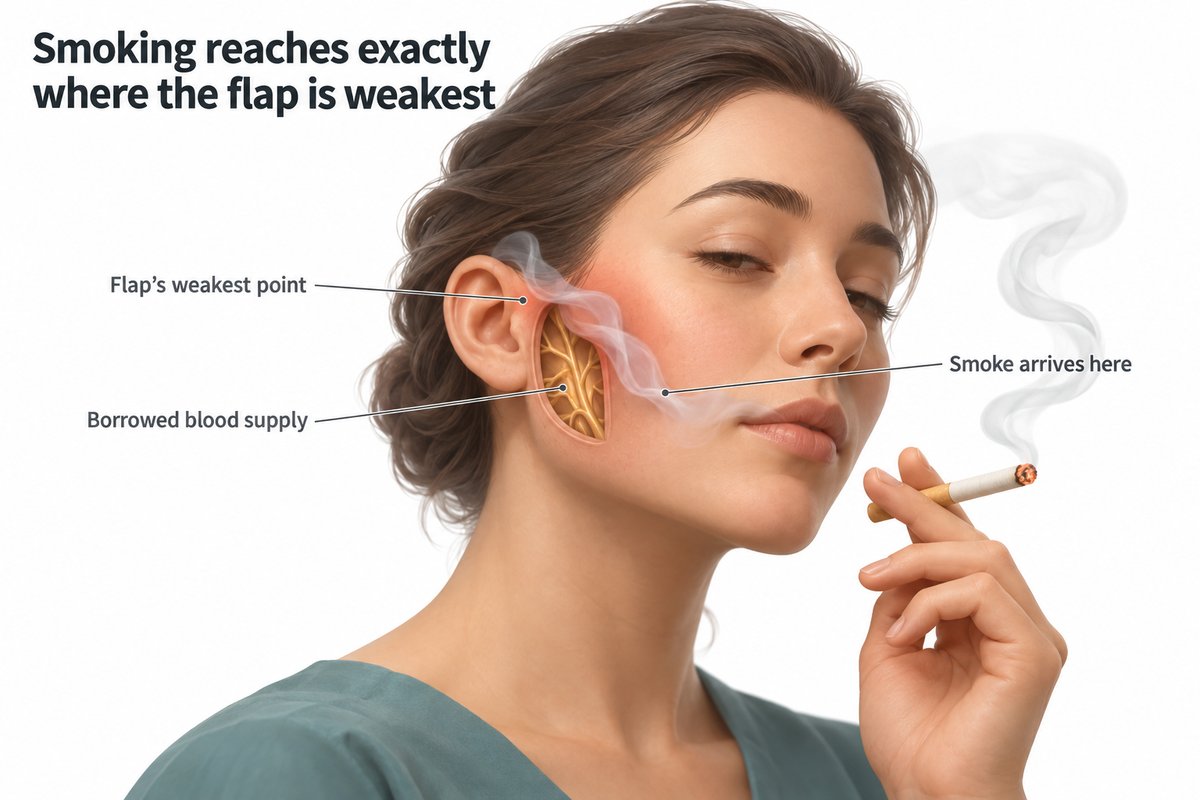
Yes, after four weeks with no nicotine of any kind, with a deep plane technique, and with a smaller operation than the patient usually wants. A patient who cannot stop does not get a facelift from me, and the reason is not the incision. It is the skin between the incisions, which after a facelift lives for a while on a borrowed blood supply and dies when that supply is cut further. Smoking multiplies the odds of that happening roughly tenfold. In a 2022 meta-analysis of 82 studies across aesthetic surgery, smokers having a facelift had odds of skin necrosis 10.29 times higher than nonsmokers, against 2.99 times for complications overall.
The mistake patients make is to hear that number as a verdict on smokers rather than a fact about flaps. Necrosis is what happens when a thin sheet of lifted skin meets a second insult, and smoking is the commonest second insult. A thicker, shorter flap carries less of that risk, and a deep plane operation is built to make exactly that kind of flap.
Dr. Yongwoo Lee also answers this on video: why smoking raises the risk of skin loss after a facelift, and the nicotine rule he gives patients, in under seven minutes. The video is in English.
What Actually Dies After a Facelift, and Where?
The skin flap, at its far end, in front of the ear and high behind it. Not the incision. A facelift incision is a closed wound with good blood supply on both sides, and it heals the way any facial cut heals. What can fail is the sheet of cheek skin the surgeon lifted off the tissue beneath it to reach the layers that need repositioning. A reference chapter on cervicofacial rhytidectomy puts skin necrosis at under 1 percent of cases, occurring at the distal portions of the flap, particularly the preauricular and superior postauricular regions. It attributes it to microvascular compromise from hematoma or seroma, or to excessively thin flap elevation.
There are two grades, and they are not the same event. Partial-thickness loss shows as discoloration and peeling and usually heals without a scar. Full-thickness loss leaves a wound that heals from its edges over weeks and can leave pigment change, a contour dent and a scar. Across 45 studies and 10,784 deep plane facelifts, frank skin necrosis ran 0.1 percent and epidermolysis, the superficial grade, 1.2 percent, in pooled single-arm series that were not broken down by smoking. For every flap that died, twelve blistered. That ratio is the honest picture of what a compromised deep plane flap usually does, and it is the picture a smoker should hear before the rare one.
Where the number comes from matters. The 3.6 percent slough rate after subcutaneous facelifts and under 1 percent with a deep plane technique that a 2021 review cites are summary estimates without denominators. And deep plane series in general come from surgeons who often decline to operate on smokers at all. No study has compared smokers undergoing a deep plane lift against smokers undergoing a subcutaneous one. What exists is mechanism, and the mechanism is strong enough to build a policy on. It is not strong enough to promise a smoker that the deep plane makes the risk go away.

Why Is Lifted Skin So Fragile, and What Does a Cigarette Do to It?
Because undermining converts well-fed skin into a flap that lives off one low-pressure vascular network, and a cigarette then squeezes that network, poisons the blood it carries, and thickens it. Each of those three is measured.
Start with the anatomy. Facial skin is fed from below by musculocutaneous perforators that rise through the muscles of expression. A 2026 cadaver study mapped 134 perforators of half a millimeter or larger across fourteen hemifaces, densest in the cheek and preauricular zone, 47 of them from the facial artery alone. An older study framed around rhytidectomy found eleven pairs of musculocutaneous perforators feeding an interconnected network redundant enough that most faces tolerate surgery well. A subcutaneous facelift divides the perforators under the whole cheek. What remains is a flap fed from its base through the subdermal plexus, a low-pressure system vulnerable to compromise under excessive twisting or stretching. That is why textbooks limit such flaps to a length no more than three times their width, and why they fail on the venous side and at the far edge first. The far edge of a facelift flap is the skin in front of the ear.
Now the cigarette. In a human experiment that separated nicotine from smoke, eight smokers and eight ex-smokers were given intravenous nicotine on one occasion and a cigarette on another. Smoking a cigarette dropped skin blood flow, dropped tissue oxygen from 53.9 to 48.4 mmHg and raised tissue lactate by 50 percent; the tissue went anaerobic. Nicotine on its own, given by infusion, reduced flow in the fat beneath the skin but did not significantly change flow in the skin itself, and tissue oxygen actually rose. That finding matters for the patch discussion below, and it corrects a sentence on most clinic websites: the smoke does more to the skin than the nicotine does.
Carbon monoxide is the second insult. A habitual smoker can carry up to 8 to 10 percent of hemoglobin as carboxyhemoglobin, against a nonsmoker baseline under 2 percent. Carbon monoxide binds hemoglobin 200 to 250 times more tightly than oxygen and shifts the dissociation curve to the left, so the oxygen that is still carried is released to tissue less readily. A flap at the end of its blood supply is exactly the tissue that cannot afford either. Carbon monoxide also clears slowly: its half-life on room air is about 300 minutes, so a cigarette the evening before surgery is still measurable in the operating room the next morning.
Platelets are the third. In 40 patients, a single cigarette increased platelet activity on a standard function test and pushed four of them into aspirin non-response. Those patients had coronary disease and the link from stickier platelets to clotting inside a skin flap is inference, not a demonstrated finding. But it is the third mechanism by which a flap that is already short of flow loses what it has.

Which Facelift Technique Tolerates a Smoker Best?
The one that lifts the least skin on its own. Every technique with a low published necrosis rate got there by keeping the skin attached to something with a blood supply, or by not undermining it far. The deep plane does the first. Conservative techniques of the 1980s did the second. A skin-only lift with wide undermining does neither, and it is the operation most of the older smoker series were done with.
The history is explicit. A 2025 systematic review of smoking and facial surgery reports that Webster, in 1986, observed markedly higher flap necrosis among smokers when wide undermining was used. In 407 patients treated with a conservative approach, he saw no slough at all. Riefkohl in the same year found that patients who kept smoking after surgery had significantly more necrosis. And the number everyone repeats, that smokers were 12.46 times more likely to slough, comes from Rees in 1984, in the era of the wide subcutaneous flap.
The largest meta-analysis of facelift technique found that complication rates differ significantly between SMAS techniques for necrosis, hematoma, seroma and nerve injury, with skin necrosis at 1.57 percent for the SMAS flap technique. Its abstract gives no deep plane necrosis figure, and its authors described the techniques as broadly comparable in safety, so it is evidence that technique matters, not that one technique wins. A reference chapter on the deep plane is willing to go further, and its hedges are worth quoting. The composite flap improves the vascularity of the flap, skin ischemia is presumably lower than with SMAS flap techniques because of it, and necrosis in smokers does not appear to be a significant problem with the technique. Presumably, and does not appear. That is the strength of the evidence, and a patient should hear it stated that way.
One more counterweight. When deep-SMAS-family lifts were compared head to head with the more limited MACS lift across four studies, overall complications did not differ significantly, 15 versus 20 events in 286 patients. Necrosis was not reported and 286 patients cannot detect a difference between 3.6 percent and 1 percent, but it is a reminder that the safety gap in single-arm literature may partly be selection.
At a Glance: how each technique treats the skin, and what that means for a smoker
| Technique | What happens to the skin | Published necrosis picture | Smoker relevance |
|---|---|---|---|
| Subcutaneous, wide undermining | Skin lifted alone, far past the cheek, fed only from its base | About 3.6 percent slough at review level; the 1980s smoker series were done on this flap | The flap most older smoker series were done on; I do not do this operation in a smoker |
| SMAS flap | Skin lifted alone over the cheek, SMAS lifted separately beneath it | 1.57 percent in the largest meta-analysis, OR 2.29 versus plication | Two separate flaps, the skin one still thin |
| Conservative, limited undermining | Skin lifted a short distance only | No slough in 407 patients in the 1986 series | Safe by lifting less, at the cost of a smaller correction |
| Deep plane, composite flap | Skin stays attached to the SMAS; lifted together as one thick flap | 0.1 percent necrosis and 1.2 percent epidermolysis in 10,784 pooled cases; under 1 percent at review level | The flap I use, with the skin-only segment shortened further in smokers |
What I Change When the Patient Smokes
Four things: four weeks of zero nicotine on each side of surgery, less skin lifted on its own with the deep plane entered closer to the ear, a shorter incision behind the ear closed with less tension, and no other procedure on the same day. The last three are the same operation I describe in deep plane versus SMAS, made smaller in three specific places.
Four weeks before, four weeks after, and nothing with nicotine in it
I ask for four weeks with no cigarettes, no vaping, no patches, no gum and no pouches before surgery, and the same four weeks after. Four weeks before is the floor the American Society of Plastic Surgeons set in 2024. Its guidance recommends cessation 4 to 8 weeks before surgery, asks surgeons to consider at least 4 weeks after, and to consider the same duration for e-cigarettes and other forms of nicotine. It is also the length at which the trial evidence turns. In a meta-analysis of six randomized trials, cessation programmes of at least four weeks produced significantly larger effects than shorter ones, and each additional week increased the size of the effect by about 19 percent. The single most persuasive trial randomized 117 patients to a programme that began four weeks before surgery and ran four weeks after. Complications fell from 41 percent to 21 percent, and five patients had to be enrolled in the programme to prevent one complication. Those were hernia, gallbladder and joint operations, not facelifts, and the programme included nicotine substitution, so they do not prove my zero-nicotine rule. They prove the four weeks.
The four weeks after are the ones patients break. Riefkohl’s finding that continued postoperative smoking raised necrosis significantly is the reason. In practice the flap is not back on its own blood supply for about a week, and a patient who lights up in that week smokes onto a flap that has not yet recovered it.
Why I do not test, and what a test would show
I do not send cotinine tests. I ask, I explain the number above, and I take the answer. A test can tell me whether someone smoked this week. It cannot make them stop for the four weeks after surgery, when I am not there and the flap is at its most vulnerable, and a rule that has to be policed by a blood test is a rule the patient has not accepted. A patient who lies to me about smoking is lying to their own cheek, and I say that in consultation in those words. For a reader who wants to know what a test would show, serum cotinine in an active smoker peaks at 200 to 800 nanograms per milliliter, while passive exposure sits under 8. Two weeks of complete abstinence brings it under 3, so the gap between smoking and not smoking is two orders of magnitude. Nicotine itself clears in hours, with a plasma half-life of about 2 hours, which is why the test looks for cotinine, its metabolite, whose half-life is given as 16 hours in one reference and about 24 hours by the Mayo laboratory.
Zero nicotine, including the patch, and why that is stricter than the evidence
The evidence on patches is more reassuring than my rule, and I want to say so plainly. In a randomized double-blind trial, smokers who stopped and wore a nicotine patch healed small experimental wounds the same as smokers who stopped and wore a placebo. The patch showed no effect on wound dimension or on collagen markers, while stopping smoking did. In the same trial, smokers ran vitamin C about a quarter lower than never-smokers, and it recovered after cessation.
I ban the patch anyway, for three reasons. First, those trials measured punch wounds a few millimeters across and blood markers, not the survival of a facelift flap many centimeters long. And nicotine on its own did reduce blood flow in the fat under the skin, which is the layer a facelift flap is lifted through. Second, the only flap experiment on vapor points the other way. Rats exposed to nicotine e-cigarette vapor for four weeks lost 28.6 to 35.9 percent of a dorsal skin flap, against 30.2 percent for tobacco smoke and 19.2 percent for room air. Nicotine without smoke was as bad as smoke in that model. Third, in practice a patient using a patch is a patient still fighting the habit, and I cannot separate the two on the day. So the rule is zero.
Less skin undermining, with the deep plane entered closer to the ear
In a smoker I shorten the segment of the operation in which the skin is lifted alone. The dissection enters the deep plane further back, closer to the ear, so that the thin skin-only flap is a narrower strip and the composite flap carries the skin for more of the distance. This is the principle Webster used in 1986 and the one the deep plane is built on. The less skin that has to live off the subdermal plexus, the less there is to lose.
A shorter incision behind the ear, and less tension
The post-auricular limb of the incision is shortened in a smoker, and the closure is set with less pull. A review of facelift complications names, alongside smoking, thin skin flaps, excessive tension, undrained hematoma and wide undermining as the precipitants of slough. Tension is the one the surgeon controls at the last minute, and a smoker’s flap gets the least of it. A face closed with less tension is a face with slightly less lift behind the ear, and I tell the patient that before surgery rather than after. My bleeding protocol, which addresses the hematoma item on that list, is in preventing facelift hematoma with a hemostatic net.
No combined procedures on the same day
A smoker gets a facelift, and only a facelift, on the day. Fat grafting, eyelid surgery and any resurfacing are staged or deferred. In 11,300 facelifts in an insurance database, the complication rate ran 1.5 percent for a facelift alone and up to 3.7 percent with combined procedures, in a database that records only complications serious enough for reoperation, emergency care or admission. Combined procedures were also on the risk list in 13,346 facelifts in the TOPS registry, alongside smoking itself. The laser question has its own article, CO2 fractional laser after a facelift, and the rule there is the same: a smoker’s flap does not get a second injury while it is still proving itself, so the laser that other patients have between day 7 and 14 moves to the six-week scar visit.
What I refuse
A patient who tells me at the pre-operative visit that they are still smoking is rescheduled, not operated on with a lower expectation. A patient who wants the subcutaneous, wide-undermining lift because they have read it is quicker is told two things. It is the flap most of the older smoker series were done on, and I will not do it in a smoker. And a patient who asks for the full combination on the day is offered the lift now, fat grafting and eyelid surgery in about three months, and laser at the six-week scar visit.

Which Smoker Are You, and What Changes for You?
Current smokers, vapers and patch users wait four weeks with zero nicotine; recent quitters go ahead under the same rules; people who quit a year or more ago carry close to a never-smoker’s risk to a facial flap.
The current smoker who wants surgery next month. Four weeks of zero nicotine first, then a deep plane lift with the changes above, and nothing else that day. The date moves; the operation does not shrink further.
The patient who stopped four weeks ago. This is the patient the cessation trials were run on. The risk is not that of a never-smoker: across all surgery, former smokers carry a higher risk than never-smokers, at an unadjusted odds ratio of 1.30, and much lower than current smokers. Every further week helps.
The patient who quit years ago. In 91 facial local flaps, complications ran 37 percent in active smokers and 17 percent in both ex-smokers of a year or more and nonsmokers. Every full-thickness skin loss occurred in an active smoker. Those were reconstructive flaps, not facelifts, but they are the most encouraging verified sentence available: the damage that matters to a facial flap is active smoking, and a year without it looks like never.
The patient who switched to vaping. Treated as a smoker, because of the rat flap experiment on vapor described above, and because the 2024 society guidance suggests the same cessation period for e-cigarettes.
The patient on a patch or gum. Four weeks off those too. The wound evidence on patches is reassuring; the flap evidence does not exist, and a facelift flap is a perfusion problem before it is a collagen problem.
The patient who plans to have one cigarette after surgery. Smoking in the weeks after surgery is the exposure most directly linked to necrosis. This is the patient I ask to say the four-weeks-after rule back to me before discharge.
What Does Recovery Look Like for a Former Smoker?
The same as for anyone else if the four weeks held, with one extra week of attention to the skin in front of the ear. That flap is examined at every early visit: day one with the drains, day three or four when the hemostatic net comes out, day seven at suture removal. What I am looking for on the cheek and in front of the ear is color and capillary refill. A flap that is pink and blanches is a flap that is being fed. A patch that is dusky, purple or mottled, that blisters, or that peels is a flap short of flow at its far end. It is watched daily rather than weekly.
Two time spans matter to a former smoker. The first is the night before surgery: carbon monoxide from a last evening cigarette is still in the blood in the morning, and the four-week rule already covers that night. After surgery come four more weeks, which for an international patient extend well past the flight home described in how long to stay in Korea after a facelift.

Surgeon’s Insight
When a smoker asks whether they can have a facelift, they are usually asking me to say yes and to say it is fine. I can say yes. I cannot say it is fine, because the number is tenfold and it was measured on real faces. What I can do is explain that the number belongs to a thin flap of skin, that I can make that flap thicker and shorter and put it under less pull, and that the four weeks are theirs to give. A patient who understands that the risk lives in the flap, not in a verdict on their character, is the patient who gives me the four weeks.
What Are the Risks, and What Is Done if the Flap Struggles?
The one that matters is skin loss in front of the ear, and the first rule of managing it is to do less. Topical nitroglycerin and hyperbaric oxygen rest on weaker evidence, or on evidence from other kinds of flap.
What it looks like. Partial-thickness necrosis presents as skin discoloration and desquamation and typically heals without scarring; full-thickness necrosis produces dyspigmentation, contour irregularities and scarring. No primary source gives a day-by-day timeline for the signs, so none is given here. What I have seen is that a flap declares itself in the first week, and that the peeling grade is far more common than the black grade. In the smokers and early relapsers I have treated, what I see is a dusky, sometimes blistered strip of skin in front of the ear that sheds over ten days to two weeks and leaves thinner but intact skin underneath, a handful of times a year rather than routinely. I have not had a full-thickness loss in a patient who kept the four weeks on both sides of surgery.

What is done. The reference chapter is unambiguous: early debridement should be minimized to avoid further damage. A review of facelift complications states that most cases heal spontaneously with wound care, with scar revision at a later date. A dusky flap is dressed, kept moist and left alone. Dead skin is allowed to separate on its own timetable. A depressed or pigmented scar that remains at six months is revised then, and the approach to those scars is covered in where the incisions go and how they heal.
Nitroglycerin ointment. The only adjunct with real evidence behind it, and none of that evidence is in facelifts. Across 7,074 mastectomy patients, topical nitroglycerin roughly halved flap necrosis and cut the debridement rate by two-thirds without a significant excess of headache or low blood pressure. A mastectomy flap is a different flap, and the ointment was applied at the time of surgery as prevention rather than as rescue. Any use on a facelift flap is extrapolation, and a surgeon who uses it should say so. I do not use it. The evidence is real but it is not mine, and I would rather manage a dusky flap with the moist wound care above than add a vasodilator to a face on the strength of a mastectomy trial.
Hyperbaric oxygen. Recognized for the compromised flap, with a described protocol of 2 hours daily at 2.4 atmospheres on 100 percent oxygen for about 30 sessions, started early. The reference chapter cites no randomized evidence of efficacy. An option with society backing, not a proven rescue.
What is not established
No study compares smokers by facelift technique, so the claim that the deep plane tolerates a smoker better rests on a hedged reference-work statement, a review-level estimate, and mechanism. No study has measured flap thickness or perfusion in a deep plane flap against a subcutaneous one. The randomized cessation evidence is weaker than the observational evidence in one specific way. Across four trials, cessation programmes significantly reduced surgical site infections but not other healing complications, and necrosis is a healing complication rather than an infection. Quitting is still the right thing to do, and the observational necrosis odds ratio of 3.60 across 479,150 surgical patients in the same review is the reason. But the trial that proves four weeks of quitting saves facelift flaps has not been done. And the 1984 Rees series is reported inconsistently at second hand, as 7.5 percent slough in smokers against 2.7 percent in nonsmokers, about threefold, in one reference and as 12.46-fold in two reviews, so the honest number is a range, not a headline.
Ask How Much Skin Will Be Lifted, Not Whether You Are Allowed
A smoker who asks a surgeon whether they can have a facelift will usually get a yes. The question that protects the face is different. How far will you lift my skin on its own, and what changes in the operation because I smoke? A surgeon who answers with a plane, a distance and a list of things they will not do that day has a plan for your flap. One who answers only with a cessation date has a plan for the paperwork.
Bring the second question to yourself: can I give this four weeks, twice? If the answer is no, the operation is not the problem, and no technique makes it safe. The layers that need lifting will still be there in three months, as described in what actually ages at 40, 50, 60 and 70.
Written by Dr. Yongwoo Lee, board-certified Korean plastic surgery specialist in facial anatomy and aesthetic procedures at VIP Plastic Surgery, South Korea.
Frequently Asked Questions About Smoking and Facelift Surgery
Can you have a facelift if you smoke?
Yes, after four weeks with no nicotine before surgery and four after, and with a technique that keeps the skin attached to the tissue beneath it. A patient who cannot stop is not a patient I operate on. The risk is skin necrosis, and smoking raises the odds of it roughly tenfold in a facelift.
How long do you need to quit smoking before a facelift?
Four weeks is the floor. The American Society of Plastic Surgeons recommends 4 to 8 weeks before surgery and suggests at least 4 weeks after. Randomized trials show that programmes of at least four weeks work significantly better than shorter ones, with each extra week adding about 19 percent to the size of the effect.
What happens to the skin if you smoke after a facelift?
The lifted cheek skin, which in practice depends on a reduced blood supply for about the first week, can lose flow at its far end in front of the ear. Its mild form is peeling and discoloration that heals; the severe form is full-thickness loss that leaves a scar. Continued smoking after surgery was linked to significantly more necrosis in a 1986 series.
Does a deep plane facelift reduce the risk for smokers?
Probably, because the skin is lifted together with the SMAS as one thick flap instead of alone. Pooled deep plane series report 0.1 percent necrosis, and a review estimates about 3.6 percent slough after subcutaneous lifts, but those are different kinds of data and neither is limited to smokers. No study has compared smokers by technique directly, so the benefit is inferred from mechanism, and it does not remove the risk.
Is vaping safer than smoking before a facelift?
Not on the evidence. In the only flap experiment on vapor, rats exposed to nicotine e-cigarette vapor lost as much skin flap as rats exposed to cigarette smoke. The 2024 society guidance suggests considering the same cessation period for e-cigarettes as for cigarettes, and I treat them the same.
Can I use a nicotine patch instead of smoking before surgery?
Not in my practice. A randomized trial found that a nicotine patch did not impair small-wound healing in abstinent smokers, which is reassuring. But no study has tested a patch against the survival of a facelift flap, and nicotine on its own still reduced blood flow in the fat beneath the skin. Four weeks means zero nicotine.
Where does skin necrosis happen after a facelift?
At the far end of the lifted flap: in front of the ear most of all, and high behind the ear, according to the reference literature. The incision itself is not the problem; the flap between the incisions is.
How is a struggling flap treated?
Conservatively. Early debridement is minimized, the area is dressed and kept moist, and dead skin is allowed to separate on its own. Most cases heal with wound care, and any residual scar is revised months later. Topical nitroglycerin has strong evidence in mastectomy flaps but none in facelifts; hyperbaric oxygen is a recognized option without randomized proof.
Do you test for nicotine before surgery?
No. I ask, and I explain what is at stake. For reference, serum cotinine in an active smoker runs 200 to 800 nanograms per milliliter and passive exposure under 8. Two weeks of abstinence brings it under 3, so a test is decisive when a surgeon chooses to use one.
Does the risk go back to normal if I quit years ago?
Close to it. In 91 facial flap reconstructions, ex-smokers of a year or more had the same complication rate as nonsmokers, 17 percent, against 37 percent in active smokers. Across all surgery, former smokers carry a modestly higher risk than never-smokers but far lower than current smokers.
Does smoking raise other facelift risks besides necrosis?
Yes, but by less. In the 2022 meta-analysis, smoking raised the odds of hematoma 1.9-fold and of complications overall about 3-fold, against 10-fold for skin necrosis. Necrosis is where smoking does its specific damage.
Can a smoker have fat grafting or eyelid surgery with the facelift?
Not on the same day in my practice. In 11,300 facelifts the complication rate rose from 1.5 percent for a facelift alone to as much as 3.7 percent with combined procedures, and a smoker’s flap does not get a second injury while it is still establishing its blood supply. Fat grafting and eyelid surgery follow about three months later; laser waits for the six-week scar visit.
Why does carbon monoxide matter if I stopped the night before?
Because it clears with a half-life of about five hours on room air, so a cigarette in the evening is still in the blood the next morning, binding hemoglobin far more tightly than oxygen does. The overnight rule sits inside the four-week rule; it does not replace it.
Does a mini facelift avoid the flap problem for smokers?
A shorter incision does not by itself mean less skin undermining, and a mini lift done as a skin-only flap carries the same flap physiology. What protects a smoker is how far the skin is lifted alone and whether it stays attached to the SMAS. That is a question about the plane, not the scar length, as discussed in mini facelift versus full facelift.
This article is for informational purposes only and does not constitute medical advice. Always consult with a qualified medical professional before making any decisions about surgical or non-surgical procedures.
