
If your vision has changed, your eye hurts, or the skin near a filler injection has turned white, gray or blue, stop reading now. If it starts during the injection, say stop. Then call your local emergency number (911 in the US, 999 in the UK, 112 in the EU, 119 in Korea, where 112 is the police) and ask for an ambulance. Do not drive yourself.
Filler blindness: key facts
- Risk: estimated at less than 1 in 100,000 syringes (0.001 percent), an estimate, not a measured rate
- Onset: usually during the injection or within 10 minutes
- Most reported sites: nose 40.6, forehead 27.7 and glabella 19.0 percent of 401 reported injection sites in 365 published cases
- Outcome: 68.2 percent no recovery and 6.0 percent full recovery, among 318 published cases with outcome data
- Brain: about 1 in 5 published cases had stroke-like signs
- Treatment: none proven to restore vision; call an ambulance first
Is Vision Loss After Filler an Emergency?
Yes. Filler blindness is sudden vision loss, usually in one eye, caused when filler injected into the face enters an artery and blocks the blood supply to the eye: the ophthalmic artery itself (ophthalmic artery occlusion), the central retinal artery (central retinal artery occlusion, or CRAO) or one of its branches. Treat it exactly like a stroke: call your local emergency number and ask for an ambulance now.
Say this to the dispatcher and at the emergency desk:
“I suddenly lost vision in my [left/right] eye at [time], after a filler injection in my [area]. I’m worried filler has blocked the artery to my eye.”
Add the product name if you know it.
A scientific statement from the American Heart Association says that a blocked central retinal artery is a form of acute ischemic stroke and a medical emergency, and that patients should be triaged to the nearest emergency department. It names cosmetic facial injections as one cause. An ophthalmic artery blockage, which cuts off the whole eye, is at least as urgent.
What Are the Warning Signs of Filler Blindness?
Filler blindness is the eye form of filler vascular occlusion, a blocked artery caused by filler. The main warning sign is a sudden change in vision in one eye, from blurring or a dark patch to complete loss of sight, usually during the injection or within about 10 minutes of it. A drooping eyelid, an eye that will not move normally, pale or mottled skin near the injection, headache, nausea or stroke signs can come with it, and pain is often absent.
The largest review of published cases, covering 365 new cases reported between 2018 and 2023, found that vision loss typically began immediately or within 10 minutes of the injection. At their first eye exam, 62.7 percent could not see any light at all in the affected eye (no light perception).
Eye symptoms
- Sudden blurring, a gray or dark area, or loss of all vision in one eye
- A drooping upper eyelid (ptosis; 56.2 percent of the 365 cases)
- An eye that will not move normally (ophthalmoplegia; 44.1 percent)
- Pain in or around the eye, which is often absent
Skin symptoms of filler vascular occlusion
- A white, gray or blue patch. The FDA lists a white, gray or blue look to the skin near the injection site, unusual pain and vision changes as reasons to seek immediate medical attention
- A faint, lacy, mottled or dusky purple pattern (livedo)
Brain and stroke symptoms
- Sudden headache, dizziness, nausea or vomiting
- A drooping face, slurred or confused speech, sudden weakness or numbness on one side, or loss of balance
No pain does not mean safe
Pain is the sign patients expect, yet most published cases did not report it; only about a third did. Normal skin does not rule out a blockage either: 26.8 percent of the 246 cases that described the skin had no visible skin change. Experienced injectors were also surveyed about filler entering any blood vessel. In their reports, the first signs were a faint mottled pattern in 63 percent of cases, pallor in 41 percent and pain in only 37 percent.
Can it start later?
Rarely. Only 2 of the 365 cases began late, one an hour after leaving the clinic and one the next day. Reports to the FDA, which anyone can file and no one verifies, include more late cases: in those, only 58 percent of 92 vision reports described immediate onset. Any sudden vision change in the days after filler deserves the same emergency call.

What Should You Do If Your Vision Changes During or After Filler?
If your vision, eye movement or eyelid changes, or you notice any stroke sign, tell the injector to stop and call your local emergency number for an ambulance without waiting to see whether it clears. If only the skin has changed, call the clinic that injected you right now, and if they cannot see you immediately, go to an emergency department.
- Say stop, out loud, and note the time. A UK consensus on filler vision loss puts stopping treatment and arranging immediate transfer to hospital first, with the treating clinician going along, and a consensus panel asks clinicians to record the time of onset, check each eye separately and photograph the skin, without delaying transfer.
- Call your local emergency number and ask for an ambulance. That is 911 in the US, 999 in the UK, 112 in the EU and 119 in Korea. Use the sentence above. If you cannot get through, have someone drive you to the nearest emergency department now.
- Take the facts. The product name (a photo of the label will do), where and when you were injected, the clinic’s phone number, and your phone, ID, and a list of medicines you take.
- Bring someone if you can, but leave now. Ideally, the person who injected you comes with you.
What not to do at home
- Do not take aspirin or any other medicine for this on your own.
- Do not press, rub or massage the eye. The American Heart Association notes that eye massage and similar conservative measures have not been proven effective and could be harmful.
- Do not breathe into a paper bag. Some clinic protocols include it, but it is not something to try on your own.
- Do not drive yourself.
- Do not wait for a callback, for the morning, or to see whether it clears.
How much time does the eye have?
No one knows exactly how long a human eye survives a blocked artery, which is why you go now. One analysis estimates that retinal infarction is most likely after only 12 to 15 minutes of a complete blockage, a figure inferred from brain data. Older monkey experiments found that the retina recovered after 97 minutes with its central artery clamped but was irreparably damaged after 105 minutes, though the same analysis argues that anesthesia and leftover blood flow protected those animals. Either way, minutes matter. Going fast does not guarantee that sight can be saved; it gives any treatment its only chance, and it gets the brain checked for stroke.

How Common Is Blindness From Filler?
Very rare: the most widely quoted estimate is less than 1 in 100,000 filler syringes. That figure is an estimate built from published case counts, not a measured rate, and no registry counts every injection or every case.
A 2020 consensus panel set roughly 300 published cases against roughly 30 million syringes and arrived at an estimated risk of 0.001 percent, less than 1 in 100,000 syringes. The FDA says of its own device reports that the incidence of an event cannot be determined from its reporting system alone. For scale, a survey of 370 US dermatologists covering 1,659,658 one-mL syringes recorded 189 vascular occlusions, mostly in the skin, and 3 of those 189 were classed as eye injury.
Rare is not the same as recoverable
Of the 318 cases in the 2024 review with outcome data, 68.2 percent had no recovery, 25.8 percent improved partly and 6.0 percent recovered completely.
Starting vision matters: in the 2024 review, vision at the first examination closely matched final vision, so a patient who can still see some light has a better outlook than one who cannot. Most reported cases came from China (61.9 percent) and South Korea (25.5 percent), for reasons no source has established.
How Does Filler Cause Blindness?
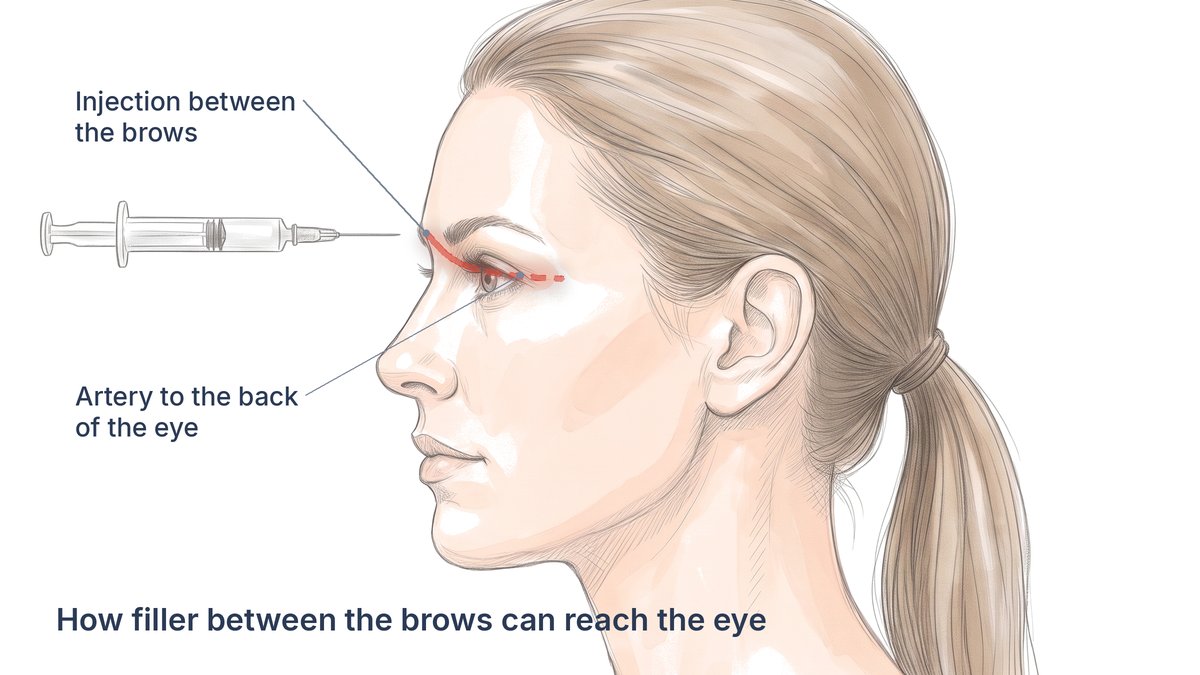
Arteries of the forehead, brow and nose connect to the ophthalmic artery, which feeds the eye, so filler pushed into one of them under pressure can travel backward against the blood flow (retrograde embolism) into the eye’s own circulation. When the pressure stops, blood flow can carry it forward into the eye’s smaller arteries, including the central retinal artery, where it blocks them.
Dr. Yongwoo Lee explains the same pathway on video, with the warning signs and the emergency steps: how filler reaches the eye and what to do when it does, in a 12-minute video. The second half of the video is written for trained injectors.
An eye guideline from Australia and New Zealand describes filler entering the ophthalmic artery through its connections with the supraorbital, supratrochlear and dorsal nasal arteries. For filler to flow backward, the injection pressure has to exceed the arterial pressure plus the friction of the filler moving through the vessel. It takes very little product: in cadavers, 0.04 to 0.12 mL, a fraction of a 1 mL syringe, filled the supratrochlear artery from the glabella back to the orbital apex.
The central retinal artery is only about 0.16 mm across, a value calculated from healthy volunteers. It enters the optic nerve between 6.4 and 15.2 mm behind the eyeball and is normally an end artery with no collateral circulation, so the inner retina it feeds has little or no backup when it is blocked. A consensus panel describes three patterns:
- Ophthalmic artery occlusion: vision loss, often with a drooping lid and an eye that cannot move normally.
- Central retinal artery occlusion (CRAO): vision loss alone.
- Branch retinal artery occlusion: loss of part of the field of vision, often the upper or lower part.
In the 2024 review, the first two were about equally common, at 32.9 and 32.4 percent of 346 diagnosed cases, though the review notes that diagnoses were labeled inconsistently. Stroke is thought to happen when filler travels farther back, through the internal carotid artery into the brain.

Which Filler Areas and Filler Types Carry the Highest Risk of Blindness?
Most reported cases followed injections in the nose, the forehead or the area between the eyebrows (the glabella), which made up 40.6, 27.7 and 19.0 percent of 401 reported injection sites in a 2024 review of 365 published cases. Hyaluronic acid (HA) filler appears in most reported cases and is the only filler that can be dissolved; fat, calcium hydroxylapatite, poly-L-lactic acid and permanent fillers cannot.
| Injection site | Reported sites (of 401) | Share of reported injection sites |
|---|---|---|
| Nose | 163 | 40.6 percent |
| Forehead | 111 | 27.7 percent |
| Glabella | 76 | 19.0 percent |
| Temple | 14 | 3.5 percent |
| Around the eye | 8 | 2.0 percent |
| Cheek | 6 | 1.5 percent |
| Eyebrow | 3 | 0.7 percent |
| Lip | 3 | 0.7 percent |
Other sites make up the rest. Figures from 401 injection sites in 365 published cases reviewed in 2024.
These are shares of reported injection sites, not the risk of a single injection: a site injected more often produces more cases. A 2020 consensus ranks the glabella, nose and forehead as very high risk, and the temples, nasolabial folds, tear troughs, the area around the eye and the inner cheek as high risk. Which vessel runs at each depth of the temple is mapped in temple hollowing: fat grafting vs filler.

Nose filler and under-eye (tear trough) filler
Nose filler, sometimes sold as a non-surgical or liquid nose job, accounts for the largest share of reported cases: 163 of 401 reported injection sites (40.6 percent). FDA device reports point the same way: the nose had the most events affecting distant blood vessels, and 14 patients with unresolved or permanent vision changes had been injected in the nose. The area around the eye, including the tear trough, made up only 8 of 401 sites (2.0 percent), but the 2020 consensus still ranks tear troughs and the periorbital area as high risk. Surgery and filler for the under-eye area are compared in lower blepharoplasty versus tear trough fillers.
Which fillers are most often involved
Of the 363 cases in the 2024 review with a known filler, HA was involved in 79.6 percent and autologous fat in 13.5 percent, with every other material under 2 percent.
Fat stands out for severity. In the same review, the odds of a stroke were about 7 times higher with fat than with HA (odds ratio 7.06), and the odds of any visual improvement were about 7 times higher with HA than with fat. The range of uncertainty around the second figure is wide (2.10 to 22.9), and the stroke figure rests on 33 strokes, so read both as a strong signal rather than an exact multiplier. A Korean national survey found that patients injected with fat had diffuse ophthalmic artery blockages, worse visual outcomes and more brain infarction than those injected with HA.
The Australian and New Zealand eye guideline states that no commercially available agent dissolves non-HA filler. Hyaluronidase, the enzyme that dissolves HA, is explained in dissolving filler versus a facelift for an overfilled face.
How Can Filler Blindness Be Prevented?
Prevention rests on technique and preparation: a blunt cannula where it suits, small, slow, low-pressure injections, knowing the high-risk zones, and hyaluronidase plus a hospital plan before the first injection. In my own practice, four choices lower the risk of filler reaching the eye without removing it: I use a blunt cannula almost everywhere, keep filler between the brows very superficial, never inject the nose, and have hyaluronidase and a hospital transfer arranged before the first injection. I plan the entry point and the depth for each area from where its arteries run, to keep the product away from them.
A blunt cannula, almost everywhere
I use a blunt cannula for filler almost everywhere, not a sharp needle. In a retrospective survey of 370 US dermatologists, vascular occlusion was reported about once per 6,410 syringes with needles and once per 40,882 with cannulas. Those figures were self-reported, most occlusions involved the skin, and the survey had no blindness category. Nor is a cannula a cure-all: a 2020 consensus does not consider cannulas safer in the nose, and in the 2024 review, 16 of the 38 blindness cases that recorded the instrument involved a cannula. The 2020 consensus also advises injecting slowly, at low pressure and in small amounts.
No filler in the nose
I never inject filler into the nose, the most common site in reported cases.
Between the brows: very superficial, and released first if the line is deep
In the glabella I place filler very superficially. A cadaver study of this area found that the arteries between the eyebrows run deeper than the superficial plane its authors recommend for filler. Superficial is not artery-free: a superficial branch of the supratrochlear artery can lie about 1.5 mm under the skin. For a very deep frown line, I first do a small release of the line (subcision), then still place the filler in a superficial layer, for safety. The logic of that combination is anatomical; I know of no outcome study that has tested it.
What a negative aspiration does not prove
Pulling back on the plunger before injecting is often called a safety check; the 2020 consensus calls it unreliable and impractical. In a laboratory test of 17 filler products, aspiration came back negative with 8 of them even though the needle tip sat in liquid.
Hyaluronidase on the shelf, a hospital already arranged
My clinic keeps an ample stock of hyaluronidase, ready at any time. Dissolving filler at the injection site has not been shown to reliably restore vision, so it does not replace the hospital. A large specialist hospital is close to the clinic, and I have agreed with it in advance how a transfer would work.
Fat grafting carries this risk too
I perform facial fat grafting, and fat can enter the same arteries. It cannot be dissolved, and in published cases it was linked to worse outcomes. That belongs in a fat grafting consultation, alongside how much transplanted fat actually lasts and the published fat embolism cases and their warning signs.
What Should You Ask Before Any Filler Injection?
Ask three questions: what exactly will be injected and can it be dissolved, what happens in the first minutes if my vision changes, and which hospital would I be taken to. A prepared clinic answers all three without hesitating, because its plan exists before anything is injected.
- What is this product, and can it be dissolved? HA can; fat and other fillers cannot.
- If my vision changes in the chair, what happens in the next five minutes? Listen for stop, call and transfer, in that order. For HA filler, hyaluronidase may be given too, but it should not delay the transfer.
- Which hospital would I go to, and is that arranged? A named hospital is a plan. “We would figure it out” is not.
Ask who is injecting, too. Only 35 cases in the 2024 review recorded who injected; in 14 of them it was not a doctor, and most of those injectors were unlicensed or had no medical training.
A prepared clinic keeps hyaluronidase on site, as the 2020 consensus says every clinic should, and knows the receiving hospital in advance, because, in that panel’s words, “The priority should be urgent referral to expert care.” This is what the consensus recommends for every clinic, including mine.
What Is the Treatment for Filler Blindness, and Does Hyaluronidase Work?
Hospital teams can try to dissolve or dislodge the filler, lower pressure inside the eye, or add oxygen, but no treatment, hyaluronidase included, has been proven to restore vision. In the 2024 review of 365 cases, no treatment was significantly associated with visual improvement, and only 2 of 38 eyes given hyaluronidase behind the eye improved.
The American Academy of Ophthalmology reached the same verdict from 19 studies, all rated level III, the lowest grade: the treatments were usually not effective in reversing vision loss, and no evidence-based protocol has been established.
At a Glance: hospital treatments and what the published cases show
| Treatment | Who does it | Reported result | Main caveat |
|---|---|---|---|
| Hyaluronidase at the injection site | Injector or emergency team | Used in 214 of 302 treated cases (about 70 percent); no separate improvement rate | Not linked to visual improvement; works on HA only |
| Hyaluronidase injected behind the eye (retrobulbar) | Ophthalmology-trained clinicians | 2 of 38 improved (5.3 percent); median 9 hours after filler | A UK consensus says the evidence does not support it |
| Hyaluronidase or thrombolytic drugs delivered through an artery (intra-arterial) | Hospital catheter team | 55 of 161 improved (34.2 percent), usually treated 24 to 48 hours after the filler; 16 of 45 (36 percent) in one series | Not linked to improvement in the 2024 review; often reopened the artery without restoring sight; brain bleeding and new blockages reported in one series |
| Draining fluid from the front of the eye (anterior chamber paracentesis) | Ophthalmologist | Outcomes not reported in the 20 cases | Not proven; may be harmful |
| Hyperbaric oxygen | Hyperbaric unit | 12 of 29 improved, often alongside other treatment | Case-series evidence only; not linked to improvement in the 2024 review |
Figures from 365 published cases reviewed in 2024 unless noted.
For treatment through an artery, one series treated 45 patients with hyaluronidase delivered by catheter: vision improved in 16, one patient had multiple small brain hemorrhages and three had new embolisms.
Hospitals also scan the brain, because some filler strokes are silent; in a series of 12 patients, 5 of the 8 who had imaging showed cerebral infarction. And because a filler embolus is not a blood clot, the American Heart Association notes that the clot-dissolving drugs used for ordinary strokes are not expected to work. In the 45-patient series, catheter treatment used hyaluronidase with a vessel-relaxing drug and mechanical disruption of the filler rather than a clot drug alone.
What Does Not Help After Filler Blindness?
Two things people rely on have no support: hyaluronidase given into a vein, and waiting to see whether vision returns. Neither, and none of the home remedies above, should take the place of an ambulance.
- Hyaluronidase into a vein. It has been proposed, but there is no published evidence in patients that it restores vision.
- Waiting to see. The American Heart Association says triage should not be delayed.
Surgeon’s Insight: The Plan Has to Exist Before the Cannula Touches the Skin
I have studied emergency medicine and worked as an emergency-room physician, so I can give emergency care myself, including managing vital signs and intubating a patient, until transfer. That does not let me treat a blocked eye artery in the clinic; that belongs to a hospital.
The hyaluronidase on the shelf and the hospital arranged in advance are there for the first minutes if something goes wrong. None of it makes the risk zero. It means no one is deciding what to do while the clock is running.
Who Will Act in the First Minutes if It Goes Wrong?
Before any filler, ask who will stop, call for help and travel with you, and to which hospital. A clinic that names the hospital and can show you its hyaluronidase has a plan.
If you ask only one thing, ask this: If my vision changes in the chair, what happens in the next five minutes, and where do I go?
Written by Dr. Yongwoo Lee, board-certified Korean plastic surgery specialist in facial anatomy and aesthetic procedures at VIP Plastic Surgery, South Korea.
Frequently Asked Questions About Filler Blindness
Can filler cause blindness?
Yes, rarely. Filler that enters an artery of the forehead, brow or nose can travel into the ophthalmic artery and block the arteries that feed the eye. A 2024 review found 365 new cases reported between 2018 and 2023.
How common is blindness from filler?
The most quoted estimate is less than 1 in 100,000 syringes, about 0.001 percent. It was built from roughly 300 published cases against roughly 30 million syringes, so it is an estimate, not a measured rate.
What are the warning signs of filler blindness?
A sudden change in vision in one eye, from blurring to complete loss, often with a drooping eyelid, an eye that will not move normally, or white, gray, blue or mottled skin near the injection. Headache, nausea or stroke signs can follow. Pain is often absent, so no pain does not mean safe.
How long after filler can blindness happen?
Usually immediately or within about 10 minutes of the injection. In a 2024 review of 365 published cases, only 2 began later, the latest the next day; later cases appear mostly in FDA reports, which are unverified. No case in that review began weeks or months later. Any sudden vision change in the days after filler still warrants an emergency call.
Is blindness from filler permanent, or can it be reversed?
Usually it is permanent. No hospital treatment has been proven to restore vision. Of 318 published cases with outcome data in a 2024 review, 68.2 percent had no recovery, 25.8 percent improved partly and 6.0 percent recovered completely.
Can hyaluronidase reverse filler blindness?
Not reliably. In a 2024 review of 365 published cases, no hyaluronidase route was linked to visual improvement, and only 2 of 38 patients injected behind the eye improved. It does nothing for non-HA fillers.
Can nose filler cause blindness?
Yes. The nose is the most common site in reported cases, about four in ten of 401 reported injection sites in a 2024 review of 365 published cases. A 2020 consensus does not consider cannulas safer in the nose. That is a share of reported cases, not the risk of one injection.
Can under-eye filler cause blindness?
It can. The area around the eye accounted for 2.0 percent of reported injection sites in a 2024 review of 365 published cases, and a 2020 consensus ranks tear troughs as high risk.
Can lip filler cause blindness?
Rarely: the lip accounted for 3 of 401 reported injection sites (0.7 percent) in a 2024 review of 365 published cases. Lip filler more often causes other problems, such as migration and the duck-lip look.
Is fat grafting riskier than filler for blindness?
No one knows whether it happens more often, but when it does, it tends to be more severe. In a 2024 review of 365 published cases, the odds of a stroke were about 7 times higher with fat than with HA, and the odds of visual improvement about 7 times higher with HA. Fat also cannot be dissolved.
Does a cannula prevent filler blindness?
No. In a US survey, blocked vessels, mostly in the skin, were reported about once per 6,410 syringes with needles and once per 40,882 with cannulas, so a cannula lowers the reported rate without preventing it. A 2020 consensus does not consider cannulas safer in the nose.
Is it a bruise or a blocked artery?
A blocked artery often starts pale or white, then turns blotchy and lacy purple; experienced injectors reported a faint mottled pattern in 63 percent of cases and pallor in 41 percent as first signs. A bruise is usually a purple patch that stays put. If you are unsure, call the injector now, and treat any change in vision as an emergency.
Can filler cause a stroke?
Yes. In a 2024 review of 365 published cases, about one in three had neurological symptoms and about one in five had stroke-like signs. Filler is thought to travel back from the eye’s artery into the internal carotid artery and the brain. Stroke signs need the same emergency call.
Can temple or cheek filler cause blindness?
It can, though these sites are less common in reported cases: in a 2024 review of 365 published cases, the temple accounted for 14 of 401 reported injection sites (3.5 percent) and the cheek for 6 (1.5 percent). A 2020 consensus still ranks the temples and the inner cheek as high risk.
What is the difference between filler vascular occlusion and filler blindness?
Filler vascular occlusion means any artery blocked by filler, and most affect only the skin. Filler blindness is the rare form in which the blocked artery feeds the eye. In a survey of 370 US dermatologists, 3 of 189 occlusions were classed as eye injury.
What should I do if my vision changes after filler?
Call your local emergency number, ask for an ambulance, and say: “I suddenly lost vision in my [left/right] eye at [time], after a filler injection in my [area]. I’m worried filler has blocked the artery to my eye.” Then give the product name and the clinic’s number. In Korea, the number is 119.
This article is for informational purposes only and does not constitute medical advice. Always consult with a qualified medical professional before making any decisions about surgical or non-surgical procedures.
