
Most facial fat grafts heal without a problem that needs treatment. When facial fat grafting complications do occur, the usual ones are a lump, an oil cyst, too much volume or an uneven side, and all of them differ from filler problems in one way: grafted fat cannot be dissolved with an injection. The most serious complication, fat entering an artery, is rare but can cause permanent vision loss or a stroke.
Quick answers
- Is it normal to feel lumpy at first? Yes. Swelling and redness are considered normal for 14 to 21 days, and the graft settles over 3 to 6 months.
- Can a lump be dissolved like filler? No; hyaluronidase works only on hyaluronic acid. A fat lump is treated in steps: waiting, a steroid injection into the lump, then drainage or removal.
- Can fat grafting cause blindness? Rarely, but most published facial fat embolism cases ended in permanent vision loss.
Are Lumps After Facial Fat Grafting Common, and Are They Normal?
True lumps are uncommon, but feeling firm, puffy or slightly uneven in the first few weeks is normal. A review of facial fat grafting complications puts contour irregularity at 0.54 to 2.9 percent in recent meta-analyses and the overall complication rate at 2.27 percent across 4,577 patients in one of them.
Those numbers are soft. A systematic review of 103 papers covering 5,479 patients found complication rates from 0 to 81.4 percent between studies and concluded that “the real complication rate of facial fat grafting is unknown due to a lack of reporting.” Among the 354 events it pooled, irregularities made up 16.1 percent, fat necrosis or lipogranuloma 8.5 percent, graft hypertrophy 6.2 percent and asymmetry 3.7 percent: shares of reported complications, not the odds for one patient.
Patients make two mistakes. One is judging the face at two weeks, while swelling and redness are still expected. The other is assuming a lump can be fixed the way filler is, with a dissolving injection. It cannot, so prevention matters more with fat, and so does the order of treatment. Early puffiness is covered in what actually reduces swelling after surgery.
Is It Swelling, a Lump, an Oil Cyst or Too Much Fat?
Four problems look alike in the mirror. Swelling is diffuse and fades within weeks; a nodule is a firm, discrete lump of dead fat and scar; an oil cyst is a smooth pocket of liquefied fat with a wall; and overcorrection is an area that is evenly smooth but too full. Timing, shape under the finger and, when unclear, an ultrasound tell them apart.
- Nodule or lipogranuloma. A firm lump of dead fat surrounded by inflammation. When lipogranulomas were removed in one Korean series, the tissue showed a foreign-body reaction and fat necrosis.
- Oil cyst. Liquid fat in a fibrous capsule. In breast imaging, aspirating an oil cyst typically yields a milky, emulsified fat, so a needle can confirm it. An older cyst whose wall has calcified feels hard.
- Overcorrection. No discrete lump, just too much volume in one zone, often puffy under the eye.
A Korean radiology series describes grafted fat as “unusual thickening of the subcutaneous fatty layer and a nodular lesion with an ill-defined margin unlike lipoma,” and found fatty masses in patients who complained of overcorrection. With the injection history, the scan separates grafted fat from filler.
Why Does Grafted Fat Turn Into Lumps, Oil Cysts and Calcification?
Grafted fat survives only where new blood vessels can reach it, so most lumps come from a parcel of fat that was too large or placed too close to the skin. The outer edge of each parcel lives, the middle regenerates from stem cells, and the center dies; a dead center becomes scar, an oil cyst, or both.

A review of graft biology describes an outer zone “in which all adipocytes survive,” a middle regenerating zone, and a central core “dominated by necrosis, oil cysts, and fibrosis”, with remodeling through the first 3 months. Only the outer few tenths of a millimeter of a deposit survive outright. Overall survival is covered in how much transplanted fat actually survives.
Calcification is the late stage. Oil cysts removed from three women 2, 4 and 6 years after cosmetic breast fat grafting had an “eggshell-like” calcification lining the inner wall and persistent inflammatory cells, and the older the cyst, the more calcification and fibrosis. The authors called oil cysts “the worst outcome of fat grafting.” Three breast cases show the mechanism and time course, not how often this happens in a face.
What prevents a dead core is the size of each deposit, not the size of the fat particles; the biology review notes that “smaller particles does not necessarily mean better”. Published guidance asks for 0.02 to 0.1 mL per pass, deposits 2 to 3 mm across or less, less flow on the backstroke near the entry point, and no superficial placement in thin skin, “especially the orbit and tear trough”.
Microfat and nanofat are not the same thing
Microfat is fat placed in small parcels, and it adds volume. Nanofat is microfat emulsified and filtered until it passes through a fine needle; in the original work it contained no viable adipocytes but abundant stem cells. A later analysis confirmed that the shearing destroys most fat cells, so nanofat is a skin treatment, not a volume filler.
Under the eye: why lumps sit just above the rim
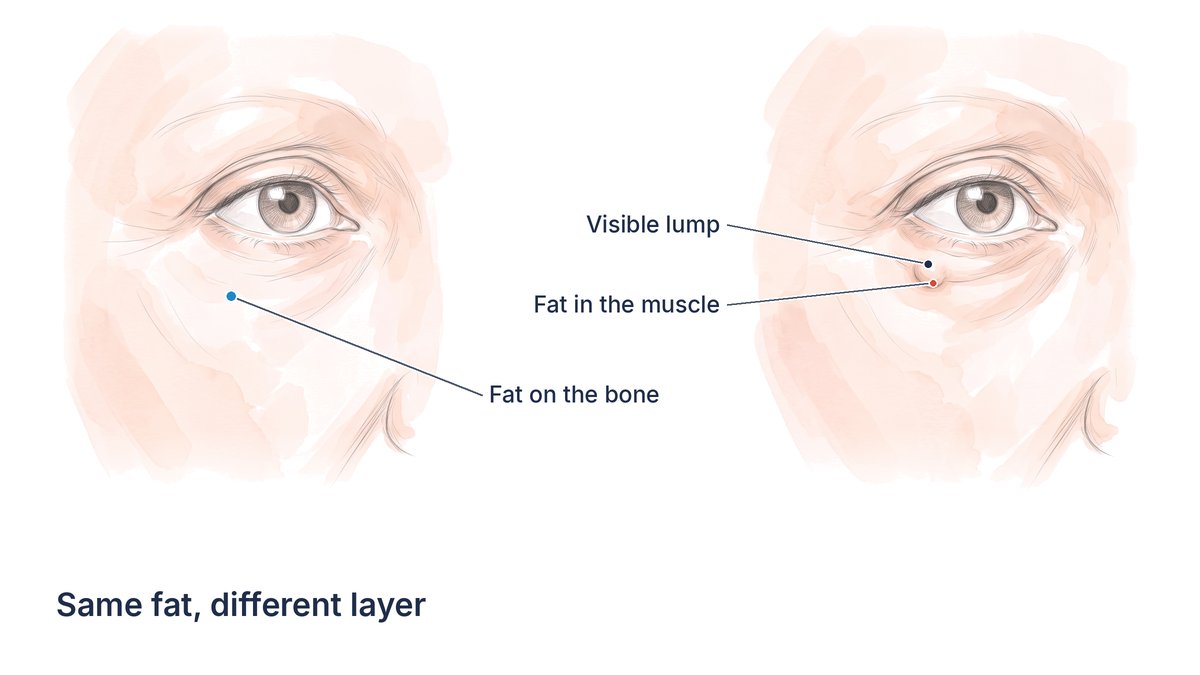
Under-eye lumps form when fat ends up too shallow, inside the orbicularis muscle of the lower lid, just above the bony rim, where the skin is thinnest and no bone lies underneath. Among 48 patients referred with lumps after lower-eyelid fat transfer, the lumps sat above the orbital rim alone in 65 percent and both above and below it in 35 percent; 54 percent were a solitary nodule, 23 percent mixed, 17 percent diffuse and 6 percent multiple. At surgery, the grafted fat lay within the orbicularis oculi muscle in the above-rim cases. As a referral series, it shows the pattern, not the frequency.
In 33 patients who had fat grafting with eyelid surgery, the authors attributed their few lumps, including one visible lower-lid lump, to “superficial fat injection during our early experience,” and they place fat deep to the orbicularis, noting that preperiosteal placement “further adds more safety”. Citing a review of lower-eyelid fat grafting complications, the management review advises no more than 1.5 to 2.0 mL per side in the eyelid and tear trough.
Can a Lump Appear Months or Years After Fat Grafting?
Yes. In a Korean series of 27 patients with lipogranulomas around the eye, symptoms began a mean of 13.6 months after the fat injection, ranging from 2 to 153 months, so a lump that appears a year later can still come from the graft.
In that series 40.7 percent had a droopy upper lid. Most had not been injected in the eyelid at all: 69.2 percent had fat placed in the forehead, and it had tracked down into the lid. A second Korean series of 27 women with lipogranuloma after forehead fat injection found that 19 had received cryopreserved, stored fat. That is an association in one series, not proof, but a fair question before any top-up.
A red, warm, painful or draining lump is different. Infection is rare, at 0.10 to 0.54 percent, and a late one should raise the possibility of atypical mycobacteria, which need specific tests.
How Are Fat Graft Lumps, Oil Cysts and Overfilling Treated?
Grafted fat cannot be dissolved, so treatment means waiting, shrinking or removing: observation first, then a steroid injection into the lump, then draining an oil cyst or removing a nodule, and for a diffuse excess, small-cannula liposuction or excision.

At a Glance: Fat Grafting Problems and Their Usual Fixes
| Problem | What you notice | Usual timing | Published options | Will not help |
|---|---|---|---|---|
| Swelling | Diffuse puffiness | First 2 to 3 weeks | Time | Judging this early |
| Nodule or lipogranuloma | Firm, discrete lump; sometimes a droopy lid | Months to years | Observation, steroid injection, excision if it persists | Hyaluronidase |
| Oil cyst | Smooth, rounded lump | Months | Drainage usually, excision rarely | Hyaluronidase |
| Calcified cyst | Hard, unchanging lump | Years | Excision if it bothers you | Steroid injection or waiting (it will not shrink) |
| Overcorrection | Smooth but too full | After the first months, or after weight gain | Microliposuction, excision, small test doses of steroid or deoxycholic acid | Hyaluronidase |
| Undercorrection | Still hollow, or sides differ | After 3 to 6 months | Repeat graft or filler | Massage |
| Late infection | Red, warm, painful | Weeks to months | Examination and tests | Waiting |
Options from a review of managing facial fat grafting complications and the Korean lipogranuloma series.
Steroid injections
Steroids are the first active treatment in the published series. Of 21 patients treated with a steroid injected into the lump, steroid tablets or both, 15 (71 percent) resolved fully, 5 (24 percent) partly and 1, on tablets alone, did not respond, and the authors made steroids first-line before excision. In the 27-patient Korean lipogranuloma series, triamcinolone injected into the lump resolved 5 of 6 completely and 1 partly, with one recurrence at 2 months. Doses are kept small and placed slowly into the lump itself, because a steroid can also thin or lighten the skin around it.
Watching, draining and removing
Some lumps settle untreated: of 18 observed patients in the same 27-patient series, three with a single mass and no other symptoms resolved within 5 months. Oil cysts are usually drained and only rarely excised. A nodule that persists is removed; the three excised in the Korean series resolved by about a month.
Too much fat
Overcorrection is treated by removing or shrinking fat. The published menu runs from microliposuction and direct excision, including a lower-lid blepharoplasty that removes fat, to triamcinolone or deoxycholic acid starting with test doses, and in extreme cases reducing cheekbone projection. Deoxycholic acid is approved only for fat under the chin; in the face it is off-label and is not injected close to the eye. A face overfilled with hyaluronic acid is the opposite case, explained in dissolving filler versus a facelift for an overfilled face.
How Does Dr. Yongwoo Lee Prevent Fat Grafting Lumps, and Treat One When It Appears?
I process fat with low-speed centrifugation, place it in thin threads through a blunt cannula, graft under the eye only on the bone, and treat a lump in steps: wait, then a steroid injection, then aspiration or excision.
Where I graft fat
I perform facial fat grafting myself, often together with a facelift. A lift repositions tissue but cannot replace lost volume, so in the same operation I graft the temples, the forehead, the cheekbones and the side of the cheeks, the nasolabial folds and the marionette area. After a brow lift, I add microfat to the brow. Under the eye, I add a small graft when a lower blepharoplasty would otherwise leave a thin face looking hollow, as described in lower blepharoplasty versus tear trough fillers. The temple has its own plane and its own choice, set out in temple hollowing: fat grafting versus filler.
How the fat is prepared and placed
I process the harvested fat with low-speed centrifugation, which concentrates the fat without the harder spinning that damages cells. Like most surgeons, I place it through a blunt cannula in thin threads, injecting only as the cannula is withdrawn, so no spot receives more fat than its blood supply can feed.
Under the eye: the deepest layer only
Under the eye I place fat only in the deep supraperiosteal layer, directly on the bone, and never in the orbicularis muscle or the fat just under the skin. The referral series found most lumps in the muscle; below the rim some lay in the deep cheek fat near the bone, so no layer is lump-proof, which is one more reason I keep the amount small. In a lower blepharoplasty I already work over the rim in the supraperiosteal plane, so the graft goes into a layer I am in anyway. If the contour still needs more once the graft has settled at about six months, adding a little is simpler than taking fat out of an eyelid.

When a lump appears
My order is fixed.
- Wait. In the first months, firmness is usually swelling and remodeling, and some true lumps settle on their own. I examine the lump and watch it.
- Steroid injection. A discrete lump still present after that gets a small steroid injection into the lump, repeated only if needed.
- Aspiration or excision. If it does not respond, an oil cyst is drained with a needle and a firm nodule is removed.
One exception overrides the order: a lump that is red, warm, painful or growing is examined and treated at once, because waiting does not treat an infection.
Timing and weight
I judge a graft once it has settled, and when an area needs more, a second session comes three to six months after the first, not earlier. For patients losing weight, including on GLP-1 drugs, my rule is three months of weight held within about 2 kg before a fat graft, for the reasons in Ozempic face: facelift, fat grafting or wait.
Does Grafted Fat Grow If You Gain Weight, or Shrink If You Lose It?
Grafted fat that survives behaves like living fat, so weight gain can enlarge it. We found no study that measured what weight loss does to a facial graft.
The management review describes weight gain causing delayed over-volumization, including delayed double vision after fat grafting around the orbit, treated by excision. In a case report of a young patient grafted for facial hemiatrophy, the result worsened after major weight gain, with the grafted volume growing and becoming asymmetric. A single case proves only that it can happen, but a face overfilled years later deserves a look at the weight history first.
Which Fat Grafting Problem Do You Have?
Two facts sort most fat grafting problems: where the change sits and when it appeared.
Two weeks after a facelift with fat, puffy cheeks, one side fuller. Usually swelling. If that side is tense, bruised, painful, warm or still growing, it needs a same-day check for a collection of blood or fluid or an infection; otherwise wait.
Four months after under-eye fat, a small firm lump in the lower lid, just above the bony rim. This is the commonest pattern in lumps after lower-eyelid fat transfer, with the fat usually lying in the lid muscle. Have it examined; a steroid injection is the usual first active step.
A year after forehead fat, a lump in the upper eyelid and a lid starting to droop. A late lipogranuloma that tracked down from the forehead fits, and a steroid injection is the usual first step.
Cheeks fuller every year since the graft, after gaining weight. Likely graft hypertrophy rather than a lump. Weight comes first; if the fullness stays once the weight is stable, the fix is removal.
A hard lump years later. Possibly a calcified oil cyst. Imaging confirms it, and one that bothers you is removed rather than injected.
Hours or days after grafting, a sudden change in vision, a lid that suddenly droops, or stroke signs. An emergency: call your emergency number now, then let your surgeon know.
What Is Normal in the First Weeks and Months After Facial Fat Grafting?
Swelling, redness, mild bruising and some unevenness are normal for the first 2 to 3 weeks, and the graft keeps changing for 3 to 6 months while fat that did not win a blood supply is cleared. Judge the result once it has settled, after three to six months, not at two weeks.
A systematic review of 103 papers regards prolonged swelling and redness as “normal for a period of 14 to 21 days,” and a review of ultrasound-assisted facial grafting found that retention fell over the first 3 to 6 months and then stabilized. The donor site has its own, usually minor, problems: in 416 cases cited in the management review, donor-site complications occurred in 5.5 percent, including contour irregularity in 1.2 percent. An uneven donor area is handled like any lumpy result after liposuction.
Call the clinic early for a lump that is growing, red, warm or painful, swelling that increases after the first week, a fever, or an eyelid that droops gradually over weeks. A sudden change in vision or a lid that droops suddenly is different: call emergency services first, then the clinic.
Surgeon’s Insight: The Lump I Worry About Is the One I Cannot Take Back
With filler, a mistake under the eye can be dissolved. With fat, it cannot, and an eyelid lump is the hardest to remove cleanly, because the skin over it is so thin. That is why my under-eye rule puts the layer first and the amount second. A small graft on the bone that needs a top-up later is a far better problem than a generous one in the muscle.
And when a patient does come back with a lump, my first job is patience, not a needle.
Can Facial Fat Grafting Cause Blindness or Stroke?
Yes, rarely: fat injected into the face can enter an artery and block the arteries to the eye or the brain, and when it does the outcome is usually severe. A systematic review found 61 published cases of arterial embolism after facial fat grafting; of 54 with outcomes, 59.3 percent had permanent vision loss, 22.2 percent neurological impairment, 7.4 percent both, and 11.1 percent died.

Warning signs
Sudden blurring or loss of vision in one eye, eye pain, an eyelid that suddenly droops, an eye that will not move normally, pale or mottled skin near the graft, sudden headache, weakness on one side, slurred speech or confusion. In the management review’s 24 stroke cases, symptoms began within 2 hours in 17 and within 24 hours in all, but some published cases began a day or more later, so these signs still matter once you are home. Call your emergency number (119 in Korea) for an ambulance first, then let your surgeon know; the full sequence is in filler blindness: warning signs and what to do immediately.
What the published cases show
Published cases show severity, not frequency. A 2024 review in Plastic and Reconstructive Surgery Global Open counted 11 cases of hemiplegia, 7 of vision loss and 3 of skin necrosis among 58 complications reported in 38 patients, with 53 percent of severe complications in the forehead and temple, and still concluded that facial fat grafting has a low incidence of complications. In the 61-case review:
- Sites. Glabella alone 26.2 percent, multiple regions 26.2, temples 16.4, forehead 14.8, midface 8.2, around the eye 4.9, nose 3.3.
- Eye. When the ophthalmic artery was blocked, vision was lost in 26 of 26.
- Timing. Onset within an hour in 66 percent, at 2 to 23 hours in 24 percent, and from 24 hours up to a week in 10 percent.
- Instrument. Where recorded, 11 of 17 involved a needle and 6 a cannula.
A blunt cannula lowers the risk without removing it: “both cannulas and sharp needles have been seen to penetrate blood vessels,” and that review advises small volumes, slow, low-pressure injection, and local anesthesia where possible so an awake patient can report symptoms.
Once in an artery, fat tends to do more harm than hyaluronic acid filler. A Korean Retina Society survey found that patients injected with fat had diffuse ophthalmic artery occlusion, worse vision and more brain infarction than those injected with hyaluronic acid. In a 2024 review of 365 blindness cases, fat made up 13.5 percent, with about 7 times the odds of stroke compared with hyaluronic acid. No agent dissolves a fat embolus, and none of the eye treatments tried is proven.
What I do about this risk
The forehead and temples, two areas I graft during a facelift, are among the most reported sites, so this risk is not theoretical to me. My blunt-cannula technique, small amounts injected only while withdrawing, doubles as the published precaution, and I add low pressure, never forcing fat against resistance.
When I graft during a facelift, the patient is under general anesthesia with a board-certified anesthesiologist, so an awake patient’s early warning is not available on the table; the reasons are in general anesthesia versus IV sedation for a facelift. After a facelift, the patient is observed in the recovery room and stays one night, which covers the hours in which most published cases began. When fat grafting is done on its own, I use IV sedation with local anesthesia and the patient goes home the same day, so the warning signs above matter most once you are home.
I worked as an emergency-room physician and can manage vital signs and the airway until transfer, and transfer to Jeju National University Hospital or Halla Hospital is arranged in advance. None of that makes the risk zero; it means the plan exists before the first cannula moves.
What Should You Ask Before Facial Fat Grafting?
Ask about the layer and the amount before the graft, because with fat the best treatment for a lump is the one that prevents it, and the second best is a plan agreed in advance.
If you ask one thing at your consultation, ask this: in which layer will the fat go under my eyes, and what is the plan if a lump appears?
Individual results vary; consultation required.
Written by Dr. Yongwoo Lee, board-certified Korean plastic surgery specialist in facial anatomy and aesthetic procedures at VIP Plastic Surgery, South Korea.
Frequently Asked Questions About Facial Fat Grafting Complications
Why do I have a lump under my eye after fat transfer?
Usually because the fat sits too shallow, inside the orbicularis muscle of the lower lid just above the orbital rim. In a 48-patient referral series, the lumps sat above the rim alone in 65 percent and both above and below it in the rest. A steroid injection is the usual first active treatment.
How long is swelling or lumpiness normal after facial fat grafting?
Swelling and redness are considered normal for 14 to 21 days. A discrete lump that persists beyond the early months, or one that is red, warm or growing, should be examined.
What is an oil cyst after fat grafting?
A pocket of liquefied fat with a fibrous wall, left where the center of a fat parcel died for lack of blood supply. It is more common after large-volume grafting than in the face, and is usually drained with a needle.
Can fat transfer cause calcification, and is it dangerous?
An oil cyst’s wall can calcify: in breast cysts removed 2 to 6 years after grafting, calcification increased with age and inflammation persisted, so the concern is permanence. Facial data are limited; a calcified lump that bothers you is removed surgically.
Can forehead fat grafting cause a lump or a droopy upper eyelid?
Yes, sometimes a year or more later. In a Korean series of 27 patients with lipogranulomas around the eye, 69.2 percent had fat placed in the forehead that tracked down into the lid, 40.7 percent had a droopy upper lid, and symptoms began a mean of 13.6 months after injection.
Do steroid injections get rid of fat transfer lumps?
Often. In one series of 21 patients treated with steroid injections, tablets or both, 71 percent resolved fully and 24 percent partly; in another, 5 of 6 injected lumps resolved completely.
Can facial fat transfer be reversed?
Not with an injection that dissolves it. Excess fat is reduced by microliposuction, direct excision or a lower-lid blepharoplasty that removes fat, or by steroid or deoxycholic acid injections starting with test doses, once the graft has settled at about six months.
What if my face is uneven or still hollow after fat grafting?
Wait until the graft has settled, usually three to six months after the session. A side that is still hollow is then topped up with a repeat graft or filler, which massage cannot replace, and a side that is too full is reduced like any overcorrection.
Is nanofat or microfat safer under the eyes?
They do different jobs. Nanofat has no viable fat cells, so it treats skin quality and adds no volume. Microfat adds volume, and its lump risk depends mainly on layer and amount. Dr. Yongwoo Lee places it under the eye only in the deep supraperiosteal layer, on the bone, and in small quantities.
Does a blunt cannula prevent fat embolism?
It lowers the risk but does not remove it: both cannulas and sharp needles have been seen to penetrate blood vessels. Where the instrument was recorded in 61 published embolism cases, 11 of 17 involved a needle and 6 a cannula.
How soon after fat grafting can a fat embolism happen?
Usually at once: in 61 published cases, symptoms began within an hour in 66 percent, at 2 to 23 hours in 24 percent and from a day up to a week later in 10 percent. Sudden vision loss, a suddenly drooping lid or stroke signs at any point mean calling your emergency number first, then your surgeon.
How do I know if a lump is fat, filler or infection?
Your injection history and an ultrasound usually answer it: grafted fat shows as thickened fat with an ill-defined nodule. A lump that is red, warm, painful or draining suggests infection, which can involve atypical mycobacteria and needs prompt examination.
This article is for informational purposes only and does not constitute medical advice. Always consult with a qualified medical professional before making any decisions about surgical or non-surgical procedures.
