
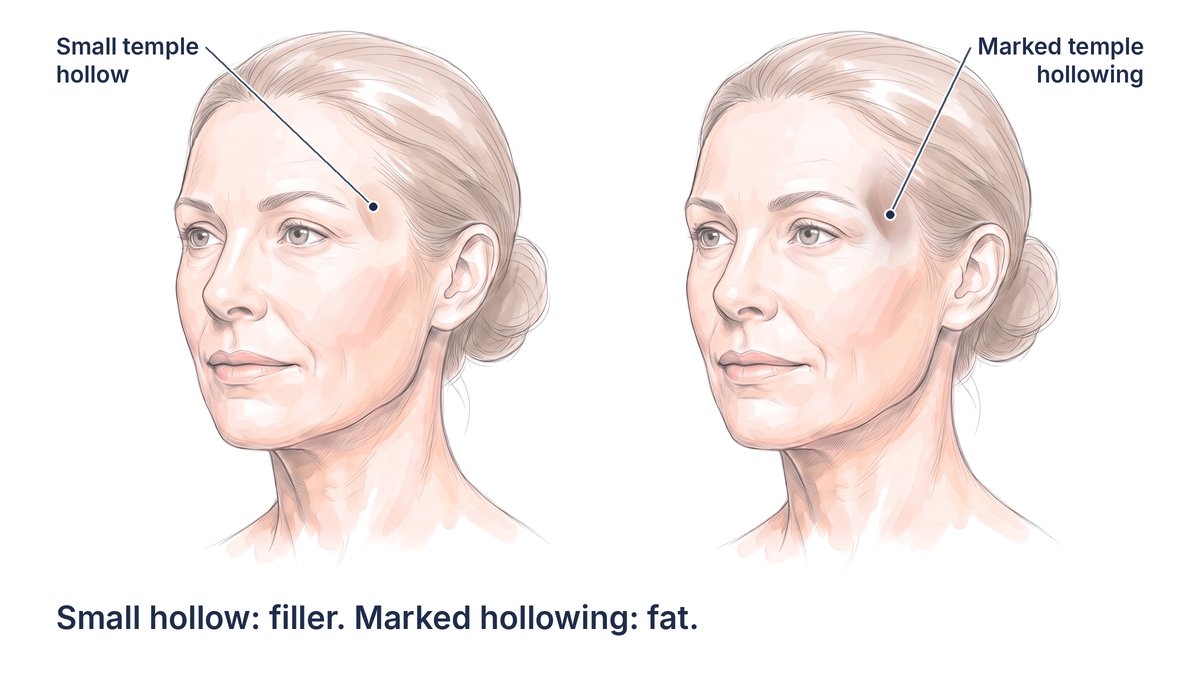
Sunken temples: key facts
- Small hollow: hyaluronic acid (HA) filler, about 1 to 1.5 mL per side in one clinical series
- Marked hollowing: fat grafting, roughly 6 to 17 mL per side placed in published studies, of which about 4 in 10 remain at one year
- Approved products: two HA fillers have a US FDA temple indication (Juvéderm Voluma XC in 2024, Restylane Contour in 2026); calcium hydroxylapatite (CaHA) and poly-L-lactic acid (PLLA) are off-label there
- Vessels: at three depths, so no layer is vessel-free
- Dissolvable: HA only
Should You Fix Sunken Temples With Filler or With Fat?
For sunken temples, the amount of volume missing decides between temple filler and fat grafting: a small hollow is a filler job, and marked hollowing is usually better answered with fat. In my practice that is the rule, with hyaluronic acid (HA) filler placed with a needle down to the bone for small hollows, and fat grafted through a blunt cannula for marked ones.
In a clinical series of 50 analyzed patients, temple hollows up to 3 mm deep took an average of 1 mL of HA per side, and deeper ones 1.5 mL per side. Fat is placed in far larger amounts: a 2024 systematic review of 719 patients found roughly 6 to 17 mL of fat injected per side, because only part of it survives.
How long each lasts matters less than fit. HA is quick, adjustable and dissolvable, but it is gradually absorbed and has to be repeated. Fat is your own tissue and does not need topping up once it has survived, but it needs a harvest, it cannot be dissolved, and its take is uneven, which makes its survival hard to predict.
Layer is the other half of the decision, because the temple carries blood vessels at three depths and every option goes into one of them.
Why Do Temples Become Hollow?
Temples hollow when the fat and other soft tissue in and around the temporal fossa, the shallow bowl behind the outer eyebrow, shrink with age, menopause, weight loss or a naturally lean build. Less often the problem is not a hollow at all but filler that has spread into the temple from the cheek.
Age and menopause. In a CT study of 58 adults, median temporal soft-tissue volume was 46.63 mL in premenopausal women and 40.32 mL in postmenopausal women.
Weight loss, including GLP-1 drugs. A 2026 review of 44 studies on so-called Ozempic face lists midfacial deflation, temporal hollowing and periorbital skeletonization as recurrent findings, though it comes from a new journal and its evidence is mostly descriptive. What GLP-1 weight loss removes from the face, and when to treat it, is covered in Ozempic face after GLP-1 weight loss.
Not a hollow at all. Filler placed over the cheekbone can spread upward. In an ultrasound study of 382 cheekbone regions, filler placed on the bone over the arch had moved up into the fat pad inside the deep temporal fascia, the layer that carries the middle temporal vein, in 94.7 percent of those cases. A temple that looks puffy or uneven after cheek filler needs the filler addressed first, as in dissolving filler for an overfilled face.
What Is Under the Temple Skin, and Where Are the Danger Zones?
The temple is a stack of thin layers over the temporalis muscle, with blood vessels at three depths: an artery in the superficial fascia, a large vein inside the deep fascia, and arteries on the bone under the muscle. No layer is free of vessels, which is why every temple treatment is a choice between risks, not a choice of a safe plane.
Papers count anywhere from 7 to 17 layers, so this article names them instead of numbering them. From the surface down, the simple version from a cadaver study of 16 temples is:
- Skin
- Subcutaneous fat
- Superficial temporal fascia
- Loose areolar tissue (the interfascial plane)
- Deep temporal fascia, which splits into two layers with a fat pad between them
- Temporalis muscle
- Periosteum, the thin lining of the bone

The roof: superficial temporal artery and the frontal nerve branch
An ultrasound study of 25 women located the superficial temporal artery between the laminae of the superficial temporal fascia, and a 2025 case series warns that subcutaneous injections risk entering the superficial temporal fascia, which contains the superficial temporal artery.
The frontal (temporal) branch of the facial nerve, which raises the eyebrow, travels in or just under the same fascia, which forms the roof of the interfascial plane. In the 16-temple cadaver study, two to four branches crossed the zygomatic arch about one fingerbreadth behind the back edge of the outer orbital rim, measured from the zygomatic process of the frontal bone. More on this nerve is in facelift nerve injury by branch.
The middle: the middle temporal vein
The middle temporal vein makes the temple different from the rest of the face. It runs in the fat pad between the two layers of the deep temporal fascia, just beneath the interfascial plane. In 18 temples from Korean cadavers, it lay 23.5 mm above the zygomatic arch at its front and 18.5 mm above it further back, with a maximum diameter of 5.1 mm, and it split and rejoined in 28 percent. A systematic review found widths across studies of 0.5 to 9.1 mm and defined the planes containing this vein as a “venous danger zone” for temple filler.
The concern is where it drains. In cadavers, saline flowed easily from the middle temporal vein into the internal jugular vein, a direct channel toward the heart and lungs, so filler entering it can travel to the lungs as a non-thrombotic pulmonary embolism. Backward flow toward the eye was hard to produce.
A smaller tributary, the sentinel vein, joins it from the front. In 18 hemifaces, it pierced the deep fascia about 27 mm up and back from the outer corner of the eye, and measured about 1.9 mm across. The cadaver study of 16 temples called the front half of the lower temple compartment a “zone of caution” for fat grafting for this reason.
The floor: deep temporal arteries on the bone
Going all the way to bone does not escape vessels. In 34 cadavers studied with contrast and CT, the deep temporal artery was present in all and ran between the temporalis muscle and the periosteum.
Which Is Best for Temples: HA Filler, Radiesse, Sculptra or Fat?
No single option suits every temple, but HA is the only filler with an FDA indication for temple hollows and the only one that can be dissolved; CaHA (Radiesse) and PLLA (Sculptra) are used in the temple off-label, on the strength of small studies; and fat is your own tissue, partly absorbed, permanent where it survives, and not dissolvable.
At a Glance: temple options compared
| Option | Temple evidence | Measured durability | Dissolvable | Temple-specific caution |
|---|---|---|---|---|
| HA filler | Two FDA-approved products (2024, 2026); randomized trials of 171 and 225 | 73.3 percent still improved at 13 months (Voluma XC); 86.1 percent at 18 months (Restylane Contour) | Yes, with hyaluronidase | Deep temporal artery on the bone; chewing pain if placed in muscle |
| CaHA (Radiesse) | Off-label; one 20-patient pilot | Improvement up to 12 months | No | Small evidence base; cannot be reversed |
| PLLA (Sculptra) | Off-label; label warns of blindness after temple injection | No long temple study; 25-month label follow-up elsewhere | No | Series of sessions; nodules in 17.2 to 28.4 percent on the label |
| Fat graft | Systematic reviews of 719 and 1,239 patients | About 42 percent of volume at 12 months, then stable | No | Surgery and harvest; uneven take; worse outcomes when embolism occurs |
HA filler
An HA filler (Juvéderm Voluma XC) was approved by the FDA on 5 March 2024 for moderate to severe temple hollows in adults aged 21 and over, the first HA filler with that indication. In the pivotal trial, 171 adults were randomized 2 to 1 to treatment or no treatment, with blinded evaluators. At three months, 80.4 percent of treated patients had improved by at least one point on a temple hollowing scale against 13.5 percent of controls, and 73.3 percent were still improved at 13 months.
Patients in that trial received a median of 3.65 mL for both temples combined, with a range of 0.4 to 8.0 mL. The label specifies the technique: a needle placed at 85 to 90 degrees until it touches bone, a single slow bolus, at most three injection points per side per session, and “Do not overcorrect.” It also states that the safety of using this product with a cannula in the temple has not been established.
A second HA filler, Restylane Contour, received an FDA indication for temple hollowing in patients over 21 on 20 March 2026. Its trial randomized 225 adults 4 to 1 to treatment or no treatment, with blinded evaluators. Treated patients had a needle bolus on the bone plus a shallower layer under the skin, placed by needle or by blunt cannula. At three months, 91.2 percent had improved by at least one grade in both temples against 9.1 percent of controls, and 86.1 percent of treated patients were still improved at 18 months.
Calcium hydroxylapatite (Radiesse)
CaHA has no temple indication in the US. The main temple study is a single-investigator, non-blinded pilot of 20 patients that reported improvement lasting up to 12 months. Like every non-HA filler, CaHA cannot be dissolved.
Poly-L-lactic acid (Sculptra)
PLLA stimulates collagen gradually. Its FDA labeling does not include the temple, and it carries a specific warning: “Visual disturbances including blindness have been reported following injection of Sculptra into the temple area.” Trials used up to four sessions three to four weeks apart, and nodules or papules appeared in 17.2 percent in the controlled phase and 28.4 percent in a later post-approval study.
In the temple, an open-label study measured gains at 8 weeks and stopped at 16 weeks, too short to show how long it lasts.
Fat grafting
A 2025 systematic review of 45 articles and 1,239 patients found a mean volume retention of 42.11 percent at 12 months. In the 2024 review of 719 patients, 36 percent were satisfied and 52 percent very satisfied.
How Long Does Temple Filler Last Compared With Fat?
HA filler in the temple lasts about 12 to 18 months in the two approval trials, while fat on average loses more than half of its volume in the first year and then keeps what remains. CaHA lasted up to 12 months in one pilot, and no temple study has followed PLLA long enough to say.

HA. Beyond the FDA trials, an ultrasound series of 25 women measured the gel itself: the HA layer was 3.82 mm thick immediately, 3.00 mm at three months and 2.51 mm at six months. It was a single-author series without controls, but it shows why HA is a repeat treatment.
Fat. In a prospective study of 63 patients measured by 3D scanning, conventionally processed fat retained 58.9 percent of its volume at one month, 39.9 percent at six months and 32.6 percent at 12 months. Across studies, retention ran from 33 to 65 percent. Why fat behaves this way, and why most of the loss happens in the first months before the volume levels off, is explained in how much transplanted fat actually lasts.
How Does Dr. Yongwoo Lee Treat Sunken Temples? A Needle on Bone for Filler, a Cannula for Fat
I treat a small temple hollow with HA filler placed by needle on the bone, in the supraperiosteal plane under the temporalis muscle, and marked hollowing with fat that I graft myself through a blunt cannula into the interfascial and subcutaneous planes.

Why the dividing line is volume
A small hollow needs a small, defined amount of product in one place, which is what a deep filler bolus does well, and HA can be dissolved if it is not right. Marked hollowing is a different job. Filling it with gel would mean large volumes, repeated as the gel is absorbed, in a region where every layer carries a vessel, while fat that survives is living tissue that does not need to be topped up.
Filler: a needle, straight down to bone
The temple is my exception to using a blunt cannula for filler. Here the HA goes in with a needle that passes through all the layers until its tip rests on the bone, so the filler sits on the periosteum beneath the temporalis muscle, below the superficial temporal artery, the frontal nerve branch and the fat pad that carries the middle temporal vein.
That is the technique on the Juvéderm Voluma XC label for temple hollows and the one tested in its approval trial; the Restylane Contour trial placed its deep layer the same way. The Voluma XC label also places the bolus: about 1 cm up and back, then 1 cm down and back, from where the temporal fusion line meets the outer orbital rim, in the upper front of the temple.
I make sure the tip is on bone before any filler goes in, because a needle that stops short can leave product in the muscle; the ultrasound series describes a dull pain and tension-type headache, worse with chewing, when filler lands in the temporalis. I inject slowly, in a small amount at each point, and I do not overcorrect.
What this plane does not avoid is the deep temporal artery, which lies on that same bone. Injectors who prefer a cannula in the interfascial plane point out that supraperiosteal injection carries a great risk of injuring the deep temporal arteries; their plane, in turn, sits directly over the middle temporal vein. I choose the deep plane knowingly and keep an ample stock of hyaluronidase in the clinic, with a hospital transfer arranged in advance.
Fat: a blunt cannula, two planes, small amounts
For marked hollowing I harvest fat and process it by low-speed centrifugation. I then place it through a blunt cannula in two planes: the interfascial plane, the loose areolar layer between the superficial and deep temporal fascia, and the subcutaneous layer above it. The 16-temple cadaver study describes the deep loose areolar layer as the plane where major neurovascular structures are largely absent, with the subcutaneous layer kept for residual irregularities.
“Largely absent” is not absent. The sentinel vein crosses this plane, the middle temporal vein lies just under it, and the superficial temporal artery and the frontal nerve branch run in the fascia that forms its roof. A blunt tip pushes vessels aside more readily than a sharp one, but it does not make the plane safe by itself. I place the fat in small amounts over many passes rather than as one deposit, which is also what lets more of it survive. A review of fat embolism after facial grafting advises injecting gently and slowly, with low pressure and small syringes.
When the face also needs lifting, I often graft the temple in the same operation as a facelift.
What I sort out before treating a temple
Three situations change the plan. A temple that looks uneven because cheek filler has migrated into it is dissolved first, if the filler is HA, and then reassessed. A patient whose weight is still falling waits: before a fat graft I ask for three months of weight held within about 2 kg. And I decline buccal fat removal when the temple is already thinning, for the reasons in buccal fat removal and long-term hollowing.
A fat graft is an operation. When the temple is grafted on its own, without a facelift, I use IV sedation with local anesthesia and the patient goes home the same day. The usual list of what to stop before surgery applies, including, in my practice, pausing a GLP-1 drug such as semaglutide or tirzepatide one month before. A prescribed blood thinner or diabetes drug is never stopped without the doctor who prescribed it.
Video in English, about 8 minutes: Temple Filler: Where, How Deep, and What Can Go Wrong
Which Temple Patient Are You?
Most temple patients fit one of five patterns, sorted by how much volume is missing and whether something other than hollowing is going on.
The 34-year-old runner with a shallow dip behind each brow. Stable weight, a small hollow. In my practice that means HA by needle on bone, accepting that it thins over a year and is repeated.
The 58-year-old with deep temples, a flattened cheek and an early jowl. Volume loss and descent together: fat to the temple, often with a facelift at the same sitting.
The 41-year-old on tirzepatide whose temples sank over six months. Volume placed now lands on a shrinking base, so she waits for three months of stable weight first.
The 45-year-old whose temples look puffy after cheek filler. Not hollowing: filler has likely moved up from the cheekbone, and more product adds to it.
The 50-year-old asking for Sculptra or Radiesse because it lasts longer. Both are used off-label in the temple, neither can be dissolved, and PLLA carries a labeled blindness warning for the temple. I do not use CaHA or PLLA at all, in any area, so my temple options are HA and fat.
What Is Recovery Like After Temple Filler or Temple Fat Grafting?
Temple filler usually means a few days of tenderness; a temple fat graft means bruising and swelling that take longer to settle, a sore donor site, and a result judged at about six months.
After HA filler. In the Juvéderm Voluma XC trial, injection-site responses occurred in 59.0 percent after the first treatment, mostly pain (50.9 percent), tenderness (49.7 percent) and redness (41.0 percent), typically gone within three days. Aching on chewing that persists or worsens suggests product in the muscle and should be reviewed.
After fat grafting. Bruising was the most common side effect in the 1,239-patient review, reported in 114 of the 261 patients for whom it was recorded (43.68 percent), with no infection, nerve dysfunction or fat necrosis described. A grafted temple looks overfull at first, then settles as fat that never gained a blood supply is cleared. In practice, nothing should press on a grafted temple in the first week: no tight hats, sleep masks or headphone bands.
A firm lump or an oil cyst can appear later in any fat-grafted area. How each is told apart and treated, with patience and a steroid injection before any removal, is in lumps and oil cysts after facial fat grafting.
Surgeon’s Insight: The Temple Is Where I Break My Own Cannula Rule
A needle in the temple can look inconsistent from a surgeon who uses a blunt cannula for filler almost everywhere else. Since no depth here is free of vessels, I would rather choose the vessel I am working near, the deep temporal artery on the bone, than work directly over the middle temporal vein, which drains straight to the jugular vein.
The same logic decides between filler and fat. A small hollow does not need an operation, and a marked one does not need a lifetime of syringes. Most of the consultation is measuring which of those two a temple is.
Is Temple Filler Safe? Blindness, Stroke and the Warning Signs
The temple is not a low-risk site: filler or fat entering an artery here can reach the eye or the brain, and material entering the middle temporal vein can travel to the lungs. A change in vision during or after a temple injection is an emergency.
How often the temple appears in reported cases. In a review of 365 published cases of vision loss from filler between 2018 and 2023, the temple accounted for 14 of 401 reported injection sites, or 3.5 percent. These are shares of reported cases, not the risk of one injection.
Which materials. In the same review, autologous fat was involved in 13.5 percent of cases with a known filler but stood out for severity: “The odds of concurrent stroke from autologous fat were 7 times greater than with HA.” The wider fat data are in fat embolism and other facial fat grafting complications.
Fat in the temple specifically. A 2021 review of 41 patients with embolism after cosmetic facial fat injection listed the temple among the most frequent sites, and none of the 22 treated patients regained visual acuity. A 2023 review of fatal cerebral fat embolism after facial grafting notes that the smallest fat volume reported to cause a cerebral embolism is 0.5 mL. The 1,239-patient review called temple fat grafting predominantly safe but collected 22 embolic serious adverse events from the literature: rare, and severe when they happen.
What can and cannot be undone. Hyaluronidase dissolves HA. No agent reliably dissolves CaHA, PLLA or fat.
Warning signs. Seek help at once for any of these during or after a temple injection:
- A change in vision in either eye, from blurring to loss of sight
- Skin turning white, gray, blue or blotchy purple near the injection
- Severe pain out of proportion to the injection
- A drooping face, slurred speech or weakness on one side
- Sudden breathlessness or chest pain
If your vision changes, or you notice stroke signs, breathlessness or chest pain, call your local emergency number or go to the nearest emergency room first, then tell the clinic that treated you. For a skin color change or severe pain without those signs, contact that clinic at once, not the next day. Full emergency steps are in the warning signs of filler blindness.
How Much Volume Does Your Temple Need, and Which Layer Will Hold It?
Volume decides the material, and the layer decides which vessel sits next to it; the brand on the syringe matters less than either.
A good consultation also checks that the weight is stable and that filler from elsewhere is not changing how the temple looks, and it sets a plan for what happens if something goes wrong.
If you ask only one question, ask this: How much volume does my temple need, which layer will it go into, and which vessel runs in that layer?
Written by Dr. Yongwoo Lee, board-certified Korean plastic surgery specialist in facial anatomy and aesthetic procedures at VIP Plastic Surgery, South Korea.
Frequently Asked Questions About Temple Hollowing, Filler and Fat Grafting
Which fillers are FDA approved for temples?
Two hyaluronic acid fillers have a US FDA temple indication: Juvéderm Voluma XC (March 2024) and Restylane Contour (March 2026). CaHA (Radiesse) and PLLA (Sculptra) are used there off-label.
How long does temple filler last?
About 12 to 18 months for HA: in the two FDA trials, 73.3 percent were still improved at 13 months with one product and 86.1 percent at 18 months with the other.
How much filler do temples need?
One clinical series averaged 1 mL of HA per side for hollows up to 3 mm deep and 1.5 mL for deeper ones. In the Juvéderm Voluma XC trial, the median was 3.65 mL for both temples combined.
Is fat transfer to the temples permanent?
The part that survives is. A review of 1,239 patients found 42.11 percent of the volume retained at 12 months; fat that has survived the first year behaves like your other body fat, changing with your weight.
Is Sculptra good for temples?
PLLA is used in the temple off-label, over a series of sessions. Its FDA labeling warns that blindness has been reported after temple injection, and it cannot be dissolved.
Can Radiesse in the temples be dissolved?
No. Hyaluronidase dissolves only HA. CaHA has no US temple indication, and its temple evidence is a 20-patient pilot.
Can temple filler cause headaches or pain when chewing?
Yes. Filler that lands in the temporalis muscle can cause a dull ache or tension-type headache that is worse with chewing. Injection-site pain in the first days is common; chewing pain that persists should be reviewed.
Why do my temples look hollow after Ozempic or Mounjaro?
Weight loss removes facial fat, and a 2026 review of 44 studies lists temporal hollowing among the recurrent findings. Before a fat graft I ask for three months of weight held within about 2 kg.
Is a cannula or a needle safer for temple filler?
Neither is safe in every layer: a needle on bone works near the deep temporal artery, and an interfascial cannula works over the middle temporal vein. I use a needle on bone for temple filler and a blunt cannula for fat.
Why do my temples look puffy after cheek filler?
Filler placed on the cheekbone can migrate upward: in an ultrasound study of 382 cheekbone regions, filler placed on the bone over the arch had moved into a deep temple fat pad in 94.7 percent of those cases. If it is HA, it is dissolved first and the temple reassessed, rather than adding more product.
Can temple filler travel to the lungs?
It can. The middle temporal vein inside the deep temporal fascia drains to the internal jugular vein, so filler entering it can reach the lungs as a non-thrombotic pulmonary embolism. Sudden breathlessness or chest pain after a temple injection means calling emergency services first.
This article is for informational purposes only and does not constitute medical advice. Always consult with a qualified medical professional before making any decisions about surgical or non-surgical procedures.
