
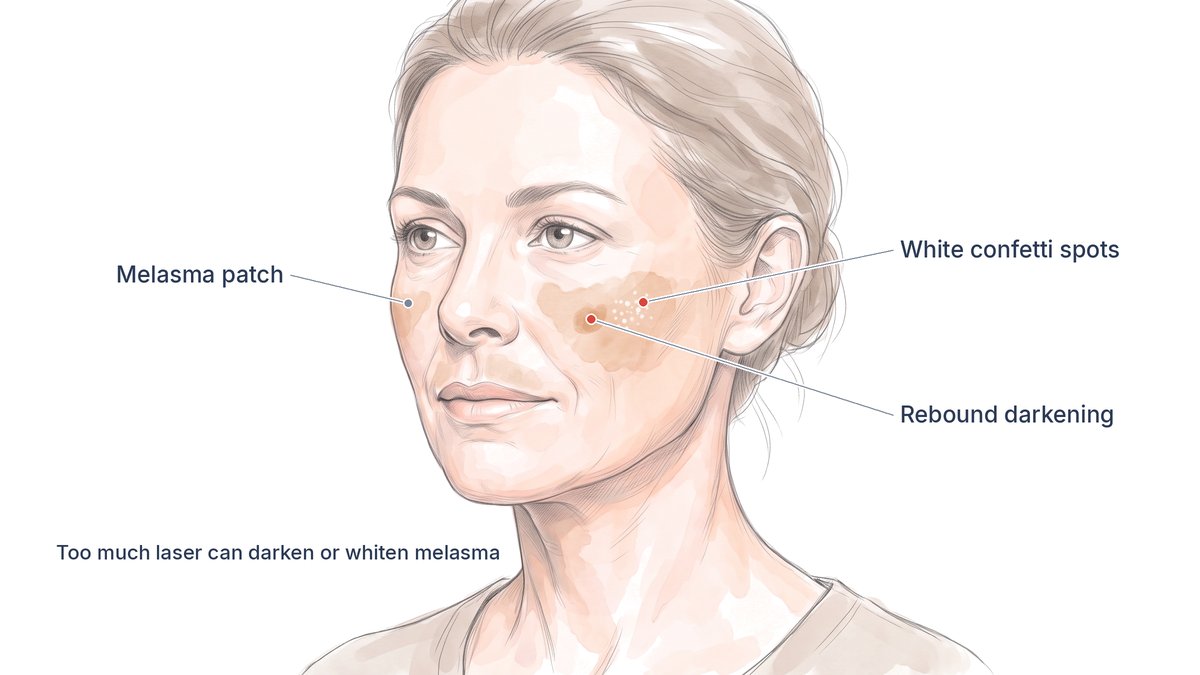
Laser for melasma uses low-energy light, most often a 1064 nm Q-switched or picosecond laser fired in gentle passes (“laser toning”), to break up melasma pigment so the patches look lighter. It can lighten melasma for a while but does not cure it, and on the wrong settings or schedule it can darken the skin or leave permanent white spots. I treat melasma myself with a picosecond laser, and the rules I follow put the schedule ahead of the machine.
Quick answers
- What is the best laser for melasma? None cures it. Low-energy 1064 nm toning, Q-switched or picosecond, has the most trial data, and it works best alongside creams and strict sun protection.
- Is pico laser better than laser toning? In three split-face trials, lightening did not differ significantly between the two; the picosecond side was less painful in two of them.
- Can laser make melasma worse? Yes. Rebound darkening and white “confetti” spots are the two signature failures, mostly from too much heat or too many sessions too close together.
- What are the white spots after laser toning? Mottled hypopigmentation: patches where pigment cells were damaged by repeated toning. In one series none had repigmented four months later.
- How many sessions, and how far apart? Recent randomized trials used 3 sessions about 4 weeks apart. Published white-spot cases mostly followed long courses of frequent sessions, often 20 or more.
- Does tranexamic acid help? Oral tranexamic acid lowered melasma severity by 49 percent against 18 percent with placebo, but it needs screening for clot risk first.
- Can laser remove melasma permanently? No. It came back or worsened in 10 of 17 patients two years after a laser trial.
- What about IPL? Generally avoided in active melasma, because its heat is thought to make melasma worse.
Can Laser Remove Melasma Permanently?
No. Laser can lighten melasma, sometimes a great deal, but melasma is a chronic, relapsing condition, and in trials that followed patients long enough, most of it came back. A laser is a tool for one phase of a long-term plan, not a cure.
The longest randomized follow-up is a split-face trial comparing a 755 nm picosecond laser with a 1064 nm Q-switched laser, three sessions a month apart. Two years later, melasma had come back or worsened in 10 of 17 patients (58.8 percent), with no difference between the two lasers. In an earlier split-face trial of weekly low-energy Q-switched toning, the laser side lightened far more than the cream side, yet melasma recurred in all 22 patients.
That pattern matters more than any single result. A treatment that lightens beautifully and then relapses has not failed if you expected the relapse and had a maintenance plan. It has failed if you were told it would be gone. The same goes for products sold as brightening shortcuts: skin boosters such as Rejuran, Juvelook and Skinvive improve hydration and texture, not pigment, and exosome brightening claims rest on weak evidence.
Key numbers
- Recurrence or worsening two years after a laser trial: 10 of 17 patients (58.8 percent).
- Weekly low-fluence toning at 3.0 to 3.8 J/cm2, 22 patients: rebound darkening in 4, mottled white spots in 3, recurrence in all.
- Toning three times a week for two months: white spots in 23 of 23 patients.
- Leukoderma (white spots) by toning frequency in 147 patients: weekly 1 of 26, fortnightly 2 of 49, monthly 0 of 72 (difference not statistically significant).
- Picosecond vs nanosecond 1064 nm: no significant difference in lightening; recurrence 12.5 percent on both sides at 3 months.
- Oral tranexamic acid 250 mg twice daily for 3 months: severity down 49 percent vs 18 percent with placebo.
What Is Melasma, and Why Can Heat Make It Worse?
Melasma, also called chloasma or, in pregnancy, the “mask of pregnancy,” is a common, long-lasting brown or gray-brown patchiness, usually on the cheeks, forehead, upper lip or jawline, caused by pigment cells that are overactive rather than by a single sun spot. Sun, visible light and hormones keep switching those cells on, and heat or inflammation from an over-strong treatment can switch them on too.
According to Mayo Clinic dermatology, ultraviolet light from the sun is the most common trigger; pregnancy, hormone changes and oral contraceptives can contribute; visible light from screens and bulbs may worsen it; and it tends to run in families. It is more common in women, and most of the laser studies below were done in light brown skin, Fitzpatrick types III and IV, where pigment cells react strongly to both light and heat.
Melasma pigment sits at different depths. In epidermal melasma it lies mainly in the top layer of skin, where creams and gentle lasers reach it. In dermal or mixed melasma some pigment has dropped into the deeper dermis, inside scavenger cells, where it is slower to clear. In a 60-patient trial, the epidermal type responded best. Most real faces are mixed.
Why heat is the enemy
A melasma pigment cell is a cell already on alert. A gentle laser pulse that shatters pigment granules without much heat can lighten the patch. A pulse that heats or inflames the skin sends the opposite signal: make more pigment. That is rebound.
And a pigment cell hit gently but very often, week after week, can be damaged until it stops making pigment at all. That is a white spot. The same machine can produce all three outcomes. Energy, spot size, the number of passes and, above all, how often the sessions are repeated decide which one you get.

What Is the Best Laser for Melasma?
No laser is best for everyone, and none is a first-line treatment. The best-studied option is low-energy 1064 nm toning, with either a Q-switched (nanosecond) or picosecond laser, used alongside lightening creams and sun protection; other lasers and light devices have weaker or riskier evidence in melasma.
Low-fluence Q-switched Nd:YAG at 1064 nm is the laser most commonly used for melasma, fired as a large, low-energy beam in several passes over the whole face. Picosecond lasers deliver a far shorter pulse, which shatters pigment with more pressure effect and less heat, at 1064 nm, 755 nm or 532 nm; used the same low-energy way, this is often called “pico toning.”
The meta-analyses are less exciting than the marketing. Pooling 22 studies and 694 patients, low-fluence Q-switched Nd:YAG lowered melasma severity scores significantly, while picosecond and non-ablative 1550 nm fractional lasers did not reach significance. A network meta-analysis of 39 randomized trials and 1,394 patients ranked Q-switched Nd:YAG combined with topical medication first and oral tranexamic acid second, and found laser plus topicals better than the same laser alone.
That second finding is the practical one. Laser works best as a partner to creams and sun protection, not a replacement for them.
At a Glance: Laser and Light Options for Melasma
| Option | How it works | What the trials show | Main risk in melasma | Where it fits |
|---|---|---|---|---|
| Low-fluence Q-switched 1064 nm (“laser toning”) | Large, gentle nanosecond pulses, several passes | Lightens; best-studied laser; relapse common | White spots and rebound when sessions are frequent or energy high | Adjunct to creams, widely spaced |
| Picosecond 1064 nm | Shorter pulse, less heat | No significant difference from Q-switched in split-face trials; less pain in two | Same as toning if overused | Equivalent alternative |
| Picosecond 755 nm | Shorter pulse, more melanin absorption | Not better than topical lightening agents in a meta-analysis | Post-inflammatory darkening | Rarely a first choice |
| Non-ablative fractional (1550 nm) | Tiny columns of heat | Pooled effect not significant for 1550 nm | Post-inflammatory darkening | Selected cases, low settings |
| Fractional ablative (CO2, Er:YAG) | Vaporizes tiny columns of skin | Largest pooled drop for CO2, from limited data | High darkening risk in skin types III to V | Not routine for melasma |
| IPL (intense pulsed light) | Broad-spectrum light and heat | Limited data | Heat thought to worsen melasma | Generally avoided in active melasma |
Is pico laser good for melasma, and is it better than toning?
It can lighten melasma, but on current evidence it is not better than Q-switched toning. Three split-face randomized trials found no significant difference in how much melasma lightened, and a meta-analysis found that the 755 nm picosecond wavelength was no better than lightening creams.
In 18 patients treated with picosecond on one side and nanosecond 1064 nm on the other, both sides improved, the difference between them was not significant, and recurrence was 12.5 percent on each side at 3 months; the nanosecond side hurt more. A double-blind trial in 16 Asian women, three sessions four weeks apart, found no significant difference in severity, global improvement or 6-month recurrence, with less pain on the picosecond side after the first session. In the two-year trial above, only the Q-switched side was significantly lighter than baseline at 6 months, and microscopy showed dendritic pigment cells in the dermis on the picosecond 755 nm side.
A meta-analysis of six randomized trials concluded that 1064 nm picosecond laser reduced severity scores, while 755 nm was not superior to topical lightening agents and caused post-inflammatory darkening. For “pico or toning?”, then, the schedule and energy matter more than the pulse length.

Is IPL good for melasma?
Usually not while the melasma is active. Mayo Clinic notes that IPL heats the surrounding skin, which is thought to worsen melasma, can cause post-inflammatory hyperpigmentation, and relapse often occurs within three months. Brown sun spots and melasma often sit on the same cheek, and IPL that is right for the sun spots can be wrong for the melasma beside them.
Is fractional or CO2 laser good for melasma?
In the pooled analysis above, fractional CO2 produced the largest drop in severity scores, but that estimate rests on limited data, and ablative lasers carry a high darkening risk in light brown and darker skin. I do not treat melasma with an ablative laser. When a patient with a melasma history has a light fractional CO2 pass for another reason, such as after a facelift, the pigment precautions are those described in CO2 laser timing after a facelift.
Can Laser Make Melasma Worse?
Yes. Melasma that darkens after laser is usually either rebound hyperpigmentation, where heat or inflammation drove the pigment cells to make more pigment, or simple relapse, where sun and hormones reactivated melasma once treatment stopped; both are common enough that they should be discussed before the first session, not after.
In the split-face trial of five weekly sessions at 3.0 to 3.8 J/cm2, rebound hyperpigmentation appeared in 4 of 22 patients and mottled hypopigmentation in 3. In 40 Asian patients treated weekly at a lower 1.2 to 2.0 J/cm2 for a median of 10 sessions, melasma severity fell by about 54 percent, and 2 patients developed both mottled hypopigmentation and rebound hyperpigmentation. Only 15 of those 40 were rated good or excellent.
Darker skin, higher energy, more passes, sessions too close together, sun exposure between sessions and stopping topical treatment all push toward rebound. A tan at the time of treatment is a particular risk, because the laser energy is absorbed by more pigment than planned.
Normal darkening versus rebound
A faint, patchy darkening for a few days after a session, especially over the darkest patches, is common and settles. Darkening that keeps building for more than about two weeks, spreads beyond the original patch, or comes with persistent redness, itching or burning is not normal recovery. That is a reason to stop, not to push through with the next session.
What Are the White Spots After Laser Toning?
The white spots are mottled hypopigmentation, also called punctate or confetti leukoderma: small, scattered pale dots or patches where pigment cells have been damaged by repeated low-energy toning. They are the classic complication of frequent toning in Asian skin, they can appear even while the melasma is improving, and they may be permanent.
The clearest warning comes from a Singapore series of 23 women with type III skin toned with a 1064 nm Q-switched laser at 2.0 J/cm2 three times a week for two months. All 23 developed bilateral confetti-like hypopigmentation, and all of them felt they looked worse than before even though the melasma was lighter. The author attributed it to cumulative damage to pigment cells.
Another case series described facial depigmentation in 14 patients treated with low-fluence 1064 nm toning for rejuvenation or melasma, after 6 to 50 sessions, a mean of 22. What these cases share is a long course, not one bad session.
Does session frequency really matter?
Probably, but the evidence is mixed. Toning three times a week whitened every face in the Singapore series, while a larger clinic series found white spots uncommon at any of the usual intervals and no statistically significant difference between them.
The larger clinic photographed every face under ultraviolet light at every session. Among 147 patients with at least five toning sessions, leukoderma appeared in 3 (2 percent): 1 of 26 treated weekly, 2 of 49 treated fortnightly and none of 72 treated monthly, a difference too small to be significant. The authors linked one type of white spot to cumulative laser energy, which is why the total number of sessions matters as much as their spacing. In two of the three patients, ultraviolet imaging showed the white spots about eight sessions before the eye could see them.
This early-detection finding is why I stop at the first white dot. By the time a patient notices one in the mirror, the damage has often been building for several sessions.

Do white spots from laser toning go away?
Sometimes they fade partly, but you should assume they may not. In the Singapore series, none of the 13 patients still followed had repigmented after four months of rest. Treatment options for established laser leukoderma are limited and slow, which is why prevention, by spacing, capping and stopping early, is the whole strategy.
Video in English, about 9 minutes: All 23 Women Got White Spots After Frequent Laser Toning
How Many Laser Toning Sessions for Melasma, and How Far Apart?
There is no proven number, but recent randomized trials used three sessions about four weeks apart, and an older one used five weekly sessions. Open-ended toning, weekly or more often for months and still common in some clinics, is the pattern most strongly linked to white spots.
Two of the split-face trials in the previous sections used three sessions at one-month intervals or four-week intervals. Older Asian protocols used weekly sessions, and they are the ones that report rebound and white spots. Based on his own unpublished audit, the Singapore author recommended toning about every two weeks and wrote that frequent laser toning, more than every 2 weeks, should be avoided.
Two numbers to hold onto, then. An interval of at least two weeks, and preferably about four. And a course with an end: in the published white-spot cases the session count ran into the twenties and beyond, while the recent randomized trials stopped at three.
Should I Take Tranexamic Acid With Laser for Melasma?
For many patients it is worth considering, if they have no risk factors for blood clots. Oral tranexamic acid is one of the best-supported melasma treatments on its own, and in melasma trials it made laser toning work better, but it is a prescription drug that affects clotting, so it needs a medical history first.
In a double-blind trial in moderate to severe melasma, tranexamic acid 250 mg twice daily for three months reduced severity by 49 percent against 18 percent with placebo, with no serious adverse events. Three months after stopping, the advantage had largely faded: 26 percent against 19 percent. It controls melasma while you take it; it does not switch it off.
With laser, the effect adds up. In 51 patients treated with IPL and low-fluence Q-switched toning, severity fell from 11.33 to 6.21 with oral tranexamic acid and from 11.70 to 8.93 without it, roughly a 45 percent drop against 24 percent. In 60 patients, adding 1064 nm laser to oral tranexamic acid improved severity scores significantly more than the tablet alone.
Who should not take tranexamic acid?
Tranexamic acid works on the clotting system, so it is not a casual supplement. A personal or strong family history of blood clots, stroke or a clotting disorder, pregnancy, estrogen-containing contraception or hormone therapy, smoking and some kidney conditions all need to be discussed with the prescribing doctor first, and for some people the answer is no. Topical and injected forms exist, but their evidence is thinner.

What Should Come Before Any Laser: Sunscreen, Hydroquinone and Triple Cream?
Sun protection and a topical lightening routine come first, usually for two to three months, and laser is added only if they are not enough. That order is not caution for its own sake: as the network meta-analysis showed, laser plus topicals outperforms laser alone, and skin that is already calm and lighter tolerates laser better.
Mayo Clinic advises daily sunscreen of SPF 50 or higher, preferably a physical blocker such as zinc oxide or titanium dioxide, reapplied every one to two hours outdoors, with a wide-brimmed hat, and names topical hydroquinone as the most common lightening agent. A tinted mineral sunscreen adds some protection against visible light, which a clear sunscreen does not block well.
Hydroquinone is often combined with a retinoid and a mild steroid in a “triple cream.” Azelaic acid, cysteamine, kojic acid, niacinamide and topical tranexamic acid are alternatives, especially for maintenance or where hydroquinone is not available.
Cream alone is slower than laser in trials. In the weekly toning trial the cream side, 2 percent hydroquinone with other topicals, improved by 24 percent against 75.9 percent on the laser side. But the same trial is the one in which every patient relapsed, which is the argument for using both.
How Does Dr. Yongwoo Lee Approach a Melasma Patient Who Asks for Laser?
I treat melasma as a chronic condition to be controlled, and I treat the laser as the most tempting and the most dangerous part of that control. My rules are simple: creams and sun protection first, then a short, widely spaced, low-energy course with a fixed end and a stop rule agreed in advance.
At the first visit
I look at where the pigment sits, whether there are sun spots, redness or broken vessels mixed in, and how the patient’s skin has reacted to previous lasers. A patient who has already had dozens of toning sessions and now has pale dots is not a patient I add sessions for. I ask about pregnancy plans, contraception and clot history, because they decide whether oral tranexamic acid is an option. And I explain at the start that melasma usually returns, so the plan includes maintenance from day one.
If laser is added
I add laser only after about two to three months of daily sun protection and a topical routine, and only to skin that is not tanned or irritated. I keep the energy low and aim for no more than faint redness, never whitening or frosting of the skin. Sessions are at least two weeks apart and usually about four. I plan a course of roughly five sessions, then stop and reassess, rather than an open-ended package. The laser I use is our clinic’s picosecond laser, under exactly these rules. That reflects what we have, not a claim that pico is better; as the split-face trials above show, the schedule is what protects the patient.
My stop rule
Any one of these stops the course:
- A new pale or white dot anywhere in the treated area.
- Darkening that keeps building for more than about two weeks after a session, or spreads beyond the original patch.
- Redness, itching or burning that persists between sessions.
- A tan, a sunburn or a beach holiday between sessions.
Stopping is not a failure. It moves the patient back to creams, sun protection and, when appropriate, oral tranexamic acid, and laser waits until the skin is quiet again, or does not resume.
Melasma and other treatments
Melasma changes how I plan other skin treatments too. Intradermal toxin for redness and oil is a separate question, discussed in skin botox. Heat-based tightening, covered in Ultherapy vs Thermage vs Shurink, works deeper and is not a melasma treatment.

Is Laser for Melasma Safe in Asian and Darker Skin?
It can be used, but with more care, because both failure modes are reported mainly in light brown and darker skin. Most of the white-spot literature comes from Asian patients toned frequently.
The Singapore author called it the Asian problem of frequent laser toning: a toning culture of weekly or more frequent sessions meeting skin that is prone to both pigment overreaction and pigment loss. A pooled laser analysis likewise notes risks of post-inflammatory hyperpigmentation and hypopigmentation in darker skin. For type V and VI skin, the threshold for laser is higher still, and topical treatment, sun protection and oral tranexamic acid carry most of the plan.
For patients traveling to Korea, the constraint is time. A safe melasma laser course spans months, with sessions weeks apart. Several sessions packed into a one- or two-week visit is exactly the schedule the data warn against.
Which Melasma Patient Are You?
The profiles below are illustrative examples, not real patients, and describe decisions, not results.
A 38-year-old woman with light cheek melasma who has never treated it. Sunscreen, a topical routine and, if suitable, oral tranexamic acid first. Laser only if those plateau.
A 45-year-old woman whose melasma lightened with weekly toning and then came back darker. Rebound or relapse. The toning stops, the skin is calmed with topicals, and any future laser is low energy and about a month apart.
A 42-year-old woman with pale dots across both cheeks after 30 toning sessions. Mottled hypopigmentation. No further toning; the white dots and the surrounding melasma are managed separately and conservatively.
A 50-year-old woman with melasma mixed with sun spots who wants IPL. The sun spots and the melasma need different plans. IPL near active melasma risks darkening it.
A woman on estrogen-containing contraception who smokes and asks for tranexamic acid tablets. Not a candidate for the oral form until those risks are addressed with her doctor; topical treatment and sun protection carry the plan.
A visitor with one week in Korea who wants her melasma “cleared.” A single gentle session can be considered after a skin assessment, but not a compressed course, and melasma will not be cleared in a week.
Surgeon’s Insight: The Session You Skip Protects You More Than the One You Add
Melasma tempts everyone into more: more sessions, closer together, a little more energy each time because the last one worked. Most published cases of white spots follow that curve. The patients who do well over years are the ones who accept that melasma is managed, not erased.
So what I offer a melasma patient is not a clear face. It is a schedule designed to avoid taking pigment away permanently, a stop rule we both agree on before the first session, and a maintenance plan for the summer when it tries to return.
Who Should Not Have Laser for Melasma?
Laser is a poor choice for anyone who is pregnant or breastfeeding, tanned or recently sunburned, has active irritation or eczema on the face, already has white spots from previous toning, or cannot commit to daily sun protection. In these patients the risks of rebound or permanent pale spots outweigh a temporary lightening.
Others need extra caution rather than a flat no: type V and VI skin, a history of darkening after any laser, peel or wax, melasma that flared with a previous laser, and patients who want a fixed number of sessions to “finish” it. Melasma in pregnancy often fades in the months after delivery, which is a reason to wait rather than treat.
What Should I Ask Before Agreeing to Laser for Melasma?
Ask what the plan is if the melasma darkens or white dots appear, how far apart the sessions will be, how many there will be in total, and what you will do between and after them. A clinic that answers with a schedule, a stop rule and a maintenance plan is treating your melasma; a clinic that answers with a package of weekly sessions is treating the machine.
Also ask whether your patches are melasma at all, since sun spots, freckles and Hori’s nevus (a deeper pigment condition) look similar and respond differently, and whether your skin type and pigment depth make laser worthwhile. The most useful question is not which laser, but how the plan keeps melasma quiet a year from now.
Individual results vary; consultation required.
Written by Dr. Yongwoo Lee, board-certified Korean plastic surgery specialist in facial anatomy and aesthetic procedures at VIP Plastic Surgery, South Korea.
Frequently Asked Questions About Laser for Melasma
Can melasma be cured with laser?
No. Laser can lighten melasma, but it does not remove the cause, and relapse is common: in one randomized trial melasma came back or worsened in 10 of 17 patients within two years. Long-term control depends on sun protection and maintenance treatment.
What is the most effective treatment for melasma?
No single treatment cures it. In a network meta-analysis of 39 randomized trials, Q-switched 1064 nm laser combined with topical medication ranked first and oral tranexamic acid second, and laser with creams beat the same laser alone, so combinations built on sun protection work best.
Is a picosecond laser better than a Q-switched laser for melasma?
Not on current evidence. Three split-face randomized trials found no significant difference in lightening, and the picosecond side was less painful in two of them. A meta-analysis found 755 nm picosecond laser no better than lightening creams.
How long do laser toning results last for melasma?
Usually months rather than years. In one trial recurrence was 12.5 percent at 3 months, and in another more than half of patients had relapsed or worsened by two years, which is why maintenance creams and sunscreen continue after the last session.
Why does my melasma look darker right after a laser session?
A faint, temporary darkening for a few days can be normal. Darkening that keeps building for more than about two weeks, spreads, or comes with redness and burning suggests rebound hyperpigmentation, and the next session should wait.
Are white spots after laser toning permanent?
They can be. In one series none of 13 followed patients had repigmented four months after toning stopped. Some fade partly over a longer time, but they should be treated as possibly permanent, which is why toning stops at the first white dot.
How many laser sessions do I need for melasma?
Recent randomized trials used three sessions about four weeks apart; an older one used five weekly sessions. Published cases of white spots involved many more, often 20 or more, so a course should have a planned end and a reassessment rather than an open-ended package.
How often can I have laser toning for melasma?
No more often than every two weeks, and preferably about every four. A series toned three times a week produced white spots in every patient; in 147 patients toned weekly, fortnightly or monthly, white spots were uncommon and the difference between schedules was not significant, so the total number of sessions matters too.
Can I have laser while taking tranexamic acid?
Yes, and melasma trials suggest the combination works better than laser alone. The tablet needs a medical history first, because tranexamic acid affects clotting.
Who should not take tranexamic acid for melasma?
People with a history of blood clots, stroke or a clotting disorder, those who are pregnant, and those on estrogen-containing contraception or hormone therapy, especially if they smoke, need their doctor’s review first, and many should not take it.
Can I have laser for melasma while pregnant?
It is best avoided. Melasma often fades after delivery, and oral tranexamic acid is not used in pregnancy. Sun protection is the treatment during pregnancy.
What is the best sunscreen for melasma?
A broad-spectrum SPF 50 or higher, preferably mineral (zinc oxide or titanium dioxide) and tinted for visible light, applied every morning and reapplied every one to two hours outdoors, with a wide-brimmed hat.
Should I use hydroquinone before laser for melasma?
Often, yes. A topical lightening routine for about two to three months before laser, and continued afterward, is standard, and a network meta-analysis ranked laser plus topical medication above laser alone.
Is fractional laser good for melasma?
Non-ablative fractional laser did not reach a significant effect in pooled data, and ablative CO2 carries a high darkening risk in light brown and darker skin. Neither is a routine first choice for melasma.
Is IPL good for melasma?
Generally not for active melasma. IPL heats the surrounding skin, which is thought to worsen melasma, and it can cause post-inflammatory darkening. It is better suited to sun spots and redness away from melasma patches.
Do skin boosters or exosomes treat melasma?
They are not established pigment treatments. Boosters improve hydration and skin quality, and exosome pigment claims rest on weak evidence, so neither replaces sun protection, topicals or tranexamic acid.
This article is for informational purposes only and does not constitute medical advice. Always consult with a qualified medical professional before making any decisions about surgical or non-surgical procedures.
