
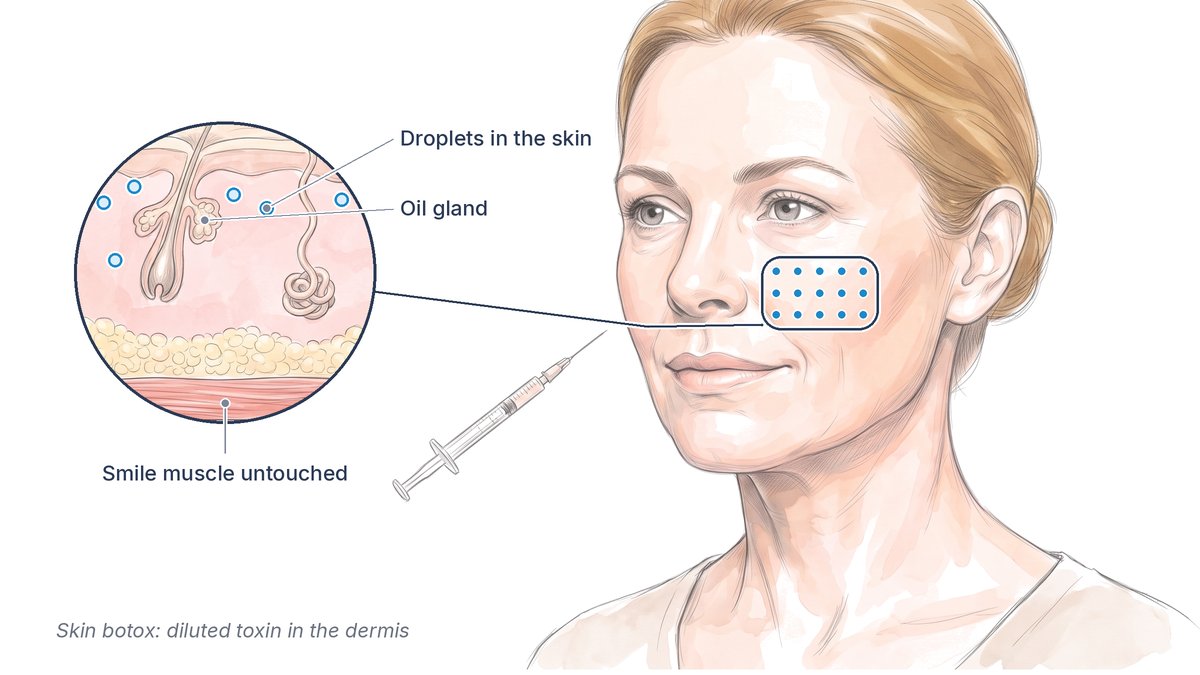
Skin botox, also sold as micro botox, Microtox or mesobotox, is botulinum toxin diluted further than usual and placed as many tiny droplets in the skin itself rather than in the muscle beneath it. Its aim is less oil, smaller-looking pores, softer fine lines and, in some studies, less redness, not a frozen face; it is an off-label use of a familiar drug, backed by small trials, and it is not a skin booster.
Quick answers
- What is it? Diluted toxin injected as many tiny droplets into the dermis, not into the muscle.
- Is it baby botox? No. Baby botox is a smaller dose of ordinary toxin in the muscle; skin botox targets the skin.
- Does it shrink pores? Modestly in most small studies, but one saline-controlled trial found no difference.
- Does it reduce oil? Usually; less oil is the most consistent finding.
- Will it give me glass skin? Not by adding moisture: hydration did not improve in a 2024 meta-analysis. The change is mostly less shine and a smoother surface.
- How long does it last? About 3 to 4 months.
- How many units are used? Published protocols commonly use about 10 to 20 units per cheek, as tiny doses spread over many points; units are brand-specific.
- What is the main risk? Toxin reaching the smile muscles, which can leave the smile uneven for weeks.
- Skin botox or a skin booster? Skin botox for oil and pores; a booster for dryness, thinness and crepey skin.
- Is it approved? In the US, Botox Cosmetic is labeled for injection into muscle for four line and band indications, so skin botox is off-label.
What Is Skin Botox (Micro Botox), and How Is It Different From Regular Botox?
Skin botox uses the same botulinum toxin as regular Botox, but diluted more and placed in a different layer: many tiny droplets just under the surface of the skin instead of a few deeper injections into a muscle. Regular Botox stops a muscle from creasing the skin, while skin botox works mainly on the oil glands and the thinnest muscle fibers tied into the skin.
The difference is easiest to see in numbers. For frown lines, the US label for Botox Cosmetic describes 20 units at 4 units per 0.1 mL, injected into the muscle at five points. In a double-blind cheek trial of skin botox, each point received 0.5 units in 0.025 mL, placed in the skin about 1 cm apart, until a small bump rose. Woffles Wu, the Singapore plastic surgeon who popularized the technique, describes a syringe of 20 to 28 units per mL that yields 100 to 120 microinjections. Same drug, a fraction of the strength per point, many more points, and a shallower target. It also does a different job from injectables that add moisture or collagen, which are compared in Rejuran vs Juvelook vs Skinvive.
Why the names are confusing
Skin botox, micro botox, Microtox, microbotox, mesobotox, intradermal botox and glass skin botox all describe roughly the same idea: diluted toxin in the dermis. Clinics in Korea tend to say skin botox, many UK and Australian clinics say Microtox, and in the US it may be sold as a Botox facial or as microdosing. Baby botox is different: it usually means a smaller dose of ordinary toxin placed in the muscle for a lighter result, so it still works on movement rather than on oil and pores.
Microdosing along the jaw and neck, sometimes called the Nefertiti lift, overlaps with skin botox in technique but aims at the platysma muscle; what it can and cannot do for the jawline is covered in treatment options for jowls.
Is skin botox approved?
Not as a labeled use in the US. Botox Cosmetic is labeled for glabellar lines, crow’s feet, forehead lines and platysma bands, given by intramuscular injection, so skin botox is an off-label use. Off-label use by a doctor is legal and common, but it means dose and technique come from small studies and experience rather than from a label. The same label also states that its units are not equivalent to those of other botulinum toxin products.
How Does Skin Botox Work on Oil, Pores and Fine Lines?
Botulinum toxin blocks the release of acetylcholine, a nerve signal, and in the skin that signal reaches oil glands, sweat glands and the fine muscle fibers that insert into the underside of the dermis. Turning those down is thought to reduce oil and shine, make pores look smaller and soften fine crinkling, without stopping the deeper muscles that move the face.
Oil is the best-supported target. A 2019 review found that most studies suggest intradermal toxin decreased sebum production, possibly by blocking cholinergic signaling to the glands, though the exact mechanism is still not settled. Wu describes the goal of microbotox as reducing sweat and oil gland activity to improve texture and sheen, and relaxing the superficial muscle fibers attached to the dermis that etch fine lines.
Pores are less direct. A pore looks large when its opening is stretched by oil and its rim loses support; less oil may let the opening look smaller, but toxin does not remodel the pore wall. In the saline-controlled cheek trial, the authors suggested that part of the early pore change may simply be swelling from the injections, since saline produced some of the same effect.
What skin botox does not do is just as clear. It adds no water, no collagen and no volume, it does not lift tissue, and it does not erase deep lines made by strong muscles; those belong to standard toxin, boosters, fillers or surgery.

Does Skin Botox Actually Work? What the Studies Show
Yes for oil, and modestly for pores, texture, fine lines and redness, but the evidence comes from small, mostly split-face studies with mixed results. The best summary, a 2024 meta-analysis of 10 studies and 153 people, found improvement in oil, pores, texture, redness and wrinkles, but not in hydration.
Key numbers
- Evidence base: 10 studies, 153 people, mean age 41, 92.1 percent women (2024 meta-analysis).
- Improved: oil, pore size, texture, redness, wrinkles. Not improved: hydration.
- Saline-controlled cheek trial: no difference from saline for pores or oil; clinician-rated texture better in 93.3 percent at weeks 2 and 4, 46.7 percent at week 12.
- Effect in a 20-patient pore and oil trial: an average of about 4 months.
- Typical published dose: commonly about 10 to 20 units per cheek, at a fraction of a unit to about 2 units per point (units are brand-specific).
- Uneven smile: 1 volunteer given 30 units on one cheek; the rest stayed under 20 units per cheek.
- Smile and mouth-corner weakness in rosacea studies: reported at 0.05 mL per point, not at 0.02 mL or less.
The meta-analysis pooled 5 randomized trials and 5 prospective studies, 8 of them split-face, in 153 participants, and the results did not differ by toxin brand or dilution. A further statistical test showed that the results crossed the usual threshold for benefit but that the total number of participants was still too small for firm conclusions.

Does skin botox reduce oil?
Usually: oil is where the studies agree most. In the first published series, 17 of 20 patients reported less oil and smaller pores one month after a single session, with no complications. In a split-face trial of 30 patients with redness after acne, oil fell more on the toxin side than on the light-treated side at months 1, 2 and 3. The exception is a double-blind cheek trial of 15 analyzed volunteers, in which oil did not differ significantly from the saline-treated side at any visit.
Does skin botox shrink pores?
Sometimes, and modestly; pore results are mixed. In a 20-patient split-face trial comparing toxin with saline, both cheeks improved at one month, the toxin side significantly more, and the toxin side kept its gain at four months. A second saline-controlled trial, with 20 patients analyzed, found that imaging showed smaller pore diameters, yet the patients themselves did not rate their pores or oil as better. In the double-blind cheek trial, pore coverage was not significantly different from the saline side at any visit. A fair reading: smaller-looking pores are possible, measurable on a camera more often than in a mirror, and not guaranteed.
Does skin botox soften fine lines and texture?
Texture improved most clearly. In the same double-blind trial, a clinician rated texture better on the toxin side in 93.3 percent of volunteers at weeks 2 and 4, 86.7 percent at week 8 and 46.7 percent at week 12, against 6.7 percent on the saline side; by week 12 the difference was no longer statistically significant. The fold beside the nose scored better through week 12, but fine lines under the eyes did not change significantly. That pattern fits the mechanism: crinkling and crepe from fibers tied into the skin respond, while lines that depend on deeper muscles or thin skin respond less.
Does skin botox hydrate skin or give glass skin?
There is no good evidence that skin botox hydrates skin. Hydration was the one outcome in the 2024 meta-analysis that did not improve. Much of the glass skin effect people describe is probably less shine and a smoother surface that reflects light more evenly; a dry, dull, thin complexion needs a different tool.
How strong is the evidence?
Moderate at best. Most trials had 15 to 30 people, follow-up of 3 to 4 months, different brands and dilutions, and outcome measures that do not always match what a patient sees. The double-blind cheek trial was funded by the maker of the toxin it tested, and still reported mainly null results for pores and oil, which is part of why it is worth weighing heavily.
Can Skin Botox Help Redness, Rosacea and Flushing?
Possibly, as an add-on for persistent redness and flushing that standard rosacea treatment has not settled. Small studies report less redness for about 2 to 3 months, but they are mostly uncontrolled, and some patients developed a temporarily unnatural smile.
In a 20-patient Korean pilot study of stubborn rosacea, each cheek received 10 units, and redness scores fell from 1.9 to 1.23 on a 0 to 3 scale by week 8; three patients stopped early because of an unnatural facial expression. In a US study of intradermal abobotulinumtoxinA injected into the nose for rosacea, the redness grade fell from 1.80 to 1.00 at three months in the 15 of 25 patients who completed follow-up.
A 2025 review of 17 studies found redness improved at month 3 in the pooled randomized trials, while the single-arm evidence was of very low certainty. In the post-acne trial, toxin cleared redness faster than broadband light at month 1, but the measured redness index no longer differed at months 2 and 3, and pigment did not differ at all. Skin botox is not a pigment treatment; dark patches and melasma are covered in when laser makes melasma worse.
Rosacea is a medical diagnosis first, so skin botox belongs after the usual creams, pills or lights, not in place of them.
Which Areas Can Skin Botox Treat? Cheeks, T-Zone, Forehead and Neck
The cheeks have by far the most data; the forehead, nose and the rest of the oily central face are commonly treated with less trial evidence, and the neck and jawline rest mainly on technique reports and experience. Injectors are most careful with the lower outer cheek, near the corners of the mouth, because that is where the smile muscles sit closest to the skin.

Cheeks
Most trials treated the cheeks, from below the lower eyelid toward the mouth corner. This is where oil, large pores and post-acne redness usually sit, and also where the reported smile problems arose.
Forehead and T-zone
The forehead and nose are classic oily zones. Forehead droplets can soften fine lines while keeping some brow movement, but a heavy hand above the brows can make them feel heavy or drop; the two kinds of droop are explained in droopy eyelid after Botox.
Neck and jawline
Wu describes hundreds of microdroplets in the lower face and neck, usually about 1 mL per side, to smooth horizontal creases and soften vertical bands. That is an experienced surgeon’s technique, not a controlled trial. Standing neck bands are a muscle problem with their own options, compared in neck liposuction versus neck lift, and crepey neck skin often responds better to a booster.
Under the eyes
Trial data do not support skin botox for under-eye lines, and the lower lid is thin, close to the muscle that closes the eye, and easy to weaken. For crepey under-eye skin, a booster is usually the better first tool.
How Is Skin Botox Done? Dilution, Depth and Units
A skin botox session is a grid of tiny, very shallow injections of diluted toxin, each raising a small bump in the skin, usually about 1 cm apart, after numbing cream. Published protocols place from a fraction of a unit to about 2 units per point, at about half the standard concentration or weaker, and commonly about 10 to 20 units per cheek.
The range across studies is narrower than the marketing suggests. In published protocols using Botox or toxins dosed on a similar unit scale, concentrations ran from about 1 to 2.8 units per 0.1 mL, compared with 4 units per 0.1 mL for standard frown-line dosing on the Botox Cosmetic label. A 20-patient rosacea study used 10 units per cheek, at 2 units per 0.1 mL, with points about 1 cm apart. The double-blind cheek trial planned no more than 20 units per cheek; one volunteer given 30 units on one cheek developed weakness on that side, which had improved a month later, and the remaining volunteers stayed under 20 units. Some trials used more, about 18 to 36 units per cheek in the post-acne study, and a case series of rosacea suggested 15 to 50 units in total, with points 0.5 to 1 cm apart.
Droplet size may matter as much as the total. In the 2025 rosacea review, smile and mouth-corner weakness was reported with 0.05 mL per point but not with 0.02 mL or less. A bigger droplet spreads farther, and in the cheek, farther down means the smile muscles.
Units are brand-specific. Skin botox recipes are often written in units of one product, and they do not convert one-to-one to another, so ask which product is used and how many units in total, not only how many syringes or shots.
How I approach skin botox
I perform skin botox myself, and I start with the complaint: oil and visible pores on the cheeks, nose and forehead, or persistent redness, are reasons to consider it; dry, dull or thin skin is not, and I steer those patients toward a booster.
I inject by hand with a very fine needle, keeping each droplet tiny and superficial enough to raise a small pale bump, on a grid about 1 cm apart. Near the mouth corners, where the smile muscles lie just beneath, I keep the lower outer cheek light or leave it out. For a first session I stay at the lower end of the published dose range and check the result at about two weeks, before any adjustment.
Afterward, I ask patients not to rub, massage or steam the treated skin for the first few hours; that is common caution with little direct evidence behind it, and makeup can usually go on the next day.
Surgeon’s Insight: Skin Botox Is a Depth Decision
As a facial surgeon, I spend much of my time in the layers between the skin and the smile muscles, and on the lower cheek that distance is short. Skin botox only works as intended while the drug stays in the dermis. The small pale bump at each point is how the injector sees the depth, and the tiny droplet and the modest total per cheek are how spread is kept in check.
That is why I think of skin botox as a depth decision before a brand or a dose decision. When it goes wrong, the drug has usually reached a layer it was never meant for. When it goes right, the face moves exactly as before and the skin simply looks less oily and a little smoother.
How Long Does Skin Botox Last, and How Often Can You Repeat It?
About 3 to 4 months. Changes in oil and texture can be seen within 1 to 2 weeks, tend to be strongest around the first month, and fade over the following months, so most people who continue repeat it no more often than every 3 to 4 months.
In the double-blind cheek trial, the texture advantage over saline had lost statistical significance by week 12. In the 20-patient pore and oil trial, results lasted an average of about 4 months. On the scalp, a saline-controlled trial found oil reduced at 1 and 3 months but no longer different from saline at 4 and 6 months, and 52 percent of treated patients said the effect did not last long enough.
Frequent top-ups are the wrong answer to a short effect. Repeated large cumulative doses at short intervals are the pattern linked to antibody-related loss of effect, and a 2025 review notes that injection into the skin is thought to carry a higher risk of resistance than injection into muscle, because the skin is rich in immune cells, a belief rather than a tested finding. So a total of skin botox, frown, jaw and neck toxin given close together deserves a plan; when toxin seems to stop working, the causes are explained in why Botox stops working.

What Are the Side Effects of Skin Botox?
Most side effects are brief: stinging during injection, small raised bumps, redness and the occasional bruise. The side effect that matters is weakness of a smile or mouth-corner muscle, which can make the smile look uneven for weeks to a few months until the toxin wears off.
Injection hurts more than people expect: in the post-acne trial, pain scored 5.0 out of 10 for skin botox against 3.1 for the light treatment. In the double-blind cheek trial, the stinging settled within 30 minutes. In a 30-patient study combining standard toxin doses with microdoses, 93 percent were satisfied, yet 56 percent had some adverse event, and the authors advised tailoring dose and pattern in the lower and middle face.
An uneven or stiff smile
The muscle complications reported for skin botox involve the smile: in the studies gathered by the 2025 rosacea review, an asymmetric expression, a weak mouth corner or a heavy cheek, all after cheek injections. In the Korean rosacea study, 3 of 20 patients stopped for this reason, all young women, and it resolved within three months without treatment. In the double-blind cheek trial, the one case followed a 30-unit cheek dose, and in the saline-controlled pore trial one of 25 participants withdrew because of facial paralysis.
If it happens, it wears off as the toxin does. Some injectors balance the other side with a small dose, as the cheek trial did, but that is a judgment made after examining the face, not a routine fix. Brow or eyelid heaviness after forehead toxin is a different problem with a different fix.
Rare, serious effects
The Botox Cosmetic label carries a boxed warning that toxin effects can spread beyond the injection site and cause botulism-like symptoms, hours to weeks later, including trouble swallowing or breathing. It is very rare at cosmetic doses, but new difficulty swallowing, speaking, breathing or seeing after any toxin treatment needs urgent medical care.
Skin Botox vs Skin Booster: Which Does Your Skin Need?
Choose by the problem, not the trend: skin botox for oily skin, visible pores and some redness, and a skin booster for dry, thin, dull or crepey skin. Many faces have both problems, and then the two are planned as a sequence rather than as rivals.
A booster improves the material of the skin, by hydrating, repairing or stimulating collagen; skin botox changes what the skin does, by turning down oil and fine muscle pull. Hyaluronic acid, polynucleotide and collagen-stimulating products are the main booster families, and an extracellular matrix booster is covered in the RE2O guide. Exosome products sold for the same glow are covered in what the evidence and the law say about exosome boosters.
At a Glance: Skin Botox vs Skin Boosters vs Energy Devices
| Option | Main job | Best for | Does not do | Typical duration | Main caveat |
|---|---|---|---|---|---|
| Skin botox | Turns down oil glands and fine muscle pull in the skin | Oily skin, visible pores, fine crinkling, some redness | Hydrate, thicken, lift or fill | About 3 to 4 months | Uneven smile if toxin reaches the smile muscles; off-label |
| Hyaluronic acid microdroplet booster | Adds water-binding gel to the dermis | Dry, dull, fine-textured skin | Reduce oil, lift | Months; varies by product | Small bumps, bruising |
| Polynucleotide booster | Supports repair of thin or stressed skin | Thin, sensitive or post-acne skin | Reduce oil, fill | Course of sessions; varies | Injection bumps for days |
| Collagen-stimulating booster | Builds dermal collagen over weeks | Lost firmness, crepey skin | Work fast, reduce oil | Builds slowly, lasts longer | Cannot be dissolved |
| Energy-based tightening | Heats deeper layers to tighten | Early laxity, soft jawline | Turn down oil glands | Months; varies by device | Discomfort; results need repeat sessions |
Energy devices are compared in Ultherapy vs Thermage vs Shurink.
Combining skin botox with boosters or lasers
Combining is reasonable when the skin has more than one problem, but it works best as a plan. As the booster guide notes, most clinics space injectable sessions a few weeks apart and keep energy-based treatments away from fresh injections, so the skin settles between steps and it is clear which treatment did what. I follow the same rule and do not stack heat-based device sessions on freshly injected skin. Patients visiting Korea for a short stay should plan the sequence before arriving; how long to stay in Korea after a procedure covers the timing logic.
Who Should Not Have Skin Botox?
Skip or postpone skin botox if you are pregnant or breastfeeding, have a neuromuscular disease, have an infection or active flare where it would be injected, are allergic to any botulinum toxin, or take medicines that strengthen its effect. It is also the wrong choice if your main complaint is dryness, thin skin or sagging.
The Botox Cosmetic label lists allergy to any botulinum toxin product and infection at the injection site as contraindications, warns that people with myasthenia gravis, Lambert-Eaton syndrome or ALS are at higher risk of serious weakness, and notes that aminoglycoside antibiotics can strengthen the toxin’s effect. It also states that there are no adequate data in pregnancy and no data on breastfeeding, which is why most injectors wait.
A few situations call for caution rather than a flat no:
- An important event within two weeks. Bumps and occasional bruises settle quickly, but the full effect takes about one to two weeks to show.
- Work that depends on facial expression. A temporarily uneven smile is rare, but it matters more to a presenter, actor or singer.
- Rosacea that is flaring. Wait until medical treatment has calmed the flare.
What Should You Ask Before Skin Botox?
Ask what problem it is meant to solve, which product and how many units in total, and how the lower cheek near your smile will be handled. A clear answer to those three questions tells you more than the name on the menu.
- What exactly will this change in my skin? Oil and pores, fine crinkling or redness are reasonable answers. Glow, hydration and lifting are not.
- Which product, how many units in total, and on what grid? Units are brand-specific, and the total per cheek is the number that matters.
- How will you protect my smile? Listen for small, shallow droplets and a light touch on the lower outer cheek.
- When will we review it, and when can it be repeated? A check at about two weeks and an interval of 3 to 4 months are typical.
Individual results vary; consultation required.
Written by Dr. Yongwoo Lee, board-certified Korean plastic surgery specialist in facial anatomy and aesthetic procedures at VIP Plastic Surgery, South Korea.
Frequently Asked Questions About Skin Botox
Is skin botox the same as baby botox?
No. Baby botox usually means a smaller dose of ordinary toxin placed in the muscle for a lighter effect on movement. Skin botox uses more diluted toxin as many tiny droplets in the skin, aimed at oil, pores and fine crinkling rather than at expression lines.
Is skin botox worth it?
It can be, if your main complaint is oil or visible pores and you accept an effect of about 3 to 4 months. The pooled studies favor it for oil and pores, but they are small and one saline-controlled trial found no pore difference; for dryness or sagging it is the wrong tool, since hydration did not improve.
Is skin botox FDA approved?
No. In the US, Botox Cosmetic is labeled for frown lines, crow’s feet, forehead lines and platysma bands, injected into muscle. Injecting it into the skin is an off-label use, which doctors may do, but the dose and technique come from small studies rather than the label.
Does skin botox shrink pores permanently?
No. Where pores look smaller, the effect fades with the toxin over about 3 to 4 months. Results are mixed: some split-face studies found smaller pores, one double-blind trial found no difference from saline, and in another study patients did not notice the change that imaging measured.
Is skin botox good for oily skin?
It is the best-supported use. In the first published series, 17 of 20 patients reported less oil a month after one session, and a 2024 meta-analysis found oil reduced across studies. The effect lasts about 3 to 4 months.
Does skin botox give you glass skin?
Not by hydrating. In a 2024 meta-analysis of 10 studies, hydration was the one measure that did not improve. The smoother, less shiny look people call glass skin comes mainly from less oil and finer texture; dry or thin skin needs a booster.
Can skin botox help rosacea redness and flushing?
It may help persistent redness that standard treatment has not settled. In small studies redness scores improved for about 2 to 3 months, for example from 1.9 to 1.23 on a 0 to 3 scale at week 8 in one pilot, but most studies were uncontrolled and some patients developed a temporarily unnatural smile.
Can skin botox be used for neck lines?
It is used for fine horizontal neck creases and soft bands, mainly on the basis of experienced surgeons’ techniques rather than controlled trials. One published technique uses hundreds of microdroplets, about 1 mL per side. Standing bands and loose neck skin usually need other treatments.
Does skin botox work for fine lines under the eyes?
Not reliably. In a double-blind cheek trial, fine lines under the eyes did not change significantly, and the lower lid sits close to the muscle that closes the eye. A skin booster is usually the better first choice for crepey under-eye skin.
How long does skin botox last?
About 3 to 4 months. In one trial, results lasted an average of about 4 months, and in a double-blind trial the share of patients with clinician-rated texture improvement fell from 93.3 percent at weeks 2 and 4 to 46.7 percent at week 12.
How soon will I see results from skin botox?
Usually within 1 to 2 weeks. Texture changes were measurable at week 2 in a double-blind trial, which is why a review visit at about two weeks is common.
Can skin botox cause a crooked or uneven smile?
Yes, occasionally, when toxin reaches the smile or mouth-corner muscles beneath the cheek. In published studies it affected a minority of patients, it was reported with 0.05 mL per point but not with 0.02 mL or less, and it improved within about one to three months as the toxin wore off.
Can I get skin botox and a skin booster on the same day?
Many clinics combine them, but the clearest results come from planning them as a sequence a few weeks apart, so it is obvious which treatment did what and the skin settles between steps. Keep heat-based device sessions apart from fresh injections.
Does skin botox count toward my total toxin dose?
Yes. Resistance after cosmetic toxin is rare, but injection into the skin is thought, without outcome studies, to carry a somewhat higher antibody risk than injection into muscle, and the known risk pattern is large total doses repeated at short intervals. Skin botox, frown, jaw and neck toxin given close together should be planned as one schedule.
Does skin botox hurt, and is there downtime?
It stings: in one trial, pain scored 5.0 out of 10, so numbing cream is usual. The stinging settled within 30 minutes in that trial, small raised bumps and redness usually settle the same day, bruises are occasional, and most people return to normal activities the same day.
Can skin botox reduce an oily scalp?
Possibly, for a while. In a saline-controlled trial of 50 patients, scalp oil was lower at 1 and 3 months but no different from saline at 4 and 6 months, and about half of treated patients felt the effect was too short.
This article is for informational purposes only and does not constitute medical advice. Always consult with a qualified medical professional before making any decisions about surgical or non-surgical procedures.
