
Can HIFU or Ultherapy Cause Facial Fat Loss?
Yes, focused ultrasound such as HIFU or Ultherapy can injure facial fat and leave a hollow, but in published studies it is uncommon, and when it happens, the published explanations point to where the heat landed and how much was delivered, not the name on the machine. A 2025 systematic review found one case of subcutaneous atrophy among 506 study patients, yet the same review found lipoatrophy, the medical term for fat loss, among the most frequent problems in 106 reports filed with the US Food and Drug Administration. Both numbers are real, and the gap between them is what this article is about.
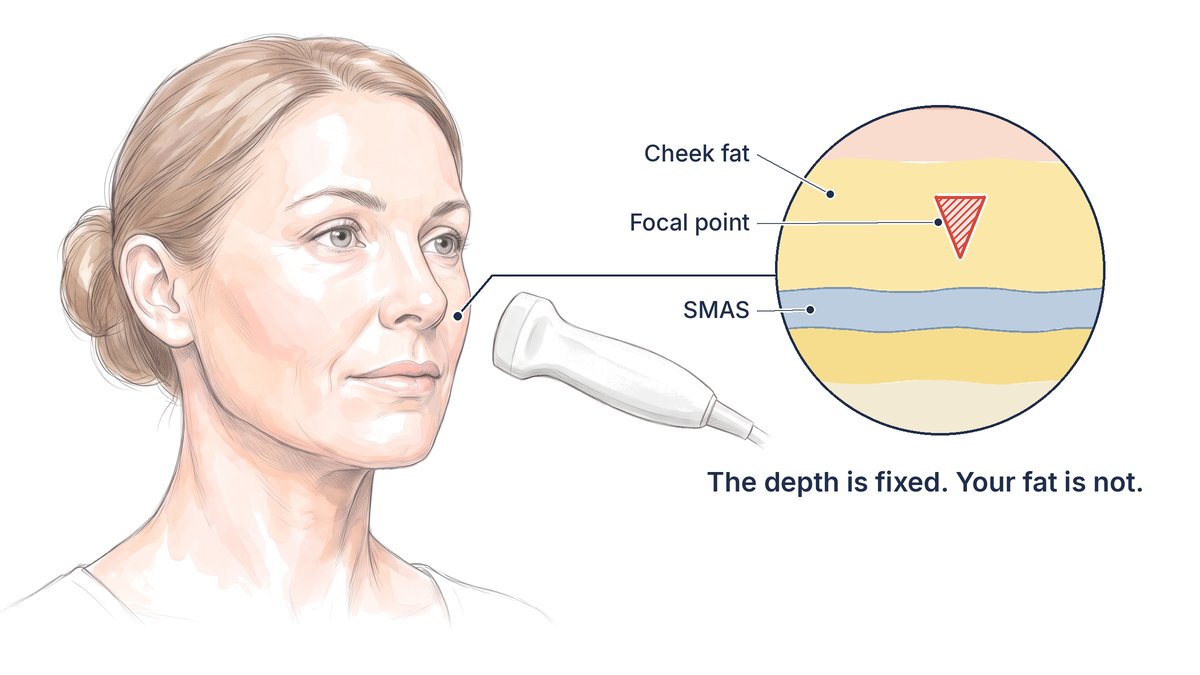
The mistake patients make is reading one number alone. A clinic quoting “1 in 506” is quoting studies that were never built to measure facial fat. A forum thread full of hollow cheeks is a set of unverified stories with no denominator. Neither tells you your own risk. A simpler question does: in your face, at the depth the cartridge is set to, will the focal point land in the dermis and the SMAS (the fibrous support layer a facelift tightens), as intended, or in fat?
Video in English, about 6 minutes: Ultherapy Fat Loss? The Face Type Most at Risk
Is the Risk 1 in 506, or Is Fat Loss the Most Common Complaint?
Published studies put fat loss after microfocused ultrasound at about one case in 506 patients, while complaint reports to the FDA list lipoatrophy among the most frequent problems; the first figure probably undercounts, and the second cannot be turned into a rate at all. The true frequency sits somewhere between them, and nobody has measured it.

Humphrey and colleagues’ 2025 review pooled 19 published articles to test surgeons’ unconfirmed concerns that energy devices harm facial fat or later facelifts. Apart from that single atrophy case, side effects were mostly transient swelling, redness and pain. In the FDA’s MAUDE database, where patients, clinicians and manufacturers report device problems, the 106 reports under Ulthera most often described lipoatrophy, nerve problems (numbness, altered sensation, drooping) and scarring, plus one compromised facelift. The authors concluded that the evidence supports neither side and that the reports are largely unverified.
Why the studies probably undercount. A 2024 meta-analysis of 42 microfocused ultrasound studies found investigator-rated improvement in 89 percent of 411 patients with no study reporting acute skin damage or long-term sequelae. Only 2 of the 42 were controlled, 31 were simple before-and-after comparisons, and none looked systematically for fat loss. A 2018 multicenter case series of five serious complications after a single session, including tissue swelling followed by atrophy, put it plainly: such events are rare but possible, and may be underreported.
Why the complaint reports cannot be counted. MAUDE has no denominator, and a report is not a diagnosis: a hollow face six months after HIFU may reflect weight loss, aging, dissolving filler or device injury, which a complaint form cannot separate.
What sits in between. A seven-expert consensus panel sponsored by the maker of Ultherapy presented 5 cases of fatty layer damage or lipoatrophy among the complications its members had managed, which are case counts, not rates. A 2025 systematic review of 45 HIFU studies summarized unintentional fat atrophy at under 1 percent, attributed to improper depth selection; that is a summary range, not a measured incidence.
A pan-Asian expert review described two HIFU patients from one author’s clinic. A 56-year-old woman who had two HIFU sessions over three months developed tear trough bulging, sunken cheeks and more skin laxity, which the authors attributed to excessive and uncontrolled delivery of HIFU into the superficial or deep fat layers. A 35-year-old developed crepey skin, a worse tear trough, sunken cheeks and fine lines five months after 400 lines; for her, no cause was stated. That review was funded by the maker of Ultherapy, and neither case named the device used.
A fair reading: fat loss after facial HIFU is real, uncommon in the studies that exist, and tied to technique and anatomy.
How Deep Does HIFU Go, and How Can a 4.5 mm Point Land in Fat?
Standard facial HIFU cartridges focus at fixed depths of 1.5, 3.0 and 4.5 mm below the skin surface, aimed at the dermis and the SMAS; some Korean platforms also carry 2.0 mm and deeper 6.0 or 9 mm cartridges. The depth is fixed, but the anatomy beneath it is not, so the same 4.5 mm point can fall in the fat above or below the SMAS, or, where tissue is thinnest, nearer bone.

Fabi’s review of ultrasound skin tightening lays out the standard set: 10 MHz at 1.5 mm for the dermis, 7 MHz at 3.0 mm for the deep dermis, and 4 MHz at 4.5 mm for the subdermal tissues including the SMAS. The pan-Asian review describes each pulse’s coagulation point as an inverted cone of about 1 mm³ heated to 60 to 70°C, enough to contract collagen and trigger new collagen. In its 2026 clearance letter for the Ulthera System, the FDA lists the eyebrow, lax tissue under the chin and on the neck, the décolleté, and skin laxity on the abdomen, arms and knees. Facial fat reduction is not on the list.
The depth is fixed; your SMAS is not
SMAS depth, the pan-Asian panel wrote, can differ depending on patient weight, body mass index, age, sex and target area, and the panel recommended imaging it by ultrasound. A cartridge counts millimeters from the skin and knows none of that. The pan-Asian authors traced the first of their sunken-cheek cases to energy in the superficial or deep fat layers: either direction.

A cadaver study with a research prototype shows how thin tissue changes the result. White and colleagues created thermal injury zones selectively in the SMAS at depths of up to 7.8 mm, with the skin surface spared. But in the forehead, where soft tissue is thinner, the highest forehead energy tested produced a lesion running from the mid dermis through the subcutaneous fat to the SMAS, and reflection from the bone beneath added overtreatment. In front of the ear, the tissue was comparatively thicker.
Two more factors widen the gap. In bench tests run for the Ultherapy maker’s consensus panel, the focal zone of one anonymized HIFU 1.5 mm cartridge ran 1.00 mm along the beam, against 0.75 mm for the visualized device, and the longest zone measured, in a deeper HIFU cartridge, ran about 4.2 mm. A focal point is a short column, not a dot, and the authors warned that a longer beam may raise the risk of surface welts and blisters. And dose adds to depth: treating only one depth can stack coagulation points, and one published sunken-cheek case followed 400 lines.
HIFU can destroy fat when that is the goal
HIFU destroys fat when it is built and aimed to, so the real question is whether your fat is where the focal point lands. The body device cleared for this, LipoSonix, was indicated for waist reduction by disrupting subcutaneous fat and required at least 1.0 cm of fat beyond the focal depth. In a review of body HIFU, the sham-controlled trial of 168 patients enrolled only people with at least 2.5 cm of abdominal fat. In safety studies in 152 volunteers, damage stayed confined to the targeted fat, which scavenger cells were clearing at 14 to 28 days.
Closer to the face, some Korean HIFU platforms aim at fat on purpose. In a single-arm study of 30 patients posted on the device maker’s website, 4.5 mm and 6.0 mm cartridges were used under the chin to reduce submental fat, and the fat rating fell from 2.37 to 1.37 at one month. Energy that slims a double chin is exactly what a patient fears in a thin cheek.
Can Thermage or RF Microneedling Cause Fat Loss Too?
Monopolar radiofrequency such as Thermage has rarely caused fat loss in published series, while RF microneedling (Morpheus8 type) at 3 to 4 mm is designed by its developers to heat the fat beneath the dermis, so its risk depends on needle depth.
In a chart review of more than 600 monopolar RF treatments, temporary side effects followed 2.7 percent of treatments and none were permanent. The most significant was a slight cheek depression in one patient, which resolved in 3.5 months.
RF microneedling works differently. In a combined fractional and bipolar RF series, the developers set needles at 2 mm over the eye area and bony regions, 3 mm for facial soft tissue and the neck, and 4 mm for the body, each with about 1 mm of extra heat beyond the tip, and described coagulation of fat as well as contraction of the reticular dermis. Among 247 neck and jowl patients in this manufacturer co-funded series, temporary nerve weakness occurred in 1.2 percent, and contour deformities were listed as possible without a rate. A report of deeper insertion warned that firing before the needles are confirmed in place risks blistering or punctate atrophy.
Which Energy Treatments Can Cause Facial Fat Loss? At a Glance
Fat loss is likeliest where the heat is aimed at or near fat: body and submental HIFU by design, RF microneedling at depth, and facial HIFU only when the focus lands in fat. Read the last column as published data, not your personal risk.
| Treatment | Where the heat is aimed | Built to remove fat? | What published data show about fat loss |
|---|---|---|---|
| Facial HIFU, 1.5 mm | Dermis | No | Burns and welts are the concern when too shallow, not fat |
| Facial HIFU, 3.0 mm | Deep dermis | No | Welts more likely than at 4.5 mm; fat loss not reported separately |
| Facial HIFU, 4.5 mm | Below the dermis, SMAS | No | 1 atrophy case in 506 study patients; lipoatrophy among the most frequent complaints in 106 unverified FDA reports |
| Submental HIFU, 4.5 and 6.0 mm | Fat under the chin | Yes, in some Korean protocols | Fat rating 2.37 to 1.37 at one month in 30 patients |
| Body HIFU | Abdominal fat, at least 1.0 cm beyond the focus | Yes | Fat cells disrupted and cleared over weeks |
| Monopolar RF (Thermage type) | Broad dermal heating | No | 1 transient cheek depression in 600+ treatments |
| RF microneedling, 2 to 4 mm | Dermis and subdermal fat | Partly, by design at depth | Contour deformity listed as possible, no rate |
Where fat is the target, fat goes. Where it is not, fat goes only when the focus lands in it: a thin face, a wrong depth, or too many points. For the lifting side of the same devices, see Ultherapy vs. Thermage vs. Shurink.
Is HIFU Safe for a Thin Face? How Dr. Yongwoo Lee Plans It
HIFU can be used on a thin face, but the plan has to change. I perform HIFU myself, and in a thin face I follow two rules: keep the energy away from the hollow under the cheekbone, over the buccal fat pad, and place fewer lines. A focal depth that suits a fuller face can fall into fat in a thin one, and every extra line adds coagulation points to tissue with little volume to spare.

Why the hollow under the cheekbone is left out
The hollow under the cheekbone shows fat loss first and forgives it least. A full face has fat in reserve, so a coagulation point that strays into fat changes little that can be seen. In a thin face the fat there is a thin cushion carrying the whole contour, and a point landing in it, above or below the SMAS, takes volume the face cannot spare. Leaving that hollow out of a thin face costs little in lift, because the areas where HIFU has its clearest track record, the brow and the tissue under the chin and on the neck, lie outside it.
Why fewer lines
A line count is a dose: more lines mean more coagulation points, more stacking, and more heat in tissue that cannot absorb it. In a thin face I place fewer lines than in a fuller face of the same size.
How I decide a face is thin
Before HIFU I look at the same two places I check before any procedure that removes volume: the temple and the hollow under the cheekbone. If either is already thinning, the face has little fat in reserve, and the plan changes. Recent weight loss counts too: a face that has just slimmed down on a GLP-1 drug, as described in Ozempic face after GLP-1 weight loss, is a thin face for this purpose. A patient who has had buccal fat removal also has less under the cheekbone to lose.
A face that is already hollow is not a HIFU problem at all: if the complaint is volume, adding heat treats the wrong layer, and the honest answer is a volume treatment, not another session.
As the skin tightening comparison explains, treatment is done awake, because a sharp pain signals energy landing too deep or near a nerve. Beyond that, the consensus panel’s strongest agreement on prevention was a detailed history, examination of skin thickness and good transducer contact, adding that visualizing the layers by ultrasound could prevent many injuries.
How Is Hollowing After HIFU Corrected?
A small, localized hollow is usually corrected with hyaluronic acid filler, and a marked hollow with fat grafting, after first confirming that the change is true fat loss and that swelling has settled.
First, confirm what it is. Weight loss, dissolving filler and ordinary midface thinning can all look like device injury, and a contour judged while swelling persists may still be changing. Pre-treatment photographs are the best evidence.
Small hollows: hyaluronic acid filler. The consensus panel’s management for lipoatrophy after microfocused ultrasound was re-volumization with a hyaluronic acid dermal filler. For a small, defined dent it is precise, adjustable, and can be dissolved if it is wrong, though cheek filler carries its own rare risk of blocking a blood vessel, explained in filler blindness and vision loss warning signs. I use the same split at the temple, filler for a small volume and fat for marked hollowing, as described in temple hollowing: fat grafting vs filler, and the same split is commonly applied to a hollow cheek.
Marked hollowing: fat grafting. When the loss is broad, or sits in a face that was thin to begin with, fat grafting replaces like with like. It has its own trade-offs: transferred fat survives only partially, around half in many areas according to how much transplanted fat lasts, and it can form lumps or oil cysts, covered in facial fat grafting complications. No study has examined grafting for HIFU-related hollowing specifically. A facelift alone does not fix this, because a lift moves tissue and adds none.
Which HIFU Patient Are You?
Find the pattern closest to yours and take it to your consultation.
The 32-year-old with a slim face who wants HIFU for prevention. Flat temples and defined cheeks mean the least fat to spare if a point lands in it. Ask for the hollow under the cheekbone to be left out, a reduced line count, and a plan built around the brow, jawline and under the chin.
The 45-year-old who looks puffy and uneven two weeks after HIFU. Swelling is the likeliest explanation. Photograph it, tell the clinic that treated you, and do not fill anything yet.
The 50-year-old whose cheeks look hollow four months after HIFU, and who has also lost 7 kg. Two causes overlap, and the weight loss alone can produce this picture. Earlier photos and a stable weight come before any correction.
The 38-year-old who had buccal fat removal and now wants HIFU. Under her cheekbone she has already lost the deepest cushion, so that hollow should be left out of any energy treatment.
The 58-year-old with heavy jowls who hopes HIFU will avoid surgery. Fat loss is the smaller worry here; disappointment is the larger, because a device does not reposition tissue that has truly descended.
What Is Normal After HIFU, and When Would Fat Loss Show?
Redness, mild swelling and tenderness are normal and fade within days to two weeks, while a hollow from fat injury, if it happens, would be expected to appear over weeks to months rather than overnight.
The 45-study systematic review gives typical ranges: redness in 30 to 50 percent of patients for 24 to 48 hours, swelling in 10 to 20 percent for days, and tenderness in 15 to 25 percent for one to two weeks. A review of facial microfocused ultrasound reports transient altered sensation lasting 3 to 10 days. Any lift builds slowly, over about two to three months.
No study has timed the onset of fat loss after facial HIFU; in the one published case with a date, sunken cheeks and a worse tear trough appeared five months after treatment. Serious facial cases have also been described as swelling followed by atrophy. A dent that deepens over the first few months, after swelling has gone, deserves a review; a fuller, uneven face in the first week usually needs only time.
Surgeon’s Insight: Plan HIFU Around the Face, Not the Setting
If a patient tells me HIFU made her face hollow, I do not start by defending the machine or blaming it. I ask what she weighed then and now and what was injected before, and I look at older photographs, because a cheek can lose volume for several reasons and only one of them is the device.
Leaving the hollow under the cheekbone alone in a thin face costs a little effect, and I accept that, because volume taken from a thin cheek is much harder to give back than a lift is to repeat. The safest treatment for a face with no fat to spare is one that does not ask it to spare any.
What Else Can Go Wrong After HIFU: Burns, Nerves and Eyes?
Besides fat loss, documented complications of facial HIFU are burns and welts, temporary nerve problems, and, when the probe is used on the eyelids, cataract. Most are rare and temporary.
Burns and welts. The pan-Asian panel links burns to energy delivered too shallow or too strong, poor transducer contact and stacked pulses; Fabi’s review ties uncommon linear welts to poor technique and the 3.0 and 1.5 mm transducers, and a review of the safety profile found surface thermal effects rare and mainly linked to improper technique. For burns, welts, or redness or swelling lasting beyond 24 hours, the consensus panel agreed on topical steroids.
Nerve problems. The facial microfocused ultrasound review describes one patient with numbness along the jaw after treatment and partial weakness around the mouth the next day, which resolved on its own at two months. Measurements cited in the cadaver study place the facial nerve branches roughly 9 to 11 mm deep where they leave the parotid gland, deeper than any lesion the device produced, but the branches become more superficial further forward, so that figure is not a margin for the whole face.
The consensus panel named brow drooping and an asymmetric smile as early signs and recommended oral steroids, and sometimes botulinum toxin on the other side for balance, during recovery. Nerve recovery in general is explained in facial nerve injury and recovery after a facelift.
Eye injury. A 43-year-old developed acute cataract in both eyes within hours of an ultrasound eyelid-tightening procedure; a 47-year-old treated on the eyelid without eye protection fell to 20/630 vision in one eye; and a 40-year-old treated in a beauty salon developed traumatic cataract in both eyes, with the authors advising that the probe stay off the eyelid and brow arch or that eye shields be used. Each of the first two needed lens surgery.
All three were treated on or around the eyelids, one in a salon, so HIFU near the eyes belongs with a physician who keeps off the lid or shields the eye. A brow lift does not require treating the lid: in a study of 30 Korean patients, forehead HIFU raised the brow by about 1.5 mm at 12 weeks with nerve danger zones over the temple marked on the treatment map.
Who should wait. Fabi’s review lists infection or open lesions, active severe acne and an active implanted device such as a pacemaker in the field as absolute contraindications, with keloids, implants, permanent fillers and smoking as cautions.
When to get help the same day. Sudden blurred or reduced vision, eye pain or a red eye after treatment near the eyes is an emergency: go to the nearest emergency room at once, then contact the clinic; in the published cataract cases, symptoms began within hours to a day. Blisters, open or crusting skin, or a spreading burn should be seen by the treating clinic, not treated at home. Report a drooping brow or uneven smile to the clinic promptly, but facial weakness with arm or leg weakness, slurred speech or confusion means calling emergency services at once, whatever treatment you had recently.
What Should You Ask Before HIFU if Your Face Is Thin?
Before HIFU, ask about your own face rather than the brand: given how much fat my face has, and where, which depths will be used on which areas, how many lines, and what will be left out?
If your face is full and your goal is modest firming of the brow, jaw and neck, HIFU is a reasonable, low-downtime option. If your face is thin, recently slimmed, or without its buccal fat pad, ask for the hollow under the cheekbone to be left out and the dose reduced, or ask whether volume rather than heat is what you need.
Written by Dr. Yongwoo Lee, board-certified Korean plastic surgery specialist in facial anatomy and aesthetic procedures at VIP Plastic Surgery, South Korea.
Frequently Asked Questions About HIFU, Ultherapy and Facial Fat Loss
Can Ultherapy cause fat loss in the face?
It can, though studies report it rarely: one atrophy case among 506 patients in a 2025 review, against lipoatrophy among the most frequent of 106 unverified FDA complaints. Your risk depends on whether the focal point lands in fat, which a thin face can least afford.
Does HIFU melt facial fat?
Facial lifting cartridges at 1.5, 3.0 and 4.5 mm are designed to heat the dermis and the SMAS, not fat. Fat is injured when the focal point lands in it, which depends on where the SMAS sits in your face. Body HIFU, and submental protocols using 4.5 and 6.0 mm cartridges, target fat deliberately; if a 6.0 mm or deeper cartridge is planned on your cheek, ask why.
Why does my face look hollow after HIFU?
In the first weeks, uneven swelling is the usual reason, and it settles. A hollow appearing over later months may be fat injury, but weight loss, aging and dissolving filler look the same; old photographs help separate them.
Is fat loss after Ultherapy or HIFU permanent?
No study has followed it long enough to say. A change that persists after swelling has settled is usually treated as lasting and corrected with filler or fat grafting.
Should I avoid HIFU if I have a thin face?
Not necessarily, but the plan should change: the hollow under the cheekbone left out, fewer lines, and a clear answer on which depth goes where. If your cheeks are already hollow, the problem is volume, not laxity.
Can Thermage cause fat loss or facial atrophy?
Rarely. In a chart review of more than 600 monopolar radiofrequency treatments, no side effect was permanent, and the most significant was one slight cheek depression that resolved in 3.5 months.
Does Morpheus8 or RF microneedling cause fat loss?
It can affect fat by design. Its developers describe needles at 3 to 4 mm coagulating fat beneath the dermis, and list contour deformities as possible without giving a rate.
Is Shurink or Ultraformer safer than Ultherapy for fat loss?
No study compares fat loss between brands. The risk follows depth, dose and the face being treated, so the planning matters more than the brand.
How do you fix hollow cheeks after HIFU: filler or fat transfer?
Filler suits a small, localized dent and is what the Ultherapy maker’s consensus panel advised for lipoatrophy; fat grafting suits broad hollowing in a thin face. No study has examined grafting for HIFU-related hollowing specifically, so confirm the cause and let swelling settle before either.
Can HIFU damage facial nerves, and will it recover?
Temporary problems are reported, such as altered sensation lasting 3 to 10 days, or weakness around the mouth that resolved at two months in one case. Brow drooping or an uneven smile after treatment should be reported promptly to the treating clinic.
Is HIFU on the eyelids safe?
Published reports describe acute cataract in at least three patients after ultrasound on the eyelids, at least two needing lens surgery. The authors of the latest report advise keeping the probe off the eyelid and brow arch or using eye shields.
Will HIFU or RF make a future facelift harder?
The evidence does not answer this either way. A 2025 review found no supporting data, and one FDA report described a compromised facelift. If you have had energy treatments, tell your surgeon the device, depths and dates.
This article is for informational purposes only and does not constitute medical advice. Always consult with a qualified medical professional before making any decisions about surgical or non-surgical procedures.
