
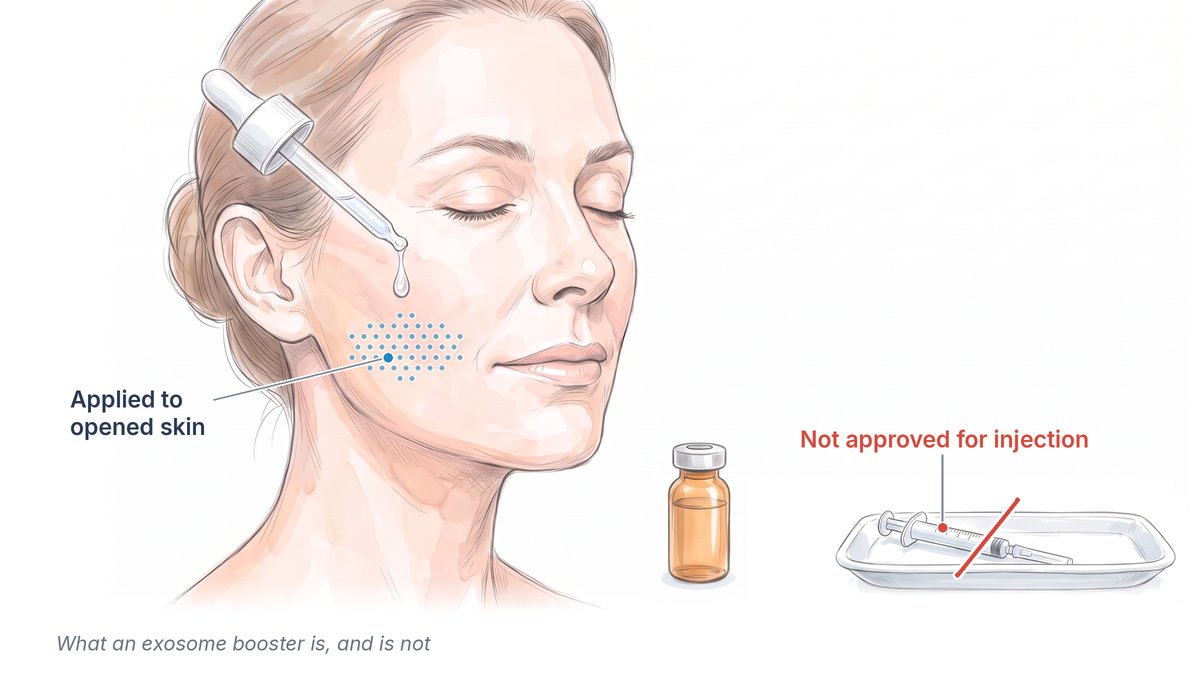
An exosome skin booster, also sold as an exosome facial or exosome serum, is a liquid or gel said to contain exosomes, tiny particles that cells release to signal to one another, applied to the face in the hope of calming the skin and supporting repair. In practice it is usually painted onto skin that has just been opened by microneedling or a laser, and most products are sold as cosmetics, not as approved medicines. No exosome product is approved for injection anywhere, and the human studies so far show a modest early signal, not proof.
Quick answers
- Are exosomes FDA approved? No. The FDA states that there are no FDA-approved exosome products.
- Can exosomes be injected? No exosome product is approved for injection in the US, Korea, the EU or the UK; most are cosmetics meant for the skin surface.
- Do they work? Early human studies report average improvements from baseline of 20.2 percent for wrinkles and 14.7 to 23.4 percent for other skin measures, but the studies are small, varied and use products that are not standardized.
- How are they used? Mostly applied right after microneedling or a fractional laser, while tiny channels in the skin are still open.
- Are they safe? After topical use, short-lived redness is the usual effect; delayed inflammatory lumps (granulomas) have been reported after injection.
- Plant or human exosomes? Different products with different evidence; most human skin data come from human stem cell sources, and results do not transfer from one to the other.
- Are they legal in Korea? They are sold as cosmetics; none is approved as a drug or an injectable.
- How many sessions, and how long do results last? No evidence-based number exists; one well-known trial used three sessions three weeks apart, and studies followed patients for months, not years.
What Is an Exosome Skin Booster, and What Is Actually in the Vial?
An exosome is a tiny bubble of cell membrane, about 30 to 150 nanometers across, that a cell releases to carry proteins, fats and genetic messages (RNA) to other cells. An exosome skin booster is a product said to contain these vesicles, harvested from cells grown in a laboratory, and its label rarely tells you how many vesicles are inside, which cells made them, or how they were purified.
A 2026 overview in the Aesthetic Surgery Journal defines exosomes as nanoscale extracellular vesicles of 30 to 150 nm that carry signals between cells, and names fat-derived (adipose) stem cells as the most common source in aesthetic products. Scientists increasingly use the broader term extracellular vesicles, because no lab method cleanly separates true exosomes from other vesicles of similar size. For a patient, the practical point is simple: the word on the box describes a category of particle, not a defined dose of a defined substance.
Source cells vary widely. The 39 human studies in a 2026 systematic review used vesicles from adipose stem cells, umbilical cord and placental stem cells, human platelet extract, rose stem cells, fibroblasts, bovine milk and seaweed. Those are not variations on one product. They are different particles from different organisms, carrying different cargo.
Exosomes, conditioned media and growth factors are not the same thing
When cells grow in a dish, they release vesicles and free proteins into the surrounding liquid, called conditioned medium. A purified exosome product has had the vesicles separated and concentrated; a conditioned-medium product contains whatever the cells left behind. The 2026 overview warns that minimally processed materials are sometimes mislabeled as purified exosomes, and that potency tests are not yet harmonized across manufacturers. It adds that storage matters: vesicles keep their function best at minus 80 degrees Celsius, and at minus 20 they can clump together and lose part of their activity.
So two vials that both say “exosome” can differ in source, particle count, purity, sterility and how they were stored before they reached the treatment room. This is the first reason results vary.

Are Exosomes FDA Approved?
No. The FDA states that there are currently no FDA-approved exosome products, and exosomes used to treat a disease or condition are regulated as drugs and biological products that need premarket review and approval.
The agency’s 2019 public safety notification followed multiple reports of serious adverse events in patients in Nebraska treated with unapproved exosome products. It also addressed clinics that claim their products fall outside drug regulation, calling that claim “simply untrue.” Its consumer alert, last updated in 2024, repeats that no exosome product is FDA approved and that unapproved products may have significant safety issues.
The FDA enforces this with warning letters. In August 2025 it told a Florida company that its exosome products were drugs and unlicensed biological products, in violation of section 351(a)(1) of the Public Health Service Act. That letter concerned therapeutic claims, not facials, but the legal line is the same.
Why exosome serums are still on US shelves
Skincare sold only to change how skin looks is regulated as a cosmetic, and cosmetics do not go through FDA approval before sale. A topical exosome serum marketed for appearance can therefore be sold legally, while the same vesicles marketed to treat a condition, or injected, fall under drug and biologic rules. “Not FDA approved” on a serum is normal; “not FDA approved” on something going through a needle is a different matter.
Are Exosome Treatments Legal in Korea, the EU and the UK?
No exosome product is approved as a medicine in any of these markets, or anywhere else. What patients meet in clinics are cosmetic products, and the rules on what those may contain and claim differ by country.
The same overview concluded that no regulatory agency worldwide has yet approved an exosome product for any medical indication. Its table of 15 jurisdictions, including South Korea, the European Union and the United Kingdom, shows no approved product in any of them, and notes that in the EU, exosome medicines would be treated as advanced therapy medicinal products needing central authorization.
Korea: sold as cosmetics, not as injectables
In Korea, exosome products used in clinics are sold as cosmetics, and none is approved as a drug. In January 2025 the Ministry of Food and Drug Safety widened its list of banned expressions in cosmetic labeling and advertising, and Korean press reported that the new list restricts advertising wording that presents human-derived ingredients such as exosomes. Korean health authorities have also told doctors that cosmetics registered for use on the skin should not be injected. If you are traveling to Korea for treatment, those rules apply to the clinic in front of you.
European Union: human-derived ingredients are banned in cosmetics
The EU cosmetics regulation lists cells, tissues or products of human origin among the substances that cosmetics may not contain. So an exosome cosmetic sold in the EU has to come from a non-human source, such as plants or milk.
United Kingdom
The UK picture matches the others: no approved exosome medicine. As in the US, a topical product sold as a cosmetic is a different legal category from a product injected into the skin.

Can Exosomes Be Injected Into the Skin?
Not as an approved product: no exosome product anywhere is approved for injection, and most exosome boosters are sold as cosmetics for the skin surface. Injecting a cosmetic skips the sterility, dosing and safety testing that injectable medicines and devices must pass, and delayed inflammatory nodules have been reported after exosome injections.
Reviewers who are enthusiastic about the biology are still blunt about the route. The 2026 overview states that reported complications typically arise from nonsterile or mischaracterized products, and a 2025 dermatology review notes that improperly prepared exosomes can carry viral proteins and microbes such as mycoplasma. Of the 26 skin studies in the 2026 systematic review, only 4 used injection.
Polynucleotide and hyaluronic acid boosters, by contrast, are made and sold to be injected, as explained in Rejuran, Juvelook and Skinvive compared and in the comparison table below. In my practice, a product registered as a cosmetic is never injected, whatever the box calls it; if it is used at all, it goes on the skin surface.
Do Exosomes Actually Work for Skin?
Early human studies are encouraging but weak: a 2026 systematic review of 39 human studies reported average improvements from baseline of 20.2 percent for wrinkles and 14.7 to 23.4 percent for pigmentation, elasticity, texture, redness and overall appearance. The studies were small and used different products, sources, doses and routes, so these numbers describe a signal, not a result to expect for one face.
Key numbers
- Human studies in the 2026 review: 39 (26 skin, 13 hair).
- Wrinkles: 20.2 percent average improvement from baseline (range of likely values 15.3 to 25.2).
- Other skin measures: 14.7 to 23.4 percent.
- How the 26 skin studies applied exosomes: topical 11, with microneedling 7, with laser 6, injection 4 (some used more than one).
- Best-known controlled trial: 25 patients, acne scars improved 32.5 percent on the exosome side vs 19.9 percent with laser alone.
- Microneedling review: 8 studies, 171 patients, follow-up no longer than 6 months.
- Injection complications: 8 women with granulomas appearing 2 weeks to 3 months later.
- FDA-approved exosome products: none.
What the 2026 systematic review shows, and what it does not
The review, published in the Aesthetic Surgery Journal, searched five databases in February 2025. Its authors rated it level 3 evidence, below the grade of large randomized trials, and named the wide differences between studies and their nonstandardized protocols as limits. They also found nine trials still running in the United States, Iran and China. For hair, the same review reported density 23.6 percent and thickness 18.0 percent higher than baseline; hair loss treatment is outside the scope of this article.
Three details matter when you read those percentages. First, they are mostly improvement from each study’s own baseline, not a difference against a placebo, so part of the gain may come from the microneedling, laser or skincare that went with the exosomes. Second, the paper’s methods say the results were synthesized descriptively rather than formally pooled, which sits awkwardly with the abstract’s description of a meta-analysis. Third, adverse events were not among the data the review set out to collect, so it says little about safety.
The best-known controlled trial
The cleanest study is a Korean split-face trial in acne scars. Twenty-five patients had three fractional CO2 laser sessions three weeks apart, with exosome gel on one half of the face and a plain gel on the other. Six weeks after the last session, scar scores fell by 32.5 percent on the exosome side and 19.9 percent on the control side. Redness in the first week was milder on the exosome side, and downtime was 4.1 versus 4.3 days.
This is a real, measured difference in a double-blind design, meaning neither the patients nor the assessors knew which side had the exosome gel. It is also one trial, in 25 people with medium skin tones (types III and IV), using fat-derived stem cell exosomes that the paper states were made and supplied by the manufacturer. The 0.2-day difference in downtime is statistically significant and practically small. And the laser did most of the work: the control side improved by about a fifth on its own.
Microneedling studies
A 2026 systematic review of microneedling with exosomes found 8 studies with 171 patients. In one aging study, a 28-patient split-face trial, skin elasticity rose 11.3 percent on the exosome side and fell 3.3 percent on the control side at 12 weeks. The authors noted that sample sizes were uniformly small, follow-up never exceeded 6 months, and no study disclosed the regulatory status of the product it used.

What Do Exosomes Add After Microneedling or Laser?
Exosomes are most studied as a recovery serum applied right after microneedling or a fractional laser, when tiny channels in the skin let large particles reach living tissue. The controlled data suggest a modest extra gain on top of the procedure and slightly calmer early redness, not a replacement for the procedure itself.
Of the 26 skin studies in the 2026 review, 7 paired exosomes with microneedling and 6 with laser. In the acne scar trial described above, the exosomes added to a result the laser was already producing. That trial used a 10,600 nm fractional CO2 laser, the same wavelength as the CO2 laser I use, though its three full-face acne scar sessions are a different treatment from the single superficial pass described in CO2 laser after a facelift.
Open skin is also an open door
Anything placed on freshly treated skin goes into it. After fractional ablative laser, infection occurred in 2.9 percent of 525 treatments, and 93 percent of those infections appeared in the first two weeks, and those figures come with ordinary wound care. A product of unknown sterility added to those channels adds risk the trial data do not measure, which is why I treat sterility and single-use packaging as the first test of any serum used after a procedure.
What about pigment and melasma?
Exosome products are often sold for brightening. In the microneedling review, one melasma study reported that 88.9 percent of patients moved from moderate to mild on a melasma score; the review’s authors described sample sizes across its studies as uniformly small. Melasma relapses easily and can be worsened by heat and inflammation, which is why the laser side of that question is covered separately in when lasers make melasma worse.

Plant vs Human Stem Cell Exosomes: Does the Source Matter?
Yes. Most published human skin data come from human stem cell sources, especially fat-derived stem cells, while plant and milk vesicles are different particles with different cargo and much less clinical data behind them.
The 2026 overview names adipose-derived stem cells as the most common source in aesthetics, alongside fibroblasts, umbilical cord stem cells, platelets, milk and several plants. In the acne scar trial, the vesicles came from human fat-derived stem cells; a rose-derived or milk-derived serum cannot borrow that trial as its evidence. Ask which source a product uses, then ask which studies used that source.
The EU and Korean rules described above push the market toward non-human sources, so a product marketed internationally as a “plant exosome” may have been chosen for legal reasons rather than because it works better or worse. Human-derived material raises its own questions, such as donor screening and contamination, which is why reviewers stress manufacturing quality for those products. Neither source is simply “safer” or “stronger”; they are not the same treatment.
Exosomes also contain no living cells, so an exosome facial is not stem cell therapy, whatever the marketing implies. Fat grafting enriched with real stem cells is a separate topic, covered in how much transplanted fat actually lasts.
Are Exosomes Safe? What Are the Side Effects and Risks?
In short-term studies of topical use on microneedled or lasered skin, the reported side effects were short-lived redness, mild swelling, pinpoint bleeding, tingling or burning that settled within 24 to 72 hours, at most about a week. The serious risks sit elsewhere: injection of products not made for injection, contamination, and long-term effects nobody has studied yet.
- Short-term reactions after topical use. In the microneedling review, no patient stopped treatment because of side effects, and the effects listed above faded within days.
- Delayed granulomas after injection. Korean aesthetic dermatologists described 8 women, aged 26 to 52, who developed red, firm bumps at injection sites 2 weeks to 3 months after exosome treatment. Biopsies showed necrotizing granulomas not caused by mycobacterial infection, and the response to steroids varied.
- Contamination. As covered in the injection section, products not made under pharmaceutical conditions can carry microbes or viral material, and most reported complications trace back to them.
- Serious reactions with unapproved products. These are what prompted the FDA’s 2019 notification, described earlier.
- Unknowns. Follow-up in the microneedling studies did not go beyond 6 months, and no long-term safety data exist. Reviewers list theoretical concerns, including whether growth signals could affect abnormal cells, that no study has been large or long enough to answer.
Who should wait: anyone with an active skin infection, cold sore or flaring eczema in the area, anyone who has had a granuloma-type reaction to an injected product, and anyone pregnant or breastfeeding, for whom there are no safety data. These are cautions based on the absence of evidence, not proven contraindications.
Surgeon’s Insight: The Word “Booster” Hides the Question That Matters
Patients often tell me they want “the exosome booster,” as if it were one product. It is a word that covers regulated injectables and topical cosmetics alike, and the trend makes it easy to forget which is which.
The biology of cell signaling is genuinely interesting, and the controlled data suggest a modest benefit when exosomes go onto skin a laser has just treated. Wanting that is reasonable. I judge any vial by what its maker can document about its contents and by what it is registered for, and if those two answers are vague, so is the result.
Exosomes vs PRP vs PDRN (Polynucleotides): How Do They Compare?
They are three different things: PRP is concentrated from your own blood on the day of treatment, polynucleotide (PDRN or PN) boosters are manufactured injectables made from purified salmon DNA fragments, and exosomes are laboratory-derived vesicles mostly sold as cosmetics for skin opened by a procedure. Only PRP and polynucleotides are prepared and sold to be injected, which is the biggest practical difference for a patient.
At a Glance: Exosome Booster vs PRP vs Polynucleotides vs Procedure Alone
| Option | What it is | Where it comes from | How it is used | Made to be injected? | Human evidence for skin aging | Main caveat |
|---|---|---|---|---|---|---|
| Exosome booster | Cell-released vesicles, or conditioned medium | Human stem cells, platelets, plants or milk | Mostly applied after microneedling or laser | No; most are cosmetics | Small, varied studies; average gains of 14.7 to 23.4 percent from baseline | Contents, dose and sterility not standardized |
| PRP (platelet-rich plasma) | Your own platelets concentrated from a blood draw | You, on the day | Injected or applied after microneedling | Yes, prepared at the bedside | Mixed results across studies | Preparation and platelet counts vary by system |
| Polynucleotides (PDRN or PN) | Purified DNA fragments | Salmon | Injected into the skin in a series | Yes, made as injectables | Clinical studies of varying size and quality | Works on repair, not volume or laxity |
| Microneedling or laser alone | Controlled injury that triggers repair | The procedure itself | Series of sessions | Not applicable | The comparison arm in exosome trials; improved scars by 19.9 percent in one trial | Downtime, and pigment risk in some skin types |
A matrix-based injectable option is explained in the RE2O ECM skin booster guide. For oily skin and large pores, diluted toxin placed in the skin works by a different mechanism altogether, as described in skin botox for pores, oil and fine lines.
No option in this table lifts sagging skin. When the problem is laxity rather than skin quality, a booster of any kind is the wrong tool; the options for that are laid out in jowls treatment, from fillers and threads to a facelift.
How Many Exosome Sessions Do You Need, and How Long Do Results Last?
No one knows an evidence-based number, because studies used different products, doses and schedules and followed patients for months, not years. The best-known controlled trial used three sessions three weeks apart, alongside a fractional laser, and measured results 6 weeks after the last one.
Clinic packages usually follow the schedule of the procedure they accompany, not dose-finding studies of the exosomes themselves. Because exosomes in these studies were an add-on, the result lasts about as long as the result of the microneedling or laser it accompanied, and then skin keeps aging at its own pace. There is no published evidence that exosome sessions alone keep skin at a fixed point, and no maintenance interval has been tested.
What Should You Ask Before an Exosome Facial or Booster?
Ask five things: where the vesicles come from, what the product is registered as, what concentration and purification the maker can document, whether it is sterile and single-use, and how it will be applied. A clinic that can answer all five from the box and the paperwork is telling you what is actually in the vial.
- What is the source? Human fat-derived stem cells, umbilical cord cells, platelets, plants or milk. The answer tells you which studies, if any, apply.
- What is it registered as? A cosmetic, a medical device or a medicine, and in which country. A cosmetic belongs on the skin surface.
- What does the maker document? Particle count, purification method and storage. The 2026 overview notes that potency tests are not harmonized, so “billions of exosomes” on a label is hard to compare between brands.
- Is it sterile and single-use? This matters most on skin opened by needles or laser.
- How will it be applied? On top of the skin after a procedure, or through a needle. If the answer is a needle and the product is a cosmetic, stop there.
When patients bring a product name to a consultation, I read the label with them and go through the same five questions. The FDA’s own advice to American patients is similar: ask whether the treatment has been reviewed by the agency.
Is an Exosome Facial or Skin Booster Worth It?
It can be a reasonable add-on when it is a documented, sterile product applied to skin you are already treating with microneedling or laser, and you value slightly calmer early recovery and a possible modest extra gain. It is not worth any risk when it means a cosmetic going through a needle, or when it is sold as a substitute for treatment of the actual problem.
Start with the problem, not the product. Texture and scarring answer to resurfacing; oil and pores to other tools; volume loss and sagging to fillers, fat or surgery. A natural-looking result, in the sense described in what natural means in plastic surgery, comes from matching the tool to the tissue.
If you ask only one thing, ask this: What exactly is in this vial, and is it registered for the way it is about to be used?
Individual results vary; consultation required.
Written by Dr. Yongwoo Lee, board-certified Korean plastic surgery specialist in facial anatomy and aesthetic procedures at VIP Plastic Surgery, South Korea.
Frequently Asked Questions About Exosome Skin Boosters
Are exosomes FDA approved?
No. The FDA has approved no exosome product, and its 2019 safety notification followed serious adverse events in Nebraska patients treated with unapproved products. A serum sold only to change how skin looks is marketed as a cosmetic and needs no approval; a product that is injected or claims to treat a condition falls under drug and biologic rules.
Can exosomes be injected into the face?
No product is approved for that in the US, Korea, the EU or the UK, and only 4 of the 26 skin studies in the 2026 review used injection. Korean dermatologists have reported delayed granulomas appearing 2 weeks to 3 months after exosome injections.
Are exosome treatments legal in Korea?
Exosome products are sold in Korea as cosmetics, and none is approved as a drug. Korean health authorities have told doctors that cosmetics registered for use on the skin should not be injected, and Korean press reported that a 2025 update to cosmetic advertising rules restricts wording that presents human-derived ingredients such as exosomes.
Are exosomes legal in the UK and the EU?
No exosome product is approved as a medicine in either. In the EU, cosmetics may not contain cells, tissues or products of human origin, so human stem cell exosomes cannot legally be sold as an EU cosmetic, and an exosome medicine would need central authorization as an advanced therapy.
What is the difference between plant and human stem cell exosomes?
They are different particles from different organisms. Most published human skin data, including the best-known controlled trial, come from human stem cell sources, especially fat-derived stem cells; plant and milk vesicles have far less clinical data. Evidence for one source does not apply to another.
Do exosomes really work for skin?
The early evidence is encouraging but weak. A 2026 review of 39 human studies reported average improvements from baseline of 20.2 percent for wrinkles and 14.7 to 23.4 percent for other skin measures, but the studies were small and varied, and most figures are improvements from each study’s own starting point rather than against a placebo.
Are exosomes worth adding after microneedling?
They may add a modest gain and calmer early redness. In a 2026 review of 8 microneedling studies with 171 patients, one 28-patient split-face trial found elasticity up 11.3 percent on the exosome side and down 3.3 percent on the control side at 12 weeks.
Can I use exosomes after a laser treatment?
That is their best-studied use. In a 25-patient split-face trial with fractional CO2 laser, acne scars improved by 32.5 percent with exosomes and 19.9 percent with the laser alone. Anything placed on freshly lasered skin should be sterile and single-use, because most post-laser infections appear in the first two weeks.
What are the side effects of exosomes?
After topical use on treated skin: short-lived redness, mild swelling, pinpoint bleeding, tingling or burning, usually gone within 24 to 72 hours. After injection, delayed red, firm bumps (granulomas) have been reported. Contamination is the main risk with poorly made products, and long-term safety is unknown because no study has followed patients for years.
Exosomes vs PRP: which is better?
Neither has been shown to be better in a head-to-head trial for skin aging. PRP comes from your own blood on the day and is prepared to be injected; exosome boosters are laboratory products mostly sold as cosmetics for skin opened by a procedure. The choice depends on what is being treated and how.
How do exosomes compare with PDRN or polynucleotide boosters?
Polynucleotide boosters such as Rejuran are made from purified salmon DNA fragments and are manufactured as injectables for a series of treatments. Exosome boosters are vesicles mostly sold as cosmetics for topical use. They are not interchangeable, and only the polynucleotides are made to be injected.
How many exosome sessions do I need?
There is no evidence-based number. The best-known controlled trial used three sessions three weeks apart with a fractional laser, and clinic schedules usually match the laser or microneedling series.
How long do exosome results last?
Nobody knows yet; in the microneedling review, follow-up never exceeded 6 months. Because the exosomes were an add-on, any gain is tied to the laser or microneedling result it came with.
Do exosomes help hair loss?
Early studies are promising: the 2026 systematic review described above also reported gains in hair density and thickness from baseline across its hair studies. Those studies share the same limits as the skin data, and no exosome product is approved for hair loss.
Are at-home exosome serums worth it?
Most of the human data come from use on skin that has just been opened by microneedling or a laser. Data on exosome serums applied to intact skin at home are thin, so there is little evidence that they do more than a good moisturizer.
Is exosome therapy the same as stem cell therapy?
No. Exosomes are vesicles released by cells and contain no living cells, even when they come from stem cells grown in a laboratory, so an exosome facial is a cell-free treatment. Treatments that use actual stem cells, such as cell-enriched fat grafting, are a separate category with their own evidence.
This article is for informational purposes only and does not constitute medical advice. Always consult with a qualified medical professional before making any decisions about surgical or non-surgical procedures.
