
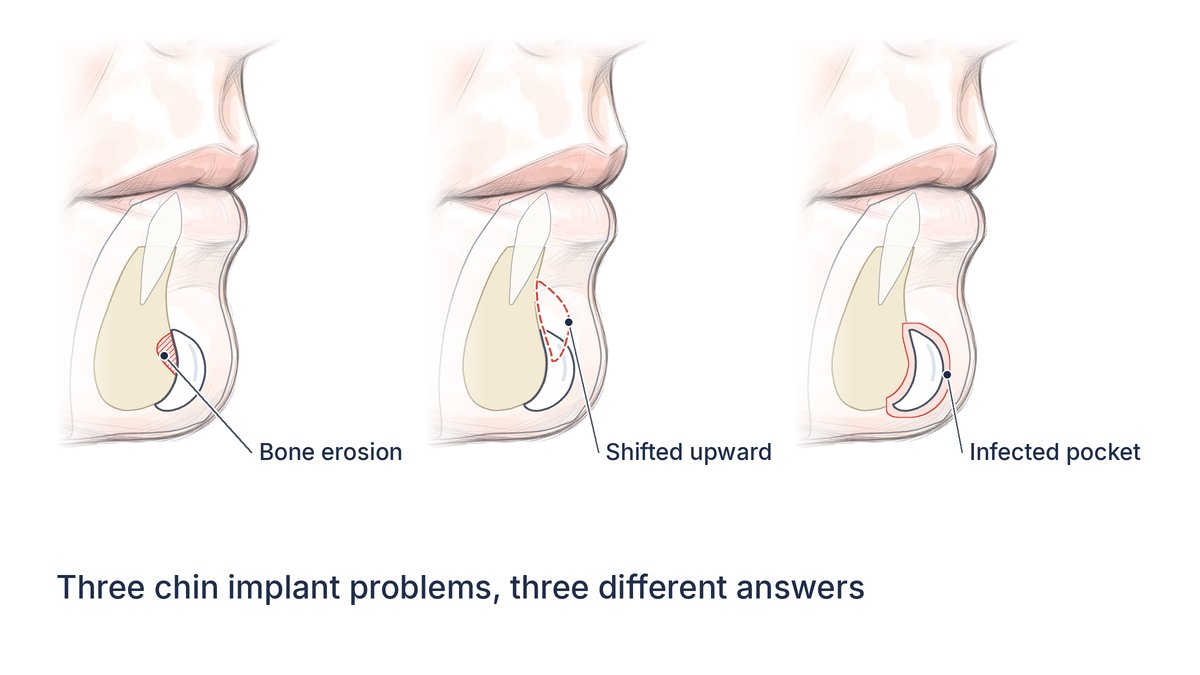
Chin implant problems fall into three groups, each with a different answer. Bone erosion under the implant is common on X-rays and usually shallow and silent, so it is watched. An implant that has shifted, or erosion that reaches the tooth roots or the nerve, usually needs surgery; in Dr. Yongwoo Lee’s practice that means removal, often with a sliding genioplasty in the same operation. An infected implant is usually removed, and the chin is rebuilt months later.
Quick answers
- Does bone erosion under a chin implant mean it must come out? Usually not. In one X-ray series, 14 of 15 patients had erosion, the deepest was 2.0 mm, and none had symptoms. It matters near the tooth roots or the lip nerve.
- Can an infected chin implant be saved? Sometimes with antibiotics, often not. Dr. Yongwoo Lee removes it and rebuilds the chin 3 to 6 months later, usually with a sliding genioplasty.
- What happens if the implant is simply taken out? The chin pad can sag, so Dr. Yongwoo Lee plans its support before removal, with a sliding genioplasty in the same operation when needed.
Chin Implant Problems: Which Ones Can Be Watched and Which Need Surgery?
Shallow bone erosion without symptoms can be watched with X-rays. Infection, an implant that has moved, and erosion that causes tooth pain or lip numbness usually need surgery.
Patients make one of three mistakes. One is panic: a dental X-ray shows a shallow dent under an implant that was causing no trouble, and the patient asks to remove it. In 15 patients X-rayed at least a year after a silicone chin implant, 14 had erosion, the deepest measured 2.0 mm, and none had symptoms. A second is the opposite: a chin that swells and drains repeatedly, treated with antibiotics while the implant stays in. A third is asking for removal with no plan for what will hold the chin afterward.
Implants serve many patients well: a systematic review of 54 studies and 4,897 patients found an overall complication rate of 15.7 percent with implants and 19.7 percent with osteotomy, the bone-moving genioplasty. Which chin suits an implant in the first place is covered in genioplasty versus a chin implant versus chin filler.
Is the Problem the Implant, the Bone Under It, the Pocket Around It, or the Jaw?
A chin implant problem is one of four things: the implant has moved, the bone beneath it has eroded, the pocket around it is infected, or the implant was asked to do a job that belonged to the jaw. Each leads to a different operation, so sorting comes before removing.
- Position. Is the implant where it was placed? Early photographs and an X-ray answer this.
- Bone. How deep is the erosion, and how close to the lower front tooth roots and the mental foramen, the opening where the nerve to the lower lip and chin leaves the jaw?
- Pocket. Redness, swelling or drainage inside the lower lip point to infection, whatever the X-ray shows.
- Indication. Was the chin the real problem? A lower jaw that sits back, or lips that close only when the chin muscle tightens, is not corrected by an implant.
Surgeons who evaluated more than 100 poor results of chin augmentation wrote that “because alloplastic chin augmentation is deceptively easy, it tends to be overused in certain situations”. A wide lower face is a separate question, sorted in whether a square jaw is muscle, bone or fat.
Why Does Bone Erode Under a Chin Implant, and When Does It Matter?
Bone erodes under a chin implant because the implant is pressed against it, mainly by the mentalis, the muscle that lifts the chin pad and helps close the lips. It matters when the erosion comes near the roots of the lower front teeth or the mental nerve, or when the chin loses projection.
The mentalis runs from the bone just below the lower incisor roots to the skin of the chin, so an implant lies between that muscle and the bone. A systematic review of 28 studies notes, citing earlier clinical work, that resorption “is usually more severe at the superior end due to the contraction force of the mentalis muscle”, the upper edge, nearest the teeth.

How common it is, and how deep
Across those 28 studies, resorption was found in 0 to 100 percent of patients, so depth is the more useful number. In one series of 40 patients, about half showed resorption at about 1.7 years, averaging 0.86 mm in those who had it, while six patients selected because they had chin-muscle strain and erosion, a mean of 13.3 years after surgery, averaged 4.3 mm. Longer follow-up seemed to go with deeper resorption, and whether it keeps progressing or levels off is unknown.
Material is not a shield. The reviewers found that implant material, placement technique and gender “did not seem to have a profound effect on the resorption rate,” and a published case describes a woman whose ePTFE implant, in place for 13 years, had eroded more than 5 mm into the bone and moved upward. In a 2025 review, every recorded case of resorption or erosion lay under silicone, but silicone also dominates the long-term studies, so other materials are not proven safer.
When erosion becomes a problem
- Teeth. Resorption that reaches the root tips of the lower incisors can cut off their nerve and blood supply, according to the 28-study review.
- Nerve. Erosion toward the mental foramen can numb the chin and lower lip. As one surgical team put it, “progressive bone erosion can cause tooth root exposure and injure the mental nerve”.
- Lip strain. In six patients with well-positioned, correctly sized silicone implants, an overactive mentalis went with progressive erosion: five had lips that did not meet at rest, four of them with the most severe grade of erosion and one with exposed tooth roots, and the sixth, who strained to hold a lower denture, also had severe erosion. Because symptoms often come late, the authors of this small series advised routine X-rays for implant patients with lip strain.
Why Does a Chin Implant Shift or Look Crooked Years Later?
A chin implant shifts when nothing but the surrounding pocket holds it to the bone. Repeated contraction of the mentalis can push it upward, and a pocket that is too large lets it slide or rotate.
Smooth silicone does not grow into bone. The body walls it off in a thin capsule of scar, and an implant that was never fixed can move inside it. In one series of 47 ePTFE chin implants held only by a snug pocket, a compressive dressing was kept on for at least two weeks “to prevent upward migration of implant”.
Upward is the direction that matters. Low on the chin, an implant rests on the thick lower border of the jaw; higher up it sits over thinner bone, closer to the tooth roots and to the mental nerves, which leave the jaw below the second premolar or between the two premolars. The authors of the 47-implant series kept at least 5 mm between the nerve opening and the implant’s upper edge.

Displacement or extrusion is uncommon in pooled numbers: 12 of 899 silicone chin and jaw implant patients, 1.3 percent, in the 2025 review. Among revisions it is prominent: in a retrospective revision series of 98 silicone chin implants, 24 patients had a diagnosed complication, displacement in 3, bone resorption in 9, both in 3, and dissatisfaction in 7.
Fixation is the published answer. The author of that series concluded that implants “should be placed in the subperiosteal plane with rigid fixation in order to prevent displacement and bone resorption,” a conclusion from a retrospective series, not a trial. Elsewhere, 28 patients given silicone implants through a small incision that spared the mentalis showed no displacement, infection or nerve damage over at least 18 months.
Can a Chin Implant Get Infected Years After Surgery, and What Are the Signs?
Yes. A chin implant can become infected years after an uneventful recovery, and the signs are swelling, redness, warmth, pain, new numbness, or a small opening that drains inside the lower lip.
In one published case, a 50-year-old woman developed swelling and numbness of the chin about seven years after a silicone implant, with an abscess at the old incision inside the mouth; the implant had sunk into eroded bone and was removed.
Infection is uncommon in large pooled data and more common in some single series, and a systematic review of 17 studies and 2,100 patients found porous facial implants more likely than non-porous ones to be associated with infection. Published rates span a wide range:
- 3 of 899 silicone chin and jaw implant patients, 0.33 percent, in the pooled 2025 review.
- 3 of 47 ePTFE chin implants, 6.4 percent, in a Korean series whose authors called the rate relatively high.
- Up to 23.8 percent in one series within a systematic review of 1,126 patients with a small chin, a ceiling from one study, not a typical figure.
Antibiotics alone sometimes work: in the 47-patient series, one of the three infected implants settled with antibiotics and two had to be removed. Bacteria can settle on an implant as a biofilm, a coating that antibiotics and the body’s defenses reach poorly because the implant has no blood supply of its own; that is the usual explanation for why antibiotics so often fail to clear it. Swelling that returns after each course is a reason to discuss removal.
What Happens to Your Chin When the Implant Is Removed?
After removal, the main published concern is the soft tissue, although a deep erosion can also leave a dent in the bone. With the implant out, the chin pad has less to rest on, and if the mentalis muscle heals low or loose, the pad can slide below the edge of the jaw, a deformity called chin ptosis or witch’s chin.
Two surgeons who reviewed 300 patients treated for chin deformities define it: “Chin ptosis describes the presence of the presymphyseal soft tissues below the inferior mandibular border.” Their surgical causes include poor reattachment of the muscle after an approach through the mouth and removal of an overly large implant.
An older report describes 10 women who presented with soft-tissue deformity that appeared 6 months to 6 years after their chin implants were removed, 9 of them with chin ptosis and bunching or dimpling of the chin. Its authors called the established deformity “virtually uncorrectable” and advised seriously considering a bone genioplasty at the time of removal. These patients came to the authors because something had gone wrong, so the series does not show how often removal ends this way.
The published answer is to give the soft tissue something solid. In the words of the same two surgeons who reviewed 300 chin deformities, “revising chin implants is better with a well-secured implant or osteotomy advancement than with no implant”. Soft tissue also follows moved bone more closely than it follows an implant, about 85 percent against 66 percent in the 1,126-patient review. Soft tissue drooping when its bony support changes is also behind cheek sagging after zygoma reduction.

Watch, Remove, Replace or Convert to Genioplasty: Chin Implant Problems at a Glance
Four paths cover almost every chin implant problem: watch it, remove the implant, replace or reposition it, or remove it and move the bone instead.
| Problem | What you notice | What studies report | Published options | In Dr. Yongwoo Lee’s practice |
|---|---|---|---|---|
| Shallow erosion, no symptoms | Nothing; found on an X-ray | 14 of 15 patients; deepest 2.0 mm | Observation with X-rays | Watched; chin X-ray every few years |
| Deep or progressive erosion | Tooth ache, lip numbness, less projection | Linked to lip strain in a six-patient series | Removal; bone genioplasty to restore contour | Removal, with sliding genioplasty in the same operation when needed |
| Shifted or crooked implant | Implant sits high, off-center or loose | 12 of 899 pooled silicone chin and jaw implant patients | Repositioning with fixation, a custom implant, or sliding genioplasty | Removal, with sliding genioplasty in the same operation when needed |
| Infection | Swelling, redness, pain, drainage inside the lip | 0.33 percent pooled to 23.8 percent in one series | Antibiotics (1 of 3 settled); removal | Removal; chin rebuilt after 3 to 6 months, usually by sliding genioplasty |
| Sagging chin pad after removal | Chin pad drops or bunches | Ptosis, bunching or dimpling in 9 of 10 in one series of problem cases | Mentalis resuspension; secured implant or bone advancement | Support planned before removal |
| Jaw problem under the implant | Lower teeth sit well behind the upper | 4 revisions in one series were jaw surgery | Orthognathic assessment | Referred; two-jaw surgery is not performed here |
How Does Dr. Yongwoo Lee Treat a Chin Implant Problem, and How Does He Place One?
I watch shallow, silent erosion with X-rays. I remove an infected implant and rebuild the chin three to six months later, usually with a sliding genioplasty. For an implant that has shifted, or erosion that causes trouble, I remove the implant and, when needed, convert to a sliding genioplasty in the same operation. The implants I place are silicone, set through the mouth under the periosteum, low on the bone, and fixed with a screw.
What I check first
I look at three things before any scan: the profile, the bite and the lips at rest. Lower front teeth that sit well behind the upper ones can mean the jaw is back, not just the chin. Lips that meet only when the chin muscle tightens mean lip strain. A radiograph comes next: a lateral cephalogram or a CBCT if an osteotomy is likely, the same imaging every genioplasty of mine starts from, because the cut must clear the nerve canal.
Erosion: watch or remove
Shallow erosion with no symptoms is watched, not operated on. I tell every patient who receives an implant from me that the bone under it will remodel, and that a chin radiograph every few years is part of having one. Removal is for erosion that approaches the tooth roots, for a change in feeling in the lower lip or chin, or for a chin that keeps losing projection as the implant sinks.
Shifting or erosion that needs surgery: remove, and convert when needed
For both, my operation is removal, and when the chin needs its projection back, I convert to a sliding genioplasty in the same operation, through the same incision inside the lower lip.
It is the same sliding osteotomy I use for a first-time genioplasty: I find and protect both mental nerves, cut at least 7 mm below each nerve opening, slide the freed segment forward and fix it with a titanium plate, and sew the chin muscle back to the cuff left on the bone. Each step, and why the line sits at 7 mm, is laid out in how a genioplasty avoids the mental nerve.
This is bone surgery, so it is done under general anesthesia given by a board-certified anesthesiologist, with capnography, BIS depth monitoring and active warming, and the patient stays one night.
Infection: the implant comes out, and the chin waits
An infected chin implant is removed, and I do not rebuild the chin in that operation. The rebuild comes three to six months later, the rule I also follow for an infected silicone nose implant, because I would rather explain that wait than place new material into an infected pocket. For most patients the rebuild is a sliding genioplasty; a patient who prefers an implant can have a new one.
How I place a chin implant when I place one
My implants are silicone, placed through an incision inside the mouth, under the periosteum, low on the thick basal bone, never over the thinner bone around the tooth roots, and fixed with a screw to keep them from sliding. Before consent I explain two things in particular, bone resorption and infection. A patient with lip strain does not get an implant from me, and a chin that needs a large movement gets a sliding genioplasty.
An incision inside the mouth leaves no skin scar but passes through the mentalis, and the chin ptosis reviewers argue that “an extraoral, submental approach avoids mentalis problems.” Either way the muscle repair matters; one group closes the mentalis over the implant as a flap.
What I do not do
I do not perform two-jaw (orthognathic) surgery. When the bite shows that the jaw is back, I say so and refer for orthognathic assessment before any chin operation. Every number in this article comes from the cited studies, not from my own patients.
Which Chin Implant Problem Do You Have?
Two facts sort most chin implant problems: what you feel, and what the X-ray shows.
A shallow dent under the implant on a dental X-ray, no symptoms, lips that close easily. Keep the implant and repeat the X-ray every few years.
An implant in place for ten years or more, a chin that dimples when the lips close, and a new ache in the lower front teeth or numbness in the lower lip. This is the lip strain pattern, and imaging comes now. If the erosion is near the roots or the nerve, the implant comes out, and a sliding genioplasty restores the projection.
A chin that has become crooked, or an implant that sits higher than it used to or moves under a finger. The implant has shifted. In this practice that means removal, with conversion to a genioplasty when the chin needs it.
A red, swollen, tender chin, or a spot inside the lower lip that drains, months or years after surgery. Treat this as an infection until a surgeon says otherwise, and contact your surgeon the same day. Swelling that spreads quickly under the jaw or tongue, or any difficulty swallowing, breathing or opening the mouth, means emergency services first, then your surgeon.
A chin implant that never gave the profile you expected, with lower teeth well behind the upper. The problem may be the jaw, and orthognathic assessment comes first.
An implant you simply want out, with nothing in its place. That can be done, but ask first how the muscle will be reattached and what will support the chin pad afterward.
What Is Recovery Like After Chin Implant Removal or Conversion to a Sliding Genioplasty?
Removal alone is mostly a matter of swelling, while conversion to a sliding genioplasty adds bone healing and a period of numbness in the lower lip and chin.
After a conversion, my routine is the one I use for any genioplasty through the mouth: soft food for a week, chin tape for a week, and most patients presentable at about two weeks. The incision inside the lip is kept clean with an antiseptic gargle. When jaw angle reduction is done in the same operation, my jaw angle aftercare applies instead: liquids for one to two weeks, soft food to week four, and a compression band for one to two weeks. Numbness is expected and usually temporary: in the 1,126-patient review, sensation changed for a time in up to 100 percent of genioplasty patients in some series and persisted in 7.4 to 12.5 percent.
After implant removal with a sliding genioplasty, patients flying home should plan on 10 to 14 days in Korea; after removal alone, with no bone cut, I usually advise 5 to 7 days (see how long to stay in Korea after surgery). Nicotine in any form (cigarettes, vapes, patches, gum) is stopped four weeks before and four weeks after a genioplasty or chin implant surgery, and a patient who cannot stop has the surgery postponed. Aspirin, anti-inflammatory painkillers and omega-3 are stopped two weeks before surgery and GLP-1 medicines one month before (restarted one to two weeks after), but aspirin or a blood thinner prescribed for the heart, a stent or a stroke, and any medicine prescribed for diabetes, is paused only by the doctor who prescribes it; see what to stop before plastic surgery.
Surgeon’s Insight: The Question Is What Holds the Chin Up
Patients arrive asking whether the implant should come out. That is usually the easy part. The harder part is what the chin will rest on afterward, because the muscle and skin have spent years draped over it.
So I decide the second step before the first. If the bone can be moved forward in the same operation, the soft tissue has living bone under it that day. If there is infection, I accept the wait and say so before the implant is removed.
What Are the Risks of Chin Implant Revision, and What Should You Watch For?
The main risks of revision are numbness of the lower lip and chin, infection, a sagging chin pad that is hard to correct once established and, after a genioplasty, some loss of the advancement over time.
- Numbness. In the 54-study review, temporary mental nerve injury was recorded in 16.4 percent after osteotomy and 2.4 percent after implants.
- Relapse. In the 1,126-patient review, relapse after genioplasty was reported in 2.63 to 27.21 percent, depending on the study.
With an implant in place, contact a surgeon promptly for:
- swelling, redness or warmth of the chin
- a bump inside the lower lip that drains, or the implant showing through the lining inside the lip
- new numbness in the lower lip or chin, or an ache in the lower front teeth
- an implant that moves, or lips that have become harder to close
Swelling that spreads quickly under the jaw or tongue, with or without fever, or any difficulty swallowing, breathing or opening the mouth, is an emergency: call your local emergency number or go to the nearest emergency department first, then tell your surgeon. For an implant placed abroad, bring the operative record and old X-rays; what to ask a clinic for is covered in choosing a plastic surgeon in Korea.
What Should You Ask Before a Chin Implant Is Removed?
Ask which part is failing and what replaces the support, before asking how soon the implant can come out.
If you ask one thing at your consultation, ask this: is the problem the implant’s position, the bone under it, or the pocket around it, and what will hold my chin up once it is out?
Individual results vary; consultation required.
Written by Dr. Yongwoo Lee, board-certified Korean plastic surgery specialist in facial anatomy and aesthetic procedures at VIP Plastic Surgery, South Korea.
Frequently Asked Questions About Chin Implant Problems
How deep does bone erosion under a chin implant usually get?
Usually shallow. In one X-ray series the deepest erosion was 2.0 mm and nobody had symptoms; in a 40-patient series it averaged 0.86 mm at about 1.7 years in those who had it, while six patients selected for chin-muscle strain and erosion averaged 4.3 mm a mean of 13.3 years after surgery. It becomes a concern near the lower front tooth roots or the mental nerve.
My X-ray shows bone loss under my chin implant. Do I need to remove it?
Not for the X-ray alone. Shallow erosion without symptoms is watched with repeat X-rays. Removal is advised when erosion threatens the teeth or changes feeling in the lower lip or chin.
Can a shifted chin implant just be put back in place?
It can be repositioned and fixed, and published options also include a custom implant or a sliding genioplasty. In Dr. Yongwoo Lee’s practice a shifted implant is removed, with conversion to a sliding genioplasty in the same operation when the chin needs its projection back. An implant not fixed to bone is held only by its scar pocket, which is why fixation is the published answer to shifting.
Is a small draining spot inside my lower lip a sign of chin implant infection?
It can be. A small opening that drains inside the lower lip, with swelling, redness, warmth, pain or new numbness of the chin, points to infection whatever the X-ray shows, and should be seen by a surgeon the same day. Swelling that spreads under the jaw or tongue, or trouble swallowing or breathing, is an emergency: call your local emergency number first. One published infection appeared about seven years after surgery.
Can an infected chin implant be saved with antibiotics?
Sometimes. In one series of 47 implants, one of three infections settled with antibiotics and two implants were removed. Dr. Yongwoo Lee removes an infected chin implant and rebuilds the chin three to six months later, usually with a sliding genioplasty, or with a new implant if the patient prefers.
What is witch’s chin after chin implant removal?
It is chin ptosis: the chin pad has slid below the edge of the jaw, which can happen when the chin muscle heals low or loose after removal. In one series of 10 women seen for problems, it appeared 6 months to 6 years after removal; that series counted only problem cases, not the odds.
After a failed chin implant, is a new implant or a sliding genioplasty the better replacement?
In Dr. Yongwoo Lee’s practice it is usually a sliding genioplasty, done through the same incision in the same operation when there is no infection, or three to six months later after an infection, with a new implant instead for a patient who prefers one. Soft tissue followed moved bone about 85 percent of the way against 66 percent for an implant in a 1,126-patient review, and two surgeons who reviewed 300 chin deformities write that revision is better with a well-secured implant or osteotomy advancement than with no implant.
Is numbness of the lower lip after a chin implant permanent?
Early numbness usually fades: in one implant series it resolved within a month in both affected patients. Numbness that appears years later can signal erosion toward the mental nerve or an infection, and needs imaging.
Which chin implant material erodes less: silicone, porous polyethylene or ePTFE?
No material has been shown to protect the bone. A review of 28 studies found that material did not seem to have a profound effect on resorption, and severe erosion has been reported under ePTFE.
What should I bring to a consultation about a chin implant placed abroad?
The operative record, with the implant’s material, size, incision and fixation, and any old X-rays. They show whether the implant has moved and how the bone under it has changed, and they shape the plan for removal.
Should I see a dentist if my chin implant has eroded the bone?
Yes, if the erosion has reached the roots of the lower front teeth, which is rare: erosion is deepest at the implant’s upper edge, nearest those roots. Those teeth may have lost their nerve and blood supply, and a dentist should test them before any chin surgery is planned.
This article is for informational purposes only and does not constitute medical advice. Always consult with a qualified medical professional before making any decisions about surgical or non-surgical procedures.
