
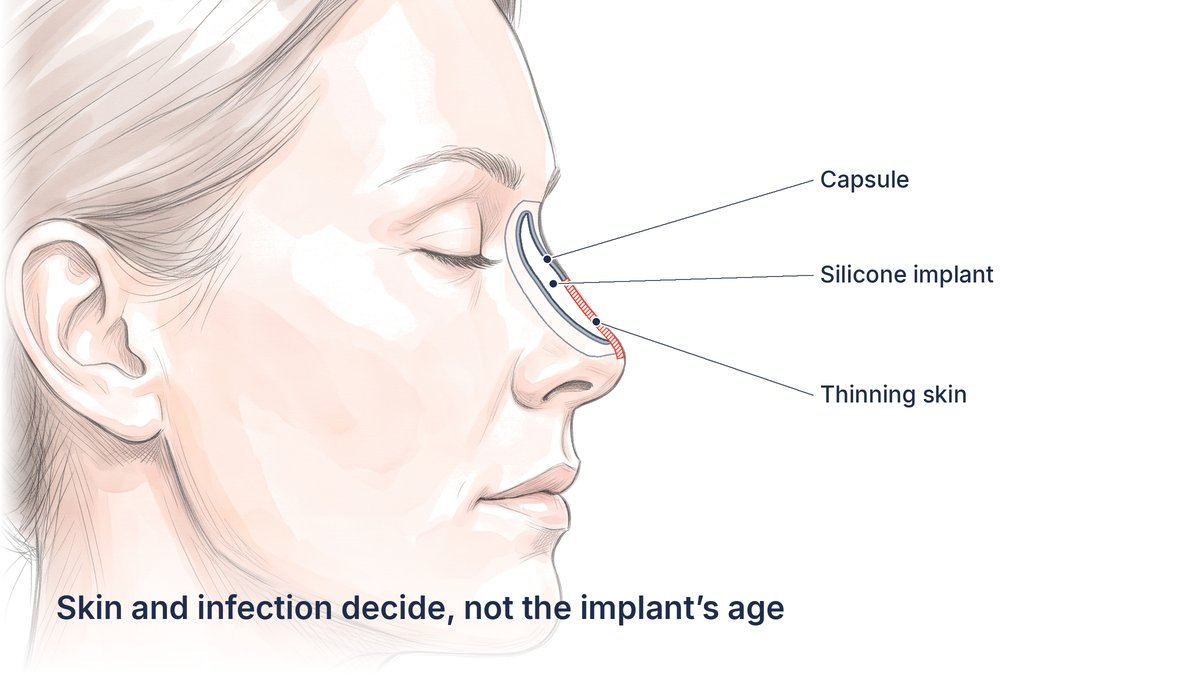
A silicone nose implant has no published expiry date, but time works against the skin over it. Silicone nose implant problems years later usually take one of five forms: an implant that shifts, an outline that starts to show, skin that turns thin, red or shiny, an infection, or a nose that slowly shortens and turns up. Which one you have, and above all whether infection is present or the implant has broken through, decides between removing the implant, replacing it with your own rib cartilage in the same operation, and staging the two.
Quick answers
- Must a silicone nose implant be replaced after 10 years? No study sets a replacement date. Dr. Yongwoo Lee still recommends replacing an old silicone implant with rib cartilage even when it causes no problems, while the skin over it is healthy.
- Can it be removed and rebuilt with rib cartilage in one operation? Usually, when there is no infection and the implant is not exposed through the skin or nostril, although a severely contracted nose may still be staged. With infection or an exposed implant, Dr. Yongwoo Lee always removes the implant first and rebuilds 3 to 6 months later.
- How much longer can a contracted nose be made? Usually about 3 to 4 mm in published reports; scarred skin sets the limit.
Do Silicone Nose Implants Need to Be Replaced After 10 Years?
Not on a fixed date: no study sets one, and problems appear in the first decade as well as later. What changes with time is the skin over the implant, which thins while the risk of contracture and show-through builds. Dr. Yongwoo Lee therefore recommends replacing an old silicone implant with rib cartilage even when it causes no problems, while that skin is healthy and reconstruction is easier; it is a surgeon’s judgment, since no study has compared this with watching. The costly mistake is watching a red, shiny tip for months because the implant has “always been fine.”
How often problems occur depends on how long patients were followed. A meta-analysis of 27 observational studies and 3,803 cases of synthetic implants on the nasal bridge found infection pooled at 2.75 percent, deviation at 1.91 percent and extrusion, the implant working its way out through the skin or the nostril lining, at 0.78 percent, with revision surgery in 6.40 percent overall and 7.64 percent for silicone. Mean follow-up was only 30 months, so those figures describe the early years, not a lifetime.
Late problems do not arrive on a date either. Among 67 patients whose silicone implants were scanned for a complication at one Korean hospital, 52 percent had had the implant for under 10 years, 39 percent for 10 to 20 years and 9 percent for 20 years or more.
What Matters More Than the Age of a Nose Implant?
Three findings matter more than the year of the surgery: whether infection is present, what the skin over the implant looks like, and how much of the nose’s own support is left.
A grading system built on 87 patients at a Korean center ranks the late changes: grade I is a normal nose, grade II a mild contracture with a detectable implant, grade III a moderate contracture with skin thinning, grade IV a severe contracture with a short-nose deformity, and grade V a destructive contracture with scarred skin over the bridge or a deficient columella, the strip of skin between the nostrils. It is one group’s system, but the order is useful: an implant you can see or feel, or thinning skin, is the time to be examined.
Infection sits outside that ladder, because it changes the plan at any grade.

What Happens Around a Silicone Implant Over 10, 20 and 30 Years?
Solid silicone never grows into the nose; the body walls it off with a thin scar envelope called a capsule. Over the years that capsule can thicken, tighten and calcify while the implant presses on the skin and cartilage around it, and most late problems trace back to the capsule, the pressure, or both.

The capsule. On CT, a dark halo around the implant was seen in 83.6 percent of the complicated silicone cases, and the authors relate it to the capsule.
Calcification. In a pathology study of 221 silicone implants removed at revision after 1 month to 25 years in place, calcification was first seen under the microscope at 4 years and with the naked eye at 5 years 8 months; half of the implants in place for more than 9 years had focal calcification, and those beyond 15 years carried large deposits. In the Korean CT series, calcification surrounded 2 of 36 silicone implants in place under 10 years, 4 of 25 at 10 to 20 years, 2 of 5 at 20 to 30 years and the one older than 30 years; the late groups are tiny.

Contracture and shifting. In a Korean review of 581 revision rhinoplasties, 376 of the implants removed were silicone, and the reason for revision was contracture in 35 percent, displacement or deviation in 30 percent, skin problems in 20 percent, infection in 10 percent and protrusion in 5 percent. Those are shares of noses that already had a problem, not the chance that a silicone nose develops one. Its authors consider calcification and the capsule the main cause of late complications.
Pressure. A 2025 review states that implants “can induce acute to chronic inflammation, leading to progressive skin envelope damage,” including “pressure-induced necrosis of the lower lateral cartilages”, the paired cartilages that shape the tip. Bone is affected too: in the CT series it had resorbed under 11.9 percent of the silicone implants.
Why Does the Nose Get Shorter and the Tip Turn Up Years After an Implant?
A nose that shortens and turns up after implant surgery is called a contracted nose: scar around the implant tightens, tip cartilages weakened by years of pressure give way, and the skin shrinks to fit the smaller frame. It is among the hardest late problems to correct, because the skin, not the cartilage, sets the limit.
A review of rib cartilage revision calls a short, contracted nose “a devastating complication” and lists capsular contraction, necrosis of the lower lateral cartilages from long-term implant pressure, and chronic inflammation among its causes.
Repair means freeing the skin widely and rebuilding the frame in strong cartilage. The 2025 review describes a septal extension graft or an extended columellar strut, supported by extended spreader grafts: a strong plate or post of cartilage that holds the tip down and forward against the tight skin.
How much length comes back is modest:
- The 2025 review warns that results are often limited to only 3 to 4 mm of elongation, and that lowering the nostril rims is limited by stiff skin and a shortage of inner lining.
- In 43 contracted noses rebuilt with a rib framework plus a composite graft of ear skin and cartilage for lining, 3D measurements at 3 months showed the nasal bridge 4.46 mm longer and the tip 4.06 mm more projected on average, with no significant relapse at one year.
Neither source has a comparison group, and they agree on the scale: millimeters, not centimeters.
A short nose that has never been operated on is a different problem, covered in lengthening a short nose with rib cartilage.
Remove It, Replace It With Rib Cartilage, or Stage It: What Are the Options?
There are three surgical paths: remove the implant and accept a lower bridge, remove it and rebuild with your own cartilage in the same operation, or remove it first and rebuild months later. Infection, or an implant already breaking through, is the main fork: without either, one operation is common; with either, staging is the usual route.
At a Glance: Paths for a Problem Silicone Nose Implant
| Path | What is done | Fits | Limits |
|---|---|---|---|
| Watch | Nothing; review if anything changes | A patient who keeps a symptom-free implant | Capsule change and skin thinning continue; Dr. Yongwoo Lee advises replacement |
| Remove only | Implant taken out | Infection, or a patient who accepts a lower bridge | Bridge drops; implant-related skin changes can persist |
| Remove and rebuild with rib, one operation | Implant out; rib cartilage framework and bridge graft in | No infection: a symptom-free old implant, shifting, visible outline, thinning skin, contracture | Longer operation; a chest incision |
| Remove, wait, rebuild | Implant out; rib reconstruction months later | Infection, drainage, an exposed implant | Two operations; skin can tighten while waiting |
| Exchange for a new implant | Another synthetic implant placed | Offered by some surgeons when skin is healthy and uninfected | A new implant under the same skin |
| Filler or fat alone | Volume injected along the bridge | A patient who declines surgery | Not a structural repair; nose filler carries a risk to vision; grafted fat is partly absorbed |
One operation when there is no infection
A published Korean case of a displaced silicone implant shows the rule, and what can lie under an old implant: once the implant was removed, an open bony roof and a deviation were found beneath it and corrected, and the tip and bridge were rebuilt with rib cartilage in the same operation. The authors “did not notice any signs of infection around the previously inserted silicone implant” and “accordingly performed single-stage rhinoplasty,” adding that with evident infection a staged operation is required.
Staging when there is infection
The rib cartilage revision review calls a staged approach with removal of the implant “the mainstay of treatment,” rates the chances of saving an infected implant as low, and concedes that “there is no consensus on the timing of the definitive revision rhinoplasty after implant removal”. Waiting has a cost the same review names: the skin envelope can contract.
Immediate rebuilding in an infected nose has been reported. In eight patients with infected nasal implants, removal and reconstruction with the patient’s own cartilage were done in one operation; over a mean follow-up of 84.4 months none had a major complication needing revision, though two asked for a cosmetic revision. In an earlier series of eight, only one of them infected, all recovered well after immediate cartilage grafting, but the skin changes caused by the implant persisted. Nine infected noses in two small series without comparison groups show that it is possible, not that it is safer, and the authors of the displaced-implant case above warn that a single-stage operation in an infected nose “confers a higher risk of postoperative infection, with disastrous outcomes”.
What replaces silicone
For revision after an implant problem, the rib revision review concludes that the patient’s own rib cartilage “may be the most practical choice,” with septal and ear cartilage for minor deformities. Rib has its own record: a meta-analysis of 20 studies and 1,648 patients found warping in 3.05 percent, resorption in 1.2 percent, infection in 1.45 percent and revision in 2.25 percent, and a 2026 meta-analysis of 50 studies and 4,482 patients, drawn from studies at serious to critical risk of bias, found extrusion in 0.0 percent and revision in 5.0 percent, with no significant difference between a patient’s own rib and donor rib.
Donor rib, which Dr. Yongwoo Lee does not use, spares the chest incision, and a second 2026 meta-analysis of 25 studies found revision in 1 percent with fresh-frozen donor rib against 7 percent with the patient’s own rib, in heterogeneous studies. The revision review’s authors still rarely use donor rib, finding its long-term resorption unpredictable. Both sides are set out in rib vs septal vs ear cartilage for rhinoplasty.
Filler and fat
Filler along the bridge avoids surgery, but the nose is the most reported injection site in published cases of vision loss after filler. Fat is at an earlier stage: a single 2026 case report describes fat grafted immediately after an infected ePTFE (Gore-Tex) implant was removed, with no recurrence at one year.
How Does Dr. Yongwoo Lee Treat a Problem Silicone Nose Implant?
I remove an infected or exposed implant every time and rebuild with rib cartilage 3 to 6 months later. Otherwise, I remove the implant and rebuild with rib cartilage in one operation; a severely contracted nose may be done in stages. I rebuild mainly with the patient’s own rib cartilage, with septal cartilage only as a small supplement, and never with a new implant, donor rib or filler.

What I check first
Before anything is planned I examine four things: the skin over the implant, whether the implant moves or sits off the midline, the inside of the nostrils for an exposed edge, and how much length and tip support the nose still has.
A silicone implant with no symptoms: I recommend replacing it
I recommend replacing an old silicone implant with rib cartilage even when it causes no problems. Over the years the skin over it thins, and the risk of contracture and of the implant showing through keeps building; replacing it while the skin is still healthy makes the reconstruction easier. No study has tested this against watching, so it is my judgment.
Infection: the implant comes out first
When an implant is infected, draining or exposed, I always remove it, and I do not rebuild on the same day. Cartilage has no blood supply of its own; a graft lives on what diffuses from the tissue around it, and I will not place it in an infected pocket. Reconstruction with rib cartilage follows 3 to 6 months later, once the tissue is quiet. Because the skin can tighten in those months, the wait has an upper end as well as a lower one.
No infection: removal and rib in one operation
When the implant causes no symptoms, or the problem is a shift, a visible outline or thinning skin with no infection or exposed edge, I take the implant out and build the rib cartilage framework in the same operation, so the skin is not left empty to shrink.
The capsule: thick or calcified comes out, thin skin keeps it
I do not remove every capsule. A thick or calcified capsule comes out, because it is stiff and limits how far the skin can stretch. Under thin skin I leave the capsule in place as a protective layer between the skin and the new cartilage. Some surgeons remove capsules thoroughly or pad thin skin with fascia, perichondrium or dermis instead. In a nose that is both contracted and thin-skinned the two aims pull against each other, and I settle it during the operation.
The rib cartilage
Under general anesthesia given by a board-certified anesthesiologist, I take the whole seventh rib cartilage, right side by default, through a 4 to 5 cm incision: in the fold under the breast in women, directly over the rib in men. How the lung is protected and tested, pain control, the drain and the scar are covered in rib cartilage harvest: scar, pain and pneumothorax risk.
The framework
I rebuild the bridge with one solid, symmetrically carved block of rib, left to rest for tens of minutes and checked for warping before it goes in. A tip that must come down and forward, as in a contracted nose, stands on a rib cartilage septal extension graft fixed between spreader grafts on both sides of the septum; one that needs only a little support stands on a columellar strut, a post of cartilage between the nostrils. Septal cartilage I use only in small amounts, as a supplement.
The contracted nose: no millimeter promise
How far a contracted nose lengthens depends on how far its tip skin will stretch, so I do not promise a number, and I may stage the correction. I also warn every patient beforehand that a tip standing on rib cartilage feels firm; it softens a little over time, but some firmness remains.
Which Silicone Nose Do You Have?
Most old implants fit one of seven descriptions, each with its own path.
An implant placed 12 years ago, no symptoms, normal skin, a shape you still like. Dr. Yongwoo Lee recommends replacing it with rib cartilage in one operation while the skin is healthy; if you keep it, learn the warning signs below.
The outline is starting to show, or the tip skin looks thin and shiny, with no pain or discharge. In one Korean grading system this is a milder grade than a shortened nose, so be examined now. With no infection and no exposed edge, removal and rib reconstruction can be one operation.
The implant has slid to one side under healthy skin. A displaced implant sits in a pocket of scar and does not stay where it is pushed. Removal and rebuilding in one operation is the usual plan.
Redness, swelling, pain or discharge, or an edge visible through the skin or inside the nostril. Treat it as infection or exposure until examined. Do not squeeze it or start leftover antibiotics on your own; antibiotics alone rarely clear an infected implant and are given alongside removal, not instead of it. The implant should come out promptly; if you live abroad, that means a surgeon near you, not after a long flight. Reconstruction waits.
The nose has become shorter, the tip turned up, the nostrils more visible. A contracted nose. It needs a rib cartilage framework, a realistic expectation of a few millimeters, and sometimes two stages.
The implant was already removed elsewhere and the nose is now low or short. Rebuilding is still possible. In one published case, a short, upturned nose left by repeated silicone rhinoplasties, its implant removed elsewhere a few months earlier, was rebuilt with a rib cartilage L-strut that bypassed a septum too scarred to dissect.
Three or four revisions, and the concern is now a detail others cannot see. Another operation may not be the answer; the reasons are in how surgeons screen for body dysmorphic disorder.
What Is Recovery Like After Implant Removal and Rib Cartilage Reconstruction?
After removal with rib cartilage reconstruction in my practice, patients stay one night, the chest drain comes out on day 2 or 3, and the nasal splint and stitches come off on day 7, after which flying home is allowed.
- Chest. Light activity for the first week and exercise from 4 weeks; for women, a soft wire-free bra for the first 2 to 4 weeks. The full chest timeline, including scar care, is in recovery after rib cartilage harvest.
- Nose. Swelling in a revised nose settles slowly, over months, not weeks. A firm tip is expected, not a complication.
- Staged patients. Removal first, then 3 to 6 months with a lower bridge, then a second operation with the recovery above: two trips for travelers. The stay after removal alone depends on how quickly drainage stops and the infection settles, and is decided at check-ups.
- Before surgery. The supplements and medicines to pause, and when, are listed in what to stop before plastic surgery; prescribed blood thinners and diabetes medicines are changed only with the prescribing doctor’s agreement.
- Nicotine. No smoking, vaping, nicotine patches or gum for 4 weeks before and 4 weeks after surgery: nicotine narrows the small vessels that thin, scarred nasal skin depends on. If a patient cannot stop, I postpone the operation.
International patients lodge in the clinic building with nurses on call; trip planning is covered in how long to stay in Korea after plastic surgery.
Surgeon’s Insight: The Skin Decides, Not the Cartilage
Patients with an old implant ask me about material. I spend most of the examination on the skin. Cartilage I can carve; skin stretched thin over an implant for twenty years, or scarred by infection, I cannot replace, and it sets the limit on height, on length and on how soon I dare rebuild.
Which Silicone Nose Implant Problems Need a Check Now, and What Are the Risks of Revision?
Any change in the skin over an implant, any discharge and any sudden shift should be examined without waiting; once a complication appears, the authors of a Korean CT study of complicated nasal implants, 67 of them silicone, write, “it is mandatory to consider the removal of the implant.” Revision carries risks of its own: a warped or resorbed graft, infection, a chest scar, and skin that does not fully recover.
Be examined promptly if:
- the skin over the bridge or tip turns red, shiny, thin or dimpled
- fluid or pus drains from the skin or inside the nostril
- an edge of the implant can be seen through the skin or in the nostril
- the nose becomes painful, warm or swollen, with or without fever
- the implant shifts suddenly, or the tip starts to turn up
Call emergency services or go to an emergency department first, then contact your surgeon, if:
- redness and swelling spread quickly across the face or around an eye
- you have a high fever with chills, or feel very unwell
- your vision changes, or moving the eye becomes painful
- you develop a severe headache, a stiff neck, confusion or unusual drowsiness
- after rib cartilage harvest, you become suddenly short of breath or develop chest pain
Risks of rib cartilage reconstruction. In the pooled rib data, warping ran at about 3 percent and graft infection under 2 percent. One-piece bridge grafts warped more often (5.42 percent) than laminated ones (0.0 percent) in the 50-study analysis. The one-piece graft I use is carved symmetrically from the central core and watched for warping before it goes in, to lower that risk, not to remove it. At the chest, the 20-study analysis found a thickened scar in 2.08 percent and recorded no collapsed lung, with an upper estimate under half a percent: rare, not zero.
Limits specific to revision. Skin thinned or discolored by an implant may stay that way after it is gone. In the 43-patient contracted-nose series, more than 80 percent of the ear composite graft survived in only 27.9 percent of patients, and two patients needed wound irrigation for infection.
Implants at the chin raise similar questions, covered in chin implant problems: erosion, shifting and infection.
What Should You Ask Before Deciding What to Do With an Old Nose Implant?
Ask about the skin and about infection before asking about material, because those two findings choose the path, and the material only fills it.
If you ask one thing at a consultation, ask this: is there any sign of infection or thinning skin, and if the implant comes out, will my nose be rebuilt in the same operation or later, and why?
Individual results vary; consultation required.
Written by Dr. Yongwoo Lee, board-certified Korean plastic surgery specialist in facial anatomy and aesthetic procedures at VIP Plastic Surgery, South Korea.
Frequently Asked Questions About Silicone Nose Implant Problems and Rib Cartilage Revision
Should I replace a silicone nose implant that causes no problems?
Dr. Yongwoo Lee recommends replacing it with rib cartilage even without symptoms, because the skin over it thins with time and reconstruction is easier while that skin is healthy. No study sets a replacement date: in one CT series of complicated silicone implants, about half had been in place under 10 years and about half longer.
Why is my nose implant suddenly red, shiny or showing through the skin years later?
Long-term pressure and inflammation can thin the skin over an implant, and infection can appear late, so be examined now.
Can a silicone nose implant be removed without replacing it?
Yes. The bridge will sit lower, and skin changes the implant caused may persist. Patients who want the height back have the nose rebuilt with their own cartilage, at the same time or later.
Can the implant be removed and replaced with rib cartilage in the same surgery?
Yes, when there is no infection and the implant is not exposed: Dr. Yongwoo Lee then removes it and builds the rib cartilage framework in the same operation, so the skin is not left empty to shrink, though a severely contracted nose may be staged. An infected or exposed implant comes out first, with rebuilding 3 to 6 months later.
How long after an infected nose implant is removed can the nose be rebuilt?
There is no published consensus on timing. Dr. Yongwoo Lee waits 3 to 6 months, so that infection and inflammation settle without leaving the skin to tighten longer than needed.
Should the capsule around a silicone nose implant be removed?
Dr. Yongwoo Lee removes a thick or calcified capsule and leaves it under thin skin as a protective layer. Some surgeons remove it completely in contracted noses, because it limits skin stretch.
Can a nose that shortened after an implant be made longer again?
Yes, usually by a few millimeters. One review describes gains often limited to 3 to 4 mm, and a 43-patient series measured an average of 4.46 mm. Scarred skin sets the limit, so no figure can be promised.
Will my skin go back to normal after the implant comes out?
Not always. In one series of immediate reconstructions, the skin changes caused by the implant persisted. Removal stops further pressure, but thinned or discolored skin may only partly recover.
Can filler or fat replace a silicone implant after removal?
Neither rebuilds structure. The nose is the most reported site in published cases of filler-related vision loss, and Dr. Yongwoo Lee never injects filler into the nose. Fat grafted right after removal has been described only in small reports, and part of the fat is absorbed.
Does a silicone nose implant calcify, and does it matter?
Yes, with time. In 221 removed implants, calcification was visible to the naked eye from 5 years 8 months and present in half of those in place over 9 years. A calcified capsule is removed at revision.
How long do I need to stay in Korea for implant removal and rib cartilage reconstruction?
At least until day 7. In Dr. Yongwoo Lee’s practice patients stay one night, the chest drain comes out on day 2 or 3, and the splint and stitches come off on day 7, after which flying is allowed. A staged plan means two trips, 3 to 6 months apart.
This article is for informational purposes only and does not constitute medical advice. Always consult with a qualified medical professional before making any decisions about surgical or non-surgical procedures.
