
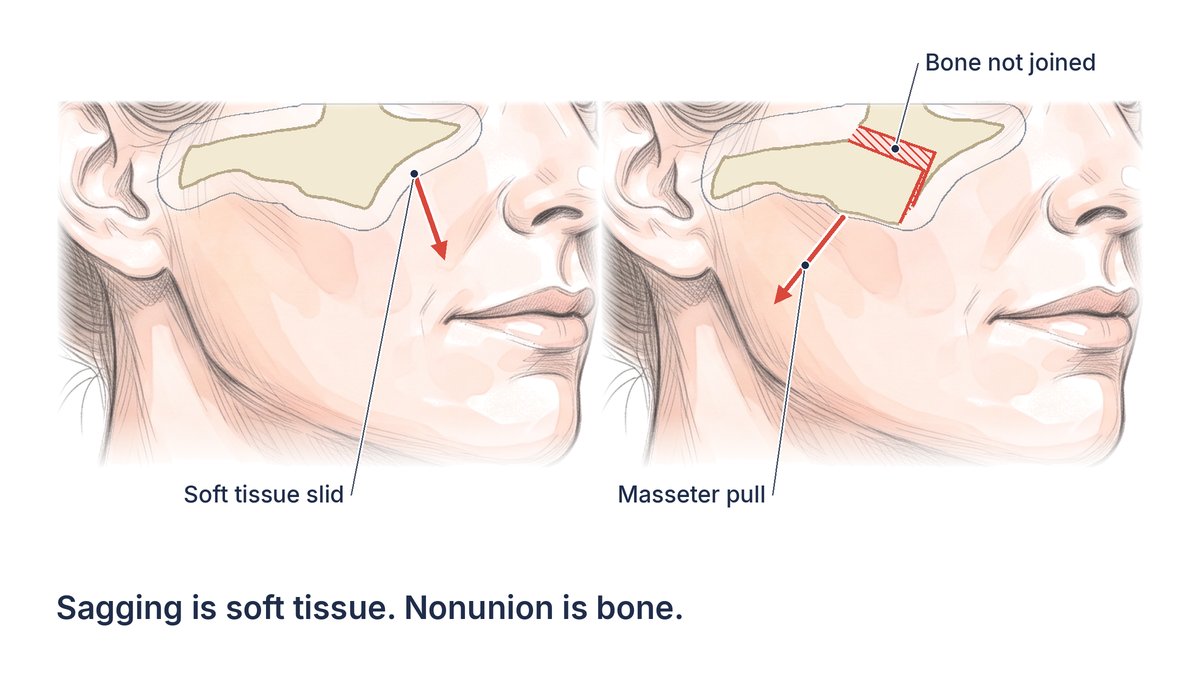
Cheek sagging and nonunion are the two complications patients fear most after zygoma reduction (cheekbone reduction, or reduction malarplasty), and in pooled published data both are real but uncommon: a meta-analysis of 14 studies with 3,149 cases put drooping at 2.8 percent and nonunion at 2.2 percent. Sagging is a soft-tissue problem and nonunion is a bone problem. They have different causes, different tests and different repairs; neither can be judged finally in the first weeks, but a cheekbone that moves or clicks is checked with a CT scan at once.
Quick answers
- Does zygoma reduction cause sagging? It can. Pooled series report drooping in about 3 in 100 patients.
- What is nonunion? The cut bone has not knitted together, so the freed segment can shift under the pull of the chewing muscle. Pooled series report it in about 2 in 100 patients.
- When can I tell? Early heaviness resolved within 3 to 4 months in one 114-patient series, and sagging and bone healing are judged at about 6 months. A cheekbone that moves or clicks, or mouth opening that worsens, is checked with a CT scan right away.
Does Zygoma Reduction Cause Cheek Sagging, and How Often Does the Bone Fail to Heal?
Zygoma reduction can cause cheek sagging, and the cut bone can fail to unite, but in pooled published series each affects a small minority of patients. A meta-analysis of reduction malarplasty through the mouth found pooled rates of 2.8 percent for drooping and 2.2 percent for nonunion across 14 retrospective studies with 3,149 cases. Its authors concluded that overall rates were not high but that soft-tissue drooping and bone nonunion were “not rare.”
Patients make three mistakes. One is judging the mirror at three weeks, when heaviness and deeper folds are still expected. Another is blaming one problem for the other: a sag is assumed to be unhealed bone, or a shifted bone is waited out as swelling. The third is planning by millimeters of bone alone, when the result depends as much on what the soft tissue does once its support has moved.
Single series range far more widely than the pooled figures, from no patients to nearly all of them.
Sagging and Nonunion in Published Series at a Glance
| Series | Patients and method | Sagging reported | Nonunion or malunion reported |
|---|---|---|---|
| Pooled meta-analysis | 14 retrospective studies, 3,149 intraoral cases | 2.8 percent | 2.2 percent |
| Intraoral L-shaped osteotomy with wire fixation | 114 patients | 2 patients (1.8 percent); both had a midface lift | 3 patients (2.6 percent) |
| Minimal incision and dissection, no internal fixation | 39 patients, followed for 46 months | None | Not given in the abstract |
| A modified L-shaped cut designed to brace the cheekbone against the chewing muscle | 157 patients, mean follow-up 9.4 months | No rate given | None |
| Smile muscle left attached to the bone | 22 patients | Nasolabial fold not deeper in 20 of 22 | Not given |
| One surgeon’s early intraoral cases, compared with his later coronal cases | 150 intraoral patients, 1994 to 1999 | Midface ptosis in 138 (92 percent) | Partial malunion in 141 (94 percent) |
Every row rests on retrospective series written by the operating surgeons, and most give no measured definition of sagging. The 92 percent figure is one surgeon’s comparison of his own older intraoral cases with his later coronal ones, with no statistical testing and no blinded assessment.
A later study from the same surgeon’s group measured landmarks, cheek curvature, the nasolabial fold and the marionette line by artificial intelligence and concluded that soft-tissue ptosis did not occur in its series; its abstract does not state the approach used, the number of patients or the length of follow-up. What the numbers support is narrower than either extreme: the risk is real, it depends on how the bone is cut, fixed and uncovered, and no single percentage can be promised to one patient.
Is It Swelling, True Sagging, or a Bone That Did Not Heal?
Three different things look alike in the mirror during the first months: swelling with temporarily slack soft tissue, true soft-tissue descent, and a bone segment that has shifted or failed to unite. Time separates the first from the other two, and a CT scan separates the second from the third.
- Early heaviness. In a series of 114 patients, most showed soft-tissue sagging and deeper wrinkles immediately after surgery, and these resolved within 3 to 4 months.
- True sagging. Once the swelling has gone, the cheek mound sits lower than before and the nasolabial fold is deeper, while the bone itself is solid and in position.
- Nonunion and malunion. Nonunion means the cut ends have not joined with bone. Malunion means they have joined in the wrong place, typically with the segment lower and further out than planned. Signs described in the published series are a step under the skin with shading over it, a depressed area over the cheekbone, asymmetry and limited mouth opening.
Both sagging and bone healing are judged at about six months after surgery, and when either is suspected the answer comes from a CT scan, not from the mirror. One situation does not wait: a segment that moves or clicks, a new step, or mouth opening that worsens should be examined, with a CT scan, as soon as it is noticed. Authors of a 172-patient revision series wrote that patients with a failed malarplasty “should receive immediate intervention,” and 35 of their 172 revisions (20.3 percent) were done as emergencies.

Why Can the Cheek Drop After the Cheekbone Is Narrowed?
Cheek soft tissue hangs from the cheekbone, so the operation can let it slide down in two ways: the bone that props it up now projects less, and tissue has to be freed from the bone to make the cut.
Less projection. One surgical group compares the cut cheekbone and arch to a tent pole: when the pole is lowered, the zygomatic muscles and the soft tissue attached to it descend and become less taut. A 2025 perspective on facial bone contouring, an opinion paper without outcome data, puts it this way: “Reduction malarplasty, by decreasing midface bony projection, can destabilize the overlying soft tissue.”
Freed attachments. Bone is covered by periosteum, the membrane that anchors soft tissue to it. Two smile muscles, the zygomaticus major and minor, arise from the body of the cheekbone, and the masseter, the main chewing muscle, arises from its lower border and from the arch. To reach the bone through the mouth, the surgeon lifts periosteum, and every centimeter lifted is a centimeter of cheek no longer fastened to bone. In the 114-patient series the authors attributed both drooping cases to wide subperiosteal dissection and advised detaching as little of the masseter and zygomaticus major as possible, about 1 cm in their hands.

Two small series point the same way: no drooping in 39 patients treated with minimal dissection, and in 22 patients whose zygomaticus major was left on the bone, three-dimensional models showed the muscle lifted and straightened after surgery. Neither is controlled, but the idea is plain: keep the cheek fastened, or fasten it again. The chin follows the same rule when an implant comes out and the chin muscle is not reattached well, as described in chin implant problems: erosion, shifting and infection.
Whose cheek is at risk. None of the series cited here reports sagging rates by age or by skin thickness. The reasoning is mechanical: tissue that has already begun to descend has less reserve when its support is reduced, so laxity before surgery matters more than a birthday. A descended cheek ends up in the fold beside the nose and then along the jawline, as described in how jowls form and what treats them.
Buccal fat. The contouring perspective lists conservative buccal fat removal as an adjunct for a heavy lower cheek, with a caution: “Care is taken to avoid over-resection to preserve midface volume.” The long-term trade is set out in buccal fat removal and long-term hollowing.
Why Does a Cut Cheekbone Sometimes Fail to Heal?
A cut cheekbone fails to heal when its two ends do not stay in firm contact, and the force working against that contact is the masseter. Because this muscle originates on the zygoma, a technical note warns that the operation “can result in nonunion after reduction malarplasty if intimate bone contact is not obtained.” During chewing, in the words of the coronal-approach authors, the masseter “pulls the cut zygoma segment downward and outward.”
Published causes fall into three groups.
- Fixation and direction. A revision series traced failures to a misjudged direction of repositioning or improper fixation, which led to nonunion or to a malar complex displaced downward and outward.
- Pressure after surgery. In the 114-patient series, 2 of the 3 nonunions followed pressure on the cheek after surgery; the third followed faulty fixation and needed a second operation.
- How the arch ends meet. A retrospective study compared an interlocking, mortice-and-tenon joint at the arch cut with simple end-to-end contact: six cases of malunion occurred in the end-to-end group and four needed a second operation.
In 157 patients treated with a modified L-shaped cut that its authors call a bracing system, designed to hold the cheekbone against the pull of the masseter, no bone nonunion was observed at a mean follow-up of 9.4 months. Across 29 studies and 6,611 patients, the L-shaped osteotomy without removing bone had the lowest incidence of complications but a limited reduction effect.
The gain is measured in millimeters. In a CT study of 86 patients, the cheekbone prominence moved inward by a mean of 4.57 mm; a 2 mm strip of bone gave 2.30 mm and a 6 mm strip gave 5.71 mm. Its scans were taken within two days of surgery, so it measured movement, not healing.
How Are Cheek Sagging and Nonunion Treated After Zygoma Reduction?
Sagging is treated by lifting the soft tissue, and nonunion by fixing the bone again, with a bone graft when a gap has formed. Each repair fails when it is used for the other problem, which is why a CT scan comes before any plan.
Sagging and Nonunion Fixes at a Glance
| What you notice | What it usually is | When it is judged | What answers it | What does not |
|---|---|---|---|---|
| Heavy, puffy cheeks and deeper folds in the first weeks | Swelling and soft tissue that is temporarily slack | Resolved within 3 to 4 months in a 114-patient series | Time and the compression band | An early revision, or threads and filler placed into swelling |
| Cheek mound lower and folds deeper at about 6 months, bone healed in place on CT | True soft-tissue sagging | About 6 months | A midface lift; a facelift when the jowls and neck are involved | Filler used as a lift, or more bone work |
| A step, dent or flat area over the cheekbone, or one side different | Bone healed in the wrong position (malunion) | CT at about 6 months | Repositioning with rigid fixation, bone graft into a gap | A lift alone, which drapes soft tissue over the same bone |
| A segment that clicks or moves on chewing, or mouth opening that worsens | Possible nonunion or a displaced segment | When noticed, with a CT scan right away | Refixation with a plate and screws, bone graft if needed | Massage, pressure, or waiting for it to settle |
Published revision surgery follows the same logic. In 20 patients revised for cheek drooping, depression, asymmetry or overcorrection, the surgeons repositioned the malar complex until bone met bone, fixed it with a plate and screws, filled the gap with bone taken from the skull, and added midface and forehead lifts when indicated; 2 of the 20 needed a further revision. In the 172-patient revision series, 81 patients (47.1 percent) needed an artificial or the patient’s own bone graft.
Threads and filler are not in that table. A thread gives a small lift counted in months, as laid out in how long thread lifts last compared with a facelift, and filler in a deepened fold moves nothing back up. When the descent has reached the jawline and neck of an older face, the operation that reaches it is a facelift.
How Does Dr. Yongwoo Lee Perform Zygoma Reduction and Guard Against Sagging and Nonunion?
I narrow the cheekbone through one incision inside the mouth and a small one in the sideburn, with an L-shaped osteotomy of its body. The body of the cheekbone is moved inward and upward and fixed there with a plate and screws, the arch is cut but left unfixed, the periosteum is lifted as little as the cut allows, and when the cheek needs it, a midface lift is added through the mouth.

Two small incisions and an L-shaped cut
Through the incision inside the mouth I make an L-shaped osteotomy of the body of the cheekbone. The arch I cut through a small skin incision in the sideburn, in front of the ear; in published descriptions of this two-incision approach, too, the arch is divided through the sideburn incision just in front of the joint. Its position matters: mouth-opening difficulty in 4 of 114 patients was attributed to an arch cut made too near the jaw joint.
Inward and upward, then a plate and screws
I move the freed body inward and upward, not only inward. Direction matters as much as distance: a segment left lower and further out than planned is the displacement that revision surgeons describe, and it is the direction in which the masseter pulls. In three-dimensional CT of 197 patients, removing bone was the main factor in moving the summit of the cheekbone inward, while setting the segment back was the main factor in its front-to-back and upward movement.
Then I fix the segment with a plate and screws on the body of the cheekbone; the arch cut is not fixed. My reason is the masseter: it pulls on this bone with every chew, and a rigid plate holds bone against bone while the cut heals. Wire fixation and no fixation at all also have published series, and none of the studies cited here compares the methods head to head. The revision authors’ summary is that “precise repositioning of the malar complex and firm fixation are essential,” and that is the standard I work to.
As little periosteal dissection as the cut allows
Against sagging, my main protection is restraint. I lift only the periosteum I need in order to see and make the cut safely, because the cheek is fastened to the bone through it and through the muscles that arise there. Minimal dissection is my protocol against sagging; the evidence behind it is case series, not a controlled trial.
A midface lift when the cheek needs it
When a patient’s cheek is already lax before the first operation, I discuss adding a midface lift at that same operation instead of narrowing the bone alone. I do it through the incision inside the mouth as a subperiosteal lift: the cheek is released from the bone in the layer under the periosteum, raised, and fixed toward the temple so that it is anchored higher. This is the one place where I free tissue from the bone more widely on purpose, because that tissue is then moved up and held, not left to settle. No published series gives an age cutoff; what decides it is how lax the cheek already is.
Anesthesia and aftercare
Bone surgery is done under general anesthesia given by a board-certified anesthesiologist, with capnography, depth-of-anesthesia (BIS) monitoring and active warming, and every zygoma reduction patient stays one night in the clinic. A drain stays in for one to two days. The compression band is worn for one to two weeks, and for longer at night. Food is liquid for one to two weeks and then soft until four weeks, with antiseptic gargling to keep the incision inside the mouth clean. In practice the same aftercare applies after jaw-angle reduction.
When sagging or nonunion is suspected
I confirm either problem with a CT scan. A cheekbone that feels loose or clicks is scanned right away; sagging and the final contour are judged at about six months after surgery. A bone that has not united or has shifted is fixed again, with a bone graft if a gap needs filling. Sagging over a bone that has healed in place is treated with a midface lift. When both are present, both are done in one plan: refixation and a lift.
Swelling, a Loose Bone or True Sagging: Which Zygoma Reduction Patient Are You?
Two facts sort most worries after zygoma reduction: how long ago the operation was, and whether the change is in the soft tissue or in the bone.
Three weeks after surgery, cheeks heavy and folds deeper than before. Expected. In the 114-patient series most patients looked this way at first, and it resolved within 3 to 4 months. Keep to the soft diet and wear the band as instructed; a swollen face is not lifted, filled or revised.
Four months after surgery, a click on one side when chewing and a mouth that opens less than last month. Do not wait for month six. Movement and worsening mouth opening are reasons for an examination and a CT scan now; if the segment has shifted, the answer is refixation.
Eight months after surgery, no step, no click, but the cheek sits lower and the nasolabial folds are deeper. With a CT that shows the bone healed in position, this is true soft-tissue sagging, and a midface lift is the operation that addresses it.
Considering zygoma reduction in the mid-forties, with cheeks that have already started to descend. Narrowing alone removes support from a face that is losing it. The plan to discuss is reduction with a lift, a smaller reduction, or none.
In the twenties, asking for the largest possible reduction. The measured change is a few millimeters, so ask about the plan for the cheek as well as the bone. If the lower face is the real concern, start with whether a square jaw is muscle, bone or fat.
What Is Recovery Like After Zygoma Reduction, and What Protects the Healing Bone?
Recovery after zygoma reduction is mostly swelling, a tight feeling when opening the mouth and, for some patients, temporary numbness. The healing bone is protected by three things: soft food, no pressure on the cheekbones, and patience until about six months.
- First night. Observation in the recovery room, then one night in the clinic.
- Days 1 to 2. The drain comes out.
- Weeks 1 to 4. Liquid diet and the compression band for one to two weeks, then soft food only, with antiseptic gargling to keep the incision in the mouth clean.
- Days 10 to 14. Flying home, planned with how long to stay in Korea after surgery.
- Months 3 to 4. In the 114-patient series, early heaviness had resolved by now and the mouth-opening difficulty seen in 4 patients had improved.
- About month 6. Shape, symmetry, sagging and bone healing are judged.
Pressure matters because 2 of the 3 nonunions in that series followed pressure on the cheek after surgery. I ask patients to sleep on the back and to put no pressure on the cheekbones, keeping hands, massage tools and anything hard off them during the first weeks. Keeping the head raised is also commonly advised.
Nicotine slows bone and wound healing, so I ask for no nicotine in any form, including cigarettes, vapes, patches and gum, for four weeks before and four weeks after bone surgery; a patient who cannot stop has the operation postponed. Supplements and medicines that raise bleeding risk are covered in what to stop before plastic surgery; prescribed blood thinners and diabetes medicines are never stopped without the doctor who prescribes them.
Surgeon’s Insight: The Bone Is the Tent Pole, and the Tent Is Also My Job
Patients ask me how many millimeters I can take. The better question is what will hold the cheek once the pole underneath it is shorter. A cheekbone can be narrowed neatly and the face can still look older, if the soft tissue was lifted off the bone widely and left to find its own place.
That is why I lift as little periosteum as the cut allows, seat the bone upward as well as inward, and fix it with a plate. And it is why, when a cheek is already lax before the first operation, I talk about a midface lift before we talk about millimeters.
What Are the Other Risks of Zygoma Reduction, and When Should You Call?
Temporary numbness of the cheek, side of the nose and upper lip, supplied by the infraorbital nerve that exits close to the body cut, is the most common complication of zygoma reduction, ahead of sagging and nonunion. Across the 14 pooled studies, the rates were 5.8 percent for transient sensory weakness, 1.8 percent for asymmetry, 1.8 percent for restricted mouth opening, 1.3 percent for uncontrolled bleeding and 0.9 percent for facial nerve injury.

Forehead nerve. The branch of the facial nerve that raises the brow crosses the zygomatic arch, close to the sideburn incision. In 93 patients who had an L-shaped osteotomy through intraoral and preauricular incisions, 4 had temporary weakness of this branch, with a brow that would not lift; eye closure was unaffected and all recovered with conservative care. This anatomy is mapped in which facial nerve branch is at risk and how it recovers.
The coronal alternative. One surgeon, who reported 92 percent ptosis in his early intraoral cases, moved to a scalp (coronal) incision, through which he fixes the bone higher and sutures the smile muscles back up. His own figures for that approach were a visible scar in 28 percent, temporary hair loss in 81 percent and temporary forehead-nerve injury in 5 percent.
Call emergency services (119 in Korea, or your local emergency number) or go to the nearest emergency room first, then contact the clinic, for any of these:
- swelling of the cheek, mouth, floor of the mouth or neck that grows quickly, bleeding from the mouth that does not stop with steady pressure, or any new difficulty breathing or swallowing;
- a change in vision, double vision, or pain and swelling around the eye that are getting worse;
- chest pain or sudden breathlessness.
Call the clinic the same day for any of these, and once you have flown home, also see a local doctor and send the clinic what was found:
- a cheekbone that moves or clicks, or a new step or dent;
- mouth opening that worsens after it had been improving;
- swelling, pain or redness that increases after the first week, a fever, or a bad taste or discharge from the incision in the mouth;
- a brow that will not lift;
- a painful, swollen calf or leg.
What Should You Ask Before Zygoma Reduction?
Ask what will hold your cheek up, and what will hold the bone, before you ask how many millimeters will come off. A plan that answers only the third question has not dealt with sagging or nonunion at all.
- Where are the cuts, and how will the bone be fixed?
- How much periosteum and muscle will be lifted off the cheekbone?
- Does my cheek need a lift at the same operation, and if not, why not?
- If sagging or nonunion is suspected later, who confirms it with a CT scan, and who repairs it?
Individual results vary; consultation required.
Written by Dr. Yongwoo Lee, board-certified Korean plastic surgery specialist in facial anatomy and aesthetic procedures at VIP Plastic Surgery, South Korea.
Frequently Asked Questions About Cheek Sagging and Nonunion After Zygoma Reduction
Does cheekbone reduction make your face look older?
It can, when the cheek has lost its support and its attachment to the bone: drooping had a pooled rate of 2.8 percent in a meta-analysis of 14 retrospective studies and 3,149 intraoral cases. Dr. Yongwoo Lee lifts as little periosteum as the cut allows and, when a cheek is already lax before the first operation, discusses adding a midface lift.
How long does swelling last after zygoma reduction?
The heaviness and deeper folds of the first weeks are mostly swelling and temporarily slack tissue: in one 114-patient series they were seen in most patients and resolved within 3 to 4 months. Shape, symmetry and true sagging are judged at about 6 months.
Why did my nasolabial folds get deeper after cheekbone surgery?
In the first months it is usually swelling and slack soft tissue. If the folds stay deeper after about 6 months, the cheek tissue has usually descended because it lost support or its attachment to the bone, but a bone segment that healed too low can look the same, so a CT scan checks the bone before a lift is planned.
Can filler or threads fix cheek sagging after zygoma reduction?
Not as a lift. A thread gives a small lift counted in months, and filler in a deepened fold moves nothing back up. Both drooping patients in the 114-patient series had a midface lift, though the paper does not report how they turned out, and Dr. Yongwoo Lee treats confirmed sagging with a midface lift once a CT scan has shown the bone healed in place.
What is nonunion after zygoma reduction, and how common is it?
Nonunion means the cut ends of the cheekbone have not joined with bone, so the segment can shift under the pull of the masseter. Pooled series report it in 2.2 percent. Malunion means the bone healed in the wrong position.
My cheekbone clicks or moves when I chew. Is that nonunion?
It may be, and it should be examined without waiting for the six-month check. Movement, a new step or dent, and mouth opening that worsens call for a CT scan right away.
My CT shows a gap at the cut. Does that mean the bone did not heal?
Not by itself. Some surgeons note that thin facial bones can heal with firm fibrous tissue that looks like a gap on CT, so the scan is read together with the examination.
Can I sleep on my side or chew hard food after zygoma reduction?
Not in the early weeks. Two of three nonunions in one series followed pressure on the cheek, so Dr. Yongwoo Lee asks patients to sleep on the back and keep pressure off the cheekbones at first, and hard food waits until after four weeks.
Are plates and screws safer than wires for zygoma reduction?
None of the studies cited here compares them directly. Revision surgeons stress rigid plate-and-screw fixation with bone-to-bone contact, which is the method Dr. Lee uses on the body of the cheekbone; he does not fix the arch cut.
Does nonunion after zygoma reduction need a bone graft?
Not always. The segment is repositioned so bone meets bone and fixed rigidly, and a bone graft is added when a gap has formed or bone has been lost; in one revision series of 172 patients, 47.1 percent needed a graft, and its authors advise prompt treatment of a failed result.
When can I fly home after zygoma reduction?
Dr. Lee clears patients to fly 10 to 14 days after zygoma or jaw-angle reduction.
This article is for informational purposes only and does not constitute medical advice. Always consult with a qualified medical professional before making any decisions about surgical or non-surgical procedures.
