
Do You Really Need to Stop Fish Oil, Aspirin and Ozempic Before Plastic Surgery?
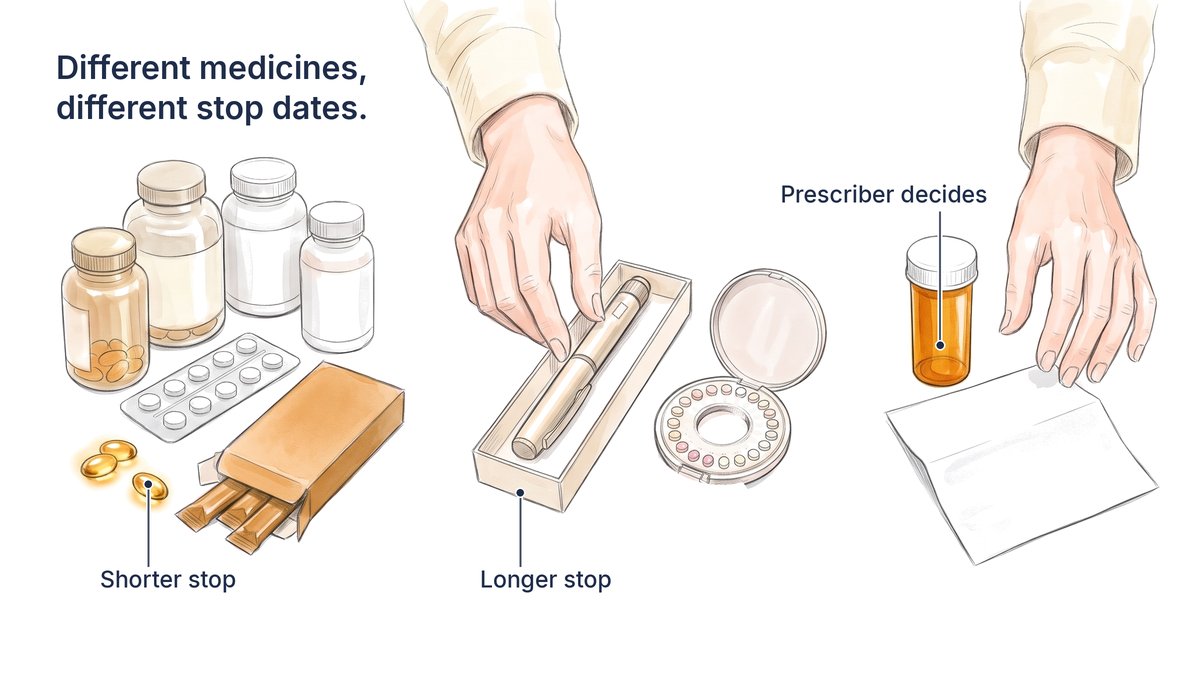
Yes, and on different clocks. What to stop before plastic surgery depends on what each medicine does: in my practice, aspirin, ibuprofen-type painkillers, fish oil, vitamin E and herbal supplements stop two weeks before surgery; GLP-1 drugs such as Ozempic, Wegovy and Mounjaro one month before; estrogen-containing contraception and hormone replacement therapy four weeks before. Alcohol stops two weeks before and two weeks after, and before any operation, including eyelid surgery and fat grafting, every form of nicotine stops four weeks before and four weeks after. The exceptions are medicines another doctor prescribed for the heart, a stent, a stroke or diabetes: an antiplatelet drug, a blood thinner or a diabetes drug is never stopped without the doctor who prescribed it.
Patients get this wrong in two directions. Some list their prescriptions and leave out the capsules in the cupboard, the red ginseng tonic, the weekly injection they think of as a diet aid. That gap is common: as many as one-third of pre-surgical patients take herbal medications, and many never mention them. Others stop too much, including a cardiologist’s aspirin after a stent, which protects them from a clot in the heart.
Some of my rules are stricter than the evidence requires. Fish oil has not been shown to increase surgical bleeding, current US anesthesia guidance lets most patients continue a GLP-1 drug up to surgery, and no study has shown that stopping hormone replacement therapy prevents clots. I stop all three anyway, and a patient deserves to know which lines on a stop list are proof and which are precaution.
Why Are There Different Stop Dates for Different Medicines?
Because the list guards against four different problems, each with its own clock: bleeding, food left in the stomach under sedation or anesthesia, blood clots in the legs, and poor healing.
- Bleeding: aspirin, ibuprofen and naproxen, fish oil, vitamin E, ginkgo, garlic, ginseng, turmeric. Under a facelift flap, extra bleeding becomes a hematoma, a blood collection that may need draining.
- The stomach: semaglutide (Ozempic, Wegovy) and tirzepatide (Mounjaro, Zepbound) slow stomach emptying, and contents that come back up can be breathed into the lungs.
- Clots: estrogen raises the risk of a deep vein thrombosis, a clot in a leg vein that can travel to the lungs.
- Healing: smoking slows healing and raises infection and tissue loss in skin that has just been lifted; heavy drinking raises infection and wound problems.
A missed stop date cannot be fixed on the morning of surgery: aspirin disables a platelet for the rest of that platelet’s life, so only time undoes it.
How Do Aspirin, Ibuprofen, Fish Oil and Supplements Affect Bleeding?
Aspirin has the clearest effect: it irreversibly inhibits COX-1, blocking thromboxane A2 production, the signal platelets use to clump. For ibuprofen-type painkillers and fish oil, surgical trials show no clear increase in bleeding, while vitamin E and herbal supplements are stopped on pharmacology and caution rather than trial results.

After the last aspirin, platelet aggregation recovers within about four days and full thromboxane restoration takes about ten, according to a 2025 meta-analysis. That matters most in a facelift, where hematoma is the most common complication, reported at 0.2 to 8 percent.
This 2024 review of hematoma prevention lists aspirin among the risk factors and quotes two series: in one, 18 percent of aspirin users developed a hematoma despite a seven-day hold, against 4.1 percent of non-users; in another, risk was 2.3 times higher despite a fourteen-day hold. These are single series, and they cannot show that a longer hold would have prevented the bleeds. The review says aspirin must be held before surgery without fixing a number of days. In smaller skin surgery, the 2025 meta-analysis of 26,860 excisions found that aspirin more than doubled the odds of severe bleeding (odds ratio 2.46, from the seven studies that recorded it).
Ibuprofen and naproxen
Anti-inflammatory painkillers are held mostly out of caution. A plastic surgery training review lists NSAID use among the risk factors for facelift hematoma, yet a meta-analysis of four randomized trials in 443 patients found surgically significant bleeding in 3.5 percent with ibuprofen, started before or just after surgery, and 4.1 percent with other painkillers, a difference that was not significant. Those trials covered cosmetic facial, breast, hernia and skin cancer surgery: reassuring, but too small to settle the question for a facelift.
Fish oil
The evidence on fish oil is reassuring. In the OPERA randomized trial of 1,516 cardiac surgery patients, a fish oil loading dose before surgery produced major bleeding in 5.5 percent against 6.6 percent on placebo, and fewer units of transfused blood. A systematic review of 52 publications found no increase in bleeding during or after surgery, although fish oil does reduce platelet clumping in laboratory tests, and concluded that its data do not support stopping fish oil before surgery. None of it comes from facelift patients, but none of it shows fish oil causing surgical bleeding.
Vitamin E and herbal supplements
Vitamin E rests on caution rather than a surgical trial. The American Society of Anesthesiologists warns patients that vitamin E can increase bleeding and cause blood pressure problems, and the same leaflet says an anesthesiologist may recommend stopping supplements at least two weeks before a procedure.
A pharmacology review gives minimum stop times: garlic at least 7 days, ginseng at least 7 days, St John’s wort at least 5 days, ginkgo at least 36 hours, kava and ephedra at least 24 hours. Garlic, ginkgo and ginseng affect bleeding; kava, valerian and St John’s wort can change how anesthesia acts; ephedra raises blood pressure and heart rate. Red ginseng (hongsam), the tonic many Korean families keep at home, is ginseng. Valerian is the exception: it should be tapered over weeks rather than stopped abruptly.
Why Do Ozempic, Wegovy and Mounjaro Matter for Anesthesia and Sedation?
GLP-1 drugs slow the stomach, and a stomach that has not emptied is a hazard under deep sedation or general anesthesia, because contents can come back up and be breathed into the lungs (pulmonary aspiration). The semaglutide label states that Wegovy delays gastric emptying and that rare postmarketing reports describe pulmonary aspiration in patients under general anesthesia or deep sedation who had food left in the stomach despite following fasting instructions.

In an ultrasound study of 124 patients before anesthesia, all fasted by the standard rules, 56 percent of GLP-1 users had increased residual gastric content against 19 percent of non-users, an adjusted prevalence ratio of 2.48. One small, single-center study, but it fits the drug’s known action.
Guidance has moved quickly, and it differs by country:
- 2023, United States. The American Society of Anesthesiologists advised holding GLP-1 drugs on the day of surgery for daily doses and a week before for weekly doses.
- 2024, United States. Multisociety guidance from five societies, including the anesthesiologists, says the drug may be continued in patients without elevated risk. Higher risk means the dose-escalation phase, higher doses, weekly injections and stomach symptoms such as nausea, vomiting, abdominal pain or constipation. For them it suggests a liquid diet for at least 24 hours before surgery, and the societies’ announcement says elective surgery should wait until escalation has passed and symptoms have settled. A team that chooses to hold the drug still follows the 2023 timing.
- United Kingdom. The Centre for Perioperative Care advises continuing the drug as normal and managing risk through individual assessment and anesthetic precautions.
Two caveats apply. The 2024 document calls itself “guidance and not an evidence-based guideline,” and says the right length of any hold is unknown; the label says available data are insufficient to know whether temporarily stopping the drug reduces retained stomach contents. Escalation is also longer than many patients assume: on the Wegovy label, dose steps run 16 weeks before the maintenance dose.
Why Do the Pill and Hormone Therapy Matter Before Surgery?
Estrogen raises the risk of blood clots, and surgery raises it again. Women on the combined pill carry about four times the venous clot risk of non-users, and oral estrogen-progestin HRT about twice, small absolute increases that matter because an operation adds its own. After the pill is stopped, its clotting changes take about four to six weeks to return to baseline, which is where four-week rules come from.

Surgeons score this risk with the Caprini model. In the American Society of Plastic Surgeons’ venous thromboembolism task force report, oral contraceptives or HRT add one point, age 41 to 60 adds one, a body mass index over 25 adds one, and major surgery longer than 45 minutes adds two. A 52-year-old woman on HRT with a body mass index of 26 having a three-hour facelift therefore scores five before any personal history is counted. At a score of 7 or more, the report suggests considering stopping HRT among other measures.
Scores predict real events: in a validation study of 1,126 plastic surgery inpatients given no blood-thinning injections, symptomatic clots occurred in 1.69 percent overall and in 11.3 percent, about 1 in 9, of those scoring above 8.
UK pharmacy guidance is more selective: consider stopping a combined pill 4 weeks before major elective surgery where prolonged immobilization is likely, with a progestogen-only method as the alternative, and consider stopping oral HRT 4 to 6 weeks before, or switching to a patch; patches and vaginal estrogen usually continue. A pharmacology review notes that no established guideline exists for either and that stopping the pill raises the chance of an unintended pregnancy. The gynecology summary cited above goes further for menopausal therapy: no studies show that stopping HRT before surgery reduces clots, so it says stopping should not be routine.
Why Do Smoking and Alcohol Need Weeks, Not Days?
Both damage healing in ways that take weeks to reverse. The World Health Organization reports that quitting about four weeks or more before surgery lowers complication risk, and that every tobacco-free week after four improves outcomes by 19 percent.
Smokers heal more slowly and lose more tissue, which is why the four weeks continue after every operation, and a lifted facelift flap is especially sensitive; the cohort data are set out in what smoking does to a lifted skin flap.
Alcohol is a dose question. In a meta-analysis of 55 studies, high alcohol use raised postoperative infection (relative risk 1.73) and wound complications (1.23), while low-to-moderate drinking showed no clear association. For heavy drinkers, a Cochrane review of intensive four-to-eight-week cessation programs found complications in 32.8 percent against 54.1 percent without one, from three small trials.
What Should You Stop Before Plastic Surgery? The Checklist at a Glance
Two weeks for blood-thinning painkillers and supplements, one month for GLP-1 drugs, four weeks for estrogen, two weeks for alcohol and four for nicotine; nothing prescribed for the heart, brain or mood stops without that doctor. The table puts my rule beside published guidance, so the precautions are visible.

| What you take | My rule at VIP Plastic Surgery | What guidance or evidence says | The concern |
|---|---|---|---|
| Aspirin you take on your own | Stop 2 weeks before | Platelets recover in about 4 days, thromboxane in about 10; no plastic surgery guideline fixes a number | Bleeding, hematoma |
| Aspirin or a blood thinner prescribed for heart, stent or stroke | Only with the prescribing doctor | Often continued, especially after a recent stent | A clot in the heart or brain |
| Ibuprofen, naproxen | Stop 2 weeks before | Commonly held; small trials found no extra bleeding with ibuprofen around surgery | Bleeding |
| Fish oil, omega-3 | Stop 2 weeks before (precaution) | Randomized trial and review: no extra surgical bleeding | Precaution only |
| Vitamin E | Stop 2 weeks before | Anesthesiologists list bleeding and blood pressure effects | Bleeding |
| Ginkgo, garlic, ginseng and red ginseng, turmeric, St John’s wort, kava | Stop 2 weeks before | Minimums of 24 hours to 7 days; at least 2 weeks in anesthesiology advice | Bleeding, anesthesia effects |
| Valerian | Off by the 2-week mark | Taper over weeks; do not stop suddenly | Anesthesia effects |
| Ozempic, Wegovy, Mounjaro, Zepbound | Stop 1 month before | US 2024 and UK: most continue; if held, 1 week for weekly doses; delay during escalation or stomach symptoms | Food left in the stomach |
| Combined pill, patch or vaginal ring | Stop 4 weeks before | UK: consider 4 weeks before major surgery with immobility; individual decision | Clots |
| Hormone replacement therapy containing estrogen | Stop 4 weeks before (precaution) | UK: oral, consider 4 to 6 weeks or switch to a patch; patches usually continue; US gynecology summary: stopping not routine | Clots |
| Progestogen-only pill, hormonal IUD | Continue | Not linked to higher clot risk | Unplanned pregnancy if stopped |
| Alcohol | None for 2 weeks before and 2 weeks after; daily heavy drinkers tell me first | Heavy use raises infection and wound problems; sudden withdrawal needs medical supervision | Infection, healing |
| Cigarettes, vapes, patches, gum, pouches | None for 4 weeks before and 4 weeks after any operation | At least 4 weeks before; every extra week helps | Skin and wound healing |
| Antidepressants (SSRIs) | Usually continue; tell me | Facelift review: no added hematoma risk; stopping risks relapse | Mood |
How Does Dr. Yongwoo Lee Decide What You Stop?
By the problem each medicine causes, with one date wherever one date will do. I keep a single bleeding list for every operation I perform, from eyelid surgery to a deep plane facelift to liposuction, and everything on it stops two weeks before surgery and is not restarted until I restart it. A single date is easier to keep than five, and two weeks clears aspirin’s ten-day thromboxane recovery and every herbal minimum in the pharmacology tables.
Why I still stop fish oil
The evidence says fish oil does not raise surgical bleeding, and I tell patients so. I stop it anyway because the trade is uneven: two weeks without a capsule costs nothing measurable, while a hematoma under a facelift flap means a return to the operating room. That is precaution, not proof.
Why I stop GLP-1 drugs one month before
My rule is stricter than the 2024 US guidance. I ask patients to stop semaglutide or tirzepatide one month before every operation I perform, small or large, for one reason: a stomach slowed by the drug is a risk under sedation and under general anesthesia alike, and the label warning names both. Both happen in my operating room: eyelid surgery under intravenous sedation that I give myself, and a facelift under general anesthesia with a board-certified anesthesiologist, as compared in general anesthesia versus sedation for a facelift.
Why a month and not a week? No study has shown that a month lowers aspiration risk more than a week does, and I do not claim one has. I prefer four weekly intervals off the drug to one, for a risk that is rare but severe; the semaglutide label gives a half-life of about one week, so a single skipped dose leaves much of the drug in the blood.
A strict rule has costs too. On the semaglutide label, missing two or more doses in a row may mean restarting at a lower dose and stepping up again. When the drug treats diabetes rather than weight, the patient decides the pause with their internist or the doctor who prescribes it, and the 2023 anesthesia guidance suggests an endocrinologist when a diabetes drug is held longer than its dosing interval. A patient still stepping the dose up finishes escalation before any date is set.
Hormones and nicotine
The four-week hormone rule covers only products that contain estrogen, because estrogen is the clot risk; a progestogen-only pill or a hormonal IUD continues. For nicotine I take the patient’s word rather than a blood test, and a patient who cannot stop for four weeks before and four weeks after an operation has it postponed.
What the stop list is part of
Stopping medicines is the patient’s half of bleeding and clot control. The other half is mine. Blood pressure is controlled before surgery, and a facelift is postponed when it is not; I give tranexamic acid, a drug that reduces bleeding, intravenously in every facelift, use gauze soaked in it during the operation, and place a hemostatic net, as set out in how a facelift hematoma is prevented. Clot risk is assessed before surgery from age, weight, hormones, personal history and the length of the operation; leg compression and clot prevention around a facelift anesthetic are covered with the rest of the operating-day plan.
Which Patient Are You?
These profiles are illustrative, not real patients.
A 49-year-old woman taking fish oil, vitamin E and red ginseng, booked for upper eyelid surgery. All three stop two weeks before, exactly as for a facelift; around the eye even a small bleed shows.
A 61-year-old man on daily aspirin after a coronary stent, asking for a facelift. The aspirin is not mine to stop. His cardiologist decides whether it can be paused, and if it cannot, the plan changes rather than the aspirin. Male sex, aspirin and blood pressure are three separate hematoma risks, explained in what is different about a facelift in men.
A 46-year-old woman on a stable weekly Wegovy dose, planning a facelift with fat grafting. Her weight has to be stable first; then she pauses the drug one month before surgery, with a restart plan agreed with her prescriber. A pause is not stopping for good: a patient who means to come off the drug waits until her weight has held for six months off it, as explained in Ozempic face: facelift, fat grafting, or wait.
A 38-year-old woman three weeks into Mounjaro, nauseated, asking for liposuction. Not yet. Escalation and stomach symptoms are the two situations in which even the 2024 US guidance asks elective surgery to wait.
A 52-year-old woman on oral HRT, having a facelift with liposuction of the abdomen. HRT stops four weeks before, agreed with her prescribing doctor, and her Caprini points decide whether she also needs clot-prevention injections; a long flight home adds to that, as covered in how long to stay in Korea after plastic surgery.
When Can I Restart My Medicines and Supplements After Surgery?
Restart each item on its own clock, and only when your surgeon says so. Fish oil, vitamin E, herbal products and ibuprofen-type painkillers usually return once bruising has settled, about one to two weeks after surgery and later after a larger operation. The rest of that period is laid out in the facelift recovery timeline.
- Pain relief in between. Acetaminophen (paracetamol, sold in the US as Tylenol) does not affect platelets and is the usual painkiller around surgery, with any medicine your surgeon prescribes. After a facelift, my pain relief is tramadol-based. Many prescription painkillers, including some tramadol tablets, already contain acetaminophen, so check the label and do not go beyond the total daily dose on the package.
- Prescribed aspirin and blood thinners. These follow a plan agreed between your surgeon and the prescribing doctor. General guidance resumes heart-protective aspirin within 24 hours after surgery; after a facelift the exact hour is set with your surgeon, because bleeding risk peaks in that first day.
- GLP-1 drugs. Restart with the prescribing doctor, who decides the dose; a month off means several missed weekly doses, so the label’s advice on restarting lower may apply.
- The pill and HRT. Restart with the prescribing doctor. UK guidance restarts the combined pill at the first period at least two weeks after a patient is fully mobile.
Surgeon’s Insight: A Stop List Is a Promise Made Two Weeks Early
Guidance is written for every kind of operating room at once, and it is still being rewritten: the advice on GLP-1 drugs changed direction within sixteen months.
The part I cannot do for anyone is remember the capsule they forgot to mention. Bring every bottle, every injection pen and every tonic to the consultation, including the ones that feel too ordinary to count.
What Is Dangerous to Stop, and What Must I Tell My Surgeon?
Some medicines are more dangerous to stop than to keep. Aspirin or clopidogrel after a stent, anticoagulants, blood pressure medicines, antidepressants and diabetes treatment are never stopped on the patient’s own; each is planned with the doctor who prescribed it.
- Stents and recent heart events. Anesthesia guidance favors continuing aspirin after a stent or a heart attack within the past year; stop times for clopidogrel, ticagrelor and prasugrel belong to the prescribing team.
- Blood pressure medicines. Keep taking them unless told otherwise; poorly controlled blood pressure is the most important hematoma risk before a facelift, and stopping a beta-blocker or clonidine suddenly can make pressure surge.
- Antidepressants. The 2024 facelift review found no added hematoma risk with SSRIs (1.72 percent against 1.95 percent) and advises continuing them, because stopping risks a relapse.
- Stomach symptoms on the day. Nausea, vomiting, retching, bloating or abdominal pain in anyone who has taken a GLP-1 drug is a reason to tell the team before sedation starts; guidance suggests delaying elective surgery.
- Pregnancy. Stopping the pill without another method risks pregnancy; UK guidance asks for it to be excluded on admission.
- Daily heavy drinking. Stopping suddenly can bring on alcohol withdrawal, with shaking, seizures or confusion; tell the team, so that stopping can be planned with medical support.
After surgery, three warnings outrank everything else: swelling and pain clearly worse on one side of the face or neck (a possible hematoma: call your surgeon at once, or emergency services if breathing or swallowing is difficult); severe eye pain, a bulging eye or failing vision after eyelid surgery (a bleed behind the eye: go to the nearest emergency room); and a swollen, painful calf, chest pain or sudden breathlessness (a possible clot: same-day care, emergency services first for chest symptoms).
What Should I Ask My Surgeon About My Medicines?
Ask not “what do I stop?” but “which of my medicines is protecting me, and which is only adding risk?” The first is planned with the doctor who prescribed it; the second stops on a date in your calendar. An anesthesiology leaflet asks patients to include all medications, herbs and dietary supplements, including vitamins.
Then ask which of the surgeon’s rules come from evidence and which from caution. A surgeon who can tell you the difference is one who has read both.
Individual results vary; consultation required.
Written by Dr. Yongwoo Lee, board-certified Korean plastic surgery specialist in facial anatomy and aesthetic procedures at VIP Plastic Surgery, South Korea.
Frequently Asked Questions About What to Stop Before Plastic Surgery
How long before plastic surgery should I stop aspirin?
Two weeks for aspirin taken on your own, in Dr. Yongwoo Lee’s practice. Aspirin prescribed for a stent, heart disease or stroke is never stopped without the prescribing doctor.
What if I forgot to stop aspirin before surgery?
Tell your surgeon as soon as you realize, not on the morning of surgery. Aspirin disables platelets for the rest of their life, so a missed stop date cannot be made up on the day; platelet function returns over about four to ten days.
Can I take ibuprofen or Advil before plastic surgery?
Not in the two weeks before surgery in this practice. Acetaminophen (paracetamol) does not affect platelets and is the usual alternative.
Do I need to stop fish oil before a facelift?
Dr. Lee stops it two weeks before as a precaution, while saying openly that a randomized trial and a systematic review found no increase in surgical bleeding.
When should I stop vitamin E before surgery?
Two weeks before, on the anesthesiologists’ warning about bleeding and blood pressure rather than on a surgical trial.
Which herbal supplements should I stop before surgery?
Ginkgo, garlic, ginseng including red ginseng, turmeric, St John’s wort, kava, ephedra and any combination product, all two weeks before; valerian is tapered over weeks instead.
Do I need to stop Ozempic, Wegovy or Mounjaro before plastic surgery?
Dr. Lee asks patients to stop semaglutide and tirzepatide one month before any surgery, stricter than both the 2024 US multisociety guidance, which lets most patients continue, and the one-week hold for weekly injections in the 2023 US advice. If you take it for diabetes, decide the pause with your internist or the doctor who prescribes it.
How long before surgery do I need to quit smoking or vaping?
At least four weeks, and for any operation, from eyelid surgery and fat grafting to a facelift or liposuction, Dr. Lee also requires four weeks after. Patches, gum, pouches and vapes count in his practice.
When should I stop drinking alcohol before cosmetic surgery?
Two weeks before and two weeks after in this practice. Daily heavy drinkers should tell the surgeon rather than stop suddenly, because withdrawal needs medical supervision.
Should I stop birth control pills before plastic surgery?
In this practice the combined pill, patch or vaginal ring stops four weeks before, because estrogen raises clot risk. Progestogen-only pills and hormonal IUDs continue, and a patient who stops the combined pill can use one of them meanwhile, chosen with her own doctor.
Do I need to stop HRT before a facelift?
Dr. Lee stops hormone replacement therapy that contains estrogen four weeks before surgery, planned with the prescribing doctor. UK guidance treats oral HRT differently from patches and vaginal estrogen, so say exactly which form you use.
Can I keep taking my antidepressant before plastic surgery?
Usually yes, and never stop it on your own. A 2024 facelift review found no added hematoma risk with SSRIs and advises continuing them, because stopping risks a relapse.
When can I restart supplements and medicines after surgery?
When your surgeon clears it, commonly once bruising has settled at one to two weeks for supplements and ibuprofen-type painkillers. Prescribed aspirin, GLP-1 drugs, the pill and HRT restart on the prescribing doctor’s plan.
This article is for informational purposes only and does not constitute medical advice. Always consult with a qualified medical professional before making any decisions about surgical or non-surgical procedures.
