
Chin Implant vs Genioplasty vs Filler: Which One Fixes a Weak Chin?
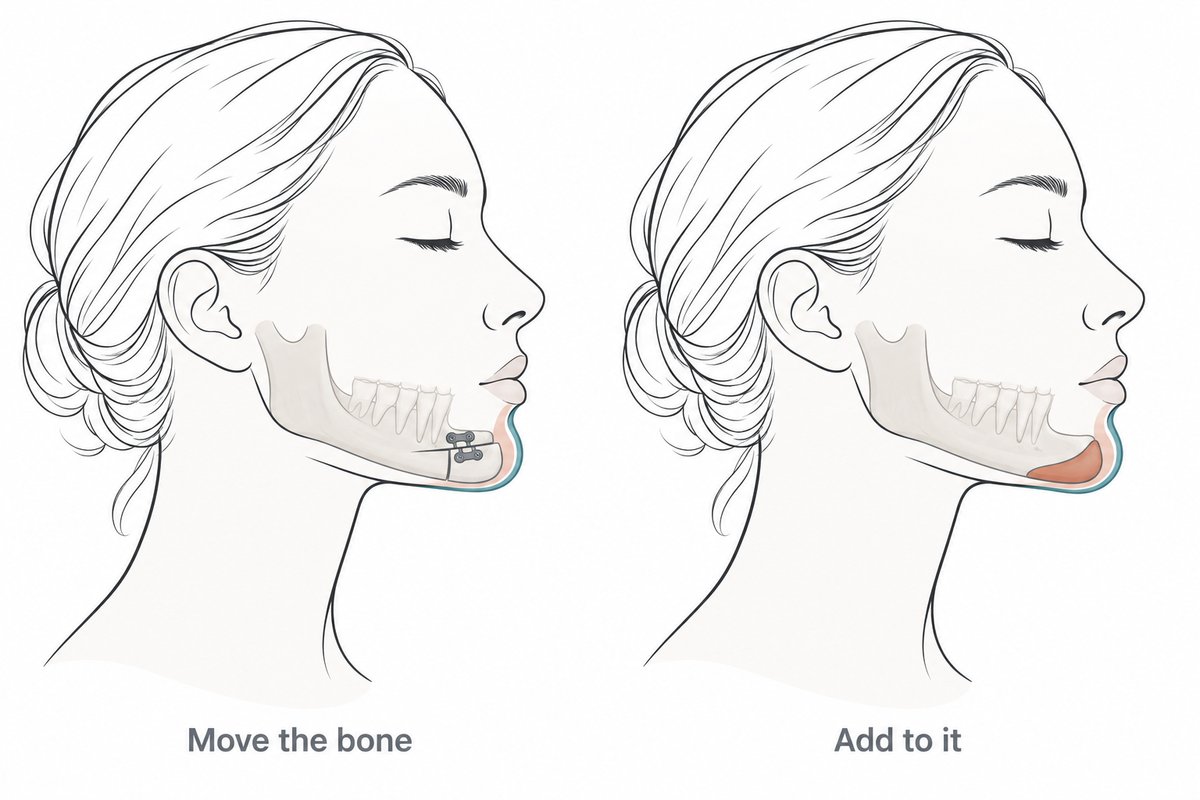
Chin implant vs genioplasty vs chin filler is a question about where the chin bone sits, because a weak chin is usually a bone in the wrong place and the operation that fixes it is the one that answers which place. Most patients choose by invasiveness instead, filler first, implant next, genioplasty last, and that order of preference lands on the operation that answers the wrong plane.
A chin bone has a position in three planes, forward and back, up and down, left and right, and it has a width. A receding chin is one finding in one of those planes, so a chin operation cannot be chosen until all four are known. An implant or filler adds forward projection only, and both sit on top of living bone. A genioplasty moves the bone in any direction, and the soft tissue follows at about 0.9 mm per millimeter of advancement in a systematic review of soft-to-hard tissue ratios at the chin. In a longitudinal cephalometric series of 85 silicone chin implants, over half showed some absorption of the bone beneath the implant.
Does Your Chin Bone Need to Move, or Does It Need Something Added?
Four questions decide it, all asked of the bone before any product is named: is the chin behind where it should be, is it too long or too short, is it too wide, and does its midpoint sit on the midline. Three findings get three answers: an implant answers a few millimeters of sagittal deficit and nothing else, filler a smaller version of the same deficit, and an osteotomy any of the four.

Occlusion comes next, because a small chin is sometimes the end of a jaw that sits back. Retrogenia, a small chin on a mandible that is otherwise in place, is a distinct diagnosis from retrognathia, the whole lower jaw sitting behind the upper. The bite tells them apart. A Class I bite with a small chin is a chin problem. A Class II bite with the lower teeth well behind the upper is a jaw problem, and a chin operation on it is a compromise the patient must choose knowingly. That is reasoning from occlusion, not a published rule.
Lip strain is the third question: some patients close the lips only by tightening the mentalis muscle, which dimples the chin skin. In a case series of six patients with well-positioned silicone implants, preoperative labial incompetence and mentalis hyperactivity correlated with progressive bone erosion, grade III in four of the six and one with dental roots exposed. Its authors recommended an alternative to an implant for lip-strain patients, and named osteoplastic genioplasty as the operation that restores the contour once an eroded implant comes out.
What Happens Under a Chin Implant, and What Happens When the Bone Is Moved?
Bone under an implant remodels, and moved bone mostly stays where it was put.

Bone under an implant remodels
Bone resorption under a chin implant is common, usually shallow, usually silent, and contested in what it means. The 1976 series of 85 silicone implants found no change in the soft-tissue profile of those who resorbed, and less absorption over thick basal bone than over alveolar bone. In 15 patients imaged at least a year after an intraoral silicone implant, 14 showed erosion, the deepest 2.0 mm, and none had symptoms. A systematic review of 28 patient studies found it across materials, most studies reporting a mean under 2 mm within five years, and deeper with longer follow-up.
In a CT study of 105 implanted patients against 108 controls, patients with resorption had a thicker mentalis, 6.35 against 5.73 mm, and thinner cortical bone, 3.25 against 5.22 mm. Silicone was more prone than porous polyethylene, and implants placed above the basal bone were more likely to induce it. In a randomized trial in ten hounds, resorption occurred under every implant regardless of plane. In children with Down syndrome given silicone implants at three sites, bone eroded only at the chin, in 75 percent, and regrew after removal.
What it means is disputed. A 2025 case report with a literature review argues that the change under silicone is remodeling with new bone formation and that the concern has been overwrought. Neither reading changes the exception: progressive erosion, in one case exposing dental roots, is documented only in the lip-strain subgroup, and a severe erosion under an ePTFE implant was attributed to mentalis hyperactivity rather than the material.
Bone that is moved stays moved, mostly
A plated chin segment loses a fraction of a millimeter and then holds. In a scoping review of genioplasty stability, an average advancement of 7.04 mm relapsed 0.69 mm by six months. In ten advancement patients followed with cephalograms, bone at the advanced segment resorbed a mean 0.85 mm, reported as 10.7 percent. Among 40 vertical reduction genioplasties done alongside mandibular setback and measured to 12 months, the drift at menton was 0.22 mm, and the soft chin shortened by roughly 0.59 mm per millimeter of bone removed.
Relapse is not zero; it ran 2.63 to 27.21 percent for osteotomy across a systematic review of 1,126 microgenia patients. In a review restricted to studies with a year or more of follow-up, soft tissue had relapsed more than hard tissue at three years, and at two years or more it sat at 0.77 to 0.91 of the bony advancement.
Why the soft tissue follows bone and not an implant
Soft tissue over the chin follows moved bone more closely than it follows an implant, and the difference has been measured. In a systematic review of 1,126 patients with microgenia, 740 treated by osteotomy and 386 by implant, bony movement translated into soft-tissue movement at 85 percent after genioplasty and at 66 percent after an implant. An earlier comparison of 34 osteotomies and 42 implants found morbidity the same, soft-tissue response more predictable after osteotomy, and the cervicomental angle improved more by it. Submental fat, the layer sorted in neck liposuction versus a neck lift, is touched by neither operation.
Direction matters too: soft pogonion follows advancement at 0.9:1 but setback at only about 0.5:1. A mean also hides variation: in 31 mandibular advancements, 17 with a genioplasty added, the ratio at pogonion was 0.9:1 with a scatter of plus or minus 2.6 mm.
Soft tissue can also substitute for bone. Holdaway wrote in 1984 that a thick integumental covering in the chin area can effectively align the lower facial profile, and that acceptable chin position spans a wide range. When E-line silhouettes were rated, attractiveness fell only with the lips 12 to 16 mm behind the line or 0 to 4 mm ahead of it. A chin pad that has descended off the bone is a soft-tissue droop, the kind mapped in what changes at 40, 50, 60 and 70, and a bony chin does not lift it.
Where Is the Mental Nerve, and How Does a Genioplasty Avoid It?
The mental nerve leaves the mandible through the mental foramen below the premolars, and the safe osteotomy line lies farther below that foramen than the classic rule says. It supplies feeling to the lower lip and chin.

The rule to cut at least 6 mm below the foramen came from 52 hemimandibles radiographed in 1992. In a CBCT study of 317 patients, 634 hemimandibles, the canal dipped a mean 3.44 to 4.42 mm below the foramen before rising to exit it. A cut at the recommended 5 to 6 mm still crossed the canal in 9.9 percent. Dropping the line to 7.06 mm brought the risk to 2.5 percent, 8.01 mm to 0.5 percent, and 9.12 mm to 0.0005 percent.
The nerve also loops forward past its own exit. Dental CBCT studies of this anterior loop, done for implant planning, find it in 85.2 percent of 732 hemimandibles at a mean 1.46 mm and in 67.8 percent of 612 hemimandibles at a mean 3.3 mm, up to 7.3 mm. A third found it in 47.2 percent of 109 scans. None gives a genioplasty injury rate.
Recovery is documented. In 50 patients tested a year or more after surgery, none had persistent anesthesia; objective hypoaesthesia was present in 17 percent after a genioplasty without a sagittal split, 40 percent when a sagittal split was added, and no patient rated it as disabling. In a systematic review of 39 implant articles covering more than 3,104 patients, paresthesia ran 0.4 percent with silicone and 20.1 percent with porous polyethylene, the only complication in that review that differed by material at all. In an 80-patient cohort that compared osteotomy against implant directly, neurosensory disturbance did not differ (P = 0.137).
Genioplasty vs Chin Implant vs Chin Filler: At a Glance
Genioplasty moves the chin bone in any direction, a chin implant adds forward projection on top of the bone, and chin filler adds a smaller amount of the same. Those are the three routes to chin augmentation, and each row below is a bone finding; the last column names what will not reach it.
| Chin finding | What it means | What answers it | What does not |
|---|---|---|---|
| Small chin, Class I bite, deficit of a few millimeters | Sagittal deficit only | Filler as a preview, an implant, or a sliding advancement | Nothing; the choice is about permanence |
| Small chin with a deeper deficit | Beyond what an implant lifts predictably | Sliding advancement | A large implant; the 1990 comparison of 76 patients judged implants justified mainly in older patients with a small degree of microgenia |
| Small chin with lip strain | Mentalis working to close the lips | Sliding advancement | An implant, on the six-patient erosion series |
| Long chin (vertical excess) | Too much bone from lip to underside | Vertical reduction, a horizontal strip removed | Anything that adds; filler and implants lengthen |
| Short chin (vertical deficiency) | Too little bone height | Vertical lengthening, the segment slid down | An implant, which adds forward and not down |
| Wide or square chin | Width across the tubercles | T-osteotomy narrowing, the central strip removed | Filler to “point” it, which adds length; the fat removal in buccal fat removal and long-term hollowing, which sits above the chin |
| Asymmetric chin | Midline off, usually weaker on the left | Differential movement or rotation of the segment | A stock implant, symmetric by manufacture |
| Class II bite with overjet | Whole mandible back | Orthognathic assessment first | A chin operation as a first answer |
| Chin that already has filler | Product in the surgical plane | Dissolving first, as in an overfilled face | Adding more, or operating through it |
How I Decide Between Moving the Bone, an Implant and Filler
I decide from the bone, and the bone has to be imaged first.
Four questions I ask of the bone before I ask about the operation
I measure four things on the profile photograph and the CBCT: the sagittal position of pogonion, the vertical height of the chin, the width across the mental tubercles, and the deviation of the chin point from the midline. I take a lateral cephalogram or a CBCT on every genioplasty patient and I do not operate on a photograph alone; the cut is planned in millimeters from a nerve canal.
Then I check the bite in the chair. A Class I bite with a small chin is a chin problem, and it is mine to solve. A Class II bite with overjet is a mandible problem. I say so, and I refer for orthognathic assessment before I offer a chin operation as a compromise, because a chin moved forward under a jaw that is still back changes the profile and not the bite.
Last I look for lip strain, dimpling of the chin skin at rest or when the lips close. A patient with lip strain does not get an implant from me, on the six-patient series in which lip strain went with progressive erosion; that patient is offered an osteotomy.
How I do the osteotomy, and where the cut goes
The incision is intraoral, through the mucosa of the lower lip, and I leave a cuff of mentalis attached to the bone to sew the muscle back to at the end. Before the saw comes near the bone I find both mental nerves and protect them. Then the horizontal cut is marked on the CBCT at least 7 mm below the lowest point of each mental foramen, not 5. My reason is the 634-hemimandible CBCT series: at 5 to 6 mm the cut still crosses the canal in about one hemimandible in ten, and at 7.06 mm the risk is 2.5 percent.
For a sliding advancement I fix the segment with a titanium step plate and monocortical screws. That plate stays unless it can be felt through the skin or becomes infected. For narrowing I do a T-osteotomy: the horizontal cut, a vertical central strip removed, and the two halves brought together and fixed. Narrowing genioplasty is commonly performed among East Asian populations, as a 117-patient series of a sliding narrowing osteotomy puts it; minor complications ran 6.0 percent in that series, which used a different narrowing cut from mine. Vertical shortening removes a horizontal strip of bone; vertical lengthening slides the segment down and leaves the gap to fill with bone. Chin asymmetry is corrected by moving the two sides by different amounts, or by rotating the segment. In a 3D-guided series of eight asymmetries, chin-point deviation at six months was 0.63 ± 0.19 mm, and most chins are weaker on the left.
At closure I resuspend the mentalis to the cuff. My reason is a study of 29 intraoral genioplasties in which releasing the mentalis raised lower-incisor exposure by a mean 1.88 mm, most after vertical reduction. Resuspension is my protocol against that drop; no study has tested whether it prevents it, and I do not claim that it does.
When I still use an implant, and how it is fixed
I place a chin implant only when five things are true at once: a sagittal-only deficit of a few millimeters, a Class I bite, a thick basal cortex on the CBCT, no lip strain, and a patient who has heard both options and declines the osteotomy.
When I do place one, it goes low, on the basal bone, never over alveolar bone, because the 1976 cephalometric series and the 2024 CT study both found less resorption under low placement. I fix it with screws, for the reason a 46-patient series of screw-fixed porous polyethylene implants gave: screw fixation prevents displacement and obliterates gaps between the implant and the skeleton, and that series reported no infections. Material is chosen with the patient, both numbers on the table: silicone’s 0.4 percent paresthesia against porous polyethylene’s 20.1 percent, and the CT finding that silicone was more prone to resorption.
I tell every implant patient before consent that the bone under it will remodel, usually shallowly and silently, and that a chin radiograph every few years is part of having one.
When filler is the right first step, and where it stops
Filler is a preview, and I keep it small, up to about 1 to 2 mL. It goes on the bone in the midline, below the plane of the ascending mental artery and never into the mentalis. In a cadaver study of 31 faces, that artery entered the chin 5.64 ± 4.34 mm off the midline at a depth of 4.15 ± 1.95 mm, within the muscular plane. Filler on periosteum sits under that artery; filler in the mentalis sits in it, inside a muscle that moves every time the lips close, the setting described in why lip filler migrates and how it is corrected.
It is for the patient undecided about an osteotomy. I decline it when the deficit is more than a few millimeters, when the problem is vertical, width or asymmetry, and when there is already filler in the chin, which is dissolved first.
What filler does is documented as a scale grade. Juvéderm Voluma XC was approved for the chin on 15 June 2020, per the manufacturer’s release and Restylane Defyne on 1 February 2021, per Galderma’s release. In the Voluma pivotal trial of 192 patients, 56.3 percent of treated patients against 27.5 percent of controls had improved by at least one grade at six months, judged from photographs. The same patients assessed live were responders at 91.8 percent, and benefit was still evident at twelve months. In the Defyne trial of 107 treated against 33 untreated, 81 percent responded at week 12 and 74 percent at week 48. A Chinese trial of the same product found 81 percent at six months and 61 at twelve; a trial of a third product in 150 treated against 50 untreated found 70 and 54.67 percent.
No study has compared these three options in one cohort, and the filler trials measured a scale grade at 6 and 12 months, not a millimeter of projection. Every filler number I quote is a responder rate, not a duration.
Genioplasty, Implant or Filler: Which Patient Are You?
The 27-year-old with a 4 mm sagittal deficit, a Class I bite and no lip strain, who wants to see it first. Filler on the bone, 1 to 2 mL, is the preview; the choice between osteotomy and implant follows.
The 33-year-old with a 9 mm deficit and chin skin that dimples at rest. Two findings rule out the implant: the size, which is beyond the small degree of microgenia an implant answers predictably, and the mentalis working against it. A sliding advancement answers both.
The 30-year-old with a wide, square chin asking for filler to point it. Filler adds forward and down, so the chin gets longer, not narrower. Width is answered by a T-osteotomy.
The 41-year-old with a long chin and a lower face that shows too much tooth and gum. Vertical excess is answered by removing a horizontal strip of bone; nothing added on top shortens it.
The 24-year-old with a Class II bite and 7 mm of overjet asking for a chin implant. That chin is probably in the right place on a jaw that is not. Orthognathic assessment comes first.
The 52-year-old with an old silicone implant, a new step in the profile and numbness in the lower lip. A radiograph comes first. In a revision series of 98 silicone chin implants, resorption was the leading reason for revision, and seven of the revisions were removal followed by a sliding genioplasty, as many as received a custom implant. Removal and a sliding genioplasty is the plan here.
What Is Recovery Like After Genioplasty, an Implant, or Filler?
Numbness is the recovery event after a genioplasty, and it follows a known curve. Most sensory change resolves within one to three months: among 321 Korean patients who had a narrowing and vertical reduction genioplasty alongside mandibular contouring, 87 had transient sensory change and all recovered within three months. In a split-mouth trial of 20 patients, where one side of each chin was treated and the other was not, the two sides still tested differently at four months and had converged by twelve. Roughly one in ten keeps some objective change at a year, 17 percent in the sensory-testing study and 7.4 to 12.5 percent across the head-to-head review, none reported as disabling.

Bone union is checked on a radiograph at six months, when T-osteotomy healing is confirmed. In 262 patients who had a genioplasty within combined orthognathic surgery, no chin plate had to be removed and the chin was the infection site once. No isolated-genioplasty rate has been published.
In 105 intraoral ePTFE implants followed for a year, minor complications ran 14.3 percent, all prolonged edema, transient lower-lip hypoaesthesia or mild asymmetry. After filler, the Voluma pivotal trial recorded injection-site tenderness in 81.1 percent and firmness in 75.1 percent.
In this practice the timeline after an intraoral osteotomy is a protocol, not a citation: soft food for a week, chin tape for a week, presentable at two weeks. That fortnight is planned with how long to stay in Korea after surgery.
Surgeon’s Insight
A chin is a bone with a position, and an implant is a guest on that bone. I move the bone because the soft tissue believes the bone and only half-believes the guest, and because the bone under a guest keeps remodeling for as long as the guest stays. The sentence that helps most in this consultation is often not an operation at all. It is: your chin is fine, your jaw is back.
What Are the Risks of Genioplasty, a Chin Implant, and Chin Filler?
Implants get infected more often than osteotomies, osteotomies go numb more often than implants, and filler can block an artery. Across 1,048 osteotomy sites in orthognathic patients, 5 became infected, 0.5 percent, one of them a chin, and no hardware was removed for infection. Single implant series run low: 1 infection, 0.91 percent, in 110 porous polyethylene chin augmentations, and none in the 46 screw-fixed porous polyethylene implants of the 2003 series. In a meta-analysis of 48 studies and 4,139 facial implants, the overall complication rate across all sites was 10.7 percent, and in the pooled analysis 2.78 percent for silicone, 2.48 percent for porous polyethylene and 1.02 percent for calcium hydroxyapatite. Against the osteotomy the direction is consistent: implants had higher infection and dehiscence rates in the 1,126-patient review, and in the 80-patient cohort infection was significantly higher with implants (P = 0.028) and satisfaction higher after genioplasty (P = 0.001).
Resorption becomes a risk when it becomes a revision. In the 98-patient silicone series, 24 had complications, and resorption was the leading one, alone in 9 and with displacement in 3. Removal is indicated when erosion threatens teeth or alters mental-nerve sensation.
An osteotomy has its own list. In 200 genioplasties from one French unit, 6 complications occurred, and its checklist runs from nerve injury and bleeding to bone necrosis, dental injury and mental ptosis, the descent of the soft chin below the lower border of the bone.
Filler carries a vascular risk, and two published occlusions show what entering a vessel looks like. One was impending necrosis of the chin and upper neck after filler entered the submental artery, treated with four pulses of hyaluronidase in the first 24 hours. The other was livedo reticularis a day after a low-volume chin injection, treated with 2,850 IU of hyaluronidase over 15 hours, recovered by day 21. As that report puts it, even minimal filler volumes can trigger vascular occlusion. In the Voluma pivotal trial one participant in 192, 0.5 percent, had two treatment-related serious events, both resolved.
Four things are unknown: whether the three options differ when compared in one cohort, which no study has done; the plate-removal rate after an isolated genioplasty; what chin filler does beyond about a year, since a 2026 systematic review of 11 studies and 876 patients found a mean follow-up of 12.8 months and called long-term outcomes unknown; and whether chin filler migrates, which no study has measured.
Ask Which Direction Your Chin Needs to Move, Not Which Product Fits It
Ask which direction your chin needs to move, and by how much, before asking which product fits it. A chin that needs to come forward 4 mm, one 3 mm too long, one too wide and one off the midline are four findings, and only the first can be answered by adding to the bone.
Three questions sort the consultation: is the bite Class I, which plane is off and by how many millimeters on a scan, and do the lips close at rest without the chin muscle working. A surgeon who names a product before a direction is choosing from stock rather than from the scan, the mismatch examined in what natural means in plastic surgery.
Written by Dr. Yongwoo Lee, board-certified Korean plastic surgery specialist in facial anatomy and aesthetic procedures at VIP Plastic Surgery, South Korea.
Frequently Asked Questions About Genioplasty, Chin Implants and Chin Filler
Is genioplasty better than a chin implant?
For most chin findings it is, because it moves the bone in any direction while an implant adds forward projection only. In 1,126 patients soft tissue followed the bone at 85 percent after osteotomy and 66 percent after an implant.
Does a chin implant cause bone loss?
Usually some, and usually shallow. Over half of 85 silicone-implant patients showed absorption on radiographs, and a review of 28 studies found means under 2 mm within five years.
Is chin implant bone resorption dangerous?
It rarely is. In those series the profile did not change and no patient had symptoms; progressive erosion is documented only in patients with lip strain.
How long does chin filler last?
Trials measure responder rates, not duration. At 48 weeks, 74 percent were still responders with Restylane Defyne; at 12 months, 61 percent in a Chinese trial of it and 54.67 percent with another product. The two-year figure for Voluma refers to the cheek.
Can filler make a wide chin narrower?
It cannot, because filler adds volume, so a wide chin injected at the tip becomes a wide chin that is longer. Narrowing takes a central strip of bone out.
Can a chin implant fix a long chin?
An implant cannot, because it adds to the bone and cannot shorten it. A long chin needs vertical reduction, which was skeletally stable at 12 months in 40 cases done alongside jaw setback.
Will I lose feeling in my chin after genioplasty?
Many patients do, temporarily. In 321 Korean patients 87 had transient numbness, all recovered within three months. At a year, testing found slight hypoaesthesia in 17 percent, none disabling.
Does the plate have to come out after genioplasty?
Rarely, and in this practice only if it can be felt or becomes infected. In 262 combined orthognathic patients no chin plate was removed; no isolated-genioplasty rate has been published.
Is a chin implant permanent?
The implant is; the bone under it remodels, by a mean under 2 mm in most studies with under five years of follow-up, and bone regrew after removal in a pediatric series.
Can a chin implant be removed and replaced with genioplasty?
Yes, and it is a common revision. In a 98-patient silicone series, 7 of the 24 patients who needed a revision had the implant removed and a sliding genioplasty done.
Do I need jaw surgery instead of chin surgery?
The bite answers it. A Class I bite with a small chin is a chin problem; a Class II bite with the lower teeth well behind the upper is a mandible problem, which a genioplasty does not correct.
Is filler a good test before surgery?
It is, for a small sagittal deficit. Non-surgical chin augmentation with 1 to 2 mL on the bone shows a fuller chin for months, long enough to choose between osteotomy and implant; it cannot preview narrowing, shortening or asymmetry.
What is a T-osteotomy?
A narrowing genioplasty: a horizontal cut frees the lower chin segment, a central strip is removed, and the halves are brought together and fixed. Among the 321 Korean patients who had a narrowing and vertical reduction genioplasty by a central-strip route, no severe complications were reported and the transient numbness in 87 of them resolved within three months.
How do I tell if my chin is small or my jaw is back?
Bite your back teeth together and look at the front teeth. If the lower front teeth sit well behind the upper ones, the whole jaw is back. If the teeth meet normally and the chin still looks weak, the chin itself is small.
This article is for informational purposes only and does not constitute medical advice. Always consult with a qualified medical professional before making any decisions about surgical or non-surgical procedures.