
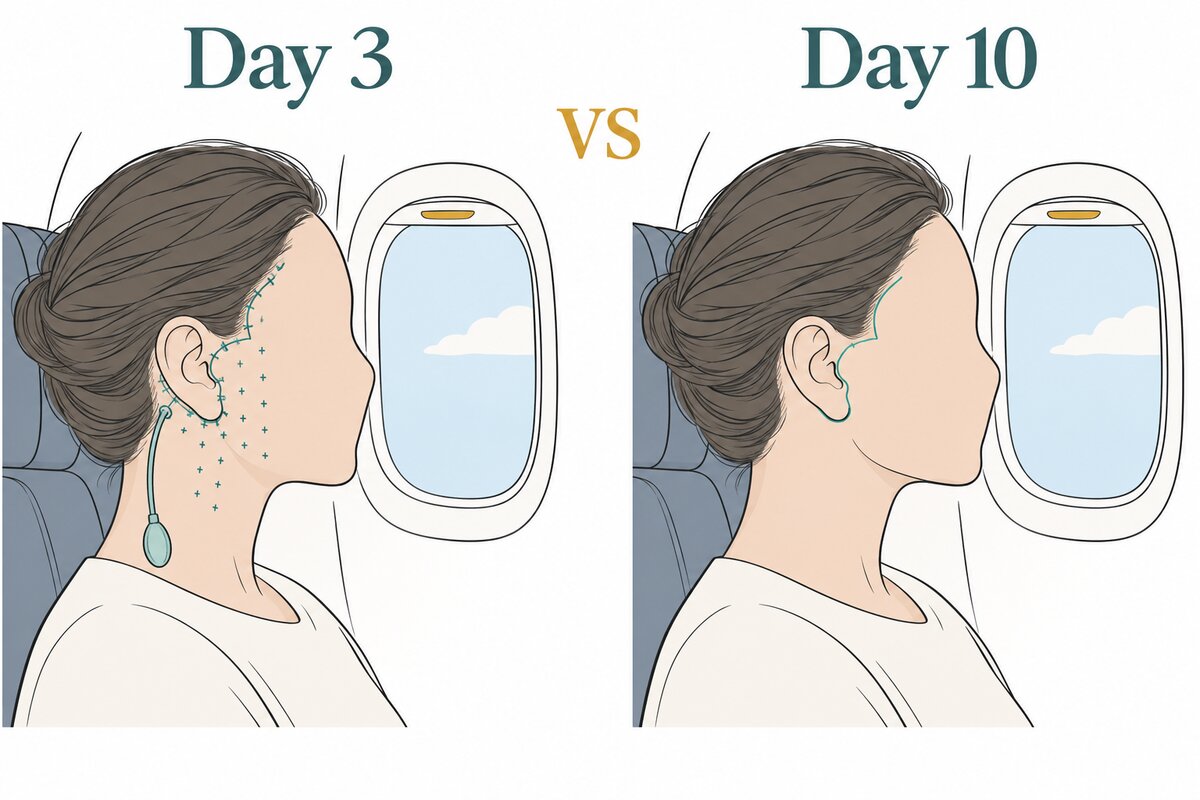
How Long Do You Actually Need to Stay in Korea After Plastic Surgery?
How long to stay in Korea after plastic surgery is not a single number, and any page that gives you one without asking what you are having done is guessing. The honest answer is a rule. You stay until the day after the last thing only your surgeon can do, then you add the days in which the two complications that need a surgeon most often appear. For an incisional double eyelid surgery that lands at about seven days. For a deep plane facelift with a neck lift it lands at ten to fourteen. For injectables and energy devices it is a day or two. For a facelift combined with eyelid surgery and fat grafting, it is the longest of the three, not the average.
The mistake almost every international patient makes is booking the return flight first and fitting the surgery into the gap. A flight is not the fixed point. Surgery is. A return date chosen before the operation forces one of two bad outcomes. Either the surgeon compresses the plan to fit the ticket, or the patient boards a long-haul flight with sutures still in, a drain output nobody has checked, and a hematoma window that has not closed. In 2024 South Korea treated 1,170,467 foreign patients, a 93.2 percent jump over 2023, with plastic surgery making up 11.4 percent of all visits. They arrive by air and they leave by air. What follows is what that second flight asks of a fresh wound, procedure by procedure, and what has to be true before you take it.
When Can You Fly After Plastic Surgery? Five Conditions Decide, Not a Number of Days
The question is not how many days, because days are only a proxy for the conditions underneath them. Five conditions decide whether a long-haul flight after facial surgery is reasonable, and every one can be checked in an examination room the morning before departure.
First, the last surgeon-dependent step is done. Drains out, a hemostatic net removed, skin sutures or hairline staples taken out, or a wound checked and declared sealed. Second, the bleeding window is closed. For facelifts, ninety percent of hematomas occur in the first 24 hours, and the late ones cluster in the first week. Third, the infection window has passed its peak. Surgical site infections typically manifest within 3 to 7 days following a procedure, which is exactly the window a patient who leaves on day three spends at 36,000 feet. Fourth, the swelling is on its way down rather than up, because cabin conditions do not help a face that is still filling. Fifth, you can walk the aisle every hour without help, because that is the main thing that protects your legs on the way home.
International guidance is built on the same logic. The Aerospace Medical Association’s guidelines for airline travel address facial plastic surgery by name, listing facelift, blepharoplasty, otoplasty and rhinoplasty. Those patients may fly once drains are removed and they are cleared by their surgeon, usually within one to two weeks. For nasal or facial fracture repair the same document waits for the postoperative bleeding risk to pass, about two weeks in most cases, and asks for clearance by an otolaryngologist. Notice the wording. It is not a number of days. It is a condition, with a typical number attached.
What Does a Long Flight Do to a Fresh Surgical Wound?
A commercial cabin is pressurized to a cabin altitude between 5,000 and 8,000 feet. At 8,000 feet a healthy passenger’s blood oxygen saturation drops to about 90 percent, with cabin humidity usually ranging from 10 to 20 percent. That is also why the UK Civil Aviation Authority holds abdominal surgery patients on the ground for ten days, because intestinal gas expands by approximately 30 percent by volume at a cabin altitude of 8,000 feet. Facial surgery does not trap gas the way an abdomen does, so that rule is not yours. Three others are.
The first is oxygen. Healing tissue consumes more oxygen than resting tissue, and the same CAA guidance notes that postoperative patients are in a state of increased oxygen consumption at exactly the moment cabin air offers less of it. A marginal flap, a fat graft in its first days of establishing a blood supply, or a smoker’s skin closure has less reserve in a cabin than on the ground. A smoker’s timeline is different again: the flap itself needs four nicotine-free weeks after surgery, well past a typical flight home, and the reasoning is in why a facelift flap needs four smoke-free weeks. None of that endangers a well-healing wound at ten days; it is a reason not to ask the wound to do it at day three.
The second is dryness and posture. Ten to twenty percent humidity for twelve hours dries the eyes of a patient whose eyelids do not yet close fully. After upper eyelid surgery, early lagophthalmos, the gap that stays open when the lids are shut, typically resolves within a few days, but most patients need lubricating drops during the day and some need ointment at night. Sleeping upright in an economy seat with the head tipped forward is also the opposite of the head-elevated position every facelift and eyelid protocol asks for in the first week.
The third is your legs. In the World Health Organization’s WRIGHT project, the risk of venous thromboembolism approximately doubles after travel lasting four hours or more, while the absolute risk in a healthy seated traveler remains about 1 in 6,000. That same project found that the risk stays elevated for about four weeks after the flight. Surgery sits on top of that. On the Caprini scale used by the American Society of Plastic Surgeons’ venous thromboembolism task force, a major operation lasting more than 45 minutes scores two points on its own. That is the same weight the scale gives to being aged 60 to 74. Age, weight, hormones and a personal history are counted on top. A patient who flies in, has a two to three hour operation, and flies out ten days later has stacked three events inside one four-week window: a flight, a surgery, and a second flight.

Does Flying After Plastic Surgery Cause Blood Clots? How Much Surgery Plus a Flight Raises DVT Risk
Flying after surgery does raise the risk, by less than most warning pages imply and by more than zero, and the size of that number is what decides what you do about it. In a prospective cohort of 129,007 cosmetic surgery patients, clinically significant venous thromboembolism within 30 days occurred in 0.09 percent overall, 0.01 percent after facial procedures and 0.21 percent after body procedures. Combined procedures ran at 0.20 percent against 0.04 percent for a single one. Facial surgery is at the very bottom of that table. Adding liposuction of the body, or combining several operations into one long anesthetic, moves a patient up it.
The flight itself, layered onto surgery, has now been studied directly. A 2026 meta-analysis in Phlebology pooled seven studies and 24,975 surgical patients and found an odds ratio of 1.96 for venous thromboembolism with recent air travel, which did not reach statistical significance. Its postoperative flight subgroup came in at 1.31, also not significant. The authors concluded that air travel may not add risk beyond the surgery itself, with the honest caveat that prophylaxis was poorly documented in every study they pooled. Read alongside the WHO data, the picture is consistent: the flight is a modest multiplier on a small baseline, the surgery is the larger term, and both are manageable. Nothing in that supports keeping a facelift patient on the ground for a month, and nothing in it supports boarding with a fresh wound and doing nothing about your legs.
The measures themselves are simple and well proven. A Cochrane review of nine trials and 2,637 passengers on flights over five hours found symptomless deep vein thrombosis in 3 of those wearing compression stockings against 47 of those who did not. That is an odds ratio of 0.10, on high-certainty evidence. The UK travel health authority specifies properly fitted below-knee graduated compression socks of 15 to 30 mmHg at the ankle, regular walking and ankle flexion. It also states plainly that aspirin is not recommended for preventing travel thrombosis. That last line matters after a facelift for a second reason: aspirin also raises bleeding risk in the very week you are trying to keep a hematoma from forming.
How Many Days in Korea by Procedure? When the Last Surgeon-Dependent Step Happens
The stay is set by the last thing your surgeon has to do with their hands, plus the days in which a bleed or an infection would need them. Below is where that step falls for the operations this site covers, and the earliest day a long-haul flight makes clinical sense for an uncomplicated patient. These are floors, not targets.
At a Glance
| Procedure | Last surgeon-dependent step | Earliest sensible long-haul flight | What must be true at the door |
|---|---|---|---|
| Deep plane facelift, with or without neck lift | Drains out 24 to 48 hours; hemostatic net out day 3 to 4; sutures out about day 7 | Day 10 to 14 | Sutures out, no collection under the flap, blood pressure controlled off intravenous drugs, walking unaided |
| Mini facelift | Sutures out about day 7 | Day 8 to 10 | Same as above; the shorter incision does not shorten the bleeding window |
| Incisional double eyelid surgery | Skin sutures out about day 7 | Day 7 to 8 | Sutures out, lids closing fully, no bleeding behind the eye, drops in hand |
| Non-incisional (buried suture) double eyelid surgery | Wound check at 48 to 72 hours | Day 3 to 5 | Swelling turning, symmetric fold in motion, no sign of a knot working out |
| Lower blepharoplasty with fat repositioning | Skin sutures out day 5 to 7; a transconjunctival approach has none, so a wound check at day 5 to 7 | Day 7 to 10 | Bruising fading, vision normal, no tightness pulling the lid down |
| Sub-brow lift or upper blepharoplasty | Stitches out day 5 to 7 | Day 7 | Wound sealed, no step-off opening, sun protection planned |
| Endoscopic forehead and brow lift | Hairline sutures or staples out day 7 to 10 | Day 10 | Fixation points settled, swelling past its peak at day 7 to 10 |
| Neck liposuction | Garment fitted; check at day 3 to 5 | Day 5 to 7 | Garment worn continuously, no fluid collection, chin strap for the flight |
| Buccal fat removal | Mucosal sutures dissolve on their own by about two weeks | Day 5 to 7 | Mouth opening improving, soft diet tolerated, rinsing routine established |
| Facial fat grafting | Check at day 5 to 7 | Day 7 | Swelling turning, no pressure on grafted areas from masks or headphones |
| Thread lift | Check at 48 hours | Day 2 to 3 | Entry points sealed, no tethering that is worsening |
| Hyaluronidase dissolving, filler, skin boosters | Check at 24 to 48 hours | Day 1 to 2 | Swelling down, no vascular warning signs; if a refill after dissolving is planned, that is a second visit at least two weeks later |
| HIFU, radiofrequency, microwave devices | None | Same day or next | Nothing beyond ordinary sun and heat precautions |
How long to stay in Korea after a facelift: ten to fourteen days
A facelift sets the longest stay because it has the most surgeon-dependent steps and the widest bleeding window. In the published deep plane facelift protocol, patients return at one day for drain and dressing removal and again at one week for wound assessment and suture removal. They sleep with the head elevated for one week and avoid strenuous activity for two. Where a hemostatic net is used, its removal at three to four days is another appointment nobody else can do. This site’s guide to why hematoma happens after a facelift and how it is prevented walks through each of those layers. Add the infection window, which peaks at days three to seven and after facelift runs at about 0.89 percent in a review of the TOPS database, and the earliest flight that leaves every window behind is day ten. Fourteen is more comfortable, and a patient having a deep plane facelift with a neck lift should plan for it.
A mini facelift shortens the incision, not the clock. Sutures still come out at about a week and the hematoma window is the same, so the floor is a day or two shorter at most, not a week shorter. Patients who choose the smaller operation to fit a shorter trip are choosing the wrong reason.
How long to stay in Korea after double eyelid surgery: seven days with sutures, three to five without
Incisional double eyelid surgery has one surgeon-dependent step, skin suture removal at about a week, and once that is done the wound is sealed and the patient can fly. Bruising and swelling after upper eyelid surgery may last up to two weeks, so a day-seven flight goes home swollen but safe, with drops for the cabin. The non-incisional method removes nothing and buries the stitches, so there is nothing to take out. A wound check at two to three days and a look at the fold in motion is enough before a flight. That difference in stay is real. It is still not a reason to choose the buried method for an eyelid that needs the incisional one, a decision the eyelid article makes on skin, fat and hidden ptosis rather than on the calendar.
Lower blepharoplasty and the sub-brow lift or upper blepharoplasty follow the same seven-day rule, with stitches out at five to seven days and the bruise fading over one to two weeks. The one eyelid emergency worth naming, bleeding behind the eye with severe pain and pressure, is a first-hours event, which is another reason the first night belongs in Korea and not on a plane.
When can you fly after neck liposuction, buccal fat removal or fat grafting? About a week
Neck liposuction has no sutures to speak of, but it has a garment, and the first several days of continuous compression are what shape the result. This site’s neck liposuction and neck lift guide puts social presentability at about a week. A flight at day five to seven, garment on, is reasonable. Body liposuction is a different category, moving a patient from the 0.01 percent facial group into the 0.21 percent body group and earning the full set of leg precautions.
Buccal fat removal is done through the mouth, and its sutures dissolve on their own by about two weeks. Its first week is swelling and a stiff jaw rather than anything a surgeon has to remove. A flight at five to seven days with a rinsing routine and soft food is fine. Facial fat grafting is the procedure where the cabin matters most in principle, because the graft is building its blood supply in exactly the first week. The practical rule is to keep every pressure off the grafted cheek or temple: sleep masks, headphone bands, and a face pressed against a window all count. A check at day five to seven, then fly.
When can you fly after a thread lift, filler or skin boosters? Days, with one trap
A thread lift is done under local anesthesia in under an hour and patients present socially within days; a 48-hour check and a flight on day two or three is enough. Skin boosters, Rejuran, Juvelook and their relatives, leave papules for one to two weeks and need nothing from a surgeon after the first day. Ultherapy, Thermage and Shurink have no downtime that a flight would interrupt.
The trap is dissolving. A patient who comes to Korea with an overfilled face to have filler dissolved can fly a day or two after the enzyme. But the tissue takes about two weeks to show its true resting shape, and a filler refill has to wait for that. The same holds for migrated lip filler: staged dissolving, a two-week minimum, then reinjection is a three-week plan or two trips, and pretending otherwise produces exactly the overcorrection the wait exists to prevent. Anything surgical waits far longer. For a face carrying years of product the interval before a lift or a fat graft is three to six months, because the skin has to rebuild the hyaluronic acid the enzyme stripped out along with the filler.
What I Check Before I Release a Patient to a Long-Haul Flight
In practice the clearance is an examination, not a date on the calendar, and for a facelift patient it runs through the same layers the operation was built on. The hemostatic net comes out at three to four days. Each side’s two closed-suction drains, brought out near the mastoid, have been out since the first or second day. So by the time a flight is in question, the dead space under the flap is held closed by the net rather than by a dressing. Systolic pressure was kept under 140 during the operation itself. In a patient whose pressure will not settle afterward I run a nicardipine infusion through the first four to five days, and intravenous tranexamic acid runs from the day of surgery through the third or fourth. A patient who still needs an intravenous drug to hold that pressure is not a patient I clear for a flight, because the drug does not board with them.
Skin sutures come out at about a week, and that appointment is the one I want behind a facelift patient before a long-haul flight is booked. At the clearance visit I look for the same four things I look for at every early visit. Symmetry of the two sides. A flap that is soft rather than tense. An ear and neck with no fullness that was not there the day before. And a patient who walks into the room without help. A face that passes those four on day ten is one I am comfortable sending twelve hours away. For eyelids the visit is the suture removal itself, and there I want the lids closing fully, a symmetric fold when the patient looks up and down, and lubricating drops in the bag before they leave.
Two things happen at that visit that I treat as part of the operation. The first is photographs, front and both sides, so that a message from another continent two weeks later has a baseline to compare against. Second comes a plain statement of the three signs that mean a doctor today rather than a message to Korea. One side of the face or neck enlarging over hours. A fever with a wound that is red and spreading. Calf pain or breathlessness after the flight. I ask the patient to say those three back before they go, because a patient who can name them is a patient I can look after from a distance.
Which Traveler Are You?
The right length of stay depends on which of these six people you are, and the planning mistake is almost always the same: the trip was booked around the wrong one.
1. Eyelids only, a week in Korea. Incisional double eyelid surgery on the first or second day, sutures out at day seven, flight on day seven or eight. A lower blepharoplasty runs a day or two longer while the bruising fades. This is the trip that actually works in a week, and it works because the wound is sealed before the flight, not because eyelid surgery is minor.
2. Facelift, with or without neck, two weeks. Surgery early in the trip. Drains out on day one or two, net out day three or four, sutures out day seven, then clearance and a flight between day ten and fourteen. Patients who try to do this in eight days either fly with sutures in or ask for a smaller operation than their face needs.
3. Several procedures in one anesthetic. The stay is set by the longest procedure. The venous thromboembolism risk is set by the combination: combined procedures carried five times the rate of a single one in the 129,007-patient cohort. This traveler needs the facelift stay, the full leg protocol on both flights, and an honest conversation about whether everything should happen on one day.
4. The traveler with a clot risk of their own. Age over sixty, a body mass index in the obese range, estrogen-containing contraception or hormone therapy, a previous clot, or a family history: each moves a patient up the Caprini scale before the operation adds its two points. UK guidance counts recent surgery of more than 30 minutes performed 4 weeks to 2 months ago as a travel risk factor in its own right. A flight home at day ten is earlier still, when the surgery is more recent, not less. Fitted stockings, an aisle seat, hourly walking and, in some cases, a prescribed anticoagulant for the flight are decided before surgery, not at the airport.
5. The dissolve-then-refill patient. Two weeks minimum between the enzyme and a filler refill, so either a three-week stay or two trips; a face carrying years of product and heading for surgery or a fat graft instead needs three to six months, which is a separate trip by definition. A patient who insists on one short trip should have only the dissolving done and come back for the second half with a face that has finished settling.
6. The patient who wants everything in four days. This is the traveler the medical tourism complication literature is written about. In a systematic review of 214 patients who had cosmetic surgery abroad and presented for care in the United States, 50.9 percent of complications were infectious. In that group, 36.8 percent were hospitalized and 51.8 percent needed surgical management. That review does not record when each patient flew, but the infection window it describes opens on days three to seven, which is after a four-day trip has already ended. The answer to this traveler is not a faster surgery. It is a shorter list, or a longer stay.

How Do You Fly Home Safely After Plastic Surgery?
Flying home well is a short list: an aisle seat, a walk every hour, fitted compression socks, water instead of alcohol, no aspirin, and nothing pressing on the healing area. Book the aisle seat so walking the cabin does not mean climbing over anyone, and walk it; ankle flexion between walks is the second-best thing. Wear fitted below-knee graduated compression socks of 15 to 30 mmHg at the ankle, put on before boarding and kept on until landing, on both flights, which is what the Cochrane trials actually tested. Skip alcohol, a diuretic and a vasodilator in a week when swelling is still resolving. Do not take aspirin for the flight; it does not prevent travel thrombosis and it does raise bleeding risk in a fresh wound.
Keep the head up. A neck pillow that stops the chin from dropping onto the chest protects a facelift or neck lift closure and keeps swelling from pooling forward. A window seat with the operated cheek against the wall does the opposite for a fat graft. Eyelid patients keep drops in the seat pocket and use them every hour or two in the dry cabin, and liposuction patients wear the garment for the flight. Nothing presses on a healing area, which rules out over-ear headphones and sleep masks.
Carry paper. A one-page operative summary in English is what a doctor at home needs on the day something is unclear. It carries the date, the procedure, any implants or materials, the sutures used and the date they came out, and the clinic’s direct contact. That page and the clearance-visit photographs are the two things a remote follow-up actually runs on.
Surgeon’s Insight
The question I hear most from international patients is not about the surgery. It is “can I fly on Friday?” and it is usually asked before we have decided what the operation is. I answer it with a different question: what is the last thing only I can do for you, and on what day does it happen? For eyelids that is a suture removal at a week. For a facelift it is the net at three or four days, the sutures at seven, and a look at the flap at ten. Once a patient sees the stay as a list of appointments rather than a number, they stop asking me to shorten the operation and start asking which appointment is the last one. Booked after that appointment, the flight home is the safest part of the whole plan. Booked before it, it is the most dangerous part.
What Happens If You Fly Home Too Soon After Plastic Surgery?
What goes wrong is rarely dramatic and almost always avoidable, and it clusters in three patterns. The first is the complication that opened in the air or the day after landing: a late hematoma in the first week, an infection presenting at day four to seven, a wound edge that opened under a mask strap. Each is ordinary in itself. What makes it a problem is that the surgeon who knows the anatomy of that wound is eleven time zones away, and the doctor who does not is being asked to guess. In the surgical tourism review cited above, 36.8 percent of patients were admitted to hospital and 51.8 percent needed surgical management, which is what happens when a problem is found late rather than at a day-five wound check.
The second pattern is the one the flight adds directly. A calf that hurts three days after landing, or breathlessness on the stairs, is the venous thromboembolism the WHO project and the cosmetic surgery cohort both describe. It is the predictable end of a day-four flight home after a combined procedure, with no stockings and no walking. Uncommon after facial surgery alone, it is not rare enough to ignore after body work, combined procedures, or in a patient carrying risk factors of their own.
The third pattern is subtler and more common than either: the result that was never assessed. A fat graft judged at six days by a patient at home, when the honest reading of a graft is at six months. A filler correction refilled too early by someone else because the two-week wait fell in another country. An eyelid asymmetry from swelling that a surgeon would have recognized as temporary and a patient alone at home did not. This is where the clearance-visit photographs and a working channel to the clinic earn their place, because everything short of the three warning signs can be photographed and sent.

The Question to Ask Is Not “How Many Days?” It Is “Which Appointment Is the Last One?”
The length of a stay in Korea after plastic surgery is decided by three windows and one appointment. First, the bleeding window, which for a facelift is mostly the first 24 hours and effectively closed by the end of the first week. Second, the infection window, which peaks at days three to seven. Third, the venous thromboembolism window, which the flight and the surgery each open for about four weeks. And last, the visit at which a surgeon has to do something with their hands. A stay that ends after that visit, with stockings on and a walk every hour, is a safe way to go home from a well-chosen operation. A stay that ends before it gambles on exactly the days the literature identifies as the ones that matter.
So the question to bring to a consultation is not how many days. It is which appointment is the last one, and on what day it falls for the operation you are actually having. This site makes the same argument about a different number in what natural actually means in plastic surgery: somebody chooses it before the operation, and the patient should be told what it is. Book the flight after that answer, not before it.
Written by Dr. Yongwoo Lee, board-certified Korean plastic surgery specialist in facial anatomy and aesthetic procedures at VIP Plastic Surgery, South Korea.
Frequently Asked Questions About Staying in Korea and Flying Home After Plastic Surgery
How long do I need to stay in Korea after double eyelid surgery?
About seven days for incisional double eyelid surgery, because skin sutures come out at around a week and the wound is sealed after that. Non-incisional surgery with buried stitches has nothing to remove, so a wound check at two to three days and a flight on day three to five is reasonable. Plan the trip around the suture removal appointment, not around the operation day.
How long should I stay in Korea after a facelift?
Ten to fourteen days. Drains come out at one to two days, a hemostatic net at three to four, and sutures at about seven. Ninety percent of hematomas occur in the first 24 hours, with the rest clustering in the first week. A flight at day ten leaves every one of those windows behind; day fourteen is more comfortable for a facelift combined with a neck lift.
How many days should I book in Korea in total, including the days before surgery?
Add the arrival days to the stay set by the procedure. For a large operation the practical rule is to arrive two to three days ahead, which also puts a little distance between the inbound flight and the anesthetic, since raised clot risk from a long flight lasts about four weeks. Then add the stay after surgery: about seven days for incisional double eyelid surgery, ten to fourteen for a deep plane facelift with a neck lift, and a day or two for injectables and energy devices. Book the return flight after the last surgeon-dependent appointment, not before it.
Can I fly a few days after a facelift if I feel fine?
Feeling fine is not the test. The test is whether the sutures are out, the flap is soft with no new fullness, blood pressure is controlled without intravenous drugs, and you can walk unaided. Most patients feel fine on day four with sutures still in and the infection window still open. The Aerospace Medical Association guidance is to fly once drains are removed and the surgeon has cleared you, which is usually one to two weeks.
Is it dangerous to fly after plastic surgery because of blood clots?
It is a small, real, and manageable risk. Travel of four hours or more roughly doubles the chance of venous thromboembolism from a baseline of about 1 in 6,000. In 129,007 cosmetic surgery patients the 30-day rate was 0.01 percent after facial procedures and 0.21 percent after body procedures. A 2026 meta-analysis pooling seven studies and 24,975 surgical patients found no statistically significant added risk from air travel around the time of surgery. Compression stockings, walking, and hydration are what keep it that way.
Should I wear compression stockings on the flight home?
Yes, on both flights. In nine randomized trials of flights over five hours, symptomless deep vein thrombosis occurred in 3 of the passengers wearing graduated compression stockings and 47 of those who did not. Use fitted below-knee socks of 15 to 30 mmHg at the ankle, put on before boarding.
Should I take aspirin before flying after surgery?
No. The UK travel health authority states that aspirin is not recommended for preventing travel thrombosis, and after a facelift or eyelid surgery it also raises bleeding risk in the week a hematoma is most likely. If your risk of a clot is high enough to need medication, that is a prescribed anticoagulant decided with the surgeon before the operation, not an over-the-counter tablet at the airport.
Does the cabin pressure affect a fresh surgical wound?
Indirectly. At a cabin altitude of 8,000 feet blood oxygen saturation drops to about 90 percent and humidity runs at 10 to 20 percent. Healing tissue gets a little less oxygen, and eyes that do not yet close fully dry out. Gas expansion of about 30 percent matters for abdominal surgery, which is why those patients wait ten days, but facial surgery does not trap gas. The practical answer is drops for eyelid patients, water instead of alcohol, and no flight while a graft or flap is in its first days.
Can I have several procedures in one trip to shorten the stay?
You can, but the stay is set by the longest procedure and the clot risk is set by the combination. Combined cosmetic procedures carried a venous thromboembolism rate of 0.20 percent against 0.04 percent for a single procedure. A facelift plus eyelids plus fat grafting needs the facelift stay of ten to fourteen days and the full leg protocol, and it deserves a conversation about whether everything belongs on one day.
Can I have filler dissolved and refilled in the same trip?
Not in a short one. Tissue takes about two weeks after hyaluronidase to show its true resting shape, and any filler refill before that is a guess at a face that has not finished changing. Plan either a three-week stay or two trips, and if only one short trip is possible, do the dissolving alone and return for the second half. Replacing the volume surgically or with fat instead is a three to six month wait, not a two-week one.
What are the warning signs that mean I should not board my flight?
One side of the face or neck enlarging over hours. A fever with a wound that is red and spreading. Severe pain or pressure behind an eye. Calf pain or breathlessness. Any of those means an examination that day, in Korea, and a changed ticket. Ordinary swelling, bruising, tightness and numbness are expected and are not reasons to stay.
How does follow-up work after I fly home from Korea?
With photographs and a direct channel. Clearance-visit photographs from the front and both sides give a baseline, and a one-page operative summary in English gives a local doctor what they need if something is unclear. Most questions in the first month are about swelling and asymmetry that resolve on their own, and they can be answered from a photograph. The three signs above are the ones that need a doctor in person.
When can I fly after neck liposuction?
Around day five to seven, wearing the compression garment or chin strap for the flight. Liposuction of the body is different: it moves a patient into the higher venous thromboembolism group, and it needs the full set of stockings, walking and hydration on the way home.
Can I fly the day after a thread lift, filler or a skin booster?
Usually within a day or two. A thread lift needs a 48-hour check and a flight on day two or three; filler, hyaluronidase and skin boosters need a check at 24 to 48 hours; energy devices need nothing. The exception is the dissolve-then-refill plan, which needs two weeks between the halves.
Does flying in right before surgery matter as much as flying out after it?
Possibly more, though the data are thinner. Elevated clot risk from a long flight lasts about four weeks, so a patient who lands and has surgery two days later is operated on inside that window. The practical rule is to arrive two to three days before a large operation and to walk and hydrate on the way in as you would on the way out. Tell the surgeon about the flight so it can be counted in the risk assessment.
This article is for informational purposes only and does not constitute medical advice. Always consult with a qualified medical professional before making any decisions about surgical or non-surgical procedures.