
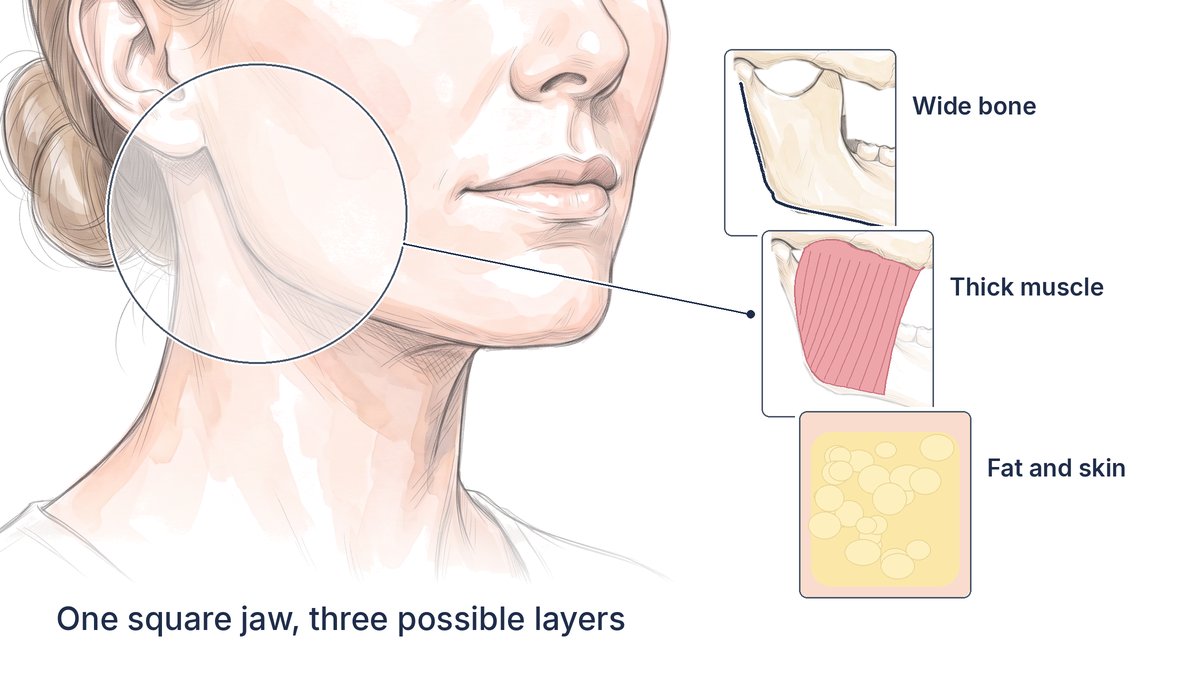
A square jaw comes from a thick masseter muscle, a wide jaw angle bone, or fat and loose skin over both, and each answers to a different treatment. Botulinum toxin of any brand (“Botox” in everyday use) thins only the muscle, jaw angle reduction reshapes only the bone, and a clench test followed, when needed, by a CT tells them apart.
Quick answers
- Can Botox slim a square jaw? Only the muscle part: studies measured the masseter about 15 percent thinner at one month and about 30 percent smaller at three months, with no narrowing of the bone.
- How do I know it is bone? If the corner is still there after the muscle has shrunk with toxin, the bone is wide, and a CT confirms it.
- What does Dr. Yongwoo Lee do? About 25 to 30 units of toxin per side for a muscular jaw; for a bony one, a long curved osteotomy through the mouth, planned on a 3D CT.
Is a Square Jaw Muscle, Bone or Fat, and Does It Need Botox or Jaw Reduction?
The right treatment is the one that matches the layer making your jaw look square: toxin for the masseter (the chewing muscle), bone surgery for a wide jaw angle, and neither for fat or loose skin. Most people choose by invasiveness instead, injections first and surgery only if they disappoint.
In a small randomized cone-beam CT study of 20 adults given one or two sessions, the muscle thinned after toxin but the angle-to-angle width of the jaw bone did not change. In a 243-patient surgical series, that width fell from 123.7 mm to 110.0 mm after a long curved bone cut with grinding of the outer cortex. A bony corner does not answer to any dose of toxin, and a muscular one does not need a saw.

How Can You Tell Whether Your Square Jaw Is Muscle or Bone?
Clench your back teeth and press your fingertips on the corner of your jaw: a muscular square jaw swells and hardens under your fingers and softens again when you relax, while a bony corner feels like the same hard edge either way. A pinch sorts out the fat, and an X-ray or CT settles the bone. Trials find the muscle the same way: one protocol placed its injection points at the area of maximal bulge with the patient clenching.
Three checks at a mirror start the sorting; they guide the conversation with a doctor and are not a diagnosis.
- Clench. A bulge that appears and hardens low on the jaw, near the corner, is muscle.
- Relax and look straight on. A corner that is still there with the muscle soft is bone or soft tissue.
- Pinch. With the teeth clenched, pinch the tissue over the tensed muscle. What rolls between finger and thumb is skin and fat.

Before bone surgery, one Korean surgeon’s review of 588 cases lists photographs, a mandible X-ray series, a lateral cephalogram and a panoramic X-ray as the routine work-up, and a CT adds the course of the nerve inside the bone. Some jaws are mixed, a thick muscle over a wide bone.
Values quoted in a Korean maxillofacial paper put the angle-to-angle width at 117.8 to 125.25 mm in Korean women and 105 to 109 mm in Caucasian women, citing earlier authors who found bone the main cause in Asian patients and muscle in Caucasian patients. These older observational reports are not rules and do not replace the examination.
Why Does a Lower Face Look Wide? The Three Layers at the Jaw Angle
A lower face looks wide because three things are stacked at the jaw angle: bone on the inside, the masseter muscle over it, and fat, gland and skin over that. Each can add width by itself.
Bone. The jaw angle is the corner where the upright back part of the lower jaw, the ramus, meets the horizontal body. Measured from one corner to the other, the bigonial width sets the frame of the lower face. Inside the bone runs the inferior alveolar nerve, which leaves it below the premolar teeth as the mental nerve and gives feeling to the lower lip and chin.
Muscle. The masseter lies on the outer surface of the ramus and the angle. Its neighbors matter for injections: in a Korean ultrasound trial, the origin of the risorius, a smile muscle, covers about the front third of the masseter, the parotid gland covers about the back quarter, and a deep tendon inside the lower muscle can keep toxin from spreading through its full thickness.
Soft tissue. The buccal fat pad sits just in front of the masseter, fat under the skin lies over it, and with age a jowl can slide down across the jaw border. Fullness in front of the muscle is the subject of buccal fat removal and long-term hollowing, and a jowl is a descent problem, sorted in treatment options for jowls.
What Can Masseter Botox Do for a Square Jaw, and What Can It Not Do?
Masseter Botox made the chewing muscle about 15 percent thinner at one month and about 30 percent smaller in volume at three months in published measurements, and after a single session much of that change has faded by about six months, although a placebo-controlled trial could still measure some effect at day 180. It cannot narrow the bone or remove fat, so a face that stays wide after the muscle has shrunk has a different layer to blame.
How much. In a split-face trial of 20 Korean volunteers given 24 units per side, masseter thickness on ultrasound fell from 12.66 mm to 10.77 mm at one month, about 15 percent, and a 3D surface scan showed the contour 1.95 to 2.22 mm flatter. In ten women followed with 3D CT after a single injection, masseter volume was about 30 percent smaller at three months while the other chewing muscles were unchanged.
How long. In the ten-woman CT study the change was noticeable at two weeks, peaked at three months and had gradually returned by six months. A little can outlast it: in a very small study, six women who completed three sessions had masseter volume about 12 percent smaller one year after the third, 23.26 against 26.39 cubic centimeters.
What it does to bone. No narrowing has been measured. In ten women scanned before toxin and three months after, the soft tissue changed and the mandible showed no significant change. In the randomized study of 20 adults, bone volume at the angle fell slightly after two sessions and the width between the angles did not change; the study was small, lasted six months, and did not test whether the bone change shows on the face.
How strong the evidence is. The case series agree with one another, but trial evidence is thin. A Cochrane review that searched to April 2013 found no randomized or controlled trial of toxin for enlarged masseters that met its criteria.
Side effects. In a 220-patient study summarized in a dermatology commentary, complications were reported in 9.1 percent: a bulge on clenching, an unnatural smile, or a hollow below the cheekbone. Jowls, a sunken cheek and what to do about each are covered in masseter Botox, jowls and sunken cheeks.
Masseter Botox vs Jaw Angle Reduction at a Glance: Which Treats Which Square Jaw?
Masseter Botox treats a muscular square jaw, jaw angle reduction a bony one, and liposuction or buccal fat removal soft-tissue fullness; none does another’s job. Measurements come from the studies cited in this article.
| Decision point | Masseter botulinum toxin | Jaw angle reduction | Soft-tissue treatment |
|---|---|---|---|
| What it acts on | The masseter muscle | The jaw angle bone and, when needed, its outer cortex | Fat under the skin or buccal fat |
| Square jaw it suits | A corner that bulges and hardens on clenching | A corner present at rest and wide on CT | A soft, pinchable lower face over ordinary bone and muscle |
| What has been measured | Muscle about 15 percent thinner at 1 month, about 30 percent at 3 months | Angle-to-angle width 123.7 to 110.0 mm in one 243-patient series | No jaw-width measurement in the studies cited here |
| What it cannot change | Bone width, fat | Muscle bulk, fat, loose skin | Bone, muscle |
| Anesthesia | None needed | General anesthesia | Depends on the procedure |
| How long it lasts | Noticeable from about 2 weeks, peaks near 3 months, much of it faded by about 6 months | Lasting change to the bone | Lasting, while the face keeps aging |
| Main risks | Bulge on clenching, uneven smile, hollow cheek, weaker chewing for weeks | Lip and chin numbness, bleeding, infection, asymmetry, sagging, a second angle, temporary lower-lip weakness | Hollowing later, irregularity |
| In my practice | About 25 to 30 units per side, every 3 to 4 months at first | Long curved osteotomy through the mouth, planned on 3D CT | Chosen only when the examination points to fat |
What Does Jaw Angle Reduction Remove, and Why Is Cutting Off the Corner Not Enough?
Jaw angle reduction removes bone from the corner and lower border of the jaw, usually through the mouth, and sometimes thins the outer surface of the bone. Cutting off only the corner mainly changes the side profile and can leave a new corner farther forward.
Side profile and front width are different jobs. A systematic review of nine case series concluded that curved cuts reduce the angle seen from the side but do not reduce the angle-to-angle width efficiently, and that cuts through the outer cortex were the trend for narrowing the front view.
The second angle. Authors of the 243-patient series describe what a corner-only cut can do: it shifts the angle forward onto the body of the jaw, creating a “second mandibular angle”. Their answer was a long curved cut running forward to below the lateral incisor, plus grinding of the outer cortex, which narrowed the width between the angles by about 13.7 mm on CT.
Too much is its own problem. In a retrospective comparison of 106 patients, a long curved cut was followed by more soft-tissue sagging and more “gonial deficiency”, a jaw left without a visible corner, than a cut that kept more height at the back of the ramus, although the final angles were similar. Its authors concluded that the comparison cut, which they call a “V-line” ostectomy (a cut design, not the V-line surgery described below), gave a more natural angle with fewer complications and may be preferable. In this single retrospective study, what separated the groups was the height left at the back of the ramus: bone taken from that edge erases the corner, so how far any cut reaches has to be planned for each jaw.

Width is often treated in layers. Of 407 patients in a Chinese series, 248 had the angle alone and the rest had it combined with genioplasty, cheekbone reduction, buccal fat removal or liposuction under the chin. “V-line surgery” usually means an angle reduction plus a narrowing of the chin, and the chin half is explained in genioplasty versus a chin implant versus chin filler.
How Does Dr. Yongwoo Lee Decide Between Botox and Jaw Angle Reduction?
I decide by layer. A corner that is muscle gets toxin, a corner that is bone on CT gets a long curved jaw angle osteotomy, and when the examination cannot separate the two, toxin goes first because the muscle’s response is itself the test.
The examination
I look at the jaw at rest from the front and from the side, then ask the patient to clench while I feel the corner. A bulge that hardens under my fingers is masseter. An edge that does not change is bone or soft tissue, and a pinch tells me which.
Toxin: dose, depth and interval
I inject masseter toxin myself: about 25 to 30 units per side of the two products I use (units do not convert exactly between brands), deep in the lower part of the muscle and away from the risorius, the smile muscle at its front edge, repeated every 3 to 4 months at first, with intervals that lengthen after several rounds. If a paradoxical bulge shows on clenching at the two-week check, I add a top-up of 5 to 10 units per side into the bulging part. Products, injection points, follow-up and what to do about a hollow are covered in masseter Botox, jowls and sunken cheeks.
When toxin is the test
My rule is short: if the corner still shows after the muscle has shrunk with toxin, the bone is wide, and I confirm it with a CT. Published measurements put the muscle at its thinnest around three months, which is when a remaining corner is easiest to judge.
Before bone surgery: a 3D CT
I take a 3D CT before every jaw angle reduction. It shows the course of the inferior alveolar nerve inside the bone on each side, because the cut runs below that canal, and I plan the cut line on it. An 11-patient series of guide-assisted angle surgery kept the planned cut more than 3 mm from the nerve canal.
The operation: a long curved osteotomy, not a corner cut
I operate through incisions inside the mouth and do not simply cut off the angle. I make a long curved osteotomy that carries the line forward along the lower border, so the jaw ends in a smooth curve instead of a second corner. When the front view needs narrowing as well, I shave the outer cortex of the bone. I take only the bone that jaw needs and lift as little of the masseter and periosteum off it as I can, because tissue that loses its attachment to bone can sag.
I often combine the angle reduction with a genioplasty, because a jaw narrowed at the back can leave the chin looking wide or blunt by comparison. When that chin already holds an implant, what to do with the implant is sorted in chin implant problems: erosion, shifting and infection.
Anesthesia, the first night, and what I do not do
Bone surgery in my practice is done under general anesthesia given by a board-certified anesthesiologist, and patients stay in the clinic the first night after jaw angle reduction.
I do not perform two-jaw (orthognathic) surgery. When a square jaw comes with a bite that does not meet properly, I say so and refer for an orthognathic assessment before any contouring is planned.
Which Square Jaw Are You?
These profiles are illustrative examples, not real patients, and they describe decisions, not results.
A woman in her late 20s whose jaw corner balloons when she clenches and softens at rest. Muscle. Toxin is the reasonable first treatment, and what is left once the muscle has shrunk shows whether bone plays a part.
A patient who has had toxin several times: the face slimmed, the corner stayed. A corner that outlasts a shrunken muscle, or one that is sharp at rest and does not change on clenching, is treated as bone. A CT and a discussion of angle reduction come next.
A round, soft lower face with an ordinary clench and a thick pinch. Soft tissue. Neither toxin nor a bone cut will thin it; what matters is which fat it is, and whether removing it will hollow the face later.
A patient in the late 40s whose jawline has turned square with a jowl. Descent, not width. Bone removal does not lift tissue that has slid, and sagging is one of its known risks, so lifting is the conversation.
What Is Recovery Like After Masseter Botox and After Jaw Angle Reduction?
Masseter Botox needs no recovery beyond waiting, and chewing can feel weaker for some weeks. Jaw angle reduction means a night in the clinic, a compression band and a liquid-then-soft diet over the first weeks, and a contour that keeps settling for months.
After jaw angle reduction, in my practice.
- First night: in the clinic. International patients then recover in the accommodation inside the clinic building, with nurses on call.
- Drain: 1 to 2 days. It exits inside the mouth, so there is no puncture in the skin.
- Compression band: 1 to 2 weeks, kept on longer at night.
- Food: a liquid diet for 1 to 2 weeks, then soft food until week 4.
- Mouth care: an antiseptic gargle, because the incisions are inside the mouth.
- Flying home: 10 to 14 days after surgery.
- With a genioplasty in the same operation: this jaw-angle schedule applies to the combination, including the liquid diet, soft food until week 4 and the band.
What the published series add. In the 243-patient series, restricted mouth opening (3.3 percent) resolved within three weeks and lip and chin numbness (6.2 percent) within three to six months. That series took its postoperative CT at a mean of about 11 months, and the 106-patient comparison judged the jaw on CT and photographs at 6 to 12 months, so the final shape is assessed months, not weeks, after surgery.
Surgeon’s Insight: The Muscle Answers First
When a patient asks me “Botox or surgery?” for a square jaw, I ask them to clench. Toxin is a treatment and a question at the same time: if the corner is still there once the muscle has shrunk, the bone has answered, and a CT confirms it.
In surgery the mistake I most want to avoid is treating the corner as if it were the whole jaw. Cut only the corner and a new one appears farther forward, which is why the cut I make is long and curved. Take too much, especially from the back edge of the ramus, and the jawline goes with it, which is why the cut line is planned around the nerve on a 3D CT and I take only what that jaw needs. A narrower jaw that has lost its angle is not an improvement.
What Are the Risks of Masseter Botox and of Jaw Angle Reduction?
Masseter Botox mainly risks a bulge on clenching, an uneven smile, a hollow cheek and weaker chewing, which fade as the drug wears off. Jaw angle reduction mainly risks numbness of the lower lip and chin, bleeding, infection, asymmetry and sagging of the soft tissue, and a small share of the numbness lasts. Rarer are temporary weakness of the lower lip from bruising of a facial nerve branch, heavy bleeding from the large vessels near the angle, and a fracture running up toward the jaw joint; the series below report them as uncommon or absent.
Toxin. As with any botulinum toxin treatment, new difficulty swallowing, speaking or breathing, or new double vision, drooping eyelids or general weakness, in the hours to weeks after an injection is an emergency: call emergency services or go to the nearest emergency room first, then tell the doctor who injected you. A neuromuscular disease such as myasthenia gravis, or existing trouble swallowing or breathing, should be mentioned before treatment, and toxin is usually postponed during pregnancy and breastfeeding.
Nerve, bleeding and symmetry. In the 588-case Korean review, about 6 percent of patients had a change in sensation, most often at the chin, and about 1.5 percent still had it at one year. In a Chinese review of 672 patients, 59 had complications, 8.8 percent, including 18 asymmetries, 20 cases of lip numbness that recovered in 3 to 6 weeks, 12 of bleeding and 5 temporary facial nerve injuries that recovered in 2 to 3 months.
Sagging. In the 243-patient series, 4.5 percent developed what the authors call a sagging face, which they attributed to lost volume and to lifting the periosteum off the bone, and treated with liposuction 6 to 15 months later. A patient whose skin is already lax hears about this before surgery, and a lift is discussed when it is needed. A similar loss of attachment lies behind cheek sagging and nonunion after zygoma reduction.
The surgeon. A ten-year review of 528 patients from one center reported an overall complication rate of 5.87 percent that ranged from 3.5 to 11.1 percent between surgeons, with no fracture toward the jaw joint, no massive bleeding and no permanent facial nerve injury. Who operates is part of the risk, and how to confirm it is in how to choose a plastic surgeon in Korea.
Before surgery. Over-the-counter painkillers and supplements that raise bleeding risk, such as aspirin taken on your own and fish oil, stop two weeks before; GLP-1 drugs such as semaglutide stop one month before and restart one to two weeks after, with the prescriber; estrogen-containing hormones stop four weeks before. In my practice, nicotine in any form (cigarettes, vaping, patches or gum) stops four weeks before and four weeks after bone surgery, and a patient who cannot stop has the operation postponed; alcohol stops two weeks before and two weeks after. Reasons are in what to stop before plastic surgery. A blood thinner prescribed for the heart, a stent or a clot, or a diabetes medicine, is never stopped without the doctor who prescribed it.
Warning signs after bone surgery. Swelling of the face, neck or floor of the mouth that grows quickly, or new difficulty breathing or swallowing, is an emergency: call emergency services or go to the nearest emergency room first, then contact your surgeon. Fever, discharge from the incision, or pain that rises after the first week needs a call to the surgeon the same day, and so does a bite that suddenly no longer meets as it did, or bleeding inside the mouth that does not slow with gentle pressure.
What Should Decide Between Botox and Jaw Reduction for a Square Jaw?
One question should decide: which layer makes the corner, and does it change when you clench? A corner that swells on clenching is muscle, and toxin is a repeatable, reversible treatment for it. A corner that stays after the muscle has shrunk is bone, and only an operation planned on a CT changes it. Fullness that pinches is neither. A consultation should begin with your jaw examined at rest and clenched, before any treatment is named.
Individual results vary; consultation required.
Written by Dr. Yongwoo Lee, board-certified Korean plastic surgery specialist in facial anatomy and aesthetic procedures at VIP Plastic Surgery, South Korea.
Frequently Asked Questions About Square Jaws, Masseter Botox and Jaw Angle Reduction
Can a square jaw be both muscle and bone?
Yes. Some jaws are mixed, a thick masseter over a wide bone. When the examination cannot separate the two, Dr. Yongwoo Lee gives toxin first: if the corner is still there once the muscle has shrunk, the bone is wide, and a CT confirms it.
Will a higher Botox dose slim a jaw that is bony?
No. Toxin acts only on the muscle, and more units cannot narrow bone. Dr. Lee uses about 25 to 30 units per side of the products he uses, in the range published studies have used, and if the corner remains once the muscle has shrunk, the next step is a CT, not more units.
Can repeated masseter Botox slim a square jaw permanently?
Not fully. After a single session much of the effect has worn off by about six months, so treatment is repeated, every 3 to 4 months at first in Dr. Lee’s practice, and a small reduction can outlast it: in a very small study, six women who completed three sessions had masseter volume about 12 percent smaller one year after the third. The bone does not narrow, so a corner made by bone is changed only by surgery.
Can Botox make my jaw bone smaller?
Not narrower. CT studies found no significant change in the jaw bone three months after one session and no change in the width between the angles at six months. One small study found slightly less bone volume at the angle after two sessions; whether that is visible is not known.
Why is my face still wide after jaw Botox?
Usually because the width was never only muscle. A corner that remains once the muscle has thinned is bone or soft tissue, and a CT separates the two.
Is V-line surgery the same as jaw angle reduction?
Not quite. Jaw angle reduction treats the back corner of the jaw, while V-line surgery usually adds a narrowing of the chin, a genioplasty, so the whole lower border tapers. Dr. Lee often combines the two.
Will jaw reduction cause sagging or jowls?
It can. In one series of 243 patients, 4.5 percent developed a sagging face. Dr. Lee lifts as little tissue off the bone as he can and discusses a lift beforehand with patients whose skin is already lax.
Is numbness after jaw reduction permanent?
Usually it is temporary. In a Korean review of 588 cases about 6 percent had a change in sensation of the chin, lower lip or inside of the mouth, and about 1.5 percent still had it at one year.
Do I need a CT scan before jaw angle reduction?
Yes, in Dr. Lee’s practice. A 3D CT shows the course of the inferior alveolar nerve inside the bone on each side, and the cut line is planned on it so the cut runs below that nerve canal.
How long is recovery after jaw angle reduction, and when can I fly home?
In Dr. Lee’s practice: one night in the clinic, a drain for 1 to 2 days, a compression band for 1 to 2 weeks, a liquid diet for 1 to 2 weeks, soft food until week 4, and a flight home 10 to 14 days after surgery. Incisions and the drain exit are inside the mouth, and the same schedule applies when a genioplasty is added.
Can buccal fat removal or liposuction slim a square jaw?
Only when the squareness is soft tissue. Neither changes bone or muscle, and in surgical series they appear as additions to a bone operation, not replacements for it.
This article is for informational purposes only and does not constitute medical advice. Always consult with a qualified medical professional before making any decisions about surgical or non-surgical procedures.
