
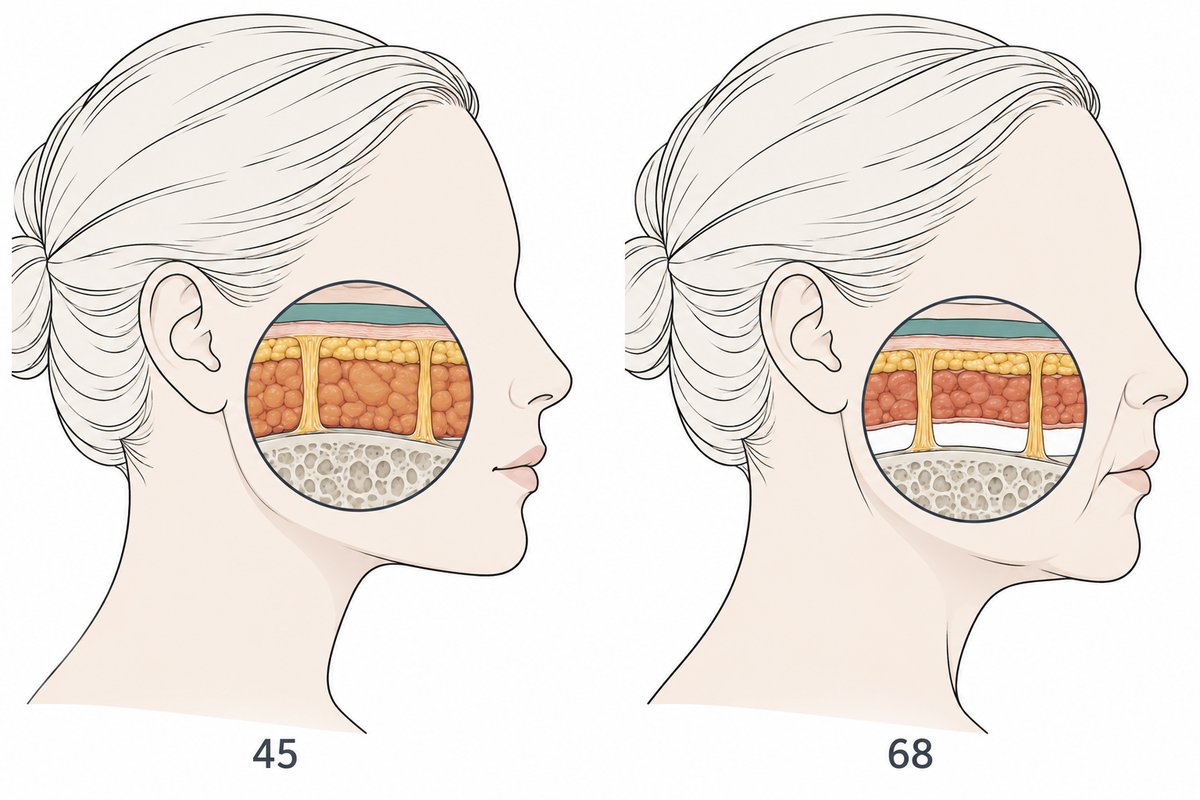
Is There a Best Age for a Facelift? A Birthday Is the Wrong Unit
The best age for a facelift is not a birthday, and the reason is more useful than the shrug that usually follows that sentence. A facelift at 45 and a facelift at 68 are the same operation performed on different tissue. What separates those two faces is not danger and not technique. It is which layer has changed, and whether an operation can reach it. Across 11,300 facelifts with a mean patient age of 59.2 years, age was not an independent predictor of complications: major complications ran at 1.8 percent, hematoma at 1.1 percent, infection at 0.3 percent. What did predict trouble was male sex, a body mass index of 25 or above, and combining the lift with other procedures.
So the birthday is doing almost no work, either as a permission slip or as a warning. Patients arrive convinced that 45 is too early and 70 too late, and both beliefs treat the calendar as a proxy for the tissue. Bone, deep fat, the tissue held between the retaining ligaments, and skin each run on their own clock.
This guide goes layer by layer through what has been measured, then maps every layer onto the procedure that reaches it. Three findings contradict what patients are told: no measurement has found retaining ligaments weakening with age, cheek fat loss is largely finished by middle age, and in Korean faces the orbital rim does not measurably widen.
The Real Question Is Which Layer Has Changed, and Whether an Operation Can Reach It
Four layers age, and no single operation touches more than two of them. Bone resorbs at specific sites and changes the platform everything else sits on. Deep fat compartments lose volume, so a skin envelope that used to be filled hangs slack. Soft tissue slides between retaining ligaments that stay where they were. Skin loses collagen, thickness and, above all, its ability to snap back.
A facelift is an operation on the third of those. It releases the tethers, moves the sheet of tissue between them up and back, and closes the skin without load. A lift does not put back what deflation took, rebuild a resorbed maxilla, or thicken dermis. Confusion here is behind much of the disappointment after facial surgery: a hollow midface with a clean jawline gets a technically correct lift, and the patient reports looking pulled and still tired. Nothing failed. Wrong layer.
Age is useful only as a rough prior about which layers are likely involved. One long-term signal does run against the fear driving most early consultations: in a review of long-term facelift outcomes, patients operated on under 50 reported better satisfaction many years later. That study did not measure why.
What Actually Ages in a Face: Bone, Deep Fat, the Tissue Between the Ligaments, and Skin
Facial aging is four processes on four schedules, and they are not equally reversible. Bone resorbs at defined sites and never returns. Deep fat compartments deflate, mostly early. Tissue between fixed ligaments slides, and that can be put back. Skin loses recoil, which can be improved but not restored.

Bone: The Platform Recedes, at Specific Sites and on an Ethnic Schedule
Facial bone does not shrink evenly; it resorbs at particular places. In a computed tomography study of 120 subjects in three age bands, the glabellar and maxillary angles decreased, mandibular length and height decreased, and the mandibular angle opened. One figure is quotable, from a review of the anatomy of the aging face: the maxillary angle is about 10 degrees less over 60 than under 30. Inferolateral orbital rim resorption is present by middle age, the superomedial rim only in old age.
Here the standard account stops describing the reader of this site. In 107 Korean subjects compared between 20 to 35 years and 60 and over, orbital aperture height and area showed no significant change, a mean difference under about 0.1 millimeter. In 54 East Asian subjects scanned in their twenties, forties and sixties, the orbital roof and floor differed between the 20s and the 40s, then held flat. Western textbooks describe a rim that widens into old age, and for Korean patients that does not hold. Broader accounts of the Asian face, such as a conceptual model of a wider, flatter midface with heavier soft tissue and thicker skin, are opinion rather than measurement.
Sex changes the schedule too. In 3D scans of 88 faces aged 26 to 90 measured at 585 points, both sexes changed along a similar trajectory until roughly 50, after which the female trajectory turned sharply, best predicted by years since the last menstrual period and attributed mainly to mandibular resorption.
Deep Fat: The Loss Is Front-Loaded, and Mostly Over by Middle Age
Cheek fat does not drain steadily from 30 to 80, because most of the loss has already happened by middle age. In an MRI study of 58 women in young, middle and older groups, medial cheek subcutaneous tissue was 3.3 millimeters thinner in the middle group and 3.2 millimeters thinner in the older group. Lateral cheek was 2.4 millimeters thinner in both comparisons, infraorbital tissue 1.6 then 2.2 millimeters thinner, and temporal thickness measured 12.3, 8.4 and 8.9 millimeters. Those authors placed the most dramatic changes between 30 and 60.
Fat sits in discrete compartments, and cadaver dye work established that the face does not age as a confluent or composite mass. In 14 hemifaces studied at the deep medial cheek, volume loss left a skin envelope with more surface than content, a state called pseudoptosis. Among 12 cadaver heads compared at 54 to 75 and 75 to 104 years, compartments sat further from the infraorbital rim, the lower third fuller.
One finding deserves pinning to the wall. In photographs of the same individuals taken 10 to 50 years apart and superimposed, the lid-cheek junction stayed stable in position, becoming visible by contrast rather than by descent. Moles and orbicularis wrinkles held their places across decades.
The Tissue Between the Ligaments: Tethers Stay Put, the Tissue Between Them Slides
No measurement has found that retaining ligaments stretch with age. That is the opposite of the standard consultation explanation, and both studies that have looked point the other way. Four ligaments run from deep fascia or bone up to the dermis in the original account of the retaining ligaments of the cheek: zygomatic, mandibular, platysma-auricular and anterior platysma-cutaneous. They restrain the facial skin against gravitational change, delineate the anterior border of the jowl, and must be interrupted for maximum upward movement, from positions later work calls constant across individuals.
Now the biomechanics. In cadaver testing of the four ligaments, the zygomatic was strongest and stiffest, then the orbital, then the mandibular and maxillary. Dimensions and biophysical properties did not vary with hemiface, age or sex. And in the only age-stratified study of these structures, performed in rats, the type I to type III collagen ratio rose from 1.74 to 3.93 to 5.58 from young to middle to mature animals, the ligaments becoming stiffer and more fascia-like rather than laxer.
So the mechanism is concrete. Fixed points stay fixed while tissue between them deflates and slides, and a fold forms where a tether holds skin back against tissue sliding past it. That is why jowls and nasolabial folds appear at predictable coordinates on very different faces, and why dividing the tethers moves tissue when tightening against them cannot.
Skin: Recoil Goes Before Firmness, and Menopause Accelerates It
Skin loses its ability to recover from stretch faster than it loses stiffness, and that decides how a face responds to surgery. In cutometry on 300 subjects aged 20 to 74, every parameter declined with age, but recovery-phase parameters declined more. A face can feel firm to the pinch with very little snap-back left, and skin like that will not shrink to a new frame after a lift. That is the property behind the pulled result described in why some facelifts look windblown.
Thickness falls too, and unevenly. In high-frequency ultrasound of 118 adults, dermal thickness fell with age in women at the forehead, glabella, zygoma and submandibular region, most strongly at the zygoma; in men only the zygoma reached significance. Collagen also falls with age, less in women at all ages in the classic study of skin collagen and age. Over the menopausal transition the loss is steep: skin collagen is thought to decrease by as much as 30 percent in the first five years after menopause, then by about 2 percent per postmenopausal year, with thickness falling about 1.13 percent per year.
Muscle is the layer patients most often blame. In MRI of 20 women aged 16 to 30 and over 59, the mimetic muscles showed no significant difference in length, thickness, volume or fatty infiltration. Muscles of expression are not what sags, so tightening a muscle sheet tightens something that did not change. That is the difference set out in deep plane versus SMAS facelifts.
What Changes at 40, 50, 60 and 70: What the Data Actually Place in Each Decade
Each decade below is built only from findings the sources locate in that range, which makes these sections shorter than the usual decade guide. Nearly all this evidence is cross-sectional: different people compared at different ages, not one person followed through. Decade boundaries are a convenience, since the studies used bands such as 21 to 30, 41 to 50 and 61 to 70.

Your 40s: Deflation Has Mostly Happened, and the Frame Is Still Intact
By the forties the fat loss has largely occurred, which is why patients in this decade describe looking tired rather than loose. Medial cheek tissue in the middle-aged MRI group was 3.3 millimeters thinner than in the young group, and the older group measured 3.2 millimeters thinner than the same young group, which is no further loss. Temporal thickness had already gone from 12.3 to 8.4 millimeters.
Skeletal change here is site-specific and, around the East Asian orbit, largely finished: roof and floor dimensions in the East Asian computed tomography series differed between the 20s and the 40s and then held flat. Inferolateral orbital rim resorption is present by middle age, while the mandible is not yet in play and no age variation has been measured in the ligaments in any decade, since the cadaver biomechanics found none. On these measurements a face in the forties is more often a volume problem than a frame problem, with skin that still recoils.
Your 50s: The Trajectory Turns, and the Jawline Joins the Problem
Something measurable happens to female facial aging at around 50. In the 3D shape analysis, both sexes followed similar trajectories until roughly that age, after which the female trajectory turned sharply, most steeply in early postmenopause. Years since the last menstrual period predicted it better than age did, and mandibular resorption carried most of it. That is the closest measured correlate of what patients report as a sudden event: a jawline clean at 51 and blurred at 53.
Skin runs on the same clock. Collagen and thickness after menopause were described in the original endocrine work as declining between 1 and 2 percent per year, and the later review puts the early drop at as much as 30 percent within the first five years. No facelift series has tested menopause as a risk factor, and in the outcome data below age itself was not an independent predictor. What menopause changes is the diagnosis: a resorbed mandible under skin with less recoil produces jowling that filler tends to make heavier.
Your 60s: The Skeleton Finishes What It Started
By the sixties the skeletal changes on the table are the ones the computed tomography series place in their oldest age band. Maxillary angle is about 10 degrees less over 60 than under 30, and the anterior maxillary wall angle decreased significantly across bands of 21 to 30, 41 to 50 and 61 to 70 in 62 patients. Pyriform aperture area increases with age in the three-band skeletal analysis while the pyriform angle does not, though that series placed the increase between its young and middle groups rather than late. Superomedial orbital rim resorption belongs here, because the anatomic review places it in old age only.
Soft tissue is quieter than expected. Cheek thickness in the older MRI group was not lower than in the middle group, so the deflation that dominated the forties is no longer the active process. Orbital aperture height and area in the 107-subject Korean series also did not change between the twenties and the sixties, so advice built on a widening orbit does not apply here.
Your 70s and Beyond: The Operation Is Still the Same Operation
Facelift outcomes in the seventies are unusually well documented, and they are unremarkable in the reassuring sense. Among 216 patients divided at age 65, mean ages 57.6 and 70.0, major complications ran 2.0 percent under 65 and 2.9 percent at 65 and over, p equal to 0.65, with minor complications at 6.1 versus 5.9 percent. Chronologic age alone was not an independent risk factor. In 541 patients stratified up to 76 and over, major complications were 0.4 percent, and the oldest stratum returned an odds ratio of 1.82, confidence interval 0.51 to 5.19, wide enough to include no effect.
One number describes who these patients are: 41.2 percent of the older group had already had a facelift, against 17.6 percent of the younger. And a review of 42 secondary facelifts found a mean interval of 11.9 years between primary and secondary lift, range 1.0 to 34.5 years, with mean ages of 50.2 and 61.9.
Which Procedure Reaches Which Layer: At a Glance
Matching a complaint to a layer, and a layer to an operation, is most of what a consultation should do. Below is that map, with an honest fourth column: what will not reach the problem however well it is done.
| Layer | What changes | What reaches it on this site | What does not |
|---|---|---|---|
| Bone: rim, maxilla, mandible | Maxillary angle about 10 degrees less by over 60; mandible loses height and length | Volume over the recessed area, or a skeletal procedure | Any lift, and filler as a substitute, the mismatch in an overfilled face |
| Deep fat compartments | Medial cheek 3.3 mm thinner by middle age, with no further thinning measured after | Fat grafting to the deflated compartment, with the caveats in how much transplanted fat survives | A facelift. Lifting an empty envelope tightens it without filling it |
| Tissue between the ligaments | Tethers stay fixed while tissue between them slides, forming folds at constant coordinates | Deep plane release of the zygomatic and mandibular ligaments | Barbed sutures, whose limits are in thread lifts versus facelifts |
| Jawline and jowl, neck clean | Jowl forms at the anterior border of the mandibular ligament; prejowl mandible resorbs | A shorter incision when the neck is genuinely clean, as in a mini facelift versus a full facelift | Skin-only tightening, which loads the tether it never divided |
| Platysma and deep neck | Submental fullness, blunted cervicomental angle, vertical banding | Platysma repair, sorted by the bedside checks in neck liposuction versus a neck lift | A cheek lift alone, which cannot reach behind the mandible |
| Skin: dermis and recoil | Recovery after stretch declines faster than firmness; dermal thinning at zygoma, forehead, glabella, submandibular region | Collagen-directed heating, compared in Ultherapy, Thermage and Shurink | Any device as a substitute for release. Heat changes dermis, not position |
| Dermal quality | Collagen is thought to fall by as much as 30 percent in the first five postmenopausal years, then about 2 percent per year | Injectable dermal support, compared in Rejuran, Juvelook and Skinvive | Structural correction. A booster improves material, never architecture |
| Lid-cheek junction | Does not descend; becomes visible by contrast between a hollow and a bulge | Repositioning orbital fat over the rim, examined in fat repositioning versus removal | Removing the fat, which deepens the contrast the patient came in about |
| Brow and upper orbit | Superomedial rim resorption in old age, with no measurable widening of the orbital aperture in Korean subjects | Brow repositioning, with the options in endotine versus suture fixation and a sub-brow lift versus an upper blepharoplasty | Skin excision at the lid when the descent is at the brow |
| Buccal fat pad | Does not deflate the way superficial compartments do | Removal through the mouth in the narrow group in buccal fat removal and long-term hollowing | Reversal. Removed fat cells do not regrow, as in whether fat comes back after liposuction |
Read down that fourth column and a pattern behind disappointing results appears: a technically correct operation aimed at the wrong layer.
How I Operate on a 45-Year-Old Face and a 68-Year-Old Face: The Same Release, Different Additions
Both faces get the same operation. I use the deep plane technique in most of my facelifts, because a tightened SMAS works against tension that never went away, and the biomechanics above say that tether did not weaken in either patient. In both, I release the zygomatic and mandibular ligaments as completely as the anatomy allows, then move skin and deep layer together as one composite unit. A partially released face is a compromised face: whatever ligament is left intact becomes the new tether and the new limit. That matters more in Asian anatomy, where the SMAS boundary at the zygomaticus muscles is indistinct.
What changes with the presentation is the access and the additions, not the plane. When the neck genuinely does not need work, the same deep plane operation goes through a shorter incision with the limb behind the ear omitted: a mini facelift here means the same release, less scar.
Some parts do not vary at all. A hemostatic net goes in at the end of every facelift without exception, 4-0 nylon through the lifted flap to the floor of the dissection, out at three to four days. Two closed-suction drains go in per side, both brought out near the mastoid. When buccal fat is genuinely the surplus, it comes out through the mouth as the first step, decided by looking at the temple and the hollow under the cheekbone. If either is already thinning, I decline. Filler in the wrong layer is dissolved first, with surgery three to six months later, and no revision happens inside six months.
What is physically different on the table
The tissue itself announces the decade before the chart does. In a patient in her forties the SMAS is thick and holds a suture, the subcutaneous fat is generous enough that the plane beneath the SMAS opens cleanly, and the skin is heavy and redrapes on its own. In a patient in her late sixties the SMAS is thinner and more fragile, and a suture placed in it under tension will pull through, which is the practical reason I move the released composite as a unit rather than gathering a weak sheet with stitches. Her skin is lighter and the dermis is sparse, and the excess is concentrated in the neck. Ligaments feel the same at both ages; what makes a release slow is not the birthday but what was done before, since threads, repeated filler and a previous lift all leave scar in the plane I need. Bleeding tracks blood pressure, sex and antiplatelet medication far more than age, which is why the hemostatic net goes in at every age.
How much skin actually comes off
Less than patients expect, because the skin does not carry the lift. In a first deep plane lift on a face in the forties, the trim in front of the ear is on the order of one to two centimeters, and behind the ear often nothing, because the limb is omitted. On a face in the late sixties the trim in front of the ear runs closer to two to four centimeters, and behind the ear, where the neck skin gathers, it can exceed five. I treat those numbers as a description of the envelope, not as a measure of the result: the tension sits in the deep layer, and the skin is closed without load at both ages.
When fat grafting is added
A finding decides it, never the age. Two findings send me to the graft: a hollow temple with a sunken deep medial cheek, and a step at the lid-cheek junction where the orbital rim shows through. When either is present, fat goes to the deep medial cheek and the temple, to the rim of the orbit, and where needed to the prejowl groove and the corner of the mouth, in small volumes per site. On faces past fifty that is a common addition to a lift; in the forties the more common plan is a graft with no lift at all, because deflation is the diagnosis and nothing has slid. What survives is partial, on the terms set out in the fat grafting guide, so I graft for what will remain, not for what goes in.
When I say wait, and when I say no
To a patient in her forties I say wait when lifting her cheek by hand corrects nothing, because a face that does not improve with a manual lift will not improve with a surgical one; deflation is treated with volume, not release. I also ask her to wait through large weight swings, to stop smoking, since a smoker faces a separate and larger risk to the skin itself than any birthday does, detailed in why smoking raises facelift skin necrosis risk, and to have filler dissolved and settled for three to six months before we plan. To a patient in her seventies I do not say no because of the number. I say no for blood pressure that will not settle, for a heart that cannot spare its anticoagulant, for a mind that cannot follow the first week of instructions, and for an expectation that is a photograph of herself at forty. Those four have sent patients home; the calendar never has.
The postmenopausal face
Menopause is not a line on my consent form, but its findings change two things in the plan. A resorbed mandible leaves a groove in front of the jowl, so a lift alone does not restore a straight jawline and the prejowl is grafted at the same sitting. And the neck skin has lost its recoil, so the retroauricular limb is rarely omitted, the platysma is repaired almost every time, and more skin is trimmed behind the ear than a younger neck would need. Oral estrogen is asked about as a thrombosis question, and its timing around surgery is decided with the prescribing physician, not by me alone.
Which One Are You
Patients sort by presentation, not by decade, and the six below cover most of what arrives at a lifting consultation.

The 44-year-old whose cheek has flattened but whose jawline is clean. Volume is the diagnosis. Medial cheek tissue is already about 3.3 millimeters thinner by middle age, while mandibular resorption is not what the sources place in this decade. Refilling the deflated compartment addresses what happened; a lift tightens an envelope short of content.
The 52-year-old whose jawline broke in eighteen months. Rapid change at this age is the pattern the 3D shape work describes, with the female trajectory turning at about 50 and mandibular resorption carrying most of it. Filler along the jaw tends to add weight to a border that lost its support.
The 58-year-old with a full neck and good skin. Neck first. Submental fullness with a blunted angle is a neck diagnosis, and the incision has to reach behind the ear and usually under the chin, whatever the cheek looks like. Good recoil helps, because a neck that can redrape holds its new angle better.
The 63-year-old who has had threads and filler for a decade. Two problems arrive together: material in the wrong layer, and tissue planes repeatedly scarred. Old filler is dissolved and the face allowed to settle before any plan is made, and dissection through thread fibrosis is slower.
The 71-year-old on her second lift. Common rather than exceptional: 41.2 percent of patients aged 65 and over in the 216-patient comparison had already had a facelift, and mean age at a secondary lift was 61.9. What differs is a plane operated on before, and how much skin is available.
The 47-year-old man. Same layers, different risk profile and different incision. Male patients carried about 3.9 times the hematoma risk of female patients in the 11,300-patient database, a reason to tighten the bleeding protocol rather than decline. Bearded skin also dictates where the incision sits relative to the tragus.
Does Recovery Take Longer at 60 Than at 45?
Recovery timelines are broadly the same at 60 as at 45, and the complication data say so directly: neither the 216-patient comparison across age 65 nor the 541-patient stratified series found a significant difference by age. Sutures come out around day seven, cheek numbness resolves over months, and a scar takes a full year, on the schedule in facelift scars and how the incision heals.
What differs is the envelope the swelling settles into. Because the ability to recover after stretch declines faster than firmness does, older skin adapts to a new contour more slowly, so the last stage of settling reads differently even when the calendar is identical. That is a finish characteristic, not a complication.
For patients traveling, the planning window is the same in any decade: presentable in private at about two weeks, socially comfortable at four to six, on the schedule in how long to stay in Korea after surgery.
Surgeon’s Insight
When a patient tells me her age before she tells me her complaint, I ask her to start again. What I need to know is which layer stopped doing its job, because that is the only thing an operation can answer. A face at 45 and a face at 68 get the same release from me, and the honest difference between them is what I have to add and what the skin will do afterward. The most useful sentence I say in these consultations is often that nothing needs lifting yet, and the second most useful is that the seventies are not a closed door. Neither is a statement about a birthday. Both are statements about tissue I have examined.
Am I Too Old for a Facelift? Risk After 65 and 75, in Numbers
Age is not what the outcome data are worried about. Across 11,300 facelifts, major complications ran at 1.8 percent, hematoma at 1.1 percent and infection at 0.3 percent, and age predicted none independently. In 216 patients split at 65 they were 2.0 and 2.9 percent, and in 541 patients with strata reaching 76 and over, 0.4 percent major and 7.6 percent minor.
What those studies do predict is easy to name. Hematoma risk was 3.9 times higher in male patients and 2.6 times higher in one facility category. Infection risk was 2.8 times higher at a body mass index of 25 or above, and 3.5 times higher when the facelift was combined with another procedure. Combining raised the major complication rate to 3.7 percent against 1.5 percent alone. Sex, weight, what else is done in the same session, and where: those are the levers, and none is a birthday.
One caveat travels with all of these numbers. These are screened populations, operated on by surgeons who declined the patients they judged unfit, and the 541-patient series was a single surgeon with strict criteria. Absence of an age effect there means age added no risk among people already judged fit, not that screening is unnecessary. Bleeding control is where the age question gets answered in practice, and the protocol this site uses is in preventing facelift hematoma with a hemostatic net.
Ask Which Layer Has Failed, Not Which Birthday Has Passed
Choosing surgery by age means answering a question nobody measured. Every study here measured a layer: a millimeter of cheek thickness, a degree of maxillary angle, a stiffness value in a ligament, a recovery curve in stretched skin. Age bands were containers for those measurements, not causes.
A useful consultation therefore runs the four layers in order. Has the platform receded, and where. Has a compartment deflated, and which one. Has tissue slid between tethers still exactly where they always were. Will this skin come back after being stretched. Answer those four and the operation names itself.
Ask a surgeon which layer he thinks has failed and what he will do about each one: what he will release, what he will add, and what he expects the skin to do afterward. A surgeon who answers in layers is examining a face. A surgeon who answers in decades is reading a chart, and that mismatch between plan and complaint is what this site examines in what natural actually means in plastic surgery.
Written by Dr. Yongwoo Lee, board-certified Korean plastic surgery specialist in facial anatomy and aesthetic procedures at VIP Plastic Surgery, South Korea.
Frequently Asked Questions About the Best Age for a Facelift
What is the best age for a facelift?
No age is best, because no study has measured a decade as a cause of anything. What has been measured is layers: cheek tissue about 3.3 millimeters thinner by middle age, a maxillary angle about 10 degrees smaller over 60 than under 30, ligaments in which no age difference has been measured, and skin that loses recoil faster than firmness.
Am I too young for a facelift at 40?
Probably not too young, but possibly aiming at the wrong layer. Most cheek volume loss has already happened by middle age, and the ligaments and mandible are usually still intact in the forties, so a face at 40 is more often deflated than descended. A jowl that lifts cleanly when the cheek is raised by hand is the finding that makes an operation reasonable.
Am I too old for a facelift at 70?
Not according to the outcome data. In 216 patients divided at 65, major complications were 2.9 percent in the older group and 2.0 percent in the younger, a difference that was not statistically significant. Chronologic age alone was not an independent risk factor there, nor in the 11,300-patient database.
Is a facelift safe after 75?
Available evidence says the age itself adds no measurable risk. In 541 patients stratified up to 76 and over, with 7 percent in that oldest band, major complications were 0.4 percent overall, and odds for the oldest group came out at 1.82, confidence interval 0.51 to 5.19. That was one surgeon applying strict selection.
Does a facelift last longer if it is done younger?
Nobody has measured that directly. A review of 42 secondary facelifts found a mean of 11.9 years between the first and second operation, range 1.0 to 34.5 years, mean age 50.2 at the primary lift, but that paper did not analyze age against longevity. A separate review reported better satisfaction in patients operated on under 50.
Should I wait until 60 and have one operation instead of two?
Waiting is reasonable only if what bothers you now is a layer surgery would not fix anyway. If the complaint is deflation, waiting changes nothing about the operation you would eventually have. If it is a jowl that a hand lift corrects, waiting gives up a decade on an untested assumption, since no study shows that a later first operation produces fewer lifetime operations.
Does menopause change the plan?
It changes the diagnosis more than the technique. Female facial shape follows a trajectory similar to men until roughly 50 and then turns sharply, and postmenopausal change is best predicted by years since the last period, with mandibular resorption carrying most of it. Skin collagen is thought to fall steeply in the same window, by as much as 30 percent in five years.
Do the facial ligaments stretch as I get older?
No measurement supports that, and it is one of the most repeated claims in facelift marketing. Cadaver testing of the zygomatic, orbital, mandibular and maxillary ligaments found that their dimensions and biophysical properties did not vary with age or sex. Tethers stay put while tissue between them deflates and slides.
If my face is losing bone, will a facelift even work?
Yes, but it works on a different layer and will not correct the bone. Resorption is site-specific: the maxillary angle is about 10 degrees smaller over 60 than under 30, the mandible loses height and length, and the inferolateral orbital rim recedes by middle age with the superomedial rim following only late.
Do Asian faces age differently?
In at least one measurable respect, yes. In 107 Korean subjects compared between 20 to 35 and 60 and over, orbital aperture height and area did not change significantly, a mean difference under 0.1 millimeter, whereas the Caucasian computed tomography literature reports the orbital aperture widening. In 54 East Asian subjects the orbit changed between the 20s and the 40s and then plateaued.
Will I need a second facelift, and when?
Some patients do and many do not. In the series of 42 patients who returned for a second lift, the mean interval was 11.9 years, the range ran from 1.0 to 34.5 years, and mean ages were 50.2 at the first operation and 61.9 at the second. Among patients aged 65 and over elsewhere, 41.2 percent had already had one.
Should I have fat grafting at the same time as a facelift?
Often it is reasonable, because the two operations address different layers, and the decision comes from the examination rather than the age. Deflation of the deep medial cheek compartment leaves a skin envelope with more surface than content, and repositioning it does not refill it. Combining procedures did raise the major complication rate to 3.7 percent against 1.5 percent alone.
Is the best age for a facelift different for men?
Layers are identical, risk profile is not. Male patients carried about 3.9 times the hematoma risk of female patients in the largest outcome database, which changes the bleeding protocol rather than the timing. Dermal thinning also reaches significance at fewer facial sites in men than in women on ultrasound.
Can thread lifts in my forties delay a facelift?
Threads act on a layer that is not the one producing the fold, so they can improve a contour temporarily without changing what caused it. A barbed suture pulls against retaining ligaments that were never released and in which no age-related weakening has been measured, which limits how far tissue travels and how long it stays. Repeated treatments also leave fibrosis.
What should I ask at a consultation about my age?
Ask nothing about your age and everything about your layers. Ask which layer the surgeon believes has failed, what he intends to release, what he intends to add, and what he expects the skin to do after it is redraped. Ask whether the retaining ligaments will be divided or tightened against.
This article is for informational purposes only and does not constitute medical advice. Always consult with a qualified medical professional before making any decisions about surgical or non-surgical procedures.