
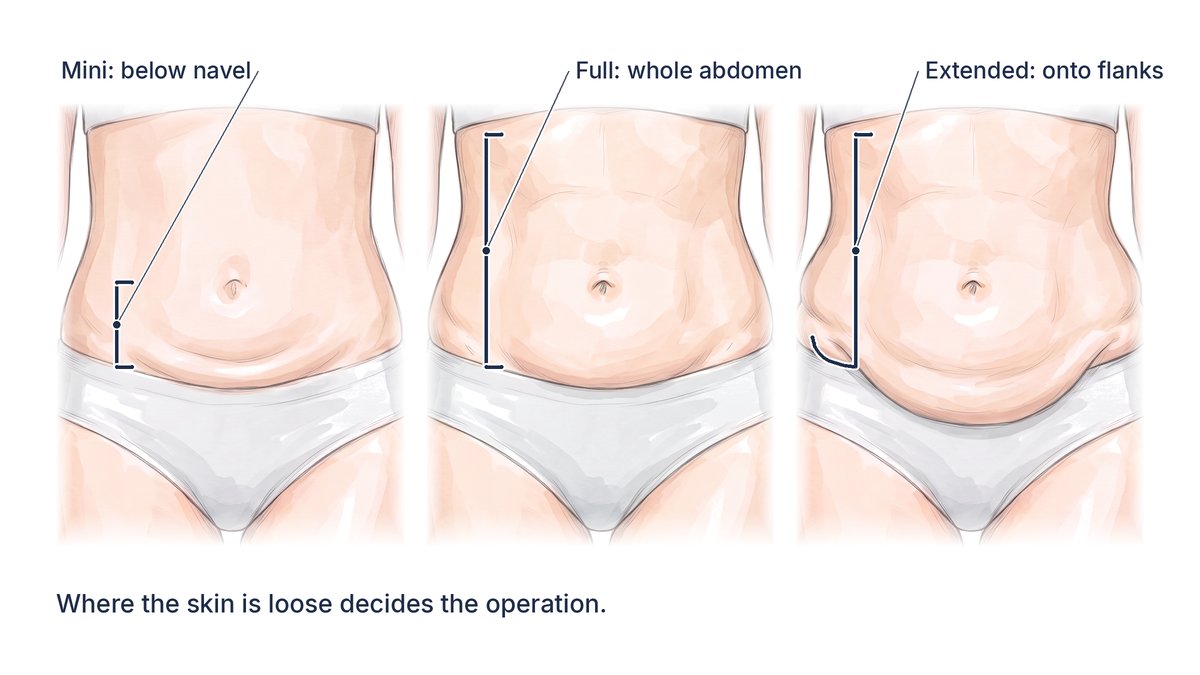
A mini tummy tuck removes loose skin below the navel through a short, low incision and leaves the navel where it is. A full tummy tuck removes the skin between the navel and the pubic area, repairs a separated muscle wall above and below the navel when needed, and brings the navel out through a new opening; an extended tummy tuck is a full one whose incision continues around the hips to remove loose skin on the flanks. Where the loose skin and the muscle separation sit decides between them, not the scar a patient would prefer.
Quick answers
- Am I a candidate for a mini? Only if the loose skin sits entirely below the navel and the upper abdomen is firm. Dr. Yongwoo Lee leaves the navel in place in a mini and recommends a full tummy tuck when there is loose skin or muscle separation above the navel.
- Does a mini fix diastasis recti? Only a separation limited to the area below the navel, which Dr. Lee repairs through the mini incision when it is present.
- Do love handles need an extended tummy tuck? Only when what continues past the hip bones is loose skin. Flank fat under skin that springs back is treated with liposuction.
Can a Mini Tummy Tuck Flatten My Stomach With a Smaller Scar?
Only when everything that bothers you sits below the navel. A mini tummy tuck removes a strip of loose lower skin through a short incision, but it does not tighten skin above the navel, so an abdomen also loose there stays loose.
Two published series suggest that the abdomens a classic mini fits are a minority. In an 11-year review of one US surgeon’s practice, presented as a conference abstract and not as a peer-reviewed paper, 63 of 264 abdominoplasties, 24 percent, were mini procedures, and the authors concluded that most patients remain candidates for a traditional abdominoplasty. A Brazilian group reporting 146 patients performed a classic mini in 1 and a full abdominoplasty in 15, preferring an in-between operation for the rest.
What Decides Whether You Need a Mini, Full or Extended Tummy Tuck?
Four findings on examination decide it: where the loose skin is, where the muscle wall has separated, how high the navel sits, and whether the fold of loose skin continues around the hips. Fat matters less, because liposuction can reduce it during any of the three, within limits that protect the lifted skin.
Where the loose skin is. Skin loose only below the navel is the mini pattern. Skin loose above or around the navel needs a full tummy tuck, which lifts the upper abdominal skin and draws it downward.
Where the muscle wall has separated. A separation below the navel can be repaired through a short, low incision. One that runs above it cannot be reached with the navel left attached and the upper skin undisturbed.
How high the navel sits. One classification of 111 patients sorted abdomens partly by navel position, separating mild skin excess with a high navel from mild excess with a well-positioned one. Some surgeons lower the navel as part of a modified mini, which a high navel tolerates and a normally placed one does not.
Whether the fold continues around the hips. An incision that stops at the hip bones cannot remove loose skin that carries on behind them onto the flanks.
Fat or skin. An abdomen with fat, little loose skin and little separation is a liposuction problem. Treating loose skin with liposuction alone is the opposite error, described in loose or uneven skin after liposuction.
Earlier operations and hernias. Scars above the navel, such as from open gallbladder surgery, or a navel detached in an earlier tummy tuck can reduce the blood supply of the lifted skin, so tell your surgeon about every abdominal operation. A bulge at the navel may be an umbilical hernia: when one accompanies the diastasis, European guidelines suggest mesh repair, while plication alone may do for a hernia under 1 cm.
Which Tummy Tuck Repairs Diastasis Recti?
A full tummy tuck can repair diastasis recti along its whole length, from the lower end of the breastbone to the pubic bone; a mini with the navel left in place reaches only the part below the navel. Diastasis recti is a stretched, widened linea alba, the connective-tissue seam between the two vertical rectus muscles; because the problem is the width of the midline, not fat, the bulge can remain in a slim person.

Some width is ordinary anatomy: an ultrasound study of 150 women who had never given birth found a normal width of up to 15 mm at the lower end of the breastbone, 22 mm at 3 cm above the navel and 16 mm at 2 cm below it. Plication folds the stretched band in on itself with rows of stitches so that the two muscles sit side by side again; in a prospective study of 28 women checked by ultrasound, no separation had returned 12 months after plication with a permanent nylon suture, a series too small to give a failure rate.
In my practice, a muscle repair is for a gap of 2 cm or more that is still there after 6 to 12 months of rehabilitation. How to measure the gap, what rehabilitation can do first and the evidence on how long a repair holds are set out in diastasis recti after pregnancy: exercise or a tummy tuck.
Mini vs Full vs Extended Tummy Tuck: How Do They Compare?
A mini treats only the lower abdomen, through the shortest incision. A full treats the whole front of the abdomen and its muscle wall, with a hip-to-hip scar and a scar around the navel; an extended adds the flanks, with a longer scar still.

At a Glance: Mini, Full and Extended Tummy Tuck
| Mini tummy tuck | Full tummy tuck | Extended tummy tuck | |
|---|---|---|---|
| Loose skin it treats | Below the navel only | Above and below the navel | Above and below the navel, plus the flanks |
| Incision | Short and low | Low, from hip to hip | Hip to hip, continued around the sides |
| Navel | Stays in place, no scar around it | Brought out through a new opening, with a scar around it | Same as a full |
| Muscle repair | Below the navel, when needed | Above and below the navel, when needed | Above and below the navel, when needed |
| Upper abdominal skin | Not tightened | Lifted and drawn down | Lifted and drawn down |
| What it cannot do | Treat skin or separation above the navel | Remove loose skin on the flanks | Treat the back, buttocks or thighs |
Scar length follows the skin to be removed. One US plastic surgeon, interviewed for a patient publication, describes a mini incision of about 10 to 12 cm centered above the bikini line, against hip to hip for a full. In one published technique for a full tummy tuck, the lower line is marked 5 to 7 cm above the upper end of the labia and the upper cut passes about 1 cm above the navel. Stretch marks are removed only if they sit on the skin that is excised.
How do surgeons classify which abdomen needs which operation?
The classification quoted most often sorts abdomens into four types by skin, fat and muscle. It was built on 75 consecutive patients of one surgeon, and matches each type to liposuction alone, a mini, a modified or a full abdominoplasty; the table follows its author’s 2021 restatement.
| Type | Skin laxity | Muscle separation | Operation in the classification |
|---|---|---|---|
| I | Minimal | Minimal | Liposuction alone |
| II | Mild | Below the navel | Mini abdominoplasty |
| III | Moderate | Below and above the navel | Modified abdominoplasty |
| IV | Severe | Complete | Full abdominoplasty, with or without liposuction |
What are the in-between operations, such as a floated navel?
Between a mini and a full, some surgeons use modified operations that reach above the navel through a shorter scar. In the 11-year US review of 264 abdominoplasties, 27 of the 63 mini procedures were “extended” minis; the methods describe releasing the navel to repair a separation above it, or repositioning a navel that sat high, not to be confused with an extended tummy tuck.
These are published options, and the ones described here involve detaching or moving the navel. In my practice the navel stays in place in a mini.
What is an extended tummy tuck, and what lies beyond it?
An extended tummy tuck is a full tummy tuck with a longer incision. The International Society of Aesthetic Plastic Surgery describes it as designed for patients whose excess skin and tissue extend beyond the front of the abdomen into the flanks and lateral waist, in exchange for a longer permanent scar; the back, buttocks and outer thighs belong to a lower body lift. After massive weight loss, other patterns such as the fleur-de-lis are also used.
How Does Dr. Yongwoo Lee Choose and Perform a Tummy Tuck?
I perform mini, full and extended abdominoplasty myself, and I choose the pattern from two findings: whether any loose skin sits above the navel, and whether the muscle separation runs above it. If either is present I recommend a full tummy tuck, extended when the loose skin carries on past the hip bones; I offer a mini only when the navel can stay exactly where it is.
What I examine
I examine the abdomen with the patient standing and then leaning forward, pinching the skin to judge how much of the fullness is skin and how much is fat. With the patient lying down, I measure the gap between the muscles with my fingers, and with ultrasound when I need a number.
My rule for a mini and for an extended tummy tuck
In a mini I leave the navel in place and do not float it (detach it and move it down). When the muscles have separated below the navel, I repair that gap through the mini incision. A mini would leave the upper abdomen exactly as it is, which is why loose skin or a separation above the navel moves the plan to a full tummy tuck.
I place the scar of a full tummy tuck low, inside the underwear line. I use the longer, extended incision when the loose skin continues past the hip bone onto the flanks; it runs onto the flanks, not onto the back. Flank fullness that is only fat, under skin with good recoil, needs liposuction, not a longer scar.
How I repair the muscle wall
I repair a separation in two layers with a permanent, non-absorbable suture. In a full tummy tuck the repair runs the whole length of the midline, from the xiphoid, the lower tip of the breastbone, to the pubis. A small umbilical hernia I close with sutures during the tummy tuck; a large one I treat together with a general surgeon.
How I add liposuction
When fat on the flanks or the upper abdomen needs reducing, I suction it in the same operation: VASER on the flanks, but conventional suction only, without VASER, over the upper abdomen, to protect the blood supply of the skin flap that will be lifted. I then free the upper abdominal skin through a limited tunnel, for the same reason.
Over the lower abdomen I leave Scarpa fascia in place, the thin fibrous sheet that divides the abdominal fat into a superficial and a deep layer. I keep total aspirate at 5 liters or less in one session and stage anything beyond that.
Where I use ultrasound, any skin tightening is a bonus and not a plan (VASER versus traditional liposuction); the combined operation is set out in liposuction and a tummy tuck together.
How I close
Against seroma, fluid collecting under the lifted skin, I use two measures together: drains, and quilting sutures, rows of stitches that tack the lifted skin and fat back down onto the muscle wall and close the space where fluid would collect. The published evidence comparing quilting sutures with drains, and the rule for taking the drains out, is set out in the tummy tuck recovery timeline.
Over the closed incision I apply a portable negative-pressure dressing. It serves as the dressing and helps prevent the wound from separating or becoming infected.
Anesthesia, the first night and clots
A tummy tuck in my practice is done under general anesthesia given by a board-certified anesthesiologist, and every patient stays the first night. Clot prevention follows my facelift protocol: pneumatic compression sleeves on the legs during surgery and through the first night, walking from the next day for everyone, and an injected blood thinner only when the clot-risk score taken before surgery is high.
Eight hours under one anesthetic is my limit for combined surgery. I do not perform breast surgery, so I do not combine a tummy tuck with a breast operation.
Who I operate on, and who I ask to wait
- Nicotine: none in any form, including cigarettes, vapes, patches and gum, for four weeks before and four weeks after surgery; a patient who cannot stop has the surgery postponed.
- Weight: a body mass index of about 30 to 32 or less, and a weight that has stopped changing; after weight loss on a GLP-1 drug, stable for 3 to 6 months.
- Pregnancy: 6 to 12 months after both childbirth and breastfeeding have ended, and only when no further pregnancy is planned.
- After massive weight loss: albumin and a blood count are checked, and a low value is corrected before surgery.
Medicines and supplements stop on their own clocks, listed in what to stop before plastic surgery. In my practice an estrogen-containing pill or hormone replacement stops 4 weeks before surgery because of clot risk, with another method of contraception agreed with your doctor in the meantime, and a GLP-1 drug stops 1 month before and restarts 1 to 2 weeks after, with the prescriber. A prescribed blood thinner or diabetes medicine is never stopped or changed without the doctor who prescribed it. Loose skin after drug-assisted weight loss is covered in liposuction after Ozempic or Mounjaro weight loss.
Mini, Full or Extended Tummy Tuck: Which Patient Are You?
These five examples are illustrative, not real patients, and describe decisions, not results.
A slim 36-year-old woman, two years after her last cesarean, with a small fold of skin above the scar. Her upper abdomen is firm and no gap can be felt above the navel. A mini fits.
A 39-year-old woman after three pregnancies, with loose skin above and below the navel and a gap above it that is still there after a year of rehabilitation. She needs a full tummy tuck with repair along the whole midline.
A 47-year-old woman who lost 28 kilograms, stable for six months, whose fold of skin runs past both hip bones. The excess is skin, continuing onto the flanks: an extended tummy tuck, once her albumin and blood count have been checked.
A 29-year-old woman with a full lower abdomen, skin that springs back and no separation. Fat, not skin: a type I abdomen. Liposuction alone fits, and if she plans a pregnancy, any skin operation waits.
A 52-year-old man with a body mass index of 34 who smokes. Male sex and obesity both raise the risk, and nicotine endangers the skin flap. Weight loss and four nicotine-free weeks come before any date is set.
Is Recovery Faster After a Mini Tummy Tuck?
Somewhat, because a mini lifts less skin, leaves the navel alone and repairs less of the muscle wall. The American Society of Plastic Surgeons quotes a recovery of usually four to six weeks for a tummy tuck.
In my practice the routine after a mini is the same as after a full tummy tuck, except that the drains may come out sooner: one night in the clinic, a knees-bent position in bed for the first days, walking from the next day, drains out once they collect less than 30 mL a day, a negative-pressure dressing for about 10 days, and absorbable skin stitches with no navel stitches to remove. A compression garment goes on in the operating room and is worn day and night for six weeks, with no heavy lifting or abdominal exercise over the same period; once the negative-pressure dressing comes off, silicone sheets or gel go on the scar for 3 to 6 months. A long-haul flight home is possible no earlier than 10 to 14 days after surgery.
Chest pain, sudden shortness of breath, coughing up blood or fainting is an emergency: call your emergency number (119 in Korea) or go to the nearest emergency room first, then let your surgeon know. A swelling under the skin that grows quickly or becomes tense and painful, or bleeding that soaks the dressing or fills the negative-pressure device, needs a call to the clinic at once. Pain or swelling in one calf or thigh needs a same-day examination: call the clinic at once while you are in Korea, and go to an emergency department that day once you are home. Fever, spreading redness, a wound that opens, a slowly growing soft swelling, or skin near the incision or navel that turns dark needs a call the same day.
Each stage, from the first night to the flight home, is described in the tummy tuck recovery timeline, week by week.
Surgeon’s Insight: The Scar Is Not the Thing to Minimize
Almost everyone who asks me for a mini tummy tuck is really asking for a short scar. But a tummy tuck scar sits low, and the upper abdomen has nowhere to hide. A mini on an abdomen that is loose above the navel gives a short scar beneath an upper abdomen that looks the way it did before.
So I ask one thing before any talk of scars: standing in front of the mirror, is what bothers you above the navel, below it, or both? If the answer includes “above,” a mini cannot reach it, and I would rather say so before surgery than explain it afterward.
Is a Bigger Tummy Tuck Riskier?
Yes, in general: risk rises with the size of the operation, with the patient’s own risk factors and, in older data, with every procedure added to it. Hematoma, infection and blood clots, in that order, made up most major complications in a US insurance database of 25,478 tummy tucks. More common and usually milder are seroma, slow healing at the center of the incision, where tension is highest, numbness below the navel that usually improves over months but may not recover fully, and small puckers at the scar ends that sometimes need a minor revision.
In that database, which covered 2008 to 2013, major complications followed 4.0 percent of 25,478 abdominoplasties, against 1.4 percent of other aesthetic procedures, with male sex, age 55 or older, a body mass index of 30 or higher and multiple procedures as independent risk factors. The rate rose from 3.1 percent for a tummy tuck alone to 10.4 percent when liposuction and another body-contouring procedure were both added; that breakdown, and what it means for combining operations, is in a tummy tuck with liposuction in one operation.
Newer data are more reassuring. A later analysis of the same insurer’s records, 2015 to 2022, reported an overall major complication rate of 2.1 percent, and no significant added risk of major complications in the 27.2 percent who had a combined procedure. Its full text gives the rate for each type: major complications followed 1.81 percent of 3,983 mini, 2.11 percent of 40,493 conventional and 2.47 percent of 5,300 extended abdominoplasties, and 3.81 percent of fleur-de-lis operations, the highest of seven types. The rates differed significantly across the seven types taken together, but the paper did not compare any two types directly, and patients were not matched, so the figures show a trend with the size of the operation, not that one type is safer for the same patient. Both analyses are retrospective and count only major complications, those that led to an emergency visit, a hospital admission or a reoperation.

Is a mini tummy tuck safer?
Probably, in the patients it suits, though the evidence comes from selected patients, not head-to-head trials. In 181 consecutive women with a body mass index under 30 who had a mini with liposuction and muscle repair, the surgeons reported no major complications and 29 minor ones, such as anemia, seroma and wound infection, about 16 percent. The single-surgeon review of 63 mini procedures reported no hematoma, skin loss or navel necrosis, one reoperation for a seroma that kept returning, and one separation above the navel that persisted.
Will my scar and navel be perfectly even?
Rarely, because few bodies are. According to the 2021 technique paper, over 80 percent of abdominoplasty candidates have asymmetric hips, and the navel sits exactly in the midline in fewer than 2 percent.
When Should You Wait Before Having a Tummy Tuck?
Wait until you have finished having children, until 6 to 12 months after both childbirth and breastfeeding have ended, and until your weight has stopped changing.
Surgeons writing for the American Society of Plastic Surgeons recommend waiting a minimum of six months postpartum, longer if breastfeeding, and ideally nine to 12 months, and warn that a future pregnancy can undo the results. My own rule is stricter, because the clock starts only once both childbirth and breastfeeding have ended; why, and what a later pregnancy does to a muscle repair, is covered in diastasis recti after pregnancy.
What Should You Ask Before Choosing a Mini, Full or Extended Tummy Tuck?
Ask where your loose skin is, where your muscle wall has separated, and whether either reaches above the navel or past the hips. How short the scar can be is the wrong first question.
Below the navel only, with a firm upper abdomen: a mini. Above the navel as well: a full. Past the hip bones: an extended. Fat under skin that springs back: none of the three. Have the surgeon show you, on your own abdomen and standing, where the skin is loose, where the gap is and what will happen to your navel.
Individual results vary; consultation required.
Written by Dr. Yongwoo Lee, board-certified Korean plastic surgery specialist in facial anatomy and aesthetic procedures at VIP Plastic Surgery, South Korea.
Frequently Asked Questions About Mini, Full and Extended Tummy Tucks
Which tummy tuck do I need after massive weight loss?
It depends on where the loose skin hangs. When the fold continues past the hip bones onto the flanks, an extended tummy tuck; loose skin on the back, buttocks and outer thighs belongs to a lower body lift, and patterns such as the fleur-de-lis are also used. Dr. Lee checks albumin and a blood count first and corrects a low value before surgery.
Am I a candidate for a mini tummy tuck?
Only if your loose skin sits entirely below the navel, your upper abdomen is firm and any muscle separation is limited to the lower abdomen.
Does a mini tummy tuck fix diastasis recti?
Only a separation below the navel, which Dr. Lee repairs through the mini incision when it is present, in two layers with a permanent suture. A gap above the navel needs a full tummy tuck, in which he repairs the whole midline, from the lower tip of the breastbone to the pubis.
What is an extended tummy tuck, and do I need one for love handles?
A full tummy tuck whose incision continues around the sides to remove loose flank skin, with a longer scar. Dr. Lee performs it when the excess past the hip bones is loose skin; flank fat under skin that springs back is treated with liposuction.
How long is the scar after a mini, full or extended tummy tuck?
One US surgeon describes a mini incision of about 10 to 12 cm, against hip to hip for a full, which Dr. Lee places low, inside the underwear line. His extended scar continues past the hip bones onto the flanks, not onto the back.
Does a mini tummy tuck change the belly button?
Not in its classic form: the navel stays where it is, with no scar around it. Some surgeons detach and lower it, an umbilical float. Dr. Lee does not, and advises a full tummy tuck when the navel would have to move.
Can a mini tummy tuck fix a C-section shelf?
Yes, when the fold above the cesarean scar is the whole problem: a firm upper abdomen, loose skin only below the navel and no separation above it. Otherwise a full tummy tuck fits better.
Is a mini tummy tuck or liposuction better for a lower belly pooch?
It depends on what the pooch is made of. Fat under skin that springs back, with little muscle separation, is treated with liposuction; loose skin below the navel over a firm upper abdomen fits a mini. Liposuction neither removes loose skin nor repairs muscle, and can leave loose skin hanging more.
Will a tummy tuck remove my stretch marks?
Only those on the skin that is removed, which in a full tummy tuck lies between the navel and the pubic area.
Can I have a tummy tuck if I have scars from earlier abdominal surgery?
Possibly, depending on where the scars are, so tell the surgeon about every abdominal operation. Scars above the navel, such as from open gallbladder surgery, or a navel detached in an earlier tummy tuck can reduce the blood supply of the lifted skin and change which operation is safe.
Do I need drains after a mini tummy tuck?
In Dr. Lee’s practice, yes. The aftercare is the same as after a full tummy tuck, and the drains come out once they collect less than 30 mL a day, which may happen sooner after a mini.
This article is for informational purposes only and does not constitute medical advice. Always consult with a qualified medical professional before making any decisions about surgical or non-surgical procedures.
