
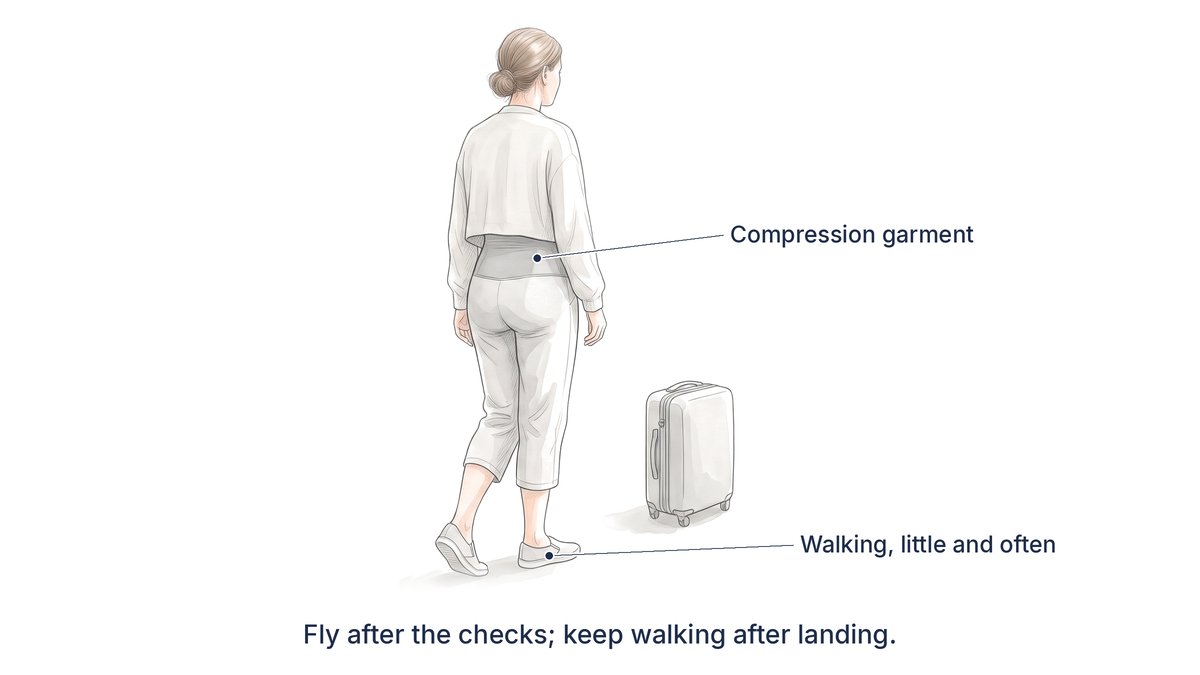
The tummy tuck recovery timeline runs on four clocks: about a week with drains, about ten days with a sealed dressing over the incision, six weeks in a compression garment, and roughly twelve weeks in which the risk of a blood clot stays well above normal. In my practice the earliest long-haul flight after a tummy tuck (abdominoplasty) is 10 to 14 days after surgery, and boarding is not the end of the precautions.
Quick answers
- How long do the drains and the garment stay? In Dr. Yongwoo Lee’s protocol, drains until day 5 to 7 and the garment for six weeks.
- When can I fly home? In his protocol, 10 to 14 days after surgery. UK guidance says 7 to 10 days for tummy tucks; the US CDC says 10 days after abdominal surgery.
- Is the clot risk over once I land? No. In a large UK study of inpatient surgery it peaked in the third week, stayed well above normal for about 12 weeks and had not fully returned to baseline months later.
How Long Is the Tummy Tuck Recovery Timeline?
Most people need at least two weeks before they move comfortably, about six weeks before the garment comes off and ordinary activity returns, and 12 to 18 months before the scar has faded. For a patient flying long-haul, the earliest sensible flight is 10 to 14 days after surgery; the common mistake is booking day five to seven, the figure quoted for liposuction.
The Aesthetic Society tells patients that recovery takes at least two weeks and can be longer depending on the surgery. NHS guidance is more conservative: about four to six weeks off work and exercise, a support garment for six weeks, and scars that fade over 12 to 18 months.
Day five to seven comes from an American Society of Plastic Surgeons (ASPS) briefing paper that suggests waiting five to seven days before flying after body procedures such as liposuction and breast augmentation. A tummy tuck is not named there, and it is a larger operation. How much is done depends on the type, compared in mini, full and extended tummy tucks.
Why Is Tummy Tuck Recovery Planned Around Blood Clots?
Because the tummy tuck is the cosmetic operation most often linked to venous thromboembolism: a clot in the deep veins of the leg (deep vein thrombosis, DVT) that can travel to the lungs (pulmonary embolism). The absolute risk is low, 0.3 to 1.1 percent in a literature review of tummy tuck complications, but a clot can be fatal, and the risk outlasts the wound by weeks.
In a US accreditation database of outpatient cosmetic surgery, 240 of the 414 recorded clots, 58 percent, followed a tummy tuck, and age over 40 and a body mass index over 25 were the predictors. In an insurance database of 25,478 tummy tucks, suspected or confirmed clots made up 20.2 percent of major complications.
In the Million Women Study of about 950,000 middle-aged UK women, the risk of a clot after inpatient surgery of any kind was about 40 times that of women without surgery in the first week, about 110 times in the third week, its peak, and still about 20 times in weeks 7 to 12. Those figures pool every kind of inpatient operation, so they show the shape of the risk over time, not its size after a tummy tuck. A flight on day 10 to 14 falls before that risk has peaked.

What Is Healing Under the Skin After a Tummy Tuck?
Three things heal at once: a long incision low on the abdomen, a sheet of skin and fat that was lifted off the abdominal wall and has to stick back down, and, in most full tummy tucks, the stitches that brought the two rectus muscles back to the midline.
The space under the lifted skin. Skin and fat are lifted off the abdominal wall, widely up toward the ribs in the classic technique, or above the navel only through a narrow central tunnel when liposuction is combined, and until the lifted layer and the wall seal together, fluid can collect between them. A pocket of that fluid is a seroma, the most frequent local complication: a 2025 meta-analysis cites seroma rates of 20 to 42 percent across the tummy tuck literature, a wide range because studies define it differently. Most resolve with needle drainage in the clinic, according to the literature review.
The muscle repair. When pregnancy or weight change has stretched the midline between the rectus muscles (diastasis recti), the gap is closed with stitches, a step called plication. Overnight the abdominal wall is tighter, which is why standing straight feels impossible at first. Whether a gap needs repair is covered in diastasis recti after pregnancy: exercise or tummy tuck.
The skin itself. Lifted skin lives on a reduced blood supply until it re-attaches, and many of the small sensory nerves that reached it from below have been cut. Reduced blood supply is why nicotine matters: in the literature review, skin necrosis occurred in 3 to 4.4 percent of patients even with limited dissection, and smoking roughly tripled the risk. Cut nerves are why the skin between the navel and the scar is numb, which NHS guidance says can last a few months to years.
What Happens Week by Week After a Tummy Tuck?
The first night is about bleeding, the first week about drains and walking, the second about the incision and clearance to travel, weeks three to six about the garment, and the months after about the scar. Days follow my own protocol where I have a fixed rule and published guidance where I do not; the day after surgery is day 1.

At a Glance: Tummy Tuck Recovery Week by Week
| When | What is healing | What closes the stage |
|---|---|---|
| Day 0 to 1 | Bleeding risk at its highest | A night in an inpatient room, then a morning check |
| Days 2 to 7 | Fluid under the lifted skin; a tight muscle repair | Drains out below 30 mL in 24 hours, usually day 5 to 7 |
| Days 8 to 14 | Incision under a sealed dressing | Navel stitches out by day 10 (from day 7); dressing opened at about day 10; flight at day 10 to 14 |
| Weeks 3 to 6 | Skin re-attaching; clot risk near its peak | Garment off at 6 weeks; lifting and abdominal exercise from 6 weeks |
| Weeks 7 to 12 | Swelling settling; clot risk still raised | Clot risk lower after about 12 weeks, but not yet back to normal |
| Months 3 to 18 | Scar and sensation | Scar faded at 12 to 18 months |
The first 24 hours
Bleeding under the lifted skin (a hematoma) occurs in about 2 percent of tummy tucks and usually shows itself within the first 24 hours, which is the reason for a night under observation. In my practice walking starts the day after surgery; published low-clot protocols had patients walking within an hour of surgery or 12 hours after it.
Days 2 to 7: drains and a bent back
Each drain stays until it collects less than 30 mL in 24 hours, usually day 5 to 7. For the first days I keep patients in a flexed position with the knees bent, as NHS guidance also advises, to avoid strain on the stitches. Walk little and often: a review of clot prevention notes that limited walking because of pain or waist flexion may itself raise clot risk, so the bent posture is a reason to get up more often, not to stay in bed.
Days 8 to 14: the incision and clearance to fly
By now the drains are out. I close the skin with dissolving sutures, so the only stitches removed are those around the navel in a full tummy tuck, at day 7 to 10. At about day 10 the sealed dressing over the incision is opened. Wound infection is reported in 1 to 3.8 percent of tummy tucks, and the ASPS briefing paper calls infection the most common complication seen after cosmetic surgery abroad: one more reason to have the incision examined before the airport.
Weeks 3 to 6: the garment weeks
The compression garment goes on in the operating room and is worn day and night until six weeks. A new soft bulge or sloshing feeling above the scar can be a seroma that formed after the drains came out; it is examined and, if needed, drained with a needle. Clot admissions after inpatient surgery peaked in the third week in the UK Million Women Study, so a calf or chest symptom counts as much now as on the ward.
Week 7 and the months after
Swelling, firmness and numbness go on settling for months after the garment comes off at six weeks. Scar care starts when the negative-pressure dressing comes off: I have patients use a silicone sheet or gel for three to six months. Hypertrophic or keloid scars are reported in 1 to 3.7 percent of patients in the literature review, which describes silicone strips with compression as useful for them.
How Does Dr. Yongwoo Lee Manage Tummy Tuck Recovery?
I plan the recovery in the operating room: general anesthesia with an anesthesiologist, Scarpa’s fascia preserved over the lower abdomen, a muscle repair in two layers of permanent suture, quilting sutures plus drains under the skin, and a sealed negative-pressure dressing over the incision. Afterward the rules are one night in an inpatient room, drains out below 30 mL a day, the garment for six weeks, and no long-haul flight before day 10 to 14.
In the operating room
I perform tummy tucks under general anesthesia given by a board-certified anesthesiologist, with capnography, BIS depth monitoring and active warming, as for a facelift. In a full tummy tuck I repair the muscles from the lower tip of the breastbone (xiphoid) to the pubic bone, closing the gap in two layers with permanent, non-absorbable suture. A small navel (umbilical) hernia is repaired with sutures in the same operation; a large one is managed together with a general surgeon.
Over the lower abdomen I preserve Scarpa’s fascia, the thin fibrous layer inside the fat, leaving it on the abdominal wall instead of lifting it with the skin. In the literature review, Scarpa-sparing dissection was reported, in unblinded studies, to avoid up to 86 percent of expected seromas and to allow earlier drain removal. When liposuction is added, where it goes, how the upper skin is freed and how much is removed are explained in liposuction and tummy tuck together.
Quilting sutures and drains, both
Surgeons control the space under the lifted skin with drains, with quilting sutures (progressive tension sutures, rows of stitches that tack the lifted skin and fat down to the tissue of the abdominal wall), or with both. I use both. Below the navel my quilting sutures anchor the underside of the lifted layer to the rectus sheath, the firm covering of the muscle, passing through Scarpa’s fascia and the deep fat left on the wall.

In a 2025 meta-analysis of 24 studies, quilting sutures were associated with about one-third the seroma risk of drains (relative risk 0.34), with no significant difference in hematoma, infection or wound separation. Few of those studies were randomized trials. The same analysis found no significant difference between quilting sutures with drains and quilting sutures alone. What a drain adds is a number: output is measured every 24 hours, and the drain comes out when it collects less than 30 mL in a day, usually on day 5 to 7. Its authors also note that drains have been linked to more postoperative pain, which is the cost of keeping them.
A sealed dressing over the incision
After closing the skin I apply a portable negative-pressure dressing (incisional negative pressure wound therapy) over the repaired wound. It serves as the dressing, and I use it to lower the chance of the wound separating or becoming infected. It stays on for about 10 days; then it is opened and simple dressings follow.
Clots: compression, early walking, selective injections
Risk scores do not catch everyone. In US accreditation data on outpatient cosmetic surgery, as summarized in a 2025 review, 89 percent of clots after tummy tucks occurred at a Caprini clot-risk score of 6 or lower. Early walking, leg compression and knowing the warning signs therefore matter whatever your score.
My clot measures for a tummy tuck are the same as for a facelift: intermittent pneumatic compression sleeves on the legs during surgery and through the first night, walking from the day after surgery, and an injected blood thinner only for patients whose risk score, assessed before surgery, is high. Estrogen-containing pills and hormone therapy stop four weeks before surgery, with another method of contraception agreed with your doctor in the meantime (a progestogen-only pill or a hormonal IUD can continue). When to restart them is agreed with the surgeon and the prescriber, and the full list is in what to stop before plastic surgery.
An ASPS task force advises surgeons to consider injections after major surgery of more than 60 minutes under general anesthesia at Caprini scores of 3 to 6, and to strongly consider extended injections at 7 or more. I do not give them to everyone, because the trade is bleeding. In a French series of 219 tummy tucks in which every patient received a daily injection for about 15 days, one patient (0.45 percent) still had a pulmonary embolism and 5.9 percent had a hematoma, against about 2 percent in the literature review, which is not a controlled comparison.
The first night and the stay
Every tummy tuck patient stays the first night in an inpatient room. Patients from abroad then recover in accommodation inside the clinic building, with nurses on call; the clinic’s partner hospitals for emergencies are Jeju National University Hospital and Halla Hospital.
Who I operate on
No nicotine in any form (cigarettes, vapes, patches or gum) for four weeks before and four weeks after surgery is the same rule I apply to facelifts and every other major operation, for the reason set out in can a smoker have a facelift: lifted skin on a reduced blood supply. A patient who cannot stop has the surgery postponed. The weight conditions are covered in mini, full and extended tummy tucks compared, and after drug-assisted weight loss in liposuction after Ozempic or Mounjaro weight loss.
When Is It Safe to Fly Home After a Tummy Tuck?
Not before day 10, and in my practice at 10 to 14 days after surgery, once the drains are out, the incision dressing has been opened and I have examined both calves myself. No date makes the flight risk-free: published advice ranges from 7 days to 6 weeks, because no study has measured the clot risk of flying after a tummy tuck.
At a Glance: How Long to Wait Before Flying After a Tummy Tuck
| Source | Advice | What it covers |
|---|---|---|
| NHS and BAPRAS (UK) | No flying for 7 to 10 days | Tummy tucks, named together with facial procedures |
| CDC Yellow Book 2026 (US) | No flying for 10 days | Chest or abdominal surgery in general |
| ASPS briefing paper (US) | 5 to 7 days | Liposuction and breast augmentation; tummy tuck not named |
| Individual surgeons | At least a month, or six weeks | Significant cosmetic surgery; opinion without data |
| Dr. Yongwoo Lee | 10 to 14 days | Tummy tuck, after drain removal and opening of the dressing |
The NHS tells patients having surgery abroad not to fly for 7 to 10 days after facial cosmetic procedures or tummy tucks. BAPRAS, the British plastic surgery association, adds that clots can start to form during the operation, and that water, walking and avoiding alcohol on the flight help but do not completely remove the risk.
The CDC advises no flying for 10 days after chest or abdominal surgery. That rule concerns pressure changes inside the chest and abdomen; a tummy tuck stays outside the abdominal cavity, but ten days is the more cautious official figure. At the far end, individual surgeons have advised at least a month, or six weeks, before flying after significant cosmetic surgery: opinion, not data.
In the World Health Organization’s travel research, the risk of a clot approximately doubled after travel lasting four hours or more, while the absolute risk for a healthy traveler stayed at about 1 in 6,000, and Korea to North America, Europe or Australia is 10 to 15 hours. Because clot risk after surgery peaks around the third week, waiting until day 14 instead of day 10 buys a second look at the wound and the legs, not immunity.
What should be true before you board?
Five things, which I check at the visit before the flight: the drains are out, the incision is dry and closed along its whole length, no pocket of fluid under the skin needs draining, both calves are soft, painless and the same size, and you can walk a long corridor without help. If one of them is not true, the flight moves.

How should you fly?
Wear the garment snug, not cinched; the clot-prevention review links abdominal binders to raised pressure inside the abdomen. Book an aisle seat and walk every hour; while seated, work your ankles up and down, the calf exercise the WHO project describes. For the flight I recommend compression stockings; fitted below-knee ones and the trial evidence for them are covered in how long to stay in Korea after plastic surgery. A blood thinner for the journey is a prescription decision made with the surgeon before the operation, not at the airport, and aspirin taken on your own is not a substitute: it does not prevent travel clots and it raises bleeding risk under the healing skin.
Which Tummy Tuck Recovery Are You?
Everyone runs on the same clocks; the size of the operation, your own clot risk and the length of the flight decide the margin. These profiles are illustrative, not real patients, and describe plans, not results.
Loose skin below the navel only, navel left in place (a mini tummy tuck). Less skin is lifted, so tightness and swelling sit at the short end of every range. The aftercare steps are the same as after a full tummy tuck, although the drains may come out sooner.
A full tummy tuck with muscle repair after two pregnancies. Muscle repair is why the first week is bent and slow. Arrange help with young children: lifting a toddler waits six weeks.
A tummy tuck with liposuction of the flanks and upper abdomen. Expect swelling and firmness for longer, on the pattern in the liposuction recovery timeline. Adding liposuction raised major complications only slightly in a US insurance database of 25,478 tummy tucks, while adding another body-contouring operation as well raised them far more, as set out in a tummy tuck with liposuction in one operation.
Age 52, body mass index 29, a 12-hour flight home. Both clot predictors in the US accreditation data, age over 40 and a body mass index over 25, apply. Plan the full 14 days, fitted socks and an aisle seat, and settle the question of injections before the operation.
When Can You Go Back to Work, Drive and Exercise After a Tummy Tuck?
Walking starts the day after surgery, and in my practice heavy lifting and abdominal exercise return from six weeks. Published guidance gives at least two weeks before ordinary routines, four to six weeks off work in its most conservative version and a few weeks before driving. Standing fully upright returns gradually; no guideline gives a day for it, but in a prospective single-surgeon series of 551 liposuction and tummy tuck patients, 167 of whom had a tummy tuck, the mean time to stand fully upright was three weeks.
A desk or remote job returns first; work with lifting or long hours standing belongs at the six-week end. Driving needs you off sedating pain medicine and able to brake hard without pain.
Surgeon’s Insight: Day 10 Is a Floor, Not a Finish Line
Patients who travel for a tummy tuck ask me one question more than any other: what day can I fly? But the number they want describes the wound, and the risk I worry about is not in the wound. By day 10 the drains are out and the dressing is open. In the large studies, the clot risk has not yet peaked.
So I answer with two things: what has to be finished before the flight, and what continues after it. That means the walking, the garment, and attention to a calf that feels different from its pair, for weeks after landing. I would rather send home a patient on day 12 who knows the second part than one on day 20 who believes the risk ended at the gate.
What Is Normal After a Tummy Tuck, and When Should You Call?
Tightness, a bent posture, bruising, swelling above the scar and numb skin below the navel are expected. Call the clinic the same day for a new or growing bulge, drain output that suddenly increases or turns bright red, a negative-pressure dressing that loses its seal or keeps alarming, spreading redness, fever, cloudy or foul-smelling discharge, a wound edge that opens or skin that turns dark. Go to an emergency department the same day for throbbing pain or swelling in one leg, and call an emergency number first for sudden breathlessness, chest pain, coughing up blood, a racing heartbeat or fainting.
| Sign | Usually normal | Call now |
|---|---|---|
| Swelling | Even on both sides, worse by evening | One area growing fast, tense and painful, or a new sloshing pocket |
| Incision and skin | A pink line, numb skin around it | Spreading redness, discharge, an opening edge, or dark or blistered skin |
| Legs and chest | Mild swelling of both ankles | Pain or swelling in one calf or thigh: emergency department today. Breathlessness, chest pain, coughing blood or fainting: emergency number first |
A numb patch on the outer thigh comes from the lateral femoral cutaneous nerve near the hip bone, the nerve behind most of the neurologic symptoms reported in about 1.9 percent of patients.
A seroma left alone can form a lined pocket that may need surgical removal, according to the meta-analysis, so fluid that appears after you are home should be seen by a doctor there. Arrange that contact before you travel.
For clots, the NHS lists throbbing pain in one leg, usually the calf or thigh, swelling in one leg, red or darkened skin and swollen veins, and warns that a clot can happen weeks after surgery. A clot that reaches the lungs can cause sudden difficulty breathing, chest or upper back pain, coughing up blood, a very fast heartbeat or collapse: call an emergency number (119 in Korea) first, then tell your surgeon.
What Should You Ask Before You Book the Flight Home?
Ask not “what day can I fly?” but “what has to be finished before I fly, who examines my legs that week, and what do I do if a calf swells after I land?” Then ask:
- When do the drains come out, and by what rule?
- How was my clot risk assessed, and what will be done about it?
- Who can examine me at home if fluid collects or a leg swells?
Book the return ticket after those answers, not before them.
Individual results vary; consultation required.
Written by Dr. Yongwoo Lee, board-certified Korean plastic surgery specialist in facial anatomy and aesthetic procedures at VIP Plastic Surgery, South Korea.
Frequently Asked Questions About Tummy Tuck Recovery and Flying Home
How long does swelling last after a tummy tuck?
Swelling, firmness and numbness go on settling for months after the garment comes off at six weeks, and the scar fades over 12 to 18 months. Swelling that is even on both sides and worse by evening is usually normal; one area growing fast, tense and painful is a reason to call the clinic.
Can I fly home with drains in after a tummy tuck?
In Dr. Yongwoo Lee’s protocol, no. The drains come out first, usually on day 5 to 7, and the flight comes at 10 to 14 days, once the incision dressing has been opened and he has examined both calves.
Is it safe to fly 7 days after a tummy tuck?
Day 7 is the earliest figure in UK guidance, not a comfortable one. The drains may only just be out, and in Dr. Yongwoo Lee’s protocol the incision dressing stays sealed until about day 10, so he advises 10 to 14 days.
How long do I need to stay in Korea after a tummy tuck?
About two weeks after surgery, plus two to three days before it for a large operation. The steps a surgeon has to do in person set the stay: drain removal at day 5 to 7, opening of the incision dressing at about day 10, and an examination before the flight.
How long do tummy tuck drains stay in?
In Dr. Yongwoo Lee’s protocol, until a drain collects less than 30 mL in 24 hours, usually day 5 to 7.
Why can’t I stand up straight after a tummy tuck?
Skin has been removed and, in most full tummy tucks, the muscles have been stitched together, so the front of the abdomen is suddenly shorter and tighter. The posture improves gradually over the first weeks.
What are the signs of a blood clot after a tummy tuck?
Throbbing pain or swelling in one leg, usually the calf or thigh, red or darkened skin, or swollen veins. Sudden breathlessness, chest pain, coughing up blood, a racing heartbeat or fainting can mean a clot in the lungs: call an emergency number at once. A clot can appear weeks after surgery.
How do I lower my blood clot risk on the flight home after a tummy tuck?
Wear fitted below-knee compression socks and the garment, take an aisle seat, walk every hour, move your ankles while seated, drink water and avoid alcohol. Do not take aspirin for the flight unless your surgeon prescribes it. These steps lower the risk without removing it.
Is a drainless tummy tuck better?
Quilting sutures were associated with fewer seromas than drains in a 2025 meta-analysis, though few of its studies were randomized trials. Dr. Yongwoo Lee uses both and removes the drains by measured output.
When can I lift my child after a tummy tuck?
In Dr. Yongwoo Lee’s protocol, from six weeks, together with other heavy lifting and abdominal exercise. Walking starts the day after surgery, so arrange help with young children before the operation.
This article is for informational purposes only and does not constitute medical advice. Always consult with a qualified medical professional before making any decisions about surgical or non-surgical procedures.
