
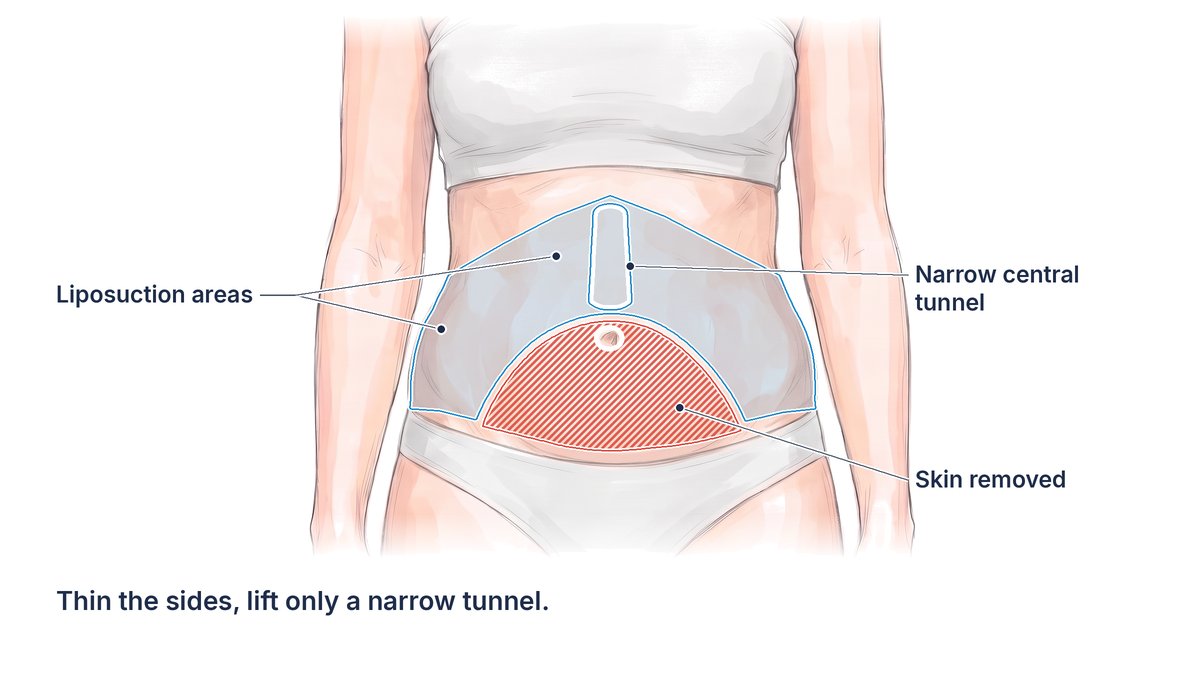
Lipoabdominoplasty is a tummy tuck (abdominoplasty) with liposuction, done as one operation: liposuction thins the flanks and the upper abdomen, and the tummy tuck removes the loose skin below the navel and repairs the muscle wall. Whether the combination is safe depends less on the pairing itself than on how the skin is lifted, where the liposuction goes and how much else is added on the same day.
Quick answers
- Is it safe to combine liposuction with a tummy tuck? For a suitable patient, usually yes. In a database of 25,478 tummy tucks, major complications were 3.1 percent alone and 3.8 percent with liposuction added.
- Where does the risk climb? With every added operation and every extra hour: 10.4 percent when another body-contouring procedure was added as well.
- Does liposuction endanger the skin? It can when the skin is lifted widely off the muscle. Lifting only a narrow central tunnel keeps more of the blood supply.
- What does Dr. Yongwoo Lee do? VASER liposuction of the flanks, conventional suction only over the upper abdomen, a limited central tunnel, Scarpa fascia preserved, quilting sutures plus drains, and at most 5 L of total aspirate.
Is a Tummy Tuck With Liposuction Safe?
Yes, for a healthy, nicotine-free patient at a stable weight, when the liposuction is limited in volume and the skin is lifted so that it keeps its blood supply. Adding liposuction raises the measured risk a little; stacking further operations onto the same anesthetic raises it a lot.
In a prospective insurance database of 25,478 abdominoplasties, major complications occurred in 3.1 percent after a tummy tuck alone, 3.8 percent with liposuction added, and 10.4 percent with liposuction plus another body-contouring procedure. Major there means needing an emergency visit, a hospital admission or a reoperation, so small fluid collections drained in the clinic are undercounted.
Why Were Surgeons Once Warned Against Combining Liposuction With a Tummy Tuck?
Surgeons were wary because a classic tummy tuck already cuts most of the vessels that feed the abdominal skin, and early reports of adding abdominal liposuction to that wide dissection showed more complications.
A surgeon’s review recounts the caution: in 2004 Florida imposed a moratorium that required at least 14 days between liposuction and abdominoplasty in office settings, and an older series of more than 1,000 cases had reported complications in 26.2 percent after abdominoplasty alone against 40.1 percent with abdominal liposuction added.
What changed was the undermining, the lifting of skin off the muscle wall. In 2003 one group described lipoabdominoplasty with selective undermining: liposuction first, removal of the skin below the navel as in a classic tummy tuck, and lifting of the upper skin only in the midline between the rectus muscles, so that the main perforating vessels are preserved.
Pooled comparisons no longer show a penalty. A 2019 meta-analysis of 17 studies and 14,061 patients found fewer overall complications with lipoabdominoplasty than with abdominoplasty alone (relative risk 0.85), with less seroma, a fluid collection under the skin (0.69), and less hematoma, a collection of blood (0.56). Most of those studies were not randomized, and healthier patients tend to be chosen for the combined operation, so a fair reading is “no evidence of added harm,” not “liposuction makes a tummy tuck safer.”
How Does the Abdominal Skin Keep Its Blood Supply During a Tummy Tuck?
Abdominal skin is fed from three territories, and a classic tummy tuck cuts the central and lower ones, leaving the skin to live on vessels entering from the sides.
Anatomists describe three zones: zone I in the midline from the breastbone to the pubis, fed by the superior and inferior epigastric vessels through the rectus muscles; zone II across the lower abdomen; and zone III in the flanks and under the ribs, fed by intercostal, subcostal and lumbar arteries. A classic abdominoplasty, the same review notes, damages the perforators of zones I and II, the small vessels that rise through the muscle to the skin, and leaves zone III to feed the flap, the lifted sheet of skin and fat.
The far end is the weak point. Skin that ends up in the midline just above the scar sits farthest from its supply. One surgeon’s review locates the highest risk of poor blood flow in a triangle running from the navel down to the pubic area.
Fat is not just padding. Scarpa fascia, a thin fibrous sheet, divides abdominal fat into a superficial and a deep layer, and the perforators climb from the muscle through the deep fat to the vessels under the skin. The author of a 26-year series of 973 cases calls preserving the superficial fat layer “the main safety factor for avoiding necrosis of the abdominal flap”.
Limited lifting keeps the rectus perforators. When only a narrow midline tunnel is lifted, the perforators that rise through the rectus muscles on either side of it stay connected to the skin. In 20 patients scanned with color Doppler before surgery and on day 15, perforator arteries were still preserved around the navel and in the right upper quadrant after lipoabdominoplasty with reduced undermining.

Tummy Tuck vs Liposuction, or Both: How Do They Compare?
Liposuction removes fat and leaves the skin and muscle as they are; a tummy tuck removes skin and tightens the muscle wall but does little for the flanks and upper abdomen; lipoabdominoplasty does both in one operation. Skin decides the choice.
Patient information from the American Society of Plastic Surgeons (ASPS) puts the limit of liposuction plainly: “your skin can only contract so much.” A tummy tuck alone has its own gap. One report lists fullness of the flanks and upper abdomen among patients’ complaints after abdominoplasty without liposuction.
At a Glance: Liposuction, Tummy Tuck and Lipoabdominoplasty
| Liposuction alone | Tummy tuck alone | Lipoabdominoplasty | |
|---|---|---|---|
| What it changes | Fat | Loose skin and the muscle wall | Fat, skin and the muscle wall |
| Loose skin below the navel | Not removed; may hang more | Removed | Removed |
| Flank and upper abdominal fullness | Treated | Often left | Treated |
| Major complications in one insurance database | 0.7 percent | 3.1 percent | 3.8 percent |
| Time off work in one prospective study | About 6 days | About 16 days | About 16 days |
Complication figures come from one insurance database, including 0.7 percent major complications after liposuction performed alone, in an analysis of 31,010 liposuction procedures. Time off work comes from a prospective study of 360 patients: about 6 days after liposuction, about 16 after a tummy tuck with or without liposuction.
Does Adding Liposuction to a Tummy Tuck Increase Complications?
A little in the largest database, and not at all in pooled technique studies; what clearly raises risk is adding further operations. No randomized trial settles it, so read each number with its study design.
| Operation in the 25,478-patient database | Major complications (percent) |
|---|---|
| Tummy tuck alone | 3.1 |
| With liposuction | 3.8 |
| With a breast procedure | 4.3 |
| With liposuction and a breast procedure | 4.6 |
| With another body-contouring procedure | 6.8 |
| With liposuction and another body-contouring procedure | 10.4 |
In the multivariate analysis, independent risk factors were male sex (relative risk 1.8), age 55 or older (1.4), a body mass index of 30 or more (1.3) and multiple procedures (1.5).
In the liposuction analysis from the same database, combined procedures were the strongest predictor of a major complication (relative risk 4.81), and combined procedures carried 5.65 times the risk of a confirmed vein clot of single procedures. That figure covers every combination, not the tummy tuck specifically.
Two single-surgeon series describe what careful technique can achieve:
- In 300 consecutive tummy tucks with liposuction of the lifted flap, with a deep perforator spared on each side where possible, complications occurred in 17.3 percent, most of them minor: scar revision in 7 percent and seroma in 4.6 percent, with major complications in 1.3 percent and no major flap necrosis.
- In the 26-year series of 973 women, abdominal seroma fell from 7.7 to 0.4 percent, with a single case of partial flap necrosis in each period, after the surgeon began suctioning the central flap in an intermediate plane, leaving it about 2 to 3 cm thick. Seroma over the lower back, 3.9 percent, appeared in the later group, and body mass index and liposuction volume fell over those years, which blurs the comparison.
Each series reports one experienced surgeon’s selected patients.
How Much Can Safely Be Done in One Operation?
Less than many patients hope: risk rises with operating time and with each added procedure, and liposuction volume has a recognized threshold. In my practice the limits are 5 L of total aspirate, the fat and fluid suctioned out, and eight hours under one anesthetic; beyond either, the plan is staged.

Time. In a review of 1,753 plastic surgery cases at one center, each additional hour of operating raised the odds of a complication by 21 percent; compared with operations under two hours, the odds were 1.6 times higher beyond 3.1 hours, 3.1 times beyond 4.5 hours and 4.7 times beyond 6.8 hours. Those were all kinds of plastic surgery. Eight hours is the outer limit I accept, not a goal.
Volume. The ASPS liposuction advisory states that limited liposuction volumes are routinely and safely combined with other plastic surgery procedures, classes more than 5,000 cc of total aspirate as large-volume liposuction needing overnight monitoring, and advises against combining large-volume liposuction with certain other procedures. In a series of 188 patients who had circumferential liposuction (“lipo 360”) followed by a tummy tuck in one session, the mean operating time was 6.09 hours, with seroma in 9.6 percent, hypovolemia (too little circulating fluid) in 3.2 percent and skin necrosis in 1.6 percent. Nearly two-thirds of that cohort smoked, and there was no comparison group.
The list. Add another body-contouring operation and a tummy tuck with liposuction moves from the 3.8 percent group into the 10.4 percent group; the database does not say which body-contouring operations it counted. For the face, the same logic is explained in combining a facelift, eyelid surgery and fat grafting.
How Does Dr. Yongwoo Lee Combine Liposuction With a Tummy Tuck?
I perform both parts myself, in one operation under general anesthesia: liposuction of the flanks and the upper abdomen, and a tummy tuck in which the skin is lifted only through a limited central tunnel, with Scarpa fascia left in place over the lower abdomen. Each choice protects the flap’s blood supply or leaves less space for fluid.
What I check before agreeing to combine
I examine the abdomen with the patient standing and leaning forward, and I pinch the skin and fat. If loose skin dominates, I recommend a tummy tuck from the start, with liposuction at the same time where fat remains, because liposuction alone can leave lax skin hanging more. When the loose skin runs around onto the flanks, past the hip bone, I extend the excision; when the flanks carry only fat, liposuction treats them. Whether a patient needs a mini tummy tuck, with the navel left in place, a full one or an extended one is set out in mini vs full vs extended tummy tuck.
Three conditions come before any plan: no nicotine in any form, including vapes, patches and gum, for four weeks before and four weeks after surgery, a body mass index of about 30 to 32 or less, and a stable weight. Timing after pregnancy follows the rule explained in diastasis recti after pregnancy, and timing after drug-assisted weight loss in liposuction after Ozempic or Mounjaro weight loss; the drug itself is paused one month before surgery and restarted one to two weeks after, agreed with the prescriber. After massive weight loss I check albumin and a blood count, and correct them first if they are low.
Old abdominal scars, especially under the ribs, and earlier abdominal liposuction may already have cut vessels the flap depends on, so they limit how much skin can safely be lifted.
Where the liposuction goes
I suction the flanks and the upper abdomen. In a full tummy tuck the skin and superficial fat between the navel and the pubic area are removed with the excision, so suctioning them first adds nothing.
The rule I follow in all liposuction, suction in the deep and intermediate fat with the superficial layer under the skin left as undisturbed as possible, matters more on a tummy-tuck flap, because that layer carries the vessels the skin lives on; the 26-year series suctioned the flap with 3 and 4 mm cannulas and left it about 2 to 3 cm thick. My general approach, ultrasound (VASER) in most liposuction and suction alone for small, soft areas, is described in VASER vs traditional liposuction.

Ultrasound adds heat to tissue whose blood supply is about to be reduced, so to protect that supply I use conventional suction only, no VASER, over the upper abdomen that becomes the flap; VASER goes on the flanks. Published technique that does use it there keeps it brief: in a prospective series of 551 patients that included 150 lipoabdominoplasties, ultrasound time over the upper abdomen was kept under one minute and suction there typically under 150 cc.
How I lift the skin
I do not lift the upper abdominal skin off the muscle out to the ribs. I open a limited tunnel in the midline above the navel, enough to reach and repair the muscle, and leave the tissue on either side attached with its perforating vessels. The 26-year series states the principle in one line: “a narrow supraumbilical central tunnel should be maintained to ensure the vascularity of the abdominal flap.”
Over the lower abdomen I preserve Scarpa fascia. Skin and superficial fat are removed above it, and the fascia with the fat beneath it stays on the abdominal wall. In a randomized trial of 160 women having a full tummy tuck, preserving Scarpa fascia reduced total drain output by 65.5 percent, allowed the drains to come out 3 days sooner and lowered the seroma rate by 86.7 percent.
How I repair the muscle and close
I repair the separated rectus muscles in the midline along their full length, from the xiphoid, the lower tip of the breastbone, to the pubis, in two layers with permanent, non-absorbable suture; who needs that repair is covered in diastasis recti after pregnancy. A small umbilical hernia is closed with sutures in the same operation; a large one is managed together with a general surgeon.
To close the space under the flap I use both quilting sutures, also called progressive tension sutures, which stitch the flap down to the abdominal wall in rows, and drains. How the drains are managed week by week is set out in the tummy tuck recovery timeline.
Over the closed incision I place a portable negative-pressure dressing, which stays on for about 10 days to help prevent wound separation and infection; simple dressings follow, and once it is off, a silicone sheet or gel goes on the scar for 3 to 6 months.
Anesthesia, clots and the first night
A board-certified anesthesiologist gives the general anesthetic, with capnography (exhaled carbon dioxide), BIS depth monitoring and active warming, and every tummy tuck patient stays at least the first night. Clots are prevented with the same protocol I use for a facelift, matched to a risk score taken before surgery. Estrogen-containing pills and hormone therapy stop four weeks before surgery, agreed with the prescriber and with another form of contraception in the meantime, and prescribed blood thinners and diabetes medicines are never stopped without the prescriber. The full list is in what to stop before plastic surgery.
What I do not do
I do not perform breast surgery, so a tummy tuck combined with a breast operation is not something I offer. I do not operate on a patient who is still using nicotine; the operation is postponed until four nicotine-free weeks are done.
Liposuction, Tummy Tuck or Both: Which Patient Are You?
These six profiles are illustrative, not real patients, and describe decisions, not results.
A 29-year-old with a full lower abdomen and flanks, firm skin and no pregnancies. Fat with good recoil: liposuction alone, no tummy-tuck scar needed.
A 38-year-old after two pregnancies, with loose skin below the navel, a muscle gap and full flanks. The patient lipoabdominoplasty was designed for: a full tummy tuck with muscle repair plus liposuction of the flanks and upper abdomen, 6 to 12 months after both childbirth and breastfeeding have ended, and with no further pregnancy planned.
A 51-year-old who lost 24 kilograms on a GLP-1 drug and now has an apron of empty skin. Skin dominates here, and liposuction alone would let it hang more. A tummy tuck from the start, with liposuction only where fat remains, after the weight has held for three to six months.
A 42-year-old who had abdominal liposuction years ago and now has a loose fold. More liposuction would remove the fat still holding the skin up, as explained in lumpy, uneven or loose skin after liposuction. Removing skin is the fix.
A 36-year-old who wants a tummy tuck, circumferential liposuction, thighs and arms in one trip. A staged plan. The abdomen and flanks come first, within 5 L and well inside eight hours; the rest waits for a second operation.
A 47-year-old who smokes, with a body mass index of 34. Not yet. Four nicotine-free weeks and a lower, stable weight come first.
What Is Recovery Like After a Tummy Tuck With Liposuction?
Recovery is set by the tummy tuck, not by the added liposuction: time off work in the 360-patient study was about 16 days either way.
In my practice the milestones are those of any tummy tuck: one night in the clinic, drains out at day 5 to 7 once output is under 30 mL a day, navel stitches out at day 7 to 10, the negative-pressure dressing off at about day 10, the earliest flight home at day 10 to 14, and a compression garment put on in the operating room and worn day and night for six weeks, when heavy lifting and abdominal exercise resume. For the first days you keep a flexed, knees-bent position. Each stage is described in the tummy tuck recovery timeline. After liposuction alone the earliest flight is day 5 to 7 for ordinary volumes, or 10 to 14 after large volumes or several areas.
Surgeon’s Insight: The Liposuction Is Rarely What Worries Me
Patients ask whether the liposuction makes a tummy tuck dangerous. Suction of the flanks and upper abdomen, kept in the deep fat and within a sensible volume, is not what makes me cautious. What does is the sentence that starts with “while I am asleep anyway.”
Each addition sounds reasonable. Together they lengthen the anesthetic and move the operation into a different risk group in the published data. I would rather do the abdomen properly, watch the flap through the first week, and see the patient again for the rest.
What Are the Risks of Lipoabdominoplasty, and What Should You Watch For?
The main risks are a fluid collection under the flap (seroma), bleeding, infection, slow healing or skin loss in the lower midline, and blood clots in the legs or lungs.
How common is seroma, and who gets it?
Seroma is one of the most common local complications: 4.1 percent across the 14,061 patients in the 2019 meta-analysis, far below the 20 to 42 percent that a 2025 review of tummy tuck studies cites, because studies define seroma differently. After massive weight loss it is far more frequent: in a series of 593 consecutive patients, seroma occurred in 33 percent (5 of 15) and 19 percent (7 of 37) of massive-weight-loss patients in its two treatment periods, against 0 and 1.3 percent of the other patients.
How likely is skin necrosis, and does smoking matter?
Skin loss is uncommon in limited-undermining series, and in two long series every case was in a smoker: partial flap necrosis in two of the 973 women, and marginal necrosis in six of the 593 patients. In the 551-patient series, delayed healing affected 6.2 percent of smokers against 1.5 percent of non-smokers. Hence the four-week nicotine rule.
How are blood clots prevented?
Clots in the leg veins or lungs made up about one in five major complications in the insurance database. They occur even in careful series: two nonfatal lung clots among the 300 flap-liposuction cases and one leg clot among 150 lipoabdominoplasties. Current practice is to score each patient’s clot risk before surgery with the Caprini assessment and match prevention to the score. In my practice every patient is scored; leg compression and early walking are for everyone, and an injected blood thinner for those at high risk.
When should you call?
Chest pain, sudden shortness of breath, coughing up blood, fainting, or a racing heartbeat with dizziness is an emergency: call your emergency number (119 in Korea) first, then your surgeon. Call the clinic immediately for a painful or swollen calf, for skin between the navel and the scar that turns dusky, dark or blistered, for a swelling that grows quickly and feels tense, for a drain or dressing that keeps filling with fresh blood, or for abdominal pain that keeps getting worse instead of better, a hard swollen belly, or repeated vomiting. Fever, spreading redness, discharge, a wound that opens or a bulge that moves like fluid: call the same day.
What Should You Ask Before Combining Liposuction With a Tummy Tuck?
Ask not “can you do both?” but “how will you lift my skin, where will the liposuction go, how much will you remove, how long will I be asleep, and what else is on the list?”
A surgeon who answers with a tunnel, a volume, a time limit and a plan for fluid and clots has thought about the flap as well as the shape.
Individual results vary; consultation required.
Written by Dr. Yongwoo Lee, board-certified Korean plastic surgery specialist in facial anatomy and aesthetic procedures at VIP Plastic Surgery, South Korea.
Frequently Asked Questions About Liposuction With a Tummy Tuck
What is lipoabdominoplasty, and how is it different from a regular tummy tuck?
A tummy tuck with liposuction in the same operation, usually with the skin lifted through a narrow central tunnel instead of widely up to the ribs. A regular tummy tuck removes skin and repairs the muscle; lipoabdominoplasty also thins the flanks and upper abdomen.
Can liposuction be done on the stomach itself during a tummy tuck, or only on the flanks?
Both are done in published series, provided the skin keeps its blood supply. Dr. Yongwoo Lee suctions the flanks and the upper abdomen and lifts the skin only through a limited central tunnel. Skin below the navel is removed in a full tummy tuck.
Should I have flank liposuction with my tummy tuck?
Often, yes. A tummy tuck alone does little for the flanks, and fullness there is a recognized complaint afterward. When the loose skin itself runs onto the flanks, past the hip bone, Dr. Lee extends the tummy tuck instead.
Can I have a tummy tuck with liposuction if I had liposuction before?
Possibly, but the plan changes. More liposuction would remove fat still holding loose skin up, so a loose fold is fixed by removing skin, and earlier liposuction or old scars under the ribs may limit how much skin can safely be lifted.
Does liposuction with a tummy tuck cause more seroma, and will I need drains?
A 2019 meta-analysis found less seroma with the combined operation, not more. Dr. Lee uses quilting sutures and drains together, and removes the drains once output is under 30 mL a day, usually on day 5 to 7.
Does smoking raise the risk of skin loss after a tummy tuck with liposuction?
Yes. In two long series, partial or marginal flap necrosis occurred in smokers only, and in a third, delayed healing was about four times as frequent in smokers. Dr. Lee requires four weeks without any nicotine before and after surgery.
Should I have liposuction first and a tummy tuck later, or both together?
If loose skin is the main problem, Dr. Lee recommends the tummy tuck from the start, with liposuction at the same time where needed. Staging is for plans that would exceed 5 L or eight hours.
Can I add lipo 360 or back liposuction to a tummy tuck?
Sometimes. Circumferential liposuction lengthens the operation: a 188-patient series averaged 6.09 hours, with seroma in 9.6 percent. In Dr. Lee’s practice extra areas are added only inside the 5 L and eight-hour limits.
Can VASER be used during a tummy tuck?
Yes. Published series have used it briefly over the upper abdomen, under one minute in one 150-patient group. Dr. Lee uses VASER on the flanks, but over the upper abdomen that becomes the flap he uses conventional suction only, because ultrasound adds heat to tissue whose blood supply is about to be reduced.
Can I add an arm or thigh lift to a tummy tuck with liposuction?
Sometimes, but the risk climbs with each addition. In the largest insurance database, major complications were 3.8 percent when liposuction was added to a tummy tuck and 10.4 percent when another body-contouring procedure was added as well; the study does not list which body-contouring operations it counted. In Dr. Lee’s practice anything added must fit inside 5 L of aspirate and eight hours under one anesthetic, and a plan that would exceed either is staged.
This article is for informational purposes only and does not constitute medical advice. Always consult with a qualified medical professional before making any decisions about surgical or non-surgical procedures.
