
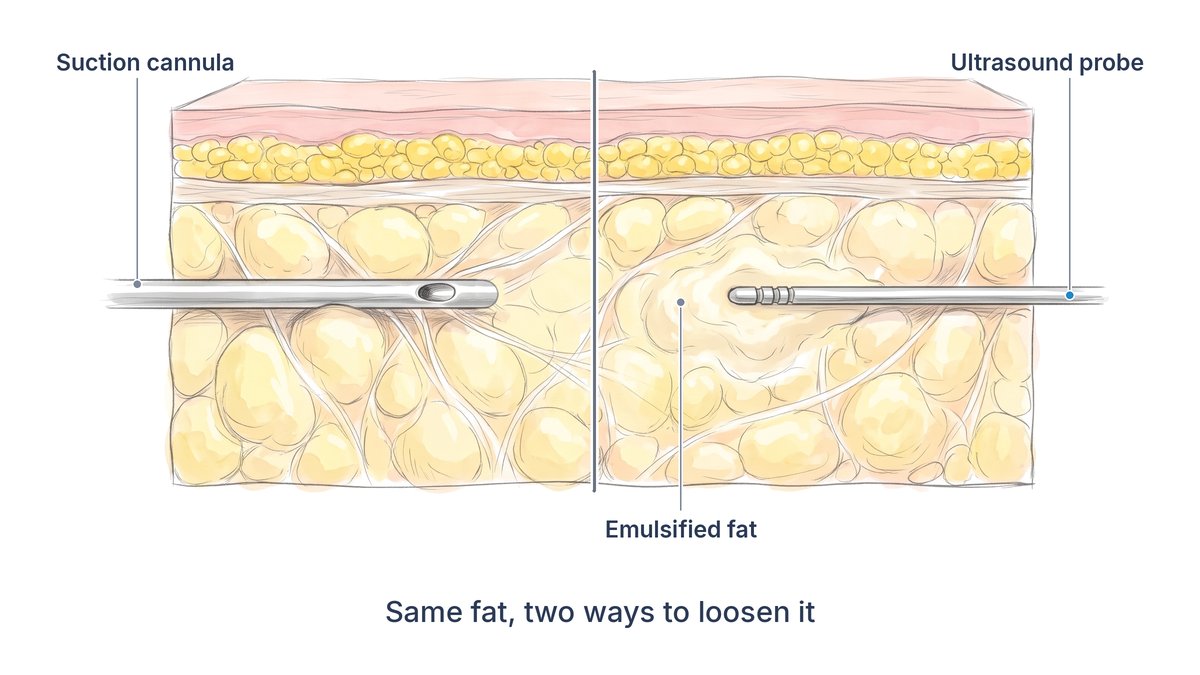
VASER liposuction is ultrasound-assisted liposuction (UAL): a thin probe sends ultrasonic vibration into fluid-filled fat to loosen and emulsify it before an ordinary suction cannula removes it. Traditional liposuction, also called suction-assisted liposuction (SAL), skips that step and relies on the cannula and the surgeon’s arm to break the fat free. What ultrasound really changes is how the fat is loosened, not how much the skin tightens or how much fat can safely come out.
Quick answers
- Is VASER better than traditional liposuction? Not across the board. Its advantage is clearest in fibrous or previously operated fat; Dr. Yongwoo Lee uses it in most liposuction cases and keeps suction alone for small, soft areas.
- Does VASER tighten skin? Somewhat, and inconsistently. A review of the comparative studies found little convincing long-term evidence of better skin tightening.
- Can VASER burn the skin? Yes, rarely: heat at the entry ports or at the probe tip can burn skin, which is why the fat must be fully wet and the skin protected.
- Is VASER less painful, with a faster recovery? In the one randomized split-body trial, pain and swelling did not differ significantly between the two sides.
- Is it good for arms, the back and the male chest? These are where it earns its place, because the fat there is dense and fibrous.
- How much fat can VASER remove? The same safety limits apply as for any liposuction; Dr. Yongwoo Lee keeps total aspirate within 5,000 mL in one session.
- Are the results permanent? Removed fat cells do not grow back with either method; regained weight goes elsewhere.
Is VASER Liposuction Better Than Traditional Liposuction?
VASER is not better in general; its advantage is clearest at one specific job, which is getting through dense, fibrous fat evenly with less force. In soft fat the gain is small, and it is not a treatment for loose skin.
Clinic pages tend to promise tighter skin, less pain and faster recovery, as if ultrasound were simply an upgrade. The comparative evidence is thinner than that. A 2025 review searching the major databases found only five studies that compared ultrasound-assisted and traditional liposuction directly. Its authors credited ultrasound with clinical efficiency, safety, less postoperative anemia and less physician effort, but found little convincing long-term evidence of better aesthetic results or skin tightening, and warned that offering it to patients who really need a more invasive operation may be misleading.
So the useful question is not which machine is better. It is what is stopping a plain cannula in your particular fat, and whether ultrasound solves that problem. Two things do not depend on the device at all: the week-by-week liposuction recovery timeline and whether fat comes back after liposuction.
Key numbers
- Head-to-head comparative studies of ultrasound vs traditional liposuction: 5, in a 2025 review.
- Skin retraction in a 20-patient split-body trial: 0.3 percent better on the flanks, 30 percent on the arms, 37 and 40 percent on the inner and outer thighs.
- Blood loss: no significant difference between the methods in one comparison of major liposuction, but 7.5 times more hemoglobin in the aspirate with traditional suction of the back in another.
- Pooled liposuction complications across 29,368 patients: 2.62 percent overall, seroma 0.65 percent, superficial burn 0.25 percent.
- Burns during the VASER period of a 5,052-patient high-definition series: 0.6 percent.
- Arm series of 28 women: mid-arm circumference down 23.5 percent at 2 months, no burns or seromas.
How Does VASER Liposuction Work?
VASER works in two stages: first a solid probe vibrating at ultrasonic frequency is passed through fat that has been filled with wetting solution, which shakes fat cells loose from the fibrous web around them and turns them into an emulsion; then a standard hollow cannula suctions that emulsion out. The ultrasound itself removes nothing. It prepares the fat so suction meets less resistance.
The fluid is not optional. Ultrasound energy is carried by the wetting solution, and fat that is not saturated heats up instead of emulsifying. The American Society of Plastic Surgeons’ executive summary on liposuction states plainly that the dry technique should never be used with ultrasound-assisted liposuction.
Third-generation devices, of which VASER is the best known, use thin probes with grooves or rings near the tip that spread the energy sideways rather than concentrating it at the point, and a pulsed mode that delivers the energy in bursts rather than continuously. Pulsing is designed to limit heat build-up in the tissue.

For the technically curious
In 2023 five American plastic surgeons ran a three-round Delphi process and reduced 32 draft statements to 18 consensus recommendations for VASER. Expert consensus is the weakest form of evidence, but it describes how experienced users actually run the device:
- About 1 minute of ultrasound for every 200 to 250 mL of wetting solution, stopping when the tissue loses its resistance, with more time allowed in fibrous or previously operated fat.
- Pulsed mode in preference to continuous mode.
- Probes with three or five rings for most areas, two or three rings for fibrous tissue, and single-ring probes generally avoided.
- The fibrous network under the skin preserved, with two or more access points and even cannula strokes.
In plain terms, more rings means gentler energy spread around the probe, and fewer rings means a more aggressive tip. The time rule exists because heat accumulates: ultrasound time is matched to the volume of fluid that carries it, not to how much fat the surgeon would like to remove.
Does VASER Tighten Skin More Than Traditional Liposuction?
Somewhat, in some areas, in small studies, and not reliably enough to plan around. The best-known trial found better retraction on the ultrasound side on average, but almost none on the flanks, and the 2025 review above found no convincing long-term advantage.
The study most often quoted is a multicenter split-body study in 20 women, presented at the 2009 meeting of the American Society of Plastic Surgeons. One side was treated with VASER and the other with traditional suction and the patient did not know which was which; over six months, retraction averaged 40 percent better on the ultrasound side. The site-by-site numbers tell a more useful story: a 0.3 percent difference on three flank sites, 30 percent on two arm sites, and 37 and 40 percent across 27 inner and outer thigh sites. Appearance and patient and physician preference did not differ significantly; pain is covered in the next section.
Two cautions follow: the abstract reports relative rather than absolute retraction, so a large percentage can still be a small change in centimeters, and the arm figure rests on just two sites.

The gynecomastia data point the same way. In a 45-patient three-arm trial comparing traditional liposuction, VASER, and VASER combined with a helium plasma radiofrequency device, measured skin firmness improved in the arm that added the separate skin-tightening device. Ultrasound changed how the dense chest tissue came out; a second energy device was what moved the skin measurements. The group that developed high-definition liposculpture eventually added radiofrequency devices for the same reason, describing them as giving greater skin retraction, although they did not put a number on it.
That is why I describe any retraction from ultrasound as a bonus, not a plan. When skin has lost its recoil, removing fat underneath it will reveal the looseness, whatever device is used, and the decision moves from liposuction to skin, which is explained for the neck in neck liposuction vs a neck lift.
Is VASER Less Painful, With Less Bleeding and Bruising?
Not measurably less painful: in the one randomized split-body trial, pain and swelling were not significantly different, and bleeding is probably a little lower only in fibrous areas such as the back, where the studies disagree. How sore you are depends far more on how much fat is removed and from how many areas than on which device loosened it.
Blood loss has been measured directly, with conflicting results. In one comparison of major liposuction, blood loss was slightly higher with ultrasound than with traditional suction, but the difference was not significant. In a study confined to the back and posterior flanks, among the most fibrous fat in the body, aspirate from traditional suction contained 7.5 times more hemoglobin and 6.5 times the hematocrit of aspirate from VASER. In the split-body trial, blood made up 9.5 percent of the fat removed on the ultrasound side against 13 percent on the traditional side. A plausible way to reconcile them is that ultrasound helps most where a plain cannula has to tear through dense tissue, and matters little in soft fat where it does not.
The 2023 consensus panel listed milder bruising and pain among its statements, but that is expert opinion, and the only blinded comparison did not confirm it.
When Is VASER Worth Using, and When Is Suction Alone Enough?
I use ultrasound in most of my liposuction cases, to loosen the fat before any suction, and keep conventional suction alone for small, soft areas where the cannula meets little resistance. The gain is not the same everywhere, and a small pocket of soft fat does not need the added heat and time. On the operating table, the difference is clearest in three situations, and the skin is a separate question.
Where ultrasound makes the clearest difference
Resistance I can feel. The upper back, the flanks in men and the male chest are packed with fibrous septa. A cannula forced through them jumps from tunnel to tunnel, and that uneven removal is what produces ridges. Ultrasound softens the web first, so suction proceeds evenly at the planned depth.
Scar from a previous operation. In secondary liposuction the fat is bound up in scar, and planes that were once soft are now tethered. Ultrasound makes those fields workable, and some groups now pair VASER with ultrasound imaging to locate scarred, fibrous areas in secondary liposuction before and during the operation. How dents and ridges from an earlier operation are corrected is covered in lumpy or uneven results after liposuction.
Definition work. Etching along the borders of the abdominal and chest muscles requires shallow, controlled passes in dense tissue. That is where ultrasound is most useful and most demanding.
Skin at the edge of good recoil. For skin that is fair but not ideal, any extra retraction is a welcome bonus, never the reason to use ultrasound. For skin that has clearly lost its recoil, ultrasound is not a substitute for removing skin, and I say so before surgery.
How I run the probe
I fill the area with tumescent fluid first and wait for it to take effect, so the fat is fully wet before the probe goes in. I use pulsed mode, keep the probe moving the whole time it is on, and stop when the resistance under my hand disappears rather than at a fixed clock time, staying within the time the fluid volume allows. A protective port sits in every entry incision so the shaft never rubs the skin edge, and wet towels cover the skin around the ports. Once the fat is emulsified, I switch to ordinary suction cannulas to remove it.
What does not change
Everything that makes liposuction safe and smooth stays the same with or without ultrasound. I work the deep and intermediate fat and leave the superficial layer under the skin as undisturbed as I can, use 3 to 5 mm cannulas on the abdomen, flanks and thighs and 3 mm on the arms, infiltrate roughly three to four milliliters of fluid for every milliliter I intend to remove, and hold to the same volume limit described below. Ultrasound loosens fat; it does not make an aggressive plan safe.

Is VASER Good for Arms, the Back, the Male Chest and Hi-Def Liposuction?
These are the areas where ultrasound has the strongest case, because each combines dense fat with a demand for an even surface. Even here, the result depends on the skin and on what kind of tissue is actually there: ultrasound cannot remove glandular breast tissue, and it cannot shrink an arm with a true skin excess, the point at which an arm lift replaces arm liposuction.
Arms
The most persuasive arm data come from a 2023 series titled, pointedly, “no rush for brachioplasty.” Twenty-eight women with heavy upper arms who had not had weight-loss surgery were treated with ultrasound in pulsed mode for 5 to 10 minutes per side, followed by suction with a 4 mm blunt cannula. Mid-arm circumference fell from 43 to 32.9 cm at two months, a 23.5 percent reduction; at six months 85.71 percent were very satisfied and the rest satisfied, and no burns or seromas were recorded.
Read the selection criteria before reading the result. The patients were 23 to 42 years old, and only arms with a moderate or large fat deposit were included: neither the grade with little fat and no hanging skin nor the grade made up mostly of hanging skin with little fat underneath was studied. Follow-up was six months, and the study did not measure skin retraction objectively or report how many patients later wanted an arm lift. A fair conclusion is that in younger patients whose arm fullness is mainly fat, liposuction alone can be a reasonable first step before considering an arm lift. Older arms, or arms that hang after major weight loss, are mainly a skin problem. An arm lift, brachioplasty, removes skin and leaves a scar along the inner arm; I perform it myself, and no device makes that trade unnecessary when the skin excess is real.
Back and flanks
The upper back and the flanks in men are where I most consistently feel the difference, and where the strongest blood-loss difference was measured. In women with softer flank fat, the difference is smaller.
Male chest
Male chest enlargement is usually a mix of fat and firm gland. Ultrasound loosens the fatty part well, and in the 45-patient trial the reduction of firm tissue behind the nipple differed significantly between the three groups. In my practice no form of liposuction reliably removes true glandular tissue, so where gland is present I plan to excise it through a small incision at the edge of the areola rather than expect the device to dissolve it.
High-definition liposuction
High-definition liposculpture removes deep fat for volume and then thins the superficial fat along muscle borders to show the outline of the abdominal or chest muscles. It is the most technique-dependent form of liposuction, and the consensus panel recommended it only after appropriate training. In the 18-year series from the group that developed it, covering 5,052 patients across three technical periods, burns occurred in 0.6 percent of patients during the VASER high-definition period and 0.3 percent in the later dynamic-definition period, which also used ultrasound. Definition only suits patients who are already lean and whose skin will follow the new contour, and it is far harder to soften an over-etched abdomen than to add definition later.
VASER vs Laser Lipo vs Power-Assisted vs Radiofrequency: How Do They Compare?
Every assisted method still removes fat with a suction cannula; what differs is how the fat is loosened first. Power-assisted liposuction vibrates the cannula mechanically, ultrasound and laser (the method behind brands such as SmartLipo) deliver energy into the fat, and radiofrequency devices mainly heat the tissue to try to tighten it.
Head-to-head trials between these methods are few and small, so no ranking is honest, and the VASER consensus panel explicitly allowed combining it with power-assisted or radiofrequency devices. A device-neutral summary:
At a Glance: Traditional, Power-Assisted, VASER, Laser and Radiofrequency Liposuction
| Method | How fat is loosened | Heat in the tissue | Where it helps most | Main trade-off | Comparative evidence |
|---|---|---|---|---|---|
| Traditional (suction-assisted) | Cannula strokes alone | None | Soft fat, small areas | Hard work in fibrous fat; uneven passage if forced | The reference standard |
| Power-assisted | Cannula vibrates mechanically | Minimal | Large volumes, moderately fibrous fat | Device noise and vibration; no skin effect claimed | Small comparative studies, mainly on surgeon effort |
| Ultrasound-assisted (VASER) | Ultrasonic probe emulsifies fat in wetting solution | Yes, controlled by fluid, pulsing and time | Fibrous fat, back, male chest, secondary cases, definition | Burn risk at ports and probe tip; extra operative step | Five head-to-head studies; modest, inconsistent retraction gains |
| Laser-assisted | Laser fiber melts fat | Yes | Small areas, often marketed for tightening | Thermal injury if overused; limited volume | Small trials; tightening claims weakly supported |
| Radiofrequency-assisted | Energy heats the underside of the skin, sometimes with fat | Yes, aimed at skin | Skin at the edge of good recoil | Added heat and time; not a substitute for excision | Mostly case series; used as an adjunct |
| Non-surgical fat reduction | Heat or cold through the skin | Mild | Small, pinchable pockets | Gradual, partial reduction over several sessions | Separate evidence base |
For small pockets where an operation is out of proportion, microwave fat reduction with ONDA covers the non-surgical side. For skin that needs tightening without any fat removal, the options are compared in Ultherapy vs Thermage vs Shurink.
Surgeon’s Insight: I Use Ultrasound Often, but Not to Tighten Skin
Patients often ask for VASER by name, as if it were a stronger kind of liposuction. I do use ultrasound in most of my cases, but as a way of loosening fat, not as a skin treatment, and for a small, soft area I leave the probe out.
What the device does not decide is the skin. If the skin has lost its recoil, no energy device will make liposuction alone the right operation, and I would rather say that before surgery than explain it afterward.
What Are the Risks and Disadvantages of VASER? Burns, Seroma, Numbness
VASER carries all the risks of ordinary liposuction plus one of its own: heat. Skin burns at the entry ports or above the probe tip are uncommon (superficial burns in 0.25 percent of patients pooled across all liposuction techniques, and burns in 0.6 percent during the VASER period of one high-definition series), and seroma, a pocket of fluid under the skin, is the other complication patients most often ask about.
Pooling 39 studies and 29,368 patients across all liposuction techniques, a 2024 meta-analysis found an overall complication rate of 2.62 percent, with contour deformity the most common at 2.35 percent, seroma at 0.65 percent and superficial burn at 0.25 percent. In a 261-patient series of third-generation ultrasound liposuction over 15 years, complications totaled 4.6 percent: contour irregularity 1.9 percent, seroma 0.8 percent and cellulitis 0.8 percent, and 86 percent of patients said they would recommend the procedure.
Burns
An ultrasound burn has two typical places. At the port, the vibrating shaft can heat the edge of the small incision. Away from the port, the tip of a probe pressed up against the underside of the skin for too long, sometimes called an end hit, can heat it from beneath; the 18-year high-definition series recorded both local and distal burns. Prevention is mechanical rather than magical, and it is the routine described under how I run the probe, with the tip kept away from the skin. The ASPS summary lists thermal injury among the serious complications of liposuction.

Seroma
Emulsifying fat leaves fluid and loosened tissue behind, and a pocket of that fluid can collect under the skin a week or two after surgery. In the high-definition series seroma fell from 18.0 percent in the early suction-only period to 7.0 percent in the VASER period and 2.1 percent in the latest period as technique evolved, which shows how much it depends on method rather than device alone. The consensus panel noted that compression may reduce seroma and that an established seroma is treated by draining it, sometimes more than once. A seroma that keeps coming back can form a capsule, a lasting problem that usually needs more than another drainage.
Numbness and nerve irritation
Temporary numbness, tingling or oversensitive skin is common after any liposuction and usually settles over weeks to months; heat is one more stress on the small skin nerves, another reason to keep ultrasound time to what the tissue needs. Ultrasound also does not prevent ridges and dents on its own, and used too close to the surface it can cause them.
How Much Fat Can VASER Remove, and Are the Results Permanent?
VASER can remove the same amount of fat as traditional liposuction, no more, because the limits are set by the patient’s safety rather than the device. ASPS classifies more than 5,000 cc of total aspirate as large-volume liposuction that belongs in an accredited or licensed facility, and fat removed by either method does not grow back.
For reference, the average volume of fat removed in the 261-patient ultrasound series was 2,284 mL. My own working limit is 5,000 mL of total aspirate in one session, and the number of areas treated matters as much as the volume.
On permanence, the device makes no difference. Fat cells removed by suction are gone, but the cells that remain can enlarge, and weight regained after surgery is stored preferentially in the areas that were not treated. How much weight gain undoes a result, and why the neck shows it first, is the subject of the weight-regain article linked near the top.
Fat loosened by ultrasound can also be used for grafting. A laboratory study found that fat-derived stem cells harvested with ultrasound matched those from standard suction in yield, viability and function, and the consensus panel agreed that appropriate exposure does not damage harvested fat. How much transplanted fat survives is a separate question, answered in how much transplanted fat lasts.
Is VASER Recovery Faster Than Traditional Liposuction?
Not substantially. The compression garment, the timeline for activity and the slow fading of swelling are the same, and the consensus panel itself recommended wearing compression for about six weeks, the same as after conventional liposuction.
My schedule does not change with the device: compression essentially around the clock for the first two to three weeks, full-time to about six weeks and then tapered, with unrestricted training after six weeks; each stage, from leaking entry points to the final contour at three to six months, is set out in the week-by-week timeline linked above.
Lymphatic massage is often offered after VASER; the consensus panel suggested 6 to 15 sessions, but that is expert opinion rather than trial evidence, and it is offered for comfort rather than as proof of faster recovery. Patients flying home after body liposuction carry a higher clot risk than after facial surgery and need the full set of leg precautions, explained in how long to stay in Korea after surgery.
Who Is a Good Candidate for VASER Liposuction?
The patients who gain most have dense or previously treated fat, and like any liposuction candidate they need skin that still recoils, a stable weight, and a goal that is shape rather than weight loss. The method should be chosen for the tissue, not requested by brand.
These profiles are illustrative examples, not real patients, and describe decisions, not results.
A 38-year-old man with a thick upper back and firm flanks. A typical case for ultrasound, because a plain cannula meets resistance from the first pass.
A 45-year-old woman with a small, soft pocket of fat below the navel and good skin. Suction alone does the job.
A 34-year-old woman with heavy upper arms and moderate laxity. A reasonable candidate for ultrasound-assisted arm liposuction, after a frank discussion that some looseness may remain.
A 58-year-old woman whose upper arms hang after losing 20 kilograms. Here the skin, not the fat, is the main issue. Liposuction alone, with any device, is likely to leave the skin looser; an arm lift is the operation I would discuss with her.
A 29-year-old man with chest fullness that is firm under the nipple. Ultrasound for the fatty part, with planned excision of any true gland.
A 42-year-old woman with dents and ridges from liposuction elsewhere. A secondary case, where ultrasound can help free scarred fat, but the plan starts with mapping what is left and what is missing.
What Should I Ask a Surgeon Who Offers VASER?
Ask why ultrasound is being recommended for your specific areas, what the surgeon would do without it, and what happens to your skin. A surgeon who can answer those three questions in terms of your tissue, rather than the device’s brochure, is choosing a tool for a reason.
Then ask whether the area will be fully infiltrated before ultrasound, whether port protectors are used, how much fat will be removed in total, and where the operation will take place. If skin tightening is the main promise, ask what happens if the skin does not tighten enough; the answer reveals whether liposuction was the right operation in the first place. A natural result, in the sense of what natural means in plastic surgery, is a body that looks like it was always that shape, whichever cannula made it.
Individual results vary; consultation required.
Written by Dr. Yongwoo Lee, board-certified Korean plastic surgery specialist in facial anatomy and aesthetic procedures at VIP Plastic Surgery, South Korea.
Frequently Asked Questions About VASER vs Traditional Liposuction
What is the difference between VASER and traditional liposuction?
VASER adds one step: an ultrasonic probe loosens fat in wetting solution before suction, while traditional liposuction frees it with cannula strokes alone. Both then remove fat with a suction cannula, within the same safety limits.
Is VASER worth it compared with traditional liposuction?
Its advantage is clearest when the fat is fibrous, previously operated or being etched for definition, because ultrasound makes even removal easier there. Dr. Yongwoo Lee uses it to loosen fat in most liposuction cases and keeps suction alone for small, soft areas, where it achieves the same result without the added heat; any skin tightening is a bonus, not a reason to choose it.
Is VASER liposuction less painful than traditional liposuction?
Not clearly. In a 20-patient split-body trial where each patient had VASER on one side and traditional suction on the other, pain and swelling did not differ significantly. An expert panel reported milder bruising and pain, but that is opinion rather than measured data.
Does VASER tighten loose skin?
Only modestly and inconsistently. One small trial found better retraction on the thighs and arms but almost none on the flanks, and a 2025 review found little convincing long-term evidence. Skin that has lost its recoil needs a skin operation, not a different liposuction device.
Can VASER burn the skin?
Yes, though it is uncommon: superficial burns occurred in 0.25 percent of patients across all liposuction techniques in a large meta-analysis, and in 0.6 percent during the ultrasound period of a high-definition series. Full infiltration, pulsed energy, port protectors, wet towels and a constantly moving probe are the standard protections.
Is seroma more common after VASER?
Seroma occurs after any liposuction and was reported in 0.8 percent of a 261-patient ultrasound series and 0.65 percent across all techniques in a pooled analysis. Higher rates have been reported in high-definition work, falling as technique improved. Compression helps prevent it, and an established seroma is drained.
Is VASER safer than traditional liposuction?
Neither is inherently safer. Ultrasound adds a burn risk that suction alone does not have, while the main dangers of liposuction, such as excessive volume, clots and fluid shifts, depend on the size of the operation and where it is done rather than the device.
Can VASER remove more fat than regular liposuction?
No. The safe volume is set by the patient, not the device, and more than 5,000 cc of total aspirate is classified as large-volume liposuction. Dr. Yongwoo Lee keeps total aspirate within 5,000 mL in one session.
Are VASER liposuction results permanent?
Removed fat cells do not grow back after either method. Weight regained later is stored in the remaining fat cells, preferentially in areas that were not treated, so a stable weight is what keeps the shape.
Is VASER good for love handles and back fat?
Often, yes, especially in men, because the flanks and upper back contain dense fibrous fat that resists a plain cannula, and the clearest blood-loss difference in favor of ultrasound was measured there.
Does VASER work for gynecomastia?
It works well for the fatty part of an enlarged male chest. True glandular tissue is not reliably removed by any liposuction device, so when gland is present, Dr. Yongwoo Lee plans to excise it through a small incision at the edge of the areola.
Can VASER on the arms avoid an arm lift?
Sometimes, when the arm fullness is mainly fat: in a 28-woman series aged 23 to 42, mid-arm circumference fell by 23.5 percent at two months with no burns or seromas, although skin retraction was not measured. Arms with a true skin excess, typically after major weight loss or with age, still need an arm lift.
What is VASER Hi Def liposuction?
It is high-definition liposculpture: deep fat removal plus selective thinning of the superficial fat along muscle borders to show abdominal or chest definition. It suits lean patients with good skin and requires specific training, and overdone etching is much harder to correct than underdone etching.
Is VASER the same as laser liposuction?
No. VASER uses an ultrasonic probe to emulsify fat in wetting solution, while laser liposuction uses a laser fiber to melt it. Both are followed by suction, both add heat, and neither has strong evidence of better skin tightening than traditional suction.
Can fat from VASER be used for fat transfer?
Yes. Laboratory work suggests that ultrasound at appropriate settings does not harm the harvested fat or its stem cells. How much of any graft survives is a separate question.
This article is for informational purposes only and does not constitute medical advice. Always consult with a qualified medical professional before making any decisions about surgical or non-surgical procedures.
