
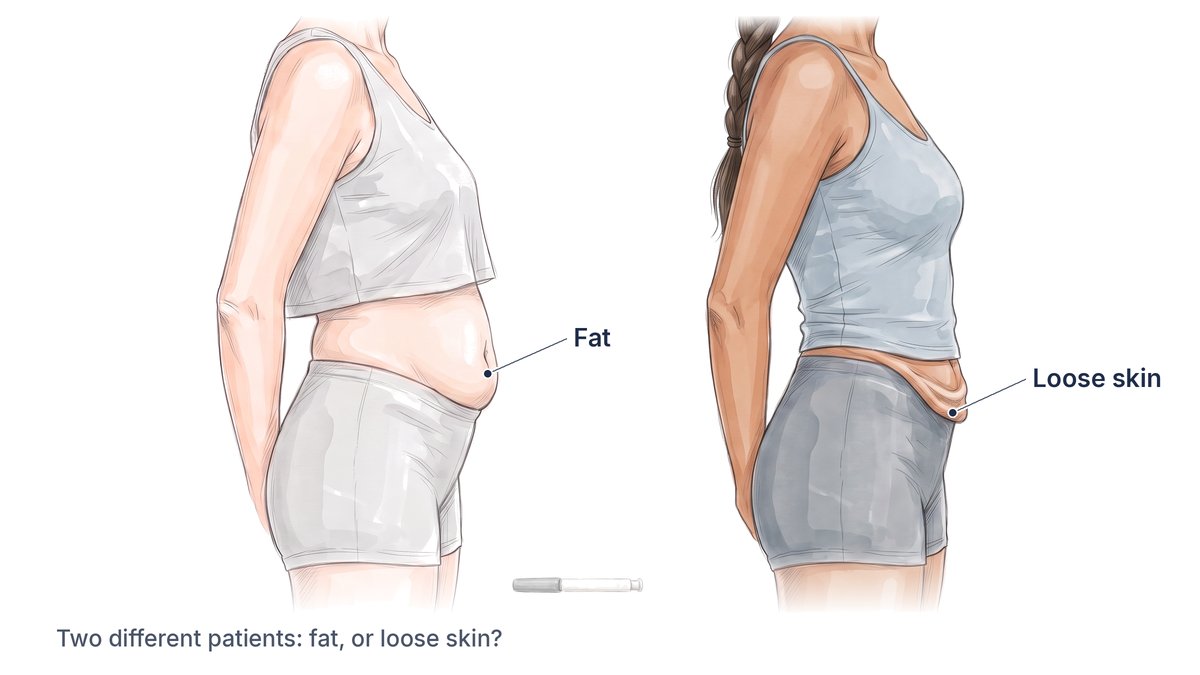
Liposuction after Ozempic, Wegovy, Mounjaro or Zepbound is possible, but it is a different consultation from liposuction in someone who never lost weight. Three questions decide it: has the weight stopped moving, is what remains fat or loose skin, and what happens to the drug before and after surgery.
Quick answers
- How long should I wait? In Dr. Yongwoo Lee’s practice, three to six months of stable weight on a stable dose, and six months of stable weight off the drug for a patient who has stopped it for good, because the weight often returns.
- Liposuction or a tummy tuck? When loose skin dominates on a pinch test, a tummy tuck from the start, with liposuction added if needed.
- Do I stop the drug? Dr. Lee pauses it one month before surgery, agreed with the prescribing doctor (for diabetes, the internist, who plans glucose control for the pause), and it restarts one to two weeks after, once eating is normal, at a dose the prescriber sets.
- Will the fat come back if I stop the drug? Removed fat cells do not return, but in one trial about two thirds of the lost weight came back within a year of stopping semaglutide.
Can You Get Liposuction After Ozempic, Wegovy, Mounjaro or Zepbound?
Yes. Liposuction after GLP-1 weight loss is reasonable once the weight has been stable for several months and what is left is mainly fat under skin that still springs back. Two mistakes are common: booking it while the scale is still falling, and booking it for a lower belly that is now mostly loose skin.
In a 2025 survey of American Society of Plastic Surgeons members, 82 percent of surgeons reported consultation requests related to GLP-1 weight loss, and the requests were mostly about skin: 88 percent of surgeons reported them for tummy tucks and 84 percent for arm lifts, against 55 percent for liposuction. After a large loss much of the fat has already gone, and what bothers the patient is the skin it left behind.
Liposuction itself has not changed. The same society describes ideal candidates as adults within 30 percent of their ideal weight who have firm, elastic skin and good muscle tone. A GLP-1 drug can bring a patient into that weight range; whether it leaves firm, elastic skin has to be examined.
One limit applies throughout: no published study has measured liposuction results or complications specifically in GLP-1 users, so the reasoning here is assembled from drug trials, liposuction trials and studies of skin-removing operations, each labeled as what it is.
How Long After Losing Weight on Ozempic Should You Wait for Liposuction?
Wait until the weight has stopped moving, not until a date on the calendar. In my practice that means a stable weight for three to six months before liposuction for a patient who stays on a stable dose, and six months of stable weight off the drug for a patient who has stopped it for good, because the weight often returns.
Stability arrives later than most patients expect. A pooled analysis of 12 studies and 13,947 patients found that weight on semaglutide leveled off at about 53 weeks of treatment, at an average loss of 16 percent; its authors advised approaching body contouring cautiously.
In the main trials, adults on semaglutide lost an average of 14.9 percent of their body weight over 68 weeks, and adults on tirzepatide 15.0 to 20.9 percent over 72 weeks, depending on the dose; someone four months into treatment is still in the first half of that curve.
Liposuction shapes the fat present on the day; if another eight kilograms leave afterward, the treated skin loosens and the planned proportions no longer fit. One American surgeon puts it plainly: “Patients should be at or near the end of their weight loss journey before having surgery.”
Published waiting periods are expert opinion, not trial results. One surgeon interviewed by the American Society of Plastic Surgeons asks for a maintenance dose for at least three months and a weight that has neither risen nor fallen for two to three months, ideally closer to six.
In a series of 1,002 body contouring patients, every patient had held a stable weight for at least six months before surgery. A 2025 narrative review asks for stability for at least three months, preferably six, with a change of no more than 5 kg between consultations. My three to six months before liposuction sits inside that range, and it is my own rule, not a guideline; after stopping the drug for good I ask for six months off it, the same as before a facelift after GLP-1 weight loss, as explained in Ozempic face: facelift, fat grafting, or wait.
Is It Fat or Loose Skin After Ozempic Weight Loss?
Often it is skin, and the difference decides the operation. Liposuction removes fat and depends on the skin to shrink over the smaller volume; when the skin has lost its recoil, taking away the fat beneath it leaves the envelope emptier, and it can hang more than before.
GLP-1 drugs remove fat from everywhere, including the places a cannula would have worked. Both drug labels state that treatment lowers body weight with greater fat mass loss than lean mass loss, and in the main tirzepatide trial waist circumference fell by 14.0 to 18.5 cm, against 4.0 cm on placebo. The fat layer is thinner; the skin that covered the old waist is all still there.
A lower belly that still bothers someone after weight loss is one of three things, or a mix:
- Fat under the skin. It pinches into a thick roll, and the skin over it springs back. Liposuction treats this.
- Loose skin. The pinch is thin, and the fold stays tented or hangs when the patient leans forward. No cannula removes skin.
- Something deeper. A belly that is round and firm but cannot be pinched is fat around the organs (visceral fat); a ridge or dome down the midline that shows when the abdomen is tensed is usually muscles separated by pregnancy (diastasis recti). Liposuction reaches neither.

A bulge at or near the navel or an old surgical scar can also be a hernia, more likely after pregnancy, years of extra weight, or earlier abdominal surgery, including laparoscopic or bariatric operations; it is checked, with ultrasound if needed, before any cannula goes near it.
How Do Liposuction, a Tummy Tuck and Waiting Compare After GLP-1 Weight Loss?
Liposuction fits a pinchable pocket of fat under skin that springs back. A tummy tuck, usually with liposuction in the same operation, fits a lower abdomen where loose skin dominates. Waiting fits anyone whose weight or dose is still changing.
At a Glance: Liposuction, Tummy Tuck With Liposuction, or Waiting
| Liposuction alone | Tummy tuck with liposuction | Waiting | |
|---|---|---|---|
| What it removes | Fat | Loose skin and fat | Nothing yet |
| Fits when | Thick pinch, skin springs back, weight stable 3 to 6 months | Loose skin dominates on the pinch test, weight stable 3 to 6 months | Weight still falling, dose still stepping up, stomach symptoms, or drug recently stopped and weight not yet proven stable |
| Scar | Entry points a few millimeters long | A long, low scar across the lower abdomen | None |
| What it cannot do | Tighten loose skin | Replace weight maintenance | Remove loose skin |
| GLP-1 drug in Dr. Lee’s practice | Paused 1 month before, with the prescriber; restarted 1 to 2 weeks after | Paused 1 month before, with the prescriber; restarted 1 to 2 weeks after | Continued with the prescriber |
The middle column is not one operation: a mini tummy tuck treats looseness below the navel, a full one treats skin above it as well, as compared in mini versus full versus extended tummy tuck.
Will the Fat Come Back If You Stop Ozempic After Liposuction?
The fat cells removed by liposuction do not come back, but the weight usually does when the drug is stopped without another plan, and regained weight is stored in the fat cells that remain. Liposuction changes where fat can be stored, not how much the body stores.
Withdrawal trials give the scale: a year after semaglutide ended, participants had regained 11.6 of the 17.3 percentage points they had lost, about two thirds, and adults switched from tirzepatide to placebo after losing 20.9 percent regained 14.0 percent over the next year, while those who continued lost a further 5.5 percent. What that regain means for the face is discussed in Ozempic face after GLP-1 weight loss.

Liposuction does not protect against that. In a randomized trial of 32 women who were not obese, body fat was lower six weeks after liposuction of the thighs and lower abdomen, but by one year the difference from untreated women had disappeared: the thighs stayed slimmer, while abdominal fat had returned. In another randomized trial of 36 women, visceral fat rose by 10 percent within six months of small-volume abdominal liposuction in those who did not exercise, and a four-month training program prevented the rise. Neither trial involved a GLP-1 drug; the cell biology is explained in whether fat comes back after liposuction.
So the drug plan is decided before surgery, with the doctor who prescribes it. One route is to stay on a maintenance dose afterward. The other is to come off the drug first and show, over six months rather than weeks, that the weight holds without it. Liposuction is not a way to come off the drug.
When Should You Stop and Restart Ozempic or Mounjaro Around Liposuction?
In my practice semaglutide and tirzepatide are paused one month before any operation, agreed with the prescribing doctor, and restart one to two weeks after surgery, once the patient is eating normally, at a dose set by that doctor. For a patient taking the drug for diabetes, the internist plans blood sugar control for the pause. That rule is stricter than current US guidance, and it is a precaution, not proof.

The reason is the stomach: these drugs slow its emptying, and the semaglutide and tirzepatide labels both describe rare reports of stomach contents being breathed into the lungs under general anesthesia or deep sedation, despite fasting. Semaglutide has a half-life of about one week, so some drug remains even after a month’s pause, and whoever gives the anesthetic or sedation is told the date of the last injection on the day of surgery. Current US guidance is less strict, and why a month is still my rule is set out in what to stop before plastic surgery.
A pause has a downside. One month before plus one to two weeks after means five to six weeks off the drug, and the Wegovy label leaves it to the prescriber, after two or more missed doses in a row, whether to resume the previous dose or step up again from a lower one.
Normal eating comes first because healing needs protein: one American surgeon reports delayed wound healing in GLP-1 patients who eat very little. On restarting, the only direct data are a meeting abstract: in 842 matched pairs of body contouring patients, starting a GLP-1 drug within 30 days after surgery was not followed by significantly more wound separation, infection, bleeding or fluid collections at 90 days. It is retrospective, and liposuction was not reported separately.
How Does Dr. Yongwoo Lee Plan Liposuction After GLP-1 Weight Loss?
I decide from the scale and the skin before I decide anything about a device: a stable weight for three to six months, a pinch test standing and leaning forward, and a tummy tuck from the start when loose skin dominates. I perform both operations myself.
What has to be true before I set a date
- Weight. Stable for three to six months on a stable dose, and for six months off the drug in a patient who has stopped it for good.
- Dose. Not still stepping up, and no nausea, vomiting or other stomach symptoms.
- Body mass index. About 30 to 32 or less.
- Nicotine. None in any form (cigarettes, vapes, patches, gum) for four weeks before and four weeks after surgery; a patient who cannot stop has the surgery postponed.
- Blood tests. After massive weight loss I check albumin, a blood protein that reflects nutrition, and a blood count for anemia, and a low value is corrected before surgery.
The pinch, standing and leaning forward
I examine the abdomen with the patient standing and pinch the lower abdomen and flanks to judge two things: how thick the fat is, and how fast the skin springs back. Then I ask the patient to lean forward. Loose skin falls away from the abdominal wall and hangs. A thick pinch with brisk recoil is a liposuction abdomen; a thin pinch that hangs forward is a skin abdomen.

When I choose liposuction alone
Liposuction alone is my choice when fat is the main finding and the skin recoils. My technique does not change after a GLP-1 drug: ultrasound (VASER) in most cases, conventional suction alone for small, soft areas, 3 to 5 mm cannulas in the deep and intermediate fat, and the layer under the skin left as undisturbed as I can. What changes is how much I remove. Any extra skin tightening from ultrasound is a bonus, never the plan, for the reasons in VASER versus traditional liposuction.
How much I remove
I keep the total aspirate, fat plus fluid, at 5 liters or less in one session, and a plan that needs more is staged. In a registry study of 4,534 liposuction patients, a volume above 100 mL for each unit of body mass index independently predicted complications, with an odds ratio of 4.58. The 5 liters is a ceiling, not a target: after GLP-1 weight loss the body mass index is lower, so that registry threshold is reached sooner.
When I choose a tummy tuck from the start
When loose skin dominates, I recommend a tummy tuck from the start, with liposuction in the same operation if it is needed. I do not suction first and hope, because liposuction alone can make that skin hang more; what that looks like is described in loose skin after liposuction.
In the combined operation the skin is lifted only through a limited tunnel so the flap keeps its blood supply; the full method, from Scarpa fascia to drains and dressing, is in liposuction and tummy tuck together.
Around the operation
Clot prevention is the same as for my facelift patients: pneumatic compression on the legs during surgery and through the first night, early walking for everyone, and a blood-thinning injection only for patients at higher risk. Every liposuction patient stays one night.
Which GLP-1 Liposuction Patient Are You?
Most patients fit one of five patterns, shown here as illustrative profiles, not real patients.
A 36-year-old woman, 14 kg lost on semaglutide, weight flat for five months on a maintenance dose. Flanks and lower abdomen pinch thick and the skin springs back. Liposuction fits, with the drug paused one month before.
A 44-year-old woman, 28 kg lost on tirzepatide, two pregnancies. The pinch is thin and the lower abdomen hangs when she leans forward. A tummy tuck with liposuction of the flanks fits, if she plans no further pregnancy, after albumin and a blood count are checked.
A 31-year-old woman five months into treatment, still losing weight every month. Not yet: the same examination will read differently in three months.
A 39-year-old woman who wants liposuction so that she can stop the injections. The order is reversed. She comes off the drug first, and surgery waits until her weight has held without it for six months, not weeks.
A 52-year-old man at a body mass index of 34, round and firm in the abdomen, with little to pinch. Most of that volume is inside the abdomen, beneath the muscle wall, where a cannula does not reach, and his body mass index is above the range I operate in.
What Is Recovery Like After Liposuction When You Take a GLP-1 Drug?
Recovery follows the usual liposuction clocks, with two additions: enough protein while the drug is paused, and a planned restart at one to two weeks. Patients walk from the first day, wear a compression garment for about six weeks, and see the final contour at three to six months; the detail is in the liposuction recovery timeline.
- Eating. Enough protein from the first days; published advice ranges from at least 100 g a day to 1 to 2 g per kilogram of body weight.
- Exercise. Light cardio at three to four weeks, unrestricted training after six; exercise is part of the treatment, because in a randomized trial visceral fat rose after abdominal liposuction only in women who did not exercise.
- Flying home. Five to seven days after ordinary-volume liposuction; 10 to 14 days after large-volume liposuction, several areas, or a tummy tuck. In-flight precautions are in the liposuction recovery timeline.
Surgeon’s Insight: The Request Is About Fat, and the Finding Is Often Skin
A patient who has lost 20 kilograms usually asks me to take the rest. But when I pinch that last pocket, there is often very little fat in it. What she is holding is skin, and suction removes none of it.
The two answers I give most often in this consultation are “not yet” and “not liposuction.” Neither is a refusal. The first is about a weight that has not finished moving, the second about choosing the operation for the tissue that is there.
Is Liposuction Safe After GLP-1 Weight Loss, and What Are the Risks?
At a stable weight, well nourished and within volume limits, liposuction after GLP-1 weight loss carries the usual liposuction risks; nobody has measured liposuction complications in GLP-1 users specifically, and the nearest studies, mostly of skin-removing operations, disagree with each other.
- More wound problems in one database study. Among nondiabetic patients having body contouring after bariatric procedures, those who had used semaglutide for at least six months had wound separation in 5.19 percent against 2.78 percent, and surgical site infection in 5.37 percent against 2.87 percent. Liposuction was not among the operations, and the authors state that causality cannot be inferred.
- No difference in a single-center series. In the 1,002-patient series, some of them with liposuction added to a skin-removing operation, complication rates did not differ between weight lost by bariatric surgery, lifestyle, GLP-1 drugs or a combination, though only about 80 had used a GLP-1 drug alone, too few to show the methods are equivalent; liposuction was not analyzed on its own.
- Less bleeding in a matched study. A database comparison found bleeding during surgery in 0.07 percent of GLP-1 patients against 0.74 percent of bariatric surgery patients, with similar infection, wound separation and clot rates.
- The closest study to liposuction. In 21 patients on semaglutide who had a tummy tuck with circumferential liposuction, compared with a control group taken from earlier records, major complications did not differ significantly, and bruising and skin darkening were more frequent, although that difference did not reach statistical significance either.
All of these are retrospective or small, and none can separate the drug from the weight loss or from what the patient was eating. Nutrition is the plausible link to slow healing: the narrative review reports lower serum protein, vitamin B12 and zinc in some GLP-1 patients. A review of body composition found that lean mass made up 15 percent or less of the weight lost in some trials and 40 to 60 percent in others; lean mass includes water, organs and bone, so those figures are not the same as muscle lost.
The usual liposuction risks still apply: contour irregularity, seroma (a pocket of fluid under the skin), numbness, and rarely infection or a blood clot. Rarer and more serious risks, injury to the abdominal wall or the organs beneath it, fat entering the bloodstream (fat embolism) and fluid imbalance after large volumes, are why volume limits and overnight observation exist. For this group the most likely disappointment is not a complication: it is loose skin that was there before surgery and shows more after it.
Call your surgeon at once for fever with spreading redness, skin that turns dark, or a swelling that keeps growing. A swollen or painful calf needs to be examined the same day: after you have flown home, go to a local emergency department rather than waiting to reach the clinic. Chest pain, sudden breathlessness, coughing blood, confusion or fainting, or severe and worsening pain in the abdomen are emergencies: call emergency services first (119 in Korea), or go to the nearest emergency department, then call your surgeon. After restarting the drug, vomiting or being unable to eat is a reason to tell the surgeon and the prescriber the same day, and severe belly pain that does not settle needs urgent medical care.
What Should You Ask Before Liposuction After GLP-1 Weight Loss?
Ask not “can I have liposuction now?” but “is what is left fat or skin, and has my weight stopped moving?” The first answer names the operation; the second names the date.
Two more are worth bringing: who decides the drug pause and the restart dose, and what is the next step if my skin does not shrink? A surgeon who can answer the last one before operating has examined the skin, not only the fat.
Individual results vary; consultation required.
Written by Dr. Yongwoo Lee, board-certified Korean plastic surgery specialist in facial anatomy and aesthetic procedures at VIP Plastic Surgery, South Korea.
Frequently Asked Questions About Liposuction After Ozempic or Mounjaro
Is liposuction after Mounjaro planned differently from liposuction after Ozempic?
Not in Dr. Lee’s practice. Semaglutide and tirzepatide are both paused one month before surgery and restarted one to two weeks after, both labels carry the same anesthesia warning, and stability is judged the same way, on the scale.
Can I stay on a maintenance dose of Ozempic after liposuction?
Yes, if you and your prescriber choose that route; it is one of the two plans to settle before surgery. The other is to come off the drug first and show over six months that the weight holds without it. Either way the drug is paused one month before surgery and restarted one to two weeks after, once you are eating normally.
How much protein should I eat around liposuction if I take a GLP-1 drug?
One American surgeon asks GLP-1 patients for at least 100 g of protein a day, adjusted for height and weight, and a narrative review gives 1 to 2 g per kilogram of body weight. Healing needs protein, and normal eating is the condition for restarting the drug after surgery.
Can liposuction remove belly fat around the organs?
No. Fat around the organs (visceral fat) lies beneath the muscle wall, where a cannula does not reach, and in one randomized trial it rose after small-volume abdominal liposuction in women who did not exercise.
Does weight loss on Ozempic cause muscle loss that matters for surgery?
Part of the weight lost is lean mass, which includes water, organs and bone, not only muscle. Nutrition is the plausible link to slow healing, which is why Dr. Lee checks albumin and a blood count after massive weight loss.
Lipo or tummy tuck after Ozempic: which one do I need for loose belly skin?
A tummy tuck, when loose skin dominates. Dr. Lee decides with a pinch test, standing and leaning forward, and recommends a tummy tuck from the start, with liposuction in the same operation if needed.
Can VASER tighten loose skin after Ozempic weight loss?
Not reliably. Dr. Lee uses VASER in most liposuction cases to loosen fat, and treats any extra skin tightening as a bonus, not a plan. Skin that hangs has to be removed.
Does Ozempic slow wound healing after surgery?
The evidence is mixed and comes mostly from skin-removing operations, not liposuction alone. One database study found about twice the rate of wound separation and infection in semaglutide users; a 1,002-patient series, in which about 80 had used a GLP-1 drug alone, found no difference by weight-loss method.
Should I have liposuction instead of taking Ozempic to lose weight?
No. Liposuction is a contouring operation for fat deposits in someone near a stable weight, not a weight-loss treatment. Dr. Lee operates at a body mass index of about 30 to 32 or less.
Is the safe liposuction volume lower after GLP-1 weight loss?
It can be. Dr. Lee keeps total aspirate, fat plus fluid, at 5 liters or less per session and stages larger plans, but a registry study of 4,534 patients found more complications above 100 mL per unit of body mass index, a threshold reached sooner at the lower body mass index that follows weight loss.
Can I travel to Korea for liposuction while taking a GLP-1 drug?
Yes, with planning. Stop the drug one month before surgery in agreement with your prescriber. In Dr. Lee’s practice a long-haul flight home is reasonable five to seven days after ordinary-volume liposuction, and 10 to 14 days after large-volume liposuction, several areas or a tummy tuck.
This article is for informational purposes only and does not constitute medical advice. Always consult with a qualified medical professional before making any decisions about surgical or non-surgical procedures.
