
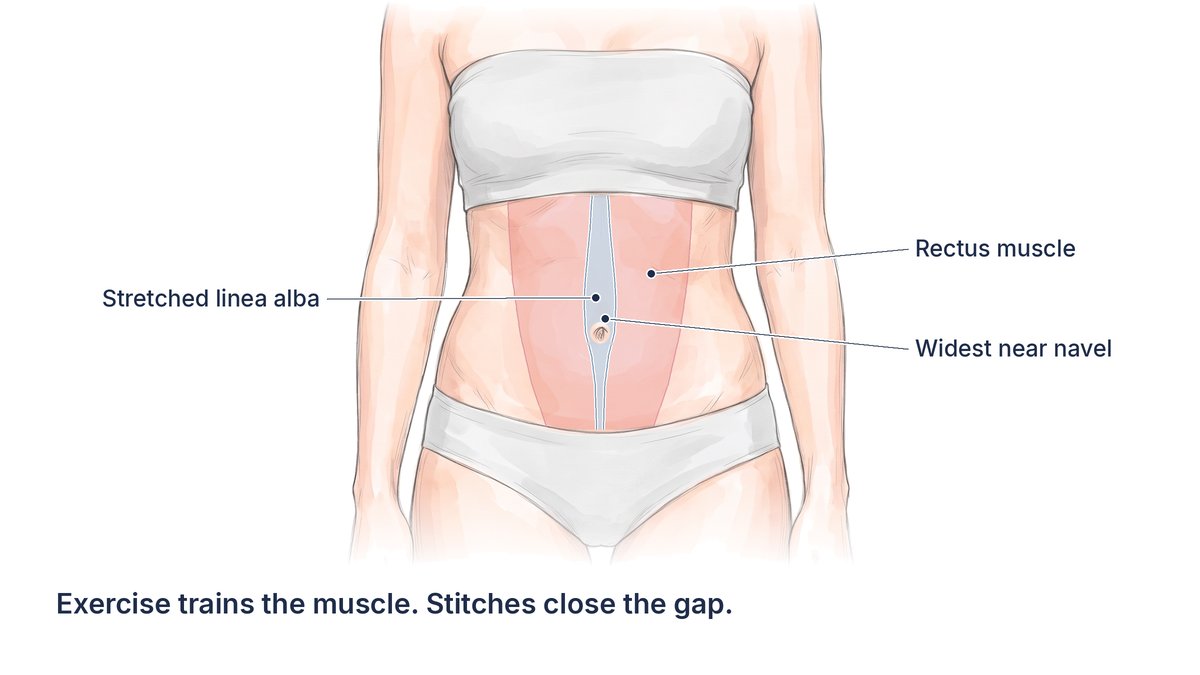
Diastasis recti after pregnancy is a widening of the linea alba, the band of connective tissue that joins the two vertical abdominal muscles in the midline, and a common reason a belly still domes forward once the baby weight has gone. Time narrows it in many women, exercise strengthens the muscles beside it, and only stitches placed during surgery, usually a tummy tuck, close it.
Quick answers
- Can exercise close diastasis recti? Not reliably. In two randomized trials, exercise groups ended with as much diastasis as control groups; in one they ended stronger.
- Will it close on its own? Often. In 300 first-time mothers, 60.0 percent had a gap six weeks after birth and 32.6 percent at 12 months.
- How wide is too wide? Surgical guidelines define diastasis as a gap of more than 2 cm. Width alone does not decide surgery.
- When does Dr. Yongwoo Lee operate? When a gap of 2 cm or more persists after 6 to 12 months of rehabilitation, 6 to 12 months after both childbirth and breastfeeding have ended, and no further pregnancy is planned.
Can Exercise Close Diastasis Recti, or Do I Need a Tummy Tuck?
Exercise has not been shown to close the gap reliably, and a tummy tuck is not the automatic next step when it does not. In two randomized trials of training after birth, women who exercised ended with as much separation as women who did not; most narrowing in the first year comes from time, and a gap that time leaves behind is closed only by stitching the midline, usually during a tummy tuck.
Exercise trains muscle; surgery shortens stretched connective tissue and removes skin. Treating them as rivals leads to self-blame after a year of training, or to a surgical consultation at four months.
Is the Problem the Gap, the Bulge, the Loose Skin or the Weakness?
Four different complaints travel under the name diastasis: a measured gap between the muscles, a bulge in the midline, loose skin, and a feeling of weakness, back pain or leaking. Only the first is a number, and it is the weakest guide to what will help.
The gap. A wide midline is common in adults with no complaint at all. In CT scans of 329 adults, the midline was wider than 2 cm at 3 cm above the navel in as many as 57 percent.
The bulge. A ridge that rises in the midline when you sit up is the thinned band giving way under pressure. Stitching the midline is designed to flatten it.
The skin. Skin stretched past its recoil does not respond to exercise or to muscle repair. Only a skin excision removes it.
The weakness, the back, the bladder. These complaints are real, but the gap is not a proven cause of them. In 300 first-time mothers, lumbopelvic pain at 12 months did not differ between women with and without diastasis, and in the same group’s data urinary leaking was no more common in women with a gap. Leaking, a feeling of heaviness or bulging in the vagina, or back pain deserves its own assessment by a doctor or a pelvic-floor physiotherapist, whatever the width of the gap.
What Is Diastasis Recti, and Why Does Pregnancy Cause It?
Diastasis recti is a stretching and thinning of the linea alba, so that the two rectus abdominis muscles, the “six-pack” muscles, sit farther apart than before. Nothing is torn: pregnancy stretches that band in every woman, and in some it does not fully recoil.
Each rectus muscle lies inside a sleeve, the rectus sheath, made from the flat tendons of the side muscles of the abdomen, and those layers fuse in the midline as the linea alba.
In an ultrasound study of 84 first-time mothers, the gap 2 cm above the navel measured 5.4 to 8.6 cm in late pregnancy and 1.7 to 2.8 cm six months after birth in the middle 60 percent of women. A meta-analysis of 295 women who had never given birth found a pooled gap of 8.77 mm at the navel, 7.22 mm above it and 4.09 mm below it. A gap of 2 cm at six months is ordinary for a mother and wide for a woman who has never given birth.

A hernia is a different problem: a hole in the abdominal wall through which fat or bowel can push, often felt as a lump at the navel that pops out with a cough. When the two coexist, the European Hernia Society guideline suggests a mesh-based repair, with plication alone possibly sufficient for hernias under 1 cm.
How Do I Check Myself for Diastasis Recti at Home?
Lie on your back with your knees bent, lift your head and shoulders as in a small crunch, and press your fingertips across the midline at the navel, then about 4.5 cm above and 4.5 cm below it. Two or more finger widths between the muscle edges at any of these points is the definition used in the main postpartum studies; surgical guidelines draw the line at more than 2 cm.

In a randomized trial of 175 first-time mothers, examiners counted a gap of at least two finger widths during a crunch, or a visible bulge in the midline. Such a finger test is a screen, not a measurement: in reliability testing by the same group, agreement was 0.7 when one examiner repeated the test and 0.5 between two examiners, on a scale where 1 is perfect.
The European Hernia Society defines rectus diastasis as a widening of the linea alba exceeding 2 cm, measured for precision with ultrasound or calipers 3 cm above the navel.
In the CT study of 329 adults, the upper limit of normal was 34 mm at 3 cm above the navel, 32 mm at the navel and only 4 mm halfway to the pubic bone: the midline is widest at and just above the navel.
Will Diastasis Recti Close on Its Own After Pregnancy?
In many women the gap narrows on its own during the first year, which is the reason not to judge it early. In a Norwegian cohort of 300 first-time mothers, diastasis was found in 60.0 percent at six weeks after birth, 45.4 percent at six months and 32.6 percent at 12 months.
The share with a gap nearly halved by one year without any operation; examiners used finger palpation, and most gaps were mild.
A gap at six weeks is a finding. A gap at one year is closer to a diagnosis.
What Do Randomized Trials Show About Diastasis Recti Exercises?
In two randomized trials, exercise did not narrow the gap and crunches did not widen it. Reviews are less clear-cut, and what exercise reliably adds is strength.
The larger trial randomized 175 first-time mothers to a 16-week program starting six weeks after birth, a weekly supervised class plus daily pelvic floor training at home, or to no program. Diastasis was present in 41.4 percent of the exercise group and 39.8 percent of the control group at 12 months, after 55.2 and 54.5 percent at six weeks and 43.7 and 44.3 percent at six months.

In a second trial, 70 women with diastasis, 6 to 12 months after birth, either followed a home curl-up program for 10 minutes a day, five days a week, for 12 weeks or were discouraged from abdominal exercise. The gap did not change meaningfully in either group, no participant’s gap worsened, and abdominal strength rose more with exercise.
Reviews are mixed: a 2014 systematic review of 8 studies and 336 women concluded that “non-specific exercise may or may not help” to prevent or reduce the separation, and a 2024 scoping review of 28 studies that exercise therapy “might be an effective approach,” while noting small samples and inconsistent programs. The European Hernia Society guideline notes that physiotherapy appears to reduce the distance, with unknown benefit for symptoms, and that it may be considered before surgical management, although no specific program can be recommended.
Waiting, Exercise or a Tummy Tuck: How Do the Options Compare?
Time narrows the gap in many women during the first year; exercise builds strength without reliably narrowing it; a full tummy tuck with muscle repair narrows the gap with stitches and removes loose skin, at the price of major surgery.
At a Glance: Time, Rehabilitation, Mini Tummy Tuck and Full Tummy Tuck With Muscle Repair
| Time alone | Rehabilitation exercise | Mini tummy tuck | Full tummy tuck with muscle repair | |
|---|---|---|---|---|
| Effect on the gap | Present in 60.0 percent at six weeks, 32.6 percent at 12 months | No difference from controls in two randomized trials | Usually cannot reach a gap above the navel | Narrowed by stitching; widest gap 5.6 cm before, 1.7 cm at 3 years in one series |
| Effect on loose skin | None | None | Lower skin only | Removes it |
| Main limit | One woman in three still has a gap at a year | Width usually does not change | Leaves an upper gap untreated | Major surgery and a long scar; recovery counted in months |
| Usual place | First year after birth | First treatment for everyone | Laxity only below the navel | Gap of 2 cm or more after rehabilitation, family complete |
Hernia surgeons also repair diastasis without removing skin, by open or laparoendoscopic plication, with or without mesh, chosen by shared decision-making, a route that suits a wide gap under skin that is not loose.
How Does Dr. Yongwoo Lee Decide Who Needs Surgery, and How Does He Repair the Muscle?
I operate for diastasis when a gap of 2 cm or more is still present after 6 to 12 months of rehabilitation, when 6 to 12 months have passed since both childbirth and breastfeeding ended, and when no further pregnancy is planned. I close the gap during a tummy tuck, with permanent, non-absorbable sutures placed in two layers.
How I measure the gap
I measure the gap with the patient lying on her back, with my fingers or with ultrasound. I also watch her sit up and stand, because the bulge, the loose skin and any lump that suggests a hernia matter as much as the number.
My line is a gap of 2 cm or more, in step with the European guideline, which defines diastasis as a gap of more than 2 cm. Below it I do not treat the gap as a reason for surgery. Above it, the number is a floor, not a trigger: a gap with no bulge and no complaint is not, by itself, a reason to operate.
Why I wait, and for how long
Six to 12 months of rehabilitation gives time its chance to narrow the gap and exercise its chance to restore strength; waiting until the family is complete keeps another pregnancy from stretching the repair and the skin again.
Every tummy tuck I perform also requires a body mass index of about 30 to 32 or less, a stable weight, and no nicotine in any form, vapes, patches and gum included, for four weeks before and four weeks after surgery; a patient who cannot stop has the operation postponed. For weight lost on semaglutide or tirzepatide, see liposuction after Ozempic or Mounjaro weight loss.
How I stitch the midline
Once the skin and fat are lifted off the abdominal wall, I fold the stretched midline inward and stitch the front of the rectus sheath on one side to the front of the sheath on the other, which brings the muscles back together. Surgeons call this plication; the muscles themselves are not cut, and in a full tummy tuck I run the fold from the xiphoid, the tip of the breastbone, to the pubic bone.
I use a permanent suture, and I place two layers. Trials do not prove that this is the only way. In a CT study of 12 women repaired with a slowly absorbable suture, no gap had reopened at 32 to 48 months, despite an average weight gain of 4.5 kg. In a small randomized comparison using nylon, one layer and two layers both held at six months, and the two-layer repair took about 33 minutes against 13.

I close a small umbilical hernia with sutures during the same tummy tuck; a large one is treated together with a general surgeon.
Why a mini tummy tuck rarely fits diastasis
In my mini tummy tuck the navel stays where it is, so any repair reaches only the muscle below it; a gap in the upper abdomen, or loose skin above the navel, moves the plan to a full tummy tuck. Because the midline is widest at and just above the navel, that describes most diastasis that needs surgery. The three types are compared in mini, full and extended tummy tucks compared.
What surrounds the operation
A tummy tuck in my practice is done under general anesthesia given by a board-certified anesthesiologist, the same anesthesia set-up I use for facelifts. Against fluid under the skin I use drains and quilting sutures together. Against clots, leg compression sleeves run through surgery and the first night, walking starts the next day, and an injected blood thinner is added only when a risk score taken before surgery is high.
One disclosure: I do not perform breast surgery, so the abdomen is the only part of a “mommy makeover” I operate on.
Does the Muscle Repair Hold, and Does It Help Back Pain or Leaking?
In published series the repair usually holds for years, and scores for back pain and urinary leaking improved afterward. Most studies of function had no comparison group, so the size of the benefit is uncertain.
Does it hold? In an ultrasound study of 38 women, none of 18 examined at about five years and 2 of 20 examined at about one year had a recurrence, and only one of the two had a complaint. A retrospective single-surgeon series of 71 women repaired with absorbable sutures found no recurrence on physical examination at a mean of 21.1 months, without imaging. In 44 Danish women repaired for post-pregnancy diastasis, the widest gap averaged 5.6 cm before surgery and 1.7 cm at a median of 36 months, with one recurrence in the upper abdomen after severe postoperative vomiting.
An older Dutch series, cited by later authors as finding recurrence in 40 percent of cases after a single line of absorbable suture, is an outlier, not today’s rate.
Does it help function? In a prospective study of 214 women, the back-pain disability score fell from 21.6 percent before surgery to 3.2 percent at six months, and the incontinence score from 6.5 to 1.6. A review of 10 studies and about 780 patients warned that the improvement may partly reflect a placebo effect of surgery, because many studies lacked controls.
The repair reliably changes the shape of the abdomen; relief of back pain or leaking is possible, not promised.
Exercise or Tummy Tuck: Which Patient Are You?
Five patterns cover most mothers with a gap; they are illustrative examples, not real patients, and describe decisions, not results.
Four months after a first baby, with a two-finger gap and a soft dome. Too early to judge. Time and rehabilitation are the treatment.
Fourteen months after a second baby, with a gap under 2 cm and a core that feels weak. Strength training is the answer, not surgery.
A 38-year-old, two years after her last child, with a 3.5 cm gap after a year of physiotherapy, a ridge when she sits up and loose skin below the navel. A full tummy tuck with muscle repair is the operation to discuss.
A 33-year-old with a 3 cm gap who wants another child in two years. Rehabilitation now; surgery, if still wanted, after her last pregnancy.
A slim 41-year-old with a wide gap, tight skin and a lump at the navel that pops out when she coughs. The lump suggests a hernia. She needs imaging, and possibly a hernia surgeon’s repair without skin removal.
What Is Recovery Like After a Tummy Tuck With Muscle Repair?
Recovery in my practice starts with one night in the clinic; drains come out when they collect less than 30 mL a day, usually on day 5 to 7; the negative-pressure dressing stays about 10 days, then silicone sheets or gel on the scar for three to six months; a compression garment, put on in the operating room, is worn day and night for six weeks; and flying home is possible at 10 to 14 days.
Patients rest with knees bent for the first days; walking starts the day after surgery. For about six weeks I ask patients not to lift anything heavy, a toddler included, and to leave sit-ups and other abdominal exercise alone, so a mother of small children needs help at home arranged before surgery, not after it.
In the Danish series, women felt limited or took precautions for a median of 8.5 months. Nausea and vomiting affected about a third, and the one recurrence followed severe vomiting, so report nausea early.
The day-by-day course is in the tummy tuck recovery timeline, week by week, and travel planning in how long to stay in Korea after plastic surgery.
Chest pain, sudden shortness of breath or coughing up blood is an emergency: call your emergency number (119 in Korea) first, then tell your surgeon. Pain or swelling in one calf is a reason to call the clinic immediately, and so is swelling of the abdomen that grows quickly or feels tight and painful, or bleeding that soaks the dressing, especially with dizziness or a racing heart. Fever, spreading redness, a wound that opens, skin near the scar turning dark or dusky, or vomiting that does not settle needs a call the same day.
Surgeon’s Insight: A Gap Is a Measurement, Not a Diagnosis
Many mothers arrive having measured their gap many times, convinced that the number is the problem. I ask different questions. What do you see when you sit up? What can you not do that you could do before? Are you finished having children?
A 3 cm gap in a woman who runs, lifts her children and is content with her abdomen does not need an operation. A 2.5 cm gap with a dome and a fold of skin that a year of rehabilitation did not change is the abdomen a tummy tuck was designed for. Fingers cannot tell those two women apart.
What Are the Risks of a Tummy Tuck With Diastasis Repair?
A tummy tuck has a higher rate of major complications than other cosmetic operations in a large insurance database: 3.1 percent when done alone and 4 percent overall, against 1.4 percent for other procedures. The gap can also reopen, though rarely in recent series.
Major complications. In those 25,478 tummy tucks recorded between 2008 and 2013, major complications occurred in 4 percent, led by hematoma, infection and blood clots; how the rate rises with added operations and in higher-risk patients is covered in liposuction and a tummy tuck in one operation.
Smaller series. In the 71-woman series, delayed wound healing affected 11 percent, seroma 8.5 percent, hematoma 2.8 percent, and a clot in the leg or lung 2.8 percent. In the Danish series, two women needed a second operation for a hematoma, 93 percent reported altered sensation around the navel, and 20 percent were dissatisfied with their scars.
Clots and medicines. Estrogen raises clot risk, so combined contraceptive pills and hormone therapy stop four weeks before surgery, arranged with the doctor who prescribed them; use another method of contraception that your doctor agrees on in the meantime. Aspirin, anti-inflammatory painkillers, fish oil and supplements stop two weeks before surgery and semaglutide or tirzepatide one month before; a prescribed blood thinner or diabetes medicine is stopped only by its prescriber together with the surgeon, never on your own. The full list is in what to stop before plastic surgery.
Can I Get Pregnant After a Tummy Tuck With Muscle Repair?
Pregnancy after a muscle repair is possible, and published pregnancies after a tummy tuck have generally gone well, but how often the repair or the skin stretches again has not been reliably measured. For that reason I operate only when no more pregnancies are planned.
A 2023 systematic review pooled 237 women from 17 studies who became pregnant after a tummy tuck, most with muscle repair, on average almost four years later: no mother or newborn died, and the authors concluded that pregnancy should not be ruled out after a tummy tuck. Abdominal-wall and cosmetic problems were reported without a breakdown, so no recurrence rate can be read from it. In two case reports, a 25-year-old pregnant about two and a half years after a tummy tuck with plication delivered at 38 weeks, with no recurrence on CT 15 months after delivery, and a 32-year-old with a mesh repair, pregnant about a year later, delivered at 40 weeks without recurrence.
A surgeon quoted by the American Society of Plastic Surgeons advises waiting until the family is complete, “particularly before a tummy tuck”.
What Should Decide Between Exercise and a Tummy Tuck?
The deciding question is not how many fingers fit in the gap, but what is still there after a year of time and rehabilitation. A gap under 2 cm, a gap that is still narrowing, or a family that is not yet complete points to exercise and patience. A gap of 2 cm or more with a bulge or loose skin that rehabilitation did not change, in a woman who has finished having children, is a reasonable case for a tummy tuck with muscle repair.
For what to check about the person who will operate, see choosing a plastic surgeon in Korea.
Individual results vary; consultation required.
Written by Dr. Yongwoo Lee, board-certified Korean plastic surgery specialist in facial anatomy and aesthetic procedures at VIP Plastic Surgery, South Korea.
Frequently Asked Questions About Diastasis Recti, Exercise and Tummy Tucks
How many fingers of separation count as diastasis recti?
Two or more finger widths between the muscle edges, felt at the navel or about 4.5 cm above or below it during a small crunch. Surgical guidelines use a gap of more than 2 cm.
How long after giving birth should I wait before a tummy tuck?
Dr. Lee operates 6 to 12 months after both childbirth and breastfeeding have ended, and only when no more pregnancies are planned.
Are crunches and sit-ups bad for diastasis recti?
A randomized trial of curl-ups found no harm. In 70 women, a 12-week curl-up program widened no one’s gap and improved strength; it did not narrow the gap either.
Is diastasis recti dangerous?
By itself, no. It is a stretched but intact abdominal wall, not a hole. A lump at the navel that pops out with a cough may be a hernia and should be examined. If that lump turns hard or painful, cannot be pushed back in, or comes with vomiting or a swollen belly, seek emergency care at once (119 in Korea): a trapped hernia can cut off its own blood supply.
Does diastasis recti cause back pain or bladder leaking?
That has not been shown. In 300 first-time mothers, back and pelvic pain at 12 months did not differ between women with and without a gap, and urinary leaking was no more common in women with a gap.
Should I see a pelvic floor physiotherapist for diastasis recti?
Yes, if you have leaking, a feeling of heaviness or bulging in the vagina, or back pain, whatever the width of the gap. The European Hernia Society guideline also says physiotherapy may be considered before surgery.
What is the difference between diastasis recti and an umbilical hernia?
Diastasis is a widened, thinned midline with no hole. An umbilical hernia is a hole at the navel through which fat or bowel can push; when both are present, a European guideline suggests a mesh-based repair, though stitching the midline alone may be enough for a hernia smaller than 1 cm.
Do I need an ultrasound to diagnose diastasis recti?
Not always, but it is more precise. A finger test is a screen: in one study two examiners agreed at only 0.5 on a scale where 1 is perfect. The European Hernia Society guideline measures with ultrasound or calipers 3 cm above the navel, and Dr. Lee uses his fingers or ultrasound.
Can a tummy tuck be done during a C-section?
It is not advised. A surgeon quoted by the American Society of Plastic Surgeons calls it a poor idea medically and aesthetically, because the patient is still swollen and not yet at her usual weight.
Can diastasis recti be fixed years after pregnancy?
Yes. The studies that followed mothers saw the gap narrow mainly during the first year after birth; a gap of 2 cm or more that is still there after 6 to 12 months of rehabilitation can be closed with stitches during a tummy tuck, once no more pregnancies are planned.
Can diastasis recti be repaired without a tummy tuck?
Yes, when the skin is not loose. Hernia surgeons repair the midline by open or laparoendoscopic plication, with or without mesh; a tummy tuck adds removal of loose skin.
This article is for informational purposes only and does not constitute medical advice. Always consult with a qualified medical professional before making any decisions about surgical or non-surgical procedures.
