
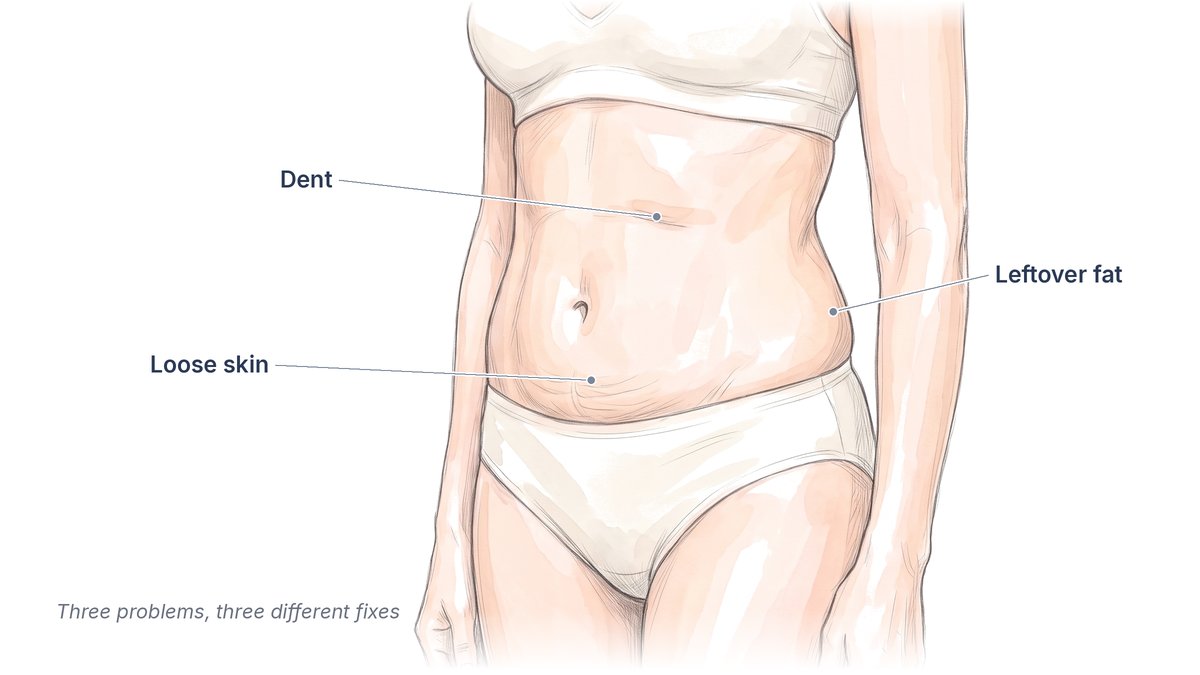
Feeling lumpy after liposuction is normal at first: treated tissue usually feels firm and uneven at 2 to 3 weeks and softens by about 3 months. Lumpiness still there at 6 months usually means a true contour deformity, such as a dent, groove, ridge or leftover bulge, or skin that did not shrink back. Each has its own cause, its own waiting period and its own fix, so the first job is to work out which one you have.
Quick answers
- Is it normal to be lumpy after liposuction? Yes, for weeks: in one series of more than 600 cases, treated areas felt firm by weeks 2 to 3, softened by 6 to 8 weeks and felt normal by about 3 months.
- Will the lumps go away? Healing firmness usually does. A dent, groove or ridge that is still there at 6 months usually does not.
- What causes dents after lipo? Too little fat left under the skin, suction too close to the skin, or a cannula worked repeatedly in one spot.
- Why is my skin loose? The skin had too little recoil to shrink over the new shape; liposuction removes fat, not skin.
- How long should I wait for a revision? Usually at least 6 months, and 6 to 12 months when loose skin is the problem.
- Can fat grafting fix dents? Often it improves them: 68 percent of 57 women rated their result very good or excellent at 12 months, and 9 needed a second session.
- Can massage fix a dent? No. Gentle massage may make healing tissue more comfortable, but it cannot put back fat that was removed.
- What is a hard lump months later? Usually fibrosis, fat necrosis or a fluid pocket with a capsule; an examination, and often an ultrasound, tells them apart.
Is It Normal to Be Lumpy After Liposuction?
Yes, for the first weeks: firmness, small lumps and an uneven surface are a stage of healing that softens without treatment. What is not normal is a specific dent, groove, ridge or bulge that is still clearly there once the swelling has gone.
That normal curve, along with compression, massage and activity, is covered week by week in the liposuction recovery timeline. This article covers what persists once that curve has run its course.
Lumpy, Dented or Loose: Which Problem Do You Actually Have?
Three different problems hide behind the word lumpy. Healing firmness (induration or fibrosis) is tissue that is still remodeling and tends to improve with time; a contour deformity is a shape problem caused by how much fat was left and where; and loose skin is an envelope that did not retract over the smaller volume.
Surgeons separate them because the treatments do not overlap: time helps the first, a targeted operation changes the second, and the third depends on tightening or removing skin.
Healing firmness. Diffuse, often tender, firm or woody to the touch, worse in the areas that had the most fat removed, and changing week to week. It is a stage, not a result.
A contour deformity. A fixed shape that stops changing. It comes in five common forms:
- A residual bulge, fat that was left behind (undercorrection).
- A dent or groove, too much fat removed in one zone (overcorrection).
- Waves or ripples, suction taken too close to the underside of the skin.
- A step-off, an abrupt edge where a treated area meets an untreated one.
- A tethered dent, skin pulled down by scar bands between the skin and the deeper layers.
Loose skin. Skin that hangs, folds or looks crepey over an area that now has less fat beneath it. It often shows most when you lean forward or lift your arms.
One bedside clue separates two of the commonest dents. The same review notes that dents from excessive superficial liposuction persist when the skin is relaxed and when you lie down, whereas dents from fibrous adhesions get worse when the underlying muscle contracts. You can check this yourself: look at the dent standing, lying flat, and while tensing the muscle beneath it, and tell your surgeon what you saw.

What Causes Dents and Uneven Results After Liposuction?
Most contour deformities come from how much fat is left under the skin and how evenly it is left. Suction too close to the skin, too much removed in one zone, a large cannula worked repeatedly from a single entry point, and poor skin elasticity are the classic causes, and weight change after surgery can create new unevenness on top of a good result.
The skin drapes over whatever fat remains: an even layer gives an even surface, and an uneven one shows through. The classic rule therefore concerns what is left behind. Illouz advised leaving at least a 5 mm layer of fat under the skin and on the muscle fascia to prevent surface irregularities, and slightly undercorrecting because injured fat cells keep breaking down for weeks afterward.
The standard causes:
- Suction in the superficial layer. Fat just beneath the skin is arranged in small, tightly packed lobules. Suctioning there can increase skin retraction, but it also leaves the skin with less padding and more chance of waviness. In a review of 2,398 superficial liposuction cases, the overall complication rate was 8.6 percent and contour irregularity was the most common complication; the authors concluded that superficial liposuction carries higher risks than conventional technique.
- Too much from one zone. Overcorrection leaves a dent; prolonged suction in one spot or suction left running while the cannula is withdrawn can leave a small crater near an entry point.
- Large cannulas and a single entry. Wide cannulas remove fat quickly and unevenly. A clinical review lists smaller diameter cannulas, avoiding the superficial layers, crisscrossing and slight undercorrection as the standard defenses, and a companion review calls cross-tunneling through several small entry points essential to smooth, even removal.
- Fibrous or previously treated tissue, where the cannula skips and channels rather than glides.
- Poor skin quality. Thin, stretch-marked skin shows every irregularity beneath it.
- Weight change. The same review notes that weight change can itself lead to contour irregularities, because the fat cells that remain enlarge unevenly between treated and untreated zones; the mechanism is explained in does fat come back after liposuction.
Cellulite is a separate issue. Liposuction removes fat from the deeper layers and does not release the fibrous bands that create dimpling at the surface, so dimples that were there before surgery can look more obvious afterward, especially on the thighs and buttocks.

How common are contour irregularities after liposuction?
Contour irregularity is the most common complication of liposuction. Pooling 39 studies and 29,368 patients, a 2024 meta-analysis put the overall complication rate at 2.62 percent, with contour deformity the most common at 2.35 percent, far more common than infection at 0.02 percent.
Rates depend on how carefully patients are asked: a clinical review estimates that as many as 9 percent of patients may report depressions, elevations, folds or wrinkles. Single-center series report more: in the 600-case series described above, 8.2 percent of patients complained of surface irregularities, 5.3 percent had undercorrection, 3.7 percent overcorrection and 4.2 percent loose skin. These figures describe one center’s patients, not any one patient’s risk.
Key numbers
- Contour deformity: the most common complication, 2.35 percent pooled across 39 studies and 29,368 patients.
- As many as 9 percent of patients may report depressions, elevations, folds or wrinkles.
- Superficial liposuction, 2,398 cases: 8.6 percent complications, contour irregularity the most common.
- One series of more than 600 cases: irregularities 8.2, undercorrection 5.3, overcorrection 3.7, loose skin 4.2 and seroma 3.5 percent.
- Fat left under the skin: at least 5 mm, by a classic rule.
- Revision: usually no earlier than 6 months; 6 to 12 months for loose skin.
- Fat grafting for post-liposuction dents: 68 percent very good to excellent at 12 months in 57 women; 9 needed a second session.
What Are Hard Lumps Months After Liposuction?
A hard lump that is still there 3 or more months after liposuction is usually one of three things: fibrosis (scar tissue in the fat), fat necrosis (a pocket of dead fat that has hardened or turned into an oil cyst), or a seroma that has formed a capsule. They feel similar but are treated differently, so a lump that persists, grows, hurts or is red should be examined, and an ultrasound is often the quickest way to tell fluid from solid.
Fibrosis
Fibrosis is the most common. Healing fat lays down fibrous tissue between the tunnels, and in some people or some zones it stays thick and cord-like. Most fibrosis keeps softening for months. When a discrete nodule persists, published options include intralesional 5-fluorouracil with or without triamcinolone, and for persistent cases surgical removal of the fibrous mass with fat transfer. Steroid injections are used sparingly and in small amounts, because too much can thin the fat and skin over the lump and leave a new dent in its place.
Fat necrosis and oil cysts
Fat that loses its blood supply can harden into a firm, round nodule or liquefy into an oil cyst. One that persists or enlarges should be examined, and it can be aspirated or removed if needed.
Seroma and the seroma capsule
A seroma is a pocket of clear fluid under the skin. Most settle with aspiration and firmer compression. In the same 600-case series, localized seromas occurred in 3.5 percent, usually found on days 5 to 7, most often on the outer and back thighs and the lower abdomen, while the 2024 meta-analysis pooled seroma at 0.65 percent.
A seroma still refilling after more than about 4 weeks is considered chronic, and a chronic seroma can develop a smooth lining, a pseudocapsule or pseudobursa, that keeps producing fluid. It may need repeated aspiration, an injection to seal the cavity, or excision of the capsule. In one reported case after a tummy tuck combined with liposuction, a pseudobursa drained 2,010 mL in a single session before it was excised: extreme, but a fluid lump that keeps returning should not simply be massaged.
Why Is My Skin Loose After Liposuction?
Skin is loose after liposuction when it had too little elasticity to shrink over the smaller volume underneath. Liposuction removes fat, not skin, so whether the skin follows depends on its recoil, which is weakened by age, sun damage, stretch marks, pregnancy and large weight loss.
Skin does shrink after liposuction in many people, and age alone does not rule it out. In 58 patients aged 40 to 75 who had tumescent liposuction of the abdomen, neck or arms, cosmetic results were rated good to excellent. Elasticity, not the birth year, is the variable. When elasticity is poor, though, removing the fat that was filling the envelope makes the looseness more visible, and that is a result of the skin rather than a surgical error. In the 600-case review, every patient with residual skin laxity had poor skin elasticity and had been warned before surgery.
Skin keeps retracting for months. The same authors note that these patients may need compression for 8 to 12 weeks rather than the usual 6, and advise waiting at least 6 months to 1 year before considering any further surgery, so the skin has the full chance to tighten.
Can skin tightening fix loose skin after liposuction?
Mild looseness can improve with energy-based tightening, but the gain is modest and moderate or severe excess skin needs removal. Heat delivered under or through the skin contracts tissue by a measurable but limited amount, and no device removes skin.
The best quantitative data are small. In 10 women who had radiofrequency-assisted liposuction on one arm and aggressive superficial liposuction on the other, arm skin surface area at one year had fallen 15.0 percent on the radiofrequency side and 10.9 percent on the superficial liposuction side at the front of the arm. That is real contraction, but achieved during the original operation, not a rescue for skin already hanging months later. External focused ultrasound and radiofrequency work on the same principle at lower intensity; their ceilings are compared in Ultherapy, Thermage and Shurink skin tightening. Whether ultrasound-assisted liposuction itself tightens skin is examined in VASER vs traditional liposuction.
When is an arm lift, tummy tuck or thigh lift the answer?
When skin hangs in a fold that stays when you stand still, the fix is to remove skin. After liposuction, published options for persistent laxity are abdominoplasty, brachioplasty or thigh lift, often in a reduced form, and I perform all three myself. Each trades loose skin for a scar. A second liposuction on loose skin removes the fat that is still holding it up and usually makes the fold look worse.
On the neck the same logic holds, and the excision is a neck lift rather than more suction. The four bedside tests that separate a fat problem from a skin and muscle problem are set out in neck liposuction vs neck lift.
How Long Should You Wait Before Liposuction Revision?
Usually at least 6 months, and 6 to 12 months when loose skin is the problem. Before then, swelling and firmness can still imitate or hide a deformity, scar tissue is still immature, and the skin has not finished retracting, so operating early risks treating a problem that would have improved, or missing one that had not yet appeared.
A major review of unfavorable outcomes states plainly that it is recommended to wait at least 6 months before revision surgery is planned, including for a leftover bulge that will need only a touch-up.
While you wait, keep your weight stable and take monthly photos in the same light and pose. A dent that shrinks month by month is still healing; one that has looked identical for three months is probably the result.
The exception is anything that looks like infection, a fluid collection, skin color change or a lump that is growing. Those are not revision questions and should be seen promptly, whatever the date.

How Do You Fix Uneven Liposuction or Dents?
The fix follows the problem: a leftover bulge is treated with a small, targeted liposuction, a dent or groove with fat grafting, a tethered dent with release of the scar band plus fat, and loose skin with tightening or removal. Many revisions combine two of these in one session.
At a Glance: What Fixes What After Liposuction
| Problem | What you see or feel | Usual cause | Earliest decision | Usual fix | What the fix cannot do |
|---|---|---|---|---|---|
| Healing firmness | Diffuse, tender, firm areas that change week to week | Normal healing | Not a revision question | Time; compression and gentle massage for comfort | Change a fixed shape |
| Leftover bulge | A soft pocket of fat that never went down | Undercorrection | About 6 months | Small-cannula touch-up liposuction | Help if the bulge is loose skin, not fat |
| Dent or groove | A depression that stays when lying down | Too much removed in one zone, or suction too close to the skin | About 6 months | Fat grafting, often with touch-up of the surrounding ridge | Guarantee full survival; a second session may be needed |
| Tethered dent | A dent that deepens when the muscle beneath is tensed | Scar bands between skin and deep tissue | About 6 months | Release of the bands plus fat grafting | Promise the band will not reform |
| Waves or ripples | A rippled surface over a wide area | Superficial suction, thin skin | 6 months or more | Staged fat grafting, partial improvement | Restore a fully smooth surface in every case |
| Seroma capsule | A soft, fluid lump that refills | Persistent seroma lining | Weeks, not months | Aspiration, sealing the cavity or excision of the capsule | Be fixed by massage |
| Loose skin | A fold or crepey skin over the treated area | Poor skin recoil | 6 to 12 months | Energy-based tightening if mild; excision lift if more | Remove a real fold without a scar |
Fat grafting into dents
Fat grafting moves spare fat from another area into the depression in small threads through blunt cannulas. In 57 women who had already had one to three liposuctions, between 14 and 120 mL of fat was transferred; at 12 months 68 percent rated the result very good to excellent, 23 percent good and 9 percent less than good, and 9 patients needed one additional session.
Grafted fat does not all survive; about half is a reasonable working assumption in many areas, so grafts are planned with some overfill and sometimes in stages, as set out in how much transplanted fat actually lasts. Scarred tissue is a poorer bed than healthy fat. One published case of a woman with a deep deformity under the buttock after over-aggressive liposuction elsewhere needed five fat grafting operations; the first graft was almost entirely absorbed, later grafts shifted, and the final contour was improved but still not natural. The authors concluded that fat grafting is of limited value for severe deformities.
Touch-up liposuction and non-surgical options
A residual bulge is the most straightforward revision: a small cannula, a limited area, and an even layer left behind. A pocket too small to justify another operation can sometimes be treated with microwave body contouring, within that device’s limits on fat thickness. Massage, lymphatic drainage and external ultrasound appear in the published list of options for smoothing irregularities while tissue is still remodeling; they can soften fibrosis and move fluid, but cannot replace removed fat or remove a leftover pocket. The evidence for comfort measures is reviewed in how to reduce swelling after surgery.
How Do I Approach a Lumpy or Uneven Result?
I name the cause before discussing any fix. Then I wait at least 6 months and plan the smallest operation that addresses it.
What I look for at the examination
I examine the area in the three positions described earlier, standing, lying flat and with the muscle tensed. I pinch the skin to judge how much fat is left and how fast the skin springs back. Where a firm lump could be scar, dead fat or fluid, I want an ultrasound before deciding anything. I also ask about weight since surgery, because a contour that changed with five kilograms is not primarily a surgical problem.
How my primary technique shapes revision
My primary liposuction is built to avoid the hardest revisions. I work the deep and intermediate fat layers and leave the superficial layer under the skin as undisturbed as I can, I use 3 to 5 mm cannulas on the abdomen, flanks and thighs and 3 mm on the arms, I crisscross from several small entry points, and I deliberately undercorrect slightly, for the reason given in the Surgeon’s Insight below.
Matching the fix to the cause
A few details shape my revisions. When I graft a dent, I usually soften the ridge around it at the same time, because a dent looks deeper than it is when the edges stand proud. For a tethered dent, I release the band before placing fat, so the graft is not filling a space that is still being pulled down. In fields with adhesions from previous surgery, I use ultrasound to loosen the scarred fat before suction; I use it in most liposuction cases, and this is where it helps most. I give the patient the expected fat survival and the possibility of a second session before surgery, not after.
When the problem is skin, I say so, and the choice is between modest tightening and an excision lift, not a smaller procedure that will not help.

Arms, Abdomen, Thighs and Neck: Where Do Problems Show Up?
Each area fails in its own way. The arms and inner thighs have thin skin that shows looseness; the abdomen shows dents and step-offs at the waist and above the navel; the outer and back thighs and the fold under the buttock are where over-resection does the most damage; and the neck has the least margin for error of any area.
Arms. Undercorrection was common on the arms in the large series, and arm skin is thin. With good recoil, liposuction alone can do well, and a leftover bulge can be touched up. With skin that hangs when the arm is raised, the choice is between accepting some looseness and an arm lift, with its scar along the inner arm, as compared in arm liposuction vs arm lift.
Abdomen. In a lumpy or uneven stomach, dents above the navel, a step-off where treated flank meets untreated back, and loose lower skin after pregnancy are the usual complaints. Stretch marks below the navel signal skin that will retract poorly.
Thighs and buttock fold. Over-resection here can create an iatrogenic banana fold, a double fold under the buttock that is produced by excessive liposuction and is usually corrected with fat grafting, although severe cases can take several sessions. The inner thigh has thin skin that sags easily.
Neck. No clothing hides it and the jawline depends on one crisp shadow line, so an even layer left under the skin matters most here. A neck that is still slightly full at three months can later be revised with a small second procedure; a neck that has been hollowed out often cannot be revised at all.
Which Uneven Result Do You Have?
Most uneven results fall into one of five patterns: healing firmness, a leftover bulge, a dent, loose skin, or a flaw only the patient can see. The profiles below are illustrative, not real patients, and describe decisions, not results.
Six weeks out, firm and lumpy all over. Healing firmness: time, the recovery routine and photos.
Eight months after flank liposuction, one side still fuller. A leftover bulge: a limited small-cannula touch-up once weight is stable.
A groove on the outer thigh that stays when lying down. A dent from overcorrection: fat grafting with softening of the surrounding ridge, one or possibly two sessions.
A 54-year-old with crepey, loose arm skin after arm liposuction. A skin problem: modest tightening if mild, or an arm lift, which I would offer her myself, if the skin hangs in a fold.
Three revisions and still a flaw nobody else can find. Before a fourth operation the question is no longer only anatomical; see body dysmorphic disorder and plastic surgery.
Surgeon’s Insight
A bulge is a problem of too much fat left behind, and a dent is a problem of too little. Only one of them is easy to fix. Taking out a little more fat is usually a short, contained procedure. Putting fat back means grafting into scarred tissue, accepting that some will not survive, and sometimes coming back a second time. That asymmetry is why I undercorrect slightly in the first operation and why I would rather see a patient at eight months with a soft leftover pocket than with a groove. When I examine an uneven result, the first thing I want to know is not how much was removed but what is left under the skin and how evenly it is spread.
What Should You Ask Before Liposuction to Avoid a Lumpy Result?
Ask how your surgeon will leave an even layer of fat under the skin, whether your skin is elastic enough for liposuction alone, and what happens if a dent or bulge remains at 6 months. The answers say more about your risk of an uneven result than any device name.
- Superficial fat: suctioned or preserved, and why?
- Cannulas and entry points: what sizes, and from how many points?
- Skin: how elastic is it, and would a lift be the better operation?
- Photos: are existing dents, asymmetry and cellulite documented?
- Undercorrection: is the plan to leave a little rather than take a little too much?
- Revision: what is the policy, and after how many months?
Travelers should also plan how long to stay in Korea after plastic surgery. What a plan stated in layers, millimeters and a target looks like is covered in what natural means in plastic surgery.
The Question to Bring to a Revision Consultation
If you are uneven after liposuction, the useful question is not whether it can be fixed but what exactly is wrong: is there too much fat, too little, a scar band, or skin that did not shrink? Each answer leads to a different operation, a different wait and a different realistic outcome.
A surgeon who waits until the tissue has settled and tells you what a revision cannot do as clearly as what it can, is giving you a plan built for your problem. When skin and support are the issue in the neck, how deep plane and SMAS lifts differ covers the larger operation.
Individual results vary; consultation required.
Written by Dr. Yongwoo Lee, board-certified Korean plastic surgery specialist in facial anatomy and aesthetic procedures at VIP Plastic Surgery, South Korea.
Frequently Asked Questions About Lumpy or Uneven Liposuction
Is it normal to be lumpy 3 weeks after liposuction?
Yes. At 2 to 3 weeks treated tissue commonly feels firm, woody and uneven, and many patients feel lumpier at this stage than in the first week. In one large series the tissue softened by 6 to 8 weeks and felt normal by about 3 months.
Will lumps after liposuction go away on their own?
Healing firmness usually does, over about 3 months. A fixed dent, ridge or leftover bulge still present at 6 months usually does not.
What does a dent after liposuction mean?
Usually that too little fat was left under the skin in that spot, or that suction was taken too close to the skin. A dent that deepens when you tense the muscle beneath it suggests a scar band tethering the skin instead.
How common are contour irregularities after liposuction?
They are the most common complication, reported in roughly 2 to 9 percent of patients depending on how carefully patients are asked.
How long should I wait before liposuction revision?
Usually at least 6 months, and 6 to 12 months when loose skin is the issue, so swelling, scar and skin retraction can settle. Infection, fluid or a growing lump should be seen at any time.
Can fat grafting fix dents after liposuction?
Often it improves them, although some patients need a second session. Severe, scarred deformities respond less well and may need several.
Can massage get rid of lumps after liposuction?
Massage may make healing tissue more comfortable and help firmness soften, but it does not correct a fixed dent or bulge.
Why is my stomach lumpy after liposuction?
In the first 3 months it is usually healing firmness, often most marked where the most fat was removed. If the stomach is still uneven at 6 months, the usual causes are a dent above the navel, a step-off where the treated flank meets the untreated back, a leftover bulge, or loose lower skin.
Can bad liposuction be fixed?
Often it can be improved, and how much depends on the problem. A leftover bulge is generally straightforward to touch up, a dent needs fat grafting and sometimes a second session, and severe over-resection in scarred tissue may improve only partly.
What is a hard lump months after liposuction?
Usually fibrosis, fat necrosis or a seroma that has developed a capsule. An examination and often an ultrasound tell them apart. A lump that grows, hurts, turns red or drains should be checked promptly.
What is a seroma capsule after liposuction?
A lining (pseudocapsule) that can form around a chronic seroma, one still refilling after more than about 4 weeks, and keeps making fluid. It may need repeated drainage, sealing or removal.
Why is my skin loose after liposuction?
Because it could not recoil enough to shrink over the smaller shape. Elasticity, not age alone, decides this: in one series of 58 patients aged 40 to 75, results were rated good to excellent, while stretch marks, pregnancy and large weight loss reduce recoil.
Can skin tightening fix loose skin after liposuction?
Only mild looseness, and only partly. In a small study of arm liposuction, radiofrequency-assisted liposuction reduced front-of-arm skin surface area by 15.0 percent at one year. A real fold of excess skin needs removal.
Do I need an arm lift after arm liposuction?
Not if your skin springs back well. If arm skin already hangs when the arm is raised, liposuction alone often makes it look looser, and an arm lift, which removes skin at the cost of a scar, is the operation that addresses the fold.
Can liposuction be redone on the same area?
Yes, for a leftover bulge, though scar tissue makes it harder and ultrasound assistance is often used in scarred fields. It is planned after about 6 months, with stable weight.
Can liposuction make cellulite worse?
It can make existing dimples look more obvious, because it does not release the fibrous bands behind them. Point out and photograph cellulite before surgery.
This article is for informational purposes only and does not constitute medical advice. Always consult with a qualified medical professional before making any decisions about surgical or non-surgical procedures.
