
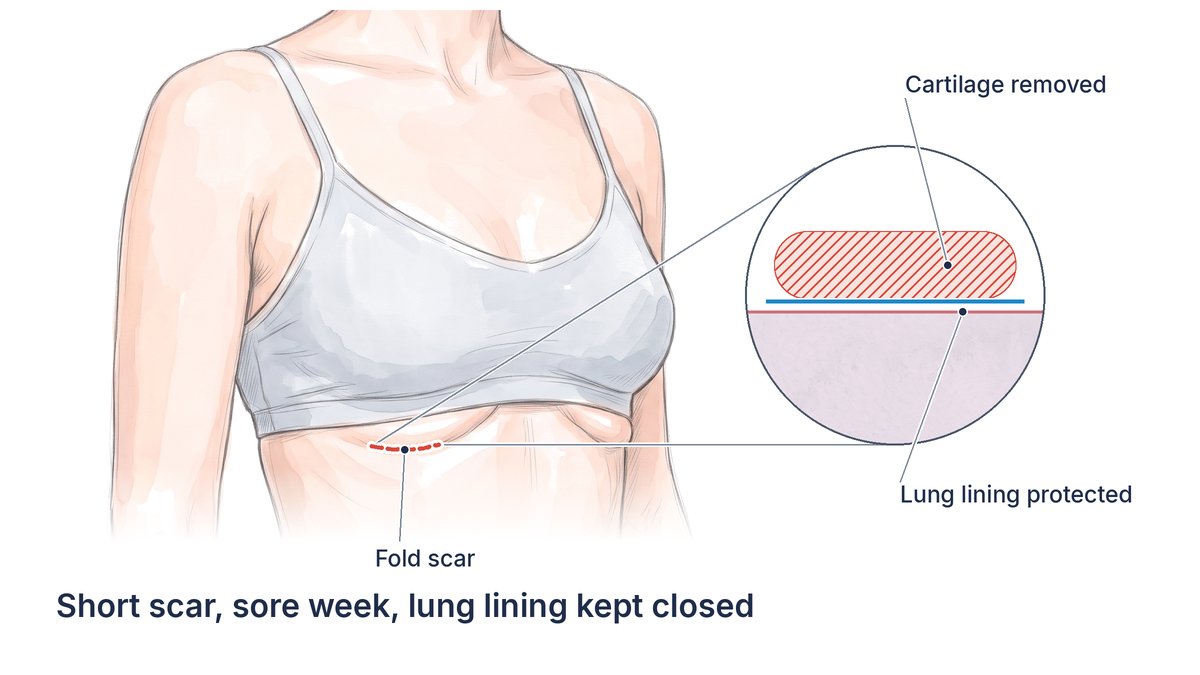
Rib cartilage harvest for rhinoplasty leaves three things on the chest: a scar a few centimeters long, a sore chest wall for about a week, and a small but real risk to the lining of the lung. Patients usually fear them in the reverse order. In published reviews the scar is the most common lasting problem, pain is the one everybody feels, and a collapsed lung (pneumothorax) is the rarest of the three.
Quick answers
- How big is the scar? Published incisions run from about 1 to 5 cm. Dr. Yongwoo Lee’s is usually 4 to 5 cm, hidden in the fold under the breast in women and placed directly over the seventh rib in men.
- How much does it hurt? Most in the first two to three days, mainly on coughing and moving. In one series of 156 patients the average pain score a week after surgery was 2.3 out of 10.
- Can it collapse a lung? Rarely. Pooled reviews put pneumothorax at about 0.1 percent, with an upper estimate under half a percent, and a tear of the lung lining at 0.6 percent.
Is Rib Cartilage Harvest for Rhinoplasty Dangerous?
For most patients, no. In a systematic review of 21 studies of rib-cartilage rhinoplasty, pneumothorax occurred in 0.1 percent of patients, a tear of the lung lining in 0.6 percent, and scar-related problems in 2.9 percent.

Across 20 studies and 1,648 patients in a later analysis, chest donor-site complications of every kind were pooled at 1.47 percent, thick (hypertrophic) chest scars at 2.08 percent, and pneumothorax at 0 percent with an upper confidence limit of 0.46 percent. Its 15.13 percent for complications of any kind is not a chest figure: it counts problems in the nose too, such as warping.
A pooled zero is not a promise. One Korean group recorded pneumothorax in 2 of 63 patients (3 percent) whose own rib was used, and prolonged donor-site pain in none. Small series swing widely, so “rare, with an upper estimate under half a percent” is a more honest summary than “it does not happen.”
Which Part of Rib Harvest Should You Actually Worry About?
All three, for different reasons: the scar lasts, the pain is felt by everyone for the first three days, and damage to the lung lining is rare but serious.
Why rib is chosen at all is covered in rib vs septal vs ear cartilage for rhinoplasty. The noses that need this much cartilage are usually difficult ones: a short nose that has to be lengthened or a silicone implant that has to be removed and rebuilt with rib.
What Lies Under the Seventh Rib, and Why Can Harvest Reach the Lung?
The seventh rib cartilage lies under skin, fat and the upper end of the abdominal wall muscle, wrapped in its own sleeve of membrane called the perichondrium. Just behind the back wall of that sleeve lies the pleura, the thin lining around the lung, so the depth of the dissection matters more than the length of the incision.

Costal cartilage is the bar of cartilage at the front end of a rib, between the bone and the breastbone. For noses, surgeons harvest from the sixth to the eighth, and the right seventh is described as the most advisable for rhinoplasty in general; one technique review notes that the seventh rib cartilage is usually the longest.
To reach it, the published whole-seventh technique splits the rectus abdominis muscle and divides the sheet of tendon between it and the external oblique, then opens the front of the sleeve. Along the lower border of each rib run the intercostal vessels and nerve, a bundle that bleeds and hurts if it is injured.
Scar, Pain and Pneumothorax: How Do the Three Risks Compare?
A thick scar is the most frequent lasting problem, pain is universal but short, and pneumothorax is rare.
At a Glance: The Three Donor-Site Worries After Rib Harvest
| Chest scar | Donor-site pain | Pneumothorax | |
|---|---|---|---|
| How often in published reviews | Scar-related problems 2.9 percent; thick scars 2.08 to 5.45 percent | Expected early in everyone; severe persistent pain 0.2 percent | About 0.1 percent; pleural tear 0.6 percent |
| When it shows | Over months; rated at about one year | Day of surgery and the day after; mostly settled by day 7 to 10 | On the leak test, or in the first days after |
| What lowers it | Layered closure, taping or silicone; a fold placement hides it | Local anesthetic at the site and a layered pain plan | Leaving the back wall of the sleeve in place; a leak test before closing |
| What Dr. Lee does | Fold incision in women, direct in men, 4 to 5 cm; layered absorbable closure, no glue; taping or silicone sheet about 3 months | Ropivacaine into the muscle and harvest bed, repeated through the drain if needed | Cartilage peeled off its inner lining; saline bubble test; any tear closed before the chest |
| When to get help | The line becomes raised and thick: tell the clinic | Pain at the scar rises after day 3 instead of falling: call the clinic that day; chest pain with breathlessness: emergency services first | Sudden breathlessness or sharp pain on breathing in: emergency services first |
How Big Is the Rib Harvest Scar, and Where Is It Hidden?
A rib harvest scar is a single line, from about 1 to 5 cm long in published techniques; mine is usually 4 to 5 cm. In women it is placed in the inframammary fold, the crease under the breast, and in men directly over the seventh rib.

One technique review uses an incision of around 2 to 3 cm and notes that reported incisions vary from 1.0 to 5 cm with the thickness of the chest wall and the surgeon’s skill. The whole-seventh series used about 3.5 cm.
For women the fold matters for a second reason: the breast. One published technique places the incision 7.5 to 8.0 cm below the nipple, in the future fold of a woman who may later have implants, or slightly lower and outside the implant capsule if she already has them. The sixth cartilage lies directly under a breast implant, one more reason to take the seventh.
In the whole-seventh series, most scars were rated excellent and the others good on a modified Vancouver Scar Scale at one year. In a prospective survey of 55 patients after rib or ear cartilage harvest, nearly all said they were not at all concerned about the appearance of the scar. Exceptions are real: an earlier meta-analysis found hypertrophic chest scars in 5.45 percent of 491 patients across 10 studies. One published protocol uses silicone sheeting for two months after stitch removal in everyone, and adds steroid injections for patients with a history of keloids or thick scars.
How Painful Is Rib Cartilage Harvest, and How Long Does the Chest Hurt?
Chest pain after rib harvest is strongest on the day of surgery and the day after, falls clearly from about day 3, and in most published patients no longer limits activity by the end of the first week. It is a pain of movement: coughing, laughing and getting out of bed hurt more than lying still.
In the whole-seventh series of 156 patients, the average pain score one week after surgery was 2.3 on a scale of 0 to 10, 113 patients chose 2 (“notice pain, does not interfere”), and nobody scored above 5. In a small, non-randomized comparison of 32 patients, pain on movement on the day of surgery averaged 2.8 when the muscle was split and 5.1 when it was cut, and was 1.0 or less by day 10.

Pain that lasts is uncommon: severe persistent donor-site pain was reported in 0.2 percent of patients in the 21-study review, and pain lasting months is described as rare but possible, especially after more than one rib.
Pain control is not only about comfort: pain that restricts breathing can leave parts of the lung poorly ventilated, so the aim is a patient who can breathe deeply, cough and walk on the first day.
A single nerve-block injection does not seem to be enough: when four randomized trials were pooled, an intercostal nerve block made no significant difference to pain at 12, 24 or 48 hours compared with control. In a randomized, double-blind trial of 42 patients, local anesthetic through a catheter in the donor site relieved pain better than saline, and ropivacaine scored lower at rest than bupivacaine and lasted about 11 hours longer.
How Rare Is a Collapsed Lung After Rib Harvest, and What Happens If the Pleura Tears?
Pneumothorax after rib harvest for rhinoplasty is rare: about 0.1 percent in the 21-study review, and a pooled 0 percent with an upper limit of 0.46 percent across 1,648 patients. A pneumothorax is air between the lung and the chest wall, which lets part of the lung fall away from it. A tear in the pleura is about six times more common, at 0.6 percent, which suggests that most tears are seen and closed during the operation and never become a collapsed lung.
How a tear is found. Before the chest is closed, the wound is filled with warm saline and the lungs are inflated under positive pressure; bubbles mean that air is escaping through the pleura.
How a tear is closed. If bubbles rise, I close the pleura with a purse-string stitch around a thin catheter, draw the air out while the lungs are inflated, remove the catheter, and take a chest X-ray after surgery. The published description of the technique I use reports a tear in an early case, repaired the same way, with the catheter withdrawn under suction as the stitch was tightened; those authors X-ray and observe for two to three days after a leak, and reported no pneumothorax in 156 patients.
Why the test is not the whole answer. The Korean group behind the 2 of 63 figure later wrote that after hundreds of harvests they had seen two cases of pneumothorax, both after a leak test in the operating room had shown no air, possibly the same two cases. They suspected a small air blister on the lung that ruptured by itself, or a leak the test missed. What a patient notices in the days after surgery still matters.
How Does Dr. Yongwoo Lee Harvest Rib Cartilage?
I take the whole seventh rib cartilage, from the right side by default, through an incision that is usually 4 to 5 cm. I leave the inner lining of its sleeve on the chest, test for an air leak under saline before closing, and numb the site with ropivacaine in layers. For structural rhinoplasty I build with the patient’s own rib cartilage, using septal cartilage only as a small supplement; I do not use donor rib or silicone implants.
The technique was published in 2022, with a series of 156 revision rhinoplasties, by Dr. Dong-Woo Jung and Dr. Myung Ju Lee. Dr. Myung Ju Lee is my mentor and the director of the clinic where I work, and readers should know that. The figures quoted from it are that series’ results, not my own.
The whole seventh cartilage, from the right
My rhinoplasty is built from a dorsal graft, a columellar strut and spreader grafts, and a short nose that needs a large gain in length takes a septal extension graft in place of the strut. Taking the entire seventh cartilage usually gives enough straight material for all of them from one rib. In the published series the harvested right-sided piece averaged 9.33 cm and the harvest took 52 minutes on average.
From that cartilage I carve the dorsal graft as one symmetrical block from its central core, and I wait tens of minutes to check it for bending before it goes into the nose; the reasons are set out in how a rib dorsal graft is carved against warping.
Fold in women, direct in men
In women I hide the incision in the inframammary fold. I do not perform breast surgery, but many of these patients have had breast augmentation or may want it later, and a line directly over the seventh rib is too visible. Men have no fold, so the incision goes directly over the rib.
My 4 to 5 cm sits toward the longer end of the published range. I prefer to see the back wall of the sleeve directly while the whole cartilage is separated from it, and I accept a slightly longer scar for that view.
The inner lining stays on the chest
I leave the posterior perichondrium, the back wall of the sleeve, in place and peel the cartilage off it. That membrane lies just in front of the pleura and protects it.
Calcification is judged in surgery
Rib cartilage hardens with age: in a CT study of 154 adults, calcification in women increased up to about age 40 to 50, in the sixth and seventh cartilages more than the eighth. Some surgeons screen beforehand; one technique review asks patients older than 40 to have a CT scan of the chest wall. I do not order routine CT; I assess the cartilage directly once it is exposed, and if it is too calcified to carve well, I harvest an additional rib cartilage, such as the sixth. A second cartilage makes the harvest larger, and pain lasting months, though rare, is described especially after more than one rib.
The leak test, and no routine X-ray
Before closing I fill the wound with saline and the lungs are inflated; if bubbles rise, I close the pleura with a purse-string stitch around a thin catheter, and a chest X-ray follows. Without a tear I take no routine chest X-ray; an X-ray is for a reason such as breathlessness, chest pain or a fall in oxygen level afterward. A drain is left in the harvest bed and comes out on day 2 or 3.
I close the chest in layers with absorbable stitches, from muscle and fascia through the fat to the deep skin layer, and the skin with a fine 4-0 Vicryl Rapide stitch. I use no skin glue, and no chest stitch has to be removed.
Pain control in layers
Before closing I inject ropivacaine, a long-acting local anesthetic, carefully and generously into the muscle that was opened and around the bed the cartilage came from. If pain remains after surgery, stronger pain medicine is given. If it still persists, I use the drain: ropivacaine is instilled through it, the drain is clamped so the drug stays in the wound for a while, and the clamp is then released.
Ropivacaine at the donor site has trial support. My clamp-and-release method through the drain has not been tested in a trial, and I do not claim it has.
Anesthesia and the first night
Rib-cartilage rhinoplasty is done under general anesthesia given by a board-certified anesthesiologist, with capnography, BIS depth monitoring and active warming, the same system described in facelift anesthesia. General anesthesia is also what makes the leak test possible, because the lungs can be inflated on request. Every rib-rhinoplasty patient stays at least the first night.
Which Rib Harvest Patient Are You?
The harvest is the same operation in everyone; what needs planning differs.
A woman who has breast implants or may want them. Say so at the consultation, so the fold incision can be planned around them.
Someone worried about calcification, at any age. Calcified cartilage is harder to carve, and age alone is a weak guide: in a CT cohort of 882 patients, most of them under 40, severe calcification did not differ significantly between those under and over 40, although older age added to the risk once sex and other factors were accounted for; and one review cites calcification in 22.5 percent of teenage female patients. Ask what the plan is if the cartilage turns out to be heavily calcified.
Someone who forms keloids or thick scars. About 2 to 5 percent of patients in pooled studies develop a thick chest scar, and it is worth asking whether your nose needs rib at all.
Someone who smokes, vapes or uses nicotine in any form. I ask for no nicotine at all, including vaping, patches and gum, for four weeks before and four weeks after surgery, and if that is not possible the operation is postponed. Nicotine slows wound healing.
Someone with a lung condition or a previous collapsed lung. The surgeon and the anesthesiologist both need to know before the day of surgery.
A patient flying home. Flying is fine after the day-7 visit, unless there was a pleural tear or air around the lung, which needs separate clearance first. See how long to stay in Korea after plastic surgery.
Someone hoping to skip the chest. Other surgeons offer processed donor rib, which avoids the harvest. A 2026 meta-analysis of 50 studies and 4,482 patients found no significant difference between donor rib and a patient’s own rib for any outcome it measured, though its authors rated the studies’ risk of bias serious to critical; one small Korean cohort found notable resorption in 3 percent of 63 own-rib grafts and in 30 percent of 20 irradiated donor grafts. I use only the patient’s own rib. If a patient will not accept a chest incision, I plan a smaller operation with septal or ear cartilage and say honestly that a large lengthening is not realistic without rib; the full comparison is in rib vs septal vs ear cartilage rhinoplasty.
What Is Recovery Like After Rib Cartilage Harvest?
Expect one night in the clinic, a small drain in the chest wound until day 2 or 3, the sorest days over by about day 3, and the nasal splint and nose stitches out on day 7; the chest stitches dissolve.
- Night of surgery to day 3. An inpatient first night, with the drain in place. Walking, deep breaths and coughing are encouraged; a pillow held against the chest makes a cough easier. The drain comes out on day 2 or 3.
- Week 1. Light activity only. The nasal splint and nose stitches come out on day 7, and flying is possible from then.
- First 2 to 4 weeks, for women. A wire-free soft bra only, because an underwire presses on the fold incision; an underwire is fine after that.
- Week 4. Exercise resumes; heavy upper-body exercise waits until week 6.
- To about month 3. Scar taping or a silicone sheet over the chest scar.
Painkillers such as aspirin and ibuprofen, and supplements such as fish oil and vitamin E, stop about two weeks before surgery; the full list is in what to stop before plastic surgery. GLP-1 medicines pause one month before and restart one to two weeks after. That change, like any change to aspirin or a blood thinner prescribed for the heart, a stent or a stroke, or to any diabetes medicine, is agreed with the prescribing doctor first. Nicotine in any form stops four weeks before surgery and stays stopped for four weeks after.
Surgeon’s Insight: The Chest Is a Second Operation
Patients choosing rib cartilage think about the nose for months and about the chest for a minute. I treat the harvest as an operation of its own, with three results to get right: a line that sits where the body hides it, a chest that lets you breathe deeply on the first night, and a lung lining that is left closed. I can see and test the lining before I close. Pain I can keep treating after I close, which is why the drain earns its place twice: it lets fluid out, and it lets ropivacaine back in.
What Are the Risks of Rib Harvest, and What Should You Watch For?
The donor-site risks are a thick or widened scar, pain that outlasts the first weeks, a fluid collection or infection, and, rarely, air around the lung. Rising pain at the scar after day 3 is a reason to call the clinic the same day, and sudden breathlessness is an emergency.
Fluid and infection. Seroma, a pocket of clear fluid, and infection at the chest were each reported in 0.6 percent of patients in the 21-study review.
Does the rib grow back? Not as the same rib, and it is not something to count on. In ear reconstruction, where several cartilages are taken, usually from children, one group left the perichondrium intact, returned leftover cartilage to it, and reported no chest wall deformity in more than 270 cases; they later reported new cartilage in that sleeve, felt at six months and resembling normal rib cartilage under the microscope. Comparable evidence in adults after a single cartilage for a nose is scarce.
Will the chest look different? After a single seventh cartilage in an adult, a visible change is not expected. None was reported in the whole-seventh series, where the eighth cartilage is stitched up to the sixth to close the gap. In ear reconstruction for microtia, a systematic review of 2,600 cases found chest deformity rates from 0 to 50 percent, significantly reduced when the perichondrium was preserved.
Warning signs. Sudden shortness of breath, sharp pain on breathing in, or a racing heartbeat can mean air around the lung: call emergency services or go to the nearest emergency department, then tell the clinic. Fever, spreading redness, wound discharge or pain at the harvest site that rises after day 3 should be reported to the clinic the same day; a swelling under the scar that grows quickly, at once. Chest pain that comes with breathlessness or feels like pressure, or coughing up blood, is an emergency on any day: emergency services first, then the clinic. For emergencies the clinic works with Jeju National University Hospital and Halla Hospital.
What Is the Right Question to Ask Before Rib Cartilage Rhinoplasty?
Ask any surgeon, including me, not “Is rib harvest dangerous?” but “What do you leave behind under the cartilage, how do you test it before you close, and what happens to my pain on the first night?” The answers tell you more than any complication rate.
Then ask the details:
- Which rib, which side, and how long an incision?
- Who performs the harvest, and is it the same surgeon who builds the nose? The reasons to ask are in choosing a plastic surgeon in Korea.
- What happens if the leak test shows bubbles?
- What is the scar-care plan?
Individual results vary; consultation required.
Written by Dr. Yongwoo Lee, board-certified Korean plastic surgery specialist in facial anatomy and aesthetic procedures at VIP Plastic Surgery, South Korea.
Frequently Asked Questions About Rib Cartilage Harvest
Can a rib harvest scar become thick or keloid?
It can, in a minority. Thick (hypertrophic) chest scars were recorded in 2.08 percent and 5.45 percent of patients in two meta-analyses. Dr. Yongwoo Lee tapes the scar or covers it with a silicone sheet for about three months, and a patient who forms keloids or thick scars should say so at consultation; one published protocol adds steroid injections for them.
Can I have breast implants later, and can rib be harvested if I already have them?
Published techniques describe both: a fold incision placed where a future breast fold would sit, or slightly lower and outside the capsule of an existing implant. Tell the surgeon about past or planned breast surgery.
Does the nose or the chest hurt more after rib cartilage rhinoplasty?
Often the nose. In a prospective survey of 55 patients, those who had rib harvested reported more pain in the nose than in the chest. Chest pain is worst on the day of surgery and the next day, mainly on coughing and moving, and averaged 2.3 out of 10 at one week in a series of 156 patients.
What are the symptoms of a collapsed lung after rib harvest?
Sudden shortness of breath, sharp pain on breathing in, or a racing heartbeat. Any of them is an emergency: call emergency services or go to the nearest emergency department, then tell the clinic. It is rare, about 0.1 percent in a 21-study review, but one 63-patient cohort recorded 2 cases.
Can a torn pleura be repaired during the same operation?
In most cases, yes. A tear found on the leak test is closed before the chest is. Dr. Lee closes the pleura with a purse-string stitch around a thin catheter, draws the air out while the lungs are inflated, removes the catheter, and takes a chest X-ray after surgery.
Do I need a chest X-ray after rib cartilage harvest?
Not routinely. Dr. Lee tests for a leak with saline and lung inflation before closing, and takes an X-ray afterward when a tear was repaired or when there is another reason, such as breathlessness.
Does rib cartilage grow back, and will my chest look dented?
Regrowth is not reliable: it has been described inside a fully preserved perichondrial sleeve in ear reconstruction, not in adult rhinoplasty. A dent is not expected after one seventh cartilage; a series of 156 such harvests reported no chest deformity.
Do I need a CT scan of my ribs before rib cartilage rhinoplasty?
Not routinely in Dr. Lee’s practice. Calcification varies between people and is found even in some teenagers. He assesses the cartilage directly during surgery.
When can I exercise or lift weights after rib harvest?
In Dr. Lee’s practice, light activity in the first week, exercise at four weeks and heavy upper-body exercise at six weeks. Women wear a wire-free soft bra, with no underwire, for the first two to four weeks; an underwire can return after that.
Is the rib harvested by the same surgeon who operates on my nose?
In Dr. Yongwoo Lee’s practice, yes. He harvests the rib cartilage himself, in the same operation and under the same general anesthetic as the nose, and he carves the nasal grafts from it. Patients choosing any clinic should ask who performs each part of the operation.
Does a pleural tear change when I can fly home?
Without one, flying is fine after the nasal splint and nose stitches come out on day 7. A patient who had a pleural tear or air around the lung needs separate clearance first, because trapped air expands at cabin altitude.
This article is for informational purposes only and does not constitute medical advice. Always consult with a qualified medical professional before making any decisions about surgical or non-surgical procedures.
