
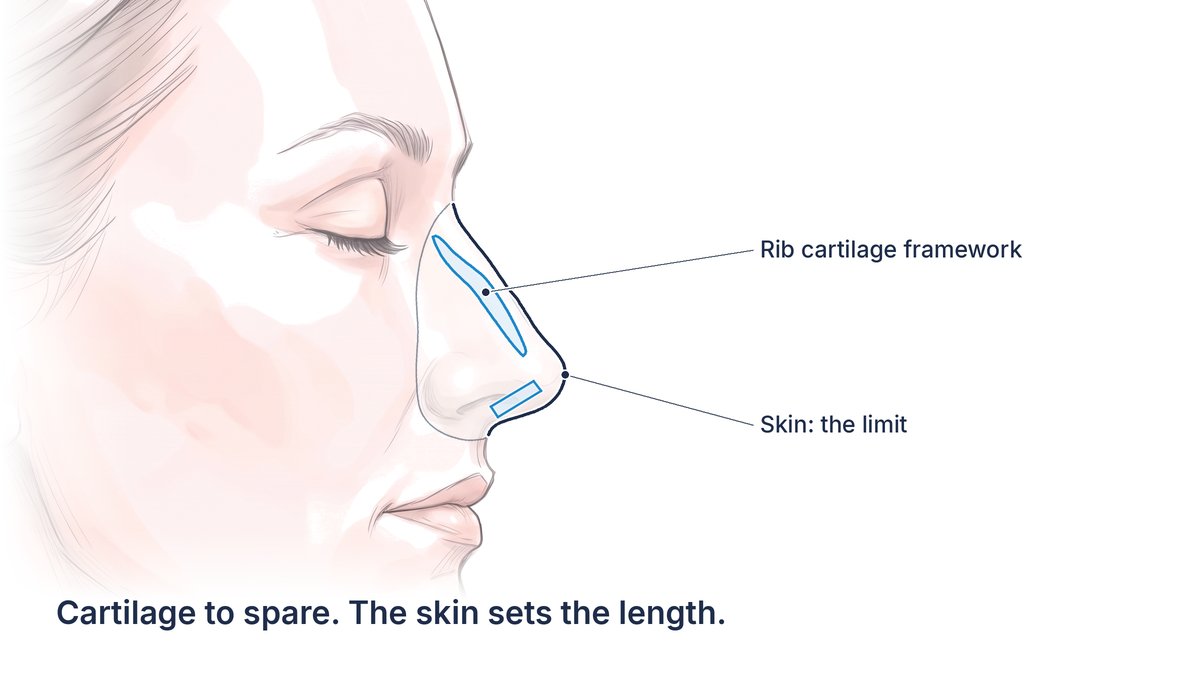
Short nose lengthening with rib cartilage is rhinoplasty that brings a short, upturned nasal tip down and forward on a framework carved from the patient’s own rib. In published series the average gain is a few millimeters: study averages run from under 1 mm to about 6 mm, with 8 mm in one rib series of mostly revision noses. The ceiling is set by how far the skin and the inner lining of the nose will stretch, not by how much cartilage the surgeon has.
Quick answers
- How much longer can a short nose be made? Average gains ran from 0.28 to 6.2 mm across eight studies in a systematic review. Noses scarred by earlier surgery often gain only 3 to 4 mm.
- Why rib cartilage? Lengthening needs long, strong pieces, and the septum is often too small. In one study rib gave more length than septal or ear cartilage.
- What does Dr. Yongwoo Lee do? He uses the patient’s own seventh rib cartilage, usually as a dorsal graft plus a columellar strut, promises no number of millimeters, and warns every patient that the tip will feel firm.
How Much Can a Short Nose Be Lengthened With Rib Cartilage?
A few millimeters on average, with published study averages from under 1 mm to about 6 mm, and often only 3 to 4 mm when the skin is scarred from earlier surgery. The common mistake is to assume the answer depends on how much cartilage is available: one rib usually supplies more length than any nose can accept, and the skin and the inner lining decide how much of it can be used.
A descriptive systematic review of short nose correction included 24 studies and 1,450 patients. In the eight studies that reported it, the average increase in nasal length ran from 0.28 to 6.2 mm. Those studies used different grafts and measurements, so the range describes the field, not one nose.
Rib cartilage sits at the upper end. In a retrospective study of 36 patients whose short noses were lengthened with septal, ear or rib cartilage, length from the root of the nose to the tip rose 11.2 percent, and rib produced a greater increase than septal or ear cartilage. The largest figure in print is an average of 8 mm, from a series of 38 patients lengthened with a rib cartilage septal extension graft in one practice. Thirty-three of those noses had been operated on before, so 8 mm is the top of the published range, not a typical result.
Noses that contracted after earlier surgery sit at the other end. A 2025 review of reconstruction for the contracted nose states that even extensive rebuilding gives “results often limited to only 3-4 mm of elongation.”

What Counts as a Short Nose, and Is Mine Short or Only Upturned?
A short nose is one in which the distance from the root of the nose, the low point between the eyes, to the tip is short for the face, usually with the tip rotated upward so the nostrils show from the front. Most are both short and upturned, and no single definition is agreed: one published benchmark calls a nose excessively short when it is under 75 percent of its ideal length.
That benchmark comes from a technique article on the excessively short nose by Stanford facial plastic surgeons, who write that “a universal definition does not exist.” Ideal length, in their account, is one third of the distance from hairline to chin. What patients see is a tip rotated upward, more nostril show, high nostril rims, a low root and an upper lip that “appears long.”

In a report of 854 primary rhinoplasties in Asian patients, 295 (35 percent) were short-nose cases, defined as two or more of three findings: a short tip, retracted nostril rims, or a retracted columella, the column between the nostrils.
Is it the lip or the nose?
A short, upturned nose exposes more of the upper lip in profile, so the lip can read as long. Before anyone shortens a lip, the nose above it deserves a look; the measurement is described in how upper lip length is measured before a lip lift.
Why Does the Skin, Not the Cartilage, Limit How Long a Nose Can Be Made?
Because a framework of almost any length can be carved from a rib, but the skin over it and the lining inside the nostrils must stretch to cover it and still receive blood. Skin closed under tension over a framework that is too long can lose its circulation, and overstretched lining can break down and pull the nostril rim upward again.
A nose has three layers that must lengthen together: the outer envelope of skin and soft tissue, the cartilage framework, and the inner lining. Only the middle one can be replaced from the rib. The Stanford authors test the other two by stretching the nasal skin by hand, and warn that forcing skin over an extended framework “can place undue tension on the skin and associated vascular plexus with resulting tissue necrosis,” meaning skin that dies for lack of blood.
In the 2025 review of contracted-nose reconstruction, a nose whose skin is loose and mobile can still do well, while “thick, scarred, and immobile skin” may significantly limit how far the tip can be lengthened.

Previous surgery is the usual reason skin will not move: over-removed cartilage, a tightening capsule around a silicone implant, or scarring after infection. Those noses are covered in silicone nose implant problems, removal and rib revision.
Rib, Septum or Ear Cartilage: Which Graft Can Lengthen a Short Nose?
All three can lengthen a nose; they differ in how much strong, straight cartilage they supply. Septal cartilage is already inside the nose but is often too small, ear cartilage comes in small curved pieces that suit modest corrections, and rib cartilage supplies long, strong pieces at the price of a second incision on the chest.
The central tool is the septal extension graft, in the Stanford article “the most powerful mechanism to elongate and project the nasal septum”: a plate of cartilage fixed to the lower end of the septum, the wall between the two nasal passages, so that it reaches beyond it, with the tip cartilages stitched to it lower and farther forward. Its main alternative, the derotation graft, is a piece of ear cartilage fixed at the front corner of the septum, against the upper edges of the tip cartilages, to push them downward.
A comparison of 429 short-nose corrections by one Korean surgeon set 287 septal extension grafts made of septal cartilage beside 142 derotation grafts made of ear cartilage, at a median follow-up of 12 months. The derotation graft drooped more often (8.45 against 4.53 percent) and caused more fullness above the tip (2.82 against 0 percent), both significant differences; the extension graft showed more deviation (5.23 against 1.41 percent), but that difference was not statistically significant. Relapse of the shortening did not differ significantly, and the authors noted a trend toward a more rigid tip in most extension-graft cases.
Septal cartilage can only be borrowed in part. In that comparison a 10 to 12 mm L-shaped strut of septum was left in place to hold up the nose. A paper on short-nose correction in Asian rhinoplasty calls short-nose correction “the most challenging part in a rhinoplasty” and states that “the amount of the septal cartilage is often not sufficient as a donor graft source in Asians.”
Rib solves the supply problem. The Stanford group prefers the seventh rib cartilage because it yields long segments.
Donor rib from a tissue bank, usually irradiated, avoids the chest incision, and a hybrid graft of septal cartilage between thin battens of irradiated donor rib lengthened 41 noses with few complications. Durability is the open question. In a systematic review of rib grafts used to support the nasal tip (14 studies, 1,358 patients), resorption was recorded in 2.4 percent of irradiated donor grafts against 0.49 percent of the patient’s own, and the most common complication with own rib was deviation or warping, in 1.7 percent. Overall complications were 4.6 percent with own rib and 5.0 percent with donor rib, and the authors judged both safe. A larger 2026 meta-analysis of 50 studies found no significant difference between own and donor rib for any outcome, in studies its authors rated at serious to critical risk of bias.
Stacking grafts on the tip is a shortcut the Stanford authors “strongly recommend avoiding” as a way to lengthen, because the grafts can show through the skin. Materials are compared in full in rib vs septal vs ear cartilage rhinoplasty.
Short Nose Lengthening Grafts at a Glance
| Septal cartilage extension graft | Ear cartilage derotation graft | Own rib cartilage framework | Donor (irradiated) rib | |
|---|---|---|---|---|
| Where it comes from | Inside the nose, same incision | The bowl of the ear | The seventh rib, through a chest incision | A tissue bank; no chest incision |
| How much there is | Limited; a 10 to 12 mm L-shaped strut stays behind | Pieces about 1.2 to 1.8 cm by 0.6 to 0.8 cm | Long, strong segments, enough for every graft | As much as needed |
| Reported effect | Tip projection preserved over time in a 429-patient comparison | Tip projection preserved over time in the same comparison | More length than septum or ear in one study; 8 mm average in one mostly revision series | Adequate lengthening in a 41-patient hybrid series |
| Main reported problems | Deviation 5.23 percent; drooping 4.53 percent | Drooping 8.45 percent; fullness above the tip 2.82 percent; deviation 1.41 percent | Deviation or warping 1.7 percent; resorption 0.49 percent; chest donor site | Resorption 2.4 percent |
| In Dr. Yongwoo Lee’s practice | Septal cartilage only as a small supplement or for small tip corrections | Ear cartilage only for small tip corrections; he lengthens with rib | His main material when support or length is needed | Not used |
Sources: the 429-patient comparison, the 36-patient and 38-patient series, and the systematic review of tip-support grafts.
How Does Dr. Yongwoo Lee Lengthen a Short Nose With Rib Cartilage?
I build the new length from the patient’s own seventh rib cartilage, usually as a dorsal graft carved as one solid block plus a columellar strut between the tip cartilages; when a nose needs a large gain in length or a tip turned down, a septal extension graft held by spreader grafts on both sides takes the strut’s place. I do not use donor rib or silicone implants, I use septal cartilage only as a small supplement, and I do not promise a number of millimeters.
The skin is examined before anything is measured
At consultation I hold the tip between my fingers and draw it down and forward. How far the skin and the inner lining follow tells me how much length this nose can accept. Loose, unoperated skin comes down easily. Skin that is thick, scarred or bound to an old implant capsule does not, and no amount of cartilage changes that.
Why I take the whole seventh rib cartilage
I harvest the whole seventh rib cartilage, from the right side by default; one cartilage usually supplies every graft the nose needs, and if it proves heavily calcified I take an additional one, such as the sixth. Where the 4 to 5 cm incision goes, how the lung is protected and tested, how calcification is judged and how pain is controlled are explained in rib cartilage harvest: scar, pain and pneumothorax risk.
The framework: what carries the tip, what holds it straight, what raises the bridge
What carries the tip. I lengthen with one of two rib grafts, chosen by how far the tip has to move. Usually it is a columellar strut, together with the dorsal graft: a post of cartilage standing on its own between the inner limbs of the two tip cartilages, inside the column between the nostrils, not fixed to the septum. When the nose needs a large gain in length, or the tip has to be turned down, I use a septal extension graft instead: it is fixed between spreader grafts on both sides so that it reaches past the septum’s lower end, and the two tip cartilages are stitched to it in their new place, lower and farther forward.
What holds it straight. Spreader grafts are a pair of cartilage strips set along either side of the upper septum. When I use an extension graft, gripping it between them keeps it straight, because a support that is too weak can buckle under the pull of the skin.
What raises the bridge. I carve the bridge graft from the same rib as one solid block, cut symmetrically around its central core so that the forces inside it stay balanced, and check it for warping after a rest of tens of minutes before it goes in. A low bridge and a short nose often come together, and a bridge that starts higher between the eyes also makes the nose read longer.

Two things I say before every lengthening
First, the length gained is limited by how far the skin of the tip stretches, so I name no number. Second, the tip will feel firm. A report of 854 rhinoplasties in Asian patients gives the same warning: when the tip is extended on septal or rib cartilage, “the resultant tip will be rigid,” and that rigidity “hinders mobility of the nasal tip.” A graft strong enough to hold the tip down against the pull of the skin does not bend when you press on it, and I would rather a patient hear that before surgery than discover it afterward.
What I do not use, and what changes after earlier surgery
I do not use donor rib or silicone implants. Both are established options in other surgeons’ hands. I also never inject filler into the nose, for the reasons set out in filler blindness and vision loss warning signs.
A nose that contracted after earlier rhinoplasty gets its length back on rib cartilage too, on a septal extension graft, and the reconstruction may be staged. When an old silicone implant is part of the problem, infection or exposure of the implant and the capsule around it change the timing, as set out in silicone nose implant problems, removal and rib revision.
Born Short, Contracted or Low-Bridged: Which Short Nose Are You?
Which short nose you have depends on two things: why it is short, and how freely its skin moves.
A nose that has always been short and upturned, never operated on. The skin is usually mobile, the favorable starting point. Its septum is often too small to build with, especially in Asian noses, which is why rib is so often needed for real lengthening here.
A short nose with a low bridge. Length and height are planned together. In the 36-patient study the key maneuvers were a septal extension graft reinforced by an extended spreader graft, plus a dorsal graft.
A nose that turned up after earlier surgery or a silicone implant. Expect less: the contracted-nose review speaks of 3 to 4 mm and of a goal that is “a more natural and normalized appearance,” not an ideal nose.
Someone who wants a small change and no chest incision. Septal extension grafts and ear cartilage derotation grafts are published options for modest corrections. If you do not want a chest incision, I plan a smaller correction with septal or ear cartilage and say plainly that a large gain in length is not realistic without rib. Ask any surgeon, including me, which material they would use for your nose and why.
Someone who needs a specific number. Nobody can promise one in advance, because the skin sets it. If the result you would accept is defined in millimeters, or by another person’s profile, read what natural means in plastic surgery first.
What Is Recovery Like After Short Nose Lengthening With Rib Cartilage?
You stay the first night at the clinic, the chest drain comes out on day 2 or 3, and the nasal splint and nose stitches come off on day 7, after which you may fly. I close the chest wound in layers with dissolving stitches, so there are no chest stitches to remove. Light activity resumes at one week, exercise at four weeks, and heavy upper-body exercise at six weeks.
Most of the early discomfort is in the chest, not the nose, and it is treated in layers, starting with a long-acting local anesthetic placed in the harvest site before closing. Rhinoplasty with a rib harvest is done under general anesthesia given by a board-certified anesthesiologist. The chest timeline, including a wire-free bra for women and about three months of scar care, is in recovery after rib cartilage harvest, and travel planning is in how long to stay in Korea after plastic surgery.
Aspirin, anti-inflammatory painkillers and supplements stop two weeks before surgery. GLP-1 medicines stop one month before and restart 1 to 2 weeks after, once you eat normally, coordinated with the prescriber. Do not stop aspirin or a blood thinner prescribed for the heart or after a stroke, or any diabetes medicine, on your own: the timing is agreed with the doctor who prescribed it. The full list, including hormones and alcohol, is in what to stop before plastic surgery.
Nicotine in any form, including cigarettes, vapes, patches and gum, narrows the small vessels that keep stretched skin alive. I ask for no nicotine in any form for four weeks before and four weeks after a rib rhinoplasty, as for every major operation, and a patient who cannot stop has the surgery postponed.
When is the length final?
The tip settles slightly in the first six weeks, and in a study that measured it with 3D photographs over years, it then held. In a three-dimensional photographic study of 20 patients with septal extension grafts, followed for a mean of 3.3 years, tip rotation fell 4.3 percent between week 1 and week 6, with no significant further loss after that. Swelling in the skin of the tip fades more slowly, so the shape goes on refining for months after the length has stopped changing.
Surgeon’s Insight: The Rib Is Rarely What Runs Out
Patients ask me how many millimeters. With a whole seventh rib cartilage on the table, I usually have more length in my hand than any nose can take, so cartilage is almost never what runs out. Skin is, and the framework stops where the skin stops. So I answer the question with my fingers on the tip, not with a ruler, and I add the sentence nobody asks for: the tip will be firm. The support that keeps the new length is the stiffness you will feel.
What Are the Risks of Lengthening a Short Nose With Rib Cartilage?
The risks specific to lengthening are a firm tip, a tip that drifts off the midline, warping, partial return of the upturn or a drooping tip, skin or lining that suffers under tension, and revision. Infection, breathing change and chest problems complete the list.
A firm tip. Expected, not a complication, but a real complaint. In a 2014 series of 113 short-nose corrections, 32 patients had come with tip stiffness from an earlier septal extension graft.
Deviation and warping. Across rib rhinoplasty in general, a meta-analysis of 20 studies and 1,648 patients found warping to be the most common complication at 3.05 percent, with infection in 1.45 percent and revision in 2.25 percent. In the systematic review of rib grafts supporting the tip, deviation or warping of the patient’s own rib was recorded in 1.7 percent. Warping is why a carved graft is left to rest and checked before it goes into the nose. In a 2026 meta-analysis, one-piece bridge grafts of the patient’s own rib warped more often than layered ones (5.42 against 0 percent, in studies at high risk of bias); how the two designs compare is set out in rib vs septal vs ear cartilage rhinoplasty.
Revision. In a single-surgeon series of 324 cosmetic rhinoplasties comparing three ways of supporting the tip, revision rates ran from 6.5 to 14.3 percent depending on the construct, 10.6 percent with a septal extension graft alone. In the 113-patient series, 11 patients (10 percent) had a revision.
Skin and lining under tension. Pushed too far, the skin of the tip or columella can lose its blood supply, and overstretched lining can retract the nostril rim.
Breathing. In a cohort of 79 patients with septal extension grafts matched against patients without one, nasal obstruction scores after surgery did not differ significantly between the groups. One cohort is not a promise for one nose.
The chest. In the 20-study meta-analysis the pooled rate of pneumothorax, air around the lung, was 0 percent (upper confidence limit 0.46 percent), and a raised chest scar occurred in 2.08 percent. Even so, the 38-patient series recorded one pneumothorax.
Warning signs. Skin on the tip or columella that turns white, dusky or blistered: contact the surgical team at once, not the next day. Increasing pain, pressure or blockage inside the nose in the first days: contact the team the same day. Rising pain with redness, discharge or fever: contact the team the same day. A chest wound that swells quickly and tightly: contact the team at once. Sudden breathlessness or sharp chest pain after a rib harvest, or a nosebleed that keeps flowing after 15 minutes of sitting upright with the head raised and gentle pressure under the nostrils (do not pinch or blow the nose), or that runs heavily down the throat, is an emergency: call emergency services or go to the nearest emergency room first, then tell the clinic.
What Should You Ask Before Short Nose Lengthening?
Ask not “How many millimeters can you add?” but “How far does the skin of my tip come down when you pull it, and what will hold it there?” The first question is about cartilage, which is rarely the limit. The second is about the two things that decide a short nose lengthening: the skin, and the support under it.
Then ask:
- Which cartilage will carry the tip, and why not the others?
- If rib, where is the incision and how is the lung protected?
- What happens if the skin will not allow the planned length?
Individual results vary; consultation required.
Written by Dr. Yongwoo Lee, board-certified Korean plastic surgery specialist in facial anatomy and aesthetic procedures at VIP Plastic Surgery, South Korea.
Frequently Asked Questions About Short Nose Lengthening With Rib Cartilage
What is a septal extension graft?
A plate of cartilage fixed to the lower end of the septum so that it reaches beyond it, with the tip cartilages stitched to it lower and farther forward; Stanford surgeons call it the most powerful way to lengthen and project the septum. Dr. Yongwoo Lee carves it from rib cartilage and fixes it between spreader grafts on both sides when a nose needs a large gain in length or a tip turned down; in most short noses he uses a columellar strut instead.
Can a short nose be lengthened without rib cartilage?
Yes, for modest corrections, with a septal cartilage extension graft or an ear cartilage derotation graft; both kept tip projection over time in a 429-patient comparison. Septal cartilage is often too small to give much length, and Dr. Lee tells patients who decline rib that a large gain in length is not realistic without it.
Will my nose tip feel stiff or hard after lengthening?
Yes, firmer than before. A tip extended on septal or rib cartilage is described as rigid and less mobile, because the graft that holds the new length does not bend. It softens a little over the months after surgery, but some firmness remains, and Dr. Lee tells every patient this before surgery.
Will a lengthened nose shrink back or turn up again?
A little settling is expected early. In 20 patients with septal extension grafts, tip rotation fell 4.3 percent between week 1 and week 6, with no significant further change over a mean of 3.3 years.
Does a short nose make my upper lip look long?
It can: an upturned tip exposes more of the upper lip in profile, and a long-appearing lip is listed among the features of the short nose. Assess the nose before planning a lip lift.
Will lengthening my nose affect my breathing?
On average it did not in one cohort: 79 patients with septal extension grafts had nasal obstruction scores no different from matched patients without one.
Is a nose shortened by previous surgery harder to lengthen than one I was born with?
Usually, yes. Scarred, immobile skin limits how far the tip can come down, and gains are often limited to 3 to 4 mm. Dr. Lee restores length in these noses with a rib cartilage septal extension graft, sometimes in stages.
Can my nose tip become crooked after a septal extension graft?
It can. Deviation occurred in 5.23 percent of septal-cartilage extension grafts in a 429-patient series, and deviation or warping in 1.7 percent of own-rib tip-support grafts in a systematic review.
Does donor rib resorb more than my own rib when it holds up a lengthened tip?
In one review it did. In a systematic review of rib grafts supporting the tip, resorption was 2.4 percent with irradiated donor rib against 0.49 percent with the patient’s own, while a larger 2026 meta-analysis found no significant difference between graft types, in studies at high risk of bias. Donor rib avoids the chest incision; Dr. Lee uses only the patient’s own rib cartilage.
Can a short nose be lengthened and the bridge raised in the same operation?
Yes, and the two are usually planned together. In a 36-patient study the key maneuvers were a septal extension graft reinforced by an extended spreader graft, plus a dorsal graft, and Dr. Lee carves the bridge graft from the same seventh rib cartilage that carries the tip.
Do I have to stop smoking or vaping before short nose lengthening?
Yes, for four weeks before and four weeks after, in every form, vapes, patches and gum included. A lengthened tip is skin stretched over new cartilage, and nicotine narrows the small vessels that keep that skin alive, so in Dr. Yongwoo Lee’s practice a patient who cannot stop has the surgery postponed.
This article is for informational purposes only and does not constitute medical advice. Always consult with a qualified medical professional before making any decisions about surgical or non-surgical procedures.
