
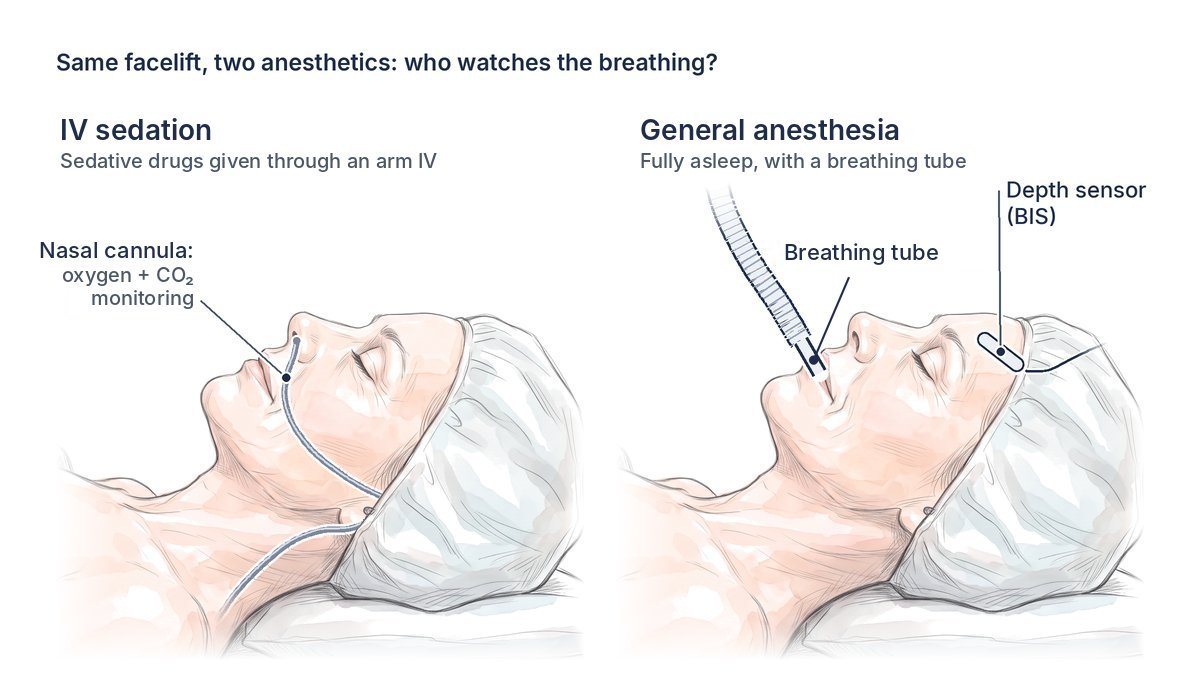
Facelift anesthesia comes in three forms: local anesthesia alone, local anesthesia with IV sedation (often sold as “twilight”), and general anesthesia. None of the three has been proven to be the safe one. What the evidence points to is how the anesthetic is run, from who watches your breathing to how bleeding and leg clots are controlled until the next morning.
Quick answers
- Is sedation safer than general anesthesia for a facelift? Not automatically. Sedation can slide deeper than intended, and in US malpractice claims, sedation cases ended in death or permanent brain damage about as often as general anesthesia cases.
- What does Dr. Yongwoo Lee use? General anesthesia given by a board-certified anesthesiologist, with capnography, BIS depth monitoring and active warming, then recovery-room observation and at least the first night in an inpatient room.
- Does the type of anesthesia change hematoma risk? The comparisons are old and conflicting. Published series point instead to control of blood pressure, pain and nausea, above all in the first 24 hours.
Is Twilight Sedation Safer Than General Anesthesia for a Facelift?
Not by default. Twilight sedation avoids a breathing tube, but it is not a fixed, light state: the American Society of Anesthesiologists describes a continuum on which a patient can drift to where breathing may fail. General anesthesia secures the airway and puts a dedicated anesthesia professional in charge of it, at the cost of a deeper anesthetic and more nausea.

“Twilight” sounds half as risky. In a closed claims analysis of monitored anesthesia care, 121 US sedation claims ended in death or permanent brain damage in more than 40 percent, similar to the 1,519 general anesthesia claims. Facial plastic surgery made up 26 percent of them, and the most common specific mechanism was oversedation slowing the breathing (21 percent), nearly half judged preventable by better monitoring such as capnography. A claims registry shows how sedation fails, not how often.
General anesthesia carries its own trade. In a 2001 survey of 273 aesthetic surgeons covering 9,937 facelifts, general anesthesia covered 43.5 percent of the facelifts but 83.7 percent of the leg and lung clots. A survey cannot separate the anesthetic from the longer, combined operations that come with it, and the same survey linked intermittent leg compression devices to significantly fewer clots. A review of short-term facelift complications also cites one surgeon’s 10,000 facelifts under IV sedation with intermittent compression and no clinically evident clot, without scans for silent ones. The honest comparison is between whole systems, not labels.
Across 13,346 facelifts in the TOPS outcomes database, the same signal appears with the same caveat: adverse events were more likely with general anesthesia, and also with the longer operations and combined procedures that tend to come with it, as well as office-based surgery, male sex, obesity and smoking.
What Actually Makes Facelift Anesthesia Safe?
Eight things, framed by whichever anesthetic is chosen: a qualified person whose only job is your breathing and circulation, monitoring of oxygen and exhaled carbon dioxide, normal body temperature, steady blood pressure, prevention of nausea and coughing, measures that limit bleeding, prevention of leg clots, and observation through the hours when bleeding is most likely.
Most of that list is a hematoma measure, because bleeding under the lifted skin is the dominant early risk. In an analysis of 11,300 facelifts from a prospective insurance database, major complications (an emergency visit, admission or reoperation within 30 days) occurred in 1.8 percent, with hematoma the most common at 1.1 percent. A facelift alone carried 1.5 percent, against up to 3.7 percent when combined with other procedures. Male sex raised hematoma risk 3.9 times, and the type of facility, unspecified in the abstract, 2.6 times.
Why Does Anesthesia Affect Bleeding Under a Facelift?
Because a facelift hematoma, blood collecting where the skin and deep layer were lifted, is triggered by the very things anesthesia controls: blood pressure, nausea and vomiting, coughing, pain, anxiety and body temperature. A rough wake-up or an unsettled first night can push a sealed vessel open.

An evidence review of hematoma prevention after facelift puts hematoma rates at 0.2 to 8 percent and notes that an expanding one “may emergently affect the airway.” In 1,078 facelifts, a systolic pressure above 150 carried an odds ratio of 3.6. In 502 patients, hematoma fell from 3.76 percent with loose control to 0.5 percent with systolic pressure kept under 120. The review advocates antihypertensives prophylactically, with a systolic goal under 140 mmHg.
Pressure also rises after surgery in people whose readings were normal before it. In a single-surgeon series of 1,089 facelifts with a hypertension protocol, 170 patients were hypertensive before surgery and 355 after it. Hematoma occurred in 0.9 percent, and 8 of the 10 patients who bled had documented high pressure in the recovery room.
Steady does not mean as low as possible. An evidence-based review of bleeding control in facelift cites a survey of surgeons in which targeting a systolic pressure below 100 during surgery was associated with more hematomas than aiming for 100 to 140, because “intraoperative hypotension may mask areas where hemostasis has not been achieved.”
Nausea is the second lever. The 2024 review states that “episodes of emesis can lead to hematoma,” with postoperative nausea and vomiting in 25 to 30 percent of patients. In one series, hematoma occurred in 7 percent of patients given pain, anxiety and nausea medicine on request and in none of those given it on a schedule. A review of expanding hematoma adds retching, coughing, anxiety, straining and a full bladder to the triggers to prevent.
Facelift Under Local, IV Sedation or General Anesthesia: How Do They Compare?
Local anesthesia alone suits small lifts in calm patients; local with IV sedation suits short to moderate operations run by a team ready to rescue the airway; general anesthesia suits long or combined operations where a secured airway, a still patient and a dedicated anesthesiologist matter most.
The ASA statement on the continuum of depth of sedation defines the levels. Under moderate sedation you “respond purposefully to verbal commands”; under deep sedation you “cannot be easily aroused” and breathing “may be inadequate”; under general anesthesia you are “not arousable, even by painful stimulation.” Because response cannot always be predicted, whoever gives sedation must be able to rescue a patient who goes deeper than intended.
At a Glance: Facelift Anesthesia Options
| Local anesthesia alone | Local with IV sedation (“twilight”) | General anesthesia | |
|---|---|---|---|
| How awake you are | Awake, the face numbed | Drowsy to hard to rouse; can drift deeper | Not arousable, even to pain |
| Breathing | Unaffected | Usually adequate; at deep levels it may not be | Airway secured and supported |
| Who runs it | The surgeon | The surgeon or an anesthesia professional, depending on the clinic | An anesthesiologist or anesthesia team, present throughout |
| Exhaled CO2 monitoring (ASA) | Not applicable | “Every effort” to monitor | Required, continually |
| Nausea and vomiting | Lowest; some protocols skip fasting | In between | About one in three without prevention, under inhaled anesthesia |
| Hematoma data | 174 patients: 13.2 percent small collections, mostly drained by needle, 1.1 percent back to surgery. 1,500 patients: 0.6 percent | Old, conflicting comparisons | Old, conflicting comparisons; low rates under strict pressure protocols |
| Clot data | Little published | No clinically evident clot in one surgeon’s 10,000 cases with leg compression | Most clots in a 2001 survey, confounded by longer, combined operations |
| Typical fit | Short skin and jowl lifts | Short to moderate lifts; patients who want to avoid a tube | Deep plane lifts with neck work; combined procedures |
Local-anesthesia figures are from the 2024 evidence review; the nausea figure is from OpenAnesthesia’s summary of adult postoperative nausea.
On hematoma, the old comparisons conflict: one series cited in the expanding hematoma review found about 1 in 114 under monitored IV anesthesia, 1 in 90 under general anesthesia and 1 in 27 under local alone, while other reports found more under general anesthesia, more under sedation, or no difference. No anesthesia type has been shown to prevent hematoma. The evidence for blood pressure, pain and nausea control comes from single-surgeon series and before-and-after comparisons, not randomized trials.
Sedation for facelift is also a published model in Korea. A Korean series on hypertension during facelift under local anesthesia with IV hypnotics describes facelifts under IV hypnotics without an anesthesiologist, calls elevated systolic pressure “the most critical risk factor that causes hematoma,” and treats it with medicine before surgery and a systolic goal under 150. That model puts the airway and blood pressure in the operating team’s hands, so its safety depends on how well that team is equipped and trained.
What Is Monitored During Facelift Anesthesia, and What Do Capnography and BIS Add?
Under general anesthesia, the ASA Standards for Basic Anesthetic Monitoring require qualified anesthesia personnel in the room throughout, pulse oximetry with an audible alarm, continual exhaled carbon dioxide by capnography, a continuous ECG (heart tracing), and blood pressure and heart rate at least every five minutes. BIS, a forehead sensor that reads anesthetic depth from brain activity, is an addition beyond that minimum.

Capnography measures the carbon dioxide in every breath you breathe out, so it shows whether you are breathing, not only whether your blood still holds oxygen. For moderate or deep sedation, the 2025 standard says that “every effort should be made” to monitor it.
A Cochrane review of bispectral index monitoring (52 studies, 41,331 participants) found awareness in about 3 per 1,000 patients with BIS against 9 per 1,000 with clinical signs, no difference against monitoring of exhaled anesthetic gas, and a recovery-room exit 6.86 minutes sooner, all at low certainty. BIS is a depth gauge, not proof of fewer complications.
Why temperature is part of safety
A cold patient bleeds more. NICE guidance on perioperative hypothermia defines hypothermia as a core temperature below 36.0°C, recommends forced-air warming from induction for anesthetics over 30 minutes, and holds ward transfer until 36.0°C. In a meta-analysis of mild perioperative hypothermia, a drop of less than 1°C raised blood loss about 16 percent and transfusion risk about 22 percent. Those studies were not facelifts, and no trial shows that warming prevents facelift hematoma.
How Does Dr. Yongwoo Lee Run Anesthesia for a Facelift?
I perform facelifts under general anesthesia given by a board-certified anesthesiologist, with capnography, BIS depth monitoring and active warming. Bleeding and clot control run alongside it: tranexamic acid, a hemostatic net and drains, leg compression devices, observation in the recovery room until vital signs are stable, and at least the first night in an inpatient room.
Why general anesthesia for a facelift
Most of my facelifts are deep plane lifts, often with work beneath the platysma in the neck: a long operation on the face and neck, around the airway itself. I want that airway secured and a specialist other than me watching it, with the patient’s breathing and pressure, for the whole operation, so my attention stays on the dissection and on hemostasis. A neck lift done on its own is also done under general anesthesia.
My eyelid surgery is different: it is short, done under local anesthesia with IV sedation that I give myself, midazolam and ketamine for upper eyelids and propofol and ketamine for lower eyelids, with oxygen through a nasal or oral airway while a dedicated nurse watches blood pressure, oxygen saturation and heart rate on the monitors continuously. Fat grafting done on its own is done under IV sedation with local anesthesia, and the patient goes home the same day. The anesthetic follows the operation.
What the anesthesiologist watches
Capnography runs from the moment the airway is placed until it comes out, alongside oxygen saturation, heart rhythm and blood pressure. BIS is read throughout to keep depth in range rather than inferring it from heart rate and movement, and active warming continues because a long, still operation cools a patient steadily.
Blood pressure: calm, not low
During surgery the anesthesiologist keeps the systolic pressure under 140, and I do not let it fall very low, because a vessel that is silent at a very low pressure can be missed and open later. Blood pressure medicines are usually continued, with any morning-of-surgery change made by the anesthesiologist. After surgery the pressure stays tightly controlled, and when it does not settle, an IV blood pressure drip is started and adjusted.
Tranexamic acid, in the vein and on the field
Tranexamic acid, a drug that slows the breakdown of clots that have already formed, is given intravenously in every facelift, from the day of surgery through the third or fourth day. During the operation I also use gauze soaked in tranexamic acid on the dissected field for hemostasis. At closure I place a hemostatic net, removed at day 3 or 4, and one or two drains depending on how much it bled, as described in how a facelift hematoma is prevented with a hemostatic net.
A quiet wake-up
Nausea, vomiting, coughing and straining push pressure into the face, so they are prevented, not waited for. Pain and anti-nausea medicine are given on a schedule, and pain relief is tramadol-based rather than anti-inflammatory painkillers, which affect clotting.
Clots: compression, selective injections, early walking
Facelift patients wear intermittent pneumatic compression devices, sleeves that inflate and squeeze the legs in cycles, during surgery and through the first night. I give an injected blood thinner only to patients whose own clot risk is high, because giving it to everyone would trade a rare clot for more frequent bleeding: in one series cited by the 2021 complications review, enoxaparin was associated with hematoma in 16.2 percent against 1.1 percent without it. Walking starts on the first day.
Who watches you overnight
Facelift patients, like patients after any other major operation, stay at least the first night in an inpatient room. Nurses are on duty overnight in the hospital and in the lodging inside the same building, and I live next door and can be reached at night. The clinic keeps an automatic CPR device, an emergency cart, a defibrillator, oxygen, emergency drugs and airway equipment, and works with Jeju National University Hospital and Halla Hospital. No emergency transfer has ever been needed; the equipment is there regardless.
General Anesthesia or Sedation: Which Facelift Patient Are You?
The right anesthetic follows the operation and the person: how extensive the lift is, your blood pressure, your nausea history, your own clot risk, and how far you are from home.
A short lift in front of the ear, in a calm, healthy patient. Local anesthesia or local with sedation is a widely published route for limited lifts, and the mini facelift vs full facelift comparison sets out what a shorter operation can and cannot do. If sedation is offered, who gives it and who watches your breathing matter more than the label, the same check that belongs in any consultation in Korea, as set out in choosing a plastic surgeon in Korea.
A deep plane lift with neck work or fat grafting at the same sitting. Combined operations carry more risk than a facelift alone in the 11,300-patient database. A secured airway, an anesthesiologist and leg compression matter most here, because the operation is longer and works around the airway.
A man, or anyone with high blood pressure. Male sex is the strongest hematoma predictor in the large database, and high systolic pressure is the strongest one you can change. Bring your home readings to the consultation: pressure that is not controlled should be treated before surgery is scheduled. See male facelift planning, beard, scars and hematoma.
Someone who vomited after a previous anesthetic, or who gets motion sick. The simplified nausea risk score counts female sex, nonsmoking, previous postoperative nausea or motion sickness, and opioids after surgery; three factors mean about a 60 percent risk. The fourth consensus guidelines on postoperative nausea, endorsed by 23 societies, call for at least two preventive drugs with one or two factors and three to four with more. Tell the anesthesiologist.
Someone with a clot risk of their own. A previous clot, estrogen-containing contraception or hormone therapy, or a high body mass index: this is the patient for whom an injected blood thinner is weighed and whose flight home needs a plan, as covered in how long to stay in Korea after plastic surgery. Estrogen-containing products stop four weeks before surgery, and a blood thinner or antiplatelet drug prescribed by another doctor is never stopped or changed without that doctor’s agreement.
Someone taking a GLP-1 medicine such as semaglutide or tirzepatide. These drugs slow stomach emptying, which raises the risk of stomach contents reaching the lungs under anesthesia or sedation. I ask patients to pause them one month before any surgery, a stricter interval than current society guidance, and a patient taking one for diabetes decides that pause with their internist or the doctor who prescribes it. Every date, with its reason, is in what to stop before plastic surgery.
Someone with sleep apnea, diagnosed or suspected. Sedatives and opioids relax the throat, and apnea episodes push blood pressure up at night, in the hours when facelift bleeding is most likely. Tell the anesthesiologist before surgery, and bring your CPAP machine for the first night.
A smoker. Smoking doubled hematoma risk in one large series and harms the lifted skin. Facelift patients stop every form of nicotine, patches, gum and e-cigarettes included, four weeks before and four weeks after surgery, for reasons explained in can a smoker have a facelift.
Do You Stay Overnight After a Facelift? The First 24 Hours
In my practice, yes: you wake in the recovery room, stay there with no fixed time limit until your vital signs are stable, then spend at least the first night in an inpatient room. That night is when facelift bleeding is most likely: most hematomas appear within 12 hours, and about 90 percent within 24.

Those figures come from two reviews. The expanding hematoma review reports onset in one series at 1.5 to 10 hours, with rare late cases at 2 to 10 days, and the 2021 complications review puts ninety percent in the first 24 hours. In a Brazilian single-surgeon series where every facelift had general anesthesia, intermittent leg compression and an overnight stay, adding hourly blood pressure control and scheduled anti-nausea drugs was followed by hematoma falling from 3.43 percent (233 facelifts) to 1.66 percent (361), not a statistically significant difference. All hematomas occurred within 48 hours.
Same-day discharge is standard in many practices and works with a documented after-hours plan. In the 2021 review, a 61-year-old woman returned about 6 hours after discharge with a hematoma compromising her airway and needed an emergency tracheostomy, a breathing opening in the neck. Such cases are rare; an inpatient night exists to close that gap, not to add comfort.
Night one itself is quiet: head raised, a compression dressing and small drains, the leg compression devices still running, medicine on schedule, and someone checking both sides of your face and your blood pressure. The rest of the course is in the facelift recovery timeline, week by week.
Surgeon’s Insight: The Anesthetic Is Part of the Hematoma Plan
Patients ask me whether they will be asleep. I think about what their blood pressure will do at hour six. A facelift is closed over a large raw surface, and the vessels on it are sealed, not healed. Everything the anesthesiologist does, from depth and warmth to a wake-up without coughing, is aimed at keeping those seals closed until they no longer need help. That is why I treat the anesthetic, the tranexamic acid, the net and the first night as one system. Any one of them can be done well and still fail if the next layer is missing.
What Are the Risks of Facelift Anesthesia, and What Should You Watch For?
Serious anesthetic complications in healthy facelift patients are uncommon. Worth understanding are hematoma, postoperative nausea, blood clots in the legs or lungs, breathing problems under deep sedation, low body temperature, and, rarely, awareness under general anesthesia or a reaction to the large volume of local anesthetic injected into the face, commonly used under all three methods and dosed by body weight.
Blood clots. In the 2001 survey, deep vein thrombosis occurred in 0.35 percent of facelifts and pulmonary embolism in 0.14 percent, with one death; stockings or elastic wraps alone gave no measurable protection. The 2021 review cites 2 pulmonary emboli in 13,346 facelifts (0.01 percent), and a series of 136 facelifts without drug prophylaxis had no clots despite an average Caprini clot-risk score of 5.6.
Fire under sedation. In the sedation claims, 17 percent were operating-room fires in facial surgery, where cautery met supplemental oxygen.
Warning signs. Sudden pain, especially on one side, swelling clearly larger on one side, a firm bulge, fresh blood through the dressing, bruising inside the cheek, or difficulty opening the mouth can mean a hematoma: call the surgical team at once. Swelling in the neck with any difficulty breathing, swallowing or speaking is an emergency: call emergency services or go to the nearest emergency department immediately, then let the clinic know. Calf pain or swelling, sudden breathlessness, chest pain or coughing up blood in the weeks after surgery, including after a flight, can mean a blood clot: call emergency services first rather than waiting to reach the clinic.
What Should You Ask a Clinic About Facelift Anesthesia?
Ask any clinic, including mine, not “Will I be asleep?” but “Who is watching my breathing and blood pressure from the first injection until the next morning, and what will they do if either one changes?” Whether a facelift is done under general anesthesia, IV sedation or local anesthesia matters less than whether the system around it is built for those first 24 hours.
Then ask the details:
- Who gives the anesthesia, and does that person stay in the room throughout?
- Is exhaled carbon dioxide monitored, and is depth monitored?
- How will I be kept warm, and what is the blood pressure target?
- What is the plan for nausea, and for clots?
- Where will I be, and who will be watching me, six hours after surgery?
Individual results vary; consultation required.
Written by Dr. Yongwoo Lee, board-certified Korean plastic surgery specialist in facial anatomy and aesthetic procedures at VIP Plastic Surgery, South Korea.
Frequently Asked Questions About Facelift Anesthesia
Is a facelift done under general anesthesia or twilight sedation?
Both. Smaller lifts are often done under local anesthesia with or without IV sedation, and longer deep plane lifts with neck work more often under general anesthesia. Dr. Yongwoo Lee performs facelifts under general anesthesia.
Do I need an anesthesiologist for a facelift?
Under general anesthesia, US standards require qualified anesthesia personnel in the room throughout. Sedation may be run by the surgeon or an anesthesia professional, depending on the clinic, and whoever gives it must be able to rescue a patient who drifts deeper than intended; Dr. Lee’s facelift anesthetics are given by a board-certified anesthesiologist.
Can a facelift be done under local anesthesia only?
Yes, for limited lifts: in two published series, 1.1 percent of 174 patients needed reoperation for hematoma, and 0.6 percent of 1,500 had one. Some surgeons skip fasting for local-only cases, but follow the fasting instructions you are given, and always fast if any sedation may be used. Extensive neck work is harder this way.
What is BIS monitoring, and do I need it?
A forehead sensor that reads anesthetic depth from brain activity: in a Cochrane review it lowered awareness compared with clinical signs alone, at low certainty, so it is a useful depth gauge, not a guarantee.
What is capnography, and why does it matter?
It measures the carbon dioxide in each breath you breathe out, showing whether you are breathing, not only whether oxygen is holding; it is required continually under general anesthesia, and under moderate or deep sedation the standard asks for “every effort” to monitor it.
Why do they keep me warm during surgery?
Because a cold body clots less well: in a meta-analysis, a drop of less than 1°C raised blood loss about 16 percent, and NICE recommends forced-air warming for anesthetics over 30 minutes.
Is facelift anesthesia riskier with sleep apnea?
It needs planning, because sedatives and opioids relax the throat: tell the anesthesiologist before surgery, even if apnea is only suspected, and bring your CPAP machine for the first night.
Can vomiting or coughing cause a facelift hematoma?
They can: retching, coughing and straining raise pressure in the face and can reopen a sealed vessel, which is why pain and anti-nausea medicine are given on a schedule rather than on request.
How is nausea after facelift anesthesia prevented?
By scoring your risk first and giving preventive drugs on a schedule: consensus guidelines call for at least two drugs with one or two risk factors and three to four with more.
Why is blood pressure watched so closely after a facelift?
High systolic pressure is the strongest hematoma risk that can be changed, and in one 1,089-patient series the number of hypertensive patients roughly doubled after surgery. Dr. Lee keeps systolic pressure under 140 during surgery, never very low, and controls it tightly afterward.
Is tranexamic acid used in facelifts?
Often; it slows the breakdown of clots already formed. Dr. Lee gives it intravenously in every facelift, from the day of surgery through day 3 or 4, and uses tranexamic acid-soaked gauze on the field during surgery.
Can I get a blood clot after a facelift?
It is uncommon but possible: deep vein thrombosis in 0.35 percent and pulmonary embolism in 0.14 percent of 9,937 facelifts in a 2001 survey. Dr. Lee uses leg compression devices through the first night, early walking, and an injected blood thinner only for patients at high clot risk.
This article is for informational purposes only and does not constitute medical advice. Always consult with a qualified medical professional before making any decisions about surgical or non-surgical procedures.
