
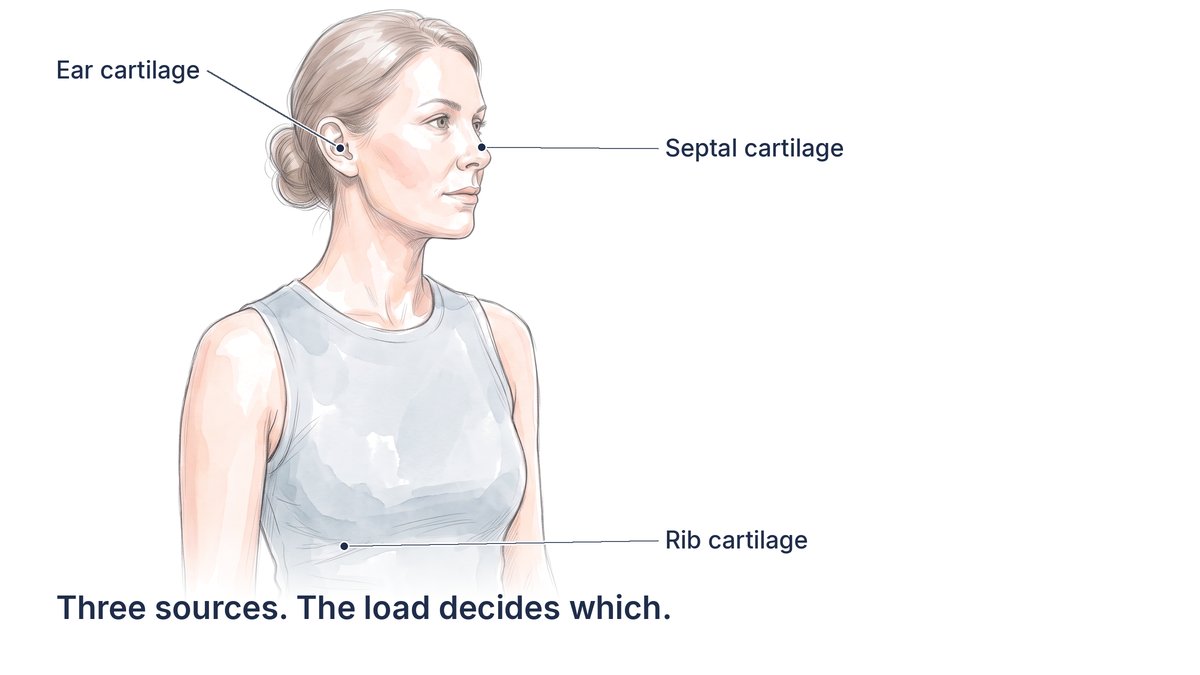
Rib vs septal vs ear cartilage rhinoplasty is not a choice between three grades of the same material: the three differ in supply and stiffness, and a nose that has to be raised, supported or lengthened needs stiffness more than a scar-free donor site.
Rib, septal and ear cartilage in rhinoplasty: key facts
- Septal cartilage: about 5 cm² harvestable on average in a Korean CT study with a 10 mm supporting frame left in place; less in women and after 50
- Ear cartilage: soft and curved, about eight times the elastin of septal cartilage and less than half its stiffness in a cadaver study; for the tip and nostril rim, poorly suited to load-bearing struts
- Rib cartilage: the largest supply; one seventh rib cartilage, a curved bar about 13 cm long along its course on CT, can usually supply every graft
- Pooled risks of own-rib grafts: warping about 3 percent, hypertrophic chest scar 2 to 5 percent, pneumothorax 0 percent recorded (upper confidence limit about 1 in 200)
- Dr. Yongwoo Lee’s material: the patient’s own rib when the nose needs support or length, with a little septal cartilage as a supplement; septal or ear cartilage for a small tip correction; no donor rib, silicone implant or nose filler
Rib vs Septal vs Ear Cartilage Rhinoplasty: What Is the Difference?
The difference is supply and stiffness. Septal cartilage suits small, straight grafts, ear cartilage suits soft, curved ones at the tip and nostril rim, and rib cartilage is for a plan that needs height, length or structural support the other two cannot supply, so your nose needs whichever cartilage has enough material and stiffness for the job.
Most patients rank the three by donor site instead: septum first because it adds no scar, ear second, rib last. Once a graft is in the nose, what matters is how much of it there is and how well it resists bending.
In my own practice the main material is the patient’s own rib cartilage whenever the nose needs support or length, with a little septal cartilage as a supplement. I use no donor rib or silicone implant, and I never inject filler into the nose.
What Does a Graft Have to Do: Shape the Nose, or Hold It Up?
A cartilage graft in rhinoplasty does one of two jobs: it fills and shapes, or it carries load. A filling graft can be soft, but a load-bearing graft has to stay straight and stiff under the pull of healing skin, and that difference decides the cartilage more than the donor site does.
- Dorsal onlay graft. Laid along the bridge to raise it.
- Columellar strut. A post between the inner limbs of the tip cartilages that supports the tip.
- Septal extension graft. A plate fixed to the front edge of the septum that sets tip position and nose length. It works under the most tension.
- Spreader grafts. A pair of strips placed along the top edge of the septum, one on each side between the septum and the upper lateral cartilage, that keep the middle of the nose straight and the internal nasal valve open.
- Tip onlay, cap and alar rim grafts. Small pieces that smooth the tip or stiffen the nostril edge, carrying little load.
Counting the grafts comes first: a plan with a dorsal onlay, a strut and two spreaders is four pieces, each of which has to be straight. Skin comes second: Korean surgeons describe noses that tend to have insufficient and weak septal cartilage and a thick soft-tissue and skin envelope, a combination that makes the tip hard to bring forward. In revision surgery for major deformities, a Korean revision group writes, the cartilage required usually exceeds the available septal cartilage, and the need for adequate strength precludes conchal (ear) cartilage.
How Much Cartilage Is There in the Septum, the Ear and the Rib?
The septum offers about 5 square centimeters of thin, flat cartilage on average, the ear a curved shell from its bowl, and one seventh rib cartilage a curved bar about 13 cm long. Ear cartilage is the softest, septum about twice as stiff in a cadaver study, and revision surgeons choose rib for strength and supply.

Septum: flat, stiff and limited
The septum is the wall between the two sides of the nose, cartilage in front and bone behind. Only its central and back part can be taken: an L-shaped strut along the bridge and the front edge has to stay, and a 2025 review of rhinoplasty grafts states that the L-strut must be preserved at least 1 cm wide in order to prevent septal collapse.
What is left is modest, and it varies. In a CT study of 123 Korean patients, the area that could be harvested while leaving a 10 mm L-strut averaged 497 mm², about 5 square centimeters. It fell from 550 mm² in the twenties to 358 mm² at 70 and over, and averaged 541 mm² in men against 378 mm² in women; its authors called the supply “insufficient and unpredictable” for operations that need several grafts. A second CT study of 200 patients found whole-septum cartilage areas ranging from 4.89 to 12.42 cm², so your own septum decides, not an average.

After earlier surgery the septum offers less. In contracted noses, septal and conchal cartilage are often depleted, and the septum may be deviated, weakened or even absent.
Ear: soft, curved and elastic
Ear cartilage comes from the conchal bowl, the hollow beside the ear canal, and the antihelical rim, the ridge that borders the bowl, is left intact. In a cadaver study of 10 donors, ear cartilage held 141.4 µg of elastin per mg of dry weight against 17.4 in septal cartilage, and its stiffness measured 1.14 MPa against 2.65 MPa for the septum. Rib was not tested in that study. The 2025 grafting review calls conchal cartilage ideal for rebuilding the nostril wall, smooth enough to blend in at the tip, and harder to use where rigidity is needed.
Rib: the largest supply, with a second surgical site
Costal cartilage is the bar that continues each rib toward the front of the chest; the seventh joins the breastbone. A surgeon who uses it routinely writes that septal and ear cartilage often lack the amount needed for revision, severe deformity or trauma, while rib can provide all of the necessary grafts from a single donor site. Cartilage can be taken from the fifth to the eleventh rib, and the seventh is the one most commonly used. In a CT study of 70 women it measured about 133 mm along its curve, 11 mm wide and 7.7 mm thick; the straight length available for carving is shorter.
Rib has two problems of its own as a graft: it can warp, bending slowly after it is carved, and it can calcify, turning partly to bone, which can make it hard to carve or unusable.
How Do Rib, Septal and Ear Cartilage Compare?
Septal cartilage is the convenient source with the smallest supply, ear cartilage the soft source for contour, and rib the structural source that needs a second incision.
At a Glance: Rib, Septal and Ear Cartilage
| Septal cartilage | Ear (conchal) cartilage | Rib (costal) cartilage | |
|---|---|---|---|
| Where it is taken | Inside the nose, no second site | Conchal bowl of the ear | Chest; seventh rib cartilage most often |
| Amount | About 5 cm² on average with a 10 mm L-strut kept; about 3.8 cm² in women | One curved shell per ear | A curved bar about 13 cm long along its course, 11 mm wide, 7.7 mm thick (CT, 70 women) |
| Shape and stiffness | Flat and thin; 2.65 MPa in a cadaver study | Curved and elastic; 1.14 MPa in the same study | Thick and carvable; not measured in that study |
| Suited to | Spreader grafts, small straight struts | Tip onlay, cap graft, nostril rim | Dorsal onlay, columellar strut, septal extension graft, spreaders |
| Reported problems | Septal collapse if the L-strut is not preserved; septal hematoma or perforation | Hematoma or keloid in 2.4 percent of 372 patients | Warping about 3 percent; hypertrophic chest scar 2 to 5 percent; chest pain; pneumothorax not recorded in pooled studies (upper limit about 1 in 200); calcification |
Is Donor Rib or a Silicone Implant an Alternative to Your Own Rib?
Donor rib cartilage and silicone implants are established alternatives that many surgeons use, and both avoid a chest incision. In two 2026 meta-analyses donor rib did not differ significantly from the patient’s own rib in pooled complications. I use neither.
Donor rib. Tissue-bank costal cartilage, irradiated, fresh-frozen or otherwise processed. A 2026 meta-analysis of 50 studies and 4,482 patients found pooled warping of 2.9 percent, resorption of 1.6 percent, infection of 1.9 percent and revision of 5.0 percent, with no significant difference between the patient’s own rib and any donor type across all grafts pooled together; in one subgroup, single-block dorsal grafts of fresh-frozen donor rib warped less (0.60 percent) than single-block grafts of the patient’s own rib. A second 2026 meta-analysis of 25 studies and 2,322 patients reported infection in 1 to 2 percent and warping in 1 to 3 percent across graft types, with revision in 7 percent for own rib, 1 percent for fresh-frozen and 7 percent for irradiated rib. Both sets of authors caution that the underlying studies are mostly retrospective.
Expert opinion is more reserved: a Korean group that specializes in revision rhinoplasty rarely uses donor rib, believing its long-term resorption unpredictable, and the 2025 grafting review, noting that most reported complications of irradiated donor rib occurred in septal extension grafts under high tension, suggests it only for nonstructural grafts. Both can be true: a meta-analysis pools every graft position, while the concern is about grafts that bear load.
Silicone. A silicone implant raises the bridge with no donor site, and the revision group describes it as the single most commonly used alloplastic implant in Asia. What can go wrong, and how the nose is rebuilt, is covered in silicone nose implant problems, removal and rib revision.
How Does Dr. Yongwoo Lee Build a Nose From Rib Cartilage?
I build the framework from the patient’s own rib cartilage: the whole seventh rib cartilage, taken from the right side by default through a 4 to 5 cm incision, and carved into a dorsal graft, a columellar strut and spreader grafts. Septal cartilage is a small supplement. A first-time nose that needs only a small tip correction, with no extra support or length, can be done with septal or ear cartilage instead.

How I harvest: right side, whole seventh rib cartilage, back lining left in place
I take the seventh rib cartilage whole, from the right side by default. In the literature, the seventh is described as the safest rib anatomically, and the right side is preferred to avoid injury to the pericardium, the sac around the heart.
The incision is usually 4 to 5 cm, hidden in the fold under the breast in women and placed directly over the rib in men, who have no fold. I leave the back layer of the cartilage’s lining, the perichondrium, on the chest to shield the pleura, the membrane around the lung, and I test for an air leak before closing the chest in layers with absorbable sutures, Vicryl Rapide 4-0 in the skin, no skin glue, no stitches to remove. The incision, the leak test, the drain and pain control are set out in rib cartilage harvest: scar, pain and pneumothorax risk.
How I carve the dorsal graft: a solid block from the central core, then a wait
My dorsal graft is one solid block, carved symmetrically from the central core of the rib cartilage. After carving I wait, for tens of minutes, and look at the block again before it goes into the nose, so that a bend shows on the table and not under the skin.
Rib cartilage holds internal tension, and if the distorting forces are balanced along a cartilage graft, the graft does not distort. Peripherally cut cartilage warps more than a centrally cut segment, the published reason for carving from the core.
None of this removes the risk; warping can still occur despite careful symmetric carving. One pooled number bears on my method: in the 2026 meta-analysis of 4,482 patients, dorsal grafts built from stacked layers of the patient’s own rib warped in 0.0 percent, against 5.42 percent for grafts carved as a single block. A solid block is the design I use, and central carving and the wait are the steps I take against warping.

Where the carved pieces go
Many of the noses I operate on are short noses that need to be made longer: a large gain, or a tip turned down, takes a rib-cartilage septal extension graft held between spreader grafts, and a tip that needs only a little support takes a columellar strut. Skin, not cartilage, sets how much length is gained, and the tip will feel firm, softening only a little over time; both limits are explained in lengthening a short nose with rib cartilage.
Calcification: judged at the operating table
I do not order a routine CT scan of the ribs before surgery; I assess calcification during the operation, with the cartilage in view, and if the seventh cartilage is too calcified to carve well, I take an additional rib cartilage, such as the sixth. Other surgeons screen beforehand with a plain X-ray or a CT scan. In one Chinese cohort of 882 plastic surgery outpatients examined by chest CT, 55.3 percent had some costal cartilage calcification and 19.3 percent had severe calcification, about 21 percent of the women against about 7 percent of the men. Most of that cohort was under 40. Severe calcification was not significantly more common over 40 than under 40 when the two groups were simply compared, but older age was linked to it once sex and other factors were accounted for.
What I do not use, and how the operation is run
I recommend replacing an existing silicone implant with rib even when it causes no trouble, and then removal and rebuild are one operation. An implant that is infected, draining or exposed I remove first and rebuild with rib 3 to 6 months later; the reasons are in silicone nose implant problems, removal and rib revision. And I never inject filler into the nose, the most commonly reported injection site in published cases of vision loss after filler.
Surgery is done under general anesthesia given by a board-certified anesthesiologist. No nicotine in any form, whether cigarettes, vaping, patches or gum, for 4 weeks before and 4 weeks after surgery; if a patient cannot stop, I postpone the operation. My usual list of what to stop before surgery applies: a GLP-1 drug stops one month before and restarts one to two weeks after surgery. That drug, whether taken for weight or diabetes, and any aspirin or blood thinner prescribed for the heart or a past clot are changed only with the prescribing doctor, never on your own.
Which Nose Are You? Six Patterns and the Cartilage Each One Calls For
Six patterns cover most patients, sorted by how many grafts the plan needs and how much load they carry.
The 26-year-old with a slightly round tip who wants it refined, with no change in height or length. Few grafts, little load. Korean revision surgeons call septal and ear cartilage the first choice even for minor deformities in revision noses, and in my practice a small tip correction like this can be done with septal or ear cartilage, with no chest incision.
The 31-year-old woman who wants a higher bridge and a more projecting tip, first operation. A dorsal onlay, a strut and spreader grafts. The average woman in the Korean CT study had about 3.8 cm² of harvestable septum, which is unlikely to cover all four pieces, least of all a dorsal onlay long and thick enough to raise the bridge. In my practice the material is her own rib.
The 29-year-old with a short, upturned nose who wants it longer. A strength problem. A graft that holds a lengthened tip sits under tension, so in my practice it is carved from rib, and the gain is limited by how far the tip skin stretches.
The 38-year-old with a silicone implant, a tip that has pulled upward, and a septum harvested at her first operation. Her septum is already used up and ear cartilage is too soft for this load, so the rebuild is with rib: in the same operation when the implant is neither infected nor exposed, 3 to 6 months after removal when it is.
The 56-year-old woman who asks whether she is too old for rib. Age alone is a weak guide. Calcification is more common in women and tends to rise with age, yet young patients can have severe calcification and many older patients have usable cartilage. I judge it at surgery, and because a totally calcified cartilage cannot be used as a grafting material, that possibility is discussed before the operation.
The patient who wants structural change but will not accept a chest scar. I offer a smaller plan built from septal and ear cartilage, and I explain honestly that a large lengthening is not realistic without rib. Donor rib and implants avoid the chest; I use neither.
What Is Recovery Like After Rhinoplasty With Rib Cartilage?
Recovery after rib cartilage rhinoplasty has two sites: the nose, where the splint and stitches come off on day 7, and the chest, where the drain comes out on day 2 or 3. In my practice patients stay one night and can fly home once the splint and stitches are out.
The chest sets the pace after that: light activity at one week, exercise at four weeks and heavy upper-body exercise at six, a soft wire-free bra for women for the first 2 to 4 weeks, and scar taping or a silicone sheet for about three months, each explained in recovery after rib cartilage harvest.
Travel dates are planned around the day 7 visit, as explained in how long to stay in Korea after plastic surgery.
Surgeon’s Insight: The Material Follows the Load
Patients often ask whether they “really need” rib, as if rib were a penalty for a difficult nose. I ask what the graft has to carry. A graft that only fills can come from almost anywhere; one that has to hold a tip forward against skin that pulls back has to be long, straight and stiff, and for the noses I am most often asked to build, that means rib.
Rib asks something in return: a 4 to 5 cm incision, a sore chest and a graft that can bend, and I name all three before surgery.
What Are the Risks of Rib, Septal and Ear Cartilage Grafts?
Rib can warp, and its harvest adds a chest scar, pain and a small risk of pneumothorax; a septal harvest that leaves too little behind weakens support; an ear harvest has a low rate of hematoma and keloid.
Rib grafts in the nose. In a 2023 meta-analysis of 20 studies and 1,648 patients, the patient’s own rib grafts warped in 3.05 percent, resorbed in 1.2 percent, became infected in 1.45 percent and needed revision in 2.25 percent. An earlier meta-analysis of 10 studies and 491 patients found warping in 3.08 percent and revision surgery in 14.07 percent, at a mean follow-up of 33.3 months. Complications were not defined consistently across studies, the earlier authors note, so the two are shown side by side, not averaged. Counting every complication at the nose and the chest together, the 2023 analysis pooled an overall rate of 15.13 percent.
The chest. Hypertrophic scarring of the chest incision was recorded in 2.08 percent in the 2023 analysis and in 5.45 percent in the earlier one. Pneumothorax, air leaking into the space around the lung, was recorded in 0 percent in both. That is not the same as no risk: the upper limit of the confidence interval in the larger analysis is 0.46 percent, about 1 in 200.
Septal cartilage. The main risk is taking too much: the L-strut left behind must stay at least 1 cm wide, or the bridge and tip can lose support, and a septum weakened by earlier surgery may have little to give safely. Like any septal operation, a harvest can also be followed by blood collecting under the lining (septal hematoma), which needs prompt draining, or, less often, a hole in the septum (perforation).
Ear cartilage. In 372 rhinoplasty patients who had conchal cartilage harvested, 9 (2.4 percent) had a donor-site problem: 4 keloids and 5 hematomas.
When to call. After surgery:
- Sudden shortness of breath, chest pain that worsens when you breathe in, heavy bleeding with blood running down the throat or trouble breathing, or fainting: call emergency services (119 in Korea) or go to the nearest emergency room first, then tell the clinic
- Bleeding from the nose that does not stop after 15 minutes of sitting up, leaning slightly forward, with a cold pack on the cheeks and without pressing on the splint, or a chest wound that swells quickly and turns tense: contact the clinic at once, or an emergency room if you cannot reach it
Contact the clinic the same day for:
- Fever, spreading redness or discharge at the nose or the chest incision
- Increasing pain, pressure or blockage inside the nose in the first days after surgery
- A swollen, tense, painful ear after an ear harvest
- A bridge that begins to curve or shift in the weeks and months after surgery
What Does Your Nose Need the Cartilage to Hold Up?
Ask what the cartilage has to hold up before asking where it will come from. A tip that needs smoothing, a bridge that needs height and a short nose that needs length are three different loads, and only the first is light enough for any cartilage to carry.
Three questions sort a consultation. How many grafts does my plan need, and which bear load? How much usable septum do I have, given my sex, age and earlier surgery? If rib is proposed, where does the incision go and how is warping controlled? How much height suits a face is a separate judgment, taken up in what natural means in plastic surgery.
If you ask only one question, ask this: What does my nose need the cartilage to do, and is there enough of that cartilage to do it?
Individual results vary; consultation required.
Written by Dr. Yongwoo Lee, board-certified Korean plastic surgery specialist in facial anatomy and aesthetic procedures at VIP Plastic Surgery, South Korea.
Frequently Asked Questions About Rib, Septal and Ear Cartilage in Rhinoplasty
Do I need rib cartilage for my rhinoplasty, or is septal cartilage enough?
It depends on how many grafts the plan needs and whether they bear load. Harvestable septal cartilage averaged about 5 cm² in a Korean CT study (about 3.8 cm² in women), enough for small straight grafts; a plan with a dorsal graft, a strut and spreader grafts usually needs more.
Can ear cartilage be used to raise the bridge of the nose?
Rarely as the main support. Ear cartilage is soft and curved, with less than half the stiffness of septal cartilage in a cadaver study, which suits the tip and the nostril rim; for major revisions, a Korean revision group writes that the need for adequate strength precludes it.
Does taking ear cartilage change the shape of my ear?
The harvest comes from the conchal bowl and leaves the antihelical rim, the ridge around it, intact. In 372 patients, donor-site problems were 4 keloids and 5 hematomas (2.4 percent); that report does not give a rate for shape change.
Will rib cartilage warp and make my nose crooked?
It can. Pooled warping rates are about 3 percent in two meta-analyses. Carving the graft from the central core and waiting to check it before insertion are meant to lower that risk, and they do not remove it.
Is donor rib cartilage as good as my own rib?
Across all grafts pooled together in two 2026 meta-analyses, warping and infection did not differ significantly between the patient’s own rib and donor rib, although one subgroup of single-block dorsal grafts favored fresh-frozen donor rib, and the underlying studies are mostly retrospective. Some experienced groups still consider donor rib less predictable in grafts under tension. Dr. Yongwoo Lee uses only the patient’s own rib.
Does age or calcification rule out rib cartilage?
Age alone does not decide it. In a CT cohort of 882 patients, severe calcification was found in 19.3 percent and was more common in women. Rates under and over 40 did not differ significantly on their own, though older age added to the risk once other factors were accounted for, and young patients can be affected too. Dr. Lee assesses the cartilage during surgery and takes an additional rib cartilage if it is too calcified.
Can septal and rib cartilage be used together?
Yes. In Dr. Yongwoo Lee’s practice rib is the main material when the nose needs support or length, and a small amount of septal cartilage is added where a small straight piece helps.
Is my own rib better than a silicone implant?
They do different jobs. A silicone implant raises the bridge with no donor site; rib can also support and lengthen the tip, at the cost of a chest incision. Dr. Lee uses only the patient’s own rib and recommends replacing an existing silicone implant with rib, even one that causes no problems.
What if my septal cartilage was already used in an earlier nose surgery?
Then there is usually little left to borrow. After earlier surgery the septum offers less, and in contracted noses septal and ear cartilage are often depleted and the septum may be deviated, weakened or even absent, so a revision that needs support is usually rebuilt with rib.
How soon can I fly home after rib cartilage rhinoplasty?
In Dr. Lee’s practice, after the nasal splint and stitches come out on day 7. The chest drain is removed earlier, on day 2 or 3.
This article is for informational purposes only and does not constitute medical advice. Always consult with a qualified medical professional before making any decisions about surgical or non-surgical procedures.
