
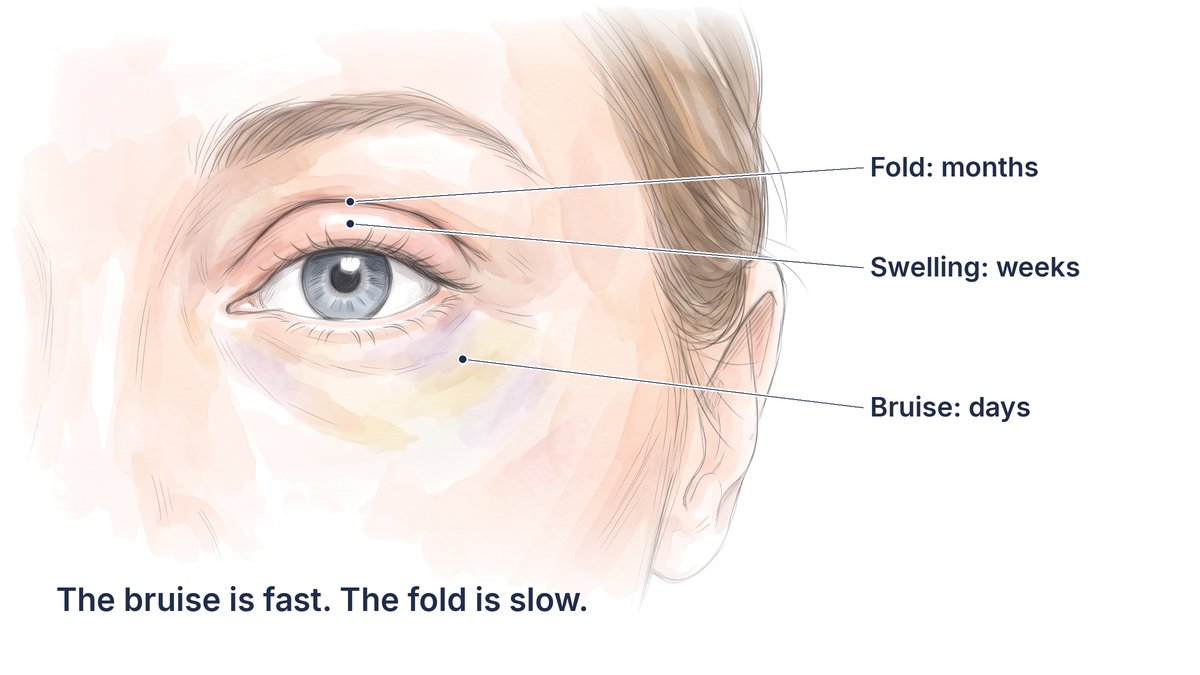
Most people judge their new eyelids at two weeks, when the bruise has gone but the fold is still coming down. Week by week, blepharoplasty recovery, including double eyelid surgery, runs about six months: bruising is the fast part, mostly gone within two weeks, and the fold is the slow part, natural at about three months and final at about six.
Quick answers
- How long is recovery? Most bruising and swelling fade by about 2 weeks; the crease looks natural at about 3 months and is final at 6.
- When do the stitches come out? On day 7 for upper and lower lids in Dr. Yongwoo Lee’s practice, counting the day after surgery as day 1; a buried-suture double eyelid has none to remove.
- When can I wear makeup and contact lenses, and exercise? Makeup, lenses and light exercise at 2 weeks; strenuous exercise and sauna at 4.
- When can I fly home? About day 3 to 5 after a buried suture, day 7 to 8 after incisional upper-lid surgery, day 7 to 10 after lower-lid surgery.
- What is an emergency? Severe pain or pressure behind the eye, a bulging or tight eye, or fading vision, most often in the first 24 hours, and also chest pain or sudden breathlessness: call your local emergency number or go to the nearest emergency department at once, then call the surgeon.
How Long Does Recovery From Blepharoplasty or Double Eyelid Surgery Take?
Plan around four dates, not one: day 7 for stitch removal, about two weeks for most bruising and swelling to fade, about three months for the crease to look natural, and six months before it is final. Judging the fold before the third month means judging swelling.
Each date belongs to a different tissue on its own clock:
- Bruise: days. In a randomized trial of upper blepharoplasty in 30 patients aged 60 and over, the bruised area measured about 0.8 square centimeters on day 3, about 0.4 on day 7 and zero on day 30.
- Swelling: weeks. One university handout says bruising and swelling of the eyelids may last one to two weeks. In 392 women followed after a minimally invasive double eyelid, swelling in the first week was the most common complication and resolved on its own by about one month.
- Fold and lid height: months. A Korean series of 28 women describes a more natural-looking fold from two weeks to one month, a clinical impression rather than a measurement. Dr. Yongwoo Lee is more conservative: natural at about three months, final at six.
- Scar: six months to a year. Eyelid scars may stay slightly pink for six months or more.

Is It Still Swelling, or Was the Fold Set Too High?
In the first month it is usually swelling, and a swollen fold can rarely be told from a fold set too high before about three months. What can be checked early is function: each lid opening, the eyes closing fully, and swelling that falls from week to week; a small difference in lid height after ptosis correction is judged at about three months.
Feeling is a poor guide after the second week. In 39 patients photographed in 3D on days 1, 7, 14 and 28 after upper blepharoplasty, the swelling patients felt tracked the measured volume only in the first week; by days 14 and 28 the two no longer matched, although fold width and measured volume fell significantly across the four checks. In that small retrospective study, how a lid felt said little about how far it had settled.
Symmetry is slower still. After an incisional double eyelid with tightening of the lid-lifting muscle, the eyes can appear deceptively asymmetric for two to three months. What a fold that stays high looks like, and why, is covered in double eyelid revision and the causes of a sausage eye.
Why Does a New Double Eyelid Look Too High, Thick or Uneven at First?
Upper eyelid skin is about half a millimeter thick and lies on loose tissue that holds fluid easily, so a small amount of swelling changes the shape of the whole lid. The strip between the lashes and the new crease swells taller and thicker than it will be, and the fold reads as too high.
In Korean adults, upper eyelid skin averages 0.52 mm, from 0.32 mm near the lash line to 1.13 mm under the brow, and the tarsal plate, the firm plate inside the lid, is about 8.9 mm tall. Behind the skin lie the orbicularis muscle, the orbital septum, a pad of fat and the levator aponeurosis, the tendon that opens the eye. A crease is the line where skin is fastened to that deep layer.
While fluid sits on both sides of that line, the strip under the fold bulges and the skin above cannot yet drape over it. As the fluid clears, the upper skin settles over the line and the visible strip narrows: the fold “comes down.”

Eyelid swelling is usually worse early in the morning and eases once you are upright. Lids also differ in how fast they drain: in a pilot study of nine patients, lids with marked swelling had fewer lymphatic vessels in the removed skin, 8.0 against 12.1 per square millimeter. Nine patients cannot prove a cause, but it may be why some lids stay puffy longer.
How Does Recovery Differ After Double Eyelid, Upper and Lower Eyelid Surgery?
The amount of surgery sets the first two weeks: a buried suture has no skin stitches and the shortest swelling, an incisional fold or upper blepharoplasty has stitches out on day 7, and after lower blepharoplasty the bruise sits where it is hardest to hide. After that, the months of settling are similar for all of them.
Eyelid Surgery Recovery at a Glance
| Operation | What comes out, and when | Visible swelling and bruising | Earliest long-haul flight | When it is judged |
|---|---|---|---|---|
| Buried-suture (non-incisional) double eyelid | Nothing; wound check at day 2 to 3 | Most settles in 1 to 2 weeks | Day 3 to 5 | Natural at about 3 months, final at 6 |
| Incisional double eyelid or upper blepharoplasty | Skin stitches on day 7 | Largely fades over about 2 weeks | Day 7 to 8 | Natural at about 3 months, final at 6 |
| Incisional double eyelid with mild ptosis correction | Skin stitches on day 7 | Same, with lid height still settling | Day 7 to 8 | Lid height at about 3 months, crease at 6 |
| Lower blepharoplasty from inside the lid (transconjunctival) | No skin stitches unless a small skin pinch is added (then out on day 7); wound check by day 7 | Bruise fades over 1 to 2 weeks | Day 7 to 10 | Contour at 2 to 3 months |
| Lower blepharoplasty through the skin (subciliary) | Skin stitches on day 7 | Bruise fades over 1 to 2 weeks; chemosis possible | Day 7 to 10 | Contour at 2 to 3 months |
Whether an under-eye needs surgery at all, or filler or a skin booster instead, is covered in under-eye polynucleotides vs tear-trough filler vs lower blepharoplasty. Upper and lower lids are often done on the same day and then recover on the slower clock. A Western upper blepharoplasty that keeps an existing crease follows the incisional row of the table; how that operation differs is explained in blepharoplasty in Korea for Western eyelids.
How Does Dr. Yongwoo Lee Manage Recovery After Eyelid Surgery?
I give tranexamic acid into a vein during the operation, keep the head raised afterward, use an eye ointment, and leave cold compresses to the patient’s choice. Patients who have flown in are admitted for the first night, patients who live in Korea go home the same day, and skin stitches, upper and lower, come out on day 7, counting the day after surgery as day 1.
In the operating room
I give the sedation myself, with local anesthesia and a dedicated nurse on the monitors: midazolam and ketamine for the upper lids, propofol and ketamine for the lower. Upper-lid patients open their eyes on the table partway through, so I can compare the fold and the height of both lids, and that matters for recovery too: unevenness seen on the table is adjusted on the table, which helps keep early asymmetry down.
Bleeding control starts two weeks ahead. Self-prescribed aspirin, anti-inflammatory painkillers, fish oil, vitamin E and supplements stop then and restart only when I restart them, alcohol stays out for two weeks on each side of the operation, and tranexamic acid, a drug that helps a clot hold, is given into a vein during it. Semaglutide or tirzepatide injections, for weight or for diabetes, stop one month before, because they slow the stomach under sedation, and restart one to two weeks after, both arranged with the doctor who prescribed them. Aspirin or a blood thinner prescribed for the heart, a stent or a stroke, and any other prescribed diabetes medicine, is never stopped without the doctor who prescribed it; dates for everything else are in what to stop before plastic surgery.
Nicotine in any form, including cigarettes, vapes, patches and gum, stops four weeks before eyelid surgery and stays out for four weeks after, because it narrows the small vessels a healing wound depends on; a patient who cannot stop has the surgery postponed.
The first night
Patients who have flown in spend that night in the clinic and can then stay in the clinic building’s accommodation, with nurses on call. Patients who live in Korea go home driven by someone else, with an adult staying with them that night, because sedation dulls judgment and reactions for the rest of the day. The first night covers the hours when bleeding behind the eye is most likely: in one large survey, every case of vision loss after blepharoplasty occurred within the first 24 hours. A later bleed is still possible, so the warning signs below apply through the first week, wherever you sleep. The head stays raised, and bending and straining are avoided. Cold compresses are optional: in a randomized trial they made no measurable difference to swelling or bruising.
Days 1 to 7
I change the dressing almost daily at first; after day 3, if healing is stable, the visits become brief checks. On day 7 the skin stitches come out. A buried-suture fold has none, and for a traveler a wound check at two to three days is usually enough.
After the stitches
Face washing starts the day after stitch removal, and makeup and contact lenses wait until two weeks. While a lid does not yet close completely, which is common in the first weeks after ptosis correction, drops by day and ointment at night protect the surface of the eye.
The lower lid
The skin decides the route, and the route decides what you see in the mirror. A lid with little excess skin is operated from the inside (transconjunctival) and has no skin stitches unless a narrow pinch of skin under the lashes is added; a lax lid gets an incision just under the lashes (subciliary) with skin removal, an orbicularis suspension and, in most middle-aged patients, a canthopexy, a supporting stitch at the outer corner. When I work from the inside, I close the conjunctiva, the lining of the lid, with three absorbable Vicryl Rapide 6-0 stitches and bury the knots, so nothing there needs removing. Any skin stitches come out on day 7.
A skin incision has a trade-off I explain beforehand. In 1,047 patients, persistent chemosis, a jelly-like swelling of the white of the eye, was more frequent after skin-incision surgery with a lateral canthoplasty, in which the outer-corner tendon is cut and reset, than after the transconjunctival route with a canthopexy; the authors link it to surgery at the outer corner. A canthopexy is a lighter stitch than a canthoplasty, but chemosis remains possible after any skin-incision lower blepharoplasty, as the blepharoplasty complications guide details. I accept that trade in a lax lid, because the swelling usually passes and a lid that has pulled down is much harder to correct.
What Happens in the First Week After Eyelid Surgery?
In the first days the lids are swollen, tight and bruising and vision is smeared by ointment; then the swelling turns, the bruise changes color, and the week ends with stitch removal. Discomfort is expected; severe or rapidly rising pain is not, and it never waits until morning.
Blur is normal at first: ointment used during surgery may make vision blurry, usually for less than 24 hours. One handout asks for the head raised 45 degrees for several days. Eyes often feel gritty or sticky this week, lids are puffiest on waking, and glasses replace contact lenses.
Published outlines give suture removal at 5 to 7 days and a review of the preliminary result at around two weeks, with no lifting, bending, straining or exercise for the first 10 days; Dr. Yongwoo Lee removes the stitches on day 7. Many patients return to desk work once the stitches are out; one handout allows 10 to 14 days before returning to work.
What Changes Between Week 2 and Week 4 After Blepharoplasty?
By two weeks most bruising and visible swelling have faded and ordinary life returns: makeup, contact lenses and light exercise at two weeks under Dr. Yongwoo Lee’s rules, sauna and strenuous exercise at four. The fold is not ready: expect it to look higher and thicker than planned through this whole period.
Scars follow a similar curve. In the randomized trial of patients aged 60 and over, the scar’s overall appearance was rated short of optimal in 17 to 20 percent of lids at one month, 3 to 7 percent at three months and none at six. That score describes the incision line in older upper-blepharoplasty patients, not how a new fold sits.
Months 2 to 6: When Does the Crease Look Natural, and When Is It Final?
The crease looks natural at about three months and is final at about six; lid height after ptosis correction is judged at about three months, and asymmetry or a revision only after six. Scars finish last and can stay slightly pink for six months or more.
After full-incision surgery, dry-eye symptoms tend to disappear by three months. In the trial of patients aged 60 and over, scar pigmentation and redness scores were close to zero by three to six months and at zero by twelve. Until then, the American Society of Plastic Surgeons advises diligent sun protection and darkly tinted sunglasses.
Revision follows the same clock: in the 392-patient series, asymmetry was corrected only after six months. An upper lid that looks hollow once the swelling has gone is a separate question, covered in sunken upper eyelids after blepharoplasty.
Which Activities Come Back in Which Week After Eyelid Surgery?
Face washing starts the day after stitch removal, makeup, contact lenses and light exercise at two weeks, and sauna and strenuous exercise at four weeks. Flights depend on the operation, from about day 3 to 5 after a buried suture to day 7 to 10 after lower blepharoplasty.
| Activity | Dr. Yongwoo Lee’s rule | Published guidance |
|---|---|---|
| Face washing | From the day after stitch removal | Full shower at about day 5 |
| Eye makeup | 2 weeks | 2 weeks off the surgical sites |
| Contact lenses | 2 weeks | At least 2 weeks |
| Light exercise | 2 weeks | No exercise for 10 days |
| Strenuous exercise, sauna | 4 weeks | Strenuous activity at 2 to 3 weeks |
| Long-haul flight | Day 3 to 5, 7 to 8 or 7 to 10 by operation | 7 to 10 days after facial procedures |
Hospital handouts give a full shower at about day 5, contact lenses after at least two weeks and driving at about 5 to 10 days and no strenuous activity for two to three weeks. For travel, the American Society of Plastic Surgeons suggests waiting seven to ten days before flying after cosmetic procedures of the face, including eyelid surgery. The conditions for clearance are set out in how long to stay in Korea after plastic surgery.
Do Ice, Tranexamic Acid or Arnica Speed Up Eyelid Recovery?
Tranexamic acid has the strongest trial evidence: less bruising in the first week and a slightly faster return to daily life. In a randomized trial of ice in 38 patients, cooling made no measurable difference to swelling or bruising. Nothing shortens the months the fold takes to settle.
Tranexamic acid. A pooled analysis of five randomized trials, 594 patients and 1,154 eyes, found less bruising on day 1 and day 7 and a patient-reported recovery about 0.7 days shorter; its authors still call for more work on dosing and clot safety. In a three-arm trial of 106 patients, day-7 bruise scores were 0.51 with the drug given into a vein, 0.66 with a local injection and 0.98 without it, and daily activities resumed at 1.6, 1.6 and 2.3 days. Dr. Yongwoo Lee gives it into a vein only. A larger trial of 325 patients was more modest: a bruise score of 4.1 against 5.8 out of 10 on day 8, and only a non-significant trend on other days.
Ice. In a randomized trial, 38 patients each had one eyelid cooled and the other left alone: swelling, redness and bruising did not differ at one hour, one day, one week or two months, and pain was lower on the cooled side only on day 1, by an amount the authors called clinically irrelevant. Eleven patients preferred cooling, 15 preferred none and 12 had no preference, so it is a matter of comfort.
Arnica, bromelain and the rest. Dr. Yongwoo Lee treats these as comfort measures; their trials are reviewed in what actually reduces swelling after plastic surgery.
Which Eyelid Recovery Are You?
Everyone passes the same dates; the operation and the travel schedule change how they feel. These profiles are illustrative, not real patients.
A 24-year-old with a buried-suture double eyelid, flying home on day 4. No stitches to remove and a wound check at two to three days. Glasses go in the bag, because contact lenses wait two weeks.
A 33-year-old having an incisional double eyelid with mild ptosis correction. Stitches out on day 7, a flight on day 7 or 8, drops and night ointment until the lids close fully, and eyes that may look uneven for two to three months.
A 49-year-old having lower blepharoplasty through the skin with a canthopexy. Stitches out on day 7, a bruise for one to two weeks, possible chemosis for some weeks, and a contour judged at two to three months.
A patient planning eyelids and a facelift on one trip. Dr. Yongwoo Lee stages them on consecutive days, eyes first, and recovery then follows the facelift’s longer clock. On the second day, under general anesthesia, the day-old eyelids are protected with eye ointment and a waterproof transparent film dressing, and blood pressure and vomiting are actively controlled. Both operations carry the same nicotine rule: none in any form for four weeks before and four weeks after.
Someone with a wedding or a photo shoot ahead. Count back at least three months from the date, and six if the crease will be seen in close-up.
Surgeon’s Insight: At Two Weeks I Am Not Looking at the Fold
At around two weeks most patients hold up a mirror and ask about the line. I am looking at other things: whether each lid opens, whether the eyes close, whether the swelling is less than it was last week. Those can be judged early, and those are what would make me act. A small difference in lid height after a ptosis correction I still judge at about three months.
The line itself I leave alone. I tell patients it will look natural at about three months and be final at six, and I do not discuss revising a fold before then, because a fold corrected while it is still swollen is corrected against the swelling and not against the eyelid.
Is My Swelling, Pain or Blurred Vision Normal After Eyelid Surgery?
Swelling on both sides, a bruise that changes color, gritty or watering eyes, blur that clears with blinking and a fold that looks too high are all expected. Severe or rapidly rising pain or pressure behind the eye, an eye that bulges or feels hard, fading or double vision, and chest pain or sudden breathlessness are emergencies: call your local emergency number or go to the nearest emergency department at once, then call the surgeon.

| Sign | Expected | Call the surgeon today | Emergency now |
|---|---|---|---|
| Swelling | Both lids, worse in the morning, less each week | Rising after the first days, with redness | One eye suddenly tense, bulging or too tight to open |
| Pain | Tightness and stinging that ease daily | Wound pain that increases after the first days | Severe or rapidly rising pain or pressure behind the eye |
| Vision | Ointment blur that clears with blinking | Blur that does not clear | Fading or double vision |
| Wound | A dry line, slightly pink | Continuous drainage, a gap in the line, fever of 38°C (100.4°F) or higher | |
| Chest and legs | Nothing new | Pain or swelling in one calf | Chest pain or sudden breathlessness, especially after a flight |
Bleeding behind the eye is rare and fast: in a survey of oculoplastic surgeons covering 269,433 blepharoplasties, it occurred in 0.055 percent, about 1 in 2,000, with permanent vision loss in 0.0045 percent, about 1 in 22,000; most bleeds came within 24 hours, especially the first three hours, though some came several days later. Surveys rely on memory, so read this as an order of magnitude; a second large survey and what such a bleed feels like are in blepharoplasty complications. A Korean case report of vision lost in one eye after lower blepharoplasty in a 63-year-old with high blood pressure who was taking aspirin makes the practical point: severe pain after eyelid surgery is never treated with painkillers alone. If you take blood pressure medicine, tell the clinic and do not skip it around surgery unless your doctors tell you to: in the survey of 269,433 operations, high blood pressure, aspirin around surgery, vomiting afterward and physical exertion were linked to bleeding. Tell the nurse or the clinic at once if you feel sick or start to vomit.
Chemosis belongs mainly to the lower lid and is slow but temporary: in 312 skin-incision lower blepharoplasties it occurred in 11.5 percent, lasted a median of four weeks and resolved in every patient. Dry eye, incomplete closure and a lower lid that pulls down have their own section in the same complications guide.
What Should I Ask My Surgeon About Eyelid Recovery?
Ask not “when will the swelling be gone?” but “on what date can this fold be judged, and who examines me before then?” Swelling ends on its own schedule; a date for judging the result, and named visits before it, are what a surgeon can commit to.
A fold that still troubles you after six months is the one to discuss again.
Individual results vary; consultation required.
Written by Dr. Yongwoo Lee, board-certified Korean plastic surgery specialist in facial anatomy and aesthetic procedures at VIP Plastic Surgery, South Korea.
Frequently Asked Questions About Blepharoplasty and Double Eyelid Recovery
How long does swelling last after upper blepharoplasty?
Most visible swelling and bruising fade over about two weeks. Subtle swelling lasts longer: in a 39-patient study, fold width and measured volume fell across checks up to day 28.
How long do bruises last after eyelid surgery?
Most bruising fades over about two weeks. In a randomized trial of upper blepharoplasty in patients aged 60 and over, the bruised area measured about 0.8 square centimeters on day 3, about 0.4 on day 7 and zero on day 30. After lower blepharoplasty the bruise sits where it is hardest to hide and fades over one to two weeks.
Can I drive after blepharoplasty?
Never on the day of surgery: after sedation, someone else drives you home. One hospital handout allows driving at about 5 to 10 days. Ointment used during surgery can blur vision, usually for less than 24 hours, so wait until your vision is clear and ask at your dressing visit.
How long can my eyes look uneven after ptosis correction?
For two to three months. After an incisional double eyelid with tightening of the lid-lifting muscle, the eyes can appear deceptively asymmetric for that long, so Dr. Yongwoo Lee judges lid height at about three months and the crease at six. A sudden, tense, painful swelling of one eye is different: it is an emergency, so call your local emergency number at once, then the surgeon.
How many follow-up visits are needed after blepharoplasty?
In Dr. Yongwoo Lee’s practice, dressings are changed almost daily at first, visits become brief checks after day 3 if healing is stable, and stitches come out on day 7; after a buried-suture double eyelid, a wound check at two to three days is usually enough for a traveler.
When are the stitches removed after eyelid surgery?
Dr. Yongwoo Lee removes skin stitches, upper and lower lids alike, on day 7, counting the day after surgery as day 1; published guidance gives five to seven days. A buried-suture double eyelid has none to remove, and an incision made inside the lower lid leaves no skin stitches unless a small skin pinch is added; its three stitches inside the lid are absorbable.
When can I wear contact lenses and eye makeup after blepharoplasty?
Both at two weeks, in line with hospital handouts. Bring glasses for the trip.
When can I exercise after blepharoplasty?
Light exercise at two weeks, and strenuous exercise and sauna at four weeks, under Dr. Yongwoo Lee’s rules. Published advice is shorter, from 10 days to three weeks.
When is it safe to fly after blepharoplasty?
About day 3 to 5 after a buried-suture double eyelid, day 7 to 8 after an incisional double eyelid or upper blepharoplasty, once the stitches are out, and day 7 to 10 after lower blepharoplasty.
Why are my eyelids more swollen in the morning?
Eyelid swelling is usually worse early in the morning and eases once you are upright, which is why the head stays raised for the first days. Lids also drain at different speeds: in a nine-patient pilot study, lids with marked swelling had fewer lymphatic vessels in the removed skin, which may be why some stay puffy longer.
How long does the eyelid scar stay red?
It can stay slightly pink for six months or more. In a trial of patients aged 60 and over, scar scores were near zero by three to six months and at zero by one year. Sun protection matters until then.
When can I wash my face after eyelid surgery?
In Dr. Yongwoo Lee’s practice, face washing starts the day after the stitches come out. One hospital handout allows a full shower at about day 5, so ask at your dressing visit before washing your hair.
This article is for informational purposes only and does not constitute medical advice. Always consult with a qualified medical professional before making any decisions about surgical or non-surgical procedures.
