
If you had blepharoplasty (eyelid surgery) and now have severe or worsening pain, an eye that bulges or feels tight and hard, swelling that keeps growing, new double vision, trouble opening the eye, or any loss of vision, stop reading. This happens most often in the first 24 hours, but it can come later. Call your local emergency number now (911 in the US, 999 in the UK, 112 in the EU, 119 in Korea) or have someone take you straight to the nearest emergency department, and call your surgeon on the way. Do not wait to see whether it settles, and do not drive yourself.
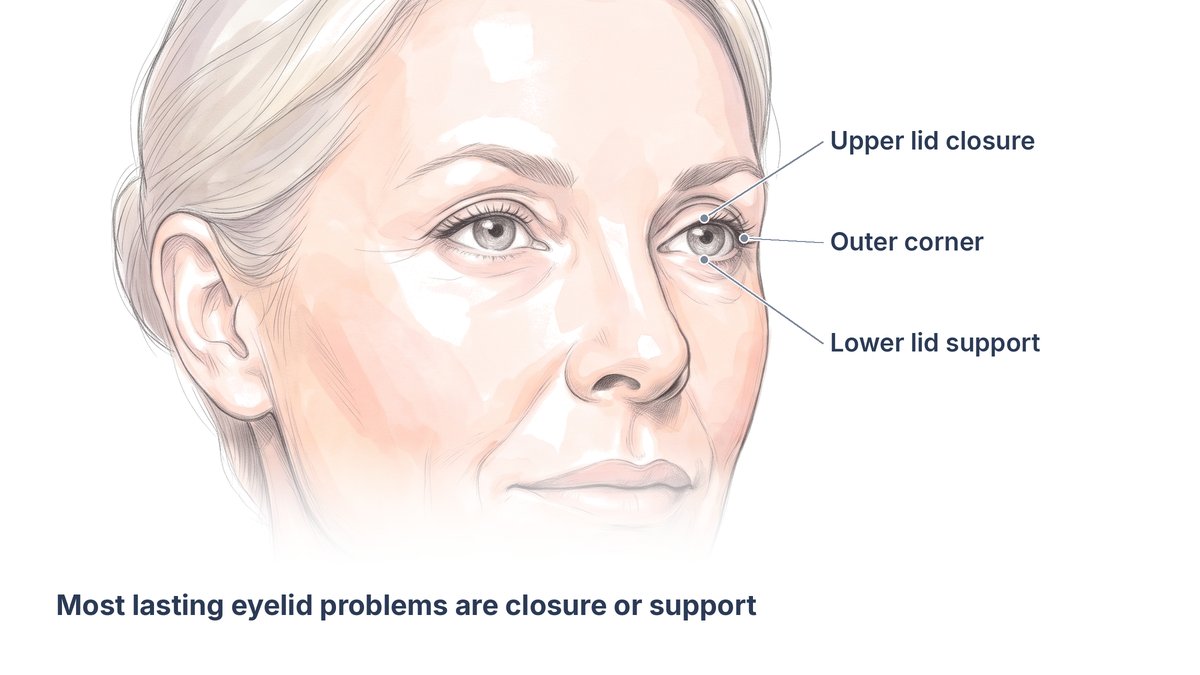
Blepharoplasty complications are the problems that can follow upper or lower eyelid surgery, from dry, gritty eyes and a temporary gap on closing to a lower lid that pulls down, an uneven upper lid and, rarely, bleeding behind the eye that threatens sight. Most lasting ones are failures of closure or support: take too much skin or muscle from the upper lid and it cannot close; weaken the lower lid without rebuilding its support and it pulls down.
Quick answers
- What is most common? Dry, gritty or watery eyes and swelling, mostly for weeks.
- How long does dry eye last? Usually weeks; 1 in 50 still had symptoms at 2 months in one series.
- I can’t close my eyes fully. Is that normal? A small early gap is common; in one trial every gap closed within 2 to 6 weeks.
- Will a pulled-down lower lid go away? Early pull often settles; a lid still low at about 3 months is assessed.
- Can blepharoplasty cause blindness? Very rarely, about 1 in 22,000 to 1 in 30,000, most often from bleeding behind the eye in the first 24 hours.
- What is the jelly swelling on the white of my eye? Chemosis; median 4 weeks in one series.
- When should I worry? Severe pain, a bulging or tight eye or any vision loss means emergency care now; spreading redness, pus or fever means calling your surgeon today.
What Are the Most Common Complications of Blepharoplasty?
Most blepharoplasty complications are temporary: dry or gritty eyes, watering, chemosis (jelly-like swelling of the white of the eye), uneven swelling and a small gap on closing, for a few weeks. Lasting problems, such as a lower lid that pulls down, a droop, a hollow look or crease and scar problems, are uncommon, and the one true emergency, bleeding behind the eye, is rare.
Key numbers
- Dry-eye symptoms: 26.5 percent of 892 operations; 2 percent still had them after 2 months in another series
- Chemosis: 11.5 percent of 312 skin-incision lower blepharoplasties, median 4 weeks
- Lower lid needing an operation: 3.5 percent of 264 patients after skin-incision lower blepharoplasty with routine canthal support
- Bleeding behind the eye: about 1 in 2,000 operations; most often within 3 hours, almost always within 24
In a 10-year series of 892 blepharoplasties, 26.5 percent of patients reported dry-eye symptoms and 26.3 percent had chemosis, both more often when upper and lower lids were done together. Most of it is short-lived: in a 202-patient series after eyelid and other periorbital surgery, 10.9 percent still had dry-eye symptoms after two weeks and 2 percent after two months.
The American Society of Plastic Surgeons lists dry eyes, difficulty closing the eyes, ectropion, infection, scarring and, very rarely, blindness among the risks.
Blepharoplasty Complications at a Glance
| Complication | How common | Normal | Warning sign | Usual fix |
|---|---|---|---|---|
| Dry, gritty or watery eyes | 26.5 percent; 2 percent past 2 months | Weeks, eased by drops | Pain, light sensitivity, lasting blur | Drops, night ointment; fix the lid if needed |
| Gap on closing (lagophthalmos) | 5 of 22 in one trial; all closed in 2 to 6 weeks | Small gap, shrinking | Unchanged after about 6 weeks, red painful eye | Protection; skin graft if skin is short |
| Chemosis | 11.5 percent; median 4 weeks | Soft swelling, settling | Lids cannot close over it, pain, discharge | Lubrication and protection |
| Lower lid pulled down | 3 to 3.5 percent in skin-incision series | Mild early pull, improving | Still low at about 3 months, exposed eye | Massage, then repair matched to the cause |
| Upper lid droop or uneven lids | Common the day after | Improves as swelling settles | Droop at about 3 months; crease problem at about 6 months | Ptosis repair or crease revision |
| Infection | 0 to 1.6 percent (lower-lid series) | Mild pinkness at stitches | Spreading redness, pus, fever | Antibiotics and review |
| Bleeding behind the eye | About 1 in 2,000 | Never normal | Severe pain, bulging tight eye, vision loss | Emergency pressure release |
What Is Normal After Blepharoplasty, and When Should You Call?
Swelling, bruising, gritty or watery eyes, blur from ointment, slight unevenness and a small gap on closing are expected in the first weeks. Call your surgeon the same day for spreading redness, pus, fever or a painful red eye, and call your local emergency number or go to an emergency department now for severe pain, a bulging or tight eye, or any loss of vision.
Expected: swelling and bruising that fade week by week; gritty or watering eyes; blur that clears on blinking; a shrinking gap on closing; mild chemosis.
Call your surgeon today: spreading redness, warmth, pain that rises after the first days, pus or fever; a red, light-sensitive eye or blur that does not clear; chemosis bulging between the lids; a gap or lower-lid pull that is getting worse.
Call your local emergency number or go to an emergency department now: severe or rising pain or pressure behind the eye; an eye that bulges or feels hard; lids too tight to open; new double vision or fading sight; vomiting with eye pain.
Mayo Clinic advises getting care right away for severe new eye pain, bleeding or vision problems; travelers can plan around how long to stay in Korea after eyelid surgery.

Is Vision Loss After Blepharoplasty an Emergency?
Yes. Vision loss after eyelid surgery is most often caused by bleeding behind the eye, a retrobulbar or orbital hematoma, that raises pressure inside the eye socket and squeezes the optic nerve. It needs a surgeon or an emergency doctor within minutes to a couple of hours, because that pressure can be released at the bedside.
How rare is it, and when does it happen?
In a survey covering 269,433 blepharoplasties, about 1 in 2,000 had bleeding behind the eye and about 1 in 22,000 lost vision permanently; most bleeds began within 3 hours, and the risk fell sharply after 24. A second survey of about 750,000 operations found permanent vision loss in about 1 in 30,000, every case within 24 hours, peaking in the first hour and again at 6 to 12 hours. Both rely on recall, so read them as orders of magnitude.
What does it feel like, and what should you do?
An eye-specialist reference lists severe pain, double vision, difficulty opening the eyelids, an eye pushed forward and loss of vision, sometimes with nausea or vomiting.
Call your local emergency number or go to the nearest emergency department at once, by ambulance or with someone else driving, and call your surgeon on the way; do not treat the eye yourself. A doctor can release the pressure at the bedside, and the same reference notes that intervention within 2 hours of onset has been shown to be needed to avoid permanent damage, a figure for orbital bleeding in general. In my clinic, if a patient shows these signs, we stop, assess and act immediately, with transfer to the emergency department of our partner hospital when needed.
Say this on the phone and at the emergency desk:
“I had eyelid surgery at [time] on [day]. My [left/right] eye now has [severe pain / a bulging, tight eye / vision getting worse]. I’m worried there is bleeding behind the eye.”
What raises the risk?
Bleeding was associated with high blood pressure, aspirin around surgery, vomiting afterward and increased physical activity. So blood thinners are stopped only as agreed with the prescribing doctor, blood pressure is treated, and the first night is spent resting close to the surgeon. Filler blocking an artery during an injection is a different event; see vision loss from filler, a different emergency.

Why Do Eyes Feel Dry After Blepharoplasty, and How Long Does It Last?
Swelling, a temporary gap on closing and a weaker blink thin the tear film, so most dry eye after blepharoplasty settles within weeks and only a small minority still have symptoms after two months. Risk is higher when upper and lower lids are done together, when the lower lid is opened as a skin-muscle flap, when the lids do not close fully afterward, and when the eye was already dry.
Upper-lid surgery can even relieve a dry eye: a 2025 meta-analysis of 12 randomized trials and 450 patients found dry-eye symptoms less likely after upper blepharoplasty than before it (odds ratio 0.22), possibly because heavy skin no longer rests on the lashes. An odds ratio below 1 means less likely, and above 1 more likely. Yet in a study of 22 eyes, tear break-up time, the seconds the tear film stays intact after a blink, fell from 7.50 to 5.50 by 6 months. The evidence is mixed, and an already-dry eye is treated before surgery.
Can dry eye after blepharoplasty be permanent?
Rarely. The ISAPS consent form says changes in tear production may be “transitory or permanent” and are “not always predictable”. Lasting cases are often tied to something treatable: in the 202-patient series, 15 of the 22 patients with dry eye beyond two weeks had persistent chemosis, and one patient in the series needed surgery for a retracted lower lid. Drops by day and ointment at night relieve symptoms; when a lid does not close or sits low, the lasting fix is the lid.
Why Can’t I Close My Eyes After Upper Blepharoplasty?
A small gap when the eyes are closed, called lagophthalmos, is common in the first weeks because the lid is swollen and its closing muscle, the orbicularis oculi, is stunned, and it usually closes within weeks. It lasts when too much skin or orbicularis was removed, so conservative handling of both is the main prevention.
In a trial of 22 patients, each had skin and muscle removed from one upper lid and skin only from the other. Five developed a gap under 3 mm, all on the skin-muscle side, and every gap closed within 2 to 6 weeks. A 2025 meta-analysis agreed: removing orbicularis with the skin raised the odds of lagophthalmos about eightfold (odds ratio 7.98, 95 percent confidence interval 1.41 to 45.21) without a significant difference in dry eye. A confidence interval is the range the true value probably lies in; this one is wide, but it stays above 1.

A gap unchanged after about 6 weeks, or with a red, painful eye, needs to be seen. Treatment starts with drops, night ointment and massage as your surgeon shows you; a review advises delaying minor touch-ups for 3 months or more, and when skin is truly short, the scar is released and skin is grafted.
Why Does the Lower Eyelid Pull Down After Blepharoplasty?
A lower lid pulls down, showing white below the iris, turning outward or rounding at the outer corner, when its support fails: the front layer of skin and muscle is short or weak, the lid is loose, internal scar tethers it, or the cheek behind it lacks volume. The commonest findings in lids that have pulled down after skin-incision surgery are a weak orbicularis and a shortage of skin, so prevention protects both.
Scleral show, retraction, ectropion and round eye
Scleral show is white visible below the iris; in retraction the lid sits too low but against the eye. A series of 280 lower blepharoplasties defined ectropion as eversion of the tarsus, usually with more than 3 mm of scleral show, and round eye as white below the cornea with rounding of the outer corner.
Why does it happen?
A lower eyelid has a front layer of skin and orbicularis, a middle layer (the orbital septum) and a back layer of tarsus and conjunctiva. In 81 retracted lids after skin-incision blepharoplasty, the commonest findings were a weak orbicularis (86 percent) and a shortage of skin (79 percent), followed by missing volume, a prominent eye over a flat cheek, a loose lid and internal scar, and lids with more of these pulled down further. The diagram gives each percentage.

Does the incision route matter?
A transconjunctival operation goes in through the inside of the lid; a subciliary, or skin-incision, approach opens the front layer just below the lashes. A canthopexy is a stitch that anchors the outer corner of the lower lid to the lining of the bone just inside the outer orbital rim, supporting the lid without cutting its tendon; a canthoplasty cuts and shortens it.
In 200 patients having upper or lower blepharoplasty through the skin, malposition occurred in 3 percent, all in lids without lateral canthal anchoring, and in 264 patients with routine canthal support, 3.5 percent needed an operation for malposition. Neither is a controlled comparison, so they suggest, without proving, that canthal support lowers the risk in lax lids. I describe the snap-back and distraction tests and the thresholds I work to in a separate article.
Will it go away?
Often, if the pull is early and mild. Upward massage, as your surgeon shows you, and waiting at least 3 months before touch-up surgery are the usual advice. A lid still low at about 3 months, or an exposed, painful eye sooner, is assessed for repair.
Canthal support has a trade-off
Corner procedures add swelling of their own: a canthopexy was linked to more chemosis in the 892-case series, and in the 200-patient series chemosis affected 8 of the 13 patients (61.5 percent) who had a canthoplasty, against 6 percent overall. The numbers are small, but canthal support is matched to the lid for this reason.
What Is Chemosis After Blepharoplasty, and How Long Does It Last?
Chemosis is jelly-like swelling of the conjunctiva, the clear skin over the white of the eye, which can bulge between the lids. It usually appears in the first week, lasted a median of four weeks in one series, and almost always settles with lubrication and protection.
In 312 skin-incision lower blepharoplasties, chemosis occurred in 11.5 percent and lasted a median of 4 weeks, ranging from 1 to 12. It was more likely in men, in loose lids or dry eyes, and after a canthopexy or combined surgery. In a larger series, chemosis lasting 3 weeks or more occurred in 4.1 percent of 1,047 lower blepharoplasties. Call your surgeon if the lids cannot close over it, the eye hurts or a discharge appears.
Why Does One Eyelid Look Different or Droop After Upper Blepharoplasty?
In the first weeks, uneven swelling is the usual reason one lid looks lower, heavier or differently creased, and most early droop improves within about three months. Asymmetry that remains, a crease set too high, or a true droop from the lid-lifting muscle, the levator, is revised later: after about 3 months for a droop and at least 6 months for a crease.
A droop the day after surgery is common, and persistent ptosis is usually followed for 3 months before repair because most resolves. Some does not: in 24 patients referred with a droop and a hollow upper lid at least 6 months after cosmetic upper blepharoplasty, every eyelid had a levator that had come away from its attachment. A crease set too high was the commonest finding in 126 revised Asian upper eyelids, at 54 percent; see how a crease set too high is lowered in revision.
How Are Blepharoplasty Complications Prevented, and How Does Dr. Yongwoo Lee Operate?
Prevention is mostly restraint and reconstruction: leave enough skin and muscle in the upper lid for it to close, and in the lower lid either stay behind the skin or rebuild the corner and muscle that hold it up. My rules follow: conservative orbicularis handling in upper blepharoplasty, a lower-lid route chosen by the skin, and with a subciliary incision an orbicularis suspension and, in middle-aged patients, usually a canthopexy.
Before surgery
I ask about dry eye, contact lenses and eye disease, and an eye that is already dry is treated first. Aspirin and other blood thinners are stopped only with the prescribing doctor’s agreement, and blood pressure is controlled.
Upper eyelid
I remove less skin rather than more: more can be taken later, none can be put back. In upper blepharoplasty I rarely remove a strip of orbicularis, and in very thick tissue only a very thin one. Where the inner fat pad bulges, as it often does in middle age, I take only the excess, since an over-emptied inner lid looks hollow years later. When a mild ptosis is present I correct it in the same operation, with the patient woken to check the height of both lids, as described in how upper blepharoplasty and mild ptosis repair are combined; I do not treat severe ptosis.
Lower eyelid
I choose the route by the skin. With little excess skin, I go through the conjunctiva and work in front of the orbital septum (a preseptal approach), without cutting the front-layer muscle, removing only a small pinch of skin under the lashes if needed, and close the inside of the lid with about three buried 7-0 Vicryl Rapide stitches that dissolve. With this route, even when I take a skin pinch, I do not add a canthopexy.
When the skin is also loose, I use a subciliary incision just below the lashes and always add an orbicularis suspension. The laxity tests guide the canthopexy, but in middle-aged patients I usually add it and recommend it, to keep the lid from pulling down.
In both routes the fat is repositioned over the rim, above the bone and beneath the muscle, and fixed with absorbable 5-0 PDS stitches rather than cut out. In some lids I also lift the upper-cheek fat beneath the orbicularis (a SOOF lift), fixed at three points. I refer a complex scarred, retracted lid for co-management with an oculoplastic surgeon, an eye surgeon who specializes in the eyelids and eye socket.

Emergency readiness and the first night
I give the sedation and local anesthesia myself. For the upper lids it is midazolam and ketamine, light enough to wake the patient, as explained in why I wake patients partway through eyelid surgery; for the lower lids it is propofol and ketamine, so the patient stays comfortable and still, which makes the operation safer and more precise. Vital signs are monitored throughout, and as a former emergency-room doctor I can intubate if needed. The clinic keeps resuscitation equipment and works with a nearby general hospital’s emergency department.
For the first night patients stay close to the clinic, sleep with the head raised, use cold compresses only if they wish and avoid straining, and they use drops by day and ointment at night until the lids close fully. Skin stitches come out on day 7; after a transconjunctival operation the stitches inside the lid dissolve on their own.
Who Is at Higher Risk of Blepharoplasty Complications?
Risk is higher in eyes that are already dry, in lower lids that are loose or sit beneath a prominent eye, in people with high blood pressure or on blood thinners, and in eyelids operated on before. Each of these changes the plan rather than ruling surgery out.
Illustrative examples, not real patients.
A 58-year-old woman who already uses drops for dry eye. Her eye surface is treated first, and operating on all four lids at once is weighed against the higher dry-eye and chemosis rates.
A 66-year-old man whose lower lid drifts back slowly when pulled down. If he needs a skin incision, his laxity calls for a canthopexy, and he is told it adds swelling.
A 61-year-old man with high blood pressure who takes aspirin. Both are linked to bleeding behind the eye and are managed before surgery.
A 54-year-old woman whose lower lids were operated on before and now sit low. Her plan is the most conservative, shared with an oculoplastic surgeon if complex.
Can Blepharoplasty Make the Eyes Look Hollow?
Yes, when too much fat is removed from the upper or lower lid; the eye can look sunken years later, and the fix is to add volume back, usually with fat grafting. That is why fat is preserved or repositioned rather than removed.
In a 2025 review of 36 lower-lid studies, hollowness ranged from 0 to 9.8 percent in the studies that reported it, and the case for keeping fat is made in why moving the fat ages better than removing it.
Can Eyelid Surgery Cause Infection, Bad Scars or Double Vision?
All three are uncommon. Infection is reported in 0 to 1.6 percent of lower blepharoplasty series, upper-lid scars usually fade into the crease, and double vision from injury to a small eye muscle is rare and usually recovers.
In the 2025 review, infection ranged from 0 to 1.6 percent. In upper-lid trials, a continuous skin stitch caused more eye irritation than one placed under the skin. Double vision most often involves the inferior oblique, a small eye muscle in the lower lid: in a survey of 371 oculoplastic surgeons, 23.2 percent had seen double vision lasting more than a week after lower-lid surgery at some point in their careers, and 73 percent of those cases resolved.
When and How Are Blepharoplasty Complications Fixed?
Most complications are watched until the swelling has settled, usually about three months, because many resolve and healing tissue does not hold a repair. Bleeding behind the eye and an eye that cannot be protected are treated at once, and other repairs are matched to the cause.
- Loose lower lid: the outer corner is tightened.
- Internal scar: released, with a small graft inside the lid to hold it up (a spacer graft).
- Missing volume: a midface lift or fat grafting; after a midface lift with a spacer graft inside the lid in 74 patients, the lower lid rose by 1.4, 2.4 and 3.2 mm in mild, moderate and severe retraction at a mean follow-up of 102 months.
- Persistent droop or crease problem: ptosis repair after about 3 months; crease revision after at least 6.
- Too little skin or a hollow lid: a skin graft, or fat grafting, though how much grafted fat survives varies.
Surgeon’s Insight: What I Leave Behind Matters More Than What I Take Out
Skin and muscle that are left can still be trimmed later. Skin and muscle that are taken cannot be put back, and in the lower lid the muscle and the corner need support when a skin incision weakens them. That is why, in upper blepharoplasty, I rarely remove a strip of orbicularis, and why, with a subciliary incision, I always suspend the orbicularis and, in middle-aged patients, usually add a canthopexy.
Having worked in the emergency room, I plan the first night before the first incision, including the hospital we would transfer to. That does not make the risk zero. It means that if the first night goes wrong, the plan is already written.
What Should You Ask Your Surgeon Before Blepharoplasty?
Ask how your eyelid will still close, how your lower lid will be supported, and who you call on the first night. A surgeon who answers with how much skin and muscle will be left, which route, whether the corner will be anchored, and a named hospital has planned for complications in advance.
Individual results vary; consultation required.
Written by Dr. Yongwoo Lee, board-certified Korean plastic surgery specialist in facial anatomy and aesthetic procedures at VIP Plastic Surgery, South Korea.
Frequently Asked Questions About Blepharoplasty Complications
What is the most common complication of blepharoplasty?
Dry, gritty or watery eyes and swelling, including chemosis, a jelly-like swelling of the white of the eye. In a 10-year series of 892 operations, 26.5 percent of patients reported dry-eye symptoms and 26.3 percent had chemosis. Most of it settles within weeks.
Can blepharoplasty cause permanent dry eye?
Rarely. In a 202-patient series, 10.9 percent still had symptoms after two weeks and 2 percent after two months. Lasting dry eye is often tied to persistent chemosis, a lid that does not close fully or sits low, or an eye that was dry before surgery.
How long does it take for the eyes to close fully after upper blepharoplasty?
Usually a few weeks. In a 22-patient trial, five patients had a gap under 3 mm, all on the side where muscle was removed, and every gap closed within 2 to 6 weeks. A gap unchanged after about 6 weeks, or a red, painful eye, needs a review.
Will ectropion after lower blepharoplasty go away on its own?
Often, if it is early and mild, because swelling and a stunned muscle drag the lid down at first. Upward massage as your surgeon shows you, and waiting at least 3 months before any touch-up, are the usual advice. An exposed, painful eye is assessed sooner.
Does transconjunctival blepharoplasty avoid lower lid problems?
It lowers the risk of the lid pulling down, because the skin and muscle of the front layer are not cut, but it does not remove every risk: chemosis, a hollow look and, rarely, bleeding behind the eye can still occur. A lid that is very loose on testing changes the plan before surgery.
What is a canthopexy, and does everyone need one?
A stitch anchoring the outer corner of the lower lid to the lining of the bone just inside the orbital rim, without cutting its tendon. It supports a lid weakened by a subciliary incision but adds chemosis. With a subciliary incision, laxity tests guide it, and Dr. Yongwoo Lee usually adds and recommends it in middle-aged patients; he does not use one with the transconjunctival route.
How rare is blindness after blepharoplasty?
Very rare. Two large surveys put permanent vision loss at about 1 in 22,000 and 1 in 30,000 operations, most often from bleeding behind the eye in the first 24 hours. High blood pressure was the most common risk factor.
What does bleeding behind the eye feel like after eyelid surgery?
Severe, climbing pain or pressure, a bulging or hard eye, lids too tight to open, double vision or fading sight. It most often starts in the first hours and almost always within 24, but can come later. Call your local emergency number or go to an emergency department, and call your surgeon on the way.
Can blepharoplasty cause double vision?
Rarely. It most often involves the inferior oblique, a small eye muscle in the lower lid. Of 371 oculoplastic surgeons surveyed, 23.2 percent had seen a case lasting more than a week in their careers, and 73 percent of those cases resolved. New double vision with pain or a bulging eye is an emergency.
Is blurry vision normal after blepharoplasty?
Some blur is expected in the first weeks, mostly from ointment and an unsettled tear film, and it clears when you blink. Blur that does not clear, or a red, light-sensitive eye, needs a same-day call. Fading sight, especially with pain or a tight eye, needs emergency care now.
How long does chemosis last after blepharoplasty?
A median of about 4 weeks, ranging from 1 to 12, in 312 skin-incision lower-lid operations. In another 1,047, it lasted 3 weeks or more in 4.1 percent: 1.9 percent after an inside approach with canthopexy and 6.4 percent after a skin approach with canthoplasty.
Is ptosis after blepharoplasty permanent?
Usually not. A droop the day after surgery is common, from swelling and local anesthetic, and is followed for about 3 months because most resolves. When it remains, the tendon of the lid-lifting muscle may have come away from its attachment, and that can be repaired.
Is it normal for one eye to look different after blepharoplasty?
Yes, in the first weeks, because the two sides rarely swell equally, so one lid can look lower, heavier or differently creased. A droop still present at about 3 months is assessed for repair, and a crease problem is usually given at least 6 months.
How long should I wait before blepharoplasty revision?
Usually about 3 months for a droop or a lower lid, and at least 6 months, often 12, for a crease, because many problems resolve as swelling settles. Bleeding behind the eye, or an exposed eye, is treated at once.
What are the signs of infection after eyelid surgery?
Spreading redness onto the cheek or brow, warmth, pain that rises after the first days, pus or fever, which need a same-day review; mild pinkness at the stitches is normal. Infection is uncommon, reported in 0 to 1.6 percent of lower blepharoplasty series.
Why are my eyes watering after blepharoplasty?
Usually reflex tearing from a dry, irritated eye, or swelling that slows tear drainage, and it settles with the swelling; drops by day and ointment at night help the eye surface meanwhile. Watering with a lower lid pulling down, or with a red, painful eye, should be examined.
This article is for informational purposes only and does not constitute medical advice. Always consult with a qualified medical professional before making any decisions about surgical or non-surgical procedures.
