
Sunken upper eyelids: key facts
- Four main causes: over-removed fat, age-related loss of the central fat pad, a low lid (ptosis), prostaglandin eye drops
- Fat grafting: about 1 to 2 mL per side; about 65 percent of the volume kept at one year in one pilot study of a processed fat (SVF gel)
- Filler: 0.1 to 0.4 mL of hyaluronic acid (HA) per side on the bony rim; dissolvable, off-label, repeated
- Fat repositioning: only in an open operation, and only when fat is left
- Dr. Yongwoo Lee’s main route: microfat by blunt cannula in several layers, no overcorrection, a top-up after 3 to 6 months if needed
Why Do My Upper Eyelids Look Hollow After Blepharoplasty, and Can It Be Fixed?
A sunken upper eyelid after blepharoplasty can usually be improved, but the common mistake is to assume the hollow is simply removed fat that now needs filling. Four things usually produce the same look: fat over-removed at surgery, the central fat pad shrinking with age, a lid that has dropped because its lifting muscle is weak or has slipped (ptosis), and a prostaglandin eye drop used for glaucoma or lash growth. Rarely, the eye itself has sunk back, for example after an old orbital fracture or with a collapsing sinus below the eye, which needs a scan rather than filling. Fat grafting, fat repositioning and filler answer only the first two.
Swelling hides a hollow in the first weeks, and uneven swelling can make one lid look emptier than the other, so a hollow is usually judged about six months after the operation, the point at which I also judge the crease.
Is a Sunken Upper Eyelid Always Missing Fat?
No. A droopy lid (ptosis) and prostaglandin eye drops both hollow the upper eyelid without any fat removed, and neither is fixed by adding volume: lifting the lid, or changing the drop under an eye doctor’s care, comes first.

The lid that is low, not empty
When the levator, the muscle that raises the lid, weakens or its tendon stretches, the lid edge drops and the eyelid fat pad can slide up and back. A University of Iowa teaching video of such a patient notes that the eyelid fat had moved up into the orbit, leaving the levator tendon directly under the orbital septum.
Repairing the muscle can therefore reduce the hollow with no graft at all. In a small series of 32 patients (60 eyes) with sunken eyes and ptosis, the hollow improved in every patient three months after levator resection, and the measured area of the groove above the lid fell significantly.
Two clues are visible in a mirror: the lid edge covers more of the iris than it used to, and the eyebrows sit high because the forehead is helping. The measurement is explained in how to tell whether an eyelid is actually droopy, and a droop that follows surgery in why one eyelid can droop after upper blepharoplasty.
The eye drop that shrinks orbital fat
Prostaglandin drops for glaucoma can hollow the upper lid by shrinking the fat around the eye. In 105 patients who used one such drop in one eye only, with the other eye as the comparison, the groove above the lid deepened in 80 percent of eyes on bimatoprost, 45 percent on travoprost and 15.7 percent on latanoprost. Bimatoprost is also sold for lash growth.
Changes typically begin one to two months after starting the drop, and stopping it usually brings partial to complete reversal, sometimes within four to six weeks. The same reference advises against surgery, filler and micro fat grafting for it, since the signs tend to resolve off the drug.
A hollow in one eye only, or one that appeared after a new drop, is the pattern to mention, along with any old injury to the eye socket, and a glaucoma drop is never stopped or switched without the ophthalmologist who prescribed it.
What Is Under the Upper Eyelid Skin, and Where Does the Hollow Form?
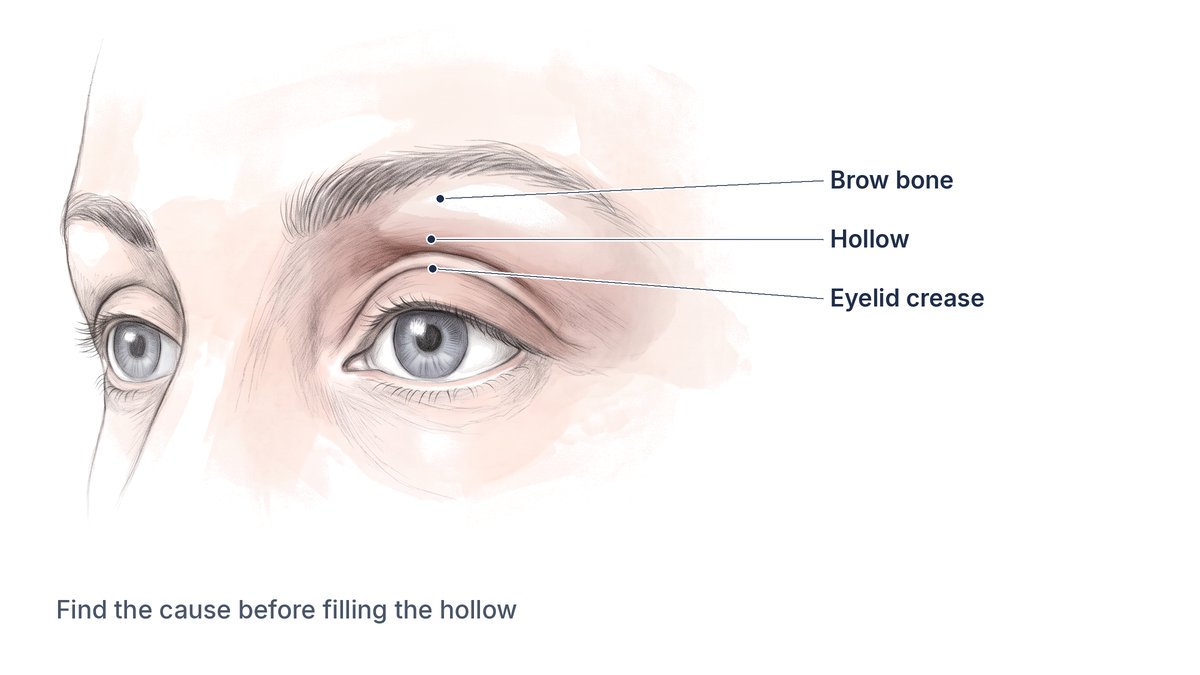
The hollow forms between the brow bone and the eyelid crease, where a pad of fat normally sits behind a thin membrane and in front of the lid-lifting muscle. When that pad is removed, shrinks or slides backward, the skin follows it inward behind the bony rim.

From front to back, the upper lid above the crease is built in layers:
- Skin, thin here
- Orbicularis oculi, the muscle that closes the eye
- Retro-orbicularis oculi fat (ROOF), a pad under that muscle over the brow bone
- Orbital septum, a membrane that holds the orbital fat in
- Preaponeurotic fat, the eyelid fat pad: a central pad and a smaller inner (nasal) pad
- Levator aponeurosis, the lifting muscle’s tendon, with Müller’s muscle behind it
- Conjunctiva, the moist lining against the eye
Below the crease, the levator tendon attaches to the tarsal plate, the firm plate in the lid edge.
Two details explain how eyelid surgery can empty this space. First, in East Asian upper lids the septum joins the levator tendon low down: in a study of cadaver lids, confirmed in lids seen during surgery, the junction lay 3.7 mm above the upper edge of the tarsal plate at the center, and less toward the sides, and the lower edge of the fat sat around the tarsal border. Fat therefore hangs down into the zone where a crease is made, and some is often trimmed so the fold can form. Take too much and the fullness above the crease goes with it.
Second, the fat changes with age whether or not anyone operates. A paper on preserving upper-lid fat cites work showing that the central pad loses volume progressively from about age 43 while the inner pad stays the same. An operation that looked right at 35 can look hollow at 50, with the inner corner still full.
Fat Grafting, Fat Repositioning or Filler: Which Fixes a Sunken Upper Eyelid?
Each fixes a different lid. Fat grafting adds your own fat through a cannula and supplies the most volume; fat repositioning moves fat you still have and is possible only inside an open operation; HA filler adds a small, dissolvable amount on the bony rim and has to be repeated. Every figure below comes from small series.
At a Glance: sunken upper eyelid options compared
| Option | Amount per side in studies | What the studies measured | Reversible | Main cautions |
|---|---|---|---|---|
| Fat grafting | About 1 to 2 mL | 65.3 percent of volume kept at 1 year with SVF gel (31 patients); repeat procedure in 12.9 percent | No | Lumps, long swelling; a fat embolus cannot be dissolved |
| Fat repositioning | Your own orbital fat | With a graft, 70 of 79 full at 1 year; second operation in 4 of 50 in another series | No | Needs fat left; harder in a scarred lid |
| HA filler | 0.1 to 0.4 mL | Touch-up in 15 percent at 2 to 3 months (40 patients) | Yes, with hyaluronidase | Off-label; bluish tint, swelling 6 to 24 months later; rare vessel blockage |
| Ptosis repair | Nothing added | Hollow improved in all 32 patients at 3 months | By revision | Over- or undercorrection; temporary incomplete closure |
| Changing a prostaglandin drop | Nothing added | Partial to complete reversal after stopping, as early as 4 to 6 weeks | Yes | Only with the ophthalmologist |

Fat grafting
In the largest series, 168 patients grafted with no eyelid incision, the mean volume was 1.8 mL in the right lid and 1.7 mL in the left, placed in three to four layers. Survival was not measured, and the lead author holds a patent on the injection device, whose maker part-funded the work.
A 2023 pilot of 31 patients (62 lids) with mild to moderate hollows did measure it, using a processed fat called SVF gel: a mean of 1.24 mL per side went in, 0.80 mL remained on 3D imaging at one year, an effective survival of 65.3 percent, and 12.9 percent had a repeat procedure.
Volume has a ceiling: a 2024 review cites advice against more than 1.5 to 2.0 mL per side in the eyelid and tear trough, and warns against superficial placement under thin skin.
Fat repositioning
Repositioning uses the orbital fat still in the lid: through the crease incision it is freed from scar and moved into the hollow while still attached to its blood supply, so it works only when fat is left. In a 2024 series of 79 women with severe hollows, the outer part of the central fat pad was swung inward on its stalk and fixed at the upper border of the tarsal plate, and 1.0 to 2.0 mL of fat per side was grafted as well, with about 20 percent overcorrection. At one year, fullness was restored in 70 of 79 patients. These were first operations, not revisions, so the figure is a guide only.
In an earlier series of 50 patients treated with the same combination, 4 needed a second operation, two for fat that had moved lower and formed a lump and two for undercorrection, over a mean follow-up of only 4.7 months.
HA filler
Filler here means a small amount of HA placed deep on the bone of the upper orbital rim, not in the lid itself. Filler around the eyes is off-label, the thin skin near the lashes is avoided because gel there shows as lumps or a blue-gray tint, and HA can be dissolved with hyaluronidase.
One described technique rests a fine needle on the rim and leaves several small deposits starting on the inner side, 0.1 to 0.2 mL per lid in total, keeping clear of the supraorbital vessels at their notch, about a third of the way out from the nose, and of the supratrochlear artery just inside it, the two arteries that cross the inner rim; its one patient, treated for a hollow after upper blepharoplasty, reported about two and a half years of effect. In 40 patients given HA during upper blepharoplasty, the average was about 0.35 mL per side and 15 percent had a touch-up at two to three months. In 32 adults treated by blunt cannula, results were stable at one year in most, and one needed hyaluronidase for overcorrection.
Late reactions occur too: in 17 women, the upper lid or brow swelled 6 to 24 months after HA, and hyaluronidase resolved it in all 17.
How Does Dr. Yongwoo Lee Correct a Sunken Upper Eyelid?
My main route for a sunken upper eyelid, including one left by an earlier blepharoplasty, is a microfat graft: about 1 to 2 mL per side, placed through a blunt cannula in small amounts across several deep layers, with no overcorrection and a top-up after three to six months if the lid still needs it. Filler is an option I explain with its risks; it is not my main route.
What is checked before adding anything
First, the lid edge. I measure MRD1, the distance from the upper lid margin to the light reflex in the pupil, with the brow relaxed. At 3.5 mm or less I recommend correcting the ptosis, and in a Western lid, which normally sits higher, I consider it at 4.5 mm or less, because a graft under a low lid treats the wrong layer. When ptosis and a hollow coexist, I correct the ptosis and graft the fat in the same operation. My first choice in mild ptosis is a Müller’s muscle tuck; when the ptosis is more than mild, or in a ptosis revision, I use an under-through levator plication from the start. Severe ptosis I refer.
Second, eye drops and lash serums, above all when one lid is hollower than the other. If a prostaglandin drop is in use, the next step belongs to the ophthalmologist.
Third, timing and weight. A hollow is usually corrected no earlier than six months after the earlier eyelid surgery, and weight should have been stable for about three months before any fat graft, because surviving fat changes size with the body.
Fourth, earlier filler. HA already in the area is dissolved with hyaluronidase first, and I wait at least two weeks, usually two to four, before grafting.
Fifth, medicines. Aspirin and anti-inflammatory painkillers taken on your own, fish oil, vitamin E and herbal supplements stop two weeks before, and a GLP-1 weight-loss injection one month before, because sedation is safer on an empty stomach. Aspirin or another blood thinner prescribed for the heart or circulation, and any diabetes medicine, are changed only by the doctor who prescribed them; see what to stop before plastic surgery.
Sixth, nicotine. I ask for no nicotine in any form, including cigarettes, vapes, patches and gum, for four weeks before and four weeks after a fat graft or eyelid surgery; a patient who cannot stop has the treatment postponed.
Why fat rather than filler for a hollow left by surgery
A hollow left by surgery is usually a volume problem measured in milliliters, while filler series for this area work in tenths of a milliliter. Fat has clear drawbacks: it needs a harvest, it cannot be dissolved, its take varies, and if fat ever enters an artery, published cases show a worse outcome than with HA, including more strokes. Choosing fat is not choosing the safer material; it is choosing the one that fits a volume deficit.
Harvest, preparation and placement
I take the fat from the abdomen or the inner thigh and process it by low-speed centrifugation. Through a small stab entry, I place it as microfat, meaning fat in small parcels, with a blunt cannula, in small amounts spread over several deep layers under the orbicularis muscle, from just above the orbital rim down into the hollow, instead of one pocket. All of it stays in front of the orbital septum, and none goes into the lid below the crease. I inject only as the cannula is withdrawn and never against resistance, so no spot receives more fat than the tissue around it can feed.

I do not overcorrect in the eyelid. Two of the series above overfilled to allow for absorption: about 20 percent in the 79-woman series and about 30 percent in the SVF-gel pilot. In an eyelid, adding a little later is simpler than taking fat out, so I fill to the contour I want and no further. If the lid still looks hollow once the graft has settled, I add a second graft after three to six months.
Anesthesia and the stay
A fat graft on its own is done under local anesthesia with IV sedation that I give myself. A ptosis repair or a crease revision follows my eyelid-surgery routine: midazolam and ketamine, again given by me, light enough to wake the patient, with a dedicated nurse on the monitors. In both cases Korean patients go home the same day and international patients are admitted for the first night.
Prevention and lumps
Prevention starts in the first operation. In my own upper blepharoplasty I keep skin removal conservative and rarely take a strip of orbicularis, and I trim the inner fat pad only where it bulges, as it often does in middle age, because a lid emptied too far looks hollow years later. The same restraint matters most in a thin, deep-set lid; see upper blepharoplasty in Korea for Western eyelids.
Repositioning depends on what is found inside the lid, so it cannot be promised beforehand; the volume in my plan comes from the graft.
If a lump forms, my order is fixed: wait through the early months, then a small steroid injection, then aspiration or excision, as explained in lumps and oil cysts after facial fat grafting.
Which Sunken Upper Eyelid Are You?
Most patients fit one of five patterns, sorted by cause first. These are illustrative examples, not real patients.
The 33-year-old whose lids have been hollow since incisional double eyelid surgery two years ago. Her lid edge is at a normal height. Over-removed fat is the likely cause: a microfat graft, with the crease assessed separately.
The 57-year-old whose lids looked right after blepharoplasty at 45 and have emptied slowly since. Her central pad has kept shrinking with age while the inner corner stayed full. A graft again, once the lid height is checked.
The 48-year-old with a hollow, a lid edge that covers the top of the iris and eyebrows that sit high. A low lid, not only an empty one. With an MRD1 of 3.5 mm or less, ptosis correction is part of the plan, with the graft in the same operation, and raising the lid changes how much volume is missing.
The 64-year-old with one hollow eye who uses a glaucoma drop in that eye only. Likely the drop. She sees her ophthalmologist; fat and filler are not advised while the cause continues.
The 38-year-old who had upper-lid filler a year ago and now wakes with puffy lids. Late swelling from HA fits, once infection, allergy and thyroid eye disease are excluded on examination. It is dissolved first; a graft, if she wants one, follows at least two weeks later.
What Is Recovery Like After Upper Eyelid Fat Grafting or Filler?
After a fat graft the lids are bruised and swollen for one to two weeks in most reports and longer in some; after filler, bruising and swelling last about a week.
After fat grafting. In a 31-patient pilot of upper-lid fat grafting, bruising lasted more than 14 days in 38.7 percent and swelling more than a month in 19.4 percent, with no infection, palpable granules or ptosis. Expect the lid to look fuller at first and to settle as the fat that never picked up a blood supply is cleared away. In practice, keep all pressure off a grafted lid for the first week: no rubbing, no sleep mask, no swimming goggles. Sleep with the head raised; cold compresses are optional.
After a ptosis repair or crease revision. The eyelid-surgery timetable applies, with stitches out on day 7 and makeup and contact lenses at two weeks, as set out in blepharoplasty recovery, week by week. Incomplete closure is common early after ptosis repair in a hollow lid: in a Korean series of 59 such lids, 52.5 percent did not close fully at one month, and all recovered. Until the lid closes, the eye is protected with lubricating drops by day and an ointment at night; a painful, red eye or blurred vision during this time is checked the same day.
Travel. After a fat graft alone, a check at day 5 to 7 and a flight at about day 7 is reasonable; after an operation with stitches, the flight follows stitch removal on day 7.
Surgeon’s Insight: Find the Cause Before You Fill the Hollow
Patients ask me whether fat or filler is better for a hollow lid. Often, the first answer is neither yet: the lid edge is low, or a drop is involved, or the operation was only three months ago.
When volume really is the problem, the upper lid rewards restraint. A small graft that needs a second visit is a minor inconvenience. Too much fat under that skin cannot be dissolved, and taking it out is harder than putting it in.
Is Filling the Upper Eyelid Safe? Blindness, Stroke and the Warning Signs
Serious events are rare in the upper eyelid but they are not zero: filler or fat that enters an artery near the orbital rim can travel to the eye or the brain. A change in vision during or after either treatment is an emergency.
How often this area appears in reported cases. In a review of 365 published cases of vision loss from filler between 2018 and 2023, the periorbital region accounted for 2.0 percent of 401 injection sites, against 40.6 percent for the nose. Among 61 published cases of arterial embolism after facial fat grafting, 3 (4.9 percent) followed periorbital injection. Both figures are shares of published cases, not the odds for one treatment. Rankings of the area around the eye differ: a 2018 guideline places it among moderate-risk sites, a 2020 consensus panel among high-risk sites, and the guideline concludes that no area of the face is absolutely safe to inject.
Which material. Fat appears in far fewer reported cases than HA, but in the 365-case review the odds of an accompanying stroke were about seven times higher with fat, and no available agent dissolves a fat embolus, while HA in a vessel can at least be attacked with hyaluronidase. The case series behind that comparison are set out in facial fat transfer vs filler.
What lowers the risk. Published precautions for both materials are small amounts and slow, low-pressure injection while withdrawing, and for fat a blunt cannula. I follow those precautions, and hyaluronidase is kept in stock at the clinic. Having worked as an emergency-room physician, I can manage vital signs and the airway until a patient is transferred, and transfer to Jeju National University Hospital or Halla Hospital is arranged ahead of time. Even so, the risk is not zero.
Warning signs. Seek help at once for any of these during or after an injection or graft:
- Sudden blurring, a missing patch of vision or loss of sight in either eye, even without pain
- Severe pain in the eye, face or head
- An eyelid that suddenly droops, or double vision
- Slurred speech or weakness on one side of the body
- Skin near the treated area that turns white, then mottled, dusky or purple, especially with pain: contact the clinic at once, because HA in a vessel is dissolved with hyaluronidase
No one knows exactly how long the retina survives once its artery is blocked, and the two figures most often quoted measure different things. A 2018 guideline gives a window of 60 to 90 minutes before blindness becomes irreversible, the deadline it sets for starting treatment. An analysis that argues the older, animal-based limits are too generous estimates that retinal infarction is most likely after only 12 to 15 minutes of a complete blockage, the point at which lasting damage probably begins. Either way, do not wait to see whether sight returns. For the vision, pain, droop and speech signs, call your local emergency number first (119 in Korea), then tell the clinic that treated you. Full steps are in the warning signs of filler blindness.
The more common problems. Lumps, asymmetry, and too little or too much volume are far more likely than a vascular event, and surviving fat can enlarge with weight gain. Call the clinic early for a lump that is red, warm, painful or growing, for swelling that increases after the first week or appears months after filler, or for a fever.
What Should You Ask Before Fixing a Hollow Upper Eyelid?
Ask what is causing the hollow before asking what will fill it, because fat, filler and repositioning treat only missing volume, and two of the four causes are not missing volume. Then ask for an amount per side, a plan for a top-up, and what happens if a lump forms or vision changes.
If you ask only one question, ask this: Is my eyelid missing fat, sitting low, or reacting to a drop, and what did you measure to tell the difference?
Individual results vary; consultation required.
Written by Dr. Yongwoo Lee, board-certified Korean plastic surgery specialist in facial anatomy and aesthetic procedures at VIP Plastic Surgery, South Korea.
Frequently Asked Questions About Sunken Upper Eyelids After Blepharoplasty
Can sunken eyelids after double eyelid surgery be fixed?
Usually, once the cause is clear. When the lid edge sits at a normal height and the hollow followed an operation that removed fat, Dr. Yongwoo Lee’s main route is a microfat graft of about 1 to 2 mL per side, with the crease assessed separately. A low lid or a prostaglandin eye drop is dealt with first, because adding volume fixes neither.
How long should I wait after blepharoplasty before correcting a hollow eyelid?
Usually about six months. The crease looks natural at about three months and is final at six, and swelling can make one lid look hollower than the other before then.
Can fat repositioning fix a hollow upper eyelid without a graft?
Possibly, but it has not been measured on its own: the published series for this area combined repositioning with a fat graft. Repositioning moves orbital fat still in the lid into the hollow on its own blood supply, so it needs fat to be left and an open operation through the crease, and it cannot be promised beforehand; in Dr. Yongwoo Lee’s plan the volume comes from the graft.
How much fat survives after fat grafting to the upper eyelid?
It has been measured only for a processed fat: in a pilot of 31 patients given SVF gel, 0.80 mL of a mean 1.24 mL per side remained on 3D imaging at one year, an effective survival of 65.3 percent. No comparable measurement exists for ordinary microfat in the upper lid, and take varies from person to person.
How long does filler last in the upper eyelid?
It has not been measured well. A 32-patient series found results stable at one year in most, and one published patient reported about two and a half years.
Can upper eyelid filler cause puffy eyelids months later?
It can. In 17 women the upper lid or brow swelled 6 to 24 months after HA filler, and hyaluronidase resolved it in all 17. Infection, allergy and thyroid eye disease are excluded first; a fat graft, if wanted, follows at least two weeks after the filler is dissolved.
Can ptosis surgery alone fix a sunken upper eyelid?
Sometimes. When the lifting muscle is weak, the eyelid fat can slide up and back, and in 32 such patients the hollow improved in every one three months after levator surgery, without any graft. When a low lid and real volume loss coexist, Dr. Yongwoo Lee corrects the ptosis and grafts fat in the same operation.
Can glaucoma eye drops or lash serums cause sunken eyes?
Yes. In 105 patients using a prostaglandin drop in one eye, the groove above the lid deepened in 80 percent on bimatoprost, which is also sold for lash growth. Never stop a glaucoma drop without your ophthalmologist.
Can fat grafting to the upper eyelid cause lumps?
It can. In a series of 50 patients, two needed a second operation for fat that had moved lower and formed a lump. Dr. Yongwoo Lee places small amounts in several layers without overfilling and treats a lump in steps: wait, steroid injection, then aspiration or excision.
When can I fly home after upper eyelid fat grafting?
About a week after a fat graft done alone, following a check at day 5 to 7; after an operation with stitches, once they are out on day 7.
This article is for informational purposes only and does not constitute medical advice. Always consult with a qualified medical professional before making any decisions about surgical or non-surgical procedures.
