
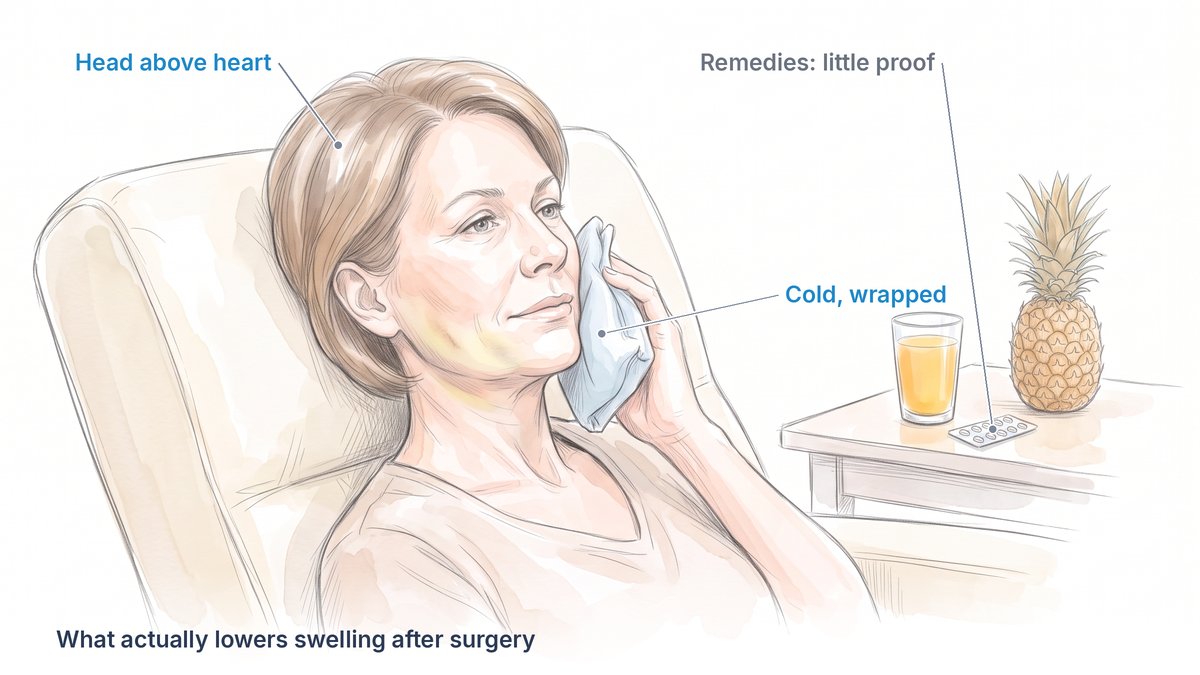
Swelling after plastic surgery is fluid and inflammatory cells collecting in tissue that has been cut, lifted or suctioned. The way to reduce swelling after surgery is, first, the surgeon’s control of bleeding and blood pressure, then cold, a raised head and no straining in the first 48 to 72 hours. Remedies sold for swelling sit lower on that list: bromelain has one encouraging recent trial, arnica has not held up, and pumpkin juice has never been tested.
Quick answers
- What reduces swelling fastest? Wrapped cold packs (never heat) and a raised head in the first 48 to 72 hours, no bending or straining, and the surgeon’s own bleeding and blood pressure control.
- How long does swelling last? About 10 to 14 days after eyelid surgery; two to three months for most visible facelift swelling, with a faint remainder up to a year.
- How long should I sleep elevated? At least the first week, head above the heart at about 30 to 45 degrees; after a facelift, back sleeping for about two weeks.
- Does arnica work? Not reliably: a meta-analysis missed significance, and eyelid and face surgery studies found no or negligible benefit for bruising.
- Bromelain before or after surgery? After, if at all: the encouraging trial started it after surgery, and it is not taken with blood thinners.
- Do pumpkin juice and Korean swelling pills work? No trial has tested pumpkin juice; ask for the ingredient list of any pill and show it to your surgeon.
- Which supplements do I stop? Aspirin, ibuprofen-type painkillers, fish oil, vitamin E and herbal supplements, about two weeks before surgery, until your surgeon restarts them.
- When should I call? At once for swelling that is clearly worse on one side, tense or more painful, for eye pain or vision change after eyelid surgery, or for a swollen calf.
What Is the Fastest Way to Reduce Swelling After Plastic Surgery?
The fastest way is to keep the operated area cold and raised for the first two to three days, avoid anything that raises blood pressure in the head (bending, straining, heat, alcohol), and take only the medicines and supplements your surgeon has cleared. The sections below rank each of these steps, and each remedy sold for swelling, by the strength of the evidence behind it, for face and body operations alike.
Day-by-day recovery for a single operation is covered elsewhere: the facelift recovery timeline week by week, what is normal after eyelid surgery and when to call and liposuction recovery week by week.
Key numbers
- Oral bromelain after upper eyelid surgery: 46 patients, less swelling from day 3 to day 11, less bruising on day 3 only.
- Homeopathic arnica: pooled effect against placebo small and not significant (Hedges g 0.18); 7 eyelid and face studies found no or negligible benefit for bruising.
- Arnica ointment after upper eyelid surgery: 136 patients, no difference in swelling, bruising or pain.
- Ice pack on one eyelid after surgery: 38 patients, no difference in swelling; slightly less pain on day 1.
- Continuous cooling masks after facial bone surgery: 4 pooled trials, less swelling on days 2 and 3.
- Tranexamic acid in upper eyelid surgery: 5 trials, 594 patients, less bruising and return to daily activities about 0.7 days sooner.
- Supplements that affect bleeding: stopped about 2 weeks before surgery in Dr. Yongwoo Lee’s practice.

Why Does Swelling Happen After Surgery, and How Long Does It Last?
Swelling happens because surgery opens small blood and lymph vessels and triggers inflammation, so fluid leaks into the tissue faster than the disrupted lymph channels can carry it away. It usually builds for two to three days, then falls over weeks, with a faint remainder that can last months.
Bleeding adds to it: oozing in the first hours becomes bruising and more swelling on day 3, which is why blood pressure, straining and bleeding-prone supplements matter so much. Gravity decides where it shows. Fluid drifts down, so a facelift bruise moves toward the jaw and neck, eyelid bruising drifts toward the lower lids and cheeks, and a body area swells most at its lowest point. After a facelift, Mass Eye and Ear describes the first 48 to 72 hours as the most critical, with bruising peaking within three to five days.
How long it lasts depends on the operation:
- Eyelid surgery: the American Academy of Ophthalmology gives bruising and swelling that typically last 10 to 14 days.
- Facelift: most visible swelling settles over two to three months, but minor swelling, tightness and numbness can take up to one year to resolve.
- Liposuction: firmness and swelling over weeks, with the final contour at three to six months; the stages are in the liposuction timeline linked above.
- Buccal fat removal: swelling hides the result for weeks, as set out in buccal fat removal recovery and long-term hollowing.
Which Swelling Remedies Actually Work After Surgery?
The best-supported measures are surgeon-side: a drug that reduces bleeding (tranexamic acid), a single steroid dose in selected cases and blood pressure control. On the patient’s side, cold and head elevation are low-risk and widely recommended, bromelain has one encouraging trial, and arnica, pumpkin juice, LED, hyperbaric oxygen and vitamin drips have no good evidence of reducing swelling.
At a Glance: Swelling Remedies and What the Evidence Shows
| Remedy | What it is meant to do | What the evidence shows | Verdict |
|---|---|---|---|
| Tranexamic acid (surgeon) | Reduce bleeding and bruising | 5 trials, 594 eyelid patients: less bruising, back to daily activities about 0.7 days sooner; used in facelift as well | Strongest; surgeon’s decision |
| Single steroid dose (surgeon) | Damp early inflammation | 10 small facial surgery trials: 10 mg dexamethasone lowered day-1 swelling and bruising in 2 trials, low certainty | Some early benefit, low certainty; surgeon’s decision |
| Cold, first 48 to 72 hours | Narrow vessels, ease pain | Less swelling with continuous cooling masks after facial bone surgery; no swelling difference with an ice pack on one eyelid | Do it, wrapped, gently |
| Head elevation | Let fluid drain by gravity | Standard in guidelines; little trial data, but low risk | Do it |
| Oral bromelain | Enzyme said to reduce edema | One triple-blind trial after upper eyelid surgery: less swelling; dental trials mostly positive | Promising, not proven |
| Homeopathic arnica | Reduce bruising | Pooled effect not significant; no or negligible benefit in eyelid and face studies | Harmless, unproven |
| Arnica ointment | Reduce bruising | 136-patient eyelid trial: no difference | Skip |
| Pumpkin juice, swelling pills | Flush fluid | No trials found | Comfort only; check ingredients |
| Lymphatic drainage | Move trapped fluid | No facelift trial; not over a fresh lift | Later, gently, for comfort |
| LED, hyperbaric oxygen, vitamin drip | Speed healing | One 20-patient retrospective HBOT study, no swelling measured | Comfort only |
Should I Use Ice or Heat After Surgery?
Use cold, not heat, in the first 48 to 72 hours: a wrapped ice pack or cool compress for short sessions, never placed directly on numb skin. Heat on a fresh operation widens vessels and adds swelling, so hot packs, saunas, hot baths and bathhouses wait for weeks.
Cold is the most recommended home measure, with more mixed evidence than its reputation. A meta-analysis of continuous cooling masks found less pain on day 2 and less swelling on days 2 and 3, but in four pooled trials of facial bone surgery, with the effect on bruising uncertain. After upper eyelid surgery, a trial that cooled one eyelid of each of 38 patients and left the other alone found similar swelling and bruising on both sides and only slightly less pain on day 1; patients were split on whether they liked it.
So cold is a safe comfort measure with some effect on early swelling, not a cure. NHS advice for eyelid surgery is a cold pack such as frozen peas wrapped in a towel, used in the first days while swelling is still building.
How to use it safely:
- Wrap it: a thin cloth between ice and skin, about 15 to 20 minutes at a time with a break between.
- Mind numb areas: after a facelift the skin around the ear cannot feel cold injury, so never ice straight on the skin.
- Rest the cold on eyelids or a lifted cheek without pressing.
- Stop after about three days, once swelling has stopped building.
When can I use heat or a sauna after surgery?
Not in the first weeks. NHS facelift advice is to avoid saunas and massages for at least two weeks, and one university handout says avoid steam baths and saunas for several months. After a facelift, Dr. Yongwoo Lee keeps saunas, hot springs and jjimjilbang (Korean bathhouses) out for four to six weeks, and numb skin also means a cool hairdryer setting.

How Long Should I Sleep Elevated After Surgery?
Sleep with your head above your heart, on two or more pillows or in a recliner at about 30 to 45 degrees, for at least the first week after face or eyelid surgery. After a facelift, stay on your back for about two weeks, until side sleeping is comfortable.
Raising the head lowers pressure in the veins of the face, so less fluid leaks out and what has leaked drains faster. Guidance ranges from propping the head up with pillows for a couple of days to sleeping with the head elevated for one week after a deep plane facelift, the operation that lifts the deeper layer under the skin together with it. Mass Eye and Ear asks for two or more pillows to keep the head above heart level.
A recliner or a wedge pillow keeps the angle better than a stack of pillows that tips the chin onto the chest. Avoid bending the head below the heart, including lifting from the floor, in the first weeks.

Does Arnica Work for Swelling and Bruising After Surgery?
Not reliably. Pooled trials of homeopathic arnica show a small effect against placebo that is not statistically significant, an American Academy of Ophthalmology review found no or negligible benefit for bruising after eyelid and face surgery, and arnica ointment made no difference in a 136-patient eyelid trial.
Two products share the name. Homeopathic pellets are diluted so far that little or none of the plant remains; herbal gels and ointments contain the plant and belong on unbroken skin only, never on an incision.
The largest pooled analysis, of placebo-controlled and active comparator trials, found an effect against placebo of Hedges g 0.18, with a confidence interval crossing zero under the model the authors chose. Pain was the outcome most trials measured, and the work was funded by a complementary medicine research association.
For the bruising patients actually worry about, the American Academy of Ophthalmology assessed oculofacial surgery and concluded that in 7 controlled studies arnica provided no or negligible benefit versus placebo; vitamin K cream matched placebo too. Arnica ointment fared no better. In a randomized, placebo-controlled trial of 136 patients after upper eyelid surgery, arnica 10 percent ointment did not improve the result for swelling, bruising, redness or pain.
Some surgeons still find oral arnica helps more than creams and gels, which is experience, not a trial. A deep plane facelift review sums it up: arnica, bromelain and low-dose steroids are offered, but definitive data on their efficacy are lacking.
Should I Take Bromelain Before or After Surgery?
If you take it, take it after surgery and only with your surgeon’s agreement: the encouraging recent trial started bromelain after the operation. It is not taken alongside blood thinners or with a pineapple allergy.
Bromelain is a mix of enzymes from the pineapple stem. Its strongest record has been after wisdom tooth surgery, where some studies suggest it may help pain and swelling. A review of 29 studies found it consistently reduced pain, swelling and jaw stiffness after molar extraction, while dosing and safety still needed study.
In 2026 a trial tested it after cosmetic surgery. In 46 adults after upper eyelid surgery, randomized and triple-blind, bromelain 200 mg every 8 hours for 14 days, started after surgery, lowered swelling grades on days 3, 7 and 11 compared with placebo, with no difference on day 1. Bruising was lower on day 3 only. Three of the 23 patients on bromelain had mild nausea or bloating, against one on placebo.
That is encouraging, but it is one small single-center trial with swelling graded by eye. It excluded anyone on blood thinners, antiplatelet drugs or herbal supplements, and those exclusions are the practical safety rules too. Eating pineapple does not reproduce it: the trial used a measured capsule dose of an extract made mainly from the stem.
Do Pumpkin Juice and Korean Swelling Pills Work?
No trial has tested pumpkin juice for swelling after surgery, and the tablets handed out in Korea as swelling pills vary in what they contain. Pumpkin juice is harmless for most people in normal amounts; any pill is worth checking by ingredient with your surgeon.
Pumpkin juice (hobak-jeup) is a fixture of recovery in Korea, sold as a way to flush out fluid, and I could find no clinical trial of it after any operation. It is a mild, potassium-rich drink, so anyone with kidney disease or taking medicines that raise potassium, such as some blood pressure tablets, should ask before drinking it daily.
Swelling pills are not one product: enzyme tablets, often bromelain-based, herbal mixtures and sometimes prescription anti-inflammatory drugs all go by the same everyday name. Ask for the ingredient list in English and check that nothing in it is an ibuprofen-type painkiller or an herbal product your surgeon asked you to stop. The ophthalmology assessment that looked at arnica also found that the literature does not support melilotus (sweet clover) extract for bruising after eyelid and face surgery.
Does Salt or Alcohol Make Swelling Worse, and What Should I Eat?
Yes, salt and alcohol both add to swelling: salt makes the body hold water, and alcohol widens blood vessels, raises bleeding and adds fluid. Eat normally, drink enough water, go easy on salty food for the first weeks, and avoid alcohol for about two weeks.
Mass Eye and Ear puts it simply: excess salt causes the body to hold onto water, which can make facial swelling persist longer. Ramen, stews, soy-based broths and processed snacks are the easy ones to cut back for two weeks.
A university facelift handout goes further, asking for no alcohol for several weeks as it causes fluid retention. Alcohol also affects blood pressure and should not be mixed with pain medicine. Water does not wash swelling out faster, but dehydration makes constipation and straining more likely, and straining pushes pressure into the face.
Which Supplements Should I Stop Before Surgery, and When Can I Restart Them?
Stop aspirin, ibuprofen-type painkillers, fish oil, vitamin E and herbal supplements about two weeks before surgery, and restart them only when your surgeon says so. Never stop a blood thinner prescribed by another doctor on your own: that is planned with the doctor who prescribed it.
Bleeding is the link to swelling. Extra oozing means more bruising and swelling for days, and in the worst case a hematoma, blood collecting under the skin that needs to be drained. After a facelift, aspirin or anti-inflammatory use was among the factors linked to hematoma, alongside male sex, blood pressure and smoking. After eyelid surgery, the risk factors for bleeding behind the eye include high blood pressure, aspirin around surgery, vomiting afterward and increased physical activity.
The National Institutes of Health warns that certain dietary supplements may increase the risk of bleeding or affect your response to anesthesia, and asks patients to list all of them as early as possible. A few in detail:
- Vitamin E can inhibit platelet clumping and work against vitamin K-dependent clotting factors, most clearly at high doses or alongside blood thinners.
- Fish oil can have antiplatelet effects at high doses, though it appears less potent than aspirin. The risk is small, and stopping it for two weeks costs nothing.
- Ginkgo may increase the risk of bleeding in people taking anticoagulants such as warfarin.
- Garlic, ginseng and turmeric capsules, and multi-herb mixes, are on most surgeons’ stop lists for the same reason.
Acetaminophen (paracetamol) does not affect bleeding and is the usual painkiller around surgery. Prescription medicines for blood pressure, thyroid or diabetes generally continue; ask about each one rather than stopping them all.
When can I restart fish oil, vitamins and other supplements?
When the surgeon clears it, commonly once bruising has settled, about one to two weeks after surgery, and later after a larger operation. Ibuprofen-type painkillers usually wait until the surgeon says bleeding risk has passed.

Does Lymphatic Drainage Massage Help Facial Swelling?
It can make the late, firm stage of facial swelling feel softer and more comfortable, but no facelift trial shows that it shortens recovery, and it does not belong over a freshly lifted face. After a facelift it usually starts at about one month, done gently by a trained therapist.
Lymphatic drainage is a light, slow skin massage that moves trapped fluid toward lymph channels that still work, while the ones cut by surgery reconnect over weeks. Strong self-massage, gua sha tools and vibrating devices are not lymphatic drainage and are not for a fresh face; after liposuction the timing differs.
Timing is the safety issue. In the first weeks, pressure and stretch on a lifted flap can bruise it, break small vessels that have just sealed or disturb the hemostatic net, the temporary stitches that hold a lifted skin flap down. That is why NHS facelift advice rules out massage for at least the first two weeks.
Do LED, Hyperbaric Oxygen and Vitamin Drips Speed Recovery?
There is no good evidence that LED light, hyperbaric oxygen or vitamin drips reduce swelling after cosmetic surgery, and they are best seen as comfort measures. They do not replace cold, elevation, blood pressure control or the surgeon’s checks.
Hyperbaric oxygen is breathing oxygen in a pressurized chamber. The only study after a facelift that Dr. Yongwoo Lee knows of compared 20 women in one practice after the fact, 9 with treatment and 11 without, and measured complications, wound healing and satisfaction rather than swelling or bruising. It was not randomized or blinded. For LED light and vitamin drips after a facelift, no trial has been found at all. They are popular in Korea and low-risk in a healthy patient, though anyone with a lung condition, ear or sinus problems or claustrophobia should ask before entering a hyperbaric chamber.
What Does Dr. Yongwoo Lee Do in Surgery to Limit Swelling?
I control bleeding in the operating room and in the first days afterward, because that is where most avoidable swelling is decided: supplements stopped two weeks ahead, blood pressure kept tightly controlled, tranexamic acid, a hemostatic net and drains after a facelift, and dressings I change myself.
Before surgery
Every patient has a medical check, and the two-week stop list above applies to every operation, including anything sold as a swelling or detox product, until I restart it.
In the operating room
Blood pressure is the first lever. After a facelift I keep it tightly controlled through waking and the first days, with an intravenous blood pressure drip when it does not settle, and tranexamic acid runs intravenously from the day of surgery through the third or fourth day. Its wider evidence is summarized in a scoping review of tranexamic acid in facelift surgery. At closure I place a hemostatic net, and small drains carry away fluid that would otherwise sit under the skin. How the net and drains prevent bleeding is explained in why facelift hematoma happens and how it is prevented.
A single steroid dose around surgery can reduce early swelling in facial operations; whether it suits a patient is decided with the anesthesiologist, because steroids affect blood sugar.
The first days
I change facelift dressings myself each morning, so any difference between the two sides is caught early. Patients rest with the head raised, use wrapped cold packs for the first two to three days and avoid bending and straining, and pain and nausea are treated on schedule, because both raise blood pressure.
After eyelid surgery the first night follows the same logic: head raised, cold compresses resting lightly on the lids if the patient wants them, no straining, and drops by day and ointment at night until the lids close fully.
What I offer, and how I explain it
In the first two weeks after a facelift I also offer hyperbaric oxygen, LED light and a vitamin drip, and from about one month lymphatic drainage. I tell patients plainly that these are for comfort and that the evidence that they speed recovery is limited. Pumpkin juice is fine if a patient enjoys it, with the potassium caution above. Arnica and bromelain are for comfort only, and a patient who wants them checks with me first.
After liposuction
Compression replaces cold as the main tool. Garments are worn essentially continuously for the first two to three weeks, then full time to about six weeks, then tapered as swelling settles, as described in whether fat comes back after liposuction.

Surgeon’s Insight: Most of the Swelling Is Decided Before You Wake Up
Patients ask me which pill will bring their swelling down, and my answer is that the biggest difference is made before they open their eyes: how dry the operating field is, how calm the blood pressure stays through waking and the first night, and whether a forgotten supplement was making them bleed. What a patient does at home still matters, but in a narrower way: a few dull rules for the first three days, and patience.
I would rather a patient spent their energy on those rules than on a shelf of remedies. And I would rather they called me about a swelling that looks different on one side than waited for a pill to work.
When Should I Worry About Swelling After Surgery?
Swelling that is similar on both sides, peaks around day 2 or 3 and then slowly eases is normal. Swelling that is clearly worse on one side, tense, shiny or more painful, especially in the first 24 hours, can be bleeding under the skin and needs a call to the surgeon at once; eye pain, bulging or vision change after eyelid surgery is an emergency.
| Sign | Usually normal | Call now |
|---|---|---|
| Both sides | Similar, peaking around day 2 or 3 | One side clearly bigger, tense or shiny |
| Pain | Easing after day 3 | Rising, or much worse on one side |
| Bruising | Yellow or purple, drifting downward | A growing, tense swelling under a bruise |
| Eyes after eyelid surgery | Puffy, watery, gritty | Severe pain, a bulging hard eye, double vision or any vision loss: emergency |
| Skin and wound | Pink, color returns when pressed | Dark or dusky skin, spreading redness, pus, fever above 38°C (100.4°F) |
| Neck and breathing | Tight, evenly swollen | Neck swelling growing fast with trouble breathing or swallowing: emergency |
| Legs | Not affected | A swollen, painful calf or breathlessness: emergency |
Most facelift bleeding shows in the first day. After eyelid surgery, bleeding behind the eye is rare, about 1 in 2,000 in one large survey, and most bleeds began within 3 hours, with the risk falling sharply after 24.
What Should I Ask My Surgeon About Swelling?
Ask not “what can I take for swelling?” but “what will you do to stop me bleeding, and what do you want me to do in the first three days?” The answer should name the supplements to stop and when, how blood pressure is managed, whether a drug such as tranexamic acid or a steroid is used, how long to keep cold and the head raised, and who to call at night.
A surgeon who answers those questions has a plan for the part of swelling that can be changed. The rest is time, and a remedy that promises to shortcut it should come with a trial; most do not.
Individual results vary; consultation required.
Written by Dr. Yongwoo Lee, board-certified Korean plastic surgery specialist in facial anatomy and aesthetic procedures at VIP Plastic Surgery, South Korea.
Frequently Asked Questions About Reducing Swelling After Surgery
How long does swelling last after plastic surgery?
After eyelid surgery most bruising and swelling settle in 10 to 14 days; after a facelift most visible swelling is gone in two to three months, with a faint remainder for up to a year; after liposuction the final contour appears at three to six months.
Why is my swelling worse in the morning?
Lying flat for hours lets fluid settle into the face, so many people wake puffier, especially around the eyes. It eases within an hour or two of being upright, and sleeping with the head raised reduces it.
Why is swelling worse on day 2 or 3?
Inflammation and fluid keep building for two to three days, then usually ease from about day 4. A side that keeps growing beyond that, or faster than the other, needs a call.
Does drinking more water reduce swelling?
Not directly. Salt, not water, is what makes the body hold fluid, so cutting back on salty food does more; drink normally to avoid constipation and the straining that comes with it.
Can I take ibuprofen for pain after surgery?
Only if your surgeon says so. Ibuprofen-type painkillers affect platelets and are usually stopped two weeks before surgery and restarted later. Acetaminophen (paracetamol) does not affect bleeding and is the usual first choice, together with any medicine your surgeon prescribes.
Can I take arnica and bromelain together?
Ask your surgeon first. Homeopathic arnica is generally considered harmless but unproven; bromelain, started after surgery, is avoided with blood thinners, antiplatelet drugs and pineapple allergy.
Should I start bromelain a few days before surgery?
No. The trial that showed less swelling started it after surgery, and enzyme supplements are best kept off the pre-surgery list unless your surgeon asks for them.
Is pumpkin juice safe after surgery?
For most people, yes, in normal amounts, but it has never been tested as a swelling treatment. It is rich in potassium, so anyone with kidney disease or taking medicines that raise potassium should ask a doctor before drinking it every day.
Should I use a warm compress for bruising?
Not in the first days, when heat adds swelling. Some surgeons allow gentle warmth on a bruise after the first week, never on numb skin; ask first.
When can I go to a sauna or jjimjilbang after surgery?
Not for weeks. After a facelift Dr. Yongwoo Lee asks patients to wait four to six weeks for saunas, hot springs and Korean bathhouses, because heat swells the face and shared water can carry infection into incisions that have not sealed. Smaller operations may need less; ask.
Can I massage my face to reduce swelling?
Wait: in the first weeks after a facelift or eyelid surgery, pressure on freshly operated tissue can cause bruising and bleeding. Gentle lymphatic drainage by a trained therapist usually starts about a month after a facelift.
Does compression help swelling after surgery?
It is standard care where the surgeon uses it, although trials of it are few. After a facelift the dressing is kept for the first day or two; after liposuction garments are worn for weeks. Wear it as instructed, and report a dressing that feels much tighter on one side.
Does walking help reduce swelling after surgery?
It helps your legs more than your face. Short, gentle walks keep blood moving in the calves, and after a facelift Dr. Yongwoo Lee has patients walking from the first day; what adds facial swelling is exertion that raises blood pressure, so strenuous exercise and lifting wait four to six weeks.
Do vitamin C, zinc or turmeric help healing?
Vitamin C and zinc matter for healing only if you are short of them, and a normal diet with enough protein usually covers that. Turmeric capsules are on many stop lists because they may affect bleeding, so they wait until your surgeon restarts them.
When is uneven swelling after surgery a warning sign?
A small difference between the sides is common. What matters is speed: a side that is visibly growing over hours, tense or more painful than the other, especially in the first 24 hours, can be a hematoma and needs a call to the surgeon at once.
Can I fly home while I am still swollen?
Swelling itself does not stop a flight, but the surgeon’s last check comes first. Keep the head up with a neck pillow, walk the aisle, skip alcohol, and see a doctor the same day if one side swells or hurts more after landing; timing is covered in how long to stay in Korea after plastic surgery.
This article is for informational purposes only and does not constitute medical advice. Always consult with a qualified medical professional before making any decisions about surgical or non-surgical procedures.
