
Under-eye polynucleotides, filler or surgery: key facts
- Thin, crepey skin and fine lines: polynucleotides (PN); in my practice 3 sessions 2 to 4 weeks apart, then one every 6 to 12 months
- A groove with no bulge above it: hyaluronic acid (HA) tear-trough filler, 0.3 to 0.5 mL per side or less, by cannula, deep on the bone
- Bulging fat or loose skin: lower blepharoplasty; no injection moves fat or removes skin
- Evidence: PN, 61 people over 3 months with no control group; HA filler, a 140-person randomized trial with 12-month data; surgery, case series
- Brown pigment in the skin: creams and lasers first
Are Polynucleotides, Tear-Trough Filler and Lower Blepharoplasty Just Mild, Medium and Strong?
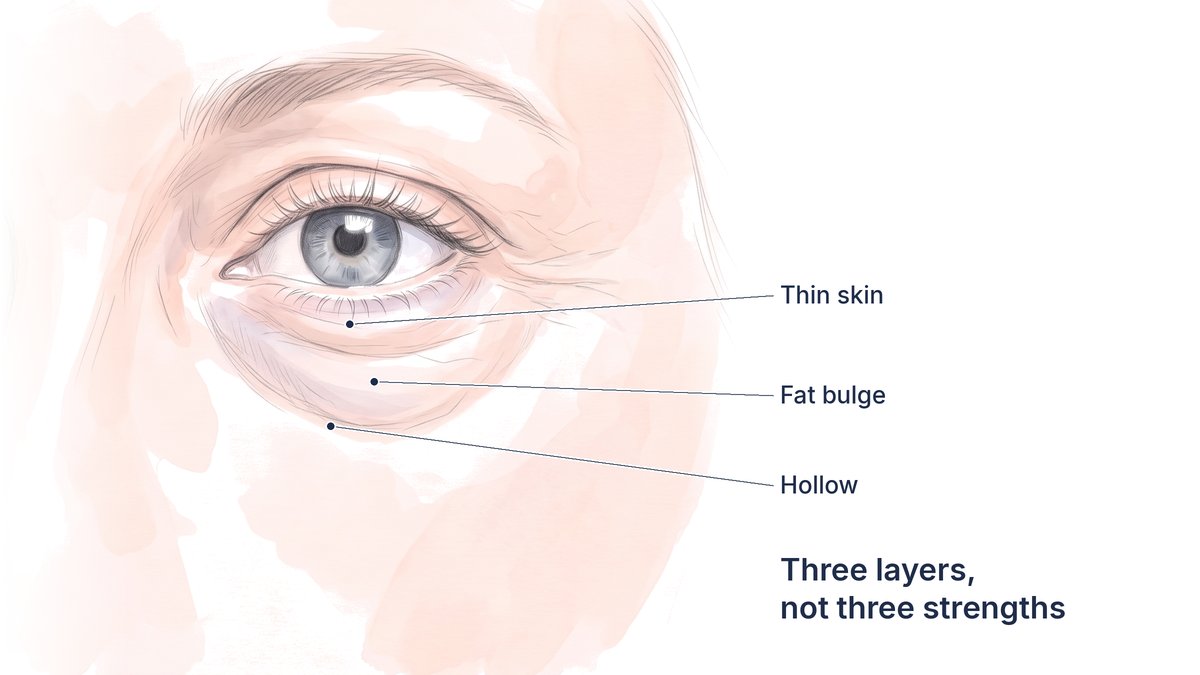
No. Under-eye polynucleotides, tear-trough filler and lower blepharoplasty are not three strengths of one treatment; each works on a different layer. Polynucleotides act on the skin itself, filler raises a groove along the bony rim, and surgery deals with fat that has bulged forward and with loose skin.
Starting with the mildest injection does not help when the problem sits in another layer.
In my practice, polynucleotides (PN) under the eye are for skin quality and fine lines, not volume; a groove with no bulge gets a small amount of hyaluronic acid (HA) filler; and bulging fat or loose skin goes to surgery instead of either injection.
PN is also the least tested of the three. For the two older options, see tear-trough filler versus lower blepharoplasty; this article adds the third and asks what it can honestly be expected to do.
Are Your Dark Circles Thin Skin, a Hollow, a Bulge or Fluid?
A dark under-eye comes from one or more of four things: the skin itself (brown pigment, or skin thin enough to show what lies beneath it), a hollow along the bony rim that casts a shadow, fat bulging above that rim, or fluid. Each sits in a different layer, which is why no single product treats them all.
A 2016 review of infraorbital dark circles sorts the causes into skin, the soft tissue and fluid of the midface, and the ligaments and bone that shape the tear trough.
Skin. Lower eyelid skin is, in the review’s words, “one of the thinnest parts in the body,” with the orbicularis muscle, which closes the eye, directly beneath it. Muscle and fluid seen through it look purplish. Brown color is a different finding: pigment, which a biopsy study cited by the review found in the dermis of all 12 Japanese patients examined, and for which the review lists creams, peels and pigment lasers.
Hollow. The tear trough is the groove running from the inner corner of the eye down and out along the rim of the eye socket, where a true ligament ties the skin to the bone. Skin anchored there stays put while the tissue around it thins, so the line deepens; the ligament and the fat above it are drawn in why a bag and a hollow need different treatment.
Bulge. When the fat that cushions the eyeball pushes forward above the rim, it forms a bag, and the groove beneath looks deeper by contrast. A bag usually pushes further forward when you look up; a hollow does not change.
Fluid. Swelling collects easily in this thin tissue, and none of the three treatments drains it. Hyaluronic acid holds water, so filler can worsen a puffy, fluid-prone lid or a swollen mound on the upper cheek. New or one-sided swelling, or swelling with a red or bulging eye, needs a doctor’s check before any cosmetic treatment, because allergy, thyroid eye disease and kidney or heart conditions can all cause it.
Lighting separates shape from color. In the review’s words, “overhead lighting can worsen the appearance of periorbital dark circles, while direct light may mask the appearance.” Darkness that eases when light shines straight at your face is mostly shadow from a hollow or a bulge; color that looks the same in any light is in the skin. Many under-eyes have more than one cause.

What Are Polynucleotides, and What Can They Do Under the Eye?
Polynucleotides are purified chains of DNA from salmon or trout, injected in tiny amounts into the skin to improve its quality. Under the eye, the published studies report better skin texture, elasticity and fine lines over a few months; none shows that polynucleotides fill a hollow for long, flatten a bag or remove loose skin.
Are PN, PDRN and “salmon DNA” the same thing?
Nearly. A 2025 review describes PN as longer DNA chains from salmon or trout testes and PDRN as shorter chains from fish sperm, but notes that “no standardized criteria have been established to delineate molecular weight thresholds.”
The two are described as working differently. PDRN “selectively activates the A2A receptor,” while PN is described mainly as a physical support that “forms a more porous, highly viscous, three-dimensional structure.” In Korea, according to the review, PDRN is approved by the Ministry of Food and Drug Safety for tissue regeneration and wound healing, while PN injectables are regulated as medical devices. Rejuran is a Korean PN brand and one of the skin boosters used at the clinic where I work; brands are compared in how the main skin boosters compare.
What do the under-eye studies show?
One randomized trial, against a thin HA. In a double-blind split-face trial, 27 people had three sessions two weeks apart, with PN around one eye and a non-crosslinked HA around the other, and patient-rated and global improvement scores did not differ between the sides. Roughness and pore volume improved more on the PN side, and no serious adverse events were reported. The comparator was a thin skin booster, not a volumizing filler, so the trial says nothing about filling a groove.
One larger series, without a control group. In the largest under-eye dataset, 61 adults in five countries had three sessions two to three weeks apart, usually 1 mL of a 7.5 mg/mL PN product per side. On a 10-point dark-circle scale, the mean grade fell from about 5 to 2.2 with a cannula and 3.2 with a needle three months after the last session. There was no untreated group, which the authors name as the main weakness, and the product’s manufacturer funded publication.
Case reports. Much of the rest resembles a report of two women treated twice with a PN and HA mixture and judged from photographs, with several authors affiliated with the manufacturer.
A 2026 narrative review of both injectables concludes that HA “remains superior for structural correction,” while PN shows “consistent improvements in dermal quality parameters” such as elasticity, hydration and fine lines. It adds that PN studies often have 30 patients or fewer and short follow-up.
What can polynucleotides not do?
They do not move fat or remove skin, and lasting volume is unproven. In the 61-person series, the 11 people with structural dark circles did improve, but some injections were placed deep, near the bone, and there was no control group. That is not evidence that PN holds a groove up the way a filler does.
Duration is the other gap: none of the under-eye polynucleotide studies cited here reports results beyond three months after the last session.
What Does the Evidence Show for Polynucleotides, Tear-Trough Filler and Lower Blepharoplasty?
Tear-trough HA filler has the strongest trial, lower blepharoplasty has the largest series and is the only one of the three that moves fat, and polynucleotides have the thinnest evidence. These studies measured different things in different people, so the numbers cannot be ranked against each other.
Under-Eye Polynucleotides vs Tear-Trough Filler vs Lower Blepharoplasty at a Glance
| Polynucleotides (PN) | Tear-trough HA filler | Lower blepharoplasty | |
|---|---|---|---|
| Treats | Thin, crepey skin, fine lines | A groove with no bulge | Bulging fat, its groove, loose skin |
| Layer | In the skin (deep dermis) | On the bone of the rim, under the muscle | Fat moved over the rim; skin trimmed if loose |
| Fills a hollow | Not shown | Yes | Yes, with your own fat |
| Flattens a bag | No | No | Yes |
| Largest study cited | 61 people, no controls | 140 randomized | 339 operations, retrospective |
| Main result | Mean grade about 5 to 2.2 (cannula) or 3.2 (needle) at 3 months | 83.1 percent responders vs 15.6 percent of controls at 3 months | Tear trough improved in 97.73 percent of 110 patients |
| Longest measured | 3 months | 12 months: 73.4 percent | Mean 12.9 months |
| Early reactions | Mild swelling or redness in 34.4 percent | Tenderness 47.7, swelling 41.7, bruising 40.2 percent | Bruising 1 to 2 weeks; skin stitches out day 7 |
| Dissolvable | No | Yes | No |
Tear-trough filler: the regulated benchmark
An HA filler was approved by the FDA in May 2021 for “the improvement of infraorbital hollowing in adults over the age of 21”. Its trial randomized 140 adults to treatment or no treatment. At three months, 83.1 percent of treated patients had responded against 15.6 percent of controls, and at 12 months 73.4 percent of those assessed were still responders. The gel was placed deep, “subcutaneous and/or supraperiosteal,” with a median total of 1.0 mL per side once the touch-up was counted.
Smaller amounts are usual elsewhere. In 22 patients followed by ultrasound, a mean of 0.45 mL per lower lid was placed in three to five deep injections just under the rim, and 21 of the 22 had a second round a week later to smooth the surface. In six cadavers, 0.3 mL of HA placed just above the bone of the infraorbital rim was found on the bone lining of the rim and along the orbicularis retaining ligament, although one of the gels also spread into the fat above and below the muscle, which shows position only, since a cadaver cannot swell.
Lower blepharoplasty: the structural fix
In fat repositioning, the bulging fat is released and laid over the rim into the groove. In 110 patients treated this way through the inside of the lid, the tear trough improved in 97.73 percent, and the remaining 2.27 percent were revised. It is a single-center series of unstated follow-up, and its authors limit the method to patients “without severe orbital skin laxity.”
Across 339 lower blepharoplasties followed for a mean of 12.9 months, complications occurred in 4 percent and revisions in 9 percent, with blending the lid-cheek junction and correcting the tear trough described as “prone to failure and unsatisfactory outcomes”.
How Does Dr. Yongwoo Lee Choose Among Polynucleotides, Filler and Surgery, and How Is Each Done?
I choose by examining three things in order, the bulge, the hollow and the skin, and each finding has its own treatment: lower blepharoplasty for bulging fat or loose skin, a small amount of HA filler for a groove with no bulge, and polynucleotides for thin, finely lined skin. Some under-eyes need two of the three.

The bulge first, then the hollow, then the skin
The first checks are the ones I use for any filler-or-surgery decision under the eye: where the fullness sits with the eyes straight ahead under overhead light, whether it pushes out on upgaze as fat does and a hollow does not, how briskly the lower lid snaps back when pulled down, and how much skin is spare. Whether polynucleotides have a role is decided by the last step: how thin the skin is, whether it creases into fine lines, and whether the color is brown pigment or a purplish show-through.
Polynucleotides: three sessions, for skin and fine lines
Under the eye I use polynucleotides for skin quality and fine lines, not for volume. My schedule is three sessions, two to four weeks apart, followed by one maintenance session every 6 to 12 months.
Maintenance has not been studied: according to the 2026 review, “optimal long-term intervals remain undefined,” so my 6 to 12 months is clinical practice, not a trial result.
For skin boosters I use a digital injector, the i-JECT, which meters a small, even dose at each point, after numbing cream.
Across the face my first choice among skin boosters is RE2O, an extracellular matrix (ECM) booster; for thin under-eye skin I use a polynucleotide, on the schedule above.
Tear-trough filler: a small amount, deep on the bone
For a groove with no bulge I use a low-viscosity (thin, soft) HA filler, 0.3 to 0.5 mL per side or less, placed through a blunt cannula deep on the bone.
I do not place filler when fat is bulging above the rim or when the skin is loose. Those eyelids go to surgery. The filler I use under the eye is always hyaluronic acid, which can be dissolved with hyaluronidase, an enzyme the clinic keeps in stock. I do not use calcium hydroxylapatite or poly-L-lactic acid fillers.
Lower blepharoplasty: the route follows the skin
Little excess skin means going in through the conjunctiva, the inner lining of the lid, with no skin incision unless a small pinch of skin under the lashes is needed, which leaves a fine line there; loose skin means a subciliary incision just below the lashes with the excess removed and, in most middle-aged patients, a canthopexy to brace the outer corner, which I do not add to the inside route. Either way the fat is repositioned over the rim on the bone’s covering (supraperiosteal), sometimes with a SOOF lift of the cheek fat beneath the muscle, as described in lower blepharoplasty with fat repositioning. I give the intravenous sedation, propofol and ketamine, with local anesthesia and a dedicated nurse on the monitors; international patients are admitted for the first night, and patients who live in Korea go home the same day.
In a thin face with too little fat to move, I add a small fat graft in the same operation, only in the deep layer on the bone and never in the muscle or under the skin, and more after three to six months if needed. Surgery leaves skin quality as it was, so a skin booster can follow, never on the day of the operation: once the lids have healed, a patient who wants it can have Rejuran I, a polynucleotide made for the eye area.
Old filler is dissolved two to four weeks before surgery
When filler is still under the eye, I dissolve it with hyaluronidase two to four weeks before a lower blepharoplasty, and I remove any that remains when I find it during the operation. Fat cannot be planned over a groove that gel is hiding.
Which Under-Eye Patient Are You?
Most under-eyes fit one of six patterns, and each points to a different first step. Illustrative examples, not real patients.
A 29-year-old with thin, finely creased skin and a purplish tint, no groove and no bag. This is the skin layer: a polynucleotide series or another skin booster may improve texture and fine lines, though whether it lightens a purplish tint is unproven.
A 34-year-old with a groove along the inner rim and firm skin. No bulge appears on upgaze, and the shadow eases in direct light. A small amount of HA filler on the bone suits this eyelid.
A 41-year-old with a bag that pushes forward on looking up and a groove beneath it, skin still tight. Transconjunctival fat repositioning; an injection first would be a detour.
A 57-year-old with a bag, a groove and loose, crepey skin. Surgery through a subciliary incision with skin removal, usually with a canthopexy.
A 38-year-old whose brown color does not change with lighting. Pigment in the skin. Creams and lasers come first, with the cautions in laser treatment for melasma. The pigmented type improved in the 61-person PN series, but with no control group that finding is weak.
Someone with old under-eye filler that looks puffy or bluish. Dissolve first, wait, and re-examine.
What Is Recovery Like After Polynucleotides, Filler and Lower Blepharoplasty?
Polynucleotides and filler cause a few days of swelling and possible bruising, while lower blepharoplasty means one to two weeks of visible bruising and skin stitches out on day 7. Results show over weeks to months with polynucleotides, within about two weeks with filler, and over two to three months after surgery.

Polynucleotides. In the 61-person series, 21 people (34.4 percent) had mild swelling or redness that settled within hours or the same day, and two had swelling and firmness for under three days. In the two-patient report, swelling lasted up to five days and both bruised. Three sessions two to four weeks apart do not fit into a one-week trip.
Filler. In the FDA trial, tenderness, swelling, bruising and lumps or bumps were each recorded in roughly 39 to 48 percent after the first treatment; most were mild and resolved within a week. Three people had mild swelling beyond 30 days, resolved by 45 days.
Before surgery or injections. Bruising is more likely after either if you take aspirin, anti-inflammatory painkillers, fish oil, vitamin E or herbal supplements. For lower blepharoplasty I ask for these to stop two weeks before and for a GLP-1 weight-loss injection to pause from one month before until one to two weeks after, with the prescriber, as listed in what to stop before plastic surgery. No nicotine in any form (cigarettes, vapes, patches or gum) is allowed for four weeks before and after lower blepharoplasty, or the surgery is postponed. A blood thinner, including aspirin prescribed for your heart or after a stent, or a diabetes medicine your doctor prescribed is never stopped on your own: ask the prescriber first.
Lower blepharoplasty. I ask for the head raised and eye ointment, give tranexamic acid intravenously during the operation to limit bleeding and leave cold compresses optional; dressings are changed almost daily at first. An inside incision gets three dissolving stitches (Vicryl Rapide 6-0), knots buried, and skin stitches, when there are any, come out on day 7. Makeup, contact lenses, exercise and sauna return on the dates in the blepharoplasty recovery timeline, week by week.
Surgeon’s Insight: Three Layers, Not Three Strengths
Patients often ask me to start with the gentlest option and “see how it goes.” That works only when the gentle option is aimed at the right layer. Polynucleotides in an eyelid with a bag leave the bag exactly where it was, and filler beside a bag adds fullness next to it. Neither is a first step toward surgery.
The reverse also holds. An operation moves fat and removes skin, but it does not thicken thin skin or lighten pigment. Sometimes the right plan is two tools aimed at two layers.
What Are the Risks of Polynucleotides, Tear-Trough Filler and Lower Blepharoplasty?
Polynucleotides have looked mild in small, short studies; filler has common early swelling and bruising and a rare risk to vision; surgery had complications in 4 percent and revisions in 9 percent in one large series.
Polynucleotides. Reactions in the studies above were mild and short, but studies of 27 and 61 people are too small to rule out rare problems. Hyaluronidase dissolves hyaluronic acid only, so a polynucleotide cannot be dissolved on request. Any injection near the eye can, rarely, enter a blood vessel, so the filler warning signs below (sudden severe pain, pale or dusky skin, any change in vision) apply here too. Because it is made from salmon or trout DNA, tell your injector about any fish or seafood allergy, as a precaution; the 61-person series does not address it.
Swelling of the lips, tongue or throat, wheezing or difficulty breathing after any injection is an emergency: call emergency services (119 in Korea) first, then your injector.
The studies cited here describe these products as medical devices in Korea and CE-marked devices in Europe; none reports a US FDA approval for under-eye use.
Filler. The serious risk is filler entering an artery. A review of the world literature found 48 new published cases of partial or complete vision loss after filler between 2015 and 2018, with vision fully recovered in only 10. Sudden severe pain, or skin turning pale or dusky, during or after an injection needs your injector at once, while the filler can still be dissolved.
Any change in vision, such as blurring, a dark patch or loss of sight, is an emergency: call emergency services (119 in Korea) or go to the nearest emergency department immediately, then call your injector. The warning signs are set out in filler blindness and its warning signs.
In the FDA trial a bluish tint was noted in four treated participants at day 30. At the clinic where I work, filler goes in by cannula in most areas, hyaluronidase is in stock, and the emergency partner hospitals are Jeju National University Hospital and Halla Hospital.
Lower blepharoplasty. The 110-patient series recorded three local dips, one bulge and one bleed, all corrected. Dry eye, a lower lid that pulls down and the rare bleed behind the eye are explained in blepharoplasty complications. Severe pain, a tight or bulging eye or any loss of vision after eyelid surgery is an emergency: call emergency services (119 in Korea) at once, then the surgeon. If you are staying in the clinic building, also alert the on-call nurse immediately.
Skin, Hollow or Bulge: Which One Should You Ask About Before Any Under-Eye Treatment?
Ask which layer is causing the darkness: the skin, a hollow, or a bulge. The answer chooses the treatment, and it should come from an examination, not from a menu.
Skin points to a booster such as a polynucleotide, with modest expectations. A hollow points to a small amount of filler on the bone. A bulge or loose skin points to surgery. Pigment points away from all three.
Individual results vary; consultation required.
Written by Dr. Yongwoo Lee, board-certified Korean plastic surgery specialist in facial anatomy and aesthetic procedures at VIP Plastic Surgery, South Korea.
Frequently Asked Questions About Under-Eye Polynucleotides, Tear-Trough Filler and Lower Blepharoplasty
Do polynucleotides work for dark circles under the eyes?
They can improve skin quality, but the evidence for dark circles themselves is early. In the largest series, 61 people had a lower mean dark-circle grade three months after three sessions, with no control group. A 27-person randomized trial found no difference in overall improvement between PN and a thin, non-crosslinked HA.
Are polynucleotides or tear-trough filler better for under-eyes?
Neither is better overall, because they treat different layers. A 2026 review concludes that HA remains superior for structural correction, meaning a groove or hollow, while PN improves skin quality such as elasticity, hydration and fine lines.
Can polynucleotides fill a tear trough or under-eye hollow?
That has not been shown. The only randomized under-eye trial compared PN with a thin HA skin booster, not a volumizing filler. Nor do they flatten a bag: a bag is fat pushed forward above the rim, and it is treated with lower blepharoplasty.
Is Rejuran the same as polynucleotides, PDRN or salmon DNA?
Rejuran is a Korean brand of polynucleotide. PN and PDRN both come from fish DNA; PN has longer chains and PDRN shorter ones, with no standard cutoff between them. “Salmon DNA” is the everyday name for both.
How many polynucleotide sessions do I need under the eyes?
Three, in the largest published series (two to three weeks apart) and in my practice (two to four weeks apart), followed in my practice by one maintenance session every 6 to 12 months.
How long do under-eye polynucleotides last?
Nobody has measured it properly. The largest under-eye series stopped three months after the last session, and a 2026 review calls long-term intervals undefined. Maintenance every 6 to 12 months is clinical practice, not a proven duration.
Why are my eyes puffy after polynucleotides, and how long does it last?
A gel has been injected into very thin skin, so some swelling is expected. In a 61-person series, 34.4 percent had mild swelling or redness that settled within hours or the same day; in a two-patient report, swelling lasted up to five days. Swelling that keeps growing, turns hot, red or painful, or lasts beyond about a week needs your injector; swelling of the lips, tongue or throat or trouble breathing is an emergency: call emergency services (119 in Korea) first.
How much tear-trough filler is needed per eye?
Dr. Yongwoo Lee uses 0.3 to 0.5 mL of a low-viscosity HA per side or less, by cannula, deep on the bone. In the FDA trial the median was 1.0 mL per side once the touch-up was counted, and an ultrasound study of 22 patients used a mean of 0.45 mL per lower lid.
Can polynucleotides delay or replace lower blepharoplasty?
Not when the problem is a bag or loose skin. Polynucleotides act in the skin; they do not move bulging fat or remove skin, so an under-eye with either needs lower blepharoplasty whatever is injected first. They can still help the skin itself afterward, once the lids have healed.
Are polynucleotides safe if I have a fish allergy?
It has not been studied. Polynucleotides are made from salmon or trout DNA, so tell your injector about any fish or seafood allergy as a precaution. Swelling of the lips, tongue or throat, wheezing or difficulty breathing after any injection is an emergency: call emergency services (119 in Korea) first.
Can polynucleotides or a skin booster be combined with lower blepharoplasty?
Yes, as a separate treatment for a separate layer, because surgery does not change skin quality. Dr. Yongwoo Lee does not inject a booster on the day of surgery; after the lids have healed, a patient who wants one can have Rejuran I, a polynucleotide made for the eye area.
Are polynucleotides FDA approved for under the eyes?
None of the studies cited here reports one; they describe these products as medical devices in Korea and CE-marked devices in Europe. The under-eye injectables with an FDA indication, for infraorbital hollowing, are hyaluronic acid fillers; at least two have it.
This article is for informational purposes only and does not constitute medical advice. Always consult with a qualified medical professional before making any decisions about surgical or non-surgical procedures.
