
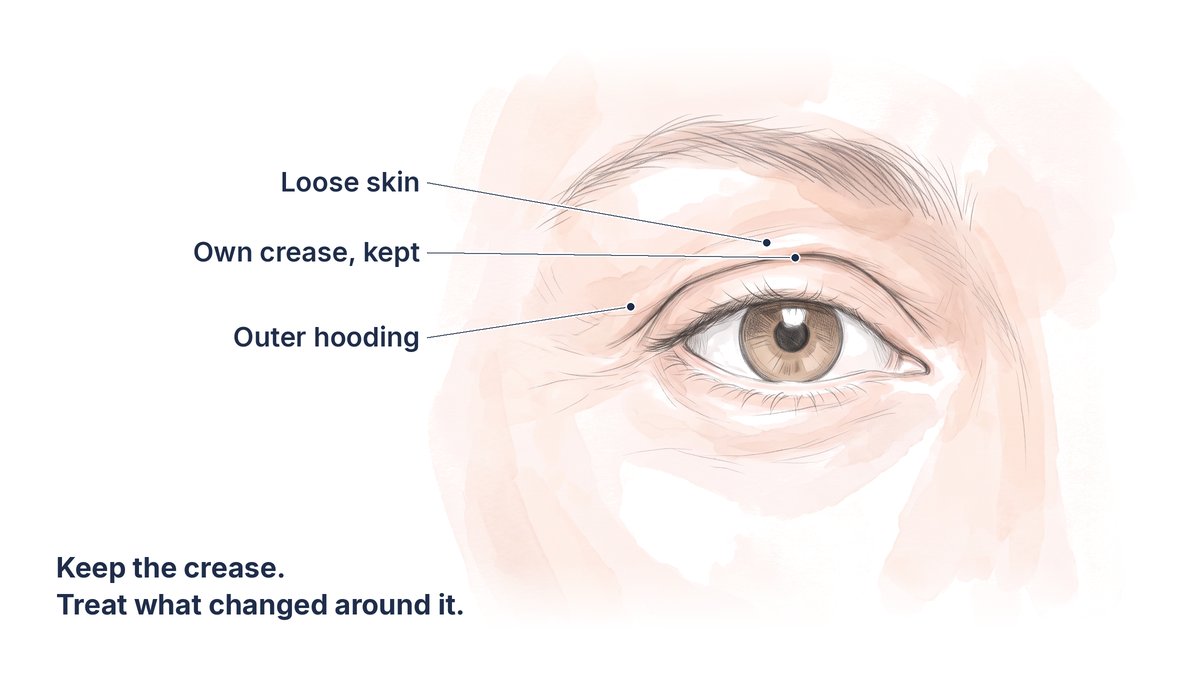
A Korean eyelid surgeon should not make a Western eyelid look East Asian, because the operation a Western lid needs is a different one. Double eyelid surgery builds a crease in a lid that never folded. An upper blepharoplasty in Korea for a Western patient usually keeps the crease already there and treats what has changed around it: loose skin, a low outer brow, a bulging inner fat pad, sometimes a low lid edge or a tear gland that has slipped forward.
“Western” here is shorthand for the lid that anatomy papers call Caucasian or white: usually creased from birth, thin, and set deep under the brow. Many lids fit neither description, and the eyelid on the table decides the plan, not the passport.
Quick answers
- Will a Korean surgeon make my eyes look Asian? Not when your own crease is kept. Dr. Yongwoo Lee follows an existing crease, usually at 10 to 11 mm in Western women against 8 to 9 mm in Asian women.
- Why am I hooded only at the outer corners? Loose skin beyond the corner, a low brow tail, or both; a fullness there may be a slipped tear gland. Skin removal alone fixes neither the brow nor the gland.
- When can I fly home? Usually on day 7 or 8 after upper-lid surgery, or day 7 to 10 if the lower lids are done too.
Will a Korean Eyelid Surgeon Make My Eyes Look Asian?
No, provided the surgeon plans a Western upper blepharoplasty and not a double eyelid operation. The real risk is not a change of ethnicity. It is a habit carried over from the other operation: a crease set at the wrong height, too much muscle or fat removed, or skin taken from a lid whose real problem is the brow.
The worry has a mirror image in the history of Asian eyelid surgery. A review of how that operation evolved describes a period when creases were placed at 10 to 12 mm on Asian lids and the results looked out of keeping with the face. Crease height alone changes how an eye reads. A surgeon who builds creases in Asian lids every day, where the published standard is 6 to 8 mm, has to work deliberately at the height a Western lid already has.
Is Double Eyelid Surgery the Same as Blepharoplasty?
No. Blepharoplasty means eyelid surgery in general. Double eyelid surgery is the version that creates a crease, while the upper blepharoplasty most Western patients need removes loose skin over a crease that already exists.
About half of the Asian population is born without an upper eyelid crease. In that lid the job is to build a fold, usually designed 6 to 8 mm above the lid edge. How a crease is built by buried suture or through an incision is its own subject.
Most Western lids fold from birth, so there is usually nothing to build. The useful question is rarely “which crease?” It is which of four things is making the lid heavy: loose skin, a low brow, a lid edge that sits low (ptosis), or a bulge of fat or gland. Two often arrive together, as the three causes of a droopy upper eyelid after 50 explains.
What Is Actually Different Between a Western and an East Asian Upper Eyelid?
Three things differ on average: how many fibers of the lid-lifting tendon reach the skin, how much fat and muscle sit in front of the lid’s firm plate, and where the crease therefore forms. Every layer is present in every lid. Only the proportions differ, and individuals overlap.
Where a crease comes from
A crease forms where the levator aponeurosis, the tendon of the muscle that lifts the lid, sends fibers forward into the skin along the upper border of the tarsal plate, the firm plate inside the lid. One technique review describes the Caucasian lid as having more of these fibers ending in the skin, fat that sits higher in the lid and a thinner orbicularis, the ring muscle that closes the eye. A lid without a crease is described there as having few or no such fibers, fat that can lie in front of the tarsal plate and, typically, a thicker orbicularis. Those contrasts are one author’s summary, not a measured comparison.
The septum: what is taught and what was measured
Eyelid fat is held back by a thin membrane, the orbital septum. Classic teaching rests on cadaver work that found the septum joining the levator lower in Asian lids, with more fat beneath the skin and muscle.
A later cadaver study of 18 Asian and 11 white lids did not find a clear difference: the septum attached 4.44 mm above the tarsal plate in Asian lids and 3.71 mm in white lids, and the fat reached down to 1.90 mm against 3.17 mm above it, neither difference statistically significant. That study was small, so the question is open; fat, muscle thickness and the tendon fibers reaching the skin probably matter more.
The numbers a surgeon works with
- Crease height. The crease usually sits 8 to 11 mm above the lid edge in Caucasian women and 6 to 9 mm in Caucasian men. In one Asian surgical series, the chosen crease height was 6.0 to 8.0 mm, with a median of 7.0 mm.
- Tarsal plate. In 50 cadaver lids from an Anatolian population, the plate was 10.6 mm tall at its center, about 7.8 mm toward the outer end and 6.2 mm toward the inner end. Published heights vary with the measuring method, so the figure that matters is your own.
- Lid edge. MRD1 (margin reflex distance 1) is the gap from the upper lid edge to the light reflex in the pupil. It measures about 3.5 to 4 mm in Caucasians in one reference, while another gives 4 to 5 mm as typical, and 3 to 3.5 mm on average in Asian adults.
- Inner corner. The web of skin called the epicanthal fold is reported in about 2 percent of non-Asian adults and in as many as 90 percent of Asian adults.
How much lid shows with the eye open
Between the lashes and the crease, the strip of lid visible with the eye open is called tarsal platform show. One study measured photographs of 38 celebrities from magazine “most beautiful” lists, which included no Asian celebrities. Women showed 3.90 mm of platform beneath 12.80 mm of fold between crease and brow, and men 2.50 mm beneath 13.70 mm. Photographs are not surgical targets, but they suggest why a wide, bare platform can look operated on a Western face, most of all in a man.

What Changes in the Operation for a Western Eyelid?
Almost every decision changes: the crease, the skin, the muscle, the fat, the outer third and the brow. In a crease-building operation most of the work is fixation; in a Western upper blepharoplasty most of the work is deciding what to leave.
Skin and muscle
Skin is the main thing removed, and the limit is eye closure. At least about 20 mm of skin should remain between the lower edge of the central brow and the lashes, a distance that often needs to be 25 to 30 mm, depending on age, sex and brow position.
Many surgeons remove a strip of orbicularis with the skin. A systematic review of six comparative studies found that adding muscle removal made no difference to long-term appearance and brought more early swelling, bruising, pain, dry eye and incomplete closure, all settling within weeks. In a double-blind randomized trial of 54 White European patients, satisfaction with the eyelids, brow, perceived age and scars at 6 and 12 months was similar whether or not muscle was removed.
One non-randomized Finnish cohort of 386 patients points the other way: the 51 who had skin, muscle and fat removed rated their satisfaction 8.3 against 7.0 after skin alone, with more bruising and longer sick leave. Hollowing was not measured.
Fat and the outer third
In a Western lid, only the fat that comes forward easily is removed, because too much taken from the center of the lid leaves a peaked hollow, the A-frame deformity. What can be done for an upper eyelid left sunken after blepharoplasty has its own article.
The upper lid has only two fat pads, inner and central, so a bulge in the outer third may be the tear gland (lacrimal gland) slipped forward. Among 198 upper blepharoplasty patients, 20 (10.1 percent) had a clinically significant prolapse, and 70 percent of those had no symptoms. One surgeon who checked the gland during every functional blepharoplasty found prolapse in 34 of 57 patients, and repositioned it with a stitch or with cautery.
Brow
Eyelid surgery itself lowers the brow a little: 0.67 mm on average after a simple blepharoplasty in a pooled analysis, and more after ptosis correction or double eyelid surgery. Whether a heavy lid is skin, ptosis or a low brow is worked through in droopy upper eyelids: skin, ptosis or brow.
At a Glance: Double Eyelid Surgery vs Western Upper Blepharoplasty
| Decision | Crease-building double eyelid surgery | Western upper blepharoplasty | What the evidence shows |
|---|---|---|---|
| Crease | Built; published designs usually 6 to 8 mm | Kept; usually 8 to 11 mm in women, 6 to 9 mm in men | Reference ranges, not targets |
| Skin | Little or none in a young lid | The main step; at least about 20 mm left from brow to lashes | Guidance, not trial data |
| Orbicularis muscle | Often thinned in a thick lid | Usually kept | Six comparative studies: no long-term gain from removal |
| Fat | Reduced where it blocks the fold | Only what bulges, mostly the inner pad | Central over-removal: A-frame hollow |
| Outer third | Rarely the issue | Hooding; tear gland checked, repositioned | Prolapse clinically significant in about 1 in 10 |
| Brow | Usually in place | Measured first, lifted when low | Falls 0.67 mm on average after a simple blepharoplasty |
| Inner corner | Fold sometimes opened | Rarely any fold to open | About 2 percent of non-Asian adults |
How Does Dr. Yongwoo Lee Operate on a Western Upper Eyelid?
In a Western upper lid I keep the crease that is already there, usually at 10 to 11 mm in women and always within the height of the tarsal plate. I rarely remove muscle, take only the inner fat that bulges, and treat outer hooding with a longer incision, a repositioned tear gland and, when the brow is significantly low, a brow lift.
Measuring before I mark
Three checks come before any ink: MRD1 with the brow relaxed, levator function (how far the lid travels) with the brow held still, and a fingertip lift of the brow to show how much of the “excess skin” is really brow. I then mark with the brow resting where it naturally sits.
The crease: yours, not a new one
Where a lid already folds, I follow that fold. In Western women it usually sits 10 to 11 mm above the lid edge; in Asian women I usually work at 8 to 9 mm, and in men I set it lower. Whatever the number, I keep the crease within the height of that lid’s own tarsal plate, whose upper border is where the levator reaches the skin. A fold set above it has nothing to anchor it, so I advise against a crease higher than that.
TAO fixation, with more muscle left in place
After the skin is removed, I hold the crease with the same TAO fixation (tarsus, aponeurosis, orbicularis) I use in double eyelid surgery: four to five points joining the skin edge, the orbicularis, the levator aponeurosis and a partial bite of the tarsal plate near its upper edge, so the fold deepens as the eye opens and lies smooth when it closes.
Most Western and other non-Asian lids I operate on are thin and put little load on the fixation, so they keep more of the muscle in front of the tarsal plate. A thick lid of any ancestry gives more of it up.

Skin, muscle and fat: less out, more left
I remove less skin rather than more, because more can be taken later and none can be put back. I rarely remove a strip of orbicularis, and in very thick tissue only a very thin one.
In middle-aged patients the inner fat pad often bulges. I open the orbital septum slightly and take only the fat that protrudes, since an over-emptied inner lid looks hollow years later. I am more cautious still with the central pad, where a hollow shows first.
The outer corner: incision, gland, brow
For hooding at the outer corner I extend the incision laterally, so that the skin beyond the corner of the eye is included. The usual limit is the bony rim or the end of the brow, because a line carried further out risks a visible scar.
When the tear gland has slipped forward under the outer lid, I reposition it during the same operation. It is a gland, not fat, so it is put back and not cut out.
When the brow is significantly low, I add a brow lift, because removing lid skin does not raise a brow. For a Western brow that is usually an endoscopic forehead lift, held by a deep-tissue suture in women and thinner foreheads and by cortical bone tunnels in men, because male forehead tissue is thick and firm. A sub-brow lift, which removes skin just beneath the brow, is not my default here.

I plan the brow and the lid together, because a brow raised after a full skin excision can leave too little lid skin for the eye to close. Without a facelift, the brow is treated first or in the same sitting. With a facelift, the brow is lifted with the facelift the next day, so on the eyelid day I remove lid skin conservatively, allowing for the brow lift.
The lid edge under the skin
In a Western lid I consider correcting a mild ptosis in the same operation when MRD1 is 4.5 mm or less and the lid edge itself is low, not merely covered by skin or brow. Many healthy Western lids measure close to that number, so it never decides alone: I also look for forehead lines that hold the lid up and a difference between the two sides.
The correction itself is the one described for mild ptosis corrected with double eyelid surgery: a Müller’s muscle tuck first, tightening the smaller of the two lid-lifting muscles with fine stitches at three points, and an under-through levator plication, folding the main lifting tendon and Müller’s muscle together, if the tuck does not lift enough with the eyes open.
Why you are woken during surgery
IV sedation with midazolam and ketamine plus local anesthesia, which I give myself while a dedicated nurse follows blood pressure, oxygen and heart rate, keeps you comfortable but rousable. Several times during the operation you open your eyes on request, and I compare the fold in motion and, after a ptosis correction, lid height and symmetry; I look more than once because raising one lid can let the other settle lower (Hering’s law).
What I refer, defer or stage
- Severe ptosis, or a lid with poor levator function that needs a sling. I refer these to a ptosis specialist.
- Thyroid eye disease. I operate only after thyroid levels and eye signs have been stable for at least six months, together with the patient’s ophthalmologist, and never in the active phase. Standard practice also leaves eyelid surgery until any orbit or eye-muscle surgery is complete, since both change lid position.
- A facelift on the same trip. Never on the same day: eyelids on day 1, the facelift on day 2, as explained in combining a facelift with eyelid surgery and fat grafting. Under the day-2 general anesthetic the healing lids are protected with eye ointment and a waterproof transparent film dressing, and blood pressure and vomiting are actively controlled.
Can Eyelid Surgery in Korea Make My Eyes Bigger or More Upturned?
A blepharoplasty cannot. It removes excess and restores the lid’s own shape; it does not lengthen the eye or tilt its outer corner. Corner operations do that, and they are separate procedures with their own risks.
Epicanthoplasty opens the fold at the inner corner, and most Western eyes have no fold there to open. Lateral canthoplasty cuts and resets the outer corner to lengthen or tilt the eye. That corner also holds the lower lid against the eye, so surgery there can affect closure and dryness; dry eye, incomplete closure and a lid that pulls down are covered separately.
Within a blepharoplasty, clearing skin off the lashes uncovers the lid, and raising a low lid edge shows more of the iris and pupil. The eye looks more open, not wider from corner to corner.
Which Western Eyelid Do You Have? Six Profiles
Most Western upper lids fit one of six patterns, and the pattern, not the word “hooded,” decides the operation. Each example is illustrative, not a real patient, and shows a decision rather than a result.
Loose skin over a clear crease, brow in place, lid edge at normal height. A skin-only upper blepharoplasty that follows your own crease.
Hooded only at the outer corners, and lifting the brow tail with a fingertip clears it. The brow is involved: usually an endoscopic forehead lift, not more lid skin.
A fullness in the outer third of the lid, just under the bony rim. Possibly the tear gland, which is checked during surgery and repositioned if it has slipped forward.
Heavy skin, a lid edge still low when the skin is lifted, forehead lines. Mild ptosis under the skin: blepharoplasty plus a Müller’s muscle tuck, considered when MRD1 is 4.5 mm or less.
A thin, deep-set lid with a hollow above the crease. Skin only, and little of it; no fat removed. If the hollow itself is the complaint, the lid needs volume, not removal.
A man. A lower crease, a brow kept flat and less lid showing between lashes and crease.
How Long Should a Western Patient Stay in Korea After Blepharoplasty?
About a week for upper eyelids alone. Stitches come out on day 7, counting the day after surgery as day 1, and a long-haul flight is usually possible on day 7 or 8, or day 7 to 10 with the lower lids. US plastic surgery guidance suggests waiting 7 to 10 days before flying after cosmetic procedures of the face, including eyelid surgery; a brow lift or a facelift on the same trip lengthens the stay.
International patients are admitted for the first night and then stay in accommodation in the clinic building with nurses on call. The crease looks natural at about three months and is final at six; bruising, makeup, contact lenses and exercise are in the week-by-week blepharoplasty recovery timeline.
Surgeon’s Insight: One Word, Two Operations
Korean eyelid surgery grew up around building a crease in a lid that never had one. A Western lid asks for the opposite discipline: the crease is already there, the lid is thin, and nearly every step is a decision about what to leave. The mistake to guard against is doing a familiar operation on an unfamiliar lid.
So I measure the lid edge and the brow before I mark the skin, follow the crease the lid already has, and look to the brow and the gland in the outer third before I blame the skin.
What Are the Risks for a Western Eyelid, and What Should I Watch For?
The risks that matter most in a thin Western lid are a hollow upper lid, incomplete closure with dry eye, a brow that settles lower, and asymmetry. Removing less makes most of them less likely.
Hollowing. Removing eyelid fat can leave a gaunt look with a recessed upper lid, and a deep-set eye shows it sooner.
Closure and dryness. A small gap on closing is common in the first weeks, and muscle removal makes it more likely. Raising a low lid edge exposes more of the eye and can leave the two lids at slightly different heights, so dry eye and full closure are checked before a lid is raised. Mention any dry eye before surgery, and carry lubricating drops on the flight.
Medicines and nicotine. Self-prescribed aspirin, anti-inflammatory painkillers, fish oil, vitamin E and herbal supplements stop 2 weeks before surgery, and alcohol stays out for 2 weeks on each side of it, to lower the risk of bleeding behind the eye. A GLP-1 weight-loss injection pauses from 1 month before until 1 to 2 weeks after, arranged with the prescriber. A blood thinner, aspirin prescribed for the heart or a stent, or a diabetes medicine is never stopped or changed without its prescriber. No nicotine in any form (cigarettes, vapes, patches, gum) is allowed for 4 weeks before and after eyelid surgery; if you cannot stop, the surgery is postponed.
Brow and symmetry. A forehead that was holding the brow up can relax once the lid is lighter, so part of the hood can return. Swelling is uneven for weeks; asymmetry and any revision are judged after six months.
Going home. Doctors at home may not know which techniques were used, and a revision can be more complicated than the first operation. Take home a written record of what was done.
Rapidly increasing pain, a tense or bulging eye, new double vision or any loss of vision after eyelid surgery is an emergency, most often in the first 24 hours. Call emergency services first (119 in Korea, or your local emergency number once home) or go to the nearest emergency department, then contact the clinic; in the clinic’s accommodation, alert the on-call nurse at the same time. Chest pain, sudden breathlessness or a swollen, painful calf, including during or after the flight home, also means calling emergency services first. A red, painful, light-sensitive eye, blur that does not clear with blinking, or spreading redness, discharge or fever needs contact with the clinic the same day.
What Should I Ask a Korean Surgeon Before Eyelid Surgery on a Western Lid?
Ask which operation is being planned: one that builds a crease, or one that treats skin, brow and lid edge around the crease you have. Then ask for numbers: where your crease sits now and where it will sit afterward, your MRD1 on each side, and how much skin will remain between brow and lashes.
If you ask only one thing, ask this: Are you building a crease, or keeping the one I already have?
Individual results vary; consultation required.
Written by Dr. Yongwoo Lee, board-certified Korean plastic surgery specialist in facial anatomy and aesthetic procedures at VIP Plastic Surgery, South Korea.
Frequently Asked Questions About Eyelid Surgery in Korea for Western Patients
Should a Western or Caucasian patient have eyelid surgery in Korea?
It can be a reasonable choice when the surgeon plans a Western upper blepharoplasty, not a double eyelid operation, and can give you the crease height and MRD1 in millimeters. Travel limits follow-up, so stay until the stitches are out on day 7.
How much skin is removed in upper blepharoplasty?
Only as much as leaves the eye able to close: at least about 20 mm between the lower edge of the central brow and the lashes, often 25 to 30 mm depending on age, sex and brow position. Dr. Yongwoo Lee removes less rather than more.
Is upper blepharoplasty different for Western men?
Usually, yes. Dr. Yongwoo Lee sets the crease lower in men, keeps the brow flat and leaves less lid showing between lashes and crease, because a wide, bare platform can look operated on a male face.
Can I have eyelid surgery in Korea if I have thyroid eye disease?
Only when the disease is quiet: Dr. Yongwoo Lee waits until thyroid levels and eye signs have been stable for at least six months, works with your ophthalmologist, and leaves the lids until any orbit or eye-muscle surgery is finished.
How high should the eyelid crease be for Western women and men?
Reference ranges are 8 to 11 mm above the lid edge in Caucasian women and 6 to 9 mm in men. Dr. Yongwoo Lee keeps an existing crease, usually at 10 to 11 mm in Western women and lower in men, always within the tarsal plate.
Why are my eyes hooded at the outer corners, and is the bulge there fat or a gland?
Loose skin beyond the corner of the eye, a low brow tail, or both. Dr. Yongwoo Lee extends the incision outward for the skin and adds a brow lift when the brow is significantly low. A bulge there may be the tear gland slipped forward, found in about 1 in 10 patients in one series; it is repositioned, not removed.
Should the orbicularis muscle be removed in upper blepharoplasty?
Usually not. In six comparative studies, removing a strip of orbicularis gave no long-term gain in appearance and more early swelling, bruising, pain, dry eye and incomplete closure. Dr. Yongwoo Lee rarely removes a strip.
What records should I take home after eyelid surgery in Korea?
A written note of the operation, where the crease was set, what skin, fat or muscle was removed, and whether the tear gland was repositioned or a ptosis corrected, so a doctor at home can follow what was done.
Why would I be woken during upper blepharoplasty?
So the fold, lid height and symmetry can be checked with your eyes open. Dr. Yongwoo Lee gives the sedation himself, light enough to rouse you several times, and rechecks both lids because raising one can let the other settle lower.
How is a hollow upper eyelid prevented in a deep-set eye?
By taking less: only fat that comes forward easily, mostly from the inner pad, since over-removal from the central pad leaves a peaked A-frame hollow. A thin, deep-set lid that is already hollow loses skin and no fat.
This article is for informational purposes only and does not constitute medical advice. Always consult with a qualified medical professional before making any decisions about surgical or non-surgical procedures.
