
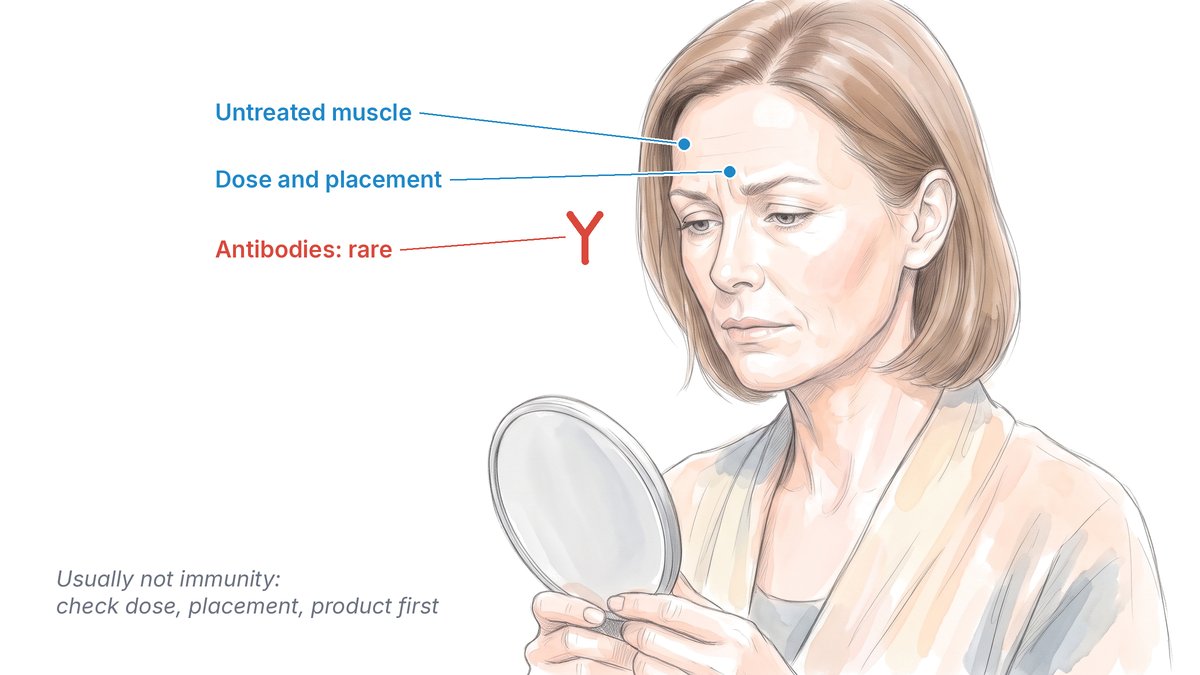
If your Botox is not working anymore, the cause is usually not immunity. True resistance from neutralizing antibodies, which block botulinum toxin, is rare after cosmetic doses; far more often too few units, a missed muscle, product handling, a brand change or lines etched into the skin explain a result that feels weaker or shorter than it used to. Below, I explain how to tell normal fading from resistance, how resistance is tested and what helps.
Quick answers
- Can you become immune to Botox? Yes, but rarely after cosmetic doses: estimates for aesthetic use run around 0.2 to 0.4 percent.
- Why did my Botox wear off so fast? Most often too few units for the muscle, a placement that missed part of it, or normal fading, which often begins between month 2 and month 4.
- Is movement at 3 months a sign of resistance? No. In the glabellar trials, fewer than half still counted as responders at day 90.
- Does switching brands help? Sometimes, possibly when the antibodies target the proteins packaged with the toxin; antibodies to the toxin itself block every type A product.
- How is resistance tested? Most practically with a one-sided forehead or brow test, judged after about 2 weeks; laboratory assays exist but few labs run them.
- Does jaw (masseter) Botox raise the risk? Large doses and short intervals raise it; masseter treatment uses more units than most facial areas, and body treatments often use more than 100 units at a time.
- How often is it safe to get Botox? Dosing more often than every 3 months has not been studied for the Botox Cosmetic label; spacing and the lowest effective dose are the main protection.
- Will a break restore it? It may help, but it is not guaranteed; suggested breaks range from about a year to over two years.
- Does Botox stop working after years? Not for most people; what usually changes over the years is the skin, while the antibody risk rises mainly with large doses, short intervals and top-ups.
Botox resistance: key numbers
- Cosmetic use: neutralizing antibodies estimated at 0.2 to 0.4 percent of patients
- Registration trials: none of 1,725 people treated for frown lines or crow’s feet had neutralizing antibodies at study exit
- Medical use, higher doses: 1.8 percent across 43 studies and 8,833 patients
- Tested non-responders: 35 of 74 people who believed Botox had stopped working still responded on a one-sided forehead test
- Normal fading: 48 percent of frown-line patients still counted as responders at day 90, 25 percent at day 120
- In Korea: 46.3 percent of 469 dermatologists surveyed had seen a case they suspected was resistance
Why Is My Botox Not Working Anymore?
Usually for an ordinary reason, and the pattern of the change is the first clue to which one. Resistance from neutralizing antibodies happens, but after cosmetic doses it is the least common explanation, so it should be the last one assumed, not the first.
Everything here applies to every type A anti-wrinkle injection, whether the vial says Botox, Dysport, Xeomin, Daxxify or a Korean brand. A heavy lid or brow after toxin is a different problem, covered in droopy eyelid after Botox, and injecting toxin into the skin in skin botox for pores, oil and fine lines.
The phrase “not working anymore” covers three different experiences, and each points somewhere else:
- It never worked well, even the first time. This is primary non-response. A narrative review defines it as no response on the first exposure, without prior treatment or antibody formation, while secondary non-response is a toxin that worked at first and failed later.
- It still works, but not for as long. This is the most common complaint, and it is usually about dose, the strength of the muscle, or normal fading that is more visible as the skin ages.
- It worked for years and now does almost nothing. This is the pattern that most deserves a resistance work-up, especially after large doses, short intervals or repeated top-ups.
Can You Become Immune to Botox, and How Common Is It?
Yes, a person can develop neutralizing antibodies that stop Botox and other type A toxins from working, but after cosmetic doses it is rare. A 2025 review estimates the neutralizing-antibody rate in aesthetic use at 0.2 to 0.4 percent, against 0.3 to 27.6 percent for antibody-associated non-response in medical uses.
The best-controlled numbers come from the manufacturer’s own registration trials. Across 10 medical and aesthetic indications, with doses from 10 to 600 units and up to 15 treatment cycles, 27 of 5,876 evaluable subjects (0.5 percent) developed neutralizing antibodies, none of the 1,725 people treated for frown lines or crow’s feet for up to five cycles had them at study exit, and all 5 true secondary non-responders were being treated for medical conditions. Several authors work for the manufacturer, and five cycles is short compared with ten years of real-world use, but the direction is clear.
Medical patients receive far larger doses, and their numbers are higher. A meta-analysis of 43 studies and 8,833 patients treated for medical conditions found neutralizing antibodies in 1.8 percent overall, 7.4 percent in dystonia, and more with longer treatment. A letter in response argued that pooling high-dose neurological treatment with aesthetic use overstates the risk, because antibodies are rare after aesthetic indications.
Why the rare number still matters
Rare is not never. Clinicians do see it: in a survey of Korean dermatologists, 46.3 percent of 469 respondents reported clinical cases suspicious for resistance. Suspicious is not confirmed, but the people who do develop antibodies tend to have the highest exposure, which is why the risk factors below matter more than the average.
How Do Antibodies Stop Botox From Working?
Botulinum toxin works by entering the nerve ending and blocking the release of acetylcholine, the chemical signal that tells a muscle to contract. Neutralizing antibodies bind the toxin before it can attach and enter, so the nerve keeps signaling and the muscle keeps moving.
The active part of every type A product is the same 150-kilodalton core neurotoxin. Some products also carry the proteins that surround the toxin in nature. A review table lists onabotulinumtoxinA (Botox) at about 900 kilodaltons with these accessory proteins, abobotulinumtoxinA (Dysport) at 300 to 500, and incobotulinumtoxinA (Xeomin) and daxibotulinumtoxinA (Daxxify) at about 150, without them.
Not every antibody blocks the toxin. Binding antibodies can be detected without any loss of effect; on the Botox Cosmetic label, 1.5 percent of 916 crow’s-feet trial subjects developed binding antibodies and none developed neutralizing antibodies.
Antibodies to the packaging, or to the toxin itself
The distinction matters for what to do next. In a Thai study of people who believed their toxin had stopped working, those who did not respond to Botox had more antibodies against the complexing proteins, while those who also failed a complex-free product carried antibodies against the core toxin. Antibodies against the packaging may leave room for a complex-free product to work; antibodies against the core toxin block every type A product, whichever brand is on the vial.

Video in English, about 4 minutes: How Botox Works | 3D Medical Animation
Why Did My Botox Wear Off So Fast? Is 3 Months Normal?
Often it did not wear off too fast: movement returning between month 2 and month 4 is the expected course, not a sign of resistance, because the nerve endings regrow their connections and the muscle wakes up gradually. The Botox Cosmetic label puts the duration of effect for frown lines at about 3 to 4 months.
The trial data show how gradual that return is. In the pivotal frown-line trials, 80 percent of patients counted as responders at day 30, 70 percent at day 60, 48 percent at day 90 and 25 percent at day 120, judged by investigators at maximum frown.
Normal fading feels like failure for two reasons: a first treatment at 35 is remembered against a fourth at 45, when the lines between sessions are deeper, and any return of movement is judged against the peak of the first weeks.

Why Is Botox Not Working on My Forehead or Frown Lines?
On the forehead and between the brows, the common causes are too few units for the muscle, injection points that miss part of it, product that lost potency through handling, a different brand dosed as if units were equal, neighboring muscles that take over, and lines that have become static creases. Each one looks like resistance to the patient, and each has a different fix.
The best evidence that most cases are something else comes from testing them. In the same Thai study, 35 of 74 people suspected of non-response (47.3 percent) still responded on the one-sided forehead test described below.
Too few units for the muscle
A frown muscle that is larger, a man’s forehead, or a strong masseter needs more toxin than an average dose. The label dose for frown lines is 4 units at each of 5 sites, 20 units in total; a lighter “natural” or “baby” dose by design wears off sooner. A softer look and a long duration pull in opposite directions.
Placement: why part of the forehead still moves
Botox only relaxes the fibers it reaches. If the outer forehead was left alone to avoid a heavy brow, or the side fibers of the frown muscle were missed, the untreated parts keep moving and pull harder. Patients often describe this as Botox “not working” when the treated area itself is still relaxed.
Product handling and dilution
A toxin vial is a biological product, not a chemical that keeps indefinitely. The label calls for reconstituted Botox Cosmetic to be kept refrigerated at 2 to 8 degrees Celsius and used within 24 hours, and the review lists improper dilution, prolonged refrigerated storage and batch variation among the causes of an apparent non-response. More saline does not change the number of units, but very dilute toxin spreads farther and can land in the wrong muscle.
A different brand, dosed as if units were equal
Units are measured differently by each manufacturer. The Botox label states that its units are not interchangeable with other preparations of botulinum toxin products. A laboratory comparison of four Asian toxins found that products each labeled 100 units differed in the amount of neurotoxin protein per vial and in specific potency, although two of its authors work for a competing manufacturer and each product was tested in a single batch. A change of clinic or brand with the same number on the chart can therefore mean a different effective dose.
Lines that are now in the skin
Botox relaxes the muscle; it does not refill a crease. After years of folding, a line etched into the skin stays visible at rest even when the muscle beneath is fully relaxed. Lines like these call for skin-quality treatment, and the options are compared in the guide to Rejuran, Juvelook and Skinvive boosters. When the brow itself has dropped, more toxin can make the eyes look heavier rather than smoother.
Medicines and the rare true primary non-responder
Some antibiotics, the aminoglycosides, can strengthen the effect of the toxin, and the label asks for caution when they are combined; the review also lists interactions with aminoglycosides or quinolones among the factors that can change the response. Beyond these, a small number of people are the primary non-responders described at the start.
Expectations that moved
A patient after many years of toxin may want a stillness that no dose produces without side effects. That is a reason for a new plan, not a failure of the toxin, a theme explored in what natural means in plastic surgery.
At a Glance: is it resistance or something else?
| Cause | What you notice | How it is checked | What usually helps |
|---|---|---|---|
| Normal fading | Movement creeps back from about month 2 to 4 | Compare with the two-week result, not the week-one peak | Nothing to fix; plan the next session |
| Too few units | Weak or short effect from the start | Movement still present at the two-week review | A higher dose next session |
| Missed or untreated fibers | One part moves while the rest is still | Look at maximum frown or raise | Adjusted points next session |
| Handling or dilution | A sudden weak session after good ones | Date of reconstitution, dilution, batch | Fresh product, standard dilution |
| Different brand, same units | Change of clinic or product | Product name and units on the record | Dose by product, not by number |
| Static lines | Lines visible at rest despite a still muscle | Muscle is still, crease remains | Skin treatment, not more toxin |
| True antibodies | Gradual loss over sessions, then little or no effect | One-sided test at about 2 weeks; lab assay if available | Stop escalating; switch formulation or pause |
Who Is Most at Risk of Botox Resistance?
The risk rises with how much toxin the immune system sees and how often it sees it: high doses per session, high cumulative doses, intervals under 3 months, and booster top-ups within a few weeks. Masseter, shoulder and body treatments, and skin injections spread across the whole face, are the cosmetic uses most likely to reach those levels.
The narrative review names these risk factors, specifying boosters within 3 weeks, and notes that off-label body and masseter treatments often involve more than 100 units of onabotulinumtoxinA. For scale, the label doses for the upper face are 20 units for frown lines, 24 for crow’s feet, and 40 for frown lines and forehead lines treated together.
Duration counts as well. In the medical meta-analysis, longer treatment was associated with a higher rate of neutralizing antibodies, and in one published series complete failure appeared after 3, 5, 10 and 13 treatment cycles, and antibodies were detected anywhere from 2 to 72 months after treatment began.
The cosmetic case reports
Aesthetic resistance is documented, not only theoretical. A report of five cosmetic patients describes a man treated with 120, 200 and then 250 units of abobotulinumtoxinA whose effect fell from 6 months to 2 months and then disappeared, and a woman who received about 11 sessions over less than three years with top-ups; all five had neutralizing antibodies on a laboratory bioassay. These are the patterns to avoid: rising doses, short gaps and repeated boosters.
Masseter, shoulder and micro botox in Korea
Korean practice includes uses that add up quickly. In the Korean dermatologist survey, body contouring of the shoulder and calf and masseter treatment were significantly more popular among patients in their 20s and 30s, and few respondents ranked a lower risk of antibody formation as the deciding factor when choosing a product. A person who starts jaw and shoulder treatment at 25 may accumulate a lifetime dose that a forehead-only patient never reaches.
Skin botox (micro botox), many tiny injections into the skin of the whole face, raises its own question. The review notes that injection into the skin is thought to carry a higher risk of antibodies than injection into muscle, possibly because the skin is rich in immune cells; this is a theoretical concern without outcome studies. Whatever its purpose, what matters here is that its units count toward the same total.

What Are the Signs of Botox Resistance, and How Is It Tested?
The typical sign is a gradual loss over several sessions, then little or no relaxation even at the two-week mark; testing starts with a checklist that rules out the common causes, then a one-sided test with a standard dose on one side of the forehead or one brow, checked after about 2 weeks. If the injected side moves as much as the untreated side, resistance is likely; laboratory tests for neutralizing antibodies exist, but they are hard to obtain.
Step 1: the checklist
- When did it start? A first-ever weak result is a different problem from loss after years of good results.
- What was the result at 2 weeks? Full relaxation that faded at 3 months is normal; movement at 2 weeks points to dose, placement or product.
- Which product and how many units, last time and the time before? A change of brand or clinic is the most common hidden variable.
- How often, and were there top-ups? Short intervals and boosters raise the risk.
- What else was injected? Masseter, shoulder, neck and skin botox all add to the total.
- What exactly is moving? A treated muscle that stays still beside an untreated one that moves is placement, not resistance.
Step 2: the one-sided test
In the Thai study, 20 units were injected on one side of the forehead, 3 centimeters above the inner and outer corners of the eye, and brow elevation was assessed at 2 weeks. A similar brow test described in the narrative review uses 20 units into one inner brow, with symmetric frowning after 1 to 3 weeks suggesting resistance. Using only one side matters because the other side is the control: a clear difference means the toxin works.

Step 3: laboratory tests, when available
Blood tests that simply detect antibodies (ELISA) cannot tell neutralizing antibodies from harmless binding ones. The bioassay that can, the mouse hemidiaphragm assay, is the only assay approved by the FDA for this and is offered by few laboratories. Even in specialist centers the results need interpretation: in 37 patients with cervical dystonia, patient-reported treatment failure did not correlate with any of the three antibody tests used. For a cosmetic patient, the one-sided test is usually the more useful answer.
What Should You Do If Botox Has Really Stopped Working?
Stop raising the dose, because more toxin given to a person with neutralizing antibodies feeds the response without restoring the effect. The usual options are to switch to a different type A formulation, often a complex-free one, or to take a break, and type B toxin is not a cosmetic alternative.
Switch formulation
In the Thai study, of 22 people who did not respond to a Botox forehead test, 7 responded when retested with incobotulinumtoxinA an average of 7.5 months later, and 15 did not. That is about one in three. The five-case report warns that switching to another toxin may not help once resistance has developed.
Take a break
Antibody levels may fall over time without further exposure, which is the reasoning behind a break. The review reports that after complete non-response many experts suggest a 12 to 18 month drug holiday, then restarting with a highly purified toxin, while others argue against it. An Asia-Pacific survey of 128 injectors suggested treatment holidays of 2 to 2.5 years; one of its authors works for a toxin manufacturer. No one can promise that response returns after a break.
Type B toxin
Type B toxin is a different serotype, and in the review two patients responded normally to type B after type A failure, but its heavy chains share about 30 percent of their structure with type A, and resistance to B can follow. It is approved only for medical conditions and is not a routine cosmetic option.
Treat the problem another way
When toxin no longer works, the goal is still achievable by other routes. Static forehead and frown lines can be softened with skin-quality treatment, a low brow with surgery as explained in droopy upper eyelids after 50, and a heavy lower face with the options in the jowl treatment guide. Antibodies to the core toxin may also matter later if a medical toxin treatment is ever needed, which is one more reason to protect the response you have.
Does Switching Brands Help? Xeomin, Dysport, Daxxify and Korean Toxins
Switching helps some people and not others, because it depends on what the antibodies target; no brand overcomes antibodies against the core toxin. Complex-free products (incobotulinumtoxinA, sold as Xeomin, and daxibotulinumtoxinA, sold as Daxxify) have a theoretical advantage that is supported mainly by laboratory work, medical-indication data and manufacturer-linked research.
What the comparisons show
In medical use, a 2025 meta-analysis found secondary treatment failure in cervical dystonia in 9 percent with abobotulinumtoxinA, 3 percent with onabotulinumtoxinA and 0 percent with incobotulinumtoxinA; it excluded aesthetic studies. The aesthetic review reports that only 9 of more than 2,600 incobotulinumtoxinA patients in pivotal trials developed neutralizing antibodies, and that daxibotulinumtoxinA pivotal trials found none, with more data needed.
Cosmetic rates are already low for every brand, so the difference is small for a forehead-only patient and more likely to matter for someone receiving large doses for years.
Korean toxins
Korea has several domestically made type A toxins, such as Botulax, Meditoxin and Nabota. In the laboratory comparison described above, the authors argued that extra, inactive toxin protein in a vial might act as an immunogenic impurity; that is a hypothesis from an industry-linked, single-batch laboratory study, not a clinical finding. For a traveling patient, the practical point is simpler: know which product and how many units you received, because units do not transfer between brands.
What Do I Do When a Patient Says Botox Stopped Working?
I start with questions, not a bigger dose. I take the history in the order of the checklist above, look at the face at rest and at maximum movement, and ask for photographs from two weeks after the last session if the patient has them, because the two-week result separates under-treatment from fading.
When the history points to dose or placement, I adjust the next session rather than adding small top-ups in the weeks after a treatment; the exception is a clear asymmetry, such as a peaked brow tail. When the history points to true loss of response, gradual over several sessions and worst after large or frequent doses, I suggest a one-sided forehead test with a standard dose and a review at two weeks. If the injected side still moves, I stop escalating and discuss a different type A formulation or a break, and I explain that neither is guaranteed to restore the effect.
For prevention, I follow the rules in the next section, counting any skin injections in the session total. For a patient who needs large doses, such as masseter treatment, I discuss a complex-free product as a precaution and explain that the evidence for it is indirect.
Surgeon’s Insight: More Units Is the Wrong First Answer
When a toxin stops doing what it used to, the easy reply is a bigger dose. If the cause is a stronger muscle, that is right. If the cause is antibodies, the bigger dose is exactly the exposure that made the problem, and it can turn a partial loss into a complete one.
So I would rather spend ten minutes on the history and two weeks on a one-sided test than ten more units on a guess. The test costs the patient two weeks of an uneven forehead; a wrong guess can cost them the toxin for years.
Video in English, about 6 minutes: Immune to Botox? The 2-Photo Test Before More Units
How Can You Keep Botox Working for Years?
Use the lowest effective dose, keep at least 3 months between sessions, avoid top-ups in the weeks after a treatment, and keep track of the total units given across all areas. The label advises the lowest effective dose given at the longest feasible intervals to reduce antibody formation, and notes that dosing more often than every 3 months has not been clinically evaluated.
- Space sessions. At least 3 months apart in the same area. Many people do well with longer gaps: in the Korean survey, the most common interval was six months (43.6 percent).
- Avoid boosters. Judge the result at 2 weeks, then change the dose next time.
- Know your totals. The label limits the cumulative dose across Botox products to generally no more than 400 units in a 3-month interval, a ceiling set for medical use; cosmetic plans are far below it, which is the point.
- Keep a record. Product name, units per area and date, so the next injector can dose by product.
- Consider a complex-free product for high-dose treatment. For masseter or body treatment, with the indirect evidence described above.
- Do not chase total stillness. A dose that allows some expression keeps you out of the high-exposure group.
Oral zinc is sometimes recommended to extend results; the review found that zinc improved duration in 2 of 3 randomized trials, with limited data. It is not a substitute for spacing and dose.
What Should You Ask If Your Botox Seems Weaker?
Ask whether your injector can show what was given last time, product and units per area, and what your face looked like at two weeks. Without that record, no one can tell normal fading from under-dosing from resistance.
Then ask whether a one-sided test makes sense before anything else changes. A clinic that suggests a test before escalating is treating the cause, not the complaint.
Individual results vary; consultation required.
Written by Dr. Yongwoo Lee, board-certified Korean plastic surgery specialist in facial anatomy and aesthetic procedures at VIP Plastic Surgery, South Korea.
Frequently Asked Questions About Botox Not Working Anymore
Can you become immune to Botox?
Yes, but rarely after cosmetic doses. Neutralizing antibodies, which block the toxin, are estimated at about 0.2 to 0.4 percent of aesthetic patients.
How common is Botox resistance?
It depends on the dose. It is rare after cosmetic use; in medical uses with much larger doses, a meta-analysis of 43 studies found 1.8 percent overall and 7.4 percent in dystonia.
Why did my Botox wear off so fast?
The usual reasons are too few units for the muscle, injection points that missed part of it, a different brand dosed by the same number of units, or product handling. Normal fading also starts earlier than many people expect, often from month 2.
What is the difference between primary and secondary non-response to Botox?
Primary non-response means toxin never worked well, from the first treatment, usually without antibodies. Secondary non-response means it worked at first and then failed later, which is the pattern that may involve neutralizing antibodies.
Does Xeomin work if Botox stopped working?
Sometimes. In one study, 7 of 22 people who failed a Botox forehead test responded to incobotulinumtoxinA (Xeomin) when retested months later. In that study it was more likely to help when the antibodies targeted the complexing proteins rather than the core toxin.
Can I switch between Botox, Dysport and Korean toxins?
Yes, but units are not interchangeable between products, so the dose has to be set for the product you receive. A change of brand at the same number of units is one of the most common hidden reasons a result changes.
Does masseter (jaw) Botox cause resistance?
It can raise the risk, because masseter treatment uses larger doses than most facial areas, about 25 to 30 units per side in my practice. Spacing sessions and using the lowest effective dose lower that risk.
Does micro botox increase the risk of resistance?
Possibly. Injection into the skin is thought to carry a higher antibody risk than injection into muscle, though this has not been measured in outcome studies. Its units also add to the total given in a session.
How often can you safely get Botox?
No more often than every 3 months in the same area is the common rule, because dosing more frequently has not been clinically evaluated for the Botox Cosmetic label. Many people do well with longer gaps.
Do Botox top-ups cause resistance?
Repeated booster injections within a few weeks of a treatment are a recognized risk factor. A better approach is to judge the result at 2 weeks and adjust the dose at the next session.
Is there a blood test for Botox antibodies?
Standard antibody blood tests cannot separate neutralizing antibodies from harmless ones. The bioassay that can is offered by few laboratories, so a one-sided forehead or brow test, checked at about 2 weeks, is the practical test in most clinics.
Will Botox work again if I take a break?
It may. Many experts suggest a break of 12 to 18 months after complete non-response, and an Asia-Pacific survey of injectors suggested 2 to 2.5 years, but there is no guarantee that the effect returns.
Is Botox resistance permanent?
Not necessarily. Antibody levels may fall over time without exposure, and some people respond again after a break or a switch of formulation, while others do not.
Does Botox stop working after years of use?
For most people, no. In the registration trials, none of 1,725 people treated for frown lines or crow’s feet for up to five cycles had neutralizing antibodies at study exit; over the years, deeper lines at rest and larger, more frequent doses are the usual reasons it seems weaker.
Does zinc make Botox last longer?
The evidence is limited: oral zinc improved duration in 2 of 3 randomized trials in a review. It does not replace sensible dosing and spacing.
Does exercise or a fast metabolism make Botox wear off faster?
This is commonly blamed, but the evidence for it is anecdotal. Dose, the strength of the muscle and placement explain most short results.
This article is for informational purposes only and does not constitute medical advice. Always consult with a qualified medical professional before making any decisions about surgical or non-surgical procedures.
