
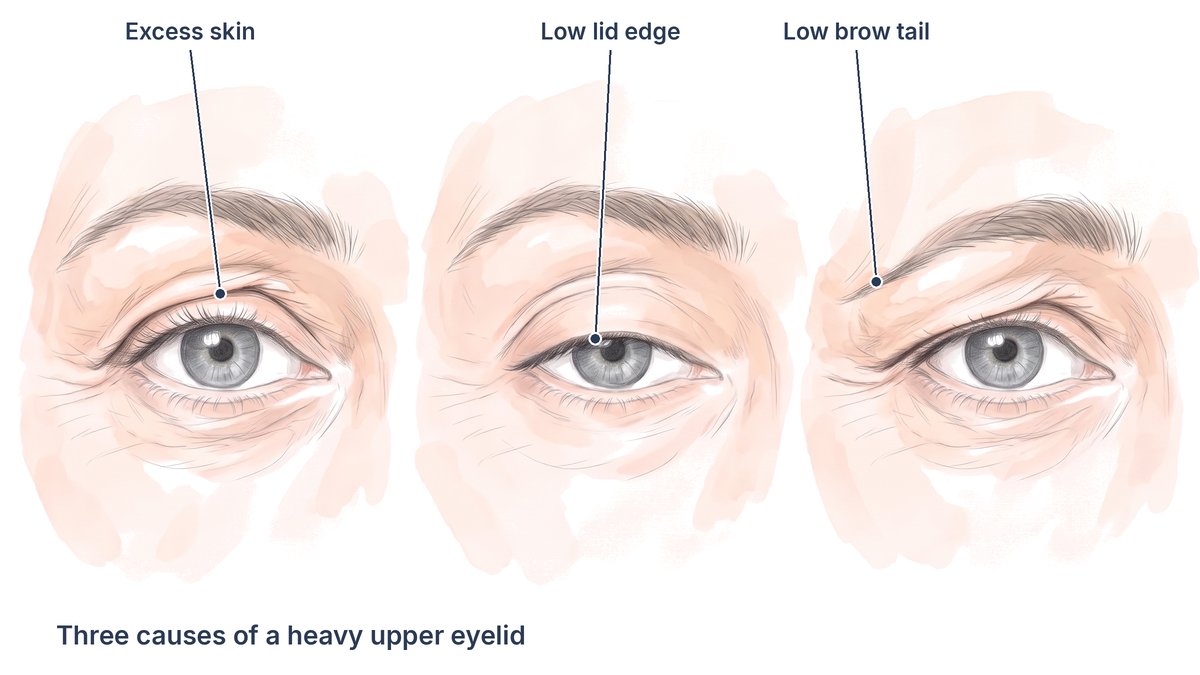
Droopy upper eyelids after 50 have three causes: extra eyelid skin (dermatochalasis), a lid edge sitting too low (eyelid ptosis) and a brow sitting low over the lid (brow ptosis). Ptosis usually means the lid-lifting tendon has stretched, and the low part of the brow is usually its tail. Many eyelids over 50 have two or three causes at once, so the lid edge and brow are measured before any skin is marked.
Quick answers
- Is it skin, ptosis or my brow? With the forehead relaxed, a lid edge over the top of the pupil suggests ptosis. Skin over a normal lid edge suggests excess skin; a hood that clears when the brow tail is lifted suggests the brow.
- Can blepharoplasty fix ptosis? Not true ptosis. Removing skin uncovers a lid that only looked low but does not raise a low lid edge, which needs its own repair.
- Can both be done in one operation? Yes. At one US center, ptosis repair was added to about 1 in 5 of 533 upper blepharoplasties, and a brow lift to about 1 in 3.
- Will my eyebrows drop after eyelid surgery? They can: in pooled studies, by under 1 mm on average after skin removal alone and by about 2 mm after ptosis repair.
- Do I need a brow lift? Possibly, if the brow rests below the bony rim of the eye socket with the forehead relaxed. In men, a brow at the rim is normal.
- Will Medicare treat it as functional? Only with documented symptoms, a visual-field test and a lid edge 2 or 2.5 mm or less above the pupil center, by contractor. Private plans differ; Medicare usually does not cover care abroad.
- Am I awake? Partly: Dr. Yongwoo Lee uses IV sedation with midazolam and ketamine plus local anesthesia, and wakes you to open your eyes.
- Do eye drops work? A prescription oxymetazoline drop lifts a low lid about 1 mm for hours (a placebo drop, about 0.5 mm), used daily. It does nothing for skin or brow.
Why Do My Upper Eyelids Look Droopy After 50?
Three structures age on their own schedules. The eyelid skin loosens, the tendon that lifts the lid stretches or slips, and the brow, especially its outer tail, sits lower over the lid.
Any one makes the eye look heavy and tired; after 50 they often arrive together. That tendon, the levator aponeurosis, carries the pull of the lid-lifting muscle down to the tarsal plate, the firm plate inside the lid.
In a Dutch study of 5,578 adults with a mean age of 67, 17.8 percent had moderate to severe sagging upper lids. In a Korean national survey, low lid edges became steeply more common from the 50s on.
Most adult ptosis is aponeurotic: the tendon stretches or comes away, with aging, long-term contact lens wear, eye rubbing and earlier eye surgery as the usual risks. In a small Japanese study, 90.2 percent of 51 women with ptosis had worn hard lenses, against 31.6 percent of 38 without, an association rather than proof.
Is It Excess Skin, Ptosis or a Low Brow?
Excess skin hangs over a lid edge at a normal height, while ptosis means the lid edge itself sits low over the colored part of the eye. Brow ptosis means the brow sits low against the bony rim above the eye and pushes skin onto the lid.
A lid that only looks low because skin or brow covers it is called pseudoptosis. Loose skin can also narrow peripheral vision and make the eyes feel heavy.
For ptosis, the key measurement is MRD1 (margin reflex distance 1), the gap from the lid edge to the light reflex in the pupil. It is normally about 4 to 5 mm, and in aponeurotic ptosis the crease often sits high while lifting strength stays good.
A smaller lifter behind the tendon, the Müller muscle, raises the lid about 2.5 mm when it contracts. One prescription drop stimulates it: oxymetazoline 0.1 percent raised the lid about 1 mm for some hours in pooled trials, against about 0.5 mm with a placebo drop.
For the brow, a normal brow sits at or above the bony rim, men’s brows are lower and flatter, and position is judged with the forehead relaxed. The ideal male brow is relatively flat at the rim, so a man’s brow at the rim is normal.
Why hooding gathers under the brow tail
A meta-analysis of 19 studies and 3,634 patients found the inner brow about 1.4 mm higher with age and no significant change at the tail. The forehead muscle, the frontalis, holds up the inner brow when the lids feel heavy but pulls less at the tail. Hooding therefore gathers at the outer corner.

How Can I Tell Which One I Have at Home?
Three mirror checks answer most of it: where the lid edge sits against the pupil light reflex, what lifting the brow tail does, and what lies under the skin fold. They suggest a cause but do not replace measurement.
Face a mirror at eye level, close your eyes, relax your forehead, then open gently and look straight ahead. Hold a phone flashlight at arm’s length below the mirror so a dot appears in each pupil.
- Lid edge to light reflex. A healthy lid leaves a gap of about 4 to 5 mm between its edge and the dot. If the edge reaches the top of the pupil or sits close to the dot, ptosis is likely.
- Lift the brow tail. With a fingertip above the outer end of the brow, lift it gently to where it sat years ago. If most of the outer hood clears, the brow is involved.
- Lift the skin fold. With a clean cotton swab on the skin, never on the eye, lift the fold off the lashes. If the lid edge underneath sits at a normal height, the problem is skin; if it is still low, ptosis is there too.
Deep forehead lines, brows that ache by evening, a tipped-up chin or one lower lid all lean toward ptosis. A sudden or fluctuating droop, or one with double vision or unequal pupils, is not a mirror question: see when a droopy eyelid is a medical warning sign.

Dr. Yongwoo Lee also walks through these checks on video: why a heavy upper eyelid after 50 can come from extra skin, a lid edge that sits too low or a brow that has dropped, with a simple mirror test you can try at home, in about eight minutes. The video is in English.
What Does a Surgeon Measure: MRD1, Levator Function, Brow Position and Visual Fields?
A surgeon measures the gap from lid edge to pupil light reflex (MRD1), the lid’s travel from down-gaze to up-gaze (levator function), and where the crease and brow sit. Those numbers, plus a visual-field test for US insurance, decide whether the lid needs repair and which operation fits.
Key numbers
- Normal MRD1: about 4 to 5 mm; Medicare contractor thresholds 2 or 2.5 mm or less.
- Levator function: normal 12 to 17 mm; poor at 4 mm or less.
- Medicare visual-field threshold with the lid raised: 12 degrees or more, or 24 to 30 percent of the upper field, by contractor.
- Skin left between brow and lashes after surgery: at least about 20 mm.
MRD1 and levator function
MRD1 is measured with a millimeter ruler and a penlight, and levator function is the lid’s travel from full down-gaze to full up-gaze with the eyebrow held still. Holding the brow stops the forehead adding millimeters the lid lacks.
Normal levator function is 12 to 17 mm; good is 8 mm or more, fair 5 to 7 mm and poor 4 mm or less, though schemes vary. A lid with good function can be tightened from its own muscles; one with poor function is usually hung from the forehead muscle with a sling.
Crease, skin and fat
The crease usually sits 8 to 11 mm above the lid edge in Caucasian women and 6 to 9 mm in Caucasian men. After surgery, at least about 20 mm of skin should remain between the brow and the lashes so the eye can still close. Fat changes too: the central fat pad has been reported to shrink from the early 40s while the inner pad does not, so the inner corner can look puffy.
The phenylephrine drop and the other eye
Many surgeons test the Müller muscle with a drop. The lid is measured, a few drops of phenylephrine, a decongestant-type eye drop that stimulates the muscle, are given, and the lid is measured again minutes later. A good lift suggests the Müller muscle can be tightened. Both lids receive the same signal to open (Hering’s law), so the test can unmask a droop in the other eye.
Visual fields and US insurance criteria
Repairing droopy lids improved vision and daily activities across 13 studies. Medicare decides through regional contractor policies, each requiring documented symptoms and visual-field testing. In one, the lid edge must sit 2.5 mm or less above the pupil light reflex with the brows relaxed. Raising the lid by hand must also widen the upper field by at least 12 degrees or 30 percent.
Another contractor sets the lid limit at 2 mm. Private insurers set their own criteria, and cosmetic surgery is excluded. Since Medicare usually does not cover health care outside the US, for patients traveling to Korea these numbers explain the diagnosis, not a coverage route.

Which Operation Fixes Which Problem?
Upper blepharoplasty removes excess skin, and ptosis repair raises a low lid edge by tightening the Müller muscle or advancing or folding the levator tendon. A low brow is raised by a brow lift, from a small tail lift to an endoscopic forehead lift.
Upper blepharoplasty
Upper blepharoplasty removes a strip of skin through a crease incision, and any fat is trimmed conservatively to avoid a hollow lid. It raises neither the lid edge nor the brow.
Ptosis repair from inside the lid or through the crease
Müller muscle and conjunctival resection works from inside the lid, through the conjunctiva, the moist lining behind the eyelid. It leaves no skin scar, spares the tarsal plate and classically suits about 2 to 3 mm of ptosis with a good phenylephrine response. External levator advancement reattaches or shortens the tendon through the crease and pairs naturally with skin removal.
A third family, mostly Korean, tightens or folds the Müller muscle with stitches, combined with an incisional crease for mild ptosis in one 28-patient series.
Both main routes lift the lid about equally, but repeat surgery was more common after levator advancement across 7 studies and 1,038 eyelids. That is partly because it is used for larger droops. The commonest problem after any ptosis repair is a lid left too low, in about 10 to 15 percent.
Brow lift options
The smallest brow procedure is an internal browpexy: the brow fat pad is stitched to the bone lining about 1 cm above the rim through the eyelid incision. Added to blepharoplasty in 98 patients, external browpexy raised the brow tail 2.97 mm and internal browpexy 2.29 mm at 4 to 5 months. A sub-brow excision removes thick skin just under the brow; when a sub-brow lift is the better match for outer hooding is covered case by case.
For a whole fallen brow, an endoscopic forehead lift works through short incisions in the hair. A review of 22 studies pooled 2,127 brows lifted by several approaches and followed for about 21 months. On average the brow rose 3.8 mm at the tail, 3.02 mm centrally and 2.41 mm at the inner end.
How a lifted forehead is anchored while it heals shapes the recovery. Dr. Yongwoo Lee anchors it with a deep-tissue suture or cortical bone tunnels, depending on the case. Cortical bone tunnels are small tunnels in the outer layer of the skull bone through which a permanent stitch holds the lifted scalp, and he favors them especially in men, whose forehead tissue is thick and firm.
At a Glance: Which Operation Treats Which Droop
| Option | Treats | Does not treat | Incision or scar | What the evidence shows | Typically suited to |
|---|---|---|---|---|---|
| Upper blepharoplasty | Excess skin, inner fat bulge | Low lid edge, low brow | Crease | Brow drops about 0.67 mm on average | Skin over a normal lid |
| Müller tightening through the crease (Dr. Yongwoo Lee’s method) | Mild ptosis | Severe ptosis | Crease | Small Korean series of related techniques; no published data for this exact method | Mild ptosis with excess skin |
| Müller muscle and conjunctival resection | Mild ptosis | Excess skin | Inside the lid | Fewer reoperations than levator advancement | 2 to 3 mm of ptosis |
| Levator advancement or folding | Mild to moderate ptosis | Poor levator function | Crease | Similar lid height to the inside approach, more reoperations, in lids that started lower | More ptosis |
| Browpexy | Steadies or lifts the brow tail | A much-fallen brow | Crease | Tail up 2.29 to 2.97 mm at 4 to 5 months | Mild tail descent |
| Sub-brow excision | Outer hooding | Low lid edge | Lower brow edge | See the sub-brow article | Keeping an existing crease |
| Endoscopic forehead lift | Whole-brow descent | Lid skin, ptosis | In the hair | Pooled brow lifts of several types: about 3.8 mm tail, 3.02 central, 2.41 inner at 21 months | A normal hairline |
| Oxymetazoline 0.1% drops | Mild ptosis, for hours | Skin, brow | None | Prescription; about 1 mm (placebo about 0.5 mm), daily | A bridge, not a fix |
Will Blepharoplasty Alone Make My Eyebrows Drop?
It can: by under a millimeter on average after skin removal alone, and by about 2 mm after ptosis repair. Once the lid no longer needs help to open, the forehead muscle holding the brow up can relax, and a brow that was already low comes down.
A meta-analysis of 17 studies, 9 of them pooled, found that brow height fell by a mean of 1.45 mm after upper-lid surgery. By type, it fell 0.67 mm after simple blepharoplasty, 2.10 mm after ptosis correction and 2.52 mm after double-eyelid surgery. The amount of skin removed made no difference.
In 70 patients with a mean age of 49.7, the brow was lower after upper blepharoplasty in 34.2 percent, more often in men.
Not every brow drops: in 19 patients averaging 73, upper blepharoplasty did not change brow height at the inner, central or outer brow. So the brow is discussed beforehand, and sometimes lifted with the lid. In men an arched brow reads as feminizing, so the aim is usually to keep it where it is.

Can Blepharoplasty and Ptosis Repair Be Done at the Same Time?
Yes. It is routine, and one crease incision means one recovery. The trade is a somewhat higher chance of a touch-up.
At one US center, mean patient age 67, ptosis repair was added to about 1 in 5 of 533 upper blepharoplasties and a brow lift to about 1 in 3. Revisions were needed in 3.8 percent after skin removal alone and 9.2 percent when ptosis was repaired too, mostly for overcorrection, leftover skin or asymmetry.
After one-sided Müller muscle resection from inside the lid in 75 patients, the untreated lid dropped later in 32.0 percent, enough to matter in 8.0 percent. A Korean review advises that, during ptosis surgery, skin removal should be limited, and the brow may descend afterward.
Skipping the ptosis is not safer: a crease built over an uncorrected ptosis can look puffy, the “sausage eye”, over an eye that still looks sleepy.
How Does Dr. Yongwoo Lee Combine Upper Blepharoplasty with Mild Ptosis Repair?
In many upper blepharoplasty patients I correct a mild ptosis in the same operation and crease incision, with a few fine internal stitches that tighten the Müller muscle. I check lid height with the patient awake, and I do not take on severe ptosis.
Measuring before I mark
Before I mark any skin, I measure MRD1 with the brow relaxed and levator function with the brow held still, and I note where the brow rests. Then I lift the brow with a fingertip to see how much “excess skin” disappears. I mark with the brow where it naturally sits, and always leave enough skin for the eye to close fully.
If the brow needs lifting, I treat it first or in the same sitting, because lifting it later can leave too little lid skin. Before raising a lid, I ask about dry eye and check that both eyes close completely, because a higher lid exposes more of the eye’s surface.
Crease height, skin and the inner fat pad
I always set the crease within the height of the tarsal plate, following any existing crease. In Western women that is usually 10 to 11 mm, and in Asian women usually 8 to 9 mm; in men I usually set it lower. Why the tarsal plate sets the ceiling for crease height is explained separately.
In middle-aged patients the inner fat pad often bulges, and I usually address it. I open the thin membrane over it, the orbital septum, slightly, and remove the protruding fat in moderation before closing.
TAO fixation: how the new crease is held
How much of the orbicularis, the ring muscle of the eyelid, I trim depends on how thick the lid is. I then fix the crease at four to five points, joining the skin, the orbicularis, the levator aponeurosis and the tarsal plate. I call this TAO fixation (tarsus, aponeurosis, orbicularis).
Tightening the Müller muscle through the crease
When the lid edge is mildly low, I correct it through the open crease before closing. A few fine internal stitches tighten the Müller muscle, the smaller of the two muscles that open the lid, against the tarsal plate. The stitches are buried inside the lid, and the levator tendon is not detached from the tarsal plate. I then adjust the tightening while the patient opens the eyes.

Why I wake you during the operation
I give the anesthesia myself: IV sedation with midazolam and ketamine plus local anesthesia, with blood pressure, oxygen level and heart rate monitored and airway equipment at hand. General anesthesia is not needed. The sedation is light enough to wake you several times to open your eyes.
Because of Hering’s law, lifting one lid can change the other, so I check both lids open and adjust the tightening. If one lid is lower before surgery, I warn you beforehand that the other may drop once it is lifted.
When tightening is not enough, and what I do not do
If tightening is not enough, or the ptosis is a little more than mild, I switch to an under-through levator plication. Without separating the Müller muscle from the levator, the stitch catches the Müller muscle and then the levator tendon, and the two are folded together and stitched to the front of the tarsal plate, with the levator left attached. The steps are in ptosis correction versus double eyelid surgery.
Severe ptosis, which usually needs a larger levator operation, I refer to a ptosis specialist rather than take on myself. A lid with poor levator function needs a sling to the forehead muscle, which I also refer. In an older eyelid I would rather stop a fraction low than high: an overcorrected lid exposes the eye, and a slightly low lid can be adjusted.
When the brow is the problem
When the heaviness lives in thick skin under the brow, I use a sub-brow lift. When the whole brow has dropped, I perform an endoscopic forehead lift at the clinic.
Which Droopy Eyelid Do You Have? Six Profiles
Most over-50 eyelids fit one of six patterns. These illustrative examples, not real patients, describe decisions, not results.
Extra skin, lid edge and brow in place. Upper blepharoplasty alone, after a talk about the brow.
Extra skin hiding a mild ptosis, the one most often missed. Blepharoplasty plus Müller tightening.
A low lid edge, little extra skin, a high crease, often after decades of hard lenses. Ptosis repair, with minimal skin removal.
Outer-corner hooding under a low brow tail. A tail lift, browpexy or sub-brow excision, not more lid skin.
A whole brow sitting low, with deep forehead lines. A brow lift first or with the lids, kept flat in a man.
All three, often after 65. A combined or staged plan; health matters more than age.
What Is Recovery Like After Blepharoplasty with Ptosis Repair?
Bruising and swelling peak in the first days and largely fade over about two weeks, and skin stitches come out on day 7. Lid height keeps settling for weeks.
Counting the day after surgery as day 1, Dr. Yongwoo Lee removes stitches on day 7. He changes dressings almost daily at first, then does simple checks after day 3 if healing is stable. In general, bruising and swelling last about 10 to 14 days, and contact lenses can usually go back in at about one week; Dr. Yongwoo Lee asks patients to wait two weeks for contact lenses and eye makeup.
In a small Korean series of a related technique, done from inside the lid with non-incisional double-eyelid surgery, MRD1 eased from 3.49 mm to 3.22 mm by six months. Dr. Yongwoo Lee judges the result at about three months.
Travelers should stay at least until the stitches are out; see how long to stay in Korea after surgery. Rapidly increasing pain, a tense or bulging eye, or any loss of vision after eyelid surgery is an emergency: contact the clinic at once, day or night, and if you cannot reach it, go to the nearest emergency department. Dry eye, incomplete closure and other blepharoplasty complications have their own article.
Surgeon’s Insight: I Measure the Lid Before I Mark the Skin
Over 50, the skin, the lid and the brow lean on one another. A lid edge a millimeter or two low makes the forehead hold the brow up, and the skin looks heavier than it is. Remove only the skin, and the brow can settle onto a lid that still does not open well.
So I measure the lid edge, its lift and the brow before any line is drawn, and I wake you to open both eyes before I close. What I will not do is take on a severe ptosis just to finish everything in one sitting.
When Is a Droopy Eyelid a Medical Warning Sign?
A droop that appears suddenly, or comes with double vision, a larger or smaller pupil on that side, or new head or neck pain, needs same-day emergency care. An aneurysm, a torn neck artery or a stroke can begin as a droopy lid.
With facial weakness, slurred speech or a weak arm or leg, call emergency services. A droop that changes through the day needs prompt medical assessment before any eyelid surgery; if it comes with trouble swallowing or breathing, call emergency services.
Causes that need a doctor before any eyelid surgery include:
- A third-nerve palsy: a droop with a larger pupil on that side. This is an emergency.
- Horner syndrome: a droop with a smaller pupil, sometimes with neck or head pain.
- Myasthenia gravis: a droop that worsens later in the day, often with double vision.
- A slowly progressive eye-muscle disease, or a hidden mass or infection under the lid.
A droop that starts days after toxin injections is usually temporary: it occurred in 5.4 percent in an early frown-line trial, likely under 1 percent with experienced injectors. It begins 3 to 7 days after injection and usually settles in 3 to 4 weeks.
What Should I Ask Before Choosing Eyelid or Brow Surgery?
Ask which of the three causes your surgeon found and what the numbers were: MRD1 on each side, levator function, and where your brow sits against the rim. Such a plan is for your eyelid, not for the word “droopy.”
Ask, too, whether ptosis repair or a brow lift is planned, and what the other eye and brow may do afterward.
If you ask only one thing, ask this: Is my lid edge low, or is it only covered?
Individual results vary; consultation required.
Written by Dr. Yongwoo Lee, board-certified Korean plastic surgery specialist in facial anatomy and aesthetic procedures at VIP Plastic Surgery, South Korea.
Frequently Asked Questions About Droopy Upper Eyelids After 50
Can blepharoplasty fix droopy eyelids caused by ptosis?
Not true ptosis. Removing skin uncovers a lid that only looked low, but it does not raise a low lid edge. Ptosis needs its own repair, often through the same crease incision. At one US center it was added to about 1 in 5 upper blepharoplasties.
What is a normal MRD1, and what counts as ptosis?
MRD1 is the distance from the upper lid edge to the light reflex in the pupil, normally about 4 to 5 mm. A large Korean population study counted ptosis below 2 mm, and Medicare contractors use 2 or 2.5 mm or less as a functional threshold.
Does Medicare or insurance cover upper eyelid surgery?
For Medicare, only when functional criteria are met, and they vary by regional contractor: typically an MRD1 of 2 or 2.5 mm or less, documented symptoms and visual-field tests. Private insurers set their own criteria. Cosmetic surgery is excluded, and Medicare usually does not cover care abroad.
Do I need a visual field test before eyelid surgery?
For US functional coverage, usually yes. Fields are compared with the lid down and raised, seeking a difference of 12 degrees or more, or about 24 to 30 percent of the upper field. A cosmetic plan made in Korea measures the lid, brow and skin directly instead.
Will my eyebrows drop after upper blepharoplasty?
They can: in pooled studies, by under a millimeter on average after skin removal alone and by about 2 mm after ptosis repair. One series found the brow lower in about a third of patients, more often in men, while a small study found no change.
Is a brow lift or blepharoplasty better for hooded eyes?
Neither overall; it depends on where the heaviness comes from. If lifting the brow tail clears most of the hood and the brow rests low against the rim, the brow is involved. If the brow is in place and skin folds onto the lashes, the lid is. Many people need both.
Why does one eyelid droop more, and will fixing it make the other one droop?
Both lids receive the same signal to open, so a low lid can make the brain over-open the other. Once the low lid is repaired, the other drops in about 1 in 3 patients in one series, usually slightly. Both lids are checked open during surgery for this reason.
Am I awake during ptosis surgery?
Partly. Dr. Yongwoo Lee gives IV sedation with midazolam and ketamine plus local anesthesia himself, with blood pressure, oxygen and heart rate monitored. The sedation is light enough to wake you several times to open your eyes, so both lids can be checked before he closes.
Do eye drops like Upneeq work for droopy eyelids?
Only a little, for hours. In pooled trials the prescription drop oxymetazoline 0.1 percent raised the lid about 1 mm, against about 0.5 mm with a placebo, used daily. It does nothing for skin, and caution is advised with narrow-angle glaucoma, severe heart disease, uncontrolled blood pressure and some medicines.
Can Botox cause droopy eyelids?
Occasionally, and temporarily. A lid droop after toxin usually starts within a week and settles within about a month, and with experienced injectors it is likely under 1 percent. A droop without recent toxin, or with vision or pupil changes, needs a doctor. How to tell a lid droop from a brow drop after toxin, and what helps, is covered in droopy eyelid after Botox.
Can long-term contact lens wear cause ptosis?
It is linked to it, especially hard lenses worn for years. Long-term lens wear, eye rubbing and earlier eye surgery are usual risks for the lid-lifting tendon to stretch. A small Japanese study found far more hard-lens wear among women with ptosis, an association rather than proof.
How long does ptosis repair last, and can the lid drop again?
The lid settles slightly at first, and the result is judged at about three months. A lid left too low, in about 10 to 15 percent of repairs, is the commonest reason for a touch-up. The eyelid keeps aging, so a repaired lid can slowly lower over the years.
What is the recovery time after blepharoplasty with ptosis repair?
Bruising and swelling last about 10 to 14 days, skin stitches come out on day 7, and contact lenses and eye makeup wait two weeks. Lid height keeps settling for weeks, so the result is judged at about three months.
How long does a brow lift last?
Published follow-up is short. In a review of 22 studies, brow lifts of several types followed for about 21 months still held the brow about 3.8 mm higher at the tail. The face keeps aging afterward, from the new starting point.
Am I too old for eyelid surgery at 65 or 70?
Age alone is not the limit: one combined-surgery series had a mean patient age of 67. Health, dry eye and blood thinners matter more. Before a lid is raised, both eyes are checked to close completely, because a higher lid exposes more of the eye’s surface.
Can lower eyelid surgery be done at the same time?
Often, yes, when health allows; it is decided at consultation. The lower lid has its own decision about repositioning or removing lower-lid fat. Doing all four lids at once is weighed against general health and how dry the eyes already are.
This article is for informational purposes only and does not constitute medical advice. Always consult with a qualified medical professional before making any decisions about surgical or non-surgical procedures.
